Actionable Steps to Protect Your Retirement Income Today
While political debates continue over permanent tax repeal, you can take immediate action to protect your income. Follow these concrete steps to optimize your finances in 2026.
First, review your tax return to verify that you claim the Senior Bonus on IRS Schedule 1-A. Ensure you receive the full $6,000 deduction if you are single or $12,000 if filing jointly.
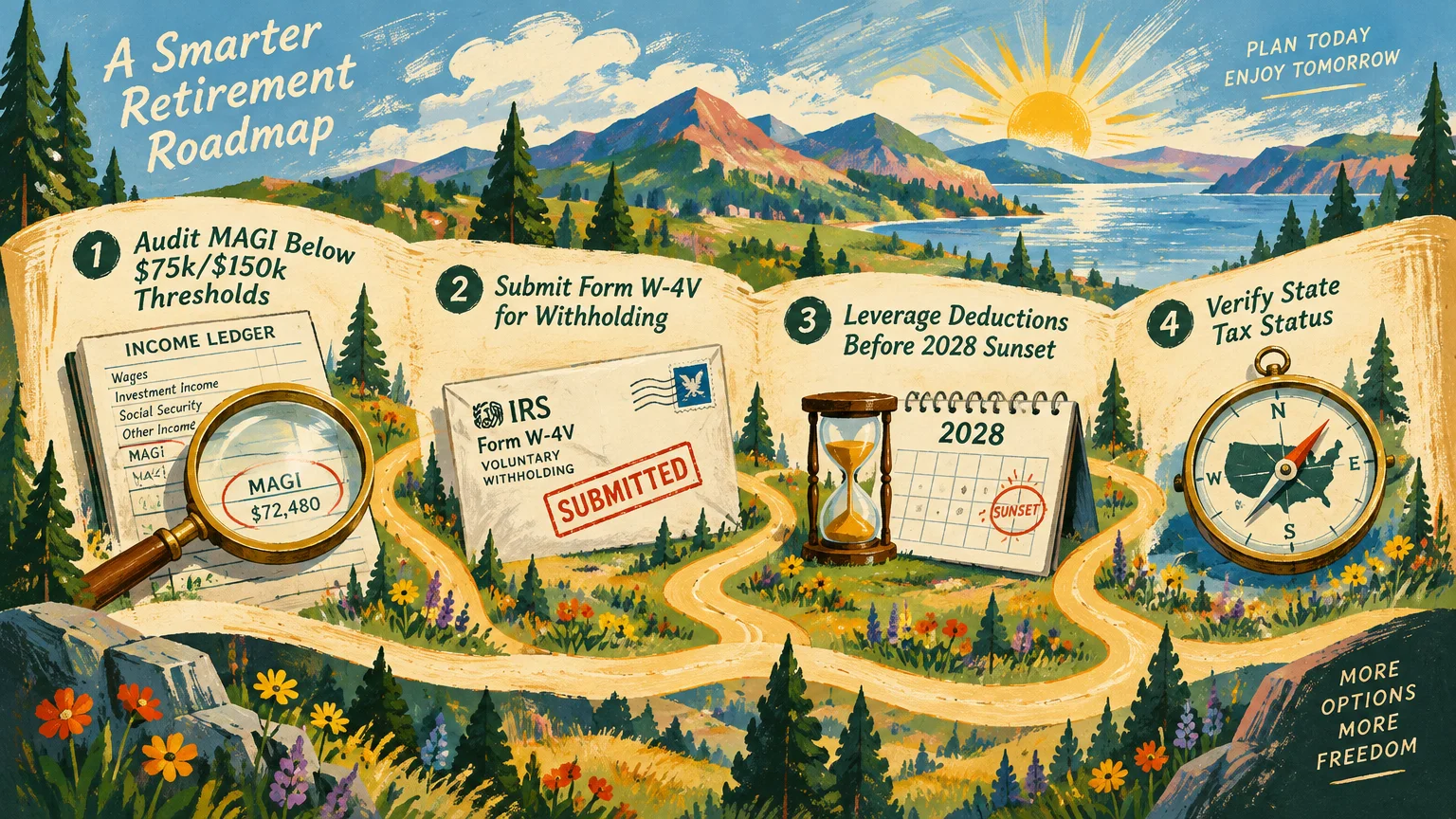
Second, track your Modified Adjusted Gross Income to stay below the phase-out thresholds. Keep your MAGI under $75,000 for single filers or $150,000 for married couples to preserve the full deduction.
Third, reevaluate your voluntary tax withholding on Social Security benefits. If the stacked 2026 deductions eliminate your tax liability, submit IRS Form W-4V to reduce withholding and increase your monthly check.
Fourth, consider accelerating tax-deferred withdrawals or Roth conversions before the deduction expires at the end of 2028. The enhanced deduction allows you to convert funds at a substantially reduced effective tax rate.
Fifth, stay informed on legislative developments through reliable senior advocacy groups like AARP. They provide continuous analysis of proposed Social Security tax changes and trust fund solvency debates.
Frequently Asked Questions About Social Security Benefit Taxes
Did President Trump eliminate federal income taxes on Social Security benefits?
No, the 2025 One Big Beautiful Bill Act did not repeal the taxes on Social Security benefits. Instead, Congress created a temporary below-the-line deduction of up to $6,000 per person aged 65 and older.
While this deduction shields roughly 88% to 90% of seniors from paying benefit taxes, higher earners still face taxation. The underlying combined income formulas remain active in the federal tax code.
Who qualifies for the enhanced senior deduction on Schedule 1-A?
Taxpayers must be age 65 or older by the end of the tax year to qualify. Individual filers receive up to $6,000, while married couples receive up to $12,000 if both are 65.
The full deduction is available for single filers with MAGI up to $75,000 and joint filers up to $150,000. Above those amounts, the deduction phases out at a rate of 6 percent.
What happens when the enhanced senior deduction expires after 2028?
Under current law, the Senior Bonus deduction expires on December 31, 2028. Unless Congress passes new legislation extending the provision, the deduction will vanish starting in tax year 2029.
If the deduction lapses, millions of seniors will face increased taxable income and higher benefit tax liabilities. Retirees should plan their distributions with this 2028 sunset in mind.
How does the new tax law affect retirees aged 62 to 64?
Retirees who claim Social Security before age 65 do not qualify for the $6,000 Senior Bonus deduction. They must wait until the tax year they reach age 65 to claim this relief.
However, their benefits remain subject to the combined income formulas immediately. Early claimers with part-time jobs or retirement distributions may owe federal income taxes on up to 85 percent of their benefits.
Which states still tax Social Security benefits in 2026?
In 2026, only eight states tax Social Security benefits: Colorado, Connecticut, Minnesota, Montana, New Mexico, Rhode Island, Utah, and Vermont. West Virginia eliminated its tax starting in 2026.
Forty-two states and Washington, D.C., now completely exempt Social Security benefits from state income taxation. Most taxing states also provide broad exemptions for low-income and middle-income seniors.
Preparing Your Retirement for What Comes Next
Tax laws and political promises will continue to shift, but your financial peace of mind depends on proactive planning. Audit your income sources, verify your Schedule 1-A deductions, and capitalize on current tax relief while it lasts.
Information in this article reflects current rules as of the publication date and may change. Always confirm benefit details directly with Social Security Administration, Medicare.gov, or relevant government agencies before making decisions.
Last updated: November 2026. Medicare and Social Security rules change annually—always verify current details at official government sources.