Moving your workplace savings at retirement seems routine, yet one paperwork error can trigger immediate tax bills and permanent penalties. Avoiding common 401(k) rollover mistakes keeps more of your nest egg working for you instead of going to the IRS.
Knowing how to handle a retirement account rollover helps you preserve early-withdrawal exceptions, protect your Medicare premiums, and avoid rollover taxes.
Below are nine costly missteps retirees make when moving employer plans, along with practical 401(k) tips for retirees to keep every dollar intact.
What You Need to Know Before Moving a 401(k)
Before you sign a distribution form, review how your age, tax bracket, and future healthcare costs interact with your plan rules. These four principles guide nearly every rollover decision:
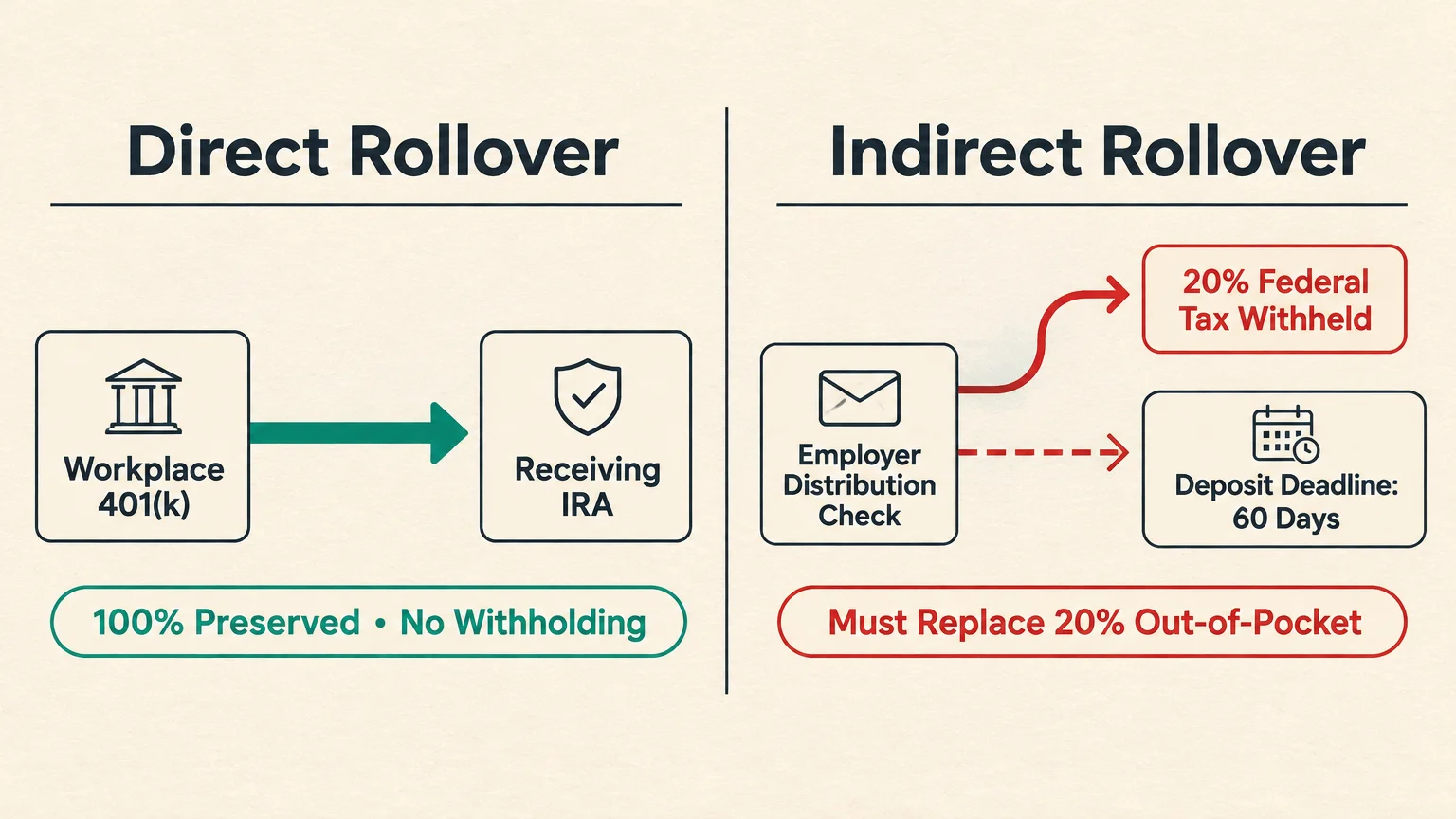
- Always choose a direct rollover: Having a check made payable to you triggers mandatory 20% federal tax withholding and a strict 60-day deposit deadline.
- Check your age before leaving a 401(k): Moving funds into an IRA eliminates the Rule of 55 penalty exception for workers who separate at age 55 or older.
- Coordinate around age 73 and work plans: Still-working employees can often delay required minimum distributions from a current 401(k), whereas traditional IRAs require withdrawals at age 73.
- Watch your Medicare lookback window: Converting pre-tax 401(k) money to a Roth IRA raises taxable income, which can trigger Medicare Part B and Part D surcharges two years later.
Mistakes 1 to 3: Timing, Withholding, and Age Penalties
1. Taking an Indirect Rollover Check Made Out to You
When you ask your plan administrator to send a check directly to your home address in your name, the IRS treats it as an indirect rollover. Your employer must withhold 20% for federal income taxes right away, even if you intend to deposit the money elsewhere.
You then have 60 days from receiving the check to deposit 100% of the original distribution into an eligible IRA or employer plan. Because 20% was withheld, you must replace that missing cash out of your own pocket.
Any shortfall you fail to replace within 60 days becomes a taxable distribution. If you are under age 59½, that unreplaced 20% may also trigger a 10% early distribution penalty.
If an error beyond your control causes you to miss the 60-day window, the IRS offers written self-certification for qualifying reasons under Revenue Procedure 2020-46. Still, avoiding the indirect route altogether is far simpler.
How to avoid it: Request a direct rollover—also called a trustee-to-trustee transfer—so funds move straight to your new custodian. If your plan insists on mailing you a check, confirm it is payable to your receiving IRA institution for your benefit, not to you personally.
2. Giving Up the Rule of 55 Too Soon
Many early retirees assume they must wait until age 59½ to touch workplace savings without penalty. Under the IRS Rule of 55, however, leaving your employer during or after the calendar year you turn 55 unlocks penalty-free withdrawals from that employer’s 401(k).
Qualified public safety employees in governmental plans can use this exception even earlier—starting in the year they turn 50 or reach 25 years of service. Ordinary income taxes still apply to pre-tax withdrawals, yet you skip the 10% early withdrawal penalty.
IRAs do not offer a Rule of 55 exception. If you complete a rollover to an IRA at age 56 and later need cash before age 59½, every withdrawal generally faces that 10% penalty unless another specific exception applies.
How to avoid it: Leave enough money inside your former employer’s 401(k) to cover your spending needs until age 59½. You can roll over the remaining balance to an IRA while keeping your early-retirement bridge intact.
3. Mismanaging an Unpaid 401(k) Loan at Separation
Leaving a job with an outstanding 401(k) loan often catches retirees off guard. Most plans require full repayment shortly after separation, or the remaining loan balance becomes a plan loan offset treated as a taxable distribution.
Fortunately, IRS rules grant extra breathing room if your loan was in good standing and offset solely because you left the job or the plan terminated. For a Qualified Plan Loan Offset, you have until your federal tax return due date—including extensions—to roll that offset amount into an IRA.
Wait past that extended tax deadline, and the unpaid balance locks in as taxable income. Also remember that a loan already treated as a deemed distribution due to missed payments before separation is never eligible for rollover.
How to avoid it: Review your loan payoff terms with human resources before setting your retirement date. If you cannot repay the balance before leaving, set aside cash and file a tax extension if needed so you can deposit the offset amount into an IRA on time.
Mistakes 4 to 6: RMD Traps, Roth Clocks, and Medicare Surcharges
4. Rolling Over Funds While Still Working—or Skipping an RMD
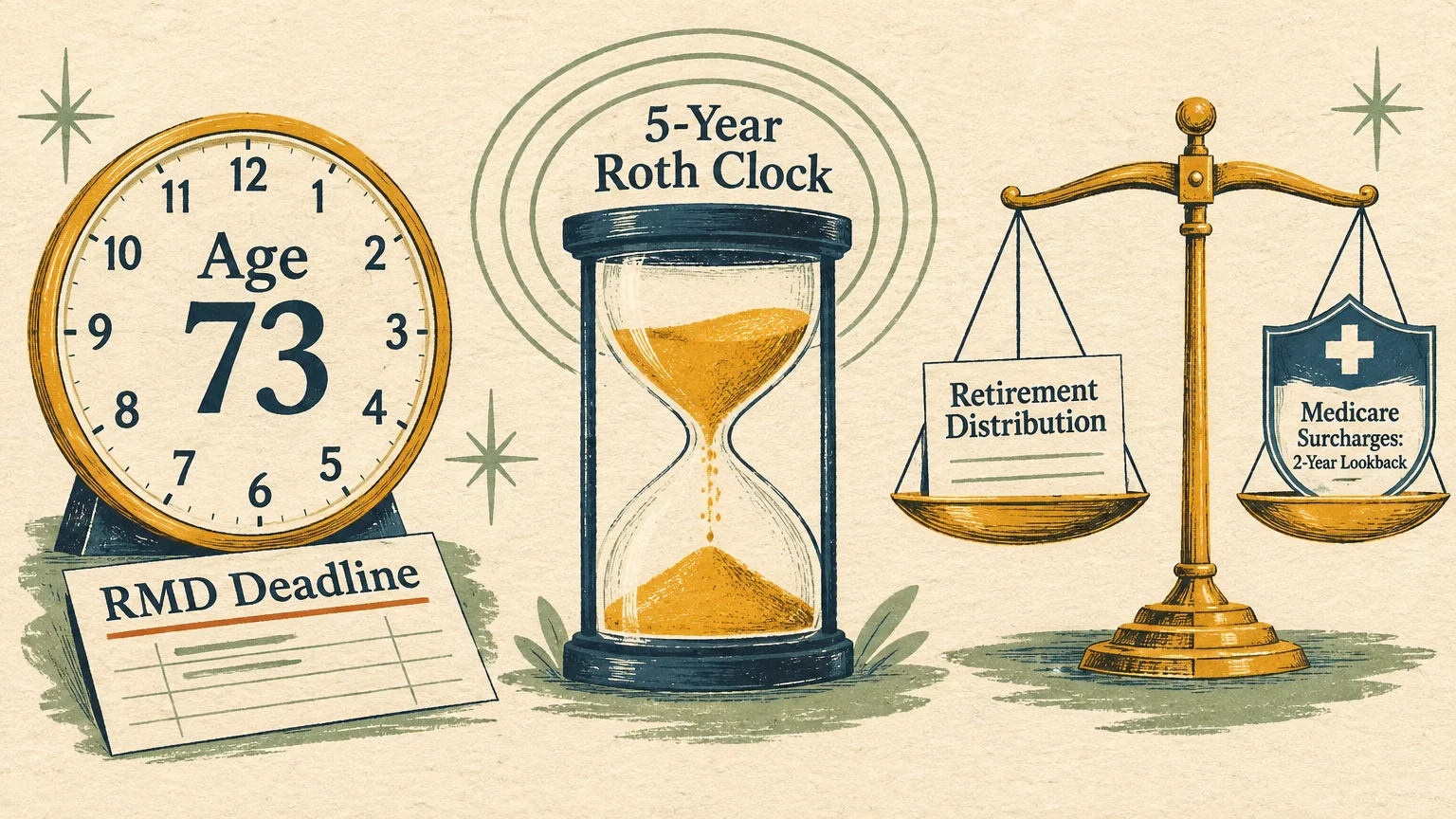
Under SECURE 2.0, Required Minimum Distributions (RMDs) begin at age 73. You can delay your very first RMD until April 1 of the following year, though doing so forces you to take two RMDs in one calendar year because your second RMD is due December 31.
If you keep working past age 73, rolling your current 401(k) into a traditional IRA can backfire. Most employees who do not own 5% or more of the company can delay RMDs from their current employer’s 401(k) until April 1 of the year after they retire, if the plan allows it.
Traditional IRAs, SEP IRAs, and SIMPLE IRAs do not offer that still-working exception. Moving your 401(k) into an IRA while still on the payroll forces RMDs to begin right away.
Watch out for RMD timing during the rollover itself, too. In any year an RMD is due, you must withdraw your full RMD before rolling over the remaining balance, because an RMD cannot be rolled over.
Finally, remember how aggregation works once you own multiple accounts. You can add up RMDs across multiple traditional IRAs and withdraw the total from one IRA, whereas 401(k) RMDs must be calculated and withdrawn separately from each workplace plan.
Missing a full RMD carries a 25% IRS excise tax on the shortfall, though fixing it within a two-year window lowers the penalty to 10%. Verify every calculation on the IRS Retirement Plans portal before initiating a transfer.
5. Triggering Medicare IRMAA Surcharges With a Lump-Sum Roth Rollover
Moving pre-tax 401(k) dollars into a Roth IRA creates tax-free growth later, yet the conversion amount adds directly to your Modified Adjusted Gross Income (MAGI) that year. Since January 1, 2018, under the Tax Cuts and Jobs Act, Roth conversions cannot be reversed or recharacterized.
A large single-year conversion can quietly inflate your healthcare costs two years later through Medicare’s Income-Related Monthly Adjustment Amount (IRMAA). Because Medicare uses a two-year lookback, your 2025 tax return sets your 2027 Part B and Part D premiums.
IRMAA brackets operate as a steep cliff rather than a gradual phase-in. Crossing an income threshold by just $1 triggers the full surcharge for the entire year, which affected roughly 9% of Medicare enrollees in 2026 according to federal estimates.
For 2026, the standard Part B monthly premium is $202.90, and IRMAA starts above $109,000 for single filers or $218,000 for joint filers based on 2024 MAGI. Surcharges lift monthly Part B premiums from $284.10 up to $689.90 at the highest bracket.
For 2027, the standard Part B monthly premium rises to $209.40, with IRMAA kicking in above $112,000 single or $224,000 joint based on 2025 MAGI. Part B premiums climb from $293.10 to $711.80 per month, alongside monthly Part D surcharges of $15.40 to $96.40 per person.
How to avoid it: Spread pre-tax-to-Roth rollovers across several lower-income years instead of converting everything at once. Check current premium brackets at Medicare.gov, and if your income fell due to stopping work, file Form SSA-44 at SSA.gov to request an IRMAA reduction.
6. Resetting Your Roth 5-Year Clock
Starting in 2024, SECURE 2.0 eliminated lifetime RMDs for designated Roth accounts inside 401(k) and 403(b) plans. Because Roth 401(k)s now match Roth IRAs on RMDs, you no longer need to rush a rollover just to avoid mandatory withdrawals.
If you still decide to roll a Roth 401(k) into a Roth IRA, pay close attention to the five-year rule for tax-free earnings. Inside your workplace plan, your five-year clock began on January 1 of the first year you contributed to that Roth 401(k).
Once rolled into a Roth IRA, however, your dollars adopt the Roth IRA’s five-year clock—not the old workplace plan’s start date. If you open a brand-new Roth IRA specifically to receive the rollover, a fresh five-year waiting period begins for tax-free earnings.
How to avoid it: Open and fund a Roth IRA with a small contribution at least five years before retirement. Rolling your Roth 401(k) into an existing Roth IRA that already cleared its five-year mark preserves immediate tax-free access to earnings once you pass age 59½.
Mistakes 7 to 9: Company Stock, After-Tax Basis, and Legal Protections
7. Rolling Appreciated Employer Stock Into an IRA
If you hold shares of your employer’s stock inside your 401(k) that grew substantially over the years, rolling everything straight into an IRA can erase a valuable tax break. An IRA converts every future withdrawal into ordinary income taxed at your highest marginal rate.
Under Internal Revenue Code Section 402(e)(4)(B), Net Unrealized Appreciation (NUA) offers an alternative if you take a lump-sum distribution of your entire 401(k) within one taxable year after separating from service. You transfer the employer stock directly into a standard taxable brokerage account while rolling other assets into an IRA.
At distribution, you owe ordinary income tax only on the original cost basis of those shares—not their market growth. When you eventually sell the stock, the NUA portion reported in Form 1099-R Box 6 is taxed at lower long-term capital gains rates.
How to avoid it: Before requesting a rollover, ask your plan administrator for the cost basis and current market value of any company stock. Compare ordinary income tax brackets against capital gains rates before moving those shares into an IRA.
8. Mixing Pre-Tax and After-Tax 401(k) Dollars Without Splitting
Some workplace plans let employees make non-Roth after-tax contributions above standard deferral limits. If your 401(k) contains both pre-tax money and after-tax basis, failing to separate them during a rollover creates messy tax headaches.
Under IRS Notice 2014-54, you can split a single 401(k) distribution across two destinations at the same time. Your plan sends the pre-tax balance and its earnings to a traditional IRA while routing your after-tax basis straight into a Roth IRA.
Done properly, you avoid creating taxable pro-rata complications inside a traditional IRA and lock in tax-free future growth on your after-tax contributions. Leaving everything mixed together forces extra tax tracking for the rest of your retirement.
How to avoid it: Confirm whether you hold any non-Roth after-tax basis before filling out distribution paperwork. Instruct your plan custodian in writing to split the direct rollover under Notice 2014-54 rules.
9. Overlooking Creditor, Bankruptcy, and Small-Balance Rules
Workplace 401(k) plans enjoy broad, uniform federal protection from creditors and civil lawsuits under ERISA. When you move money out of a 401(k) into an IRA, those legal shields change noticeably.
Under federal bankruptcy law (11 U.S.C. § 522(n)), traditional and Roth IRAs carry a combined exemption cap of $1,711,975 per person for cases filed between April 1, 2025, and March 31, 2028. However, funds rolled over from qualified employer plans—plus their earnings—are excluded from that dollar limit.
If you mix a 401(k) rollover with annual IRA contributions inside the same account, proving which dollars came from your workplace plan becomes much harder. Outside bankruptcy, FINRA notes that state laws vary sharply in how well they protect IRAs from non-bankruptcy lawsuits.
Also keep estate planning in mind for your adult children. In Clark v. Rameker (2014), the U.S. Supreme Court ruled that non-spouse inherited IRAs are not retirement funds and generally lose federal bankruptcy protection.
Watch for automatic force-outs on smaller leftover balances, too. Under SECURE 2.0, plans can automatically roll a separated worker’s vested balance up to $7,000 into a default IRA without consent, and cash out balances of $1,000 or less directly minus 20% withholding.
How to avoid it: Keep rollover dollars in a dedicated Rollover IRA separate from annual IRA contributions so your paper trail stays clear. If you face high professional liability risks, verify your state’s IRA creditor laws before leaving ERISA protection behind.
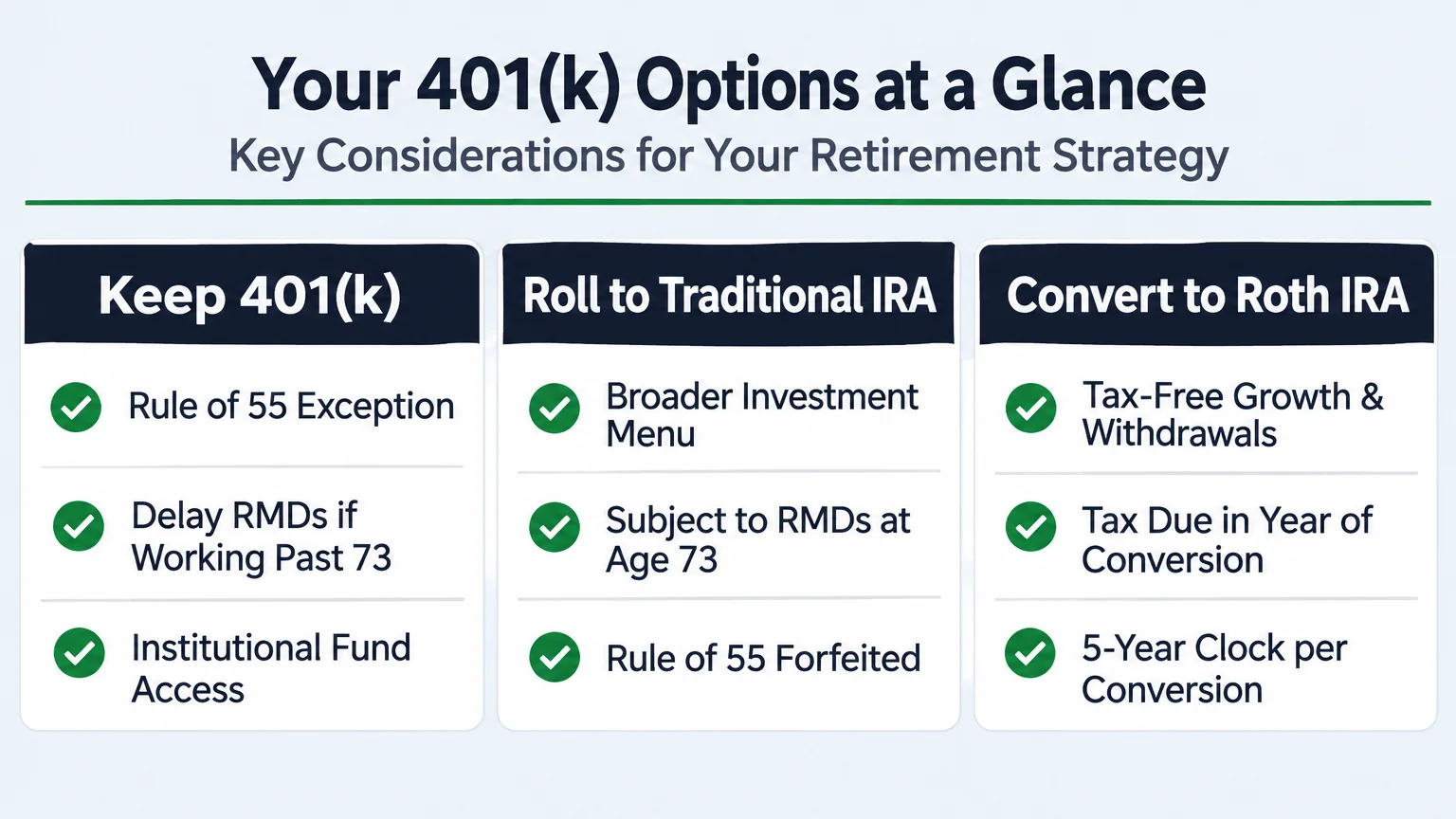
Comparing Your Options: Keep the 401(k), Roll to a Traditional IRA, or Convert to Roth
Every destination carries trade-offs across taxes, withdrawal flexibility, and legal safeguards. Use this comparison table to weigh your three main choices before moving a dollar:
| Feature | Keep in Former 401(k) | Roll to a Traditional IRA | Convert to a Roth IRA |
|---|---|---|---|
| Immediate Tax Impact | None; funds stay tax-deferred. | None with a direct rollover. | Taxable as ordinary income in conversion year; irreversible. |
| Early Withdrawal Penalty (Age 55–59½) | Penalty-free via Rule of 55 if you left at age 55+ (50+ for qualifying public safety). | 10% penalty applies before age 59½ unless another exception fits. | Converted principal has a 5-year rule; earnings face penalty before 59½. |
| RMD & Still-Working Rules | Starts at age 73; current-employer 401(k) allows still-working delay (under 5% owner). | Starts at age 73; no still-working delay; can aggregate across IRAs. | No lifetime RMDs for the original owner. |
| Medicare IRMAA Risk | Only when taxable withdrawals occur. | Only when taxable withdrawals occur. | High in conversion year; affects Part B and Part D two years later. |
| Creditor & Bankruptcy Protection | Uniform federal ERISA protection against lawsuits and bankruptcy. | Unlimited federal bankruptcy protection for tracked rollovers; state lawsuit rules vary. | Tracked rollovers keep unlimited bankruptcy protection; state lawsuit rules vary. |
Protecting your retirement savings is less about chasing slightly higher returns and more about preventing irreversible tax, penalty, and healthcare surcharges when you move your money.

Common Retirement Traps After Leaving an Employer
Even retirees who execute a clean direct rollover often run into three adjacent traps during the transition out of full-time work.
First, do not leave small workplace accounts scattered across former employers. A 2025 study by Capitalize and Boston College’s Center for Retirement Research estimated 31.9 million forgotten 401(k) accounts holding $2.1 trillion as of July 2025—roughly 25% of all 401(k) assets—with an average forgotten balance of $66,691 as of March 2026, up 18% from $56,616 in May 2023.
If you lost track of an old plan, search the U.S. Department of Labor’s Retirement Savings Lost and Found Database launched in December 2024. Consolidating stranded balances keeps your investment mix aligned and prevents missed RMDs later.
Second, scrutinize rollover sales pitches carefully. Following court rulings on prior rules, the Department of Labor republished Prohibited Transaction Exemption 2020-02 on March 20, 2026, requiring advisors relying on that exemption to document client-tailored reasons comparing your 401(k) fees and features before recommending a rollover.
Ask any advisor recommending an IRA transfer to put those fee and service comparisons in writing. Many institutional 401(k) plans offer low-cost funds you cannot buy as an individual retail investor.
Third, if you are 55 or older and still working, avoid cutting back contributions just because retirement is close. For 2026, the 401(k) employee deferral limit is $24,500 plus an $8,000 age-50+ catch-up—or an $11,250 super catch-up if you are ages 60 to 63—while IRA limits sit at $7,500 plus a $1,100 catch-up.
In 2027, the 401(k) deferral limit rises to $25,500, with an $8,500 catch-up (50+) and an $11,750 super catch-up (ages 60–63), while IRA limits stay at $7,500 plus $1,100. Note that workers whose prior-year employer FICA wages topped $150,000 in 2025 (or $155,000 in 2026 for 2027) must make 401(k) catch-up contributions as Roth.
When to Consult a Professional
You can handle a straightforward direct rollover between a plain-vanilla 401(k) and an existing IRA on your own. Complex tax elections, however, reward a single paid session with a fee-only fiduciary financial planner or Certified Public Accountant (CPA).
Seek qualified advice before initiating a rollover if you hold appreciated company stock eligible for NUA, have mixed pre-tax and after-tax basis, or plan multi-year Roth conversions near Medicare IRMAA brackets. A professional can also model whether keeping ERISA protection or preserving the Rule of 55 outweighs IRA flexibility.
Before hiring anyone, review unbiased checklists on comparing fees and credentials at the Consumer Financial Protection Bureau’s Retirement Tools. Always ask whether an advisor earns a commission from moving your assets.
Frequently Asked Questions About 401(k) Rollovers
How do I avoid rollover taxes when moving a 401(k) to an IRA?
Request a direct rollover from your 401(k) administrator into a like-taxed IRA—pre-tax 401(k) to traditional IRA, or Roth 401(k) to Roth IRA. Direct transfers bypass mandatory 20% federal withholding and trigger zero current income tax.
Does rolling a 401(k) into an IRA count toward the one-rollover-per-year rule?
No. Under IRC Section 408(d)(3)(B), the IRS enforces a strict one-rollover-per-year limit on indirect IRA-to-IRA rollovers, whereas rolling an employer 401(k) plan into an IRA does not count toward that limit.
Can I roll over my 401(k) after I turn 73?
Yes, you can roll over a 401(k) at age 73 or older, provided you satisfy the current year’s RMD first. Because RMDs are never eligible for rollover, you must withdraw your required amount before transferring the remaining balance.
Should I keep my rollover IRA separate from my contributory IRA?
Keeping employer rollover dollars in a dedicated Rollover IRA makes it far easier to document unlimited federal bankruptcy protection under 11 U.S.C. Section 522(n). It also preserves clean records if you ever wish to roll funds back into a future employer’s 401(k).

Your Next Step Before Moving Any Funds
Call your 401(k) plan administrator this week to request a written summary of your fund expenses, loan status, company stock basis, and any after-tax contributions before filling out a rollover form. Confirming those four numbers first ensures your retirement account rollover protects both your tax bracket and your Medicare premiums.
This article is for informational purposes only and does not constitute financial, legal, or medical advice. Medicare rules, Social Security benefits, and tax laws change regularly—verify current details at Medicare.gov, SSA.gov, or with a licensed professional.
Last updated: November 2026. Medicare and Social Security rules change annually—always verify current details at official government sources.