Thousands of retirees unintentionally overpay the IRS each year simply by missing tax breaks designed specifically for their stage of life. Claiming the right tax deductions for seniors can slash your taxable income and secure a substantially bigger tax refund.
Major tax code updates now offer older Americans unprecedented opportunities to protect hard-earned retirement assets. Overlooking these provisions means leaving thousands of dollars in government hands rather than keeping that money in your family budget.
You can legally lower your tax liability by reviewing four essential senior tax breaks before filing your next return. Here is exactly how to claim every dollar you deserve.
1. The Enhanced Standard Deduction Package for Filers Age 65 and Older
Most taxpayers understand the concept of the standard deduction, but many retirees fail to claim the full amount available to them. Reaching age 65 triggers substantial increases that can dramatically reduce your taxable earnings.
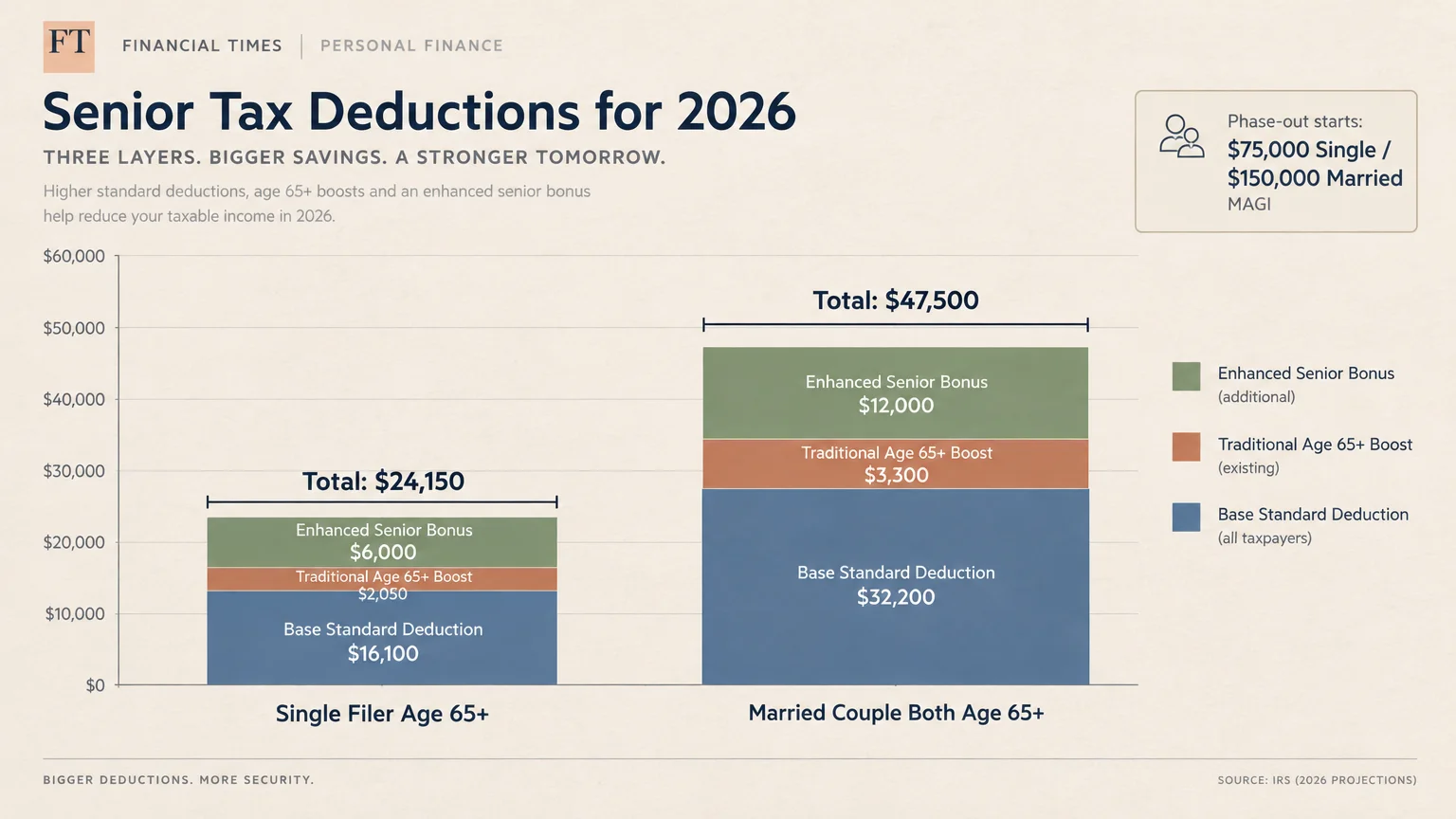
Base standard deduction amounts set the initial baseline for every taxpayer. For the 2026 tax year, single filers receive a base standard deduction of $16,100.
Married couples filing jointly claim a base deduction of $32,200. Heads of household qualify for a base standard deduction of $24,150.
Once you turn 65, the tax code rewards you with an additional standard deduction. This traditional bonus provides an extra $2,050 if you file as single or head of household.
For married taxpayers filing jointly, the traditional senior boost provides an extra $1,650 per qualifying spouse. If both you and your spouse are 65 or older, you receive a combined additional boost of $3,300.
A recent legislative expansion under the One Big Beautiful Bill Act created the Enhanced Senior Deduction for tax years 2025 through 2028. This temporary provision adds an extra $6,000 deduction per person for taxpayers age 65 and older.
A qualifying married couple where both partners have reached age 65 gains an additional $12,000 deduction under this rule. Best of all, you can claim this enhanced deduction whether you itemize or take the standard deduction.
Income limits do apply to this enhanced senior bonus. The full $6,000 per person deduction begins to phase out at a 6% rate once Modified Adjusted Gross Income exceeds certain thresholds.
Single filers face a phase-out threshold starting at $75,000 of Modified Adjusted Gross Income. Married couples filing jointly begin facing phase-outs once their income surpasses $150,000.
When you combine these layers, the total deductions become significant. A qualifying single senior age 65 or older can deduct up to $24,150 without itemizing a single receipt.
A qualifying married couple with both spouses age 65 or older can deduct up to $47,500 on their joint tax return. That large total protects a substantial portion of your retirement distributions from federal income tax.
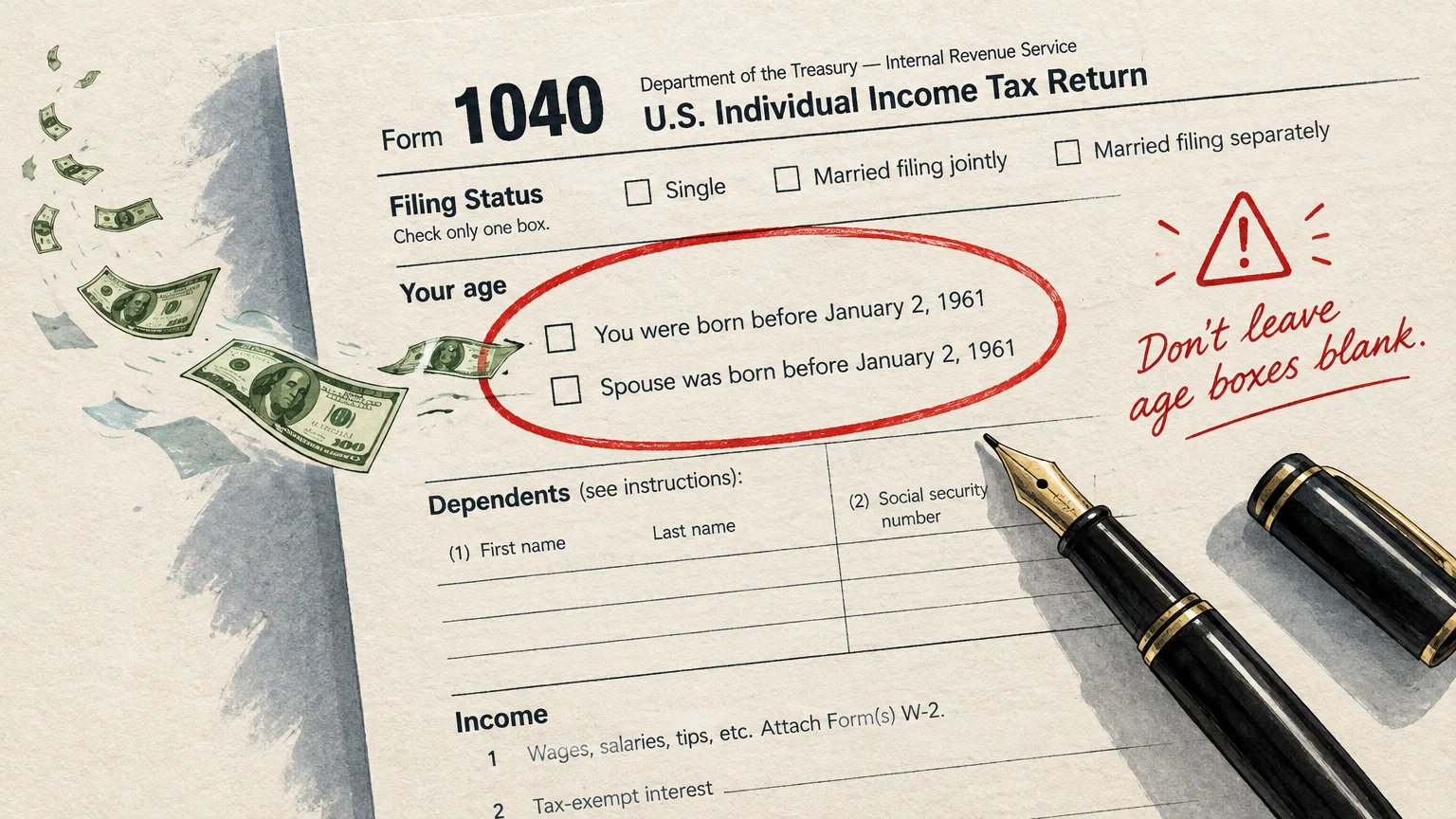
To claim these benefits, you must check the appropriate age boxes on Form 1040. Leaving those boxes blank is one of the most frequent errors that costs older filers money.
2. Out-of-Pocket Healthcare, Medicare Premiums, and Long-Term Care
Healthcare expenses represent one of the largest budget categories for aging Americans. Fortunately, the Internal Revenue Service permits itemizing taxpayers to deduct unreimbursed medical and dental costs.
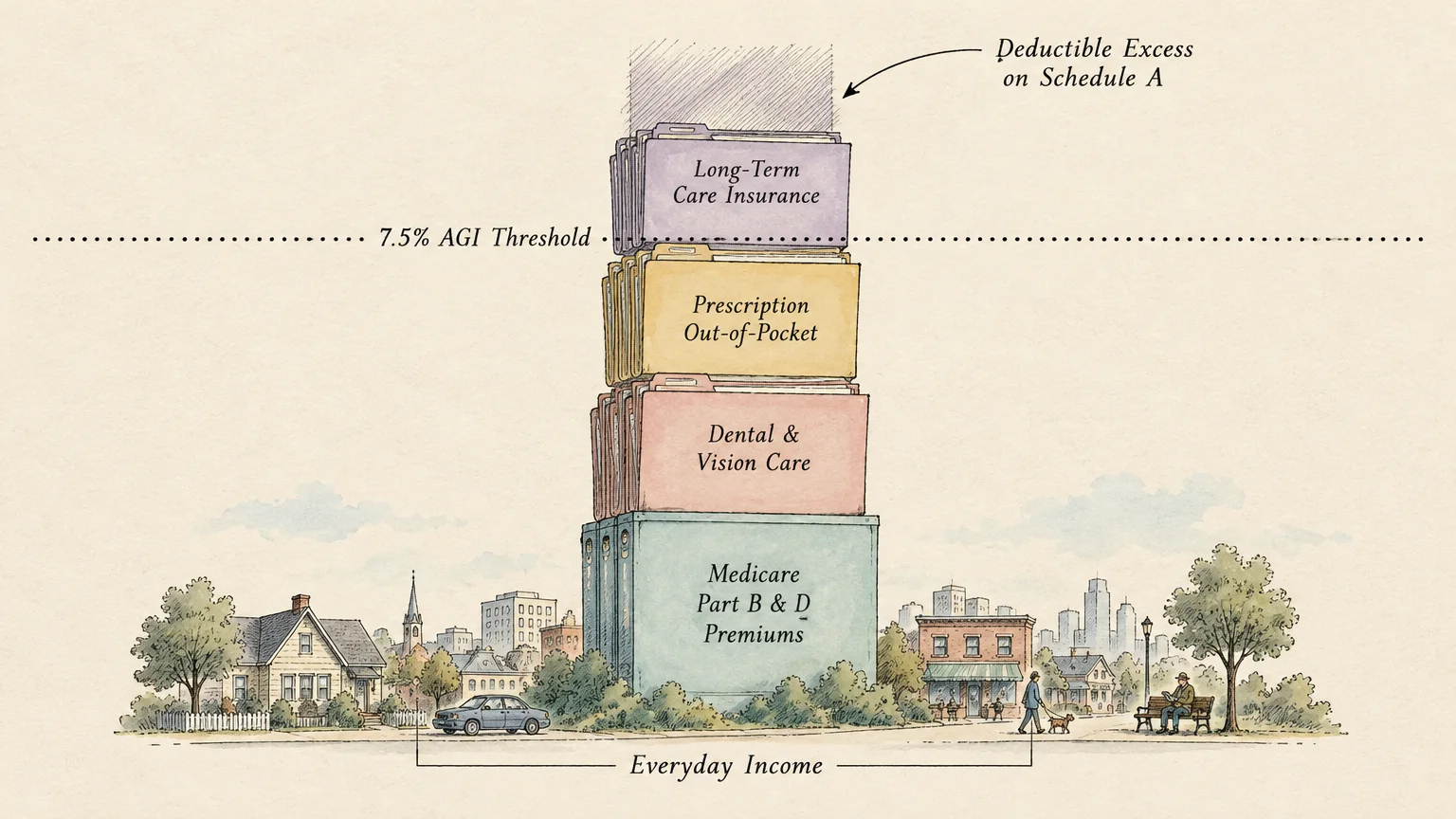
You can deduct eligible healthcare expenses that exceed 7.5% of your Adjusted Gross Income on Schedule A. Every dollar spent above that 7.5% threshold directly reduces your taxable income.
Many retirees believe they cannot reach this hurdle because they only track basic doctor copays. However, the range of eligible expenses is far wider than most taxpayers realize.
Your monthly Medicare premiums qualify directly as deductible medical expenses. This includes standard premiums for Medicare Part B medical insurance and Medicare Part D prescription drug plans.
If you purchase private supplemental coverage, your Medigap premiums count toward the threshold. Premiums paid for Medicare Advantage plans also qualify as deductible medical costs.
You can research covered options and compare plan structures directly on Medicare.gov to ensure you track all relevant expenditures. Tracking every monthly premium payment throughout the calendar year establishes a strong financial baseline.
Home modifications made to accommodate physical limitations or aging in place qualify as medical deductions. Installing entrance ramps, widening doorways, or adding support bars in bathrooms can provide valuable write-offs.
Modifications that lower your out-of-pocket costs must serve a primary medical purpose. You should maintain written recommendations from a physician along with contractor invoices to substantiate these claims.
Long-term care insurance premiums provide another substantial medical deduction for retirees. The tax code establishes specific age-based caps on the amount of qualified long-term care premiums you can include.
For the 2026 tax year, taxpayers aged 51 to 60 can deduct up to $1,860 per person in eligible premiums. That cap expands significantly as you advance into later decades.
Filers aged 61 to 70 can deduct up to $4,960 in qualified long-term care premiums. Seniors aged 71 and older can deduct up to $6,200 per individual.
If you maintain self-employment income through consulting or freelancing in retirement, special rules apply. You can often deduct health and long-term care premiums directly above-the-line without itemizing on Schedule A.
“It’s not how much money you make, but how much money you keep, how hard it works for you, and how many generations you keep it for.” — Robert Kiyosaki
3. Strategic Charitable Giving and Qualified Charitable Distributions (QCDs)
Supporting charitable causes provides deep personal satisfaction, but it should also yield tangible tax savings. Recent tax law revisions have restructured how older donors claim philanthropic contributions.
Under new rules effective for 2026, non-itemizers receive a dedicated above-the-line deduction for cash donations. Single filers claiming the standard deduction can deduct up to $1,000 for direct charitable gifts.
Married couples filing jointly who take the standard deduction can write off up to $2,000 in cash donations. These gifts must go directly to qualified 501(c)(3) public charities, excluding donor-advised funds.
Meanwhile, seniors who itemize deductions face a new limitation starting in 2026. Itemized charitable gifts are now subject to a 0.5% Adjusted Gross Income floor.
Under this restriction, only charitable contributions that exceed 0.5% of your Adjusted Gross Income provide a tax benefit on Schedule A. This hurdle makes alternate giving strategies even more attractive for retirees.
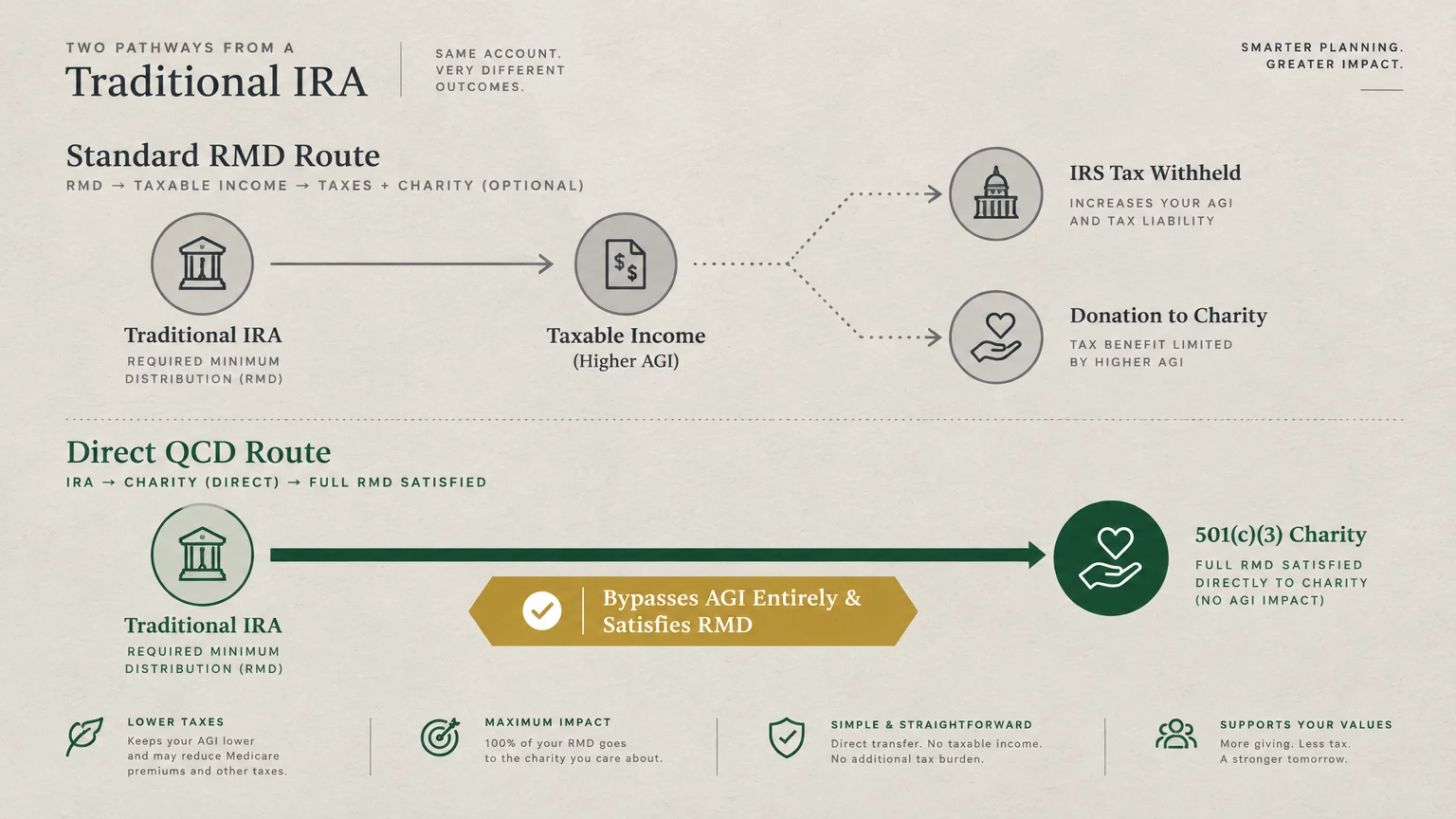
The Qualified Charitable Distribution represents the single most powerful tax tool for philanthropic seniors. Once you reach age 70½, you can transfer money directly from a traditional IRA to an eligible charity.
For the 2026 tax year, you can transfer up to $111,000 per individual through Qualified Charitable Distributions. A married couple with separate traditional IRAs can donate up to $222,000 combined.
A Qualified Charitable Distribution counts toward satisfying your annual Required Minimum Distribution. This feature provides an exceptional advantage if you do not need the mandatory withdrawal for living expenses.
Because the custodian transfers the funds directly to the charity, the distribution never touches your personal bank account. As a result, the money never enters your Adjusted Gross Income.
Keeping the money out of your Adjusted Gross Income shields you from several expensive secondary taxes. Lower income protects you from Medicare Income-Related Monthly Adjustment Amount surcharges, known as IRMAA.
A lower Adjusted Gross Income also prevents larger portions of your Social Security benefits from becoming taxable. Reviewing official guidelines at the Social Security Administration helps you monitor income limits that trigger benefit taxation.
A Qualified Charitable Distribution completely bypasses the new 0.5% Adjusted Gross Income itemizer floor. You enjoy a dollar-for-dollar income reduction without needing to itemize deductions on Schedule A.

4. Retirement Account and HSA Catch-Up Contributions
Older workers approaching retirement can leverage specialized catch-up rules to shield substantial income from immediate taxation. These contributions lower your current tax bracket while accelerating wealth accumulation.
For traditional and Roth IRAs, savers aged 50 and older can contribute an additional $1,100 catch-up amount in 2026. Combined with the $7,500 base limit, your total deductible IRA contribution reaches $8,600.
You have until the April 15, 2027 tax filing deadline to make your IRA contributions for the 2026 tax year. This grace period gives you ample time to calculate your income and maximize your write-off.
Workplace retirement plans such as 401(k), 403(b), and 457 accounts offer even higher savings ceilings. The baseline employee contribution limit for 2026 stands at $24,500.
Workers aged 50 to 59, as well as those age 64 and older, qualify for an extra $8,000 catch-up contribution. This allowance raises your total tax-deferred workplace contribution limit to $32,500.
The SECURE 2.0 legislation introduced a special Super Catch-Up bracket for individuals navigating their final career years. Workers turning 60, 61, 62, or 63 in 2026 can contribute an extra $11,250 instead of the standard catch-up.
This Super Catch-Up pushes the maximum employee contribution to $35,750 for eligible participants. Utilizing this ceiling creates an immediate reduction in your federal and state taxable income.
A critical rule change affects higher earners making workplace catch-up contributions in 2026. If your prior-year FICA wages exceeded $150,000, your catch-up contributions must go into an after-tax Roth account.
While Roth contributions do not provide an immediate upfront deduction, they generate completely tax-free distributions throughout your retirement years. You can review detailed rules regarding workplace plans on the IRS Retirement Plans portal.
Health Savings Accounts offer another valuable catch-up deduction for individuals who have not yet enrolled in Medicare. Account holders aged 55 and older can make a $1,000 annual catch-up contribution.
This catch-up comes on top of the 2026 base limits of $4,400 for self-only coverage and $8,750 for family coverage. Contributions to a Health Savings Account are entirely deductible above-the-line.
To qualify for Health Savings Account contributions, you must maintain enrollment in an eligible High-Deductible Health Plan. You must also avoid enrolling in Medicare Part A or Part B, which terminates contribution eligibility.
“The goal of retirement is to live off your assets—not live off your regrets.”
Standard Deduction vs. Itemized Deductions: Strategic Comparison
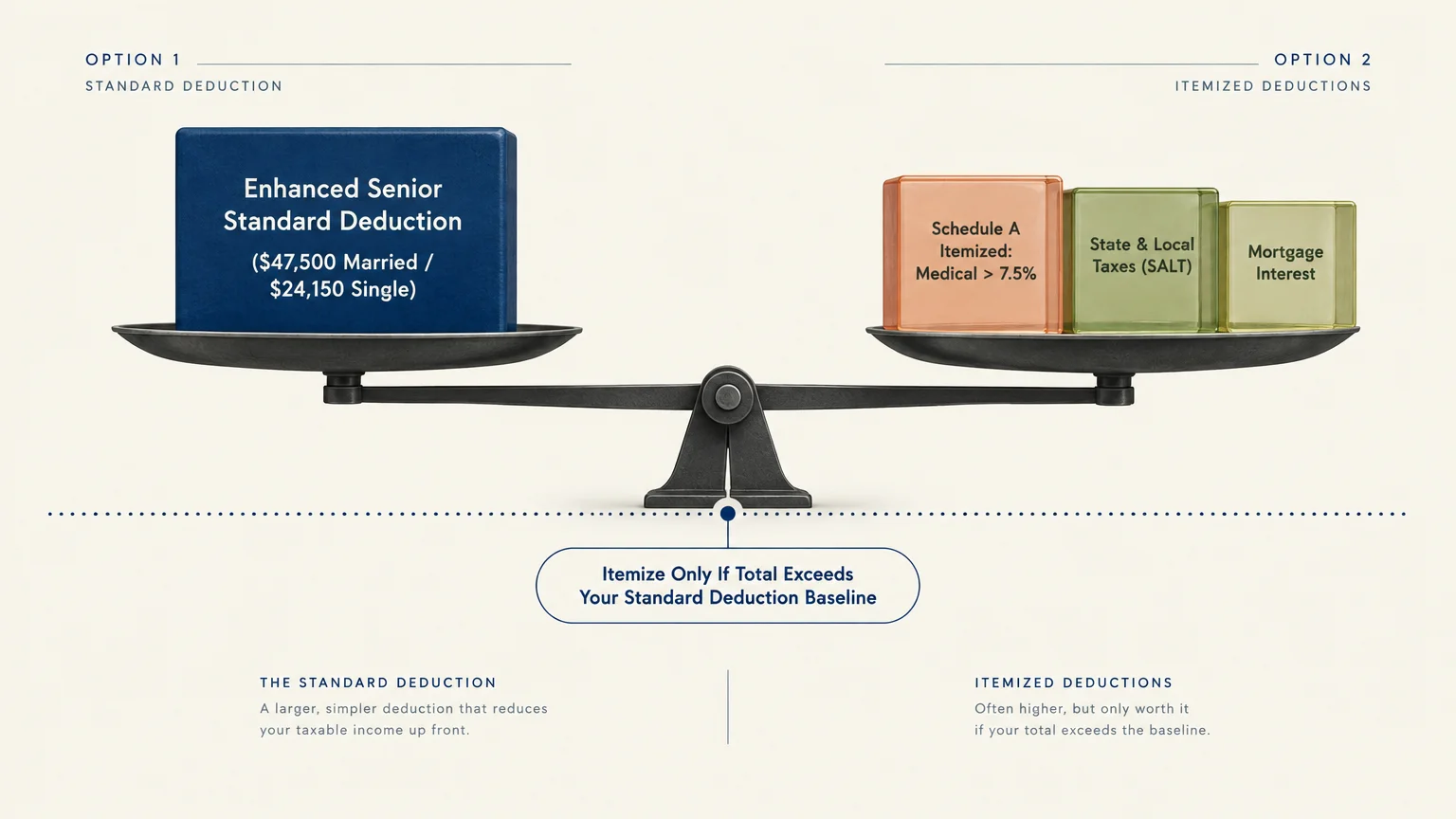
Determining whether to itemize expenses or claim the standard deduction requires careful mathematical evaluation each tax season. Significant standard deduction increases have made itemizing less common, but specific situations still warrant Schedule A filing.
If your combined medical costs, state taxes, and qualifying charitable gifts exceed your standard deduction, itemizing remains profitable. Seniors with substantial nursing home bills or major home modifications frequently exceed the standard threshold.
The table below outlines how key tax deductions for seniors operate under both filing strategies for the 2026 tax year.
| Deduction Category | Standard Deduction Filers | Itemized Deduction Filers |
|---|---|---|
| Base Senior Deduction (Age 65+) | Up to $24,150 (Single) / $47,500 (Joint) with enhanced senior bonus. | Not applicable for base standard deduction amounts. |
| Enhanced Senior Bonus | $6,000 per person subject to MAGI phase-out above $75k/$150k. | $6,000 per person subject to MAGI phase-out above $75k/$150k. |
| Unreimbursed Medical Expenses | No deduction permitted on Schedule A. | Deductible to the extent costs exceed 7.5% of AGI. |
| Long-Term Care Insurance | Deductible above-the-line only if self-employed. | Included in 7.5% medical expense bucket up to age caps. |
| Cash Charitable Gifts | Above-the-line deduction up to $1,000 (Single) / $2,000 (Joint). | Deductible only to the extent gifts exceed 0.5% of AGI. |
| Qualified Charitable Distributions | Excluded from AGI up to $111,000 per person (Age 70½+). | Excluded from AGI up to $111,000 per person (Age 70½+). |
| Retirement Catch-Up Plans | Deducted directly from gross income on Form 1040. | Deducted directly from gross income on Form 1040. |
Reviewing this comparison helps you visualize how individual deductions interact across different reporting methods. Choosing the right path ensures you keep more money in your account.
Common Retirement Traps That Shrink Your Refund
Tax code complexity often causes retirees to make expensive missteps when preparing their annual filings. Avoiding these frequent traps keeps your hard-earned wealth intact and prevents painful IRS adjustments.
One major error involves failing to aggregate small medical expenses throughout the year. Many retirees assume they cannot hit the 7.5% Adjusted Gross Income threshold and stop tracking expenditures.
When you combine dental work, vision exams, hearing aids, Medicare premiums, and prescription costs, totals climb rapidly. Neglecting to track medical mileage to and from healthcare providers also forfeits valuable write-offs.
Another dangerous trap occurs when seniors make charitable gifts directly from personal checking accounts rather than utilizing Qualified Charitable Distributions. Writing personal checks forces you to include retirement distributions in your gross income.
Taking the taxable distribution raises your Adjusted Gross Income even if you subsequently write off the donation. That unnecessary income increase can trigger Medicare IRMAA surcharges and make your Social Security benefits taxable.
Many older filers also fail to mark the age 65 checkbox on page one of Form 1040. Tax preparation software usually captures this automatically, but paper filers frequently overlook the prompt.
Missing that single checkbox deprives you of thousands of dollars in traditional and enhanced senior deductions. Always double-check your demographic selections before submitting your paperwork.
Retirees often forget to investigate state-specific senior tax breaks. Many individual states exempt Social Security benefits, military pensions, or specified portions of retirement account distributions.
Failing to claim state-level homestead exemptions or senior property tax freezes costs older Americans hundreds of dollars annually. Exploring community-specific benefits through resources like AARP can reveal substantial regional relief programs.
Finally, continuing Health Savings Account contributions after enrolling in Medicare constitutes an expensive violation. Medicare Part A retroactively covers up to six months prior to enrollment, which can create accidental excess contributions.
Excess contributions trigger a 6% excise penalty each year until corrected. Stop all Health Savings Account deposits at least six months before applying for Medicare benefits.

When to Consult a Professional
Navigating the intersection of Social Security, pension payouts, required distributions, and tax deductions can challenge even seasoned investors. Knowing when to solicit professional guidance prevents costly errors.
You should consult a Certified Public Accountant or Enrolled Agent when your tax situation changes substantially. Life transitions such as selling a home, losing a spouse, or starting retirement distributions warrant expert review.
A professional tax preparer can run multi-year projections to model whether itemizing or claiming standard deductions serves you better. They can also structure multi-year charitable giving strategies to optimize deductions.
If you face complex healthcare choices, consider speaking with a State Health Insurance Assistance Program counselor. These trained volunteers provide unbiased guidance regarding Medicare plan options and premium structures.
Working alongside a fee-only fiduciary financial advisor helps coordinate your investment withdrawals with current tax code limits. A fiduciary ensures your distribution plan avoids unnecessary tax bracket creep and preserves your estate.
Frequently Asked Questions
Can I claim both the traditional age 65 standard deduction and the new enhanced senior deduction?
Yes, qualifying filers age 65 and older can claim both benefits simultaneously on their tax return. The enhanced $6,000 deduction stacks on top of the traditional additional standard deduction and base amounts.
Do Medicare Part B and Part D premiums count toward medical expense deductions?
Yes, all premiums paid for Medicare Part B, Part D, Medicare Advantage, and Medigap count as deductible medical expenses. You can deduct them alongside other unreimbursed healthcare costs to the extent they exceed 7.5% of your AGI.
How does a Qualified Charitable Distribution help lower my Medicare costs?
A Qualified Charitable Distribution bypasses your Adjusted Gross Income entirely rather than appearing as a taxable withdrawal. Keeping your AGI lower helps you remain beneath the income thresholds that trigger Medicare Part B and Part D IRMAA surcharges.
Can I contribute to an HSA catch-up plan if I am already enrolled in Medicare Part A?
No, enrollment in any part of Medicare disqualifies you from making further contributions to a Health Savings Account. You can still withdraw existing HSA funds tax-free for qualified medical expenses, but new contributions must cease.
Action Steps for Your Next Tax Return
Take control of your tax return by gathering your medical receipts, year-end premium summaries, and charitable distribution confirmations today. Reviewing your eligibility for enhanced senior deductions now will position you to capture every eligible write-off and maximize your refund.
Information in this article reflects current rules as of the publication date and may change. Always confirm benefit details directly with Social Security Administration, Medicare.gov, or relevant government agencies before making decisions.
Last updated: November 2026. Medicare and Social Security rules change annually—always verify current details at official government sources.