Federal rules for Medicare shift sharply in 2027, changing what you pay for monthly premiums, prescriptions, and hospital care. Deciding between Medicare Advantage vs. Original Medicare now requires looking well past the advertised monthly price tag.
Stand-alone prescription drug premiums are climbing steeply as temporary subsidies expire, while millions of beneficiaries are losing their private plans nationwide. At the same time, lower negotiated prices take effect for 15 costly medications on January 1, 2027.
Understanding these Medicare 2027 changes helps you keep your trusted doctors, cap your annual spending, and avoid irreversible enrollment mistakes.
What You Need to Know About Medicare in 2027
Comparing your health coverage options takes extra care this year because both major pathways carry notable price adjustments and rule changes. Review these five developments before you finalize your 2027 coverage:
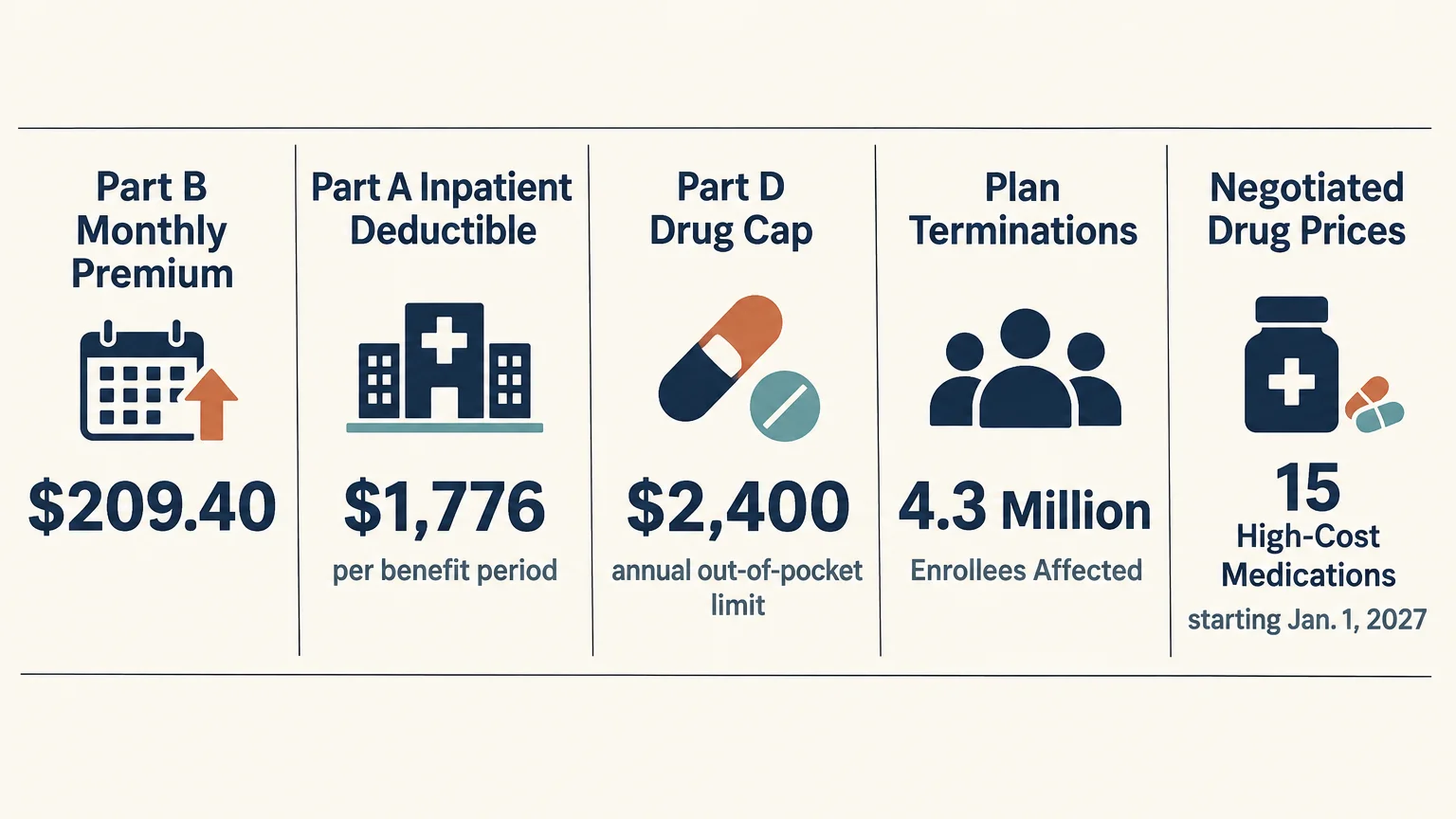
- Higher Original Medicare baseline costs: The standard Part B monthly premium climbs to $209.40 in 2027, and the Part A inpatient hospital deductible rises to $1,776 per benefit period.
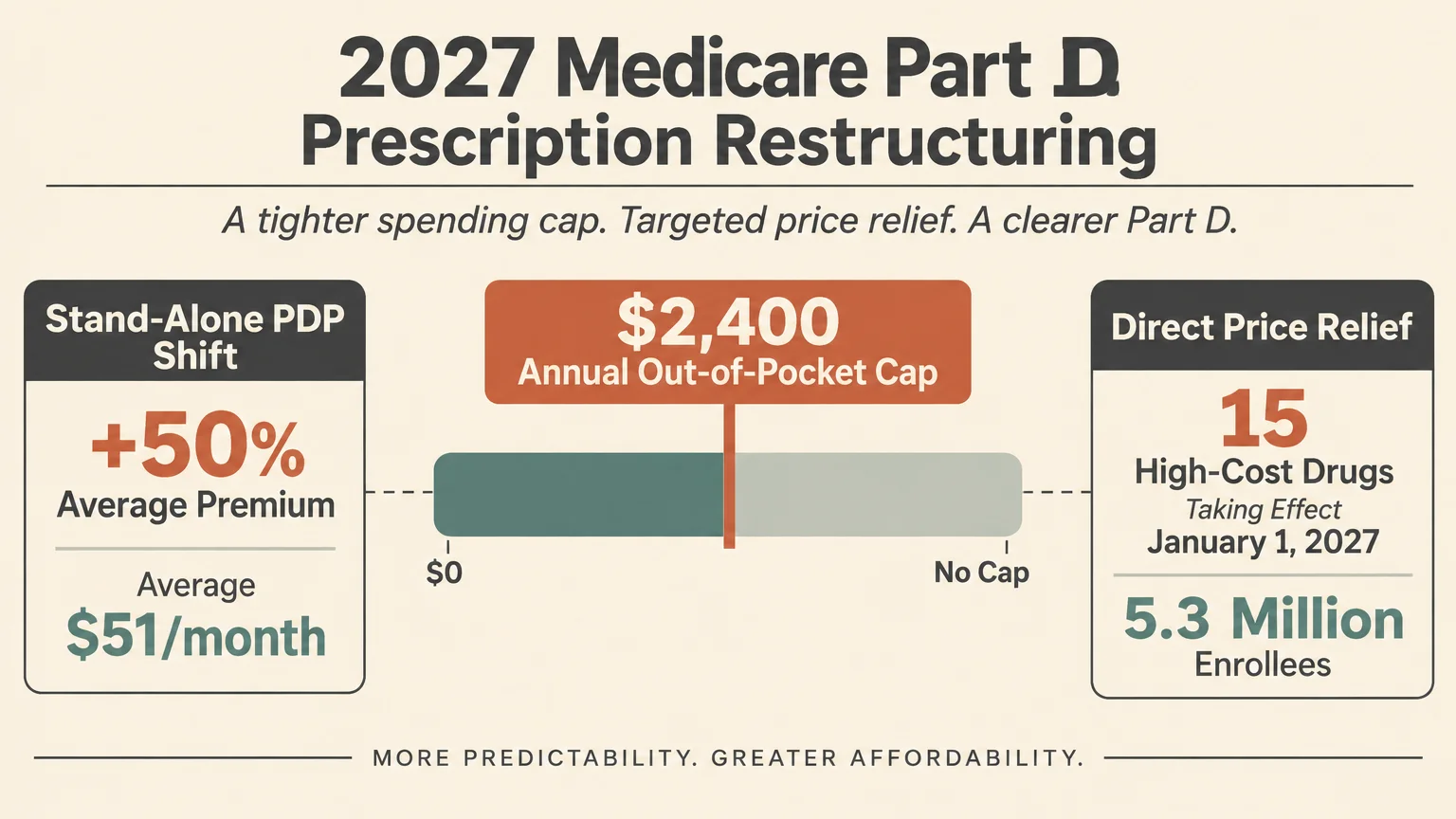
- Steep prescription plan shifts: Stand-alone Part D premiums are projected to jump 50% on average for enrollees who stay in their 2026 plans, while the annual drug out-of-pocket cap rises to $2,400.
- Widespread Medicare Advantage exits: Roughly 4.3 million beneficiaries face private plan terminations at the end of 2026, prompting narrower provider networks and trimmed extras across many counties.
- New drug price relief: Lower negotiated prices take effect on January 1, 2027, for 15 high-cost medications used by roughly 5.3 million beneficiaries.
- Special switching protections: If your Medicare Advantage plan terminates for 2027, federal guaranteed-issue rules allow you to buy certain Medigap policies without medical underwriting.
Side-by-Side: Medicare Advantage vs. Original Medicare in 2027
Both coverage tracks start with the same federal foundation, yet they divide your financial risk and provider access in very different ways. Use this Medicare plans comparison to see how the two paths stack up for 2027.
| Feature | Original Medicare (Parts A & B) | Medicare Advantage (Part C) |
|---|---|---|
| 2027 Part B Monthly Premium | $209.40 standard (higher with IRMAA) | $209.40 standard, plus plan premium averaging $12.00 |
| Annual Medical Deductibles | $292 for Part B; $1,776 per Part A benefit period | Varies by plan; many plans charge $0 medical deductibles |
| Out-of-Pocket Maximum | None on Original Medicare alone (requires Medigap to cap) | Up to $9,850 federal in-network cap in 2027 |
| Provider Access | Any U.S. doctor or hospital accepting Medicare | Plan networks (increasingly HMOs rather than broad PPOs) |
| Prior Authorization | Minimal, except a 17-procedure pilot in 6 states | Common; electronic portals launch Jan. 1, 2027 |
| Drug Coverage (Part D) | Requires stand-alone PDP (averaging $51/month if unchanged) | Usually bundled (averaging $9/month for drug portion) |
| Supplemental Coverage | Pairs with Medigap to cover the 20% Part B coinsurance | Cannot be combined with Medigap policies |
Original Medicare gives you nationwide provider freedom in exchange for higher fixed monthly costs when you add Medigap and a stand-alone drug plan. Medicare Advantage keeps monthly premiums low, yet it shifts your risk toward higher out-of-pocket caps and tighter local networks.

Original Medicare Changes for 2027: Premiums, Pilots, and Care Models
If you choose Original Medicare, your baseline monthly and hospital expenses edge upward in 2027 according to figures released by the Centers for Medicare & Medicaid Services (CMS). Knowing every tier helps you budget accurately against your Social Security check.
2027 Part A and Part B Cost Increases
Your standard Part B monthly premium increases by $6.50—about 3.2%—from $202.90 in 2026 to $209.40 in 2027. Your annual Part B deductible rises $9 to $292, after which you generally pay 20% coinsurance for outpatient care with no yearly cap unless you carry supplemental insurance.
Part A remains premium-free for roughly 99% of beneficiaries who worked at least 40 Medicare-covered quarters. If you buy Part A directly, monthly premiums rise to $328 for 30 to 39 work quarters and $597 for fewer than 30 quarters.
Hospital stays also cost more out of pocket in 2027. The Part A inpatient deductible rises $40 to $1,776 per benefit period for days 1 through 60, while daily coinsurance climbs to $444 for days 61 through 90 and $888 for lifetime reserve days.
Skilled nursing facility care under Part A still charges $0 for the first 20 days of a qualifying stay. For days 21 through 100, your daily coinsurance increases from $217 to $222 in 2027.
Social Security COLA and 2027 IRMAA Surcharges
Social Security benefits rise 3.6% in January 2027—adding an average of roughly $75 per month—which helps absorb the $6.50 Part B increase. Remember that Medicare automatically deducts Part B premiums from your monthly Social Security deposit.
Higher-income retirees face Income-Related Monthly Adjustment Amount (IRMAA) surcharges based on 2025 modified adjusted gross income. If your 2025 income exceeded $112,000 as an individual or $224,000 filing jointly, you pay extra each month.
Part B IRMAA surcharges add $83.70 to $502.40 per month in 2027, pushing total Part B costs between $293.10 and $711.80 monthly at the highest bracket ($500,000 individual or $750,000 joint). High earners also pay $15.40 to $96.40 extra each month on top of Part D premiums.
If your income dropped because you recently retired or experienced another qualifying life-changing event, do not automatically accept the higher bill. File Form SSA-44 with the Social Security Administration to request an IRMAA reduction based on your current income.
New Care Support, Telehealth, and Prior Authorization
Beyond pricing, Original Medicare adds new support while testing targeted oversight in 2027. Official guidance on Medicare.gov highlights these operational updates for traditional Medicare beneficiaries:
- ACCESS chronic-care model: Participating providers can offer home-based support—including virtual check-ins, wearable health devices, and lifestyle coaching—at low or no cost if you manage diabetes, high blood pressure, or depression.
- Extended telehealth access: Under federal legislation signed in 2026, at-home Medicare telehealth coverage without geographic limits continues through December 31, 2027, including audio-only visits for non-behavioral care and postponed in-person requirements for mental health visits.
- WISeR prior authorization pilot: Running from 2026 through 2031 in Arizona, New Jersey, Ohio, Oklahoma, Texas, and Washington, this CMS pilot uses screening software and clinician review for 17 high-risk outpatient procedures, such as spinal cord stimulators, epidural steroid injections, and knee arthroscopy.
Outside those six pilot states and 17 procedures, Original Medicare still rarely requires prior authorization. That broad clinical freedom remains one of its strongest advantages over private plans.
Medicare Advantage Shifts in 2027: Shrinking Networks and Higher Caps
Private Medicare Advantage (Part C) plans now cover 55% of eligible Medicare beneficiaries—more than 35 million Americans, according to KFF. Yet while CMS projects average monthly plan premiums will fall in 2027, private insurers are tightening networks and cutting benefits.
Lower Monthly Premiums vs. a Higher Out-of-Pocket Ceiling
CMS estimates the weighted average monthly Medicare Advantage premium—paid alongside your $209.40 Part B premium—will drop 16% from $14.37 in 2026 to $12.00 in 2027. Many $0-premium plans remain available across the country.
However, your worst-case financial exposure rises noticeably. The federal maximum out-of-pocket (MOOP) cap for in-network Part A and Part B care increases from $9,250 in 2026 to $9,850 in 2027.
Most plans still set lower caps than the federal ceiling—KFF reported 2026 averages of $4,636 for HMOs and $6,592 for PPOs—yet rising ceilings mean serious illnesses can strain your budget. Check your specific plan’s 2027 Evidence of Coverage rather than assuming last year’s limit still applies.
A lower monthly premium only saves you money if your trusted doctors stay in network and your annual spending cap fits your emergency savings.
Plan Terminations, County Exits, and Trimmed Perks
Disruption is the biggest Medicare Advantage headline for 2027. According to KFF, 4.3 million Medicare beneficiaries will see their current private plan terminate on December 31, 2026—including 3.1 million in Medicare Advantage drug plans and 1.2 million in stand-alone drug plans.
Another 1.4 million beneficiaries face plan consolidations that move them into different coverage structures automatically. Across the nation, the average beneficiary has 28 Medicare Advantage drug plans to pick from in 2027, down from 32 in 2026 and 36 in 2024.
Major insurers are pulling back from specific counties, cutting broad-network PPO offerings, and shifting members toward tighter-network HMOs. Many plans are also trimming extra allowances for dental care and over-the-counter items to offset higher medical costs and federal payment pressures—where MedPAC estimated 2026 Medicare Advantage payments ran 14% higher per person than traditional Medicare.
Faster Electronic Approvals and Regulatory Trade-Offs
On the bright side for patients waiting on medical approvals, CMS requires Medicare Advantage insurers to launch standardized electronic prior authorization portals starting January 1, 2027. Your doctor can submit requests digitally, and you can track approval decisions directly online.
Federal turnaround limits remain strict: plans must decide standard prior authorization requests within seven calendar days and urgent requests within 72 hours. Still, several consumer rule changes under the 2027 CMS final rule demand extra vigilance on your part:
- Stronger chronic-benefit clarity: Plans must publicly post eligibility rules for Special Supplemental Benefits for the Chronically Ill and follow stricter guardrails on supplemental debit cards.
- Fewer automatic reminders: CMS rescinded the requirement for plans to send mid-year notices listing your unused dental, vision, or flex benefits.
- Looser marketing restrictions: Regulators rolled back rules separating educational events from sales pitches and lifted bans on superlative advertising claims.
- Removed referral requirement: Insurance brokers are no longer required to include State Health Insurance Assistance Programs (SHIPs) on mandatory referral lists.
- No special mid-year switch: CMS declined to create a Special Enrollment Period if your doctor or hospital leaves your plan’s network mid-year.
Because plans face fewer marketing limits and mid-year network drops no longer unlock a switch, verify every doctor and hospital before enrolling. Never rely solely on a promotional flyer or sales pitch.
Part D Prescription Drug Changes Affecting Both Pathways
Prescription costs often tip the scales when comparing Medicare Advantage vs. Original Medicare. In 2027, the gap in monthly drug premiums widens dramatically depending on which path you select.
The $2,400 Out-of-Pocket Cap and Deductible Rise
Under the Inflation Reduction Act, the annual Part D out-of-pocket cap rises from $2,100 in 2026 to $2,400 in 2027. Once your covered drug spending reaches $2,400, you pay $0 for covered prescriptions for the rest of the calendar year.
Meanwhile, the maximum allowable Part D annual deductible increases from $615 in 2026 to $700 in 2027. KFF also projects that most Part D enrollees will face percentage-based coinsurance rather than predictable flat copays for brand-name medications in 2027.
Why Stand-Alone Drug Plans Cost More in 2027
If you pair Original Medicare with a stand-alone Part D plan, watch your renewal notice closely. CMS is ending its $9.8 billion Part D Premium Stabilization Demonstration at the close of 2026, removing federal subsidies that previously held down stand-alone plan prices.
KFF projects that stand-alone Part D enrollees who keep their 2026 plan will see average monthly premiums jump 50%—from $34 in 2026 to $51 in 2027. Nearly 30% of non-low-income stand-alone enrollees could pay $100 or more per month if they fail to shop around.
By contrast, the drug portion inside bundled Medicare Advantage prescription plans averages just $9 per month—over five times less than unchanged stand-alone plans. Shopping stand-alone drug plans every autumn is no longer optional if you want to keep Original Medicare affordable.
15 Negotiated Drugs and Cash-Card Warnings
Both coverage tracks deliver substantial relief if you take certain high-cost brand medications. On January 1, 2027, lower Medicare Maximum Fair Prices take effect for 15 widely used Part D drugs—projected by CMS to save roughly 5.3 million beneficiaries $685 million out of pocket.
The 2027 negotiated list includes blockbuster treatments such as Ozempic, Rybelsus, and Wegovy, alongside Trelegy Ellipta, Xtandi, Pomalyst, and Ibrance. Check your plan’s 2027 formulary to confirm tier placement and any prior authorization rules for your dosage.
Federal guidance for 2027 also introduces the Medicare GLP-1 Bridge program, giving eligible Part D enrollees access to select GLP-1 medications for weight and health management at a $50 monthly copay. At the same time, Medicare.gov explicitly warns that buying drugs with cash-discount coupons through programs like TrumpRx.gov is not creditable coverage and will not count toward your deductible or $2,400 out-of-pocket cap.

Medigap and Guaranteed-Issue Rules: What Happens If You Switch
Many retirees start with Medicare Advantage at age 65 and plan to switch back to Original Medicare plus Medigap if a serious illness develops later. In most states, that strategy carries a major catch.
2027 Medigap Limits and the Underwriting Barrier
Medigap policies cover Original Medicare’s 20% Part B coinsurance and Part A hospital deductibles, making your medical bills highly predictable. For 2027, CMS adjusted the deductible for High-Deductible Plans F, G, and J up 3.40% from $2,950 to $3,050.
Annual out-of-pocket limits on cost-sharing Medigap options also inch upward in 2027. Plan K’s cap rises from $8,000 to $8,360, while Plan L’s cap climbs from $4,000 to $4,180.
The biggest hurdle is qualifying to buy a policy later in retirement. Outside your initial six-month Medigap Open Enrollment Period at age 65 or a one-time 12-month Medicare Advantage trial right, insurers in most states can review your health history and reject you.
According to KFF, 74% of Medicare Advantage enrollees—roughly 20.9 million people—have at least one health condition that could trigger a Medigap denial under medical underwriting. Only four states—Connecticut, Maine, Massachusetts, and New York—require continuous or annual guaranteed-issue Medigap access for adults 65 and older.
Your 2027 Guaranteed-Issue Window for Terminated Plans
If you are among the 3.1 million Medicare Advantage enrollees whose plan terminates on December 31, 2026, federal rules hand you a rare second chance. Plan terminations trigger federal guaranteed-issue rights to buy select Medigap policies without answering health questions.
Generally, your guaranteed-issue Medigap window runs for 63 days after your old plan ends, and a non-renewal Special Enrollment Period remains open through the last day of February 2027. Save your official plan termination notice because Medigap insurers require it as proof of eligibility.
How to Compare Medicare Plans During Open Enrollment
Timing matters just as much as benefit details when choosing Medicare for 2027. Mark these two enrollment windows on your calendar immediately:
- Annual Open Enrollment Period (October 15 – December 7, 2026): You can switch between Original Medicare and Medicare Advantage, change Medicare Advantage plans, or pick a new stand-alone Part D plan for coverage starting January 1, 2027.
- Medicare Advantage Open Enrollment Period (January 1 – March 31, 2027): If you are already in a Medicare Advantage plan on January 1, you get one chance to switch to a different Advantage plan or return to Original Medicare and add a Part D plan.
Follow this step-by-step process to complete your 2027 plan check without feeling overwhelmed:
- Read your Annual Notice of Change: Confirm whether your 2026 plan is renewing, consolidating, or terminating on December 31, 2026, and note any premium or copay hikes.
- List every provider and prescription: Write down your primary doctor, specialists, preferred hospital system, and exact medication names with dosages.
- Run your numbers on official tools: Enter your drug list and zip code into the Medicare Plan Finder to compare total estimated annual costs—premiums plus copays—rather than monthly premiums alone.
- Verify provider participation directly: Call your doctors’ billing offices to confirm they remain in network for the exact 2027 plan name and contract number you are considering.
- Check Medigap eligibility before leaving Advantage: If you live outside Connecticut, Maine, Massachusetts, or New York and do not hold a termination notice, confirm you can pass Medigap underwriting before dropping your Advantage plan.
Common Retirement Traps to Avoid in 2027
Even careful planners overlook subtle Medicare rules that cost thousands of dollars over time. Watch out for these frequent pitfalls during Medicare open enrollment:
- Letting coverage auto-renew blindly: KFF survey data showed 69% of Medicare Advantage enrollees failed to compare plans during a recent enrollment cycle; with stand-alone drug premiums jumping 50% and millions of beneficiaries losing their plans, passive renewal is especially risky for 2027.
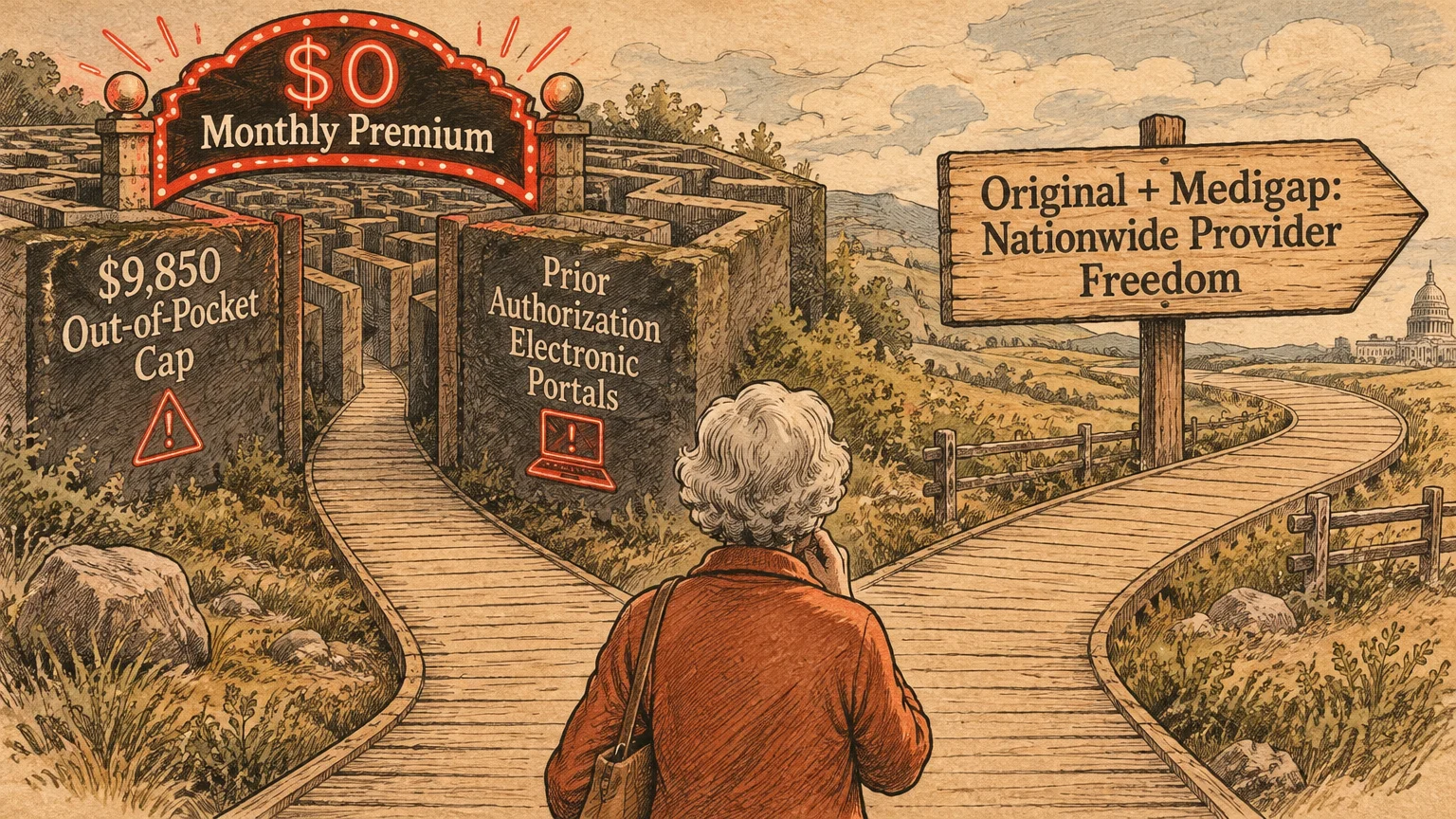
- Chasing $0 premiums without checking the MOOP: A $0 Medicare Advantage premium looks appealing until a major diagnosis triggers coinsurance up to the $9,850 federal in-network ceiling.
- Ignoring stand-alone Part D shopping: Keeping an older stand-alone drug plan alongside Original Medicare could easily push your monthly drug premium past $100 in 2027 when cheaper, comparable formularies exist.
- Assuming discount coupons replace Part D: Using cash-discount cards instead of enrolling in creditable Part D coverage can leave you facing permanent late-enrollment penalties and zero protection toward the $2,400 annual drug cap.
- Missing IRMAA appeals after retirement: Paying elevated Part B and Part D premiums based on high working-year income from 2025 wastes thousands if you qualified to file Form SSA-44.
When to Consult a Professional
Because CMS removed State Health Insurance Assistance Programs (SHIPs) from mandatory broker referral lists for 2027, you have to seek out unbiased help proactively. Reach out to your local SHIP office—accessible through the National Council on Aging or your state aging agency—for free, one-on-one Medicare counseling with zero sales commissions.
Working with a SHIP counselor is especially smart if your Medicare Advantage plan is terminating and you want help exercising your guaranteed-issue Medigap rights. They can also check whether you qualify for Medicare Savings Programs or Part D Extra Help.
Consult a fee-only financial advisor when managing retirement account withdrawals, Roth conversions, or capital gains that might push your income past the $112,000 individual or $224,000 joint IRMAA cliffs. Coordinate with an elder law attorney if you need help planning around long-term care costs, since neither Original Medicare nor Medicare Advantage covers extended custodial nursing care.
Frequently Asked Questions About Medicare in 2027
Is Medicare Advantage better than Original Medicare in 2027?
Neither option is universally better because your ideal fit depends on your health, budget, and travel habits. Medicare Advantage offers lower monthly premiums and bundled drug coverage, while Original Medicare with Medigap delivers nationwide doctor access and predictable hospital bills.
What happens if my Medicare Advantage plan is canceled for 2027?
If your plan terminates on December 31, 2026, you qualify for a Special Enrollment Period through the last day of February 2027 to pick another Advantage plan or return to Original Medicare. You also receive federal guaranteed-issue rights to purchase certain Medigap policies without medical underwriting.
Why is my stand-alone Part D drug plan jumping in price for 2027?
CMS is ending a $9.8 billion temporary premium stabilization program at the end of 2026, causing average stand-alone Part D premiums to jump roughly 50% for enrollees who keep their existing plan. Comparing plans on Medicare Plan Finder can often help you switch to a lower-cost option covering the same medications.
Can I switch from Medicare Advantage back to Original Medicare and Medigap anytime?
You can return to Original Medicare during Annual Open Enrollment or the Medicare Advantage Open Enrollment Period, yet buying a Medigap policy is not automatic. Outside four guaranteed-issue states or special termination rights, insurers can deny Medigap applications based on your medical history.

Your Next Step Before Enrollment Closes
Pull out your current prescription bottles, confirm your doctors’ 2027 network status, and run a side-by-side comparison on Medicare Plan Finder well ahead of December 7, 2026. Taking an hour this fall protects both your healthcare access and your retirement cash flow throughout 2027.
Retirement rules and benefit amounts vary based on individual work history, income, and circumstances. This article provides general guidance only.
Consult a SHIP counselor, financial advisor, or elder law attorney for advice specific to your situation.
Last updated: November 2026. Medicare and Social Security rules change annually—always verify current details at official government sources.