Finding your cola notice 2027 inside your my social security account takes the guesswork out of next year’s budget. Instead of waiting weeks for paper mail, you can check your updated numbers online in minutes.
Knowing how to read that ssa notice matters just as much as finding it. Your 2027 gross increase tells only part of the story until you factor in Medicare premiums and tax withholdings.
This guide walks you through every line on your social security letter so you can verify your 2027 benefit amount in two minutes flat. You will also learn which deductions shift your net deposit and which deadlines protect your income.
Where and When to Access Your 2027 COLA Notice
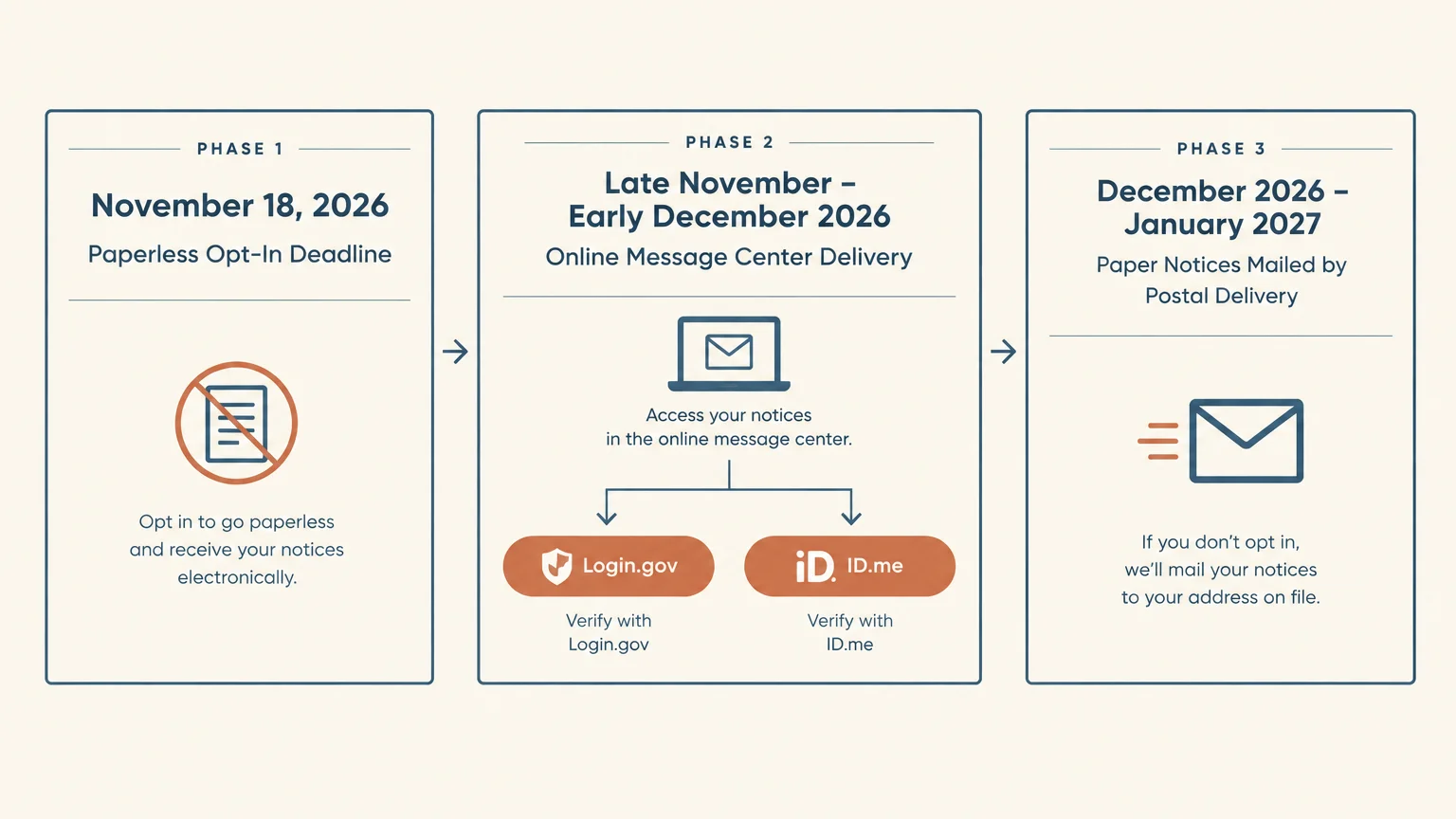
The Social Security Administration (SSA) makes personalized 2027 COLA notices available online in the Message Center of your my Social Security account starting in late November 2026. Viewing your digital notice lets you see your figures up to three weeks earlier than waiting for postal delivery.
To receive your notice electronically for the current cycle, SSA rules require you to create an account and opt into paperless notices by November 18, 2026. Some SSA guidance notes that retirement and disability beneficiaries can also view digital notices beginning in early December.
If you miss the paperless cutoff or prefer physical mail, SSA sends printed notices throughout December 2026. Wait until January before contacting the agency about a missing paper letter so holiday mail delays have time to clear.
Signing In Through Login.gov or ID.me
Access to your online account requires signing in through either Login.gov or ID.me rather than an old username and password. Legacy SSA usernames created more than three years ago must transition to one of these verified partners for uninterrupted access.
- Login.gov: Recommended for most U.S. residents, this option requires a personal email address, a government-issued photo ID, and a phone number for two-factor verification.
- ID.me: Available both inside and outside the United States, this service requires an email address, a photo ID, and a camera-enabled smartphone or computer.
- Message Center alerts: Once inside your account, open Message Center Preferences to turn on email or text alerts whenever SSA posts a new document.
Always type the official SSA web address directly into your browser instead of clicking links inside unexpected messages. Every SSA service and online account is completely free.
How to Read Your One-Page SSA Notice in 2 Minutes
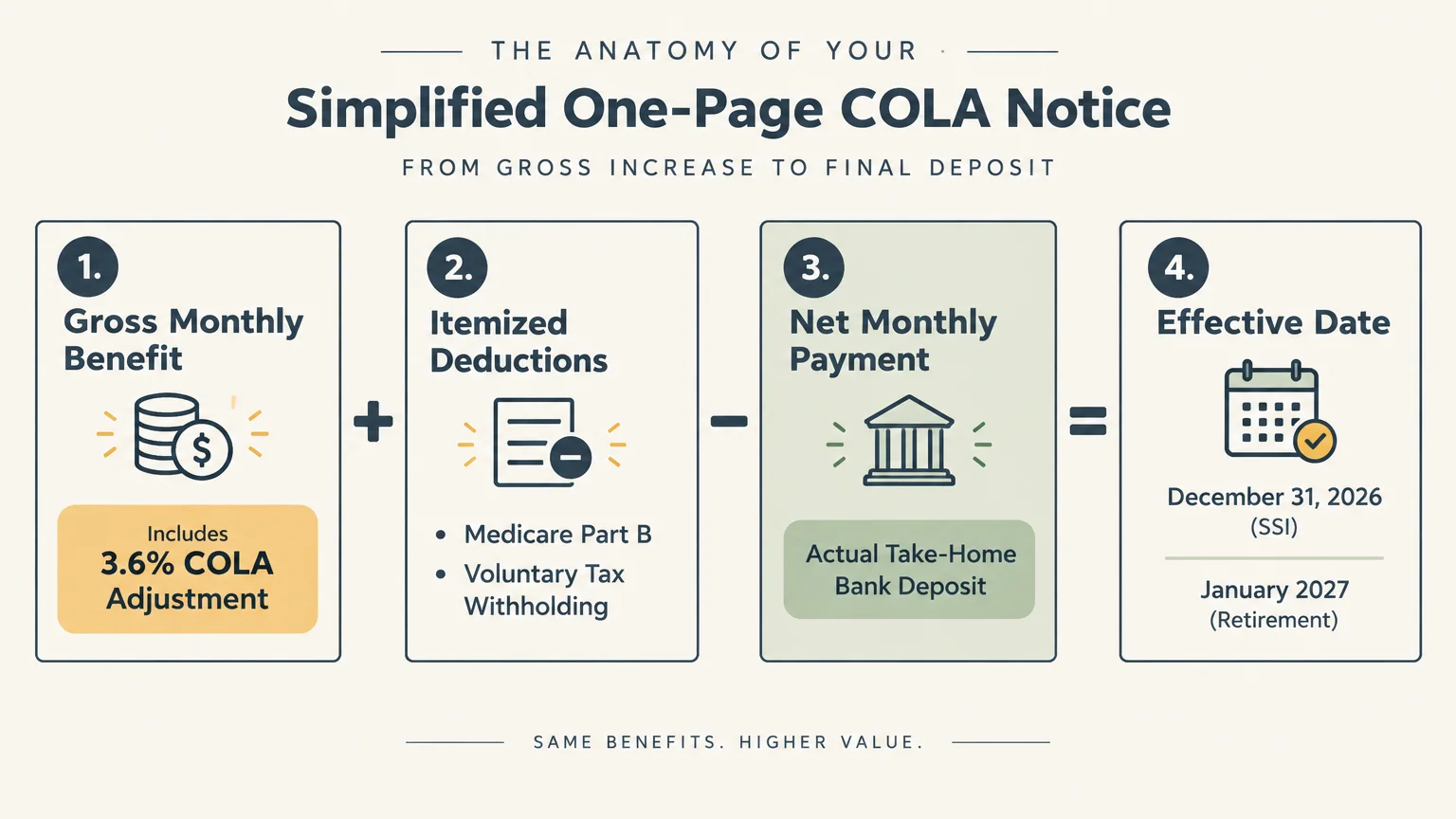
Since 2025, SSA has replaced dense multi-page mailings with a simplified, one-page COLA notice written in plain language. You can scan the entire document in two minutes once you know where the four core figures sit.
- Check your new gross monthly benefit: Look first at the top-line figure reflecting your 3.6% adjustment before any deductions leave your check.
- Review every listed deduction: Scan the itemized lines showing Medicare Part B or Part D withholdings alongside any voluntary federal income tax withholding.
- Verify your resulting net payment: Confirm the exact dollar amount scheduled to land in your bank account or Direct Express card after deductions clear.
- Note the effective date: Confirm whether your adjusted payment begins in January 2027 for standard Social Security or December 31, 2026 for Supplemental Security Income (SSI).
Your gross COLA percentage tells only half the story; your real retirement budget depends on the net deposit after Medicare and tax withholdings clear.
Medicare enrollees will see updated 2027 benefit and Medicare premium deduction details in the Message Center starting in late November, as well as on December paper notices. Saving a PDF copy right away helps if you need proof of income later.
Keep in mind that assistance programs such as Medicaid evaluate your gross Social Security income from the COLA notice rather than your net bank deposit. You will still receive a separate annual tax form, Form SSA-1099, in January for your federal tax return.
What the 3.6% COLA Means for Your 2027 Benefit Amount
Announced on October 14, 2026, the 2027 cost-of-living adjustment raises Social Security and SSI payments by 3.6% for 76 million Americans. That total covers nearly 72 million Social Security beneficiaries and roughly 7.3 million SSI recipients, including people who receive both.
This 3.6% boost exceeds the 2.8% adjustment in 2026 and the 2.5% increase in 2025, making it the largest annual raise since 2023. Under the Social Security Act, SSA calculates each year’s increase using Bureau of Labor Statistics CPI-W inflation data from Q3 2025 through Q3 2026.
For an average retired worker, SSA estimates monthly benefits will climb by roughly $75, moving from $2,095 to $2,170 per month on the 2027 COLA Fact Sheet. Specific household figures vary depending on your work history, claiming age, and benefit category.
| Benefit Category | 2026 Monthly Amount | 2027 Monthly Amount | Monthly Change |
|---|---|---|---|
| Average retired worker (SSA Fact Sheet) | $2,095 | $2,170 | +$75 |
| Average aged couple (both receiving benefits) | $3,238 | $3,355 | +$117 |
| Average aged widow(er) alone | $1,936 | $2,006 | +$70 |
| Average disabled worker | $1,642 | $1,701 | +$59 |
| Maximum benefit at Full Retirement Age | $4,152 | $4,188 | +$36 |
| Maximum benefit at age 70 (per Kiplinger) | $5,181 | $5,358 | +$177 |
| SSI federal payment standard (individual) | $994 | $1,029 | +$35 |
| SSI federal payment standard (couple) | $1,491 | $1,544 | +$53 |
While SSI monthly payment standards rise in 2027, federal SSI resource limits stay unchanged at $2,000 for an individual and $3,000 for a couple. Watching both income and asset limits protects SSI eligibility if you hold cash reserves.
Why Your Net Deposit Differs From Your Gross Increase
Even with a 3.6% gross raise, the extra money landing in your checking account depends heavily on Medicare costs and federal tax choices. Checking those deductions on your ssa notice prevents unwelcome surprises in January.
Pending 2027 Medicare Part B Premiums and Hold Harmless Rules
As of mid-November 2026, the Centers for Medicare & Medicaid Services (CMS) had not yet released official 2027 Part B premiums, deductibles, or higher-income brackets. Until CMS publishes final figures, the 2026 baseline remains $202.90 per month for standard Part B coverage with a $283 annual deductible.
For planning purposes, the 2026 Medicare Trustees Report projected a 2027 standard Part B premium of $209.50 per month and a $292 annual deductible. Keep in mind that Trustees Report estimates are projections rather than official CMS rates.
Most people who already have Part B deducted from Social Security receive protection under the hold harmless rule. This rule prevents a Part B increase from shrinking your net Social Security check below the prior year’s dollar amount.
Hold harmless protection does not apply to everyone, however. People paying income-related surcharges, new Part B enrollees, and beneficiaries whose state Medicaid agency pays their Part B premium fall outside that safety net.
Higher-Income IRMAA Surcharges and Confirmed 2027 Part D Rules
Higher-income beneficiaries can owe an Income-Related Monthly Adjustment Amount (IRMAA) on top of standard Part B and Part D premiums. Your 2027 IRMAA determination looks back at the Modified Adjusted Gross Income (MAGI) reported on your 2025 federal tax return.
Official 2027 IRMAA brackets are still pending CMS release, though 2026 surcharges began above $109,000 for single filers and $218,000 for married couples filing jointly. If your income dropped due to retirement or another qualifying life event, you can request a recalculation.
Unlike Part B, key 2027 Part D prescription drug figures are already confirmed on Medicare.gov. If you have Part D premiums deducted directly from your Social Security check, those plan changes will affect your net deposit.
- Part D maximum deductible: Rises from $615 in 2026 to $700 in 2027.
- Part D out-of-pocket cap: Increases from $2,100 in 2026 to $2,400 in 2027.
- National base beneficiary premium: Moves from $38.99 in 2026 to $41.33 in 2027, while CMS projects average standalone Part D premiums to edge up from $35.09 to $36.
You can review your current drug coverage during Medicare Open Enrollment, which runs from October 15 through December 7, 2026. Comparing local options on the Medicare Plan Finder helps confirm whether your current plan still fits your prescriptions.
Voluntary Federal Tax Withholding via IRS Form W-4V
Social Security does not withhold federal income taxes automatically unless you ask. You can set or adjust voluntary tax withholding by filing IRS Form W-4V, available through IRS retirement resources.
Under IRS rules, you may choose only one of four flat withholding percentages: 7%, 10%, 12%, or 22%. Neither custom percentages nor flat dollar amounts are permitted, and SSA calculates your withholding against your gross benefit before Medicare deductions.

When Your Higher 2027 Payments Arrive
Your cola notice 2027 lists the exact effective date of your new payment so you can align automatic bills accordingly. Most Social Security beneficiaries see the 3.6% boost starting with their January 2027 deposits.
SSI recipients receive their first adjusted check slightly earlier, on December 31, 2026. That shift happens because January 1 is a federal holiday.
- Born on the 1st through 10th: Paid on the second Wednesday of each month.
- Born on the 11th through 20th: Paid on the third Wednesday of each month.
- Born on the 21st through 31st: Paid on the fourth Wednesday of each month.
- Pre-May 1997 or dual SSI/Social Security recipients: Paid on the 3rd of each month.
Working in Retirement? Check the 2027 Earnings Limits
If you collect benefits before Full Retirement Age (FRA) and continue working, your net check can also change under the Retirement Earnings Test. For 2027, the annual limit if you stay under FRA all year rises from $24,480 to $25,560, or $2,130 per month.
SSA withholds $1 in benefits for every $2 you earn above that $25,560 threshold. During the calendar year you reach FRA, the limit climbs from $65,160 to $67,920, or $5,660 per month, with $1 withheld for every $3 earned over the limit before your FRA month.
Once the month you reach Full Retirement Age arrives, the earnings limit disappears completely. For workers contributing payroll taxes, maximum taxable earnings rise from $184,500 to $192,300 in 2027.
Disability beneficiaries also receive updated work thresholds for 2027. Substantial Gainful Activity limits rise to $1,770 per month for non-blind individuals and $2,950 for blind individuals, while the Trial Work Period trigger moves to $1,270 per month.
Errors That Cost Retirees Thousands
Reading your social security letter carefully protects you from small misunderstandings that compound over a full year. Watch out for these costly mistakes as you plan for 2027.
- Budgeting from your gross benefit instead of net pay: Committing your full 3.6% raise to new monthly expenses before accounting for Part B, Part D, and tax withholdings can leave your checking account short in January.
- Missing the December 7 Medicare Open Enrollment deadline: Ignoring rising Part D deductibles or plan premium jumps until after December 7 locks you into higher out-of-pocket costs for all of 2027.
- Ignoring outdated Form W-4V tax withholding: Failing to review your 7%, 10%, 12%, or 22% withholding after a spouse passes away or other retirement income changes can trigger an unexpected April tax bill.
- Assuming income-based programs count net deposits: Reporting your net Social Security check instead of your gross COLA amount on Medicaid or senior assistance renewals can cause benefit disruptions or overpayment notices.
- Paying or clicking through COLA scam messages: Responding to calls, texts, or emails claiming you must confirm bank details or pay a fee to unlock your 2027 raise puts your identity and savings at risk.
Remember that SSA and the Office of the Inspector General (OIG) never demand payments via gift cards, cryptocurrency, wire transfers, prepaid debit cards, cash, or precious metals. No outside company or government agency can transfer a phone call directly to SSA or OIG.

When to Get Expert Help
Most retirees can verify their 2027 benefit amount independently in two minutes. Still, several situations warrant guidance from a qualified specialist before you finalize your 2027 financial plan.
Consider contacting a State Health Insurance Assistance Program (SHIP) counselor if your notice shows Medicare Part D increases or if you want free, unbiased help comparing 2027 plans before December 7. SHIP counselors explain coverage trade-offs without selling insurance.
A fee-only financial advisor or tax professional can help if your 2025 tax return triggered an IRMAA surcharge or if you need to adjust Form W-4V withholding alongside IRA withdrawals. They can also help file an IRMAA life-changing event request if your income dropped after retiring.
Consult an elder law attorney if a 3.6% gross COLA increase pushes you or a spouse near state Medicaid income thresholds. Because Medicaid measures gross income directly from your COLA notice, proper legal planning helps protect long-term care eligibility.
Finally, a Social Security claiming specialist can clarify options if you are working under Full Retirement Age and expect to exceed the $25,560 or $67,920 earnings limits. Understanding how withheld checks are recalculated at FRA keeps your long-term strategy on track.
Frequently Asked Questions About the 2027 COLA Notice
Why can I see my 2027 gross benefit but not final Medicare Part B rates yet?
CMS had not yet released official 2027 Part B premiums, deductibles, and IRMAA brackets as of mid-November 2026. Once CMS finalizes those numbers, your 2027 Medicare deduction information appears in your online Message Center and on December mailed notices.
What if I missed the November 18 deadline to sign up for paperless notices?
If you did not create a my Social Security account and choose paperless notices by November 18, 2026, SSA will mail your printed 2027 COLA notice in December. You can still set up your online account afterward to manage future letters and check your payment status.
Will a Medicare Part B increase shrink my 2027 Social Security check?
For most existing beneficiaries who have Part B deducted directly from Social Security, the hold harmless rule prevents a Part B hike from reducing your net payment below 2026 levels. However, people paying IRMAA, new Part B enrollees, and Medicaid-paid enrollees are not covered by hold harmless.
Why do I need to save my 2027 COLA notice if Form SSA-1099 arrives in January?
Form SSA-1099 summarizes your prior-year total benefits for federal taxes, whereas your COLA notice proves your upcoming 2027 monthly gross and net benefit amounts. Landlords, lenders, and assistance programs such as Medicaid often ask for your current COLA notice as official income verification.
Take Two Minutes to Verify Your 2027 Numbers Today
Sign in to your account at SSA.gov through Login.gov or ID.me, open your Message Center, and download a copy of your 2027 COLA notice as soon as it posts. Checking your gross increase, deductions, net payment, and Medicare choices before December 7 keeps your retirement budget steady heading into January.
This article is for informational purposes only and does not constitute financial, legal, or medical advice. Medicare rules, Social Security benefits, and tax laws change regularly—verify current details at Medicare.gov, SSA.gov, or with a licensed professional.
Last updated: November 2026. Medicare and Social Security rules change annually—always verify current details at official government sources.