If your monthly Social Security check tops $2,088.79, you collect more than the typical American retiree. That baseline figure represents the latest average benefit paid to retired workers nationwide.
Knowing where your benefit stands against national benchmarks helps you measure your overall financial security. It also reveals whether your current income strategy successfully covers your everyday living expenses.
Comparing your payout to national data clarifies your financial standing and highlights options to optimize your household budget. Here is how your monthly benefit stacks up and how to make every dollar count.
The Official Social Security Benchmark: Where the Average Stands
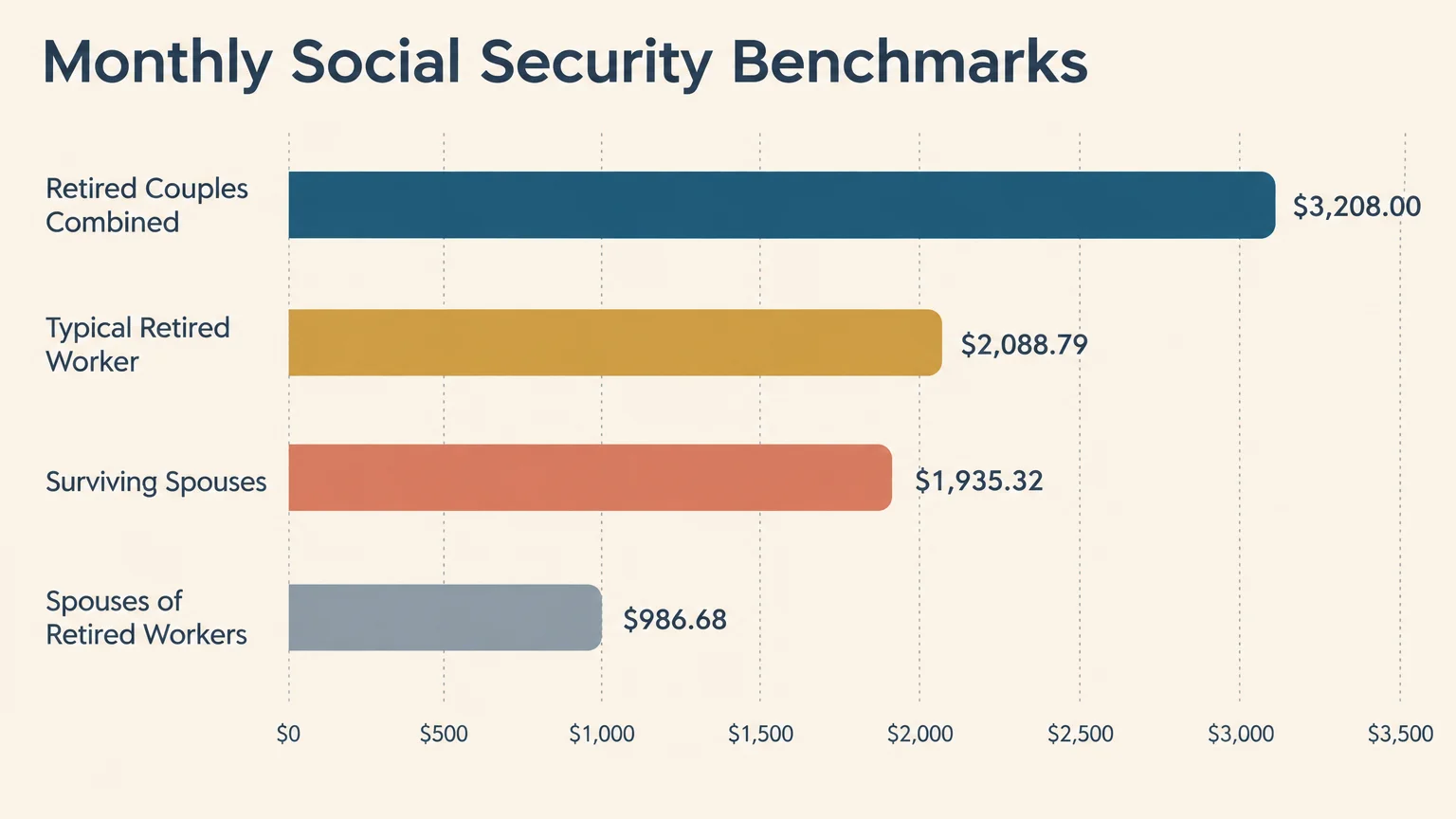
According to official data from the Social Security Administration (SSA), the average monthly benefit for retired workers reached $2,088.79 in late 2026. This translates to an annual Social Security income of $25,065.48.
That monthly average marks a steady rise from the baseline of $2,071 per month established at the beginning of 2026. Annual cost-of-living adjustments continue to boost these figures across the country.
In January 2026, beneficiaries received a 2.8% Cost-of-Living Adjustment (COLA) to help offset persistent consumer inflation. That modest increase provided welcome breathing room for millions of households managing tight monthly budgets.
More relief is scheduled to arrive soon. The SSA announced a 3.6% COLA for 2027, which takes effect in January 2027.
That 3.6% boost will add roughly $75 per month to the typical retired worker’s benefit check. This scheduled increase will push the nationwide average monthly payment past $2,160 entering the new calendar year.
If your current monthly payment exceeds these averages, you belong to the upper tier of benefit recipients. You have secured a larger guaranteed income floor than the majority of your peers.
However, benefit amounts vary significantly across different household types. Spousal and survivor benefits follow distinct calculation rules that produce different baseline averages.
- Retired Couples: Married couples who both receive benefits take home an average combined total of $3,208 per month.
- Surviving Spouses: Nondisabled widows and widowers receive an average monthly survivor benefit of $1,935.32.
- Spouses of Retired Workers: Individuals claiming benefits solely on a living spouse’s record collect an average of $986.68 monthly.
Evaluating your check against these exact numbers gives you an accurate snapshot of your standing. You can verify your exact monthly payment details directly through the official Social Security Administration web portal.

How Your Benefit Compares Across Different Claiming Ages
Your claiming age remains the single most influential factor determining whether your check lands above or below average. The system permanently adjusts your monthly payment based on when you choose to file.
Your Full Retirement Age (FRA) depends entirely on the year you were born. For individuals born in 1959, FRA is 66 years and 10 months; for anyone born in 1960 or later, FRA is 67.
Filing at the earliest possible age of 62 triggers a permanent benefit reduction of up to 30%. In contrast, delaying your claim past your FRA earns you delayed retirement credits.
These credits add an extra 8% per year to your payment for every year you delay up to age 70. Waiting until age 70 guarantees a benefit equal to 124% of your baseline Primary Insurance Amount (PIA).
The table below illustrates the dramatic difference claiming age makes for top earners reaching retirement in 2026.
| Claiming Age | Maximum Monthly Benefit (2026) | Percent of Baseline (PIA) | Core Financial Trade-off |
|---|---|---|---|
| Age 62 (Early Claiming) | $2,969 | 70% | Immediate cash flow paired with a permanent 30% reduction for life. |
| Age 67 (Full Retirement Age) | $4,152 | 100% | Full baseline entitlement with no early filing penalties applied. |
| Age 70 (Maximum Delay) | $5,181 | 124% | Maximum monthly guaranteed payout boosted by 8% annual delayed credits. |
Achieving the maximum payout requires more than just waiting until age 70. You must also have earned at or above the maximum taxable earnings cap for at least 35 years.
In 2026, the maximum taxable earnings limit sits at $184,500. Any wages you earn above that cap are exempt from the standard 6.2% Social Security payroll tax.
Most retirees fall somewhere between the nationwide average and the theoretical maximum. If your monthly check exceeds $2,500, your earnings history and filing choices place you comfortably ahead of the pack.
To explore how different claiming dates alter your projected checks, check the interactive Social Security Retirement Estimator. Modeling several scenarios helps you identify the claiming age that fits your household cash needs.

The Reality of Retirement Spending: The 41% Coverage Problem
Collecting an above-average Social Security check provides genuine financial satisfaction. Yet evaluating your benefit in a vacuum can create an unrealistic sense of financial security.
Data from the Bureau of Labor Statistics (BLS) Consumer Expenditure Survey reveals that senior households spend real money. Households headed by someone age 65 or older spend an average of $61,432 per year, or $5,119 each month.
When you stack typical living costs against guaranteed benefits, a substantial income gap emerges immediately. The average annual Social Security payment of $25,065 covers roughly 41% of average senior household expenses.
That dynamic leaves an average annual spending shortfall of $36,367 that retirees must cover from other sources. You must fund that gap through personal savings, investment portfolios, pensions, or part-time work.
This coverage gap should not come as a total surprise. Social Security was never engineered to serve as a complete, standalone retirement income solution.
The program was intentionally designed to replace roughly 40% of an average worker’s pre-retirement earnings. Higher earners often find that Social Security replaces an even smaller percentage of their working income.
“The goal of retirement is to live off your assets—not live off your regrets.”
If you receive $2,500 or $3,000 per month, your checks cover a substantially higher portion of your living costs. You rely far less on volatile market withdrawals to handle baseline housing and food expenses.
You can analyze how your projected benefits coordinate with your broader spending goals using the Consumer Financial Protection Bureau Retirement Planning Tool. Planning for that 59% spending gap protects your long-term independence.

Key Factors That Push Your Check Above the National Median
Retirees who collect above-average checks rarely reach that benchmark by pure accident. Higher benefits result from a formula that rewards prolonged earnings and thoughtful claiming timing.
The Social Security Administration calculates your Primary Insurance Amount using your 35 highest-earning working years. The agency adjusts those historical earnings for national wage inflation before running them through a tiered formula.
Understanding the levers behind this formula helps you see why your check looks the way it does. Four primary factors consistently push monthly benefits above the national average:
- Consistent High Earnings: Earning near or above the annual taxable wage cap boosts your lifetime average indexed earnings.
- A Full 35-Year Work Record: Working fewer than 35 years inserts zero-earning years into your calculation, which drastically drags down your average.
- Delaying Past Full Retirement Age: Capturing the 8% annual delayed retirement credit between age 67 and 70 increases your payout by 24%.
- Compound Cost-of-Living Adjustments: Higher base benefits capture larger absolute dollar gains whenever annual COLA increases take effect.
If you worked for 38 years, the SSA automatically eliminated your three lowest-earning years from the calculation. That indexing process ensures that youthful, low-wage jobs do not depress your final benefit amount.
Delaying your claim remains the single most dependable strategy for surpassing the median benchmark. Every year you postpone claiming past your FRA delivers a guaranteed, inflation-protected return that no commercial annuity can match.
Working While Claiming: Understanding the Earnings Limits
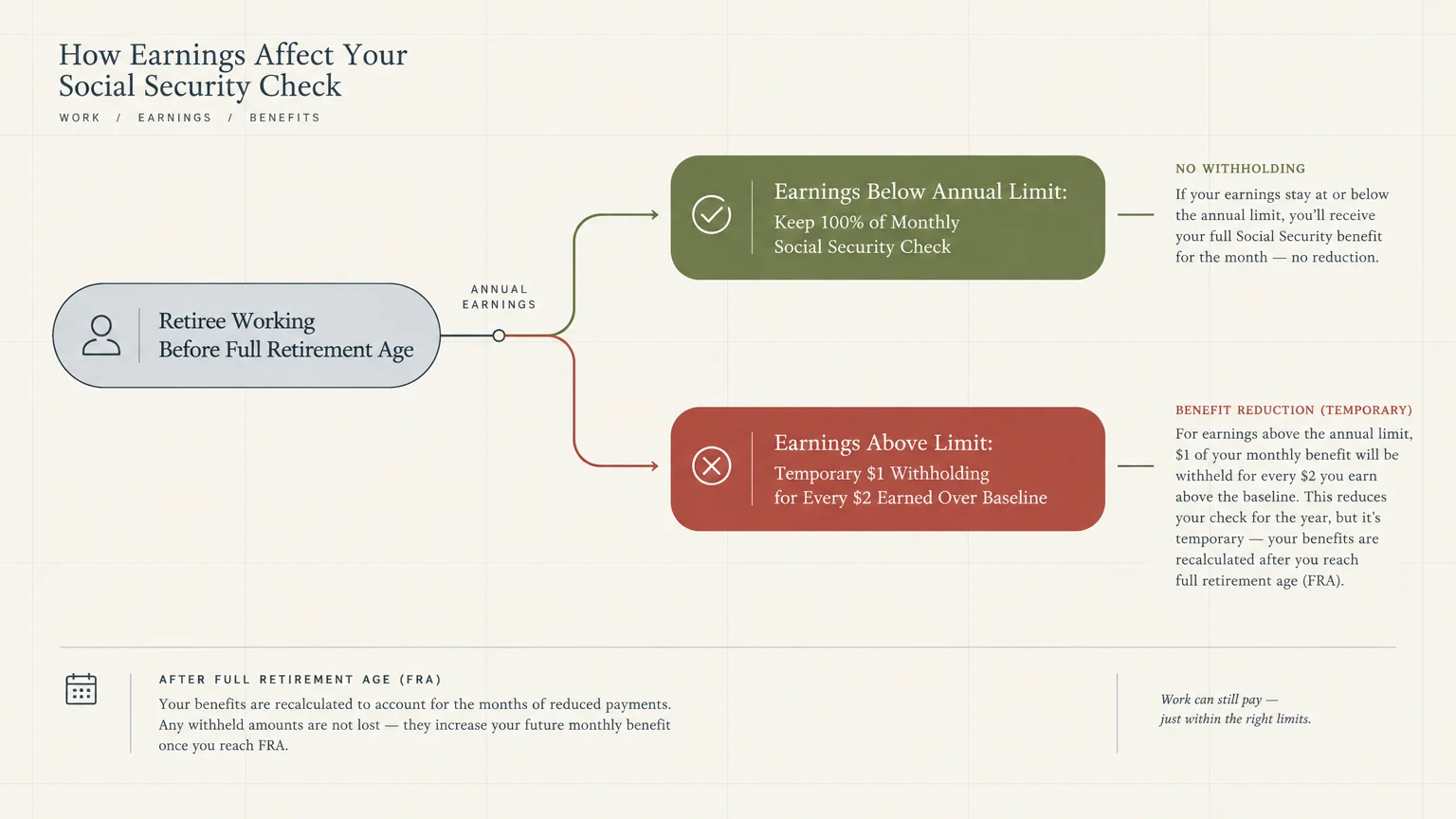
Many retirees choose to work part-time or consult while collecting their monthly benefits. If you claim benefits before reaching your Full Retirement Age, you must monitor the Retirement Earnings Test.
Earning too much money from employment before reaching FRA triggers a mandatory temporary withholding of your benefits. The SSA applies strict earnings thresholds that adjust annually for wage growth.
For all of 2026, the annual earnings limit for workers under FRA is $24,480, or $2,040 per month. If your earnings exceed this threshold, the SSA withholds $1 in benefits for every $2 earned above the limit.
A more generous earnings threshold applies during the specific calendar year you reach your Full Retirement Age. In that milestone year, the earnings cap rises to $65,160, or $5,430 per month.
During the months leading up to your FRA birthday, the SSA withholds $1 for every $3 earned above the limit. The moment you reach your FRA birthday month, the earnings limit disappears entirely.
You can then earn unlimited wage income without surrendering a single dollar of your monthly Social Security check. Furthermore, any benefits withheld earlier are not permanently lost.
When you reach Full Retirement Age, the SSA automatically recalculates your monthly benefit upward. They adjust your check to credit you for every month your payment was previously withheld.
Even so, cash flow disruptions can create genuine hardship if you fail to anticipate these withholding rules. Always inform the SSA in advance if your anticipated post-retirement work income will exceed the annual limit.

The Social Security Tax Trap: Why a Higher Check Can Cost You
Collecting an above-average Social Security benefit provides greater buying power, but it also creates a distinct tax vulnerability. Higher checks frequently trigger federal income taxes on your benefit payments.
The federal government taxes Social Security benefits using an outdated metric known as provisional income. You calculate provisional income by adding your Adjusted Gross Income, tax-exempt interest, and exactly 50% of your annual Social Security benefits.
Congress established the provisional income thresholds in 1983 and never indexed them for inflation. Because wages and benefits have doubled since then, more retirees cross these tax thresholds every single year.
The tax brackets for single tax filers kick in at remarkably low thresholds:
- Provisional income between $25,000 and $34,000: Up to 50% of your Social Security benefits become subject to ordinary federal income tax.
- Provisional income above $34,000: Up to 85% of your Social Security benefits become subject to ordinary federal income tax.
Married couples filing joint tax returns face similarly compressed income bands:
- Provisional income between $32,000 and $44,000: Up to 50% of combined Social Security benefits face federal taxation.
- Provisional income above $44,000: Up to 85% of combined Social Security benefits face federal taxation.
If you receive an above-average check of $2,500 monthly, half of your annual benefit totals $15,000. Just $17,001 of additional taxable income pushes a married couple over the initial 50% taxation threshold.
“It’s not how much money you make, but how much money you keep, how hard it works for you, and how many generations you keep it for.” — Robert Kiyosaki
Retirees who pull traditional 401(k) or IRA distributions often find themselves pushed into the 85% taxation zone. Careful tax planning helps you avoid surrendering a huge chunk of your above-average check to the IRS.
Strategically drawing income from Roth accounts or taxable brokerage accounts can keep your provisional income below these triggers. Managing your distribution sources preserves your net take-home pay throughout your retirement years.

Errors That Cost Retirees Thousands
Securing an above-average benefit requires years of consistent effort, yet simple administrative mistakes can erode your lifetime income. Avoiding common claiming errors protects the financial foundation you worked decades to build.
One frequent mistake involves claiming early at age 62 simply because the money becomes available. Accepting that 30% lifetime reduction locks you into a permanently lower base benefit.
That reduced base diminishes every future COLA dollar you will ever receive. Over a twenty-year retirement, that early claiming decision can cost an individual well over $100,000 in lost purchasing power.
Another damaging misstep is ignoring the long-term impact on spousal and survivor benefits. A primary earner who claims early permanently caps the survivor benefit available to a surviving spouse.
Upon your death, your surviving spouse inherits your exact monthly benefit amount if it exceeds their own. Delaying your claim to earn the maximum payout provides vital financial protection for your surviving partner.
Many working seniors also fail to check their earnings records for reporting inaccuracies. Employers occasionally report earnings under incorrect tax identification numbers, leaving zero-income gaps on your official lifetime record.
A single uncorrected zero-earning year can drag down your lifetime average and reduce your monthly check forever. Review your personal earnings history every few years on the SSA website to correct discrepancies promptly.
Finally, retirees frequently fail to coordinate traditional retirement account withdrawals with their claiming date. Taking heavy taxable distributions in the same year you start benefits can trigger higher Medicare Part B and D premiums.

When to Get Expert Help
Navigating the intersection of Social Security, tax laws, and retirement portfolio distributions can quickly become overwhelming. Knowing when to engage professional support prevents costly and irreversible claiming missteps.
You should consider consulting a fee-only fiduciary financial planner if you have substantial assets outside of Social Security. A qualified professional can design a coordinated drawdown plan that minimizes provisional income and avoids high tax brackets.
Professional guidance becomes especially valuable if you navigate complex family dynamics. Blended families, ex-spouses from marriages lasting over ten years, and dependent adult children all introduce specialized Social Security claiming rules.
Working with an elder law attorney or a dedicated Social Security claiming specialist helps you navigate specialized survivor strategies. They can calculate optimal claiming dates for both spouses to maximize your household’s total lifetime payout.
If you suspect errors in your historical earnings record, reach out directly to SSA staff before submitting your formal application. Correcting past wage records requires W-2 documentation and takes time to process through administrative channels.
Frequently Asked Questions About Social Security Benchmarks
What is the average Social Security benefit in 2026?
The average monthly Social Security benefit for a retired worker reached $2,088.79 in late 2026. This equates to an annual baseline income of approximately $25,065.48.
How much will the 2027 COLA increase average checks?
The SSA announced a 3.6% COLA for 2027, which takes effect in January 2027. That adjustment will add approximately $75 per month to the average retired worker’s benefit check.
What is the maximum possible Social Security benefit in 2026?
The maximum monthly benefit in 2026 is $5,181 for retirees who delay claiming until age 70. Those claiming at Full Retirement Age can receive up to $4,152 per month.
How much can you earn while collecting Social Security before FRA?
In 2026, workers under FRA can earn up to $24,480 annually without penalty. The SSA withholds $1 in benefits for every $2 earned above that annual limit.
Does having an above-average benefit mean my benefits will be taxed?
Yes, higher checks frequently push your provisional income over the $25,000 individual or $32,000 married filing jointly thresholds. Crossing these thresholds subjects up to 85% of your benefits to ordinary federal income tax.
Next Steps for Securing Your Retirement Income
Collecting more than the $2,088.79 national average gives you an undeniable head start on retirement security. Take the time today to review your latest Social Security statement and confirm your exact payment numbers.
Coordinate your guaranteed monthly benefits with your private savings, budget for taxes, and build an intentional spending plan. Taking control of these moving parts ensures your hard-earned benefits support the lifestyle you deserve.
This article is for informational purposes only and does not constitute financial, legal, or medical advice. Medicare rules, Social Security benefits, and tax laws change regularly—verify current details at Medicare.gov, SSA.gov, or with a licensed professional.
Last updated: October 2026. Medicare and Social Security rules change annually—always verify current details at official government sources.