Every month, silent recurring charges slip out of retirement accounts for streaming tiers, equipment rentals, and memberships nobody uses anymore. Over a year, these small drafts quietly drain hundreds of dollars from your fixed income.
U.S. adults who pay for subscriptions spend an average of $111 per month and waste $21 monthly on unused services, according to CNET and AARP reports from 2026. For retirees managing tight budgets, spotting those leaks pays off immediately.
Below are seven common monthly fees retirees overlook—along with exact steps to verify your benefits, cancel subscriptions, and keep more cash in your pocket.
What You Need to Know
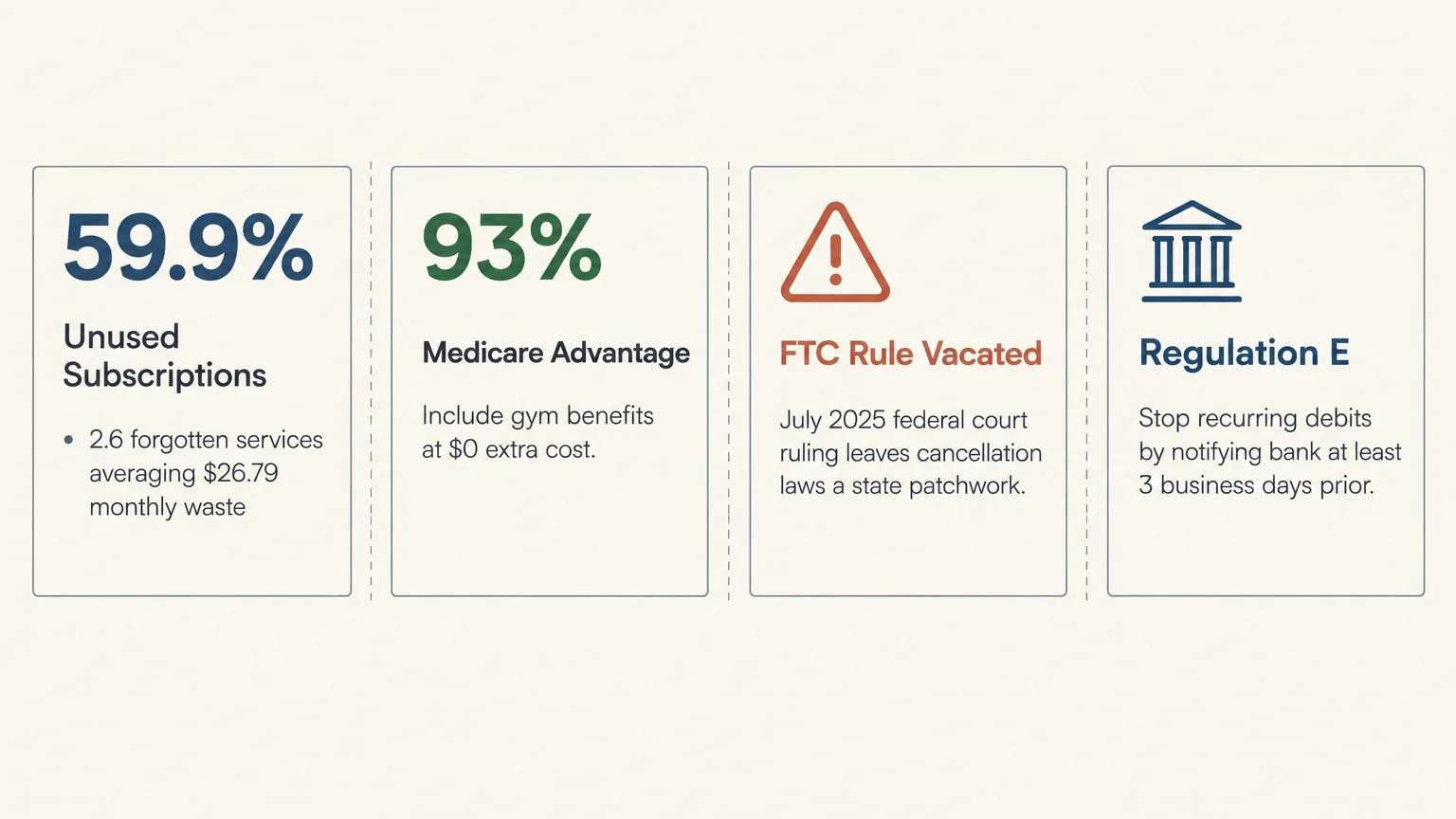
- Subscription creep is accelerating: A 2026 Self Financial survey found 59.9% of U.S. adults pay for at least one unused subscription monthly, averaging 2.6 forgotten services worth $26.79 per month.
- Medicare may already cover your gym: In 2026, 93% of Medicare Advantage plans include a fitness benefit at $0 extra cost, making many standalone gym contracts unnecessary.
- Federal cancellation rules remain a patchwork: Because a federal court vacated the FTC Click-to-Cancel rule in July 2025, companies can still make canceling difficult unless state law protects you.
- Your bank must honor stop-payment revocations: Under federal Regulation E, you can stop recurring bank debits by notifying your bank at least three business days before the draft.
1. Stacked Streaming Services and Ad-Free Tier Hikes
Streaming started as a cheap alternative to cable, yet prices climbed sharply through 2026. Signing up for a single show and forgetting to cancel afterward turns a bargain into a steady leak.
According to a September 2026 Fortune analysis, subscribing to eight major ad-free platforms—Netflix, Apple TV, Disney+, Hulu, Paramount+, Peacock, HBO Max, and Prime Video—now costs $139.41 per month, or $1,672.92 per year. Choosing ad-supported tiers across those same eight services drops the bill to $89.92 per month.
Individual price increases quietly inflate older accounts even if you never add a new app. Effective April 10, 2026, Amazon raised its fee to remove ads from Prime Video from $2.99 to $4.99 per month on top of a Prime membership.
Hulu implemented similar hikes in September 2026, pushing standalone ad-free Hulu to $21.49 per month compared with $12.49 for the ad-supported plan. The Hulu and Disney+ ad-free bundle climbed to $21.99 monthly at the same time.
Rotating one or two platforms at a time is the simplest way to save money for retirees who watch selectively. Watch what you want for a month, pause that service, and switch to another library the following month.
2. Monthly Modem, Router, and Gateway Rental Fees
Internet providers routinely add $5 to $20 per month to your bill just for renting their modem, router, or combined gateway. Industry data from BroadbandNow, EarthLink, and Allconnect in late 2026 shows most households pay $10 to $15 monthly—such as Spectrum’s $10 Wi-Fi fee.
Over five years in retirement, a $15 monthly rental costs $900 for hardware you never own. Many retirees pay these monthly fees for a decade simply because the line item blends into the internet bill.
Buying your own compatible modem averages $127 upfront and typically pays for itself within 12 months. After that first year, every billing cycle puts pure savings back into your checking account.
Follow these four steps before ordering new hardware:
- Check your current internet statement for wording like “equipment rental,” “gateway fee,” or “managed Wi-Fi.”
- Look up your provider’s official list of approved third-party modems and routers online or by phone.
- Purchase a supported unit and call your provider to activate the device’s serial number on your account.
- Return the rented equipment in person at a local store or via tracked shipping, and keep the return receipt indefinitely.
Keeping that receipt protects you if a billing error later claims you never returned the company’s hardware.
3. Legacy Copper Landlines and Bundled Telecom Bloat
More than 75% of U.S. adults now live in wireless-only households, according to CDC National Health Interview Survey data cited by Ooma in May 2026. Yet many retirees still pay high rates for an untouched traditional copper landline.
Legacy phone lines often carry $20 to $50 in base monthly charges before hidden add-ons appear. Ooma’s 2026 breakdown shows providers stack $5 to $15 in regulatory recovery fees, $5 to $20 in taxes and surcharges, and $5 to $15 in equipment rentals.
Combined telecom packages create an even larger drain when cable TV stays bundled out of habit. Reviews.org reported in November 2026 that the average U.S. household spends $283.39 per month across home internet, wireless service, traditional TV, and streaming—with traditional TV alone averaging $101.79.
AARP noted in August 2026 that a phone line, internet, and cable TV frequently cost a retired couple $300 per month before digital subscriptions even begin. Dropping unused channels or switching to an antenna and wireless phone service trims over $1,000 a year.
Before disconnecting a copper landline, verify whether your home security system or medical alert pendant relies on that phone jack. Many modern alert devices and alarms now run over cellular networks without needing a landline at all.
4. Gym Memberships Already Covered by Medicare
Paying monthly for a local fitness center is one of the easiest recurring charges to eliminate if you have Medicare coverage. While Original Medicare Parts A and B do not cover gym dues, private Medicare plans frequently include them.
According to KFF data cited in 2026, 93% of Medicare Advantage plans include a fitness benefit. Select Medigap supplement policies also partner with national gym networks at $0 extra cost beyond your regular plan premium.
Programs like SilverSneakers connect eligible members with more than 17,000 participating gyms and community centers nationwide. UnitedHealthcare’s Renew Active reaches over 25,000 locations, while other carriers often use Silver&Fit.
Watch closely for annual benefit changes before canceling a paid membership or joining a new club. Some insurers switched fitness vendors or trimmed gym networks for 2026, so check your current Summary of Benefits or compare options on Medicare.gov.
Once you confirm eligibility, request your program ID number online or through your insurer’s customer service desk. Present that ID at your gym’s front desk to freeze or replace your private monthly contract.
5. Auto-Renewing Annual Memberships and Duplicate Perks
Annual memberships feel harmless because you only see the charge once a year, which makes them remarkably easy to forget. When renewal dates arrive automatically, you may pay hundreds of dollars for perks you barely touch or already get elsewhere.
Amazon Prime now costs $139 per year, or $14.99 per month ($179.88 annually) if billed monthly. If you receive Medicaid, EBT, or other qualifying government assistance, Prime Access cuts that cost to $6.99 per month.
You can screen for assistance programs that unlock lower-cost memberships and utility discounts using BenefitsCheckUp from the National Council on Aging. Amazon’s policy also states that members who have not used Prime benefits during the current billing period qualify for up to a full refund when canceling.
Warehouse clubs and roadside plans require calendar reminders to avoid unwanted renewals. Costco charges $65 per year for Gold Star memberships and $130 for Executive memberships, and requires auto-renewal cancellations at least 72 hours before your renewal month begins.
AAA memberships run $64.99 for Classic, $99.99 for Plus, and $124.99 for Premier annually. Many retirees forget that AAA already includes identity theft monitoring and travel discounts—and pay separately for identical features through their auto insurer or credit card.
If you felt trapped in an Amazon Prime sign-up between June 23, 2019, and June 23, 2025, check your eligibility under the FTC’s $2.5 billion settlement announced in September 2025. Following a September 17, 2026 court order, eligible customers who used 20 or fewer Prime benefits a year can receive automatic refunds up to $200 through April 2027.
Never pay anyone who calls promising to speed up a settlement check. The FTC warns that neither the agency nor Amazon will phone you or charge a fee to deliver a refund.

6. Checking Account Maintenance and Paper Statement Fees
Retirees often keep legacy bank accounts opened decades ago, even when bank mergers quietly introduce new monthly fees. Keeping cash in the wrong account tier erodes your purchasing power without delivering extra value.
Bankrate’s checking fee data shows non-interest checking accounts with fees charge an average of $5.47 per month, or roughly $65 per year. Interest-bearing checking accounts charge far more—averaging $15.65 monthly ($187.80 yearly)—when balances dip below strict minimums.
Yet 47% of non-interest checking accounts charge nothing at all, and 95% allow easy fee waivers. Routing your Social Security check or monthly pension via direct deposit generally waives maintenance fees at major banks.
Small incidental charges add up just as quickly for retirees who prefer cash and paper records:
- Paper statement fees: Many banks charge $1 to $5 every month to mail printed statements, which disappears immediately when you switch to electronic statements.
- Out-of-network ATM fees: Combined out-of-network ATM surcharges hit a record average of $4.86 per withdrawal in Bankrate’s latest study.
- Overdraft charges: Overdraft fees remain on 94% of checking accounts at an average of $26.77 per incident after Congress repealed a CFPB rule’s $5 cap in May 2025.
- Stop-payment fees: Asking a bank to block a single check or draft typically triggers a $20 to $35 administrative charge.
Ask your branch manager to confirm your account qualifies for senior waivers or zero-fee checking. Moving excess cash into a fee-free account takes one visit and permanently ends needless bank drafts.
7. Forgotten Free-Trial Conversions and Silent App Subscriptions
Free trials are designed to convert silently into paid plans once your introductory week or month expires. Because 86% of consumers keep subscriptions on autopay according to C+R Research, one forgotten click can bill a card for years.
Older adults face real exposure to these silent enrollments. A CreditCards.com survey cited by AARP found 35% of Americans accidentally enrolled in an automatic-payment plan—including 57% of adults ages 53 to 62 after starting a free trial and 17% of adults over age 72.
Mastercard and FT Strategies reported in April 2026 that 44% of consumers spent more on subscriptions the prior year, averaging $1,887 annually. Cloud storage upgrades, puzzle games, digital newspapers, and antivirus renewals often bill through Apple or Google app stores rather than your main statement.
Open the Subscriptions menu inside your iPhone, iPad, or Android settings to see every app billing your wallet automatically. Canceling unused apps there stops the next renewal cycle immediately without requiring awkward phone calls.
Protecting your retirement cash flow rarely requires dramatic lifestyle cuts—it starts with closing the quiet leaks you never agreed to fund indefinitely.
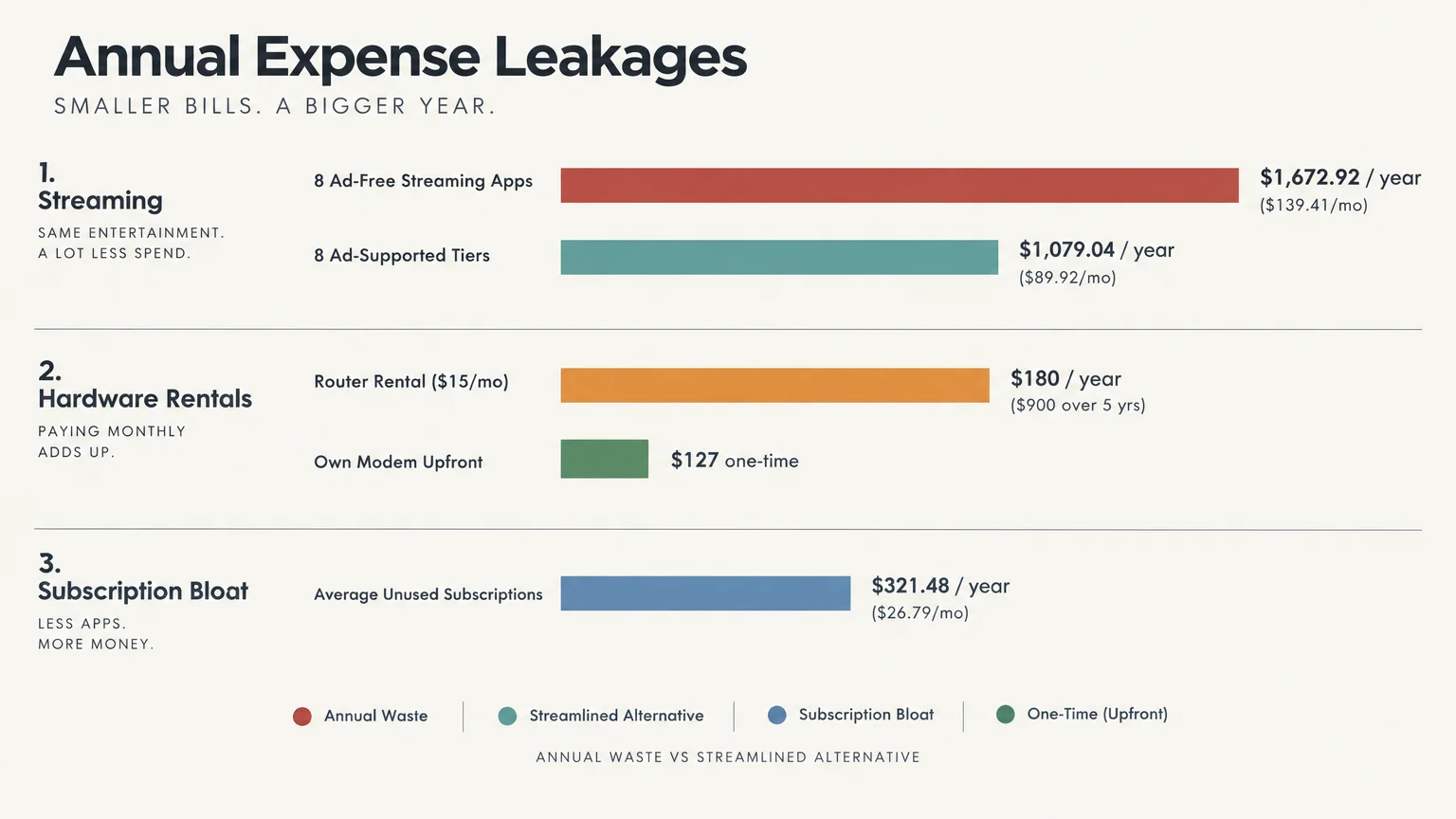
At a Glance: What These 7 Recurring Charges Cost Each Year
Seeing the annual price tag of small monthly fees makes it much easier to decide what stays and what goes. This table compares common 2026 costs with practical retiree alternatives.
| Recurring Charge | Typical 2026 Annual Cost | Smart Retiree Alternative |
|---|---|---|
| Eight major ad-free streaming apps | $1,672.92 ($139.41/mo) | Rotate 1–2 apps or use ad tiers ($89.92/mo for all 8) |
| Modem or Wi-Fi gateway rental | $60 to $240 ($5–$20/mo) | Buy compatible modem (~$127 once; pays back in 12 months) |
| Legacy copper landline + fees | $420 to $1,200+ ($35–$100/mo) | Switch to wireless-only or low-cost VoIP plan |
| Private gym membership | Varies by gym | Use Medicare Advantage or Medigap fitness perk ($0 extra) |
| Duplicate Prime, Costco, or AAA perks | $65 to $180 per plan | Audit perks, use Prime Access ($6.99/mo), or drop overlaps |
| Interest checking + paper statements | $200 to $248 ($16.65–$20.65/mo) | Use free checking or waive fees via Social Security deposit |
| Unused app & free-trial subscriptions | $252 to $321 ($21–$26.79/mo avg. waste) | Audit Apple/Google settings and cancel dormant apps |
How to Audit and Cancel Subscriptions in One Afternoon
Gathering every active draft in one sitting removes the guesswork from budgeting. Set aside 60 minutes with a notepad, your statements, and your smartphone to run a thorough cleanup following AARP guidance.
- Pull three months of statements: Review checking, debit, and credit card records for unfamiliar merchant names and recurring monthly fees, since annual charges may require checking a full 12-month history.
- Search your email inbox: Type words like “renewals,” “memberships,” “subscription,” and “free trials” into your email search bar to catch annual plans before they draft again.
- Check smartphone and tablet billing: Inspect your Apple Account or Google Play subscription lists, where app trials often hide under generic billing labels.
- Look for banking-app trackers: Because 77% of consumers want subscription controls inside their banking app according to Mastercard’s 2026 research, many major banks now list recurring merchants in one tab.
- Cancel directly and save proof: Cancel subscriptions through the merchant’s website or customer service desk, and save confirmation numbers or screenshots in a dedicated folder.
Knowing your federal consumer rights helps if a company refuses to cooperate or makes canceling nearly impossible. Although the FTC finalized a Click-to-Cancel rule in October 2024, the U.S. Court of Appeals for the Eighth Circuit vacated that rule on July 8, 2025.
On March 11, 2026, the FTC issued a new notice to restart rulemaking, meaning no federal Click-to-Cancel mandate is active as of November 2026. However, roughly 30 states—including California under its updated July 2025 law—enforce strict online cancellation rules, and the FTC still prosecutes deceptive billing under existing law.
When a merchant keeps drafting your checking account after you cancel, federal Regulation E (12 CFR § 1005.10(c)) gives you direct power at your bank. According to the Consumer Financial Protection Bureau, you can stop preauthorized recurring bank debits by notifying your bank orally or in writing at least three business days before the scheduled transfer.
Your bank may ask for written confirmation within 14 days, after which it must block all future debits from that payee. Always report unauthorized transfers within 60 days of receiving your bank statement to preserve full federal liability protections, while remembering that blocking a payment does not cancel the underlying service contract.
Common Retirement Traps
Even financially careful retirees underestimate how quickly small automatic bills multiply. C+R Research found consumers estimated spending $86 per month on subscriptions when their actual average reached $219—a $133 monthly blind spot.
Avoid these frequent mistakes as you review your household cash flow:
- Paying monthly for annual habits: Paying $14.99 per month for Amazon Prime totals $179.88 a year instead of the $139 annual rate—an avoidable $40.88 markup.
- Waiting until renewal day to cancel: Clubs like Costco require cancellation notices at least 72 hours before your renewal month starts to prevent the next automated charge.
- Ignoring small “mystery” charges: Scammers and aggressive marketers sometimes test accounts with $4.99 or $9.99 recurring charges, betting you will overlook anything under $10.
- Forgetting shared family logins: Retirees frequently pay for a streaming app, cloud plan, or antivirus license that an adult child already shares on a family plan.
A quick five-minute check of your bank alerts each week stops minor billing errors from turning into multi-year losses.

When to Consult a Professional
Most forgotten subscriptions take just a few phone calls or clicks to resolve on your own. Still, certain recurring expenses overlap with complex benefits or estate protections where professional advice saves far more than it costs.
Contact your state’s free State Health Insurance Assistance Program (SHIP) counselor before dropping a paid gym contract or changing Medicare coverage just for fitness perks. A SHIP counselor can verify whether a Medicare Advantage or Medigap change affects your doctors, prescription drugs, or out-of-pocket medical caps.
Consider sitting down with a fee-only fiduciary financial advisor if recurring household bills still strain your retirement withdrawals after cutting obvious subscriptions. An advisor can coordinate Social Security timing, tax-efficient withdrawals, and cash-flow guardrails without selling commissioned products.
If an aging parent is repeatedly signing up for confusing free trials or unauthorized debits keep appearing, consult an elder law attorney or trusted family co-signer. Setting up read-only account monitoring, low-limit credit cards for online trials, or formal powers of attorney protects vulnerable retirees from predatory auto-renewals.
Frequently Asked Questions
How much money do retirees usually waste on forgotten subscriptions?
In 2026, U.S. adults who pay for subscriptions waste an average of $21 per month ($252 a year) on unused services, while Self Financial found those with at least one dormant plan waste $26.79 monthly. Cutting bundled cable, rented modems, and duplicate memberships often saves over $1,000 annually.
Can I block a recurring charge through my bank if a company will not let me cancel?
Yes, under federal Regulation E, you can revoke authorization for preauthorized bank debits by contacting your bank at least three business days before the next scheduled draft. Follow up in writing within 14 days if your bank asks, and still send the merchant a written cancellation notice.
Does Original Medicare pay for my monthly gym membership?
No, Original Medicare Parts A and B do not cover gym dues or fitness programs. However, 93% of Medicare Advantage plans in 2026 and several Medigap plans include programs like SilverSneakers, Renew Active, or Silver&Fit at $0 extra cost.
What is the easiest way to find hidden subscriptions on my phone?
Open the Settings app on an iPhone or iPad, tap your name at the top, and select Subscriptions to view active and expired app plans. On Android devices, open the Google Play Store, tap your profile icon, and choose Payments & subscriptions.
Take One Step Today
Pick just one checking or credit card statement from the past 30 days and highlight every recurring charge you did not actively use last week. Canceling even two forgotten services tonight gives your retirement budget an immediate, permanent raise.
Retirement rules and benefit amounts vary based on individual work history, income, and circumstances. This article provides general guidance only. Consult a SHIP counselor, financial advisor, or elder law attorney for advice specific to your situation.
Last updated: November 2026. Medicare and Social Security rules change annually—always verify current details at official government sources.