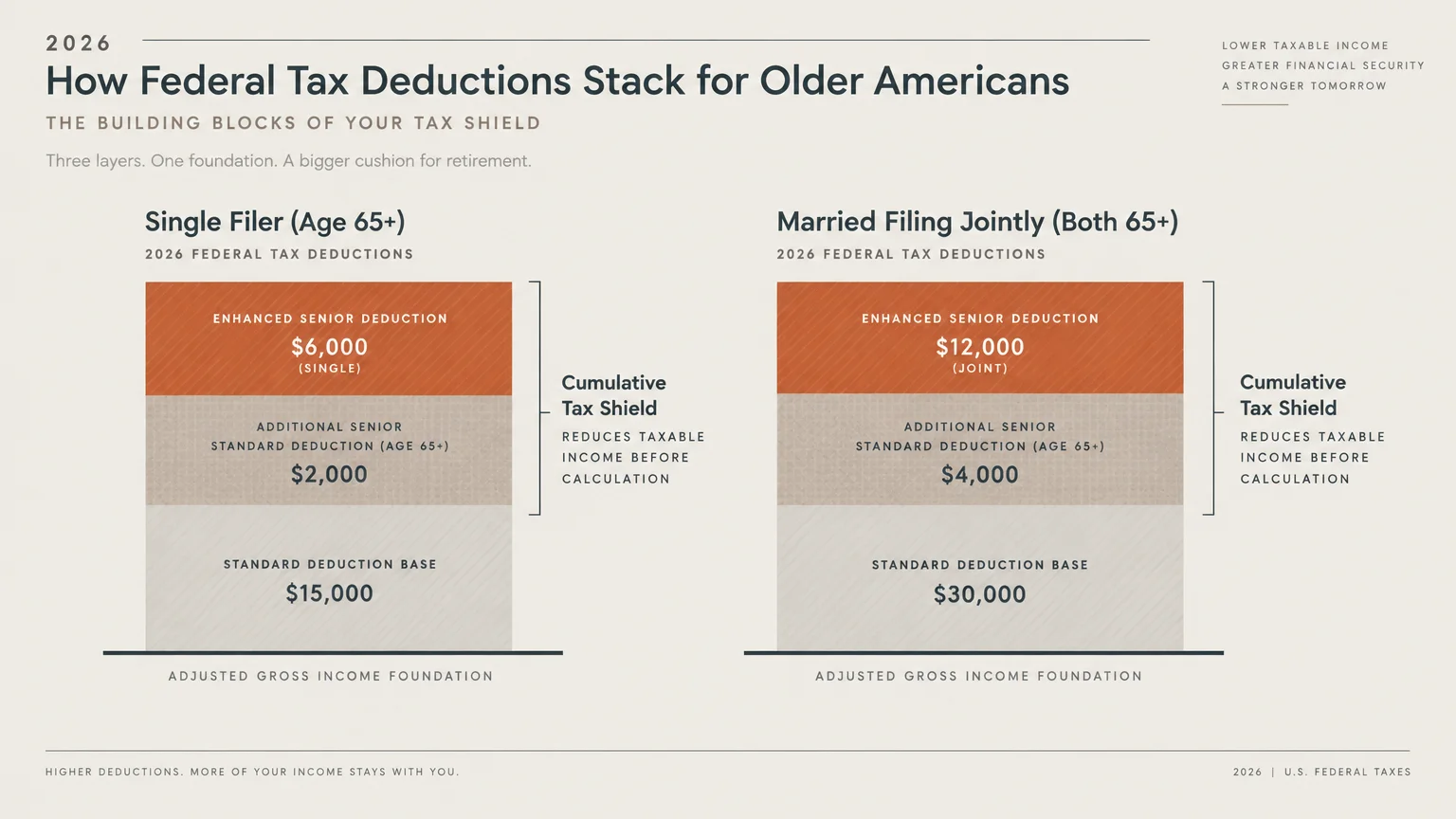
How the 2026 Tax Deductions Stack Up
The new Senior Bonus does not replace existing tax breaks. Instead, it stacks on top of your standard deduction and the existing age-65 additional deduction.
For the 2026 tax year, the baseline standard deduction is $16,100 for single filers. Married couples filing jointly receive a baseline standard deduction of $32,200.
Seniors aged 65 and older also continue to receive the preexisting additional standard deduction. In 2026, that amount is $2,050 for single filers and $1,650 per qualifying spouse on joint returns.
When you combine all three tax breaks, your total tax shield expands significantly. The table below outlines how these deductions combine for the 2026 tax year.
| Filing Status | Baseline Standard Deduction | Age 65+ Additional Deduction | Enhanced Senior Deduction | Total 2026 Deduction Shield |
|---|---|---|---|---|
| Single (Age 65+) | $16,100 | $2,050 | $6,000 | $24,150 |
| Married Joint (One Spouse 65+) | $32,200 | $1,650 | $6,000 | $39,850 |
| Married Joint (Both Spouses 65+) | $32,200 | $3,300 ($1,650 each) | $12,000 | $47,500 |
A married couple with both partners aged 65 or older can shield $47,500 from federal taxation. This means many older couples pay zero federal tax on combined retirement distributions.
According to data from the White House Council of Economic Advisers, roughly 88% to 90% of seniors pay $0 in federal taxes on benefits under this stacked structure.
Over 30 million seniors claimed this enhanced deduction during the recent filing season. For the vast majority of older households, this effectively mimics a no tax on Social Security environment.
The Unchanged Combined Income Formula
Despite widespread claims of tax elimination, the statutory formulas governing benefit taxation remain fully operational. The IRS still calculates benefit taxation using your combined income.
Your combined income is your Adjusted Gross Income, plus any nontaxable interest, plus 50 percent of your annual Social Security benefits. This total determines how much of your benefit is taxable.
Congress created these threshold brackets in 1983 and 1993, but never tied them to inflation. As cost-of-living adjustments increase your checks, more of your benefits cross into taxable territory.
For single filers, a combined income between $25,000 and $34,000 subjects up to 50 percent of benefits to income tax. Combined income exceeding $34,000 taxes up to 85 percent of your benefits.
For married joint filers, combined income between $32,000 and $44,000 exposes up to 50 percent of benefits to tax. If your combined income surpasses $44,000, up to 85 percent is taxable.
Consider a married couple receiving $36,000 in Social Security and $35,000 from a retirement pension. Their combined income equals $53,000, which pushes them well into the 85 percent tier.
While the stacked $47,500 deduction may wipe out their ultimate tax bill, the IRS still classifies their benefits as taxable income. You can learn about taxable retirement accounts through IRS Retirement Plans.