Understanding the Enhanced Senior Deduction for 2026
The primary vehicle for senior tax relief is the Enhanced Senior Deduction. Tax preparers often refer to this provision as the Senior Bonus.
You claim this deduction on IRS Schedule 1-A when you file your federal income tax return. It operates as a below-the-line deduction, reducing your taxable income before calculating final tax liability.
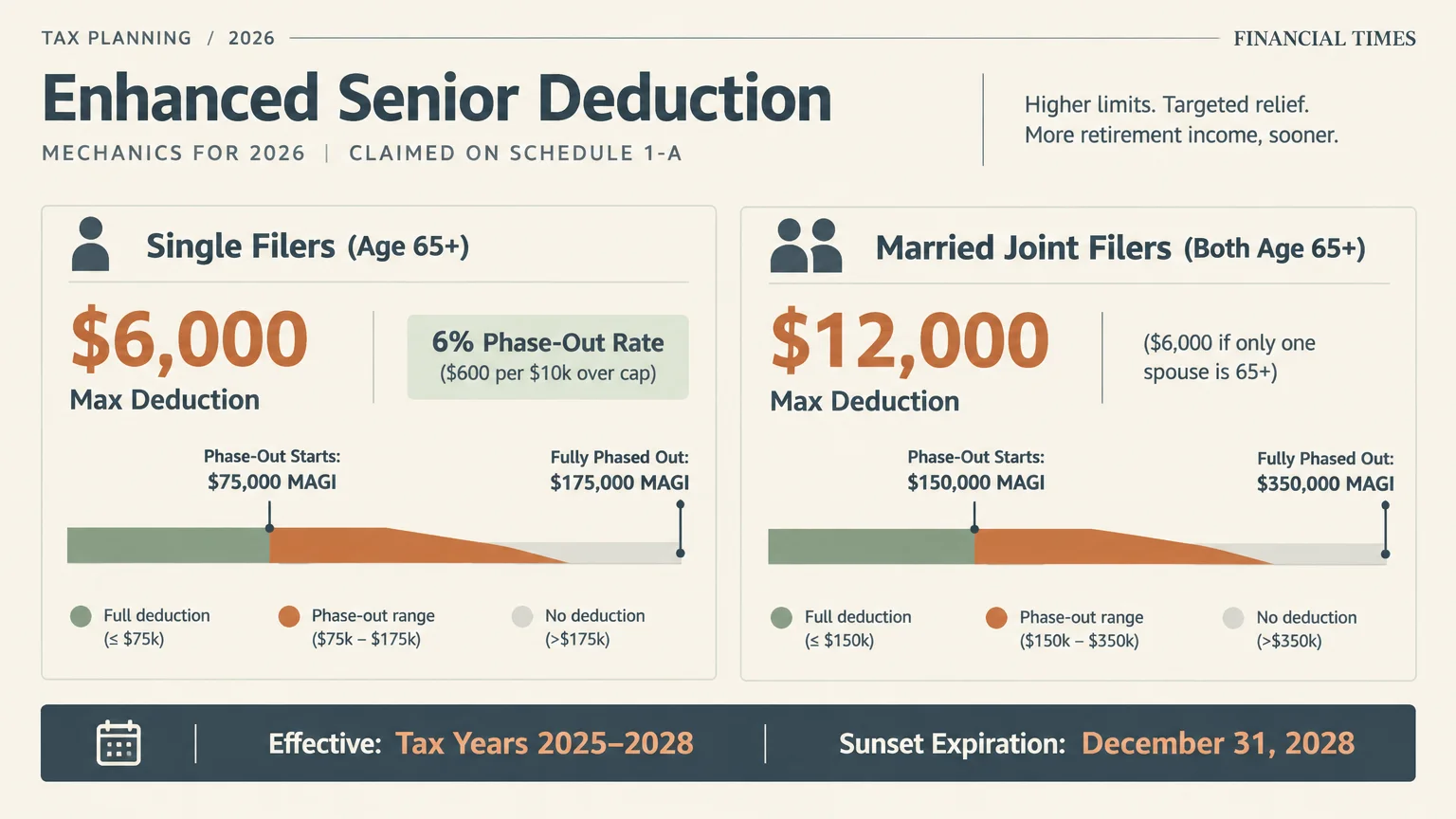
For individual filers aged 65 and older, the deduction provides up to $6,000 of relief. Married couples filing jointly can claim up to $12,000 if both spouses have reached age 65.
If only one spouse has reached age 65, the married couple receives a single $6,000 deduction. The younger spouse does not qualify until the tax year they reach their 65th birthday.
Crucially, this deduction is temporary. Current law establishes the benefit only for tax years 2025 through 2028, meaning it expires automatically at the close of 2028.
Congress also added income phase-outs to target the deduction toward middle-income seniors. Single taxpayers receive the full $6,000 deduction if their Modified Adjusted Gross Income remains at or below $75,000.
For married couples filing jointly, the full $12,000 deduction applies up to $150,000 of MAGI. Above those thresholds, the deduction phases out at a rate of 6 percent.
For example, a single filer with an income of $85,000 exceeds the cap by $10,000. A 6 percent phase-out reduces their $6,000 deduction by $600, leaving a $5,400 deduction.
The deduction completely phases out at $175,000 for single filers and $350,000 for married joint filers. High-income retirees earning above these limits receive zero relief from this specific provision.
One major benefit of this structure is filing flexibility. You can claim the Senior Bonus whether you choose the standard deduction or itemize your deductions.