Only eight states still tax Social Security benefits heading into 2027, down from twelve just a few years ago. Even inside those eight states, most retirees pay zero state tax on their checks thanks to generous age and income exemptions.
Still, a small group of retirees gets caught off guard each spring by state tax cliffs and phaseouts. Knowing exactly where your state stands—and how your 2027 cost-of-living increase affects your adjusted gross income—helps you keep more of every monthly deposit.
This guide lists all eight states taxing benefits in 2027, compares their exact thresholds, and outlines practical steps to protect your income.

The 8 States That Still Tax Social Security in 2027
For tax year 2026 returns filed in 2027 and under enacted 2027 laws, just eight states tax Social Security benefits. Those states are Colorado, Connecticut, Minnesota, Montana, New Mexico, Rhode Island, Utah, and Vermont.
Seven of those eight states shield lower- and middle-income retirees through exemptions, deductions, or tax credits. Montana is the lone state on the list with no Social Security–specific exemption at all.
The shrinking roster reflects a steady nationwide shift toward tax friendly states retirees actively seek out. West Virginia completed its three-year phaseout under House Bill 4880, granting a 100% exemption starting with tax year 2026 regardless of age or income.
Before West Virginia dropped off the list, Kansas, Missouri, and Nebraska all ended state taxation of benefits in 2024. Across the remaining 42 states and Washington, D.C., your monthly retirement checks stay completely free from state income tax.
Even if you live in one of the eight taxing states, your filing status, age, and adjusted gross income (AGI) determine whether you owe a dime. Understanding your state’s exact formula prevents surprise tax bills in April.
Side-by-Side Comparison of the 8 Taxing States
State rules for Social Security benefits taxation vary dramatically from one border to the next. Some states use gentle phaseouts, while others enforce hard cliffs where one extra dollar of income triggers tax on your entire federally taxable benefit.
| State | Full Exemption Income Limits (AGI) | Key Rule or 2027 Change |
|---|---|---|
| Colorado | 100% exempt at age 65+; ages 55–64: $75,000 single / $95,000 joint | Flat 4.4% tax rate; $20,000 cap above limit for ages 55–64 |
| Connecticut | Under $75,000 single or MFS / under $100,000 joint or HoH | Above limit, no more than 25% of total benefits are taxed |
| Minnesota | Below $86,410 single or HoH / $110,780 joint (TY 2026) | Phases out by 10% per $4,000 excess ($2,000 MFS) |
| Montana | No Social Security–specific exemption | Top rate drops from 5.65% (2026) to 5.4% in 2027 |
| New Mexico | Up to $100,000 single / $150,000 joint / $75,000 MFS | Hard tax cliff with no partial phaseout above limit |
| Rhode Island | Below $107,000 single / $133,750 joint | 2027 law drops full retirement age rule for early retirees |
| Utah | Full credit up to $54,000 single / $90,000 joint / $45,000 MFS | Flat 4.45% rate in 2026; uses nonrefundable tax credit |
| Vermont | $65,000 or less single or MFS / $80,000 or less joint (TY 2026) | Partial exemption phases out up to $79,999 single / $94,999 joint |
Notice how filing married filing separately (MFS) often slashes your exemption threshold in half or strips away credit eligibility. Always review your state’s filing rules before splitting returns to chase other deductions.
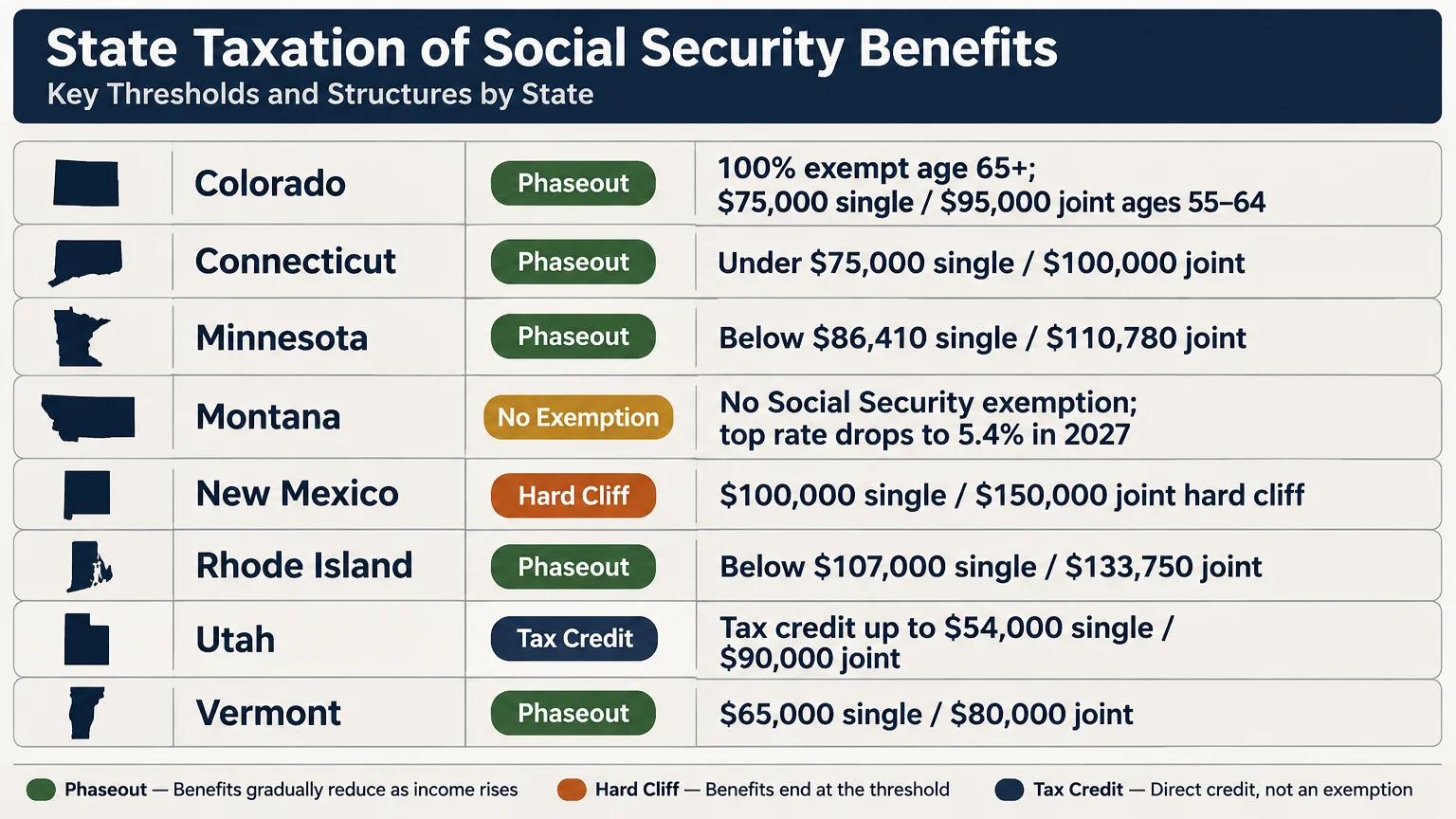
State-by-State Rules for Every Taxing State
Each of the eight states that tax Social Security applies its own definition of income, phaseout math, and age rules. Below is how each state calculates social security state taxes 2027 filers need to plan around.
Colorado
Colorado levies a flat 4.4% state income tax rate, making its baseline tax math relatively predictable. If you are age 65 or older, you can deduct 100% of your federally taxable Social Security benefits regardless of how high your income climbs.
Retirees ages 55 to 64 face an income test for tax year 2026 returns filed in 2027. You qualify for a 100% deduction if your AGI is $75,000 or less as a single filer or $95,000 or less filing jointly.
If you are between 55 and 64 and exceed those thresholds, your deduction is capped at $20,000 or your federally taxable retirement income, whichever is less. Once you turn 65, that cap disappears completely.
Connecticut
Connecticut exempts 100% of your Social Security benefits if your federal AGI falls under $75,000 as a single or married-filing-separately taxpayer. Married couples filing jointly and heads of household receive a full exemption when federal AGI stays under $100,000.
Even if your income crosses those thresholds, Connecticut caps the pain. Above those limits, no more than 25% of your total Social Security benefits can be subjected to state income tax.
Because federal rules can tax up to 85% of your benefits, Connecticut’s 25% ceiling leaves high-income retirees paying state tax on a much smaller slice than their federal return shows.
Minnesota
Minnesota adjusts its exemption thresholds each year for inflation, helping retirees keep pace with cost-of-living adjustments. For tax year 2026, you can subtract 100% of federally taxable benefits if your AGI sits below $86,410 for single or head-of-household filers.
Married couples filing jointly get a full subtraction below $110,780 in AGI for tax year 2026, up from $108,320 in tax year 2025. Above those limits, Minnesota applies a gradual phaseout rather than an immediate cliff.
Your state subtraction shrinks by 10% for every $4,000 of AGI above the threshold, or 10% per $2,000 for married couples filing separately. Knowing where you sit in that phaseout window helps you time retirement account withdrawals carefully.
Montana
Montana stands alone among all 50 states because it provides no Social Security–specific exemption. The state starts with your federal taxable income and taxes the full federally taxable portion of your benefits.
There are two small cushions for Montana seniors. First, Montana offers a separate general senior subtraction—$5,660 in tax year 2024 for residents age 65 and older—that trims overall taxable income.
Second, Montana is steadily cutting its top individual income tax bracket rate. That top rate drops from 5.9% to 5.65% for tax year 2026, then falls again to 5.4% for tax year 2027.
New Mexico
New Mexico taxes individual income at progressive rates ranging from 1.7% to 5.9% for 2026. Most middle-income retirees owe nothing on their benefits thanks to generous exemption caps.
Your Social Security benefits remain fully exempt if your AGI stays at or below $100,000 as a single filer, $150,000 filing jointly, or $75,000 filing separately. Those ceilings shield a large share of retirees across the state.
Watch out for the cliff, however. New Mexico offers no partial phaseout, meaning going even $1 over your AGI limit exposes 100% of your federally taxable benefits to state income tax.
Rhode Island
Rhode Island taxes income at rates between 3.75% and 5.99% in 2026, and its Social Security rules are undergoing a major welcome update for 2027. Under 2026 rules, you must meet two tests to exempt your benefits.
First, you must have reached Social Security full retirement age. Second, your federal AGI must stay below $107,000 for single and most filers, or below $133,750 for married couples filing jointly.
Like New Mexico, exceeding Rhode Island’s income threshold creates a sharp cliff with no partial phaseout. However, legislation enacted by the Rhode Island General Assembly in June 2026 takes effect in 2027.
That 2027 update eliminates the full-retirement-age requirement, allowing income-eligible early retirees to claim the full Social Security exemption—a change expected to benefit roughly 9,200 residents.
Utah
Utah applies a flat 4.45% income tax rate in 2026, slightly down from 4.5% in 2025. Rather than subtracting benefits from your income, Utah includes federally taxable benefits and offsets them with a nonrefundable Social Security benefits tax credit.
Following 2025 legislation, you qualify for the full credit up to modified adjusted gross income thresholds of $54,000 for single filers, $90,000 for joint or head-of-household filers, and $45,000 for married couples filing separately.
Above those income levels, the credit phases out gradually rather than vanishing overnight. Keep in mind that claiming this Social Security credit bars you from claiming Utah’s $450 retirement tax credit available to taxpayers born on or before December 31, 1952.
Vermont
Vermont expanded its Social Security income exemptions through 2025 legislation, delivering tax relief to nearly 30,000 taxpayers. For tax year 2026, single and married-filing-separately taxpayers receive a 100% exemption with AGI of $65,000 or less.
Married couples filing jointly get a full 100% exemption at AGI of $80,000 or less. Vermont also softens the transition above those thresholds with a partial exemption zone.
The partial exemption phases out completely at $79,999 for single filers and $94,999 for joint filers. Once your AGI crosses those upper limits, your full federally taxable benefit becomes subject to Vermont tax.
Why Federal Rules Still Affect Your State Tax Bill
Even when focusing on state taxes, you cannot ignore how the IRS calculates your taxable benefits. Most of the eight taxing states start their calculations directly from your federal AGI or your federally taxable Social Security amount.
Federal taxation depends on your combined income, which equals your AGI plus nontaxable interest plus half of your Social Security benefits. Those federal thresholds have stayed frozen since 1984 and 1994 without inflation adjustments.
- Single filers: Up to 50% of benefits are taxable federally between $25,000 and $34,000 of combined income, and up to 85% becomes taxable above $34,000.
- Married filing jointly: Up to 50% of benefits are taxable between $32,000 and $44,000 of combined income, and up to 85% is taxable above $44,000.
- Supplemental Security Income (SSI): SSI payments are never taxed at the federal level.
A major federal change signed on July 4, 2025, adds a wrinkle you must understand for 2027 planning. Under the Working Families Tax Cuts provisions, taxpayers age 65 and older can claim a temporary bonus deduction of up to $6,000 per person for tax years 2025 through 2028.
Married couples where both spouses are 65 or older can claim up to $12,000 on Schedule 1-A, though married-filing-separately filers are ineligible. The bonus deduction phases out at 6% per dollar of modified AGI between $75,000 and $175,000 for single filers, and $150,000 to $250,000 for joint filers.
For 2027, the separate regular additional standard deduction for seniors age 65 and older also rises to $2,100 for single filers and $1,700 per qualifying spouse on joint returns. The senior bonus deduction lifts the share of seniors paying zero federal tax on benefits to nearly 90%, according to the Social Security Administration.
Lowering your federal tax bill with the senior bonus deduction does not automatically lower your state tax bill—because state formulas look at your AGI before standard or bonus deductions apply.
That distinction catches many retirees by surprise. Because the $6,000 senior bonus deduction is taken below the AGI line, it does not reduce your combined income or the federally taxable Social Security amount flowing onto your state return.
Meanwhile, your monthly check is growing in 2027. On October 14, 2026, a 3.6% cost-of-living adjustment (COLA) was announced for nearly 72 million Social Security beneficiaries starting January 2027, along with 7.3 million SSI recipients starting December 31, 2026.
Based on the October 2026 average retirement check of $2,092 per month, that 3.6% COLA adds roughly $75 each month and pushes the average benefit above $2,100 per month in 2027. While welcome for household budgets, higher checks can nudge retirees closer to frozen state tax cliffs.
For retirees still working part-time or full-time in 2027, payroll taxes rise as well. The Social Security taxable wage base increases 4.2% from $184,500 in 2026 to $192,300 in 2027 at the 6.2% employee rate, or 12.4% for self-employed workers.
You can review your current benefit estimates and earnings record anytime through the SSA online portal, and verify deduction details at the IRS Retirement Plans resource center.

42 States and D.C. Where Your Benefits Stay Tax-Free
Looking at the broader map of retirement taxes by state shows why taxing Social Security has become the rare exception. Forty-two states and Washington, D.C., take zero state income tax from your monthly benefit checks.
Nine states impose no broad-based individual income tax at all: Alaska, Florida, Nevada, New Hampshire, South Dakota, Tennessee, Texas, Washington, and Wyoming. The remaining 33 states and D.C. levy an income tax on wages or investments but grant a 100% exemption for Social Security.
Recent state reforms show strong momentum in retirees’ favor. In West Virginia, House Bill 4880 phased out taxes for higher-earning filers from a 35% subtraction in 2024 and 65% in 2025 to a complete 100% exemption starting in tax year 2026.
Kansas, Missouri, and Nebraska all eliminated their Social Security taxes in 2024. Still, living in a state that skips taxing your benefit check does not guarantee low overall retirement taxes.
Before relocating for tax friendly states retirees often target, compare total state and local tax burdens. Some states with zero income tax rely heavily on high property taxes, steep sales taxes, or vehicle fees that can outweigh modest savings on Social Security.
Errors That Cost Retirees Thousands
Small miscalculations around state AGI rules and federal benefit formulas routinely trigger avoidable tax bills. Watch out for these costly traps as you plan your 2027 withdrawals.
- Triggering a tax cliff by $1: In New Mexico and Rhode Island, crossing the AGI threshold by a single dollar from a Roth conversion, required minimum distribution (RMD), or mutual fund capital gain distribution exposes your entire federally taxable benefit to state tax.
- Assuming the $6,000 federal senior bonus shields state taxes: Because the 2025–2028 senior bonus deduction reduces taxable income after AGI is calculated, states that key off AGI or federal taxable benefits still count your full benefit amount.
- Overlooking Utah’s credit conflict: Utah seniors born on or before December 31, 1952, sometimes claim the Social Security credit without comparing whether Utah’s $450 retirement tax credit yields a better net result.
- Ignoring how COLA interacts with frozen thresholds: A 3.6% COLA in 2027 can push borderline households in Connecticut, New Mexico, Rhode Island, or Vermont over an exemption limit.
- Moving solely to escape Social Security tax: Selling a home and relocating just to avoid state tax on benefits can backfire if higher property taxes, homeowners insurance, or state taxes on pensions and IRA withdrawals cost more each year.
Data from the Pew Research Center shows 63% of beneficiaries rely on Social Security for at least half of their income, and 27% depend on it as their sole income source. Avoiding these preventable tax surprises keeps vital monthly cash flow intact.
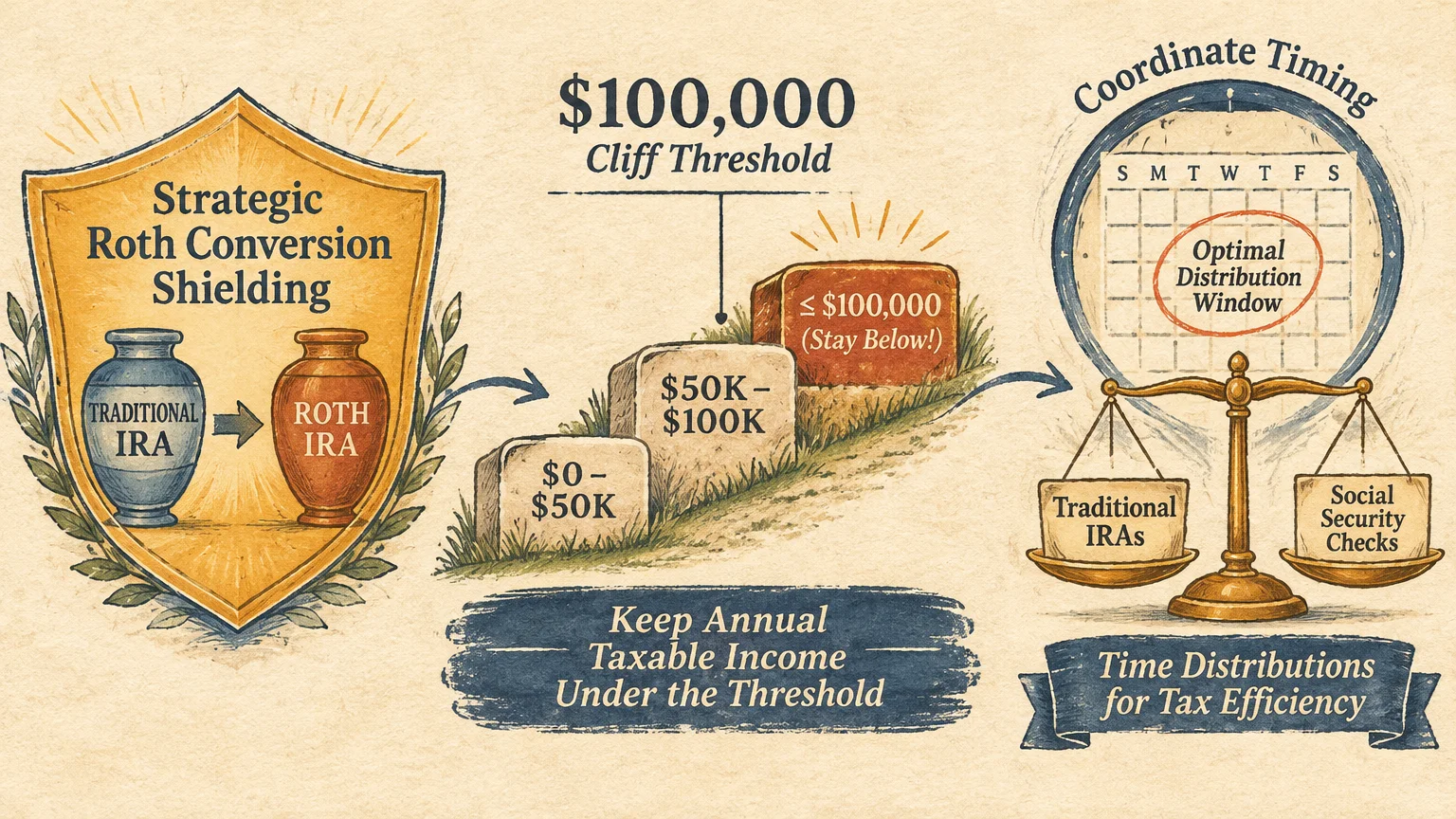
Practical Moves to Lower Social Security State Taxes in 2027
If you live in one of the eight taxing states and sit near an exemption cutoff, smart income timing can save hundreds or thousands of dollars. Focus on controlling your AGI before December 31 each year.
- Map your distance to the nearest state cliff: Compare your projected 2027 AGI—including your 3.6% COLA increase—against your state’s exemption ceiling so you know your exact cushion.
- Time Roth conversions and capital gains carefully: Spread Roth IRA conversions or stock sales across multiple tax years so a single spike never pushes you past New Mexico, Rhode Island, or Vermont cutoffs.
- Use Qualified Charitable Distributions (QCDs) if eligible: If you are age 70½ or older and give to charity, sending IRA distributions directly to a qualified charity satisfies RMDs without raising your federal AGI.
- Revisit Rhode Island early-retirement timing: If you live in Rhode Island and claimed Social Security before full retirement age, factor the 2027 repeal of the age requirement into your upcoming state tax withholding.
- Review state tax withholding and estimated payments: Social Security only withholds federal taxes through Form W-4V, so retirees who owe state tax on benefits must set aside quarterly estimated payments or withhold extra from pension or IRA distributions.
You can explore broader state-by-state retirement tax comparisons at AARP and review budgeting tools through the Consumer Financial Protection Bureau.
When to Get Expert Help
Simple retirement returns with Social Security as your main income source are often easy to file on your own. Complex income mixes inside the eight taxing states usually pay for professional guidance many times over.
Consider working with a certified public accountant (CPA) or tax advisor if your AGI hovers within $10,000 of a state cliff or phaseout zone. A tax pro can model exact AGI outcomes before you sell investments or complete a Roth conversion.
A fee-only fiduciary financial advisor or Social Security claiming specialist helps coordinate when to claim benefits alongside IRA withdrawals and pension start dates. That coordination matters even more if you are deciding whether to delay benefits in states like Colorado or Rhode Island.
If rising income from retirement distributions could also push you into higher Medicare Part B or Part D premiums (IRMAA), contact your local State Health Insurance Assistance Program (SHIP) counselor for free, unbiased Medicare guidance. An elder law attorney is worth consulting if you are restructuring assets for long-term care or multi-state estate planning.
Frequently Asked Questions About State Taxes on Social Security
Which states still tax Social Security in 2027?
Only eight states tax Social Security benefits entering 2027: Colorado, Connecticut, Minnesota, Montana, New Mexico, Rhode Island, Utah, and Vermont. West Virginia fully ended its tax on benefits starting with tax year 2026.
Does the new $6,000 federal senior bonus deduction stop my state from taxing Social Security?
No, the temporary $6,000 senior deduction ($12,000 for qualifying couples) available from 2025 through 2028 lowers federal taxable income after AGI is calculated. Because taxing states base exemptions on AGI or federally taxable benefits, the bonus deduction does not shield your state return.
Will my 2027 Social Security COLA raise my state taxes?
It can if your household sits just below a state exemption threshold. The 3.6% COLA taking effect in January 2027 raises your total income, which could reduce a phaseout in Minnesota, Utah, or Vermont—or trigger a cliff in New Mexico or Rhode Island.
Is Montana really the only state with no Social Security exemption?
Yes, Montana is the only state that provides no Social Security–specific exemption or credit, taxing the full federally taxable portion of your benefits. Its top income tax rate does drop to 5.4% in 2027, and seniors age 65 and older receive a general senior subtraction.

Your Next Step for 2027 Tax Planning
Check your most recent tax return’s AGI line today, add your expected 2027 COLA increase, and see where you stand against your state’s threshold. A 15-minute midyear projection now gives you plenty of runway to adjust IRA withdrawals, charitable gifts, or estimated payments before tax season arrives.
Retirement rules and benefit amounts vary based on individual work history, income, and circumstances. This article provides general guidance only.
Consult a SHIP counselor, financial advisor, or elder law attorney for advice specific to your situation.
Last updated: November 2026. Medicare and Social Security rules change annually—always verify current details at official government sources.