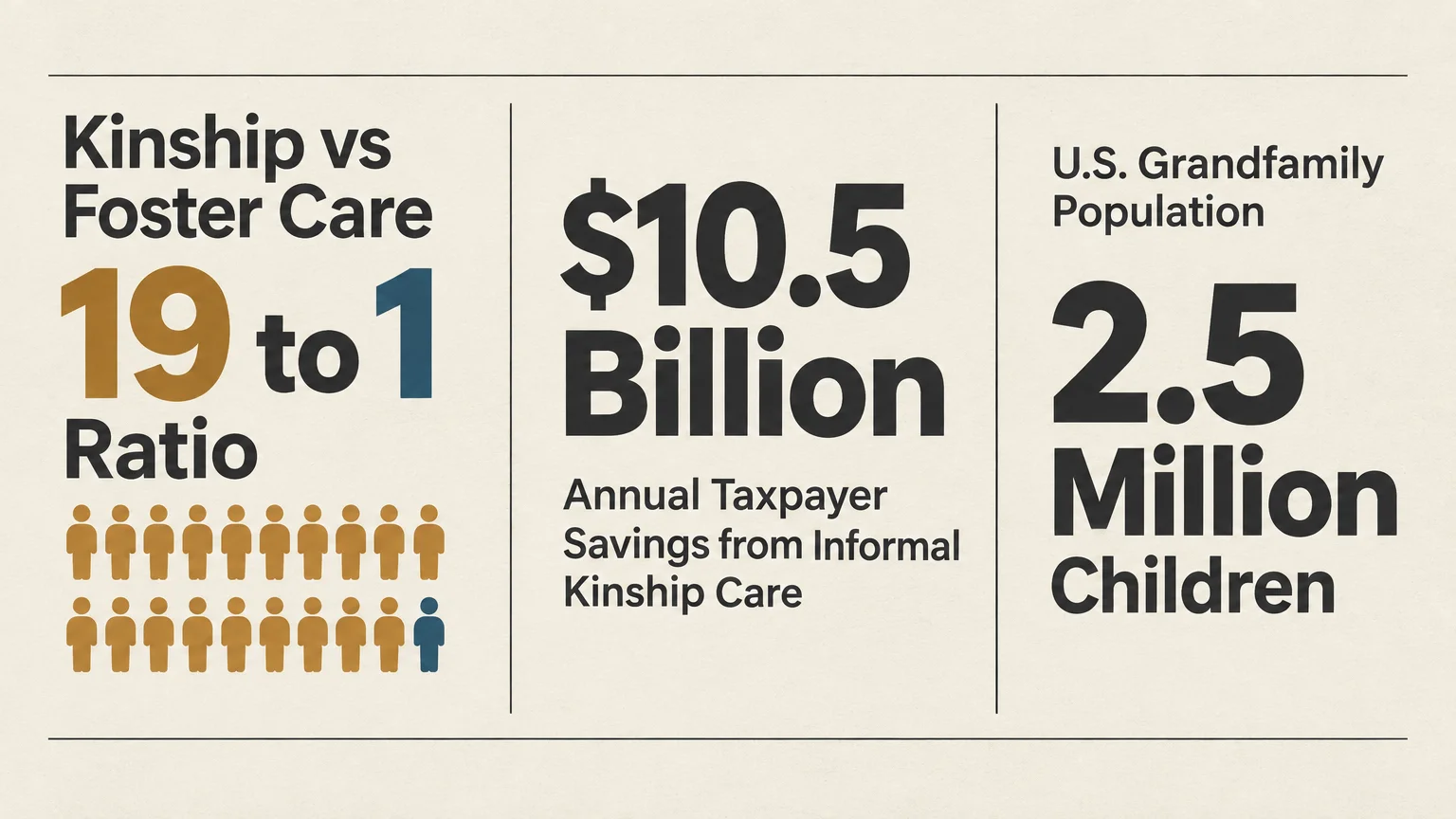
Stepping up to raise a grandchild changes your retirement budget overnight. Around 2.5 million U.S. children live in grandfamilies without a parent at home, yet many caregivers miss thousands of dollars in annual support.
You do not need formal custody to claim several major tax breaks, food benefits, and caregiver grants. Learning how your retirement income interacts with 2026 tax rules and Social Security helps you protect your nest egg.
Below, you will find clear eligibility rules, payment ranges, and filing steps for every major grandfamily program.
Key Takeaways for Grandfamily Finances
For every child raised by relatives in formal foster care, 19 children live with kin outside the foster care system, saving taxpayers roughly $10.5 billion each year. You can tap public benefits without surrendering your family’s privacy or autonomy.
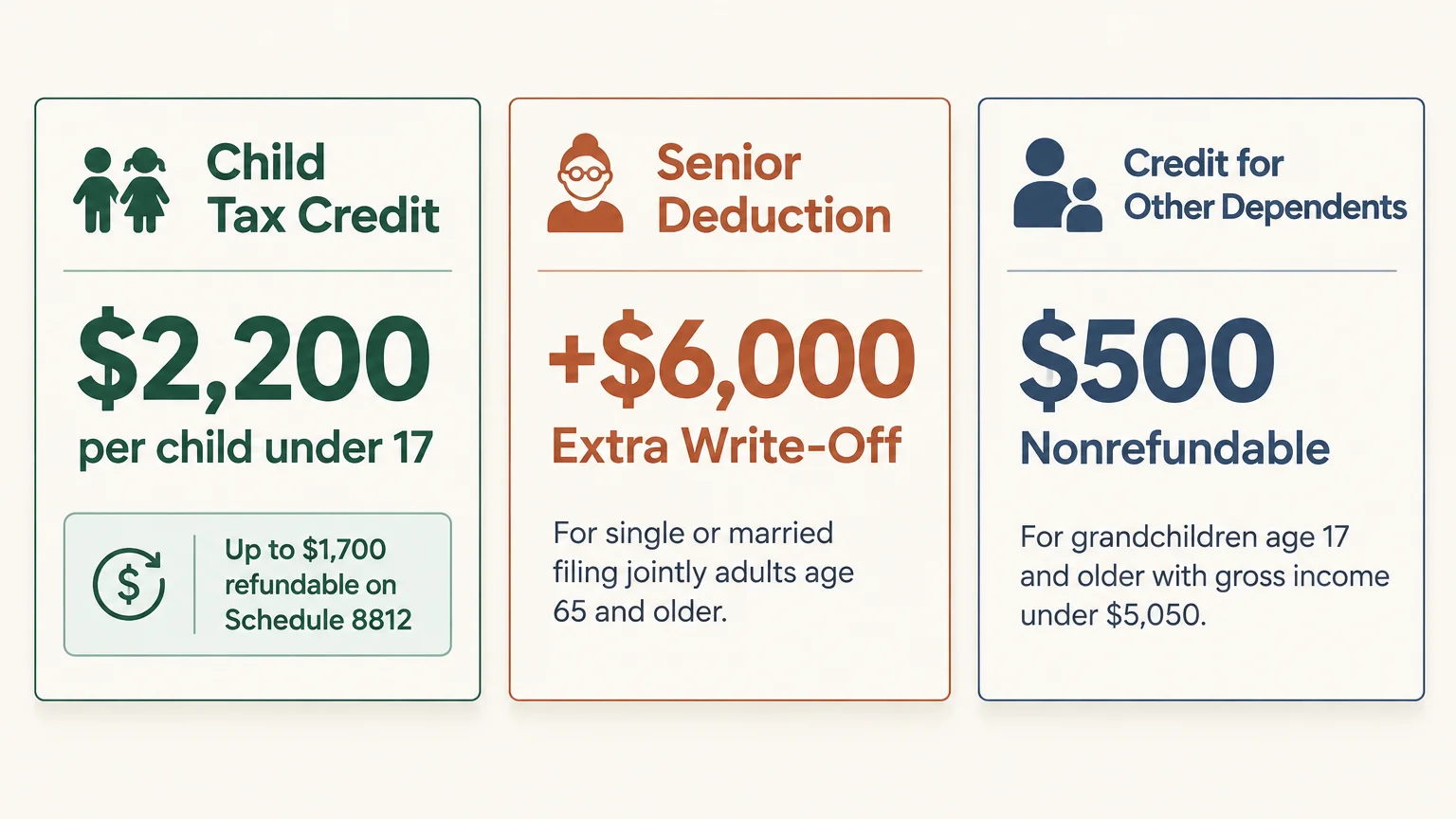
- Federal tax relief expanded in 2026: The Child Tax Credit pays up to $2,200 per child under 17, while the enhanced senior deduction gives adults 65 and older an extra $6,000 write-off.
- Informal care still unlocks aid: Programs like Medicaid and TANF child-only grants typically look at the child’s income rather than your retirement accounts.
- Earned income governs refundable credits: Social Security checks and pensions do not count as earned income for the Earned Income Tax Credit or dependent care credits.
- Timing shapes Social Security eligibility: If you already collect retirement benefits, you generally must legally adopt your grandchild before they can qualify on your work record.
Federal Tax Credits That Lower Your Tax Bill
Tax credits reduce your tax bill dollar for dollar, and several expanded under the Working Families Tax Cuts enacted in July 2025. To claim a grandchild as a qualifying child, the child generally must live with you for more than half the year.
Both you—or your spouse on a joint return—and your grandchild must hold valid Social Security numbers. The grandchild also cannot provide more than half of their own financial support during the year.
Child Tax Credit and Additional Child Tax Credit
For tax year 2026, the Child Tax Credit pays up to $2,200 for each qualifying grandchild under age 17. If the credit exceeds what you owe, you can receive up to $1,700 per child as a refund through the Additional Child Tax Credit.
Claiming the refundable portion requires at least $2,500 in earned income from wages or self-employment. The credit begins phasing out once your modified adjusted gross income exceeds $200,000, or $400,000 for married couples filing jointly; you claim it on Form 1040 Schedule 8812.
Credit for Other Dependents
Once a grandchild turns 17, they age out of the Child Tax Credit, but they do not age out of tax support. You can claim the $500 nonrefundable Credit for Other Dependents for older grandchildren or qualifying relatives you support.
To qualify as a relative dependent outside the age limits for a child, your grandchild generally must earn under $5,050 in gross income. You must also supply over half of their total support for the calendar year.
Expanded Child and Dependent Care Credit
If you still work part-time or full-time while raising a grandchild under age 13, childcare costs can strain your paycheck. Beginning in 2026, federal law raised the maximum credit rate from 35% to 50% of eligible care expenses.
You can count up to $3,000 in expenses for one child or $6,000 for two or more children on Form 2441. That makes the credit worth up to $1,500 for one grandchild or $3,000 for two or more, provided you—and your spouse, if married—have earned income.
Earned Income Tax Credit
Grandparents working in retirement often overlook the Earned Income Tax Credit, one of the largest refundable breaks available. For 2026, maximum credits reach $4,427 with one qualifying child, $7,316 with two children, and $8,231 with three or more children.
Single or head-of-household filers qualify in 2026 with adjusted gross income up to $51,593 for one child, $58,629 for two, or $62,974 for three or more. Joint filers have higher thresholds of $58,863, $65,899, and $70,244, and investment income cannot exceed $12,200.
Keep one firm rule in mind before counting on this refund. Social Security, traditional IRA withdrawals, and pensions do not count as earned income, and refunds claiming this credit or the refundable Child Tax Credit are held by law until mid-February.
Adoption Tax Credit
If you legally adopt your grandchild, the Adoption Tax Credit helps offset legal fees, court costs, and home studies. For tax year 2026, the maximum credit rises to $17,670 per eligible child, with up to $5,120 refundable.
You claim the credit using Form 8839, and you must attach Schedule 3-A to receive the refundable portion. Unused nonrefundable amounts carry forward for up to five years, and the credit phases out between $265,080 and $305,080 in modified adjusted gross income.
| 2026 Federal Tax Credit | Maximum Value | Refundable? | Earned Income Required? | Primary Tax Form |
|---|---|---|---|---|
| Child Tax Credit (CTC / ACTC) | $2,200 per child under 17 | Up to $1,700 per child | Yes ($2,500+ for refund) | Form 1040 Schedule 8812 |
| Credit for Other Dependents | $500 per dependent | No | No | Form 1040 |
| Child & Dependent Care Credit | $1,500 (1 child) / $3,000 (2+) | No | Yes (all filing spouses) | Form 2441 |
| Earned Income Tax Credit | Up to $8,231 (3+ children) | Yes | Yes | Form 1040 & Schedule 3-A |
| Adoption Tax Credit | $17,670 per child | Up to $5,120 per child | No | Form 8839 & Schedule 3-A |
Filing Status, Senior Deductions, and 2026 Child Accounts
Claiming a grandchild changes more than your tax credits; it can lower your taxable income before credits even apply. Unmarried grandparents who pay more than half the cost of maintaining a home for a qualifying grandchild can file as Head of Household.
For 2026, the Head of Household standard deduction jumps to $24,150, compared with $16,100 for single filers. Married couples filing jointly receive a $32,200 standard deduction.
Your age unlocks two additional layers of tax protection on top of your base standard deduction:
- Traditional age-65 deduction: Filers age 65 and older receive an extra $2,050 deduction when filing single or Head of Household, or $1,650 per qualifying spouse on a joint return.
- Enhanced senior deduction (2025–2028): Adults 65 and older can claim a separate $6,000 deduction per person—$12,000 if both spouses are 65 or older—whether they itemize or take the standard deduction.
- Income phaseouts to watch: The $6,000 senior deduction begins phasing out once modified adjusted gross income tops $75,000 for single filers or $150,000 for married couples filing jointly.
You can also jump-start your grandchild’s long-term savings through the new child savings accounts created for 2026. Starting July 4, 2026, guardians and parents could open a Trump Account featuring a one-time $1,000 federal pilot contribution for eligible children.
Family members and employers can contribute up to $5,000 total per year into the account. Once the child turns 18, the account is treated like a traditional IRA for long-term retirement growth.
If coordinating new tax forms like Schedule 3-A feels overwhelming, skip expensive commercial preparers. Seniors age 60 and older qualify for free preparation through the IRS Tax Counseling for the Elderly program at 800-906-9887 or through Volunteer Income Tax Assistance sites.
You can also book free, certified help through the AARP Foundation Tax-Aide service by calling 888-227-7669. Visit AARP to locate neighborhood tax sites and caregiver guides near you.
Social Security Benefits for Grandchildren and Caregivers
Many retirees assume a grandchild automatically qualifies for auxiliary checks once they move in, yet Social Security applies strict dependency tests. Under federal rules, a grandchild or step-grandchild can collect on your record only under specific conditions.
First, the child’s natural or adoptive parents must both be deceased or disabled—or you must legally adopt the child yourself. Legal adoption becomes mandatory if you were already receiving Social Security retirement or disability benefits before taking your grandchild in.
Second, the child must have begun living with you before turning 18. You must also have provided at least half of the child’s financial support during the full year before you became entitled to benefits, or since birth for infants under age one.
Protecting your retirement means pairing your personal savings with every earned benefit, public credit, and caregiver resource your family qualifies to receive.
When a grandchild qualifies on your work record, the monthly payment equals up to 50% of your full retirement or disability benefit. In survivor cases after a grandparent’s death, an eligible grandchild can receive up to 75% of the worker’s full benefit.
Keep the Family Maximum rule in mind if a spouse also collects on your record. Total monthly payments on one worker’s earnings record generally cap between 150% and 180% of the worker’s full benefit.
Exceeding that cap reduces your dependents’ shares proportionately, though your own monthly retirement check never drops. You can review your estimated benefits and family maximum scenarios directly through the Social Security Administration.
Here is how long those Social Security checks continue for an eligible grandchild:
- Standard cutoff: Benefits stop at age 18 unless the teenager remains enrolled full time in elementary or secondary school.
- High school extension: Full-time K–12 students keep receiving checks until they graduate or reach age 19 and two months, whichever occurs first.
- Lifelong disability exception: A grandchild with a qualifying disability that began before age 22 can receive benefits indefinitely on your record.
Your spouse may also qualify for a child-in-care spousal benefit before reaching age 62. A spouse caring for a grandchild who collects on your record can receive spousal payments until the child turns 16, or longer if the child has a qualifying disability.
Even if your grandchild does not qualify on your work record, check whether a deceased or disabled parent left a record behind. You can apply to serve as the child’s representative payee to manage their monthly survivor or disability payments for housing, food, and school needs.
Grandchildren living with significant disabilities in households with limited income and resources may also qualify for Supplemental Security Income. Roughly one million minors nationwide received SSI benefits as of late 2025.
Cash Assistance, Food Support, and Health Coverage
Informal kinship caregivers make up the vast majority of grandfamilies, and federal safety-net programs recognize that reality. You do not need court-ordered guardianship or a foster care license to apply for monthly cash or grocery help for your grandchild.
TANF Child-Only Cash Grants
Temporary Assistance for Needy Families offers “child-only” cash grants in most states for children raised by relatives outside foster care. Unlike standard family welfare, eligibility looks strictly at the grandchild’s income—not your Social Security, pension, or home equity.
Monthly grants vary by state and household size, typically running around $100 to $400 per month for one child. Despite broad eligibility, only about 13% of children in kinship families currently receive TANF child-only grants, leaving vital monthly cash unclaimed.
Formal Foster Care and Guardianship Assistance
If child welfare placed your grandchild with you, becoming a licensed foster parent unlocks substantially higher monthly support. State foster care maintenance payments often range from $400 to over $900 per month per child, depending on the state and the child’s age.
Under the federal Title IV-E Guardianship Assistance Program, relatives in 32 states and 58 Title IV-E agencies can transition from foster parent to legal guardian without losing monthly financial help. After caring for the child as a licensed foster parent for at least six consecutive months, you can receive ongoing monthly guardianship subsidies if reunification and adoption are ruled out.
SNAP Grocery Support and Senior Medical Deductions
You can add grandchildren you are raising to a SNAP application without legal custody or guardianship papers. Including a child raises your household size, which adjusts the monthly income limit and maximum food benefit upward each October 1.
Retirees also hold a major advantage under SNAP budgeting rules. If anyone in your household is age 60 or older—or receives disability benefits—you can deduct unreimbursed medical expenses exceeding $35 per month from your countable income.
Counting prescription copays, Medicare Part B premiums, dental bills, and eyeglasses often pushes borderline retirees over the threshold into substantial monthly grocery aid.
Medicaid and CHIP Health Coverage
Children placed through formal foster care generally receive automatic Medicaid coverage at zero cost. For informal grandfamilies, state agencies usually evaluate the child’s eligibility for Medicaid or the Children’s Health Insurance Program without disqualifying them over your retirement savings.
CHIP covers uninsured children under age 19 in families earning too much for standard Medicaid, with state income limits spanning 170% to 400% of the federal poverty level. If you rely on ACA Medicaid expansion coverage for yourself before turning 65, prepare for new adult work requirements and semi-annual renewals taking effect in January 2027.
| Benefit Program | Legal Custody Required? | Counts Grandparent Assets? | Typical Support Level |
|---|---|---|---|
| TANF Child-Only Grant | No (in most states) | No (child’s income only) | Around $100–$400/month for one child |
| Licensed Foster Care / GAP | Yes (court placement or guardianship) | No | Often $400–$900+/month per child |
| SNAP (Food Assistance) | No | Household rules apply; 60+ medical deduction | Varies by household size and net income |
| Medicaid / CHIP | No for informal; automatic in foster care | Generally child-focused for informal care | Full pediatric coverage up to 170%–400% FPL |
To check your household’s eligibility across food, healthcare, utility, and tax programs in one screening, use the free BenefitsCheckUp tool from the National Council on Aging.

Caregiver Support Services for Older Relatives
Raising children in your 60s or 70s demands physical stamina and local backup, not just monthly checks. Federal aging policy specifically funds community services for grandparents and non-parent relatives age 55 and older raising children under 18.
The Older Americans Act Title III-E National Family Caregiver Support Program distributes funds through 56 state agencies on aging and 618 local Area Agencies on Aging. Whether you hold formal custody or care for a grandchild informally, you qualify for five core services:
- Information and outreach: Up-to-date local guidance on school enrollment, medical consent forms, and public benefits.
- Access assistance: One-on-one case managers who help you complete applications for TANF, SNAP, and Medicaid.
- Counseling and training: Peer grandfamily support groups, caregiver workshops, and individual counseling sessions.
- Respite care: Short-term childcare or camp vouchers that give you scheduled time to rest or attend medical appointments.
- Supplemental services: Emergency funds for essentials like car seats, winter coats, cribs, or school supplies.
Federal lawmakers removed an older 10% spending cap on services for relative caregivers in 2020, and in July 2026 the U.S. Senate unanimously passed S. 2120 to reauthorize the Older Americans Act. Connect with your local Area Agency on Aging right away through the federal Eldercare Locator.
Common Retirement Traps for Grandfamilies
Well-meaning grandparents often lose thousands of dollars simply by making fast assumptions under stress. Watch out for these five common traps as you organize your household finances:
- Treating pensions as earned income: Counting Social Security or 401(k) withdrawals toward the Earned Income Tax Credit or dependent care credit triggers IRS rejections and delayed refunds.
- Assuming your savings block child aid: Skipping TANF child-only or CHIP applications because you own a home or hold an IRA forfeits benefits designed solely around the child’s income.
- Waiting too long on Social Security adoption rules: Taking a grandchild in after your retirement checks start without completing a legal adoption permanently blocks auxiliary child benefits on your work record.
- Filing taxes without coordinating with parents: If a biological parent claims the child electronically first, your return will bounce, forcing months of IRS paper tie-breaker reviews.
- Draining retirement principal first: Pulling extra cash from taxable retirement accounts to pay daycare or groceries can raise your MAGI, phase out your $6,000 senior deduction, and increase future Medicare premiums.

When to Consult a Professional
Department of Labor figures show that nearly half of grandparents raising grandchildren—48.8%—have already provided care for five years or longer. Because kinship care frequently becomes long-term, coordinating legal authority, taxes, and retirement cash flow pays off quickly.
Consult an elder law or family law attorney before signing informal care agreements if a child welfare agency is involved. An attorney helps you weigh whether licensed foster care followed by Title IV-E guardianship preserves better monthly subsidies and Medicaid protection than private custody.
An elder law attorney can also update your will, powers of attorney, and beneficiary designations so your grandchild stays protected if your health declines. That planning keeps your retirement assets from accidentally disqualifying a disabled grandchild from future SSI benefits.
Meet with a certified public accountant or a Tax Counseling for the Elderly volunteer before filing your first return with a dependent grandchild. A tax specialist ensures you document the six-month residency test, apply Head of Household rates, and coordinate the $6,000 senior deduction without losing credits.
Consider speaking with a fee-only financial advisor or Social Security specialist if you plan to return to work part-time to qualify for child tax credits. A specialist can model how new wages interact with the Social Security earnings test, the Family Maximum cap, and your Medicare Part B premiums.
Frequently Asked Questions
Can I claim my grandchild on my taxes without legal custody?
Yes, the IRS does not require court-ordered custody or guardianship to claim the Child Tax Credit or Head of Household status. Your grandchild generally must live with you for more than half the year, not provide over half of their own support, and hold a valid Social Security number.
Will my pension or 401(k) disqualify my grandchild from Medicaid or TANF?
In most states, TANF child-only grants evaluate only the grandchild’s income and ignore your retirement savings, pension, and Social Security. Informal kinship children also usually qualify for Medicaid or CHIP based on their own circumstances rather than your retirement nest egg.
Can I collect the Earned Income Tax Credit if I am retired and living on Social Security?
No, Social Security benefits, pensions, annuities, and IRA distributions do not count as earned income for the Earned Income Tax Credit or the Child and Dependent Care Credit. However, working even part-time for wages or self-employment income can unlock both credits and the refundable Child Tax Credit.
How can I get respite care or emergency supplies if I am over 55?
Grandparents and non-parent relatives age 55 and older raising children under 18 qualify for the National Family Caregiver Support Program even without formal custody. Contact your local Area Agency on Aging through Eldercare Locator to request respite care, support groups, and supplemental vouchers.
Your Next Step for Grandfamily Support
Start by gathering three core documents this week: your grandchild’s birth certificate, their Social Security card, and proof of school or medical residency at your address. Those records unlock TANF child-only grants, SNAP medical deductions, and local Area Agency on Aging respite services right away.
Retirement rules and benefit amounts vary based on individual work history, income, and circumstances. This article provides general guidance only. Consult a SHIP counselor, financial advisor, or elder law attorney for advice specific to your situation.
Last updated: November 2026. Medicare and Social Security rules change annually—always verify current details at official government sources.