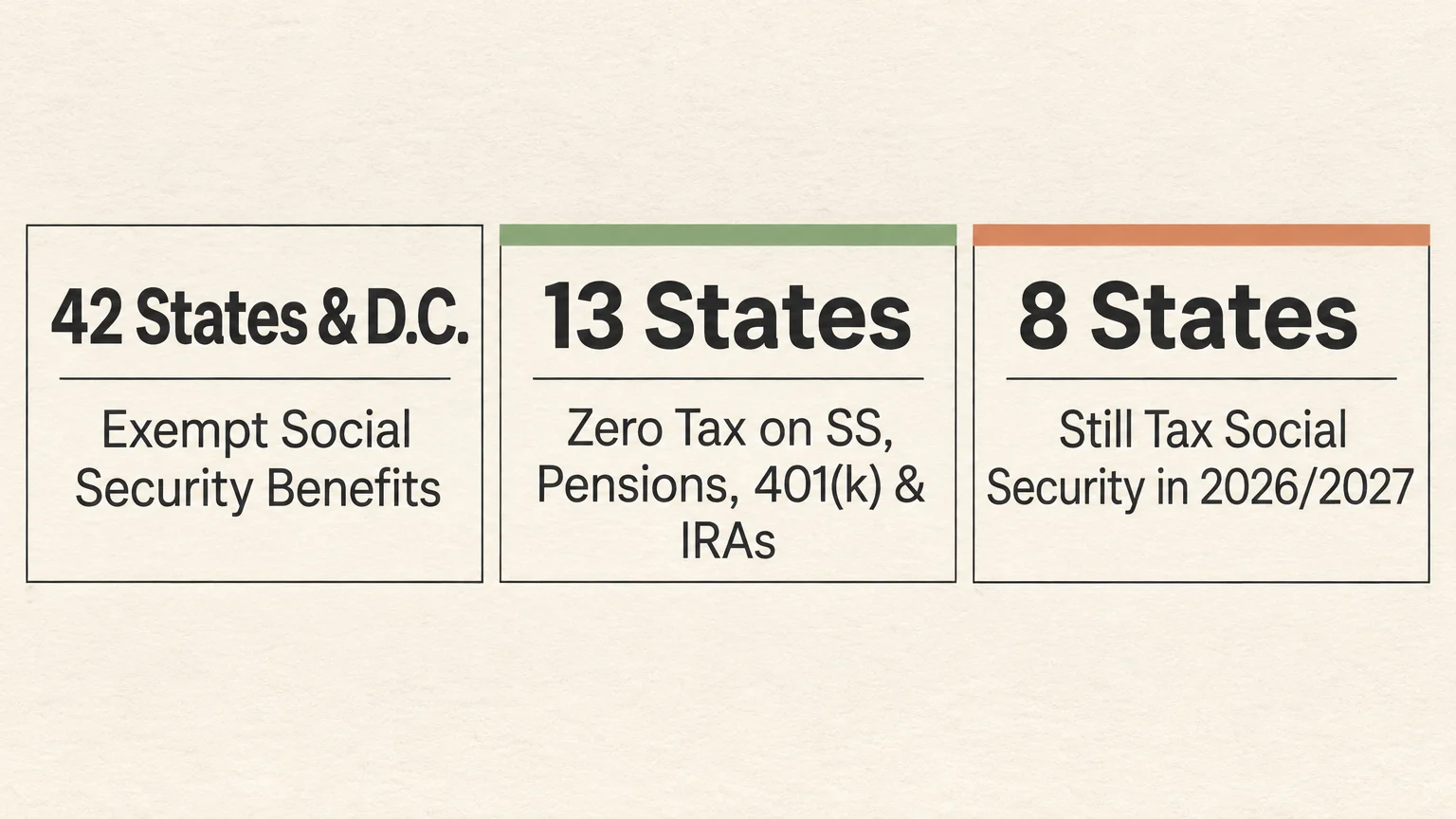
Where you live in retirement can quietly protect—or shrink—thousands of dollars in annual income. While 42 states and Washington, D.C. leave your Social Security checks untouched, 8 states still tax those benefits.
Better yet, 13 tax-friendly states exempt not just Social Security, but also pensions, 401(k) withdrawals, and IRAs. Knowing how your state treats retirement income helps you keep more of every check.
Whether you plan to relocate or stay put in 2027, these state-by-state rules show exactly where retirees win big—and where hidden taxes still bite.
The Bottom Line Up Front
State tax rules for retirees continue shifting in your favor, yet sharp differences remain across state lines. Reviewing where the map stands helps you avoid costly surprises when filing your 2026 and 2027 returns.
- 42 states and Washington, D.C. do not tax Social Security benefits for tax year 2026, filed in 2027.
- 13 tax friendly states for retirees impose zero state income tax on Social Security, pensions, 401(k)s, and IRAs.
- 8 states that tax Social Security remain, though 7 provide age- or income-based exemptions; only Montana offers no income-based benefit relief.
- 2027 rule shifts include West Virginia’s completed repeal, Rhode Island dropping its age-67 requirement, and a 3.6% federal COLA pushing more retirees toward frozen federal tax thresholds.
Why 42 States Skip Social Security Taxes—and Recent Repeals Shifting the Map
Most states have stepped away from taxing Social Security benefits over the past decade. For tax year 2026, 42 states and Washington, D.C. exclude your benefits from state income tax entirely.
Several states accelerated this trend through recent legislative repeals. North Dakota ended its Social Security tax in 2023, and Kansas, Missouri, and Nebraska eliminated theirs starting in 2024.
West Virginia followed with a multi-year phase-out that exempted 65% of benefits in 2025. Starting with tax year 2026—the return you file in 2027—West Virginia makes Social Security 100% exempt.
Still, looking only at Social Security tax by state misses half the picture. Many of those 42 states still tax 401(k) distributions, traditional IRAs, and pensions as ordinary income.
To truly win big on retirement taxes in 2027, you have to examine how states treat all of your retirement accounts together. According to 2026 state reviews by AARP and Kiplinger, only 13 states exempt every traditional retirement income stream.
The 9 No-Income-Tax States Where Retirees Keep Every Dollar
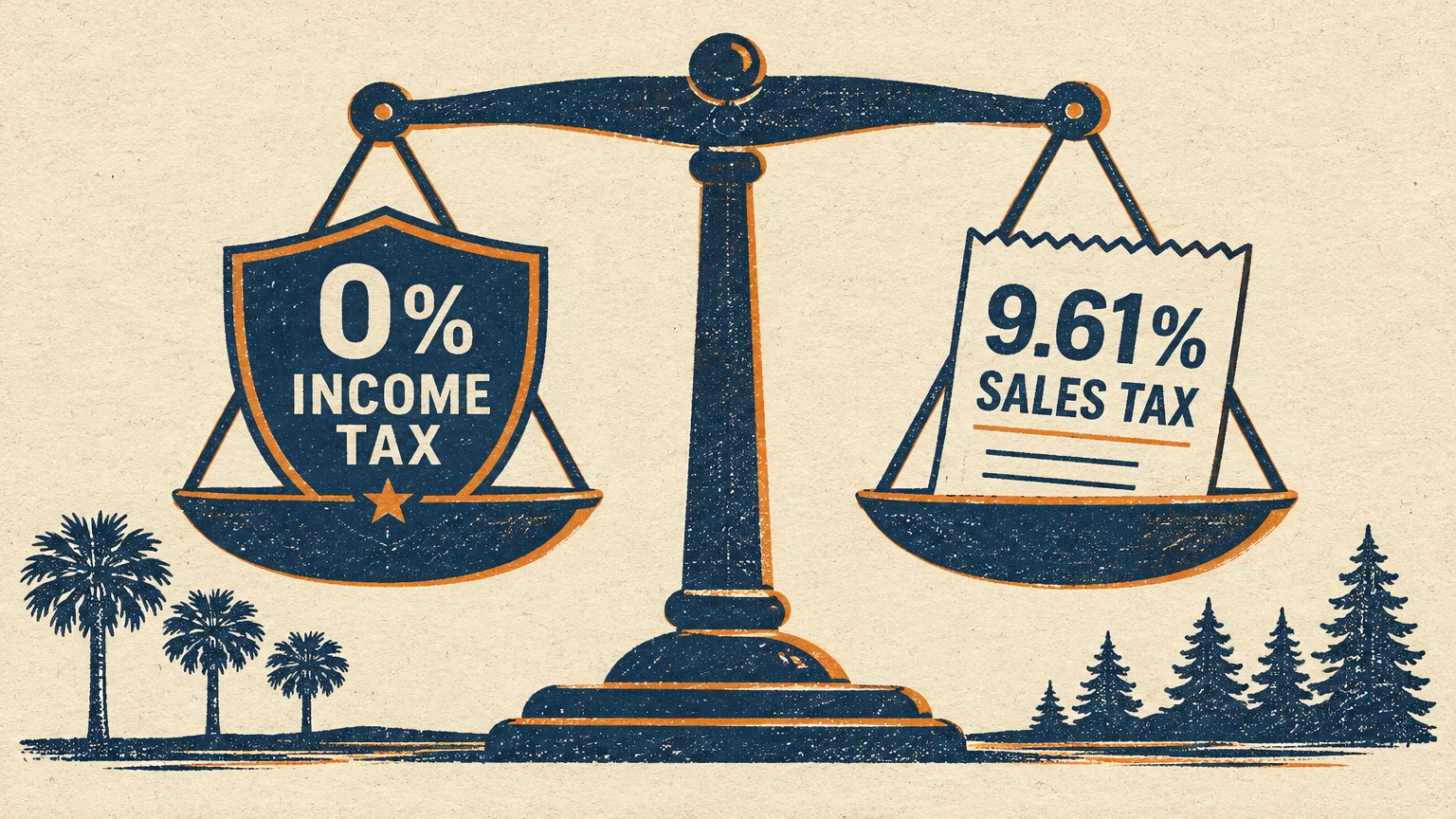
Nine states skip broad-based personal income taxes altogether, meaning your Social Security checks, pensions, 401(k)s, IRAs, and part-time wages stay free from state income tax. Those nine states are Alaska, Florida, Nevada, New Hampshire, South Dakota, Tennessee, Texas, Washington, and Wyoming.
New Hampshire recently joined the true zero-income-tax club for investors and retirees. The state repealed its tax on interest and dividends effective in 2025, leaving no personal income tax on your portfolio earnings.
Washington offers no wage or retirement income tax, yet high-net-worth retirees face notable exceptions. Washington taxes long-term capital gains above an annual deduction and enacted a 9.9% tax on income exceeding $1 million taking effect in 2028.
Before packing boxes for one of these nine states, look closely at what replaces missing income taxes. States still have to fund roads, schools, and local services, often through higher sales and property levies.
Tax Foundation data from January 2026 puts the national weighted average combined state and local sales tax rate at 7.53%. Tennessee ranks second-highest in the nation at 9.61%, and Washington sits right behind in third place at 9.51%.
For retirees living primarily on fixed Social Security checks, high sales taxes can quietly erode the savings gained from zero income tax. Comparing your expected annual spending against local sales and property rates prevents unpleasant budget shocks.
4 Income-Tax States That Exempt Your Retirement Accounts
Four additional states levy a state income tax seniors must watch if they still work, yet carve out generous exemptions for retirement income. Illinois, Iowa, Mississippi, and Pennsylvania all leave Social Security, pensions, 401(k)s, and IRAs untaxed for qualifying residents.
Each of these four states applies slightly different rules and trade-offs. Checking the fine print ensures your distributions actually qualify before you relocate.
- Illinois: Exempts Social Security, pensions, 401(k)s, and IRAs, while taxing other income at a flat 4.95% with an extra exemption at age 65 and older. However, Tax Foundation 2026 data shows Illinois effective property taxes average 1.88%—tied for highest in the nation—alongside a state estate tax.
- Iowa: Exempts qualifying retirement income for residents age 55 or older, as well as disabled taxpayers and surviving spouses. Other taxable income faces a flat 3.8% rate for 2026.
- Mississippi: Exempts Social Security, pensions, and qualifying retirement plan distributions from income tax. On the flip side, residents pay a 5% state sales tax on groceries.
- Pennsylvania: Exempts Social Security and qualifying retirement plan or IRA distributions after retirement or age 59½. Other income is taxed at a flat 3.07% plus local earned income taxes, and the state levies an inheritance tax.
For middle-income retirees who hold modest home values or rent, Iowa and Pennsylvania often deliver remarkably low overall tax burdens. By contrast, homeowners with expensive properties in Illinois may find property tax bills outweigh the income tax savings.
| Winning State | Tax on Social Security | Tax on 401(k)s, IRAs & Pensions | Key Trade-Off or Rule to Watch |
|---|---|---|---|
| Alaska | None | None | No broad income tax or state sales tax; local sales taxes may apply |
| Florida | None | None | No income tax; watch coastal property insurance and local property taxes |
| Illinois | None | None | 4.95% tax on other income; 1.88% avg. property tax and state estate tax |
| Iowa | None | None (age 55+) | 3.8% flat tax on non-retirement income for 2026 |
| Mississippi | None | None (qualifying plans) | 5% state sales tax on groceries |
| Nevada | None | None | No personal income tax; relies heavily on sales and excise taxes |
| New Hampshire | None | None | Repealed interest and dividends tax in 2025; higher property taxes |
| Pennsylvania | None | None (age 59½ / retired) | 3.07% tax on other income; local earned income and state inheritance taxes |
| South Dakota | None | None | No personal income tax |
| Tennessee | None | None | No income tax; 9.61% avg. combined sales tax (2nd highest in U.S.) |
| Texas | None | None | No personal income tax; relatively high local property taxes |
| Washington | None | None | Capital gains tax, estate tax, 9.51% avg. sales tax, 9.9% tax over $1M in 2028 |
| Wyoming | None | None | No personal income tax |
The 8 States That Still Tax Social Security in 2026 and 2027
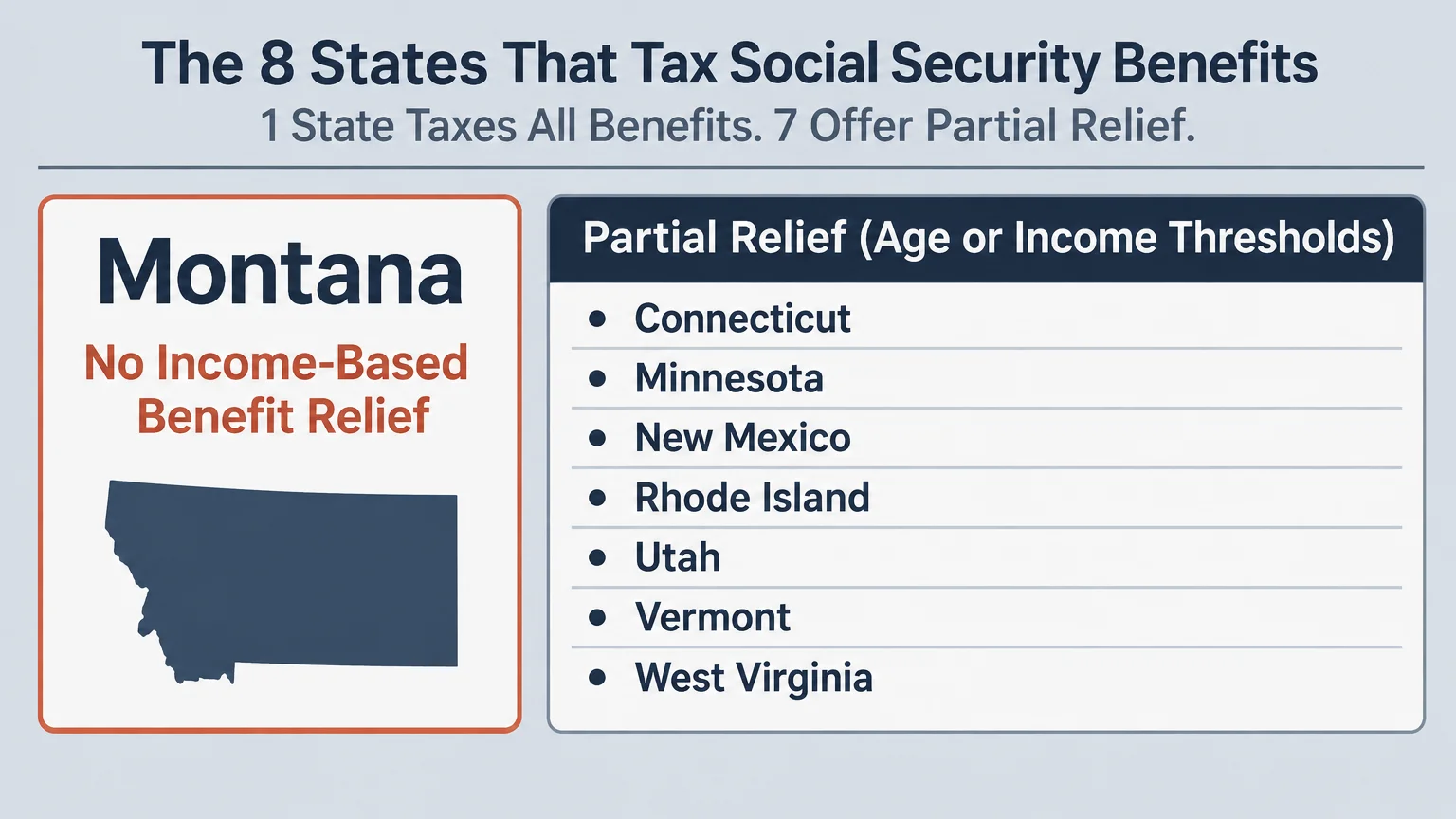
Only 8 states still tax Social Security benefits in some form during the 2026 and 2027 tax years. Those states are Colorado, Connecticut, Minnesota, Montana, New Mexico, Rhode Island, Utah, and Vermont.
Fortunately, being on this list does not automatically mean you will pay state tax on your benefits. Seven of these 8 states offer age- or income-based exemptions that protect low- and moderate-income retirees.
Only Montana lacks an income-based Social Security exemption altogether. Knowing each state’s exact threshold helps you see whether your household clears the bar or gets hit with an extra tax bill.
Colorado
Colorado gives full Social Security relief once you hit traditional retirement age. Residents age 65 and older at year-end can deduct 100% of federally taxed Social Security benefits regardless of income.
If you claim benefits earlier—between ages 55 and 64—your adjusted gross income (AGI) decides your deduction. You qualify for a full deduction with an AGI of $75,000 or less for single filers, or $95,000 or less for joint filers; above those limits, the deduction caps at $20,000.
Connecticut
Connecticut shields lower- and middle-income seniors completely, while capping taxes for higher earners. Your benefits are 100% exempt if your federal AGI falls below $75,000 (single or married filing separately) or $100,000 (joint or head of household).
Even if your AGI exceeds those limits, Connecticut does not tax your entire check. At least 75% of your Social Security benefits remain exempt, meaning no more than 25% of your benefits can be taxed by the state.
Minnesota
Minnesota indexes its Social Security subtraction thresholds each year to keep pace with inflation. For tax year 2026, you qualify for a full subtraction with AGI up to $86,410 (single or head of household), $110,780 (married filing jointly or qualifying surviving spouse), or $55,390 (married filing separately).
Those limits stepped up from $84,490, $108,320, and $54,160 in 2025. Above the 2026 thresholds, your subtraction phases out by 10% for each $4,000 over the limit, or $2,000 if married filing separately.
Montana
Montana stands as the toughest state for Social Security recipients because it offers no income-based exemption for benefits. Taxpayers age 65 and older receive only a general $5,500 subtraction from federal taxable income.
Modest rate relief is arriving under HB 337, however. Montana’s top income tax rate dropped from 5.9% to 5.65% in 2026 on income over $47,500 (single) or $95,000 (joint), and drops again to 5.4% in 2027 on single income over $65,000.
New Mexico
New Mexico protects the vast majority of retirees with generous income thresholds. Social Security benefits are 100% exempt if your AGI sits at or below $100,000 for single filers, $150,000 for joint filers, or $75,000 for married couples filing separately.
If your AGI climbs above those caps, New Mexico taxes the federally taxable portion of your benefits. Standard state rates ranging from 1.7% to 5.9% apply once you cross the line.
Rhode Island
Rhode Island is mid-transition between its 2026 and 2027 rules. For tax year 2026, benefits are exempt only if you have reached full retirement age (67) and keep federal AGI below $107,000 (single and most filers) or $133,750 (joint).
Under Rhode Island’s enacted FY 2027 budget signed in June 2026, lawmakers eliminated the age-67 requirement starting in tax year 2027. However, legislators rejected a full phase-out and kept the inflation-adjusted $107,000 and $133,750 AGI caps in place.
Utah
Utah taxes Social Security benefits at its flat 4.45% to 4.5% state rate, then offsets the bill through a nonrefundable Social Security Benefits Credit. You receive full relief up to a modified AGI (MAGI) of $54,000 (single), $90,000 (joint or head of household), or $45,000 (married filing separately).
Once your MAGI crosses those limits, the credit shrinks quickly. It phases out by 2.5 cents for every $1 above the threshold, leaving higher-earning retirees paying state tax on their benefits.
Vermont
Vermont updated its exemption under 2025 Act 71, effective January 1, 2025, though the limits are not indexed for inflation. Benefits are 100% exempt if your AGI is $55,000 or less (single) or $70,000 or less (joint).
A narrow $10,000 phase-out window gives partial relief just above those floors. The exemption disappears completely once AGI reaches $65,000 for single filers or $80,000 for joint filers.
| State Taxing Social Security | Full Exemption Limit (Single / Joint) | Key Rule or 2027 Change |
|---|---|---|
| Colorado | All incomes at 65+; $75,000 / $95,000 (ages 55–64) | Ages 55–64 capped at $20,000 deduction above AGI limits |
| Connecticut | $75,000 / $100,000 AGI | At least 75% exempt above thresholds (max 25% taxed) |
| Minnesota | $86,410 / $110,780 AGI (2026) | Phases out 10% per $4,000 over limit ($2,000 if MFS) |
| Montana | None | No income-based exemption; $5,500 general 65+ subtraction; top rate 5.4% in 2027 |
| New Mexico | $100,000 / $150,000 AGI | Standard 1.7%–5.9% rates apply above thresholds |
| Rhode Island | $107,000 / $133,750 AGI | Age-67 requirement eliminated starting tax year 2027; AGI caps remain |
| Utah | $54,000 / $90,000 MAGI | Nonrefundable credit phases out by 2.5 cents per $1 above limit |
| Vermont | $55,000 / $70,000 AGI | Unindexed limits; partial exemption ends completely at $65,000 / $80,000 |
How Federal Social Security Taxes Collide With 2027 Rules
Even if you live in one of the 13 states where retirees keep every dollar from the statehouse, Uncle Sam still takes a closer look. Roughly 74 to 76 million Americans receive Social Security or Supplemental Security Income (SSI), according to 2026 Pew Research Center and Social Security Administration (SSA) data.
About 63% of beneficiaries report Social Security makes up at least half their income, and 27% rely on it as their sole income source. Meanwhile, roughly 36% to 50% of recipients pay federal income tax on their benefits.
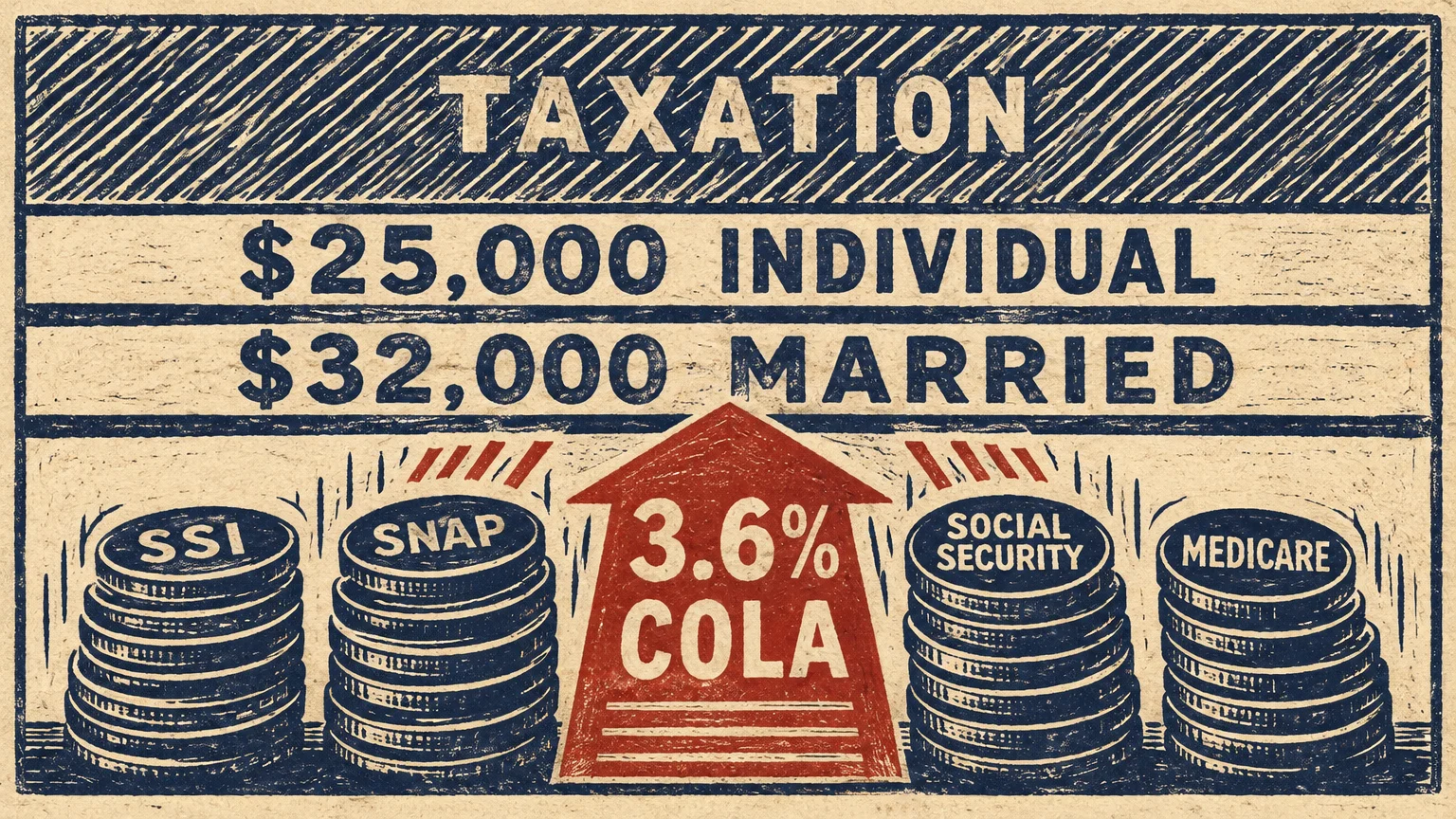
Unlike income tax brackets, the federal thresholds for taxing Social Security have never been indexed for inflation. The IRS bases your tax on “combined income”—your AGI, plus nontaxable interest, plus half of your Social Security benefits.
- Up to 50% taxable: Combined income between $25,000 and $34,000 (single) or $32,000 and $44,000 (joint).
- Up to 85% taxable: Combined income above $34,000 (single) or $44,000 (joint).
- SSI exception: Supplemental Security Income is never subject to federal income tax.
Annual cost-of-living adjustments (COLAs) make those frozen thresholds pinch harder every year. Following a 2.5% COLA in 2025 and a 2.8% bump in 2026, Social Security benefits rise 3.6% starting in January 2027 (and December 31, 2026 for SSI).
That 3.6% raise helps cover rising grocery and healthcare bills, yet it pushes more modest-income retirees across the $25,000 and $32,000 federal thresholds. If you still work while claiming early, watch the 2027 Retirement Earnings Test too.
Workers under full retirement age in 2027 can earn up to $25,560 before benefits drop by $1 for every $2 earned above the cap. Those reaching full retirement age during 2027 can earn up to $67,920 before losing $1 for every $3 over, while the payroll taxable wage cap rises to $192,300.
One bright spot arrives through the $6,000 enhanced senior deduction available for tax years 2025 through 2028. Taxpayers age 65 and older can deduct an extra $6,000 per eligible person—$12,000 if both spouses are 65 or older—on top of standard or itemized deductions.
This bonus deduction phases out at 6% for MAGI above $75,000 (single) or $150,000 (joint), disappearing completely at $175,000 and $250,000. While it does not change the federal Social Security combined-income formula directly, it lowers your overall taxable income significantly.
Pairing that bonus with standard deductions creates substantial shelter for 2026 and 2027. For tax year 2026, the base standard deduction sits at $16,100 (single), $32,200 (joint), and $24,150 (head of household), plus a regular 65+ add-on of $2,050 (unmarried) or $1,650 per spouse (married).
Combined with the $6,000 bonus deduction, a qualifying single filer age 65 or older can deduct $24,150 in 2026. For tax year 2027, base standard deductions rise to $16,600 (single), $33,200 (joint), and $24,925 (head of household), with 65+ add-ons climbing to $2,100 and $1,700 per spouse.
That means a married couple, both age 65 or older and below the phase-out, can deduct $48,600 on their 2027 federal return. Keeping your withdrawals inside these larger deduction brackets helps offset frozen Social Security thresholds.
Your gross retirement income matters far less than the after-tax dollars you actually get to spend—and where you live often decides the difference.
Common Retirement Traps
Tax surprises rarely come from a single line on your tax return; they usually stem from overlooking how different taxes interact. Watch for these four traps as you plan your 2027 budget or consider a move.
- Chasing zero income tax while ignoring local levies: Moving from a moderate-tax state to Illinois, Tennessee, Texas, or Washington can backfire if higher property taxes, 9.5%-plus sales taxes, or estate taxes absorb your income-tax savings.
- Triggering a state AGI cliff with a one-time withdrawal: Selling a vacation home, taking a large IRA distribution for a new car, or realizing capital gains in states like New Mexico, Rhode Island, or Vermont can suddenly push you past their hard exemption ceilings.
- Assuming the $6,000 senior deduction erases Social Security taxes: Because the deduction sits below AGI, it does not reduce the combined income number that decides whether 50% or 85% of your Social Security benefits become federally taxable.
- Forgetting that Roth conversions affect state exemption formulas: Converting traditional IRA funds to a Roth increases your current-year AGI, which can temporarily wipe out state Social Security credits in Utah or subtractions in Minnesota.

Practical Steps to Cut Your 2027 Retirement Tax Bill
You do not have to uproot your life and move across the country to trim your retirement taxes. A few deliberate moves before December 31 can keep you under key state and federal cliffs.
- Calculate your total state tax burden before relocating: Add projected state income taxes, local property taxes, average sales taxes on your budget, and any grocery, estate, or inheritance taxes using tools at USA.gov Retirement Resources.
- Map your AGI against your state’s exemption ceiling: If you live in Connecticut, Minnesota, New Mexico, Rhode Island, Utah, or Vermont, track IRA withdrawals and capital gains all year so you do not accidentally cross a phase-out threshold by a few hundred dollars.
- Use Roth conversions strategically during low-income years: In the 13 winning states, Roth conversions carry zero state income tax; in the 8 taxing states, time conversions in years before you claim Social Security or spread them carefully across multiple tax years.
- Adjust federal and state withholding proactively: If your 2027 3.6% COLA pushes you over federal thresholds, file IRS Form W-4V with the SSA to withhold 7%, 10%, 12%, or 22% directly from your monthly check and avoid underpayment penalties.
- Pair charitable giving with Required Minimum Distributions (RMDs): Once eligible, Qualified Charitable Distributions (QCDs) from an IRA count toward your RMD without raising your AGI—helping preserve both federal senior deductions and state Social Security exemptions.
When to Consult a Professional
State and federal retirement tax rules overlap in tricky ways, especially when pensions, investment accounts, and Medicare premiums enter the mix. Bringing in the right specialist before a major financial move often pays for itself many times over.
Work with a CPA or tax-focused financial advisor before relocating across state lines, executing large Roth conversions, or selling real estate in states with strict AGI cliffs. They can run multi-year projections showing how a single transaction impacts your state exemption and the $6,000 senior deduction.
Consider an elder law or estate planning attorney if you live in—or plan to move to—Illinois, Washington, or Pennsylvania, where state estate or inheritance taxes can affect what passes to your heirs. Finally, contact your local State Health Insurance Assistance Program (SHIP) counselor if higher taxable withdrawals might trigger Medicare Part B and Part D income-related surcharges.
Frequently Asked Questions About Social Security Taxes by State
Which states still tax Social Security in 2027?
Eight states tax Social Security benefits in some form for the 2026 and 2027 tax years: Colorado, Connecticut, Minnesota, Montana, New Mexico, Rhode Island, Utah, and Vermont. Seven of those eight offer age- or income-based relief, while Montana offers no income-based Social Security exemption.
What are the 13 states where retirees win big on retirement taxes?
Nine states impose no broad-based personal income tax: Alaska, Florida, Nevada, New Hampshire, South Dakota, Tennessee, Texas, Washington, and Wyoming. Four more states tax other income but exempt Social Security, pensions, 401(k)s, and IRAs: Illinois, Iowa, Mississippi, and Pennsylvania.
Does the $6,000 senior deduction eliminate federal taxes on Social Security?
No, it does not alter the federal Social Security benefit-taxation formula directly because it applies after your AGI is calculated. However, the $6,000 deduction per person age 65 and older (available 2025 through 2028) lowers your overall taxable income, which can shrink or offset your final federal tax bill.
How does Rhode Island’s Social Security tax change in 2027?
For tax year 2026, Rhode Island exempts Social Security only if you have reached age 67 and stay below AGI caps of $107,000 (single) or $133,750 (joint). Starting in tax year 2027, Rhode Island eliminates the age-67 requirement while keeping those inflation-adjusted AGI limits.
If I move to a state with no income tax, will I still owe federal taxes on Social Security?
Yes, your state of residence does not change federal IRS rules. You can still owe federal income tax on up to 50% or 85% of your benefits if your combined income exceeds $25,000 (single) or $32,000 (joint).
Your Next Step for a More Tax-Friendly 2027
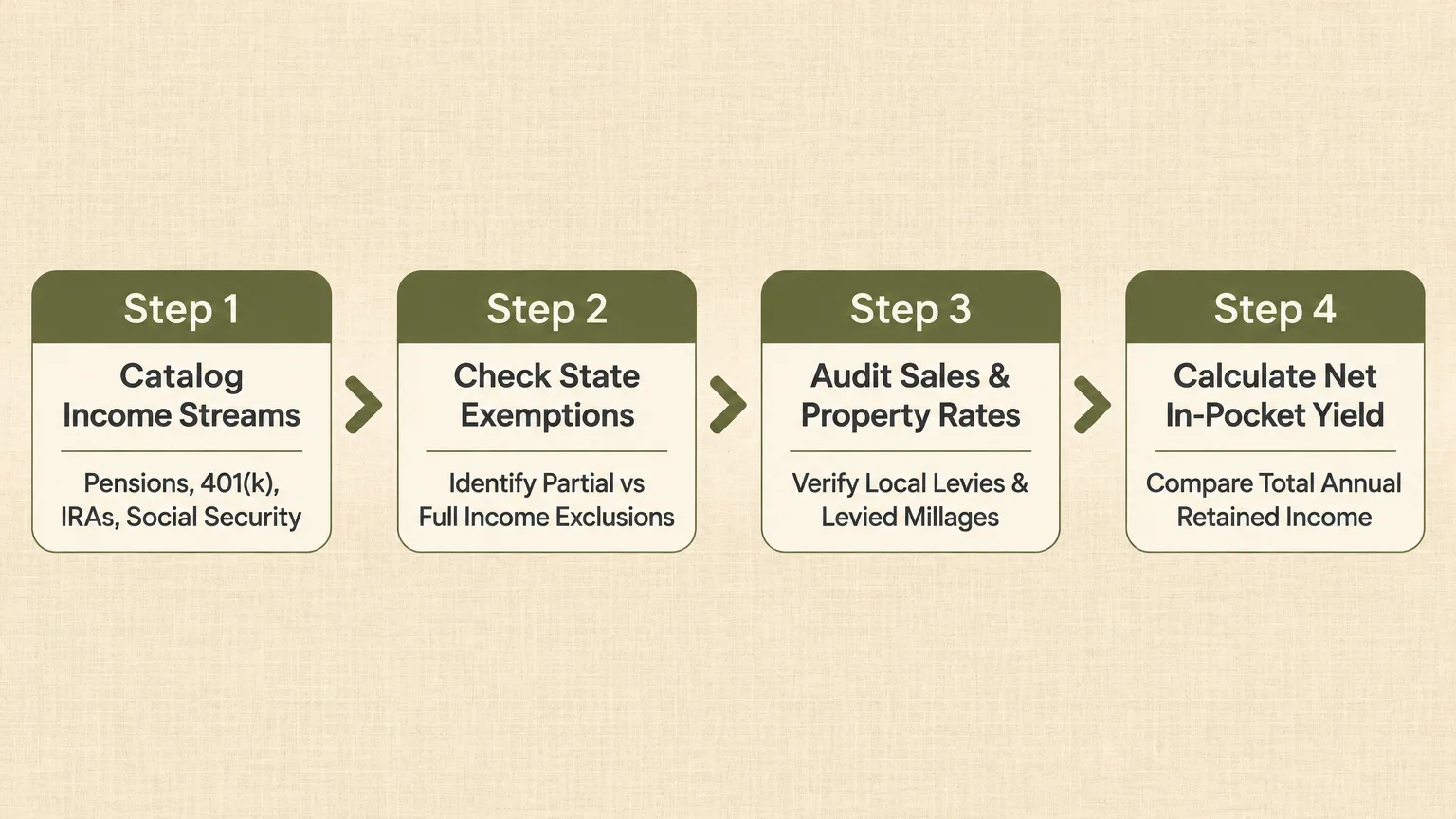
Pull out last year’s tax return this week and check two lines: your AGI and the state tax paid on your retirement income. Comparing those numbers against your state’s 2026 and 2027 rules takes fifteen minutes and shows immediately whether simple adjustments—like timing IRA withdrawals or updating withholding—can keep more of your Social Security working for you.
Retirement rules and benefit amounts vary based on individual work history, income, and circumstances. This article provides general guidance only. Consult a SHIP counselor, financial advisor, or elder law attorney for advice specific to your situation.
Last updated: November 2026. Medicare and Social Security rules change annually—always verify current details at official government sources.