The IRS announced substantial increases to the standard deduction for 2027, shielding thousands more of your retirement dollars from federal taxes. Married couples will see their baseline deduction climb to $33,200, while single filers receive a boost to $16,600.
Qualifying taxpayers age 65 and older capture even larger protections through layered age-based exemptions and enhanced senior deductions. These expanded thresholds give you significant leverage to offset inflation, manage investment withdrawals, and preserve your nest egg.
Understanding these mechanical shifts now allows you to structure income distributions and minimize taxes before filing season arrives. Here is exactly what these latest IRS updates mean for your household budget.
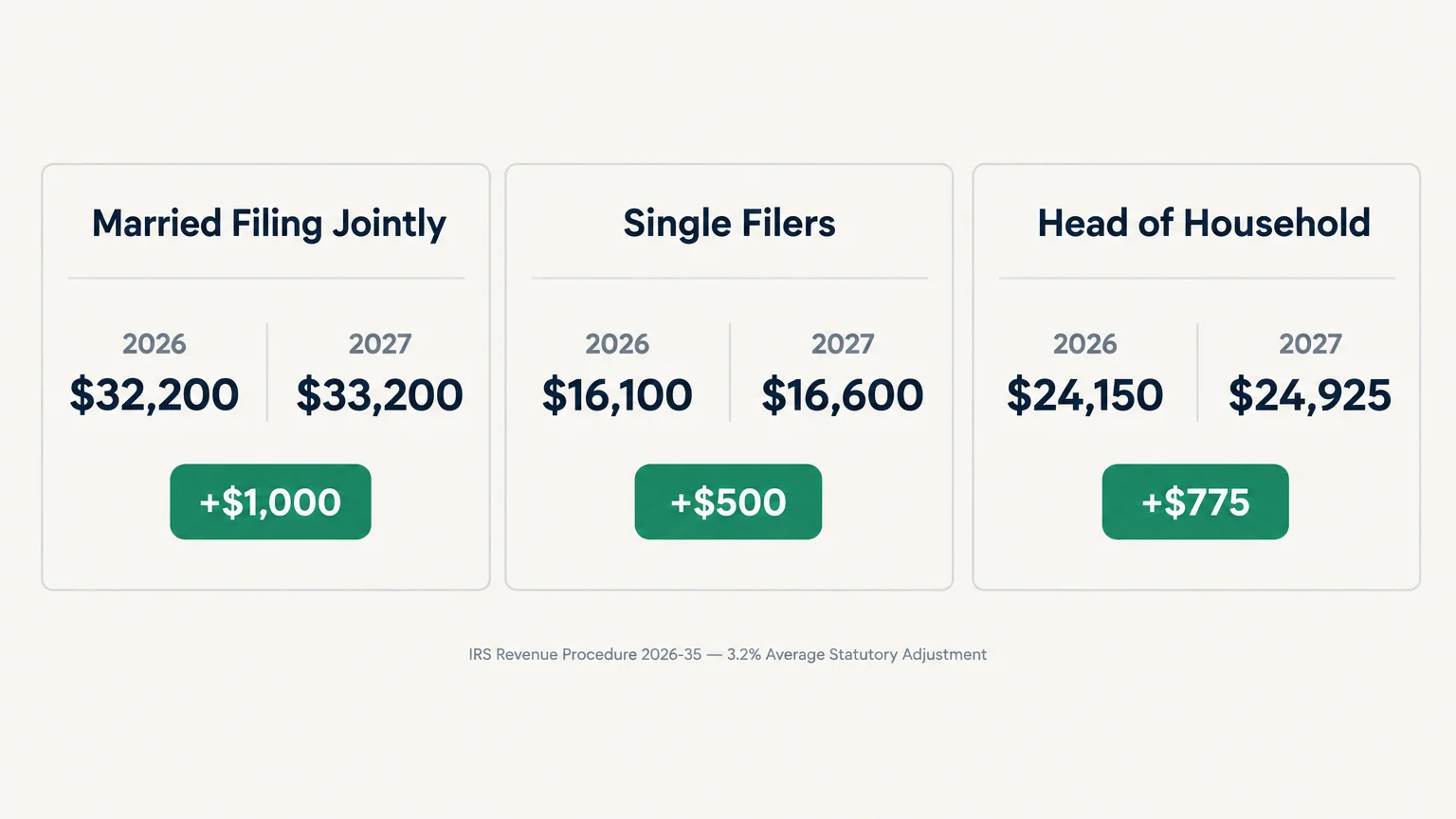
The 2027 Standard Deduction Increases at a Glance
On November 5, 2026, the IRS released Revenue Procedure 2026-35; this key document outlines the cost-of-living adjustments for the 2027 tax year. Taxpayers will use these updated amounts when filing their annual tax returns in early 2028.
Federal tax parameters increased by an average of about 3.2% across the board. This statutory adjustment accounts for persistent living costs that affect everyday household expenses.
For married couples filing jointly and surviving spouses, the base standard deduction rises to $33,200. That figure represents a clean $1,000 increase over the 2026 deduction level of $32,200.
Single filers and married individuals filing separately will see their standard deduction climb to $16,600. This adjustment delivers a $500 boost over the previous year’s $16,100 limit.
Taxpayers filing as heads of household receive an increase to $24,925 for 2027. This change reflects a $775 increase over the 2026 threshold of $24,150.
These baseline figures represent the portion of your annual income that completely escapes federal income tax. For most retirees, claiming the standard deduction remains far more lucrative and straightforward than itemizing individual write-offs.
Deduction Comparison: 2026 Versus 2027
Tracking the year-over-year changes helps you calculate your baseline tax liability with greater accuracy. The table below details the base amounts alongside the enhanced deductions available to older Americans.
| Filing Status | 2026 Base Deduction | 2027 Base Deduction | 2027 Combined Max (Age 65+) |
|---|---|---|---|
| Single | $16,100 | $16,600 | $24,700 |
| Married Filing Jointly (One Spouse 65+) | $32,200 | $33,200 | $40,900 |
| Married Filing Jointly (Both Spouses 65+) | $32,200 | $33,200 | $48,600 |
| Head of Household | $24,150 | $24,925 | $33,025 |
| Married Filing Separately | $16,100 | $16,600 | $24,300 |
As the table demonstrates, retirees age 65 and older enjoy substantially higher deduction limits than younger wage earners. Taking advantage of these layered benefits ensures you keep more money in your account.
Senior Tax Superchargers: The Age 65 and Older Advantage
Federal tax law provides an additional standard deduction specifically for taxpayers who reach age 65 by the close of the tax year. You also qualify for this additional deduction if you are legally blind.
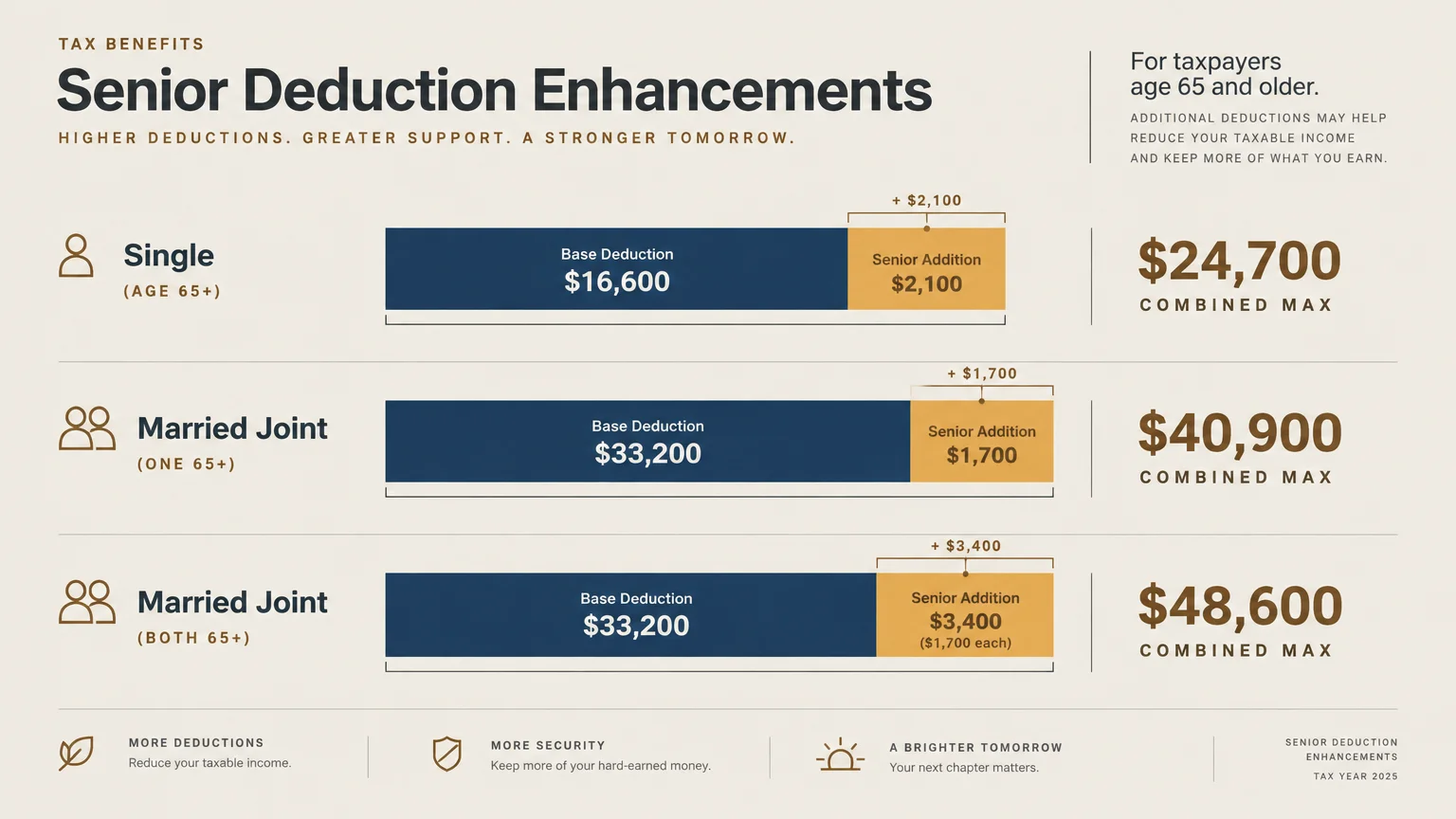
For the 2027 tax year, the additional standard deduction for unmarried seniors rises to $2,100. This marks a $50 increase over the $2,050 allowance in 2026.
If you are married and file jointly, the additional allowance rises to $1,700 per qualifying spouse. That is up $50 from the $1,650 level provided in 2026.
When both spouses are 65 or older, your joint return receives two additional allowances totaling $3,400. This is added directly on top of your $33,200 base deduction.
These additional exemptions require no itemized receipts or complex accounting records; you simply check the corresponding age box on IRS Form 1040. Checking that box immediately reduces your taxable income.
Understanding the $6,000 Senior Bonus Deduction Rules
Retirees also benefit from the enhanced Senior Bonus Deduction enacted under the Working Families Tax Cuts / One Big Beautiful Bill Act. This provision delivers a massive tax shield for middle-income older Americans.
The Senior Bonus Deduction provides a fixed $6,000 deduction per qualifying individual age 65 or older. Because Congress enacted this as a fixed statutory allowance for tax years 2025 through 2028, it does not adjust for inflation.
If you are a single senior age 65 or older, you claim this full $6,000 deduction alongside your other allowances. If you and your spouse are both 65 or older, you claim a combined $12,000 bonus deduction.
However, this bonus deduction includes strict income limits that you must monitor closely. The deduction begins phasing out once your Modified Adjusted Gross Income (MAGI) crosses specific thresholds.
For single filers, the phase-out starts at a MAGI of $75,000. For married couples filing jointly, the phase-out threshold begins at $150,000.
If your income exceeds these limits, your bonus deduction gradually reduces until it reaches zero. Retirees hovering near these income borders must manage their distributions carefully to avoid losing this valuable tax shield.
When you combine every available layer, qualifying single seniors age 65 or older can deduct up to $24,700 in 2027. That calculation blends the $16,600 base deduction, the $2,100 age deduction, and the $6,000 senior bonus.
For a qualifying married couple where both partners are at least 65, the total deduction reaches an unprecedented $48,600. That shields nearly fifty thousand dollars of retirement income from any federal income tax.
“It’s not how much money you make, but how much money you keep, how hard it works for you, and how many generations you keep it for.” — Robert Kiyosaki
Updated 2027 Federal Income Tax Brackets
Higher deductions work hand-in-hand with adjusted federal income tax brackets to prevent inflation from pushing you into higher tax rates. While the marginal rates remain unchanged at 10%, 12%, 22%, 24%, 32%, 35%, and 37%, the income thresholds expanded.
Reviewing these updated brackets allows you to forecast your exact tax liabilities on pension distributions, annuities, and retirement account withdrawals. The 2027 federal tax brackets apply as follows:
- 10% Bracket: Taxable income up to $12,800 for single filers; up to $25,600 for married couples filing jointly.
- 12% Bracket: Taxable income over $12,800 to $52,025 for single filers; over $25,600 to $104,050 for married couples filing jointly.
- 22% Bracket: Taxable income over $52,025 to $109,125 for single filers; over $104,050 to $218,250 for married couples filing jointly.
- 24% Bracket: Taxable income over $109,125 to $208,325 for single filers; over $218,250 to $416,650 for married couples filing jointly.
- 32% Bracket: Taxable income over $208,325 to $264,550 for single filers; over $416,650 to $529,100 for married couples filing jointly.
- 35% Bracket: Taxable income over $264,550 to $661,375 for single filers; over $529,100 to $793,650 for married couples filing jointly.
- 37% Bracket: Taxable income over $661,375 for single filers; over $793,650 for married couples filing jointly.
Because these brackets begin only after subtracting your standard deduction, your gross income can be significantly higher before you owe higher rates. This mechanism safeguards your purchasing power during retirement.

How the 2027 Deductions Protect Social Security and RMDs
Many retirees worry about paying taxes on their Social Security benefits. While the standard deduction does not alter the formula used to calculate taxable Social Security, it offsets the resulting liability.
Up to 85% of your Social Security benefits can become subject to income taxes if your provisional income exceeds certain thresholds. You can monitor your benefit estimates through the Social Security Administration website.
When taxable Social Security flows onto your Form 1040, your standard deduction absorbs those dollars. A single senior with $24,700 in total deductions can offset thousands in taxable retirement income.
The higher deduction thresholds also cushion the tax impact of Required Minimum Distributions (RMDs) from traditional IRAs and 401(k) plans. RMDs count as ordinary taxable income during the year you withdraw them.
If you take an RMD, your elevated 2027 standard deduction neutralizes a larger portion of that mandatory distribution. This helps keep you within the lower 10% or 12% marginal tax brackets.
For retirees evaluating broader financial assistance, exploring programs through BenefitsCheckUp can uncover additional ways to lower health and utility expenses. Combining reduced living expenses with lower tax obligations maximizes your disposable cash.
Strategic Roth IRA Conversions Under the New Thresholds
The expanded 2027 deduction limits create an ideal environment for strategic Roth IRA conversions. Converting funds from a traditional IRA to a Roth IRA requires paying taxes today in exchange for tax-free growth forever.
If your deductions exceed your guaranteed income, you have what planners call “empty tax bracket space.” You can convert traditional retirement assets up to the edge of your deduction without owing any federal tax.
For instance, a married couple age 65 or older with $35,000 of fixed income could convert over $13,000 to a Roth tax-free. Their $48,600 standard deduction shields the entire distribution from taxation.
Even if you convert amounts beyond your deduction, the widened 10% and 12% brackets keep the tax cost relatively low. Converting assets within the 12% bracket protects your heirs from receiving taxable inherited accounts.
Official rules regarding retirement contribution limits and conversion mechanics are detailed under IRS Retirement Plans guidelines. Reviewing these rules ensures your conversion strategies comply with current regulations.
“The goal of retirement is to live off your assets—not live off your regrets.”

Estate and Gift Tax Thresholds for Generational Wealth
The IRS inflation adjustments for 2027 also include major updates to estate and lifetime gift tax exclusions. These figures are vital if you plan to transfer wealth to children or grandchildren.
The annual gift tax exclusion rises to $20,000 per recipient for the 2027 calendar year. This allows you to give up to $20,000 to as many individuals as you wish without filing a gift tax return.
If you are married, you and your spouse can combine allowances to gift up to $40,000 per recipient each year. Gifting removes future asset growth from your taxable estate while supporting family members immediately.
Meanwhile, the basic federal estate tax exclusion amount increases to $15.48 million per individual for decedents dying in 2027. A married couple can shield up to $30.96 million through portability elections.
These historically high exemptions give retirees broad flexibility when designing their legacy plans. Leveraging annual gifts alongside standard deductions ensures efficient wealth preservation across generations.
Common Retirement Traps
While larger deductions benefit taxpayers, navigating these rules requires vigilance. Many retirees fall into avoidable traps that inadvertently trigger higher tax bills or reduce their deductions.
The first trap involves crossing the Senior Bonus Deduction phase-out threshold without realizing it. Because the phase-out starts at $75,000 for single filers and $150,000 for couples, a sudden withdrawal can erase this $6,000 or $12,000 deduction.
Another common mistake is attempting to itemize deductions when the standard deduction is far larger. Many homeowners continue tracking mortgage interest and property taxes out of habit, even when itemizing no longer makes sense.
Unless your total deductible expenses exceed $16,600 for singles or $33,200 for married couples, claiming the standard deduction remains your best choice. For seniors claiming enhanced deductions, beating the standard deduction through itemizing is exceptionally rare.
Retirees also make errors when calculating the tax impact of selling taxable investments or real estate. A large capital gain boosts your MAGI, which can disqualify you from the senior bonus deduction and trigger Medicare surcharges.
Educational resources from the Consumer Financial Protection Bureau offer helpful guidance on managing debt and retirement income. Staying informed helps you sidestep unexpected tax liabilities.

When to Consult a Professional
Tax regulations grow increasingly complex as your retirement income shifts between Social Security, pensions, annuities, and investments. Working with certified experts ensures you make optimal decisions for your situation.
Consider consulting a Certified Public Accountant (CPA) or Enrolled Agent (EA) if your income hovers near the $75,000 or $150,000 bonus phase-out lines. These professionals can model withdrawal scenarios to keep your deductions intact.
A fee-only financial planner can help coordinate Roth conversions, charitable gifts, and RMD distributions across multiple tax years. Their guidance ensures you maximize your standard deductions without triggering higher Medicare premiums.
If your estate approaches federal or state exemption thresholds, consult an elder law attorney or estate planner. They can establish trusts and transfer strategies that protect your assets for your beneficiaries.
For questions about healthcare expenses and Medicare choices, connect with a local State Health Insurance Assistance Program (SHIP) counselor. SHIP counselors provide free, unbiased guidance on Medicare options in your community.
Frequently Asked Questions About the 2027 Tax Rules
Do I have to do anything special to receive the higher standard deduction?
No, you do not need to submit special applications to claim the base standard deduction. You simply select the standard deduction option when filing your 2027 tax return in early 2028.
How do I claim the extra standard deduction for seniors age 65 and older?
You claim the age 65+ deduction by checking the designated age box on the first page of Form 1040. Checking this box automatically applies the additional $2,100 or $1,700 deduction to your calculation.
Will the Senior Bonus Deduction continue after 2028?
Under current statutory law, the $6,000 Senior Bonus Deduction is authorized only through the 2028 tax year. Congress must pass new legislation to extend or make the provision permanent before it expires.
Does the standard deduction reduce my Medicare Part B or Part D premiums?
No, the standard deduction does not lower your Modified Adjusted Gross Income for Medicare calculations. Medicare premium surcharges rely on your MAGI from two years prior before deductions are applied.
Taking Action on Your 2027 Retirement Tax Strategy
The expanded 2027 IRS standard deductions provide substantial relief against inflation and rising living costs. With base amounts climbing to $33,200 for couples and $16,600 for singles, retirees hold powerful tools to protect their money.
Take time now to review your distribution schedules, assess your income thresholds, and consider Roth conversions while tax brackets remain accommodating. Proactive tax management today guarantees that more of your hard-earned savings remain where they belong—in your hands.
Retirement rules and benefit amounts vary based on individual work history, income, and circumstances. This article provides general guidance only. Consult a SHIP counselor, financial advisor, or elder law attorney for advice specific to your situation.
Last updated: November 2026. Medicare and Social Security rules change annually—always verify current details at official government sources.