When one spouse retires while the other keeps working, claiming Social Security at the wrong time can permanently shrink your household income. Hidden rules around spousal benefits, the earnings test, and federal taxes catch many staggered-retirement couples off guard.
A working partner’s paycheck can freeze monthly checks, inflate tax bills, and trigger steep Medicare surcharges. Even worse, an early claim can cut future survivor payments for the partner left behind.
Understanding how these rules interact lets you coordinate both timelines before filing. You can protect your monthly cash flow today without sacrificing lifetime retirement security.
Key Takeaways for Couples Retiring at Different Times
Before either of you submits an application, review these five realities that govern staggered Social Security claims:
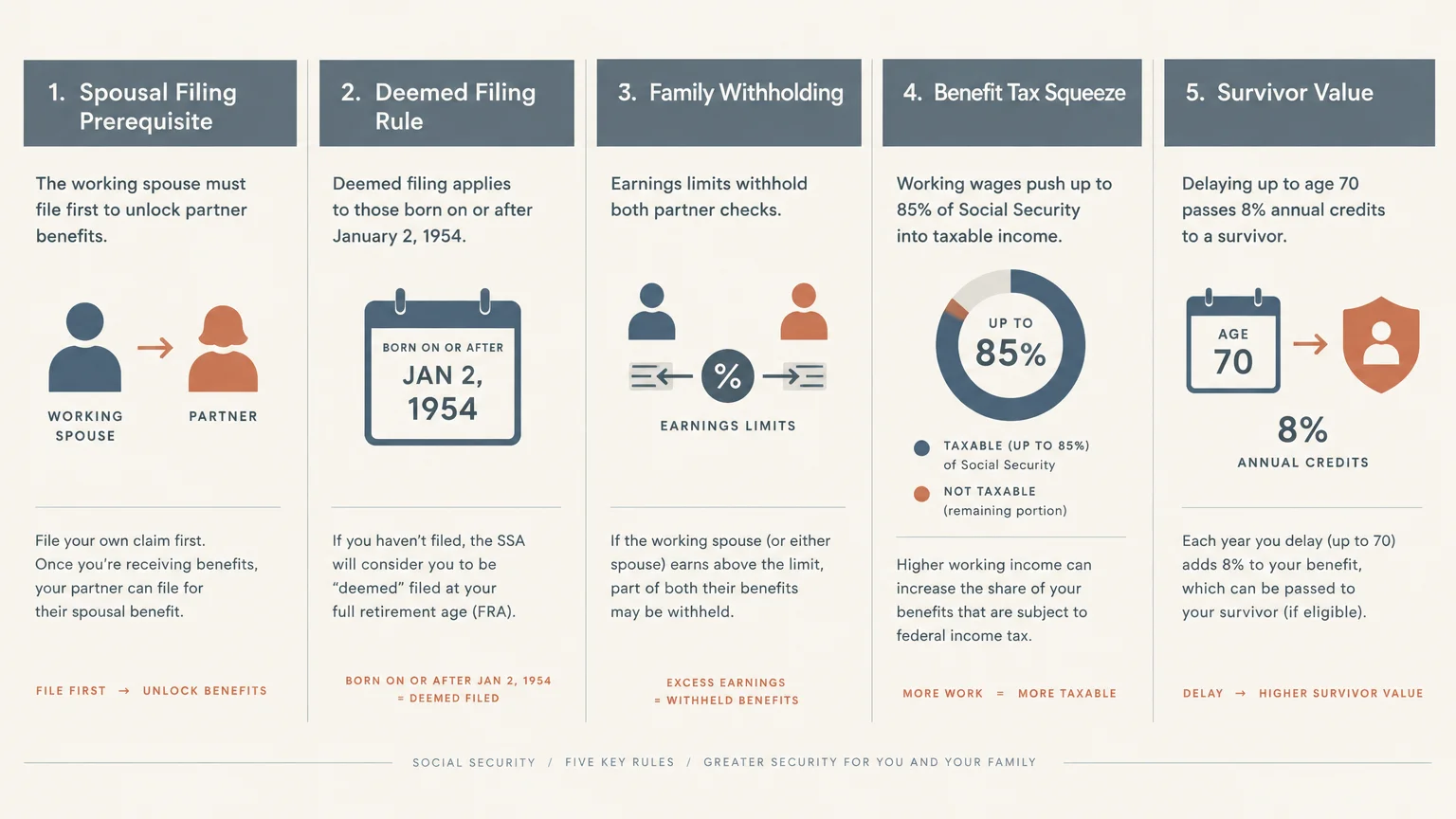
- Spousal benefits require a filing first: A retired spouse generally cannot collect spousal benefits until the working partner actually files for their own retirement benefit.
- Deemed filing removes spousal-only claims: Anyone born on or after January 2, 1954, automatically applies for both own-record and spousal benefits whenever claiming either one.
- Family withholding cuts two checks: If a working spouse claims before full retirement age and exceeds earnings limits, Social Security withholds both the worker’s and the spouse’s payments.
- One paycheck drives up benefit taxes: A working spouse’s salary on a joint return easily pushes up to 85% of the retired spouse’s Social Security into taxable income.
- Survivor protection hinges on the higher earner: Delaying the higher earner’s claim up to age 70 passes permanent 8% annual credits to the surviving partner.
Why Staggered Retirement Trips Up Social Security Couples
Roughly half of Americans aged 65 and older live in households where Social Security supplies at least 50% of total family income. About one-quarter rely on those monthly payments for 90% or more of their income.
When both partners leave the workforce together, coordinating benefits feels straightforward. Staggered retirements complicate that math because one spouse still earns wages while the other needs replacement income right away.
In 2026, the average retired worker receives $2,095 per month, rising by $75 to $2,170 in January 2027 after the 3.6% cost-of-living adjustment. For an aged couple both receiving benefits, average monthly payments rise by $117, from $3,238 to $3,355.
Those averages mask wide swings based on claiming age. Full retirement age is 66 and 10 months for people born in 1959, and 67 for anyone born in 1960 or later.
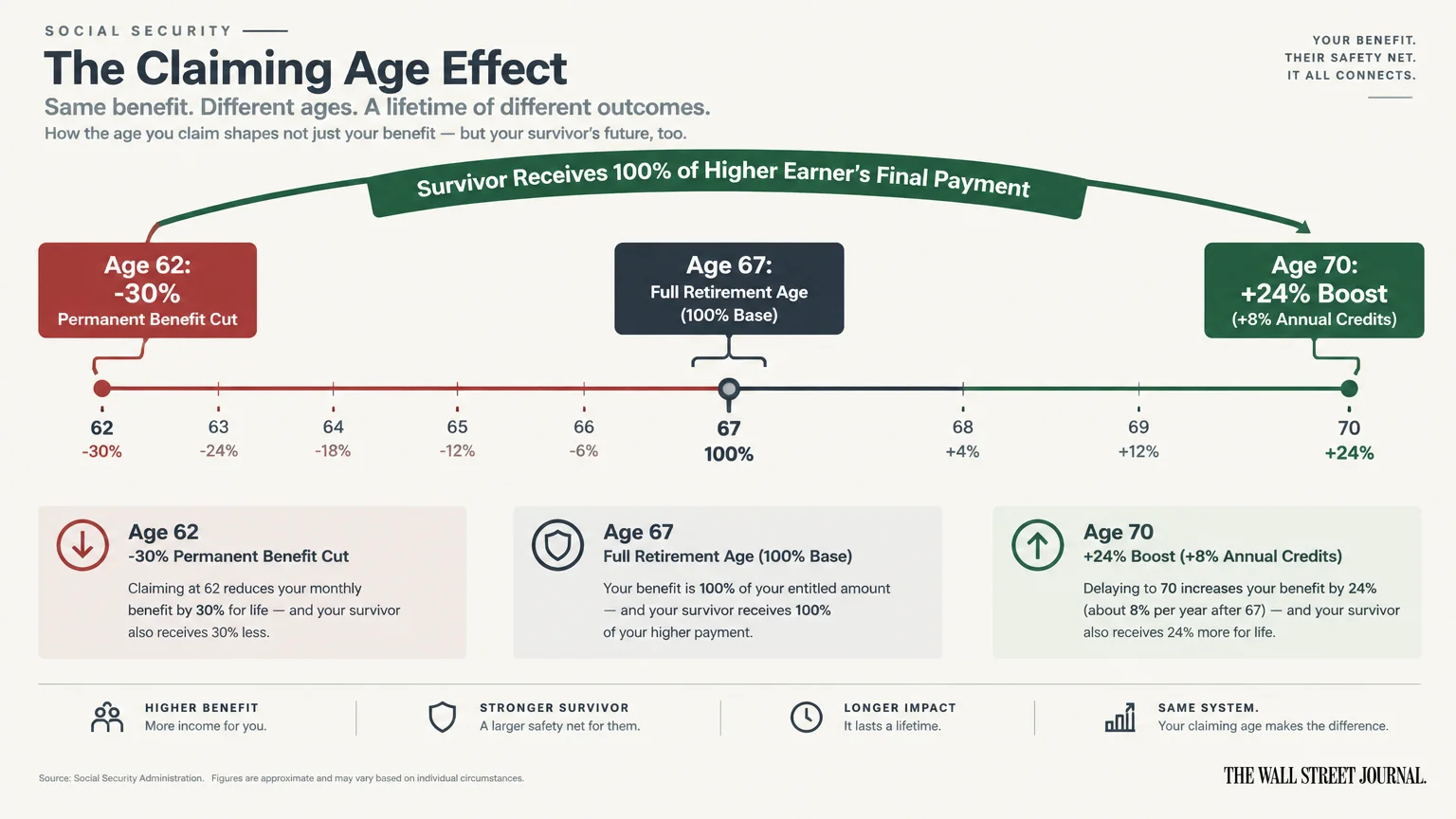
Claiming at age 62 permanently cuts your own benefit by 30% when your full retirement age is 67. Waiting past full retirement age adds two-thirds of 1% per month, or 8% per year, boosting payments by 24% at age 70.
Notice how the rules also shift slightly around the calendar. Anyone born on January 1 uses the prior birth year when determining their full retirement age.

The Spousal Benefit Catch When the Higher Earner Keeps Working
Many couples expect the lower-earning spouse to retire first and draw spousal benefits while the higher earner keeps working. Social Security rules block that plan immediately.
A married spouse cannot collect spousal benefits on a partner’s work record until the working spouse files for their own retirement benefit. By contrast, an independently entitled divorced spouse from a marriage lasting at least 10 years can claim even before an ex-spouse files.
Some couples try to work around that requirement by having the working partner file solely to unlock spousal checks. Two rule changes over the past decade closed those older loopholes.
Deemed Filing Locks In Both Benefits at Once
Under rules enacted in 2015, anyone born on January 2, 1954, or later faces deemed filing at every age, including at or after full retirement age. You cannot claim a spousal benefit at 67 while letting your own retirement benefit grow to 70.
Whenever you apply for either your own retirement check or a spousal check, the Social Security Administration forces an automatic application for both. The agency pays your own earned benefit first and adds a spousal supplement only if that spousal rate is higher.
Voluntary Suspension Freezes Family Checks Too
Years ago, a worker could file at full retirement age to unlock spousal checks and immediately suspend their own payment to earn delayed credits. That option ended for suspension requests submitted on or after April 30, 2016.
Under current rules, suspending your own retirement benefit also suspends all spousal and family benefits payable on your record. Only an eligible divorced spouse can continue collecting while you suspend your benefit.
Spousal Benefit Caps and Early Reductions
A full spousal benefit equals up to 50% of the working spouse’s primary insurance amount at full retirement age. Spousal checks never earn delayed retirement credits, even if the working spouse waits until age 70 to file.
Claiming spousal benefits before your own full retirement age permanently shrinks that percentage. Social Security reduces the benefit by 25/36 of 1% per month for the first 36 months early, and 5/12 of 1% for earlier months.
If your full retirement age is 67 and you claim at 62, your spousal benefit drops to as little as 32.5% of your partner’s full benefit. One exception spares spouses caring for a qualifying child under age 16 or a child with a disability.
Public-sector couples also recently regained access to full spousal benefits. The Social Security Fairness Act, signed January 5, 2025, eliminated both the Windfall Elimination Provision and the Government Pension Offset retroactively for benefits payable after December 2023.
Spouses and survivors receiving non-covered government pensions no longer lose spousal benefits to the prior two-thirds reduction. If one of you worked in covered private employment and the other holds a government pension, review your updated benefit eligibility right away.
The Social Security Earnings Test and the Family Withholding Trap
Suppose the working spouse decides to claim retirement benefits before full retirement age simply to unlock spousal payments for a retired partner. That move triggers one of the steepest traps in the system: the Retirement Earnings Test.
Whenever you collect Social Security before full retirement age and keep earning wages, the agency withholds benefits above strict annual limits. Those exempt thresholds rise each year alongside inflation:
- Under full retirement age for the entire year: The exempt limit is $24,480 ($2,040 per month) in 2026 and $25,560 ($2,130 per month) in 2027. Social Security withholds $1 in benefits for every $2 earned above the limit.
- Year you reach full retirement age: The exempt limit increases to $65,160 ($5,430 per month) in 2026 and $67,920 ($5,660 per month) in 2027. Only earnings from months before your full retirement age month count, with $1 withheld for every $3 over.
- Month reaching full retirement age and later: The earnings limit disappears completely once you hit your full retirement age month. You can earn any salary without triggering benefit withholding.
Here is the trap that blindsides couples retiring at different times. If the still-working spouse claims before full retirement age and earns above the limit, their excess wages charge against the entire family benefit on that record.
That means Social Security withholds both the working spouse’s check and the retired spouse’s spousal payment. A single high salary can wipe out both monthly checks until the working partner quits or hits full retirement age.
However, a working spouse’s wages never reduce benefits that a retired partner collects strictly on their own work history. If you claim on your own record, only your personal wages count toward the earnings test.
Benefits withheld under the earnings test are not forfeited permanently. Upon reaching full retirement age, Social Security permanently raises your monthly check to credit the months in which payments were withheld, except for child-in-care benefits.
A special first-year monthly rule also helps workers retiring mid-year. During your first claiming year, Social Security pays full checks for any whole month your earnings stay under the monthly threshold, regardless of higher wages earned earlier that year.
Before submitting paperwork, run your exact birth years and earnings through the Social Security Retirement Estimator to see how withholding affects household cash flow.
Comparing Four Claiming Strategies When One Spouse Still Works
The table below compares common approaches when Spouse A retires at 62 while Spouse B keeps working toward full retirement age or beyond.
| Claiming Strategy | How Social Security Rules Apply | Best Household Fit | Primary Financial Risk |
|---|---|---|---|
| Retired spouse claims own record at 62; working spouse waits to 70 | Working spouse’s salary does not reduce retired spouse’s own check; higher earner builds 8% annual credits. | Retired partner needs income now and expects lower lifetime benefit than working partner. | Retired spouse locks in up to a 30% permanent cut on own record. |
| Working spouse claims before FRA to unlock spousal benefits | Earnings test applies to working spouse’s salary and withholds both worker and spousal checks above limits. | Working spouse earns under $24,480 (2026) or $25,560 (2027) part-time. | Full-time wages wipe out both checks and permanently shrink survivor benefits. |
| Retired spouse bridges gap with savings until working spouse reaches FRA | Both spouses avoid early-claiming cuts and earnings test withholding while waiting. | Couples with taxable brokerage or cash reserves to cover early retirement years. | Draining investment accounts earlier than planned if markets dip. |
| Retired spouse claims own record at FRA; working spouse delays to 70 | Deemed filing pays retired spouse’s full PIA first; survivor inherits higher earner’s age-70 boost later. | Retired spouse has savings to bridge ages 62 to 67 and seeks higher survivor floor. | Joint provisional income from working spouse still triggers benefit taxes. |
Survivor Benefits: Why the Higher Earner’s Timeline Matters Most
Choosing when to file is not just about maximizing monthly income while both of you are living. The higher earner’s claiming age sets the financial floor for whichever spouse lives longest.
A surviving spouse can claim survivor benefits as early as age 60, or age 50 with a qualifying disability, and at any age if caring for a child under 16 or disabled. Payments start at 71.5% at age 60 and reach 100% at the survivor’s full retirement age, plus a $255 lump-sum payment.
When the higher earner claims early reduced benefits, the widow’s limit caps what the surviving partner can ever collect. That rule reduces monthly payments for 33% of Social Security’s 8.1 million widow and widower beneficiaries.
Conversely, delaying the higher earner’s claim past full retirement age passes those delayed retirement credits directly to the survivor. Waiting until age 70 increases the surviving spouse’s maximum benefit by 24% when full retirement age is 67.
Even better, survivor benefits enjoy a major exception that retirement and spousal benefits do not share. Deemed filing does not apply to survivor claims.
A surviving spouse can claim a survivor benefit at age 60 or 62 while leaving their own retirement benefit untouched until age 70. Alternatively, a survivor with a smaller earned benefit can claim their own reduced check early and switch to a 100% survivor benefit at full retirement age.
Keep one caution in mind if a surviving spouse continues working. Social Security applies the annual earnings test using the survivor’s retirement full retirement age, even when survivor full retirement age differs slightly.
The Hidden Tax and Medicare Traps of One Paycheck Plus One Benefit
Even if your claiming strategy avoids earnings-test withholding, blending one full-time salary with one Social Security check creates immediate tax and healthcare surprises. Federal tax formulas treat mixed-income couples much more strictly than fully retired households.
Provisional Income Pushes Benefits Into the 85% Tax Tier
The Internal Revenue Service taxes Social Security using provisional income, which equals adjusted gross income plus tax-exempt interest plus 50% of combined benefits. Single filers face thresholds of $25,000 and $34,000, while joint filers face $32,000 and $44,000.
Once joint provisional income exceeds $32,000, up to 50% of your Social Security benefits become taxable. Above $44,000, up to 85% of your benefits count as taxable federal income.
A single full-time paycheck easily pushes a joint tax return past $44,000. That means the retired spouse loses a significant slice of their monthly benefit to higher federal income taxes while the working partner stays employed.
Filing separate returns almost never rescues couples from this trap. Married individuals filing separately who lived together at any time during the year face up to 85% benefit taxation starting at $0.
The 2025–2028 Senior Deduction Has a Staggered-Age Catch
Recent tax legislation added temporary relief for older Americans, yet couples retiring at different times often miss part of it. Under the One Big Beautiful Bill Act, taxpayers aged 65 or older by year-end receive an extra $6,000 deduction per eligible spouse for tax years 2025 through 2028.
Both spouses aged 65 or older filing jointly can claim up to $12,000, whether itemizing or taking the standard deduction. However, if the working spouse is under 65, your household receives only $6,000 instead of $12,000.
Income phaseouts create a second hurdle when one partner still earns a strong salary. The senior deduction begins phasing out at $150,000 in modified adjusted gross income for joint filers, or $75,000 single, and vanishes completely at $250,000 joint, or $175,000 single.
This temporary deduction also left the $32,000 and $44,000 Social Security taxation thresholds untouched. Check official updates at the IRS Retirement Plans page before estimating your net retirement check.
Ongoing Payroll Taxes While You Work
A spouse who keeps working continues paying Federal Insurance Contributions Act taxes on every paycheck, even while collecting Social Security. Workers pay the 6.2% Social Security tax—12.4% if self-employed—on earnings up to $184,500 in 2026 and $192,300 in 2027.
All earned wages also incur the 1.45% Medicare tax with no income cap. Joint filers pay an extra 0.9% Medicare surtax on combined earnings exceeding $250,000.
Medicare Part B Surcharges and the Two-Year Lookback
High household earnings also raise healthcare premiums for the retired spouse enrolled in Medicare. In 2026, the standard Medicare Part B premium is $202.90 per month with a $283 annual deductible, with trustees projecting $209.50 monthly for 2027.
Medicare determines Income-Related Monthly Adjustment Amount surcharges using your tax return from two years prior. For 2026 premiums, Medicare checks your 2024 modified adjusted gross income.
If a working spouse’s income pushed joint modified adjusted gross income above $218,000—or $109,000 for single filers—the retired partner pays surcharges on both Part B and Part D. Fortunately, work stoppage qualifies as a life-changing event.
Once the second spouse retires, file Form SSA-44 with Social Security to request a surcharge reduction based on your lower current income. You can review official premium tiers and enrollment rules anytime at Medicare.gov.

Smart Alternatives When Only One Spouse Retires
Retiring years apart does not force you into a poor claiming decision. Stepping back to coordinate cash flow, taxes, and survivor income turns a tricky transition into a durable plan.
Protecting the higher earner’s claiming timeline is often the strongest financial safeguard you can build for the surviving spouse, even when one partner retires years earlier.
- Have the retired lower earner claim first only if needed: If one paycheck cannot cover expenses, the retired partner can claim their own earned benefit while the higher earner works toward age 70.
- Bridge early retirement years with cash or taxable savings: Living on one salary plus savings allows both partners to delay Social Security past full retirement age and capture 8% annual credits.
- Target maximum benefit milestones thoughtfully: The maximum monthly benefit at full retirement age is $4,152 in 2026 and $4,188 in 2027, and delayed retirement credits stop growing at age 70.
- Time Roth conversions after the second retirement: Waiting to convert pre-tax retirement accounts until the working spouse stops earning avoids stacking extra income onto top tax brackets and Medicare surcharges.
- Submit Form SSA-44 promptly after final retirement: Proving a work stoppage removes two-year-old IRMAA surcharges tied to peak earning years.
Don’t Make These Mistakes
Misunderstanding one rule while one partner works can cost your household thousands of dollars in lost or taxed benefits. Watch closely to avoid these five common errors:
- Assuming you can file and suspend at full retirement age: Suspending your benefit under current rules freezes your spouse’s benefits on your record at the same time.
- Waiting to claim spousal benefits until age 70: Spousal benefits max out at 50% of the worker’s full retirement age benefit and never earn delayed credits past your own full retirement age.
- Filing separately to avoid benefit taxation: Living together and filing separate tax returns triggers up to 85% Social Security taxation starting at $0.
- Overlooking the family withholding rule: Having a working spouse claim before full retirement age to unlock spousal checks exposes both payments to the earnings test.
- Ignoring survivor impact when the higher earner files early: Taking reduced benefits at 62 permanently lowers the widow or widower benefit your spouse could depend on for decades.

When Professional Advice Is Worth It
Free calculators show basic monthly estimates, yet staggered retirements weave together Social Security timing, income taxes, and Medicare premiums. Spending a modest fee for personalized modeling before either spouse files often pays for itself many times over.
Consult a fee-only financial planner or Social Security claiming specialist if you have a wide age gap, uneven lifetime earnings, or substantial pre-tax savings. Modeling how one partner’s retirement date shifts provisional income and survivor cash flow takes coordinated projections.
Couples affected by the Social Security Fairness Act repeal of the Windfall Elimination Provision and Government Pension Offset should also verify benefit recalculations carefully. For free, unbiased Medicare enrollment and IRMAA guidance, contact your local State Health Insurance Assistance Program counselor.
You can also explore trustworthy planning guides and scam-prevention tools through the Consumer Financial Protection Bureau retirement portal.
Frequently Asked Questions
Does my working spouse’s income reduce my own Social Security check?
No, your spouse’s wages never reduce benefits you collect solely on your own work record. Only your personal earnings count toward the annual Retirement Earnings Test if you claim before full retirement age.
Can I collect spousal benefits while my husband or wife keeps working?
You generally cannot collect spousal benefits until your working partner files for their own retirement benefit. If they claim before full retirement age to unlock your spousal check, their excess wages can withhold both payments.
How does the 2027 COLA affect couples who claim at different times?
The 3.6% cost-of-living adjustment taking effect in January 2027 boosts existing payments and raises base amounts for eligible workers waiting to claim. Delaying your claim still adds 8% annual credits on top of yearly adjustments.
Can we appeal Medicare IRMAA surcharges once the second spouse retires?
Yes, retirement qualifies as a life-changing event that overrides Medicare’s two-year tax return lookback. File Form SSA-44 with proof of your spouse’s work stoppage so Social Security recalculates Part B and Part D premiums.
Take Your Next Step Together
Pull both Social Security statements this week and map out your exact ages, full retirement ages, and expected household expenses before either spouse files. Coordinating both timelines today protects your current cash flow, lowers unnecessary taxes, and secures lasting survivor income.
This article is for informational purposes only and does not constitute financial, legal, or medical advice. Medicare rules, Social Security benefits, and tax laws change regularly—verify current details at Medicare.gov, SSA.gov, or with a licensed professional.
Last updated: November 2026. Medicare and Social Security rules change annually—always verify current details at official government sources.