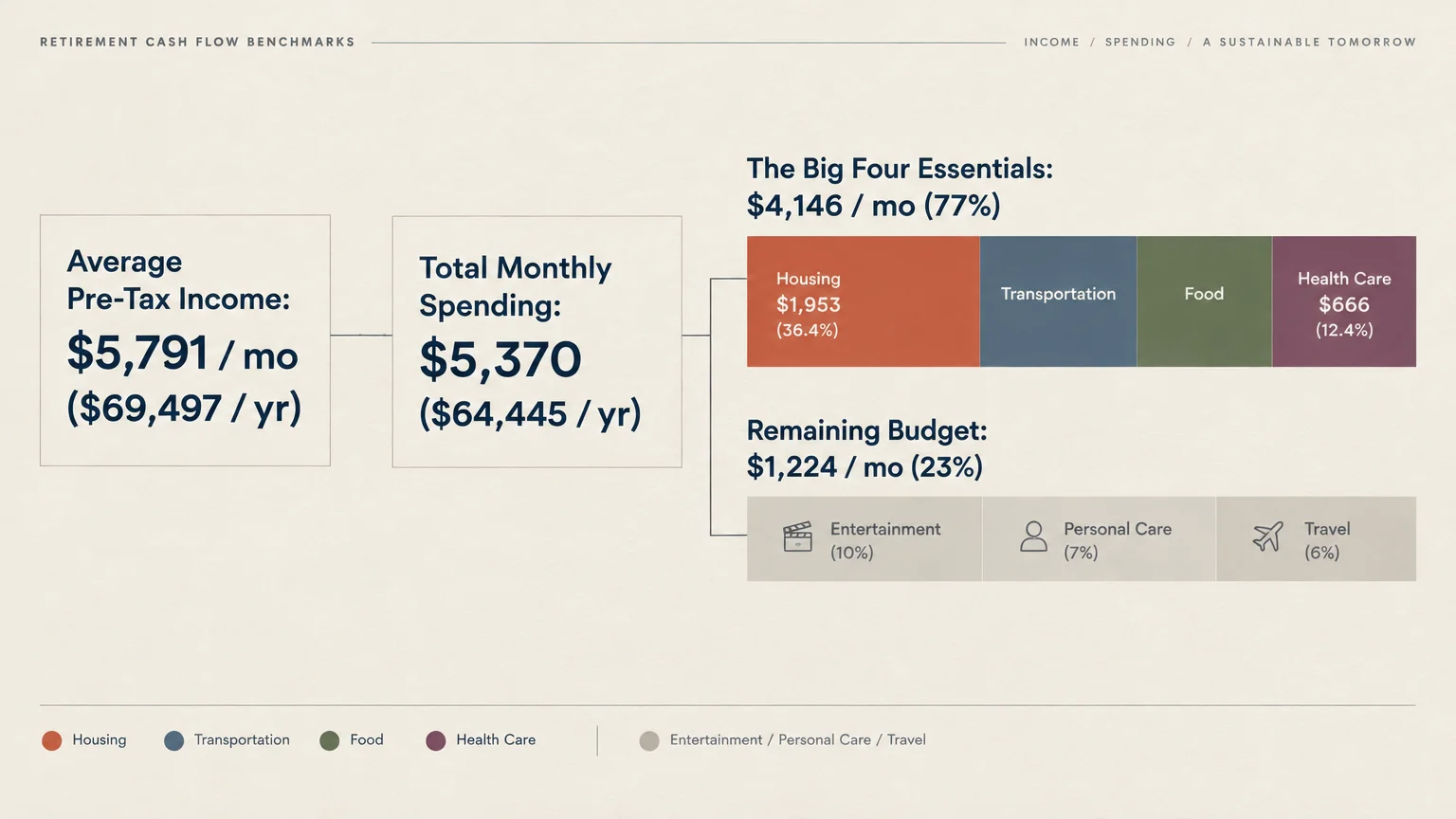
Planning your retirement budget often feels like aiming at a moving target. According to federal expenditure surveys, typical households headed by adults age 65 or older spend an average of $5,370 every month.
That amounts to $64,445 per year; this realistic baseline catches many retirees completely off guard. In fact, 41% of retirees report that their actual living expenses exceed their initial expectations.
Understanding where your money goes empowers you to protect your nest egg and live comfortably on your terms. Let us examine the exact monthly breakdown of retiree expenses today.
The Bottom Line Up Front
Retirement spending follows distinct patterns that shift as you age. While work-related costs vanish, other essential categories consume a larger share of your wallet.
Here are the key benchmarks defining retiree household budgets today:
- Total monthly spending: The average household age 65 and older spends $5,370 per month ($64,445 annually).
- Average pre-tax income: Older households collect an average of $5,791 per month ($69,497 per year) before taxes.
- The “Big Four” expenses: Housing, transportation, food, and health care consume 77% of all retiree spending—roughly $4,146 each month.
- Housing remains number one: Sheltering costs require $1,953 per month, accounting for 36.4% of your total budget.
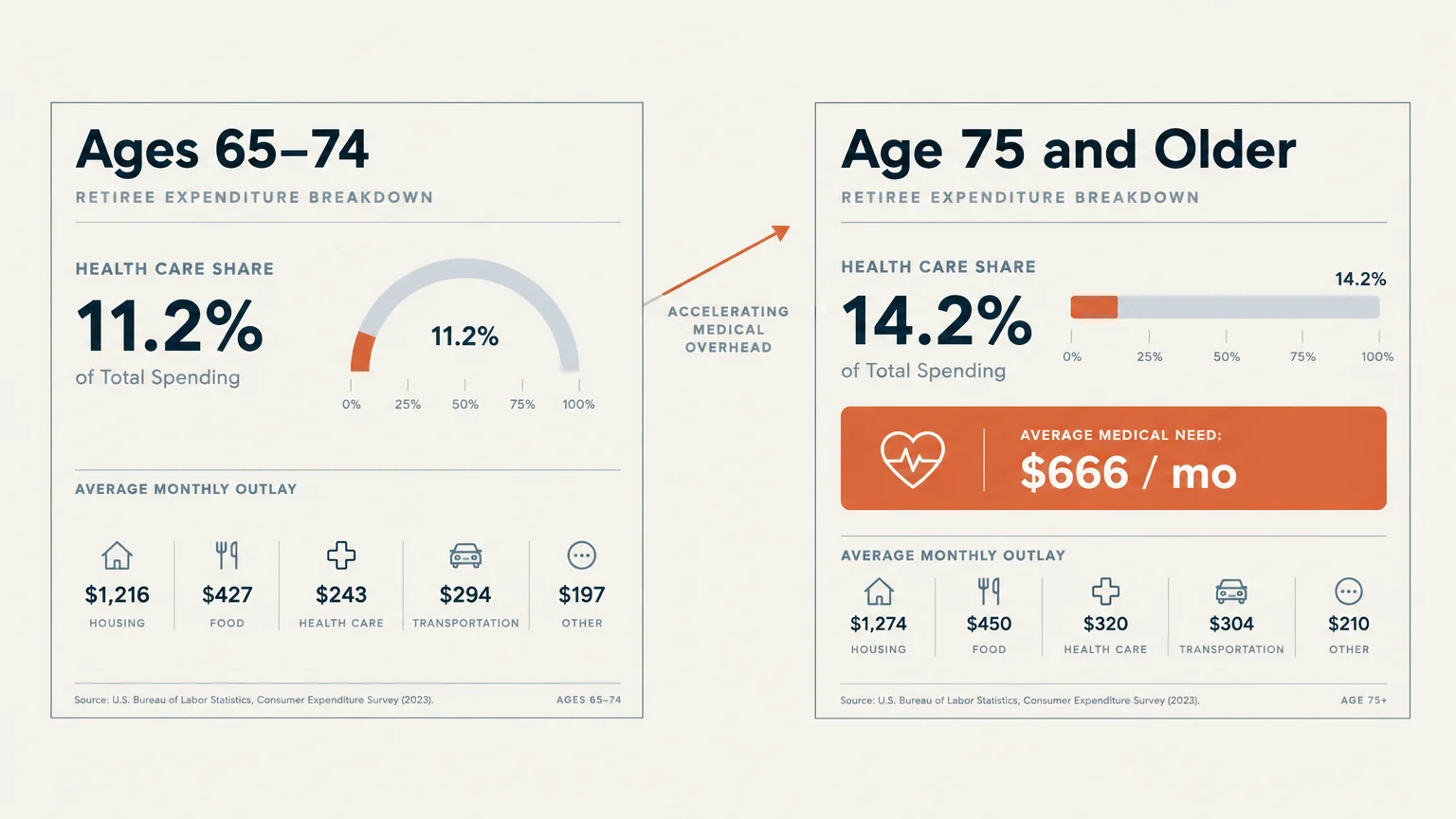
- Health care accelerates: Medical needs cost an average of $666 per month, rising from 11.2% of spending at ages 65–74 to 14.2% at age 75 and beyond.
Knowing these figures helps you stress-test your cash flow before unexpected bills arise.
The Big Four: Where 77% of Your Money Goes
Many pre-retirees assume spending drops by 30% or more the moment they stop working. Real spending data paints a much different picture.
You may eliminate commuter costs, business attire, and payroll taxes; however, basic survival needs remain non-negotiable. Housing, transportation, groceries, and medical treatments demand three out of every four dollars you spend.
Together, these essential categories account for approximately $4,146 per month. That leaves only $1,224 each month for entertainment, clothing, travel, charitable giving, and personal care.
When you build a spending plan, you must stabilize these core pillars first. Controlling your fixed overhead gives you the freedom to enjoy your retirement years without financial stress.
“The goal of retirement is to live off your assets—not live off your regrets.”
Housing Costs: Your Largest Line Item in Retirement
Housing remains your single largest expense in retirement, consuming $1,953 per month on average. That equals $23,430 annually, or 36.4% of your overall budget.
Many homeowners believe paying off their mortgage solves their housing worries. Yet 54% of households headed by adults 65 and older own their homes completely free of debt.
Despite having no monthly mortgage payment, these homeowners still face significant recurring costs. Property taxes, homeowners insurance, and general maintenance require $344 per month ($4,132 annually).
Utility bills, heating fuel, and public services demand another $390 per month ($4,680 per year). These utility bills rise steadily alongside regional energy rates.
As you age, housing claims an even larger portion of your resources. Housing expenses rise from 34.7% of total spending between ages 65 and 74 to 39.0% at age 75 and older.
If you rent your home, your monthly outlay is often higher and less predictable. You can review tenant rights and subsidized housing options through the Consumer Financial Protection Bureau (CFPB).

Transportation Expenses: High Initial Costs That Decline Over Time
Transportation ranks as your second-largest expense during the early retirement years. Older households spend an average of $842 per month, which totals $10,109 each year.
Vehicle independence remains vital for American retirees. In fact, 88% of households age 65 and older own or lease at least one vehicle.
Vehicle purchases represent a substantial portion of this expense, averaging $3,670 per year. Routine auto insurance adds another $1,734 annually, while gas and motor oil require $1,748 per year.
However, transportation is the single expense category that experiences the sharpest decline as you age. Between ages 65 and 74, retirees spend $1,007 per month ($12,082 per year) maintaining their mobility.
Once you reach age 75, that monthly figure drops to $627 per month ($7,523 per year). Retirees drive fewer miles, downsize to a single vehicle, or transition to local community transit.
Downsizing to one reliable car early in retirement can free up hundreds of dollars each month. You reduce registration fees, insurance premiums, and ongoing maintenance in a single move.
Food and Dining: Balancing Groceries and Social Meals
Older households spend an average of $686 per month on food, representing $8,226 per year. That equals 12.8% of your overall monthly budget.
Most of this spending goes toward groceries and cooking at home. The average retiree allocates $451 per month ($5,408 annually) to supermarket trips.
Dining out accounts for the remaining $235 per month ($2,818 per year). Restaurant meals serve as important social outings for retirees, offering leisure and connection with friends.
Smart grocery shopping can immediately lower your monthly food bill. Buying seasonal produce, using store loyalty programs, and preparing meals in bulk create noticeable savings.
You can also check community resources if food inflation strains your fixed monthly income. The National Council on Aging (NCOA) connects older adults with local assistance programs.
Health Care Realities: The Cost That Grows With Age
Health care requires an average of $666 per month ($7,986 per year) for older American households. This represents 12.4% of typical retiree spending.
By comparison, health care accounts for only 7.9% of spending across the general U.S. population. Health expenses accelerate as you age, making medical costs a primary threat to your savings.
Health insurance premiums make up approximately two-thirds of your entire medical outlay. Retirees spend an average of $451 per month ($5,406 annually) just on insurance coverage.
Direct medical services, including doctor visits and diagnostic tests, cost another $119 monthly ($1,429 per year). Prescription drugs add an average of $70 per month ($837 annually).
Between ages 65 and 74, health care averages $7,793 annually, or 11.2% of total spending. At age 75 and older, health costs jump to $8,238 per year, or 14.2% of the budget.
This surge causes health care to overtake transportation as the second-largest expense for older seniors. Budgeting realistically for medical inflation protects your portfolio from late-life shocks.
Medicare Costs and Prescription Drug Benchmarks
Enrolling in Medicare does not mean your medical care becomes free. Understanding your baseline Medicare obligations helps you budget accurately each month.
For 2026, the standard Medicare Part B premium is $202.90 per month, with an annual deductible of $283. Projections from Medicare Trustees place the standard 2027 Part B premium at approximately $209.50 monthly.
High-income retirees pay higher Part B premiums through Income-Related Monthly Adjustment Amounts (IRMAA). In 2026, IRMAA surcharges apply to single filers with income above $109,000 and joint filers over $218,000.
Prescription drug pricing reforms provide meaningful relief for retirees taking maintenance medications. Under the Inflation Reduction Act, negotiated lower prices for the first 10 Medicare Part D drugs took effect on January 1, 2026.
Negotiated prices for an additional 15 Part D medications take effect on January 1, 2027. You can evaluate your plan choices each year through official tools at Medicare.gov.
“The best time to plan for retirement was 20 years ago. The second best time is today.”
The Spending Arc: How Costs Shift From Age 65 to 75 and Beyond
Retirement spending is not static; it changes dramatically across three distinct phases. Financial planners often describe these phases as your go-go, slow-go, and no-go retirement years.
Before retirement, households aged 55 to 64 earn an average pre-tax income of $125,333 and spend $84,946 annually. Once you retire, your lifestyle and spending contract naturally.
During the early retirement years (ages 65 to 74), average spending drops to $69,333 per year ($5,778 monthly). During this active period, you travel more, pursue hobbies, and dine out frequently.
At age 75 and older, overall spending drops further to $57,959 per year ($4,830 monthly). Travel and vehicle spending decline significantly, while health care and in-home assistance costs climb.
Your income drops alongside your expenses in later life. Average pre-tax income falls from $78,221 per year at ages 65–74 down to $58,124 per year at age 75 and older.
| Expense Category | Ages 65–74 (Monthly / Annual) | Ages 75+ (Monthly / Annual) | Shift Over Time |
|---|---|---|---|
| Housing | $2,004 / $24,050 (34.7%) | $1,884 / $22,604 (39.0%) | Higher share of budget |
| Transportation | $1,007 / $12,082 (17.4%) | $627 / $7,523 (13.0%) | Substantial decrease |
| Food | $741 / $8,892 (12.8%) | $609 / $7,308 (12.6%) | Moderate decrease |
| Health Care | $649 / $7,793 (11.2%) | $687 / $8,238 (14.2%) | Steady increase |
| Other Spending | $1,377 / $16,516 (23.9%) | $1,023 / $12,286 (21.2%) | General decline |
| Total Spending | $5,778 / $69,333 | $4,830 / $57,959 | 16.4% overall drop |
This spending table illustrates why front-loading your discretionary travel makes mathematical sense. Your desire and ability to travel often diminish just as medical costs begin to rise.
Bridging the Social Security Income Gap
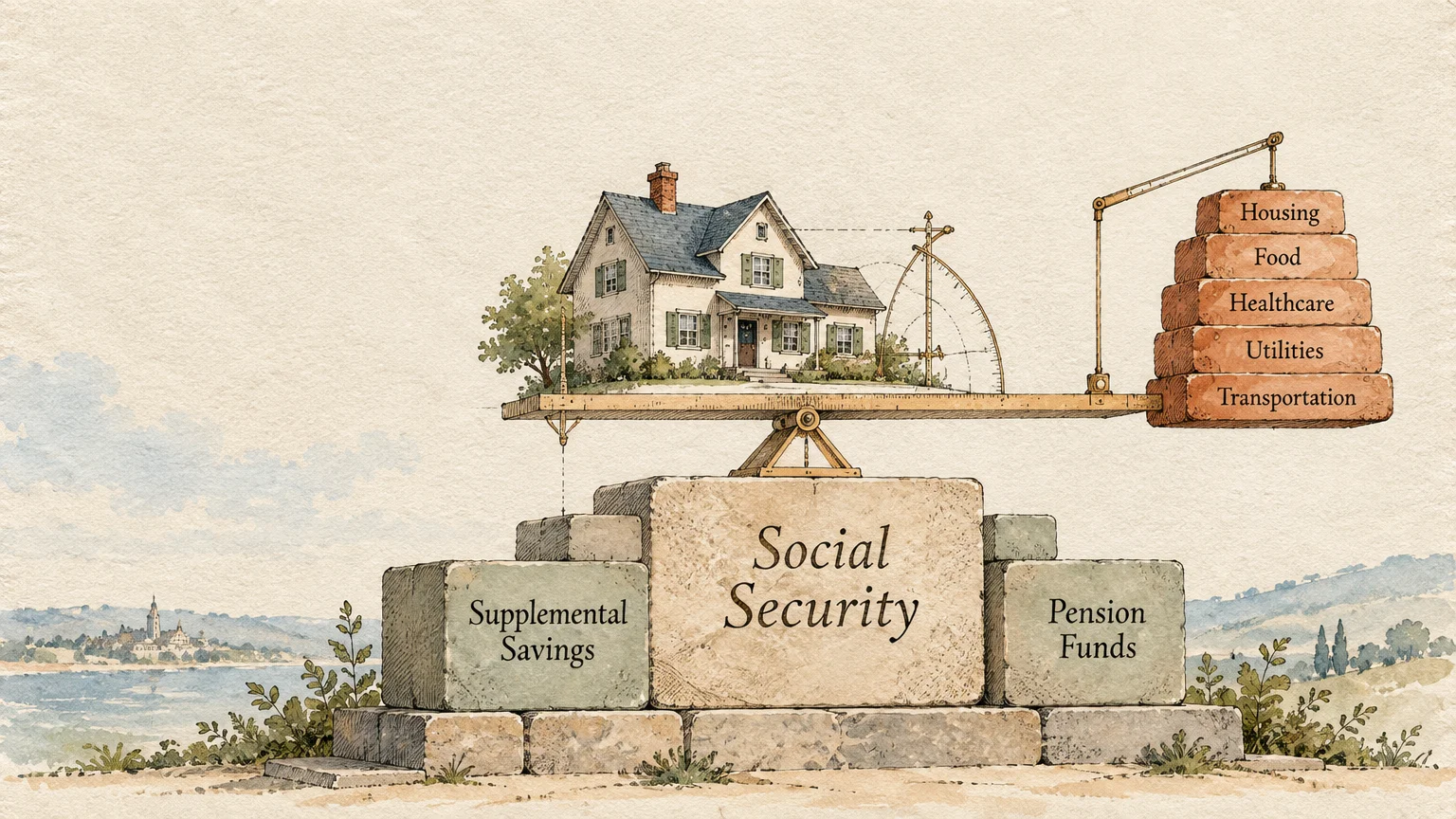
Social Security provides a reliable income floor, but it rarely covers all monthly retiree spending. Understanding your exact monthly benefit shortfall is essential for long-term survival.
In October 2026, the SSA announced a 3.6% Cost-of-Living Adjustment (COLA) for 2027, up from 2.8% in 2026. This adjustment increases monthly checks across the country.
The average retired worker benefit rises by about $76 per month, moving from $2,094 in late 2026 to $2,170 in January 2027. For a retired couple where both receive benefits, the average payment rises from $3,237 to $3,354.
Compare those checks to the typical retiree spending figure of $5,370 per month. An average individual retiree faces a monthly deficit of $3,200 without supplementary income.
Even an average retired couple receiving $3,354 per month faces an ongoing gap of over $2,000 every month. You must bridge this difference with personal pensions, traditional IRAs, 401(k) accounts, or part-time earnings.
Check your estimated payments and personal earnings history directly on the Social Security Administration (SSA) website. Reviewing your earnings record prevents surprise deficits when you retire.
Don’t Make These Mistakes
Navigating retirement expenses requires dodging several common financial traps. Avoiding these errors keeps your monthly cash flow secure and predictable.
1. Assuming a paid-off mortgage eliminates housing expenses: Even without a mortgage, property taxes, insurance, and repairs cost $344 per month. Set aside dedicated funds each month for annual property tax bills and home maintenance.
2. Forgetting that Medicare premiums change annually: Medicare Part B premiums are deducted directly from your Social Security benefit check. A premium increase can consume a significant portion of your annual Cost-of-Living Adjustment.
3. Underestimating out-of-pocket health care expenses: Traditional Medicare excludes routine dental cleanings, vision exams, and hearing aids. Failing to budget for these services forces many seniors to tap emergency reserves unexpectedly.
4. Claiming Social Security too early to cover debt: Claiming at age 62 permanently slashes your monthly benefit by up to 30%. Delaying your claim builds a higher, inflation-protected monthly income floor for your later years.
5. Ignoring late-life health transitions: Health care rises to 14.2% of total expenses after age 75. Failing to account for in-home care or assisted living costs can derail an otherwise healthy retirement plan.

When Professional Advice Is Worth It
Managing a complex monthly budget across multiple retirement accounts can feel overwhelming. Seeking professional guidance helps you optimize withdrawals and reduce costly mistakes.
Work with a Medicare counselor (SHIP): State Health Insurance Assistance Programs provide free, unbiased counseling on Medicare plan options. A SHIP counselor helps you select prescription drug plans that cover your specific medications.
Consult a fee-only fiduciary financial advisor: Fiduciary advisors hold a legal obligation to act in your best interest. They can design a tax-efficient withdrawal strategy to fund your $5,370 monthly baseline without triggering IRMAA surcharges.
Speak with an elder law attorney: An elder law specialist helps you structure assets to protect against long-term care costs. They establish powers of attorney, health directives, and trusts to secure your estate.
Consult a Social Security claiming specialist: Claiming strategies for married couples, divorced spouses, and surviving partners are complex. A specialist ensures you maximize your lifetime household benefit before locking in your claim.
Frequently Asked Questions
How much does the average retiree spend per month in the United States?
Households headed by adults age 65 and older spend an average of $5,370 per month ($64,445 annually). Households aged 65 to 74 spend about $5,778 monthly, while those 75 and older spend approximately $4,830 per month.
Why do housing costs remain high for retirees who own their homes?
Even without a monthly mortgage payment, homeowners face ongoing taxes, insurance, and utilities. Average utilities cost $390 per month, while property taxes, maintenance, and insurance demand another $344 every month.
How does monthly spending change between age 65 and age 75?
Overall spending drops by about 16% as retirees age, falling from $5,778 monthly at ages 65–74 to $4,830 at age 75 and older. Transportation costs drop sharply, while health care increases from 11.2% to 14.2% of the budget.
Will Social Security cover my average monthly expenses in retirement?
Social Security alone rarely covers average spending. In 2027, the average retired worker benefit is approximately $2,170 per month, leaving a substantial gap compared to the typical monthly budget of $5,370.
What is the largest health care expense for retirees?
Health insurance premiums represent about two-thirds of all out-of-pocket medical spending for retirees, averaging $451 per month. Direct medical services and prescription drugs make up the remaining out-of-pocket costs.
Taking Charge of Your Monthly Spending
Review your personal spending today against these national benchmarks to see where your money flows. Tracking your expenses gives you the power to make intentional adjustments before spending imbalances arise.
Information in this article reflects current rules as of the publication date and may change. Always confirm benefit details directly with Social Security Administration, Medicare.gov, or relevant government agencies before making decisions.
Last updated: November 2026. Medicare and Social Security rules change annually—always verify current details at official government sources.