Losing a spouse alters every corner of your retirement, from your daily routines to your long-term financial security. While friends and family offer sympathy, few truly grasp the quiet realities of life after losing a spouse.
Widowed retirees face a unique combination of deep emotional grief and sudden administrative upheaval. Even the most organized households struggle to navigate the complex social, tax, and lifestyle changes that immediately follow.
Understanding these unspoken hurdles gives you clarity, validates your personal journey, and helps those around you provide meaningful widowhood support. Here is what surviving spouses genuinely want family, friends, and financial professionals to know.

1. Grief Does Not Follow a Convenient Calendar
Many people expect grief to subside after the first year of memorial services and estate settlements. In reality, grief after spouse death evolves into a lasting companion that changes shape over time.
The second year often feels harder than the first. The protective shock wears off, leaving you to confront the permanent reality of your altered household.
Surviving spouses frequently experience sudden waves of sorrow triggered by familiar songs, scents, or seasonal traditions. These emotional surges do not mean you are sliding backward in your recovery.
Friends often withdraw invitations or avoid conversations when grief lingers past an arbitrary deadline. True healing requires patience from your entire social circle, allowing you to mourn without feeling rushed.
You do not move on from a decades-long marriage. Instead, you slowly learn how to move forward while carrying your partner’s memory beside you.
2. Household Income Plummets While Fixed Living Costs Remain Flat
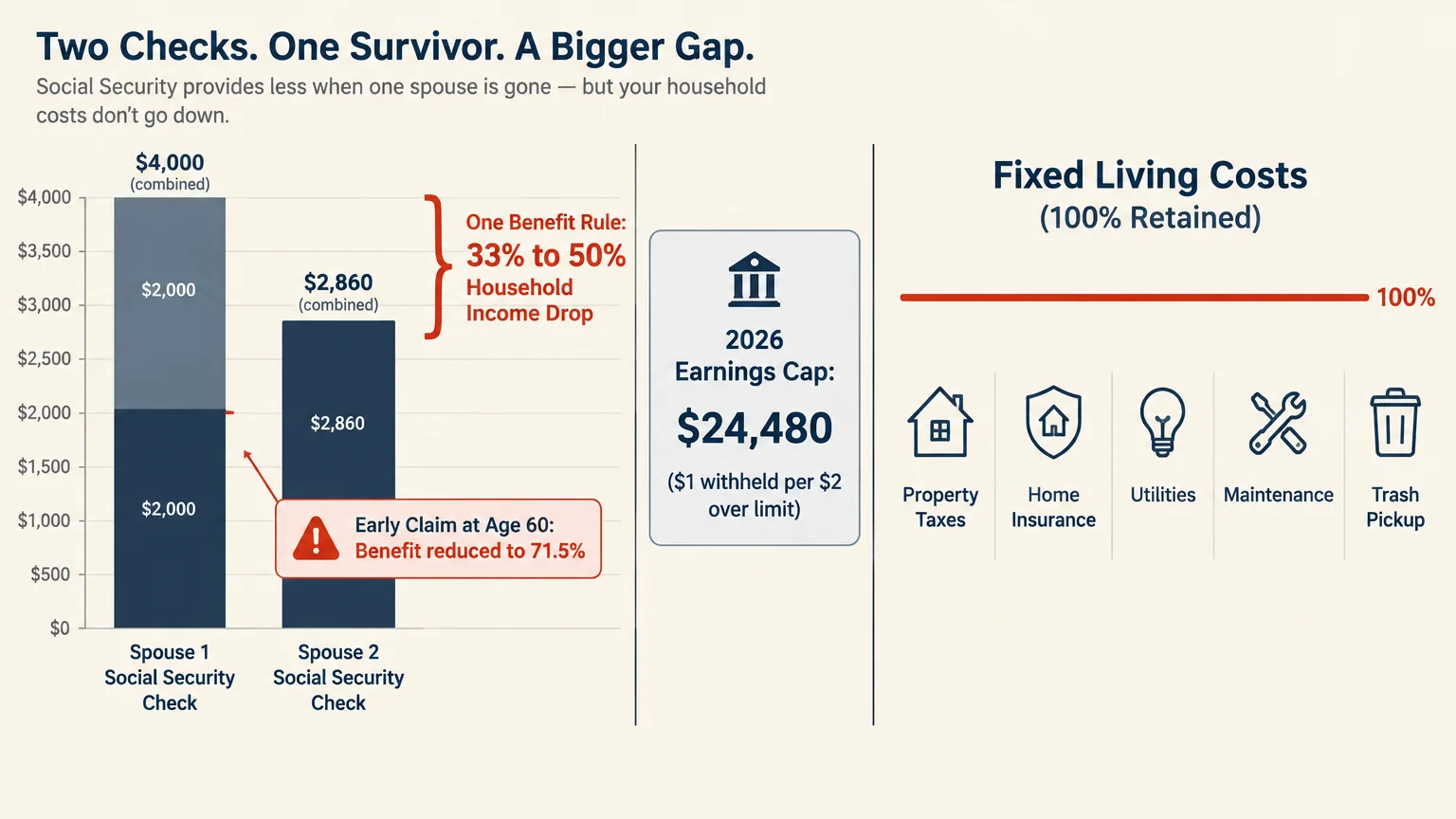
One of the harshest shocks for widowed retirees is the sudden reduction in retirement income. Under federal rules, a surviving spouse does not get to keep both monthly Social Security checks.
The Social Security Administration (SSA) applies the “one benefit” rule, leaving you with only the higher of the two monthly amounts. The smaller check disappears entirely, which triggers an average household income drop of 33% to 50%.
If you claim survivor benefits early at age 60, your payout drops to 71.5% of your late spouse’s full amount. Waiting until your Full Retirement Age ensures you collect 100% of that monthly benefit.
Surviving spouses under Full Retirement Age who continue working face strict annual earnings limits. In 2026, the SSA withholds $1 for every $2 earned above the $24,480 earnings cap.
Meanwhile, your essential overhead expenses barely decline. Property taxes, homeowners insurance, trash pickup, roof repairs, and basic utility bills cost the exact same amount for one resident as they did for two.
3. The “Widow’s Tax Penalty” Delivers an Unexpected Financial Shock
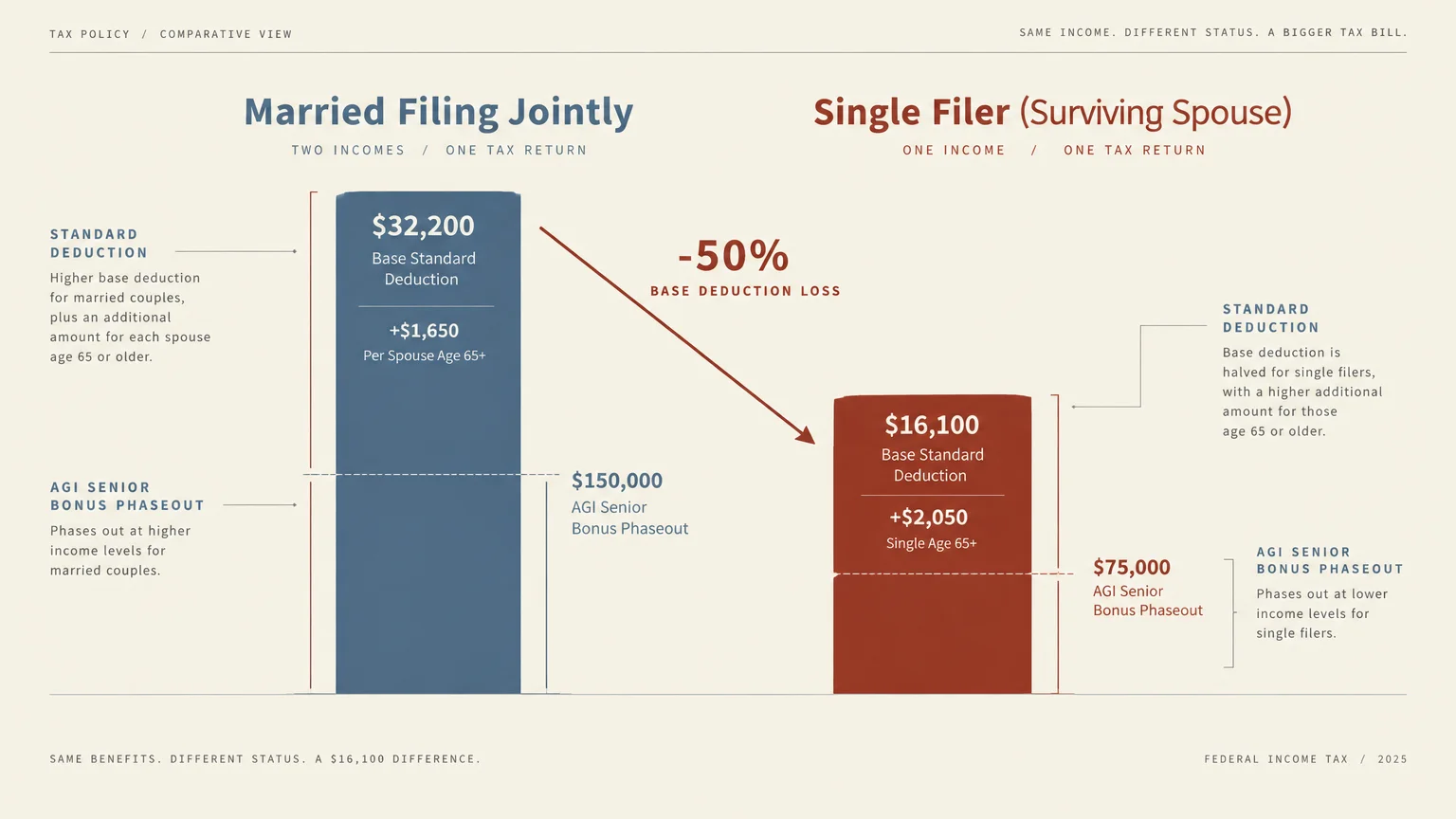
Federal tax rules change dramatically in the tax year following your partner’s death. You must transition your filing status from Married Filing Jointly to Single, which compresses your tax brackets.
For the 2026 tax year, the base standard deduction drops in half from $32,200 for married couples to just $16,100 for single filers. You suddenly pay higher taxes on significantly less household income.
Single filers aged 65 and older receive an extra $2,050 standard deduction, compared to $1,650 per spouse on a joint return. However, this modest adjustment rarely offsets the massive reduction in the primary deduction.
Recent tax legislation provides seniors aged 65 and older with an additional $6,000 bonus deduction. Yet this temporary relief begins phasing out above $75,000 of Adjusted Gross Income for single individuals, compared to $150,000 for married filers.
Required Minimum Distributions (RMDs) from inherited traditional retirement accounts can quickly push single survivors into higher marginal brackets. Sound widow advice begins with proactive tax planning to prevent severe distribution penalties.
4. Medicare Premium Surcharges Often Catch Solo Retirees by Surprise
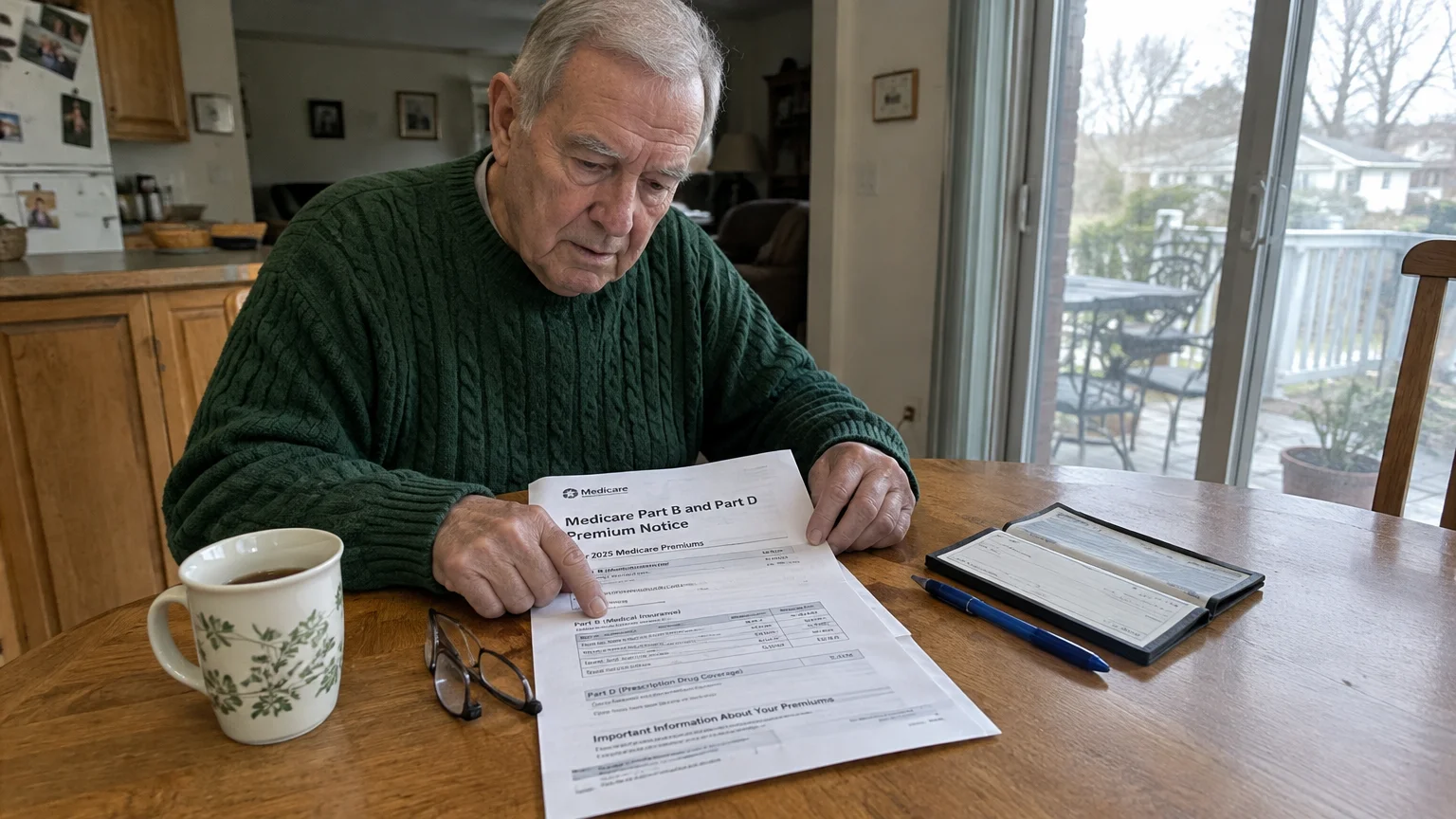
The widow’s penalty extends directly into your healthcare expenses through Medicare’s Income-Related Monthly Adjustment Amount (IRMAA). Social Security calculates these surcharges based on your tax return from two years prior.
For 2026, the standard Medicare Part B monthly premium is $202.90, paired with an annual Part B deductible of $283. Beneficiaries must also account for the Part A inpatient hospital deductible of $1,736 per benefit period.
The IRMAA income threshold drops sharply from $218,000 for married joint filers down to $109,000 for single retirees. A solo income above $109,000 forces you to pay total monthly Part B premiums ranging from $284.10 up to $689.90.
Fortunately, surviving spouses can fight back against outdated tax calculations. You can submit Form SSA-44 directly to the Social Security Administration, requesting a premium reduction based on the qualifying life-changing event of a spouse’s death.
Failing to appeal this surcharge forces many widows to overpay hundreds of dollars each month for healthcare coverage they already struggle to afford.
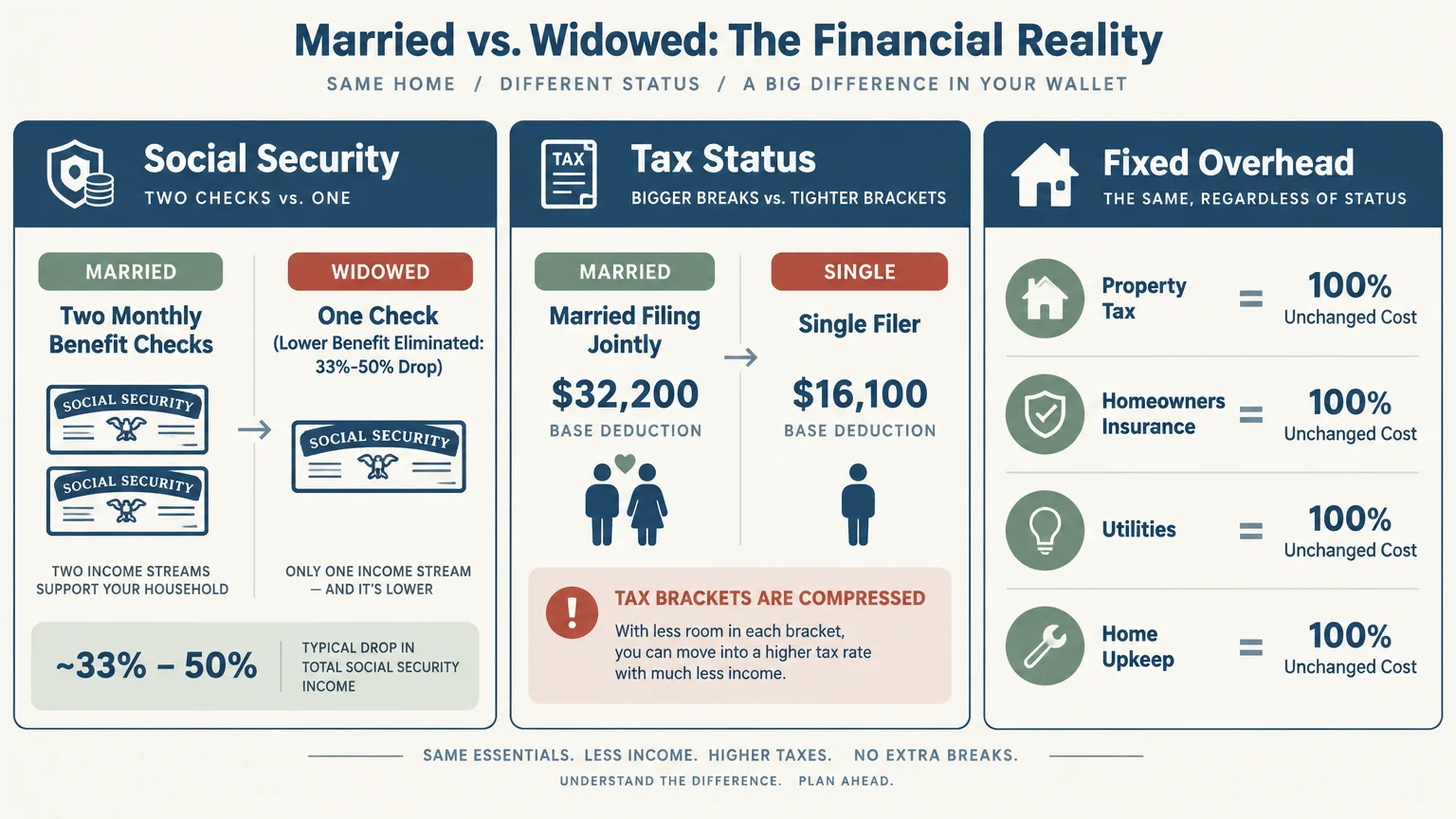
Comparison: The Financial Shift from Married to Widowed Status
Understanding the mathematical realities of widowhood helps you make calculated adjustments to your budget. The following table contrasts typical financial rules for married couples against the reality facing single surviving spouses.
| Financial Metric | Married Couple (Joint) | Surviving Spouse (Single) | Direct Household Impact |
|---|---|---|---|
| Social Security Checks | Two monthly checks | One monthly check (the higher amount) | Total household benefit drops by 33% to 50% immediately. |
| Base Standard Deduction (2026) | $32,200 | $16,100 | Taxable income rises despite lower gross household earnings. |
| Senior Bonus Deduction (65+) | $12,000 total ($150,000 phaseout) | $6,000 total ($75,000 phaseout) | Phaseout threshold halves, raising net income tax liability. |
| Medicare IRMAA Threshold | $218,000 Modified AGI | $109,000 Modified AGI | Survivors face higher Part B and Part D premiums sooner. |
| Core Home Maintenance | Shared labor and costs | Paid solely by surviving spouse | Per-person living expenses increase substantially. |
This stark financial transition highlights why well-intentioned friends must avoid making assumptions about a widow’s financial comfort. Even debt-free retirees face steep cash-flow contractions.

5. Well-Meaning Advice Often Feels Rushed and Overwhelming
Immediately following a funeral, acquaintances frequently offer urgent opinions regarding housing and finances. Suggestions to sell your home, relocate closer to grandchildren, or downsize belongings often create intense emotional distress.
Major life decisions require cognitive bandwidth and emotional stability. Making permanent choices while experiencing acute grief frequently leads to lasting financial and personal regrets.
“The goal of retirement is to live off your assets—not live off your regrets.”
Experienced financial professionals advise widowed retirees to pause major, irrevocable transactions during the first twelve months. Giving yourself grace allows you to evaluate your ongoing living costs without external social pressure.
Instead of offering unsolicited advice, supportive friends should provide direct, practical assistance. Raking autumn leaves, delivering home-cooked meals, or handling routine vehicle maintenance relieves daily burdens far more effectively.

6. Navigating Grief Fog and Endless Administrative Red Tape Is Exhausting
Bereavement creates cognitive exhaustion, commonly described by researchers as grief fog. Memory lapses, indecision, and physical fatigue make basic administrative tasks feel insurmountable.
Yet American legal systems require immediate, meticulous paperwork following a death. Widowed spouses must locate death certificates, contact pension administrators, notify banks, transfer vehicle titles, and navigate local probate courts.
Even securing government assistance requires significant effort. The federal lump-sum death benefit remains capped at an outdated $255.
Surviving spouses cannot claim survivor benefits or this one-time death payment through online portals. You must call the Social Security Administration at 1-800-772-1213 or schedule an in-person appointment at your local field office.
Managing bureaucratic delays while grieving depletes your energy reserves. Adult children can offer practical widowhood support by organizing documents, scheduling phone appointments, and tracking official correspondence.

7. Social Circles Shift and Coupled Friendships Often Fade
Roughly 1.4 million Americans experience the death of a spouse each year. Census data shows that over 11.5 million widowed women live in the United States, compared to approximately 3 to 4 million widowed men.
The average age of widowhood for American women is surprisingly young at 59.4 years old. Among citizens aged 75 and older, 58% of women and 28% of men have lost their lifetime partners.
Despite these high numbers, widowhood often isolates you from longtime social circles. Many retirees find that friendships built on dinner dates, golf outings, and couple trips quietly dissolve.
Surviving spouses frequently report feeling like an uncomfortable third wheel at dinner parties. In some cases, married friends feel uneasy confronting their own mortality and gradually stop calling.
This social withdrawal deepens your isolation. Rebuilding a community requires finding local peer groups through senior community centers, grief workshops, and supportive organizations like AARP.

8. Surviving Spouses Still Yearn to Hear Their Late Partner’s Name
Friends often avoid speaking about a deceased partner out of fear of causing sadness or tears. They change the subject abruptly whenever past memories surface in casual conversation.
Surviving spouses wish others understood that mentioning their late partner brings comfort rather than fresh pain. The tears that arise reflect lasting love, not an emotional setback caused by the conversation.
Avoiding the deceased person’s name makes widows feel as though their partner’s entire existence is being erased. Acknowledging shared stories, inside jokes, and personal quirks honors the significant life you built together.
Simple questions like, “What would your spouse have thought about this?” validate your past and present identity. Speaking their name signals that your community still cherishes their memory.

9. The Profound Silence of an Empty House Demands Time to Navigate
The physical absence of a partner transforms the daily atmosphere of your home. The sudden lack of footsteps, background television noise, and spontaneous conversation creates an overwhelming quiet.
Evenings and meal times present the most difficult emotional challenges. Preparing a single meal often feels pointless, leading many widowed retirees to neglect their nutritional health.
Surviving spouses frequently leave televisions or radios playing continuously simply to fill the empty air. Others adopt companion pets to restore a comforting physical presence and consistent routine to their living space.
If you or an aging parent struggle with intense isolation, resources from the Eldercare Locator can connect you with local companion programs and daily check-in services. Adapting to solo living requires deliberate, compassionate environmental adjustments.

10. Rediscovering Meaning and Purpose Requires Deep Patience
Life after losing spouse companionship requires rebuilding an entire personal identity. In retirement, couples frequently plan their schedules, travel dreams, and daily hobbies as an inseparable team.
When one partner passes away, the survivor must redefine what brings daily joy, motivation, and personal satisfaction. This process cannot be completed overnight through forced cheerfulness or rushed activity.
“Don’t simply retire from something; have something to retire to.” — Harry Emerson Fosdick
You must give yourself permission to explore personal interests your partner did not share. Pursuing gentle volunteering, attending educational seminars, or exploring independent travel can gradually restore a sense of agency.
Embracing a new chapter does not signify disloyalty to your late spouse’s memory. It represents a courageous commitment to honor the life you still have ahead of you.

When Professional Advice Is Worth It
Managing the intersection of grief and financial preservation requires experienced outside guidance. Attempting to handle complex legal and tax filings alone during periods of emotional stress frequently leads to costly errors.
Partnering with targeted professionals shields your nest egg and simplifies complex administrative decisions. Consider consulting the following specialists to protect your retirement standing:
- Fee-Only Certified Financial Planner (CFP): Coordinates asset distributions, analyzes cash flow after the loss of a Social Security check, and builds sustainable tax strategies.
- Social Security Claiming Specialist: Evaluates the optimal timing for claiming survivor benefits versus your own retirement benefits to maximize lifetime income.
- Elder Law or Estate Attorney: Updates wills, establishes revocable trusts, restructures real estate deeds, and designates new durable powers of attorney.
- SHIP Counselor: State Health Insurance Assistance Programs provide free, unbiased guidance to help you navigate Medicare drug plans and supplemental coverage transitions.
Paying for fiduciary, fee-only advice protects you from high-commission sales pitches disguised as widow assistance. An objective professional acts as a steady buffer during your most vulnerable moments.

Don’t Make These Mistakes
Grief compromises short-term decision-making, leaving widowed retirees vulnerable to administrative and financial missteps. Avoiding critical errors early on prevents lasting damage to your retirement security.
Protect your household stability by steering clear of these common pitfalls:
- Selling your home immediately: Rushing to relocate eliminates familiar neighborhood support systems before your long-term emotional needs become clear.
- Cashing out retirement accounts quickly: Large lump-sum withdrawals trigger massive income tax bills and accelerate standard deduction phaseouts.
- Ignoring Medicare IRMAA appeal deadlines: Failing to submit Form SSA-44 leaves you paying unnecessary healthcare surcharges based on outdated joint earnings.
- Assuming online SSA applications work for survivor claims: Submitting standard online retirement forms instead of calling the SSA directly can delay survivor benefits for months.
- Lending money to well-meaning relatives: Loaning retirement capital to family members under financial pressure jeopardizes your solo long-term care reserves.
Give yourself time to breathe before authorizing any transaction that cannot be undone. Deliberate patience remains your strongest financial shield.
Frequently Asked Questions About Widowhood in Retirement
Can I collect my own Social Security benefit and my late spouse’s survivor benefit at the same time?
No, the Social Security Administration does not combine both checks into a dual payment. You receive an amount equal to the higher of the two monthly benefits, effectively ending the smaller payment.
How does the widow’s tax penalty affect my income taxes?
In the year following your spouse’s death, you must file as Single rather than Married Filing Jointly. This cuts your base standard deduction in half, from $32,200 to $16,100 in 2026, pushing more income into higher brackets.
Can I appeal a Medicare IRMAA surcharge caused by my spouse’s death?
Yes, you can file Form SSA-44 with the Social Security Administration under the “Death of a Spouse” life-changing event category. Providing a copy of the death certificate allows officials to recalculate your premiums using your current solo income.
How do I claim the Social Security $255 lump-sum death benefit?
You cannot apply for the $255 death payment online. You must contact the SSA by phone at 1-800-772-1213 or visit your local Social Security field office with a certified death certificate within two years of the death.
Moving Forward on Your Own Terms
Navigating widowhood requires profound resilience, practical awareness, and radical patience with your personal healing timeline. By protecting your financial assets, asserting your social boundaries, and honoring your late spouse’s memory, you regain steady control over your future.
Take your retirement decisions one deliberate day at a time. Surround yourself with professionals and friends who respect your autonomy, validate your grief, and empower you to build a secure, meaningful life ahead.
This article is for informational purposes only and does not constitute financial, legal, or medical advice. Medicare rules, Social Security benefits, and tax laws change regularly—verify current details at Medicare.gov, SSA.gov, or with a licensed professional.
Last updated: October 2026. Medicare and Social Security rules change annually—always verify current details at official government sources.