Major federal updates will directly reshape your monthly budget and long-term savings in 2027. Knowing these new retirement rules today allows you to claim larger benefits and shield your investments from avoidable taxes.
Lawmakers designed several provisions to offset inflation, while other shifts complete multi-decade transitions for federal programs. Whether you currently receive benefits or plan to stop working soon, these updates alter your personal financial roadmap.
Take time now to review how updated income thresholds, Medicare structures, and retirement account rules influence your daily life. Proactive adjustments will safeguard your purchasing power and preserve your hard-earned wealth.

1. Social Security Delivers a 3.6% Cost-of-Living Adjustment
The Social Security Administration announced a 3.6% cost-of-living adjustment (COLA) for 2027. This welcome increase surpasses the 2.8% adjustment retirees received in 2026.
Beginning in January 2027, the bump adds approximately $75 to the average retired worker’s monthly payout. That adjustment lifts average monthly checks from $2,095 to $2,170.
Widows and widowers receiving survivor benefits will also see meaningful relief. Their average monthly payment climbs by $69, reaching a new average of $2,005.
The annual adjustment directly reflects changes in consumer prices for everyday household goods and energy. You can review your personal adjustment notice through your online account at the Social Security Administration.
Higher benefits provide essential support, but you must still budget carefully for daily expenses. Rising healthcare premiums and grocery bills can quickly absorb the extra monthly cash.

2. Full Retirement Age Officially Reaches 67 for Newer Retirees
A historic shift in federal retirement policy reaches its final milestone in 2027. Anyone born in 1960 or later now faces a Full Retirement Age (FRA) of exactly 67.
Congress set this transition into motion back in 1983 to stabilize the national retirement system. Americans born in 1960 turn 67 throughout 2027, making them the first cohort subject to the complete age increase.
You can still claim benefits as early as age 62; however, filing early triggers permanent reductions. Claiming at age 62 reduces your baseline monthly check by up to 30%.
Waiting until age 67 ensures you receive 100% of your earned primary insurance amount. If you delay filing past age 67, your monthly benefit grows by 8% per year until age 70.
Carefully evaluate your health status, family longevity, and career plans before picking a claiming date. Locking in a permanent reduction can strain your finances later in retirement.
3. Higher Limits on Early Earnings and Maximum Monthly Benefits
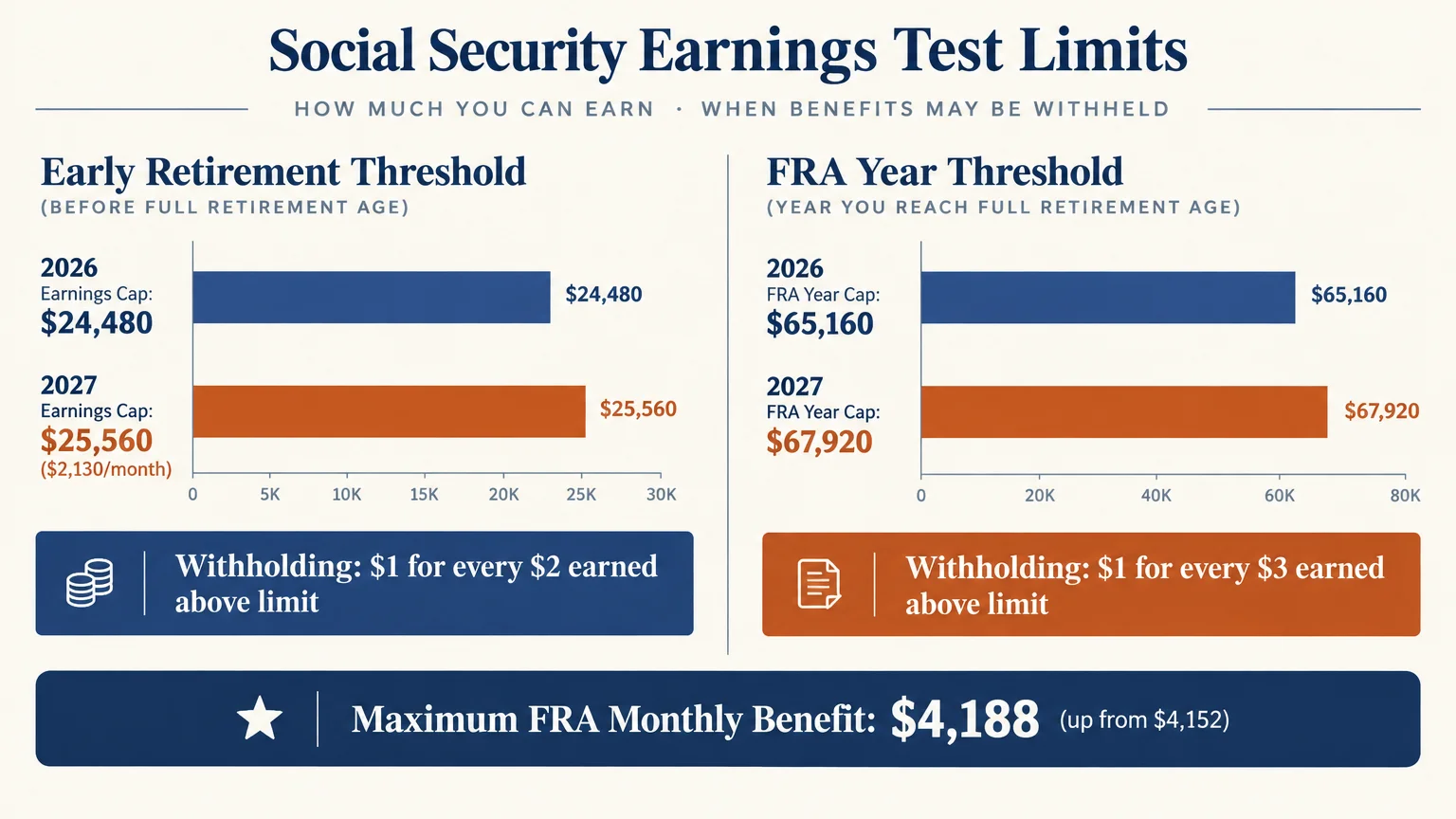
Retirees who choose to work while collecting early Social Security receive generous leeway in 2027. The annual retirement earnings test threshold rises to $25,560, up from $24,480 in 2026.
This change allows you to earn up to $2,130 per month before the government withholds benefits. If you earn more than that limit, the agency temporarily holds back $1 for every $2 earned above.
Different rules apply during the calendar year you reach your Full Retirement Age. In that milestone year, your earnings cap surges to $67,920, up from $65,160 in 2026.
For earnings above that higher cap, the government withholds only $1 for every $3 earned. The withholding stops entirely once you reach your birthday month in your FRA year.
The maximum possible benefit for a worker retiring at full retirement age also increases. High earners reaching FRA in 2027 can receive up to $4,188 per month, up from $4,152.

4. Social Security Payroll Tax Ceiling and Work Credits Expand
Older adults who remain in the workforce will notice adjustments to payroll tax withholdings. The maximum amount of annual income subject to Social Security tax jumps to $192,300 in 2027.
This figure represents a noticeable jump from the $184,500 threshold enforced during 2026. Earnings above this ceiling remain exempt from the standard 6.2% Social Security payroll tax.
Part-time workers building their lifetime safety net will face a slightly higher earning requirement for coverage. Earning one Social Security credit, or quarter of coverage, now requires $1,970 in earnings.
This requirement rises from $1,890 in 2026. Workers must accumulate 40 lifetime credits to qualify for retirement benefits, earning a maximum of four credits per calendar year.
You will earn the full four credits for 2027 once your annual gross wages reach $7,880. Monitoring your earnings statement ensures you stay on track for full program eligibility.
5. The SECURE 2.0 Saver’s Match Replaces the Saver’s Tax Credit
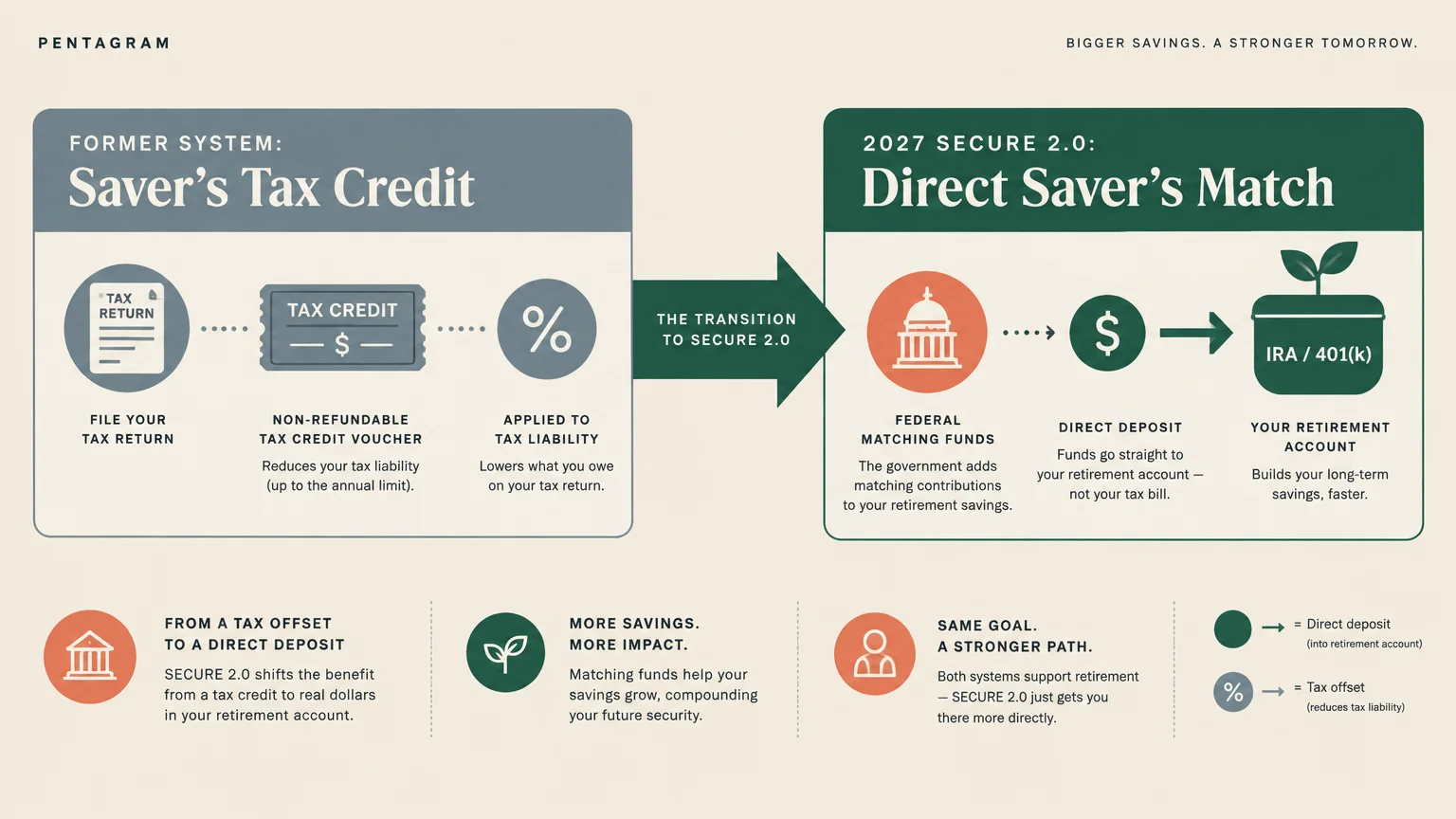
Effective January 1, 2027, Section 103 of the SECURE 2.0 Act revamps federal retirement incentives. The old non-refundable Saver’s Tax Credit officially transforms into the direct federal Saver’s Match.
Low-to-moderate-income workers can secure a direct 50% federal match on contributions up to $2,000. This structure delivers up to $1,000 in free retirement funds directly from the Treasury.
In past years, non-refundable credits only reduced tax liabilities down to zero. Low-income filers with little or no tax liability often missed out on the financial reward completely.
Under the 2027 system, the government deposits this matching cash directly into your qualified retirement account or IRA. You will claim this match on your 2027 federal tax return filed in 2028.
This change turns a complicated tax line-item into immediate, compoundable wealth inside your retirement portfolio. Review the updated rules through the IRS Retirement Plans portal to verify your income eligibility.

6. Mandatory Roth Rules Take Full Effect for High-Earner Catch-Up Contributions
High-earning workers age 50 and older face strict retirement plan rules beginning January 1, 2027. Section 603 of the SECURE 2.0 Act now mandates after-tax Roth contributions for specific catch-up deposits.
If you earned more than $145,000 in wages from your employer during the preceding year, you cannot make pre-tax catch-up contributions. All catch-up savings must flow directly into a designated Roth account.
The IRS allowed an extended transition period so plan administrators could update complex payroll platforms. That transition period ends in 2027 as final, mandatory compliance regulations take total legal effect.
You will lose the upfront tax deduction on those catch-up deposits, raising your taxable income for the current year. However, qualified withdrawals from your Roth balance will remain completely tax-free throughout retirement.
Check with your human resources department immediately to verify that your company retirement plan accommodates Roth savings. If your employer does not offer a Roth option, high earners cannot make catch-up contributions at all.

7. Higher Contribution Limits for 401(k), 403(b), and TSP Accounts
Workplace retirement accounts offer greater tax-advantaged capacity starting in 2027. Standard employee deferral limits for 401(k), 403(b), and federal Thrift Savings Plan accounts rise to $25,500.
This increase raises annual baseline savings from the $24,500 ceiling allowed during 2026. The additional room helps savers accelerate their nest egg during their peak earning years.
Workers age 50 and older enjoy an expanded standard catch-up limit of $8,500, up from $8,000. This adjustment brings the total annual contribution potential for older employees to $34,000.
If you are between the ages of 60 and 63, you can use the enhanced super catch-up provision. This special limit increases to $11,750 for 2027, up from $11,250 in 2026.
Eligible savers ages 60 to 63 can deposit a staggering total of $37,250 into their workplace accounts. Taking full advantage of these expanded brackets creates massive tax benefits before you exit the workforce.
“The goal of retirement is to live off your assets—not live off your regrets.”

8. Shifts in Medicare Part D Prescription Caps and Deductibles
Medicare prescription drug coverage experiences important structural adjustments for the 2027 calendar year. The annual out-of-pocket prescription cap established under the Inflation Reduction Act climbs to $2,400.
This updated cap rises from $2,100 in 2026 and $2,000 in 2025 due to statutory inflation adjustments. Once you spend $2,400 on covered medications, your plan covers 100% of remaining drug costs.
At the same time, the maximum allowable Part D annual deductible climbs to $700. This represents a noticeable increase from the $615 maximum deductible permitted during 2026.
To manage out-of-pocket costs smoothly, consider enrolling in the Medicare Prescription Payment Plan. This voluntary program spreads your prescription drug expenses across predictable monthly payments throughout the year.
Always evaluate your personal medication list against annual plan formularies by exploring the official Medicare.gov portal. Plan formularies and tier classifications shift every single year.

9. Lower Medicare Advantage Premiums and Innovative Care Programs
Older adults shopping for healthcare coverage will encounter favorable rate adjustments across Medicare Advantage plans. The Centers for Medicare & Medicaid Services projects weighted average monthly premiums will drop by more than 16%.
Meanwhile, average premiums for stand-alone Part D prescription drug plans remain exceptionally stable, rising by less than $1. These pricing trends provide much-needed breathing room for retirees living on fixed incomes.
Medicare also introduces the innovative ACCESS model to enhance chronic condition management in 2027. This framework delivers low-cost or no-cost home support services, virtual medical consultations, and remote monitoring wearables.
The federal government is also rolling out the targeted Medicare GLP-1 Bridge program. This initiative allows qualifying Part D enrollees to access critical GLP-1 medications for an affordable $50 monthly copay.
These combined initiatives aim to curb preventable hospital visits while expanding access to life-saving modern treatments. Compare plan offerings closely during open enrollment to secure these expanded benefits.

10. Increased Health Savings Account (HSA) Contribution Ceilings
Health Savings Accounts remain one of the most potent tools for building tax-free medical wealth. The IRS raised contribution ceilings under Revenue Procedure 2026-24 for the 2027 tax year.
Individuals with self-only qualifying high-deductible health coverage can save up to $4,500, up from $4,400. Family coverage limits climb to $9,000, providing a significant boost from the $8,750 cap in 2026.
Savers age 55 and older can contribute an additional $1,000 annual catch-up amount. This provision allows an older couple with family coverage to stash away a total of $11,000 tax-free.
Qualifying high-deductible health plans also adjust their baseline annual deductibles. Single coverage plans now require a minimum deductible of $1,750, while family plans require a minimum deductible of $3,500.
Remember that you must stop contributing to an HSA once you enroll in any part of Medicare. Contributing after Medicare coverage begins triggers steep tax penalties from the federal government.
Key 2026 vs. 2027 Retirement Thresholds Compared
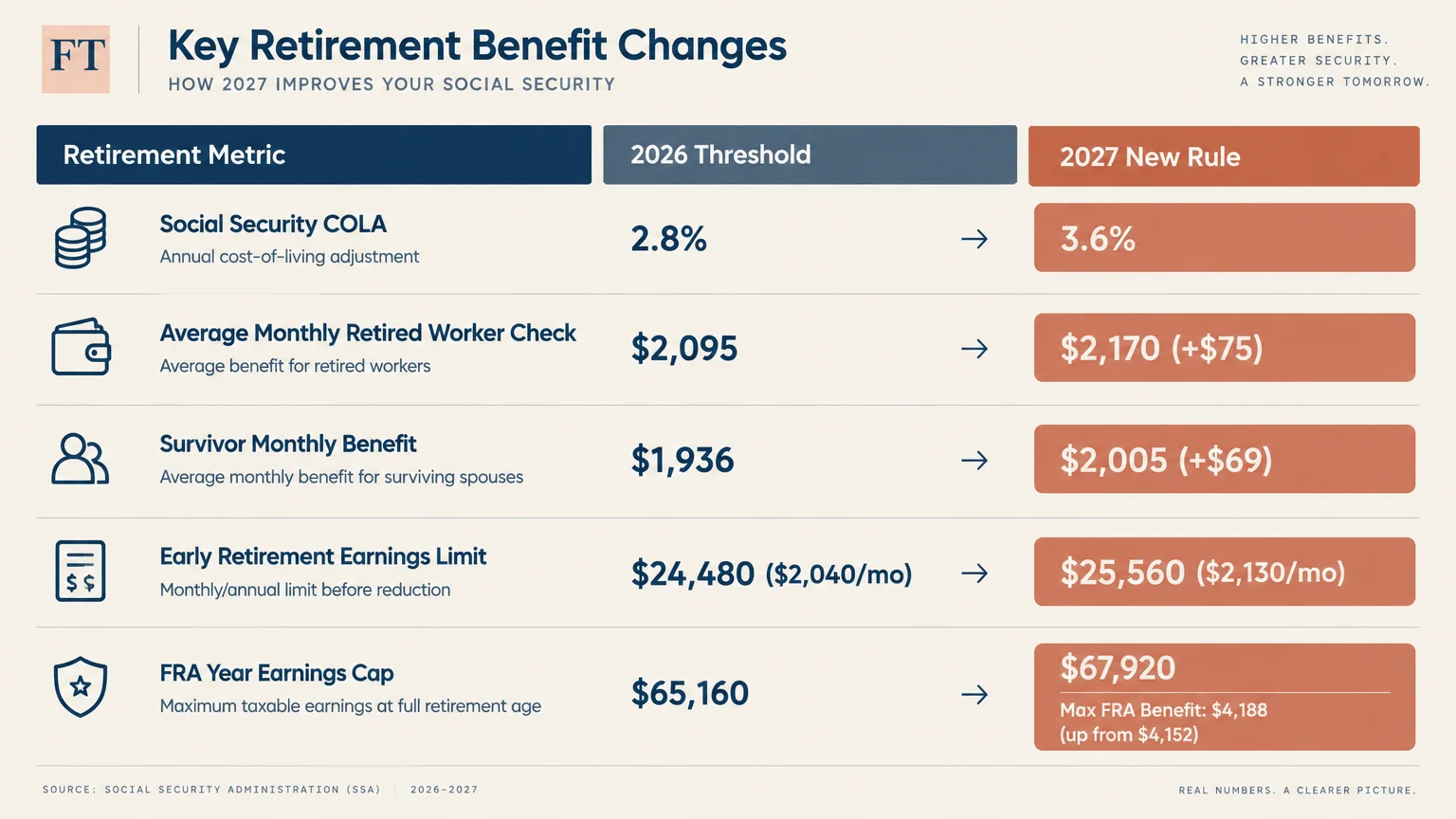
Comparing these updated regulatory thresholds side by side clarifies your strategic options for the year ahead. Small numerical changes across multiple programs often combine into significant annual shifts.
Use the summary table below to assess which retirement areas require immediate adjustments to your monthly cash flow.
| Retirement Provision | 2026 Rules | 2027 Rules | Strategic Action |
|---|---|---|---|
| Social Security COLA | 2.8% increase | 3.6% increase | Update personal cash flow projections. |
| Full Retirement Age (FRA) | 66 and 10 months (1959 births) | 67 years (1960 or later births) | Review claiming dates to prevent reductions. |
| Early Claiming Earnings Limit | $24,480 annually ($2,040/month) | $25,560 annually ($2,130/month) | Monitor part-time work to prevent benefit withholding. |
| FRA Year Earnings Limit | $65,160 annually ($5,430/month) | $67,920 annually ($5,660/month) | Coordinate final career bonuses before birthday month. |
| Max Social Security Benefit at FRA | $4,152 per month | $4,188 per month | Verify lifetime earnings records with SSA. |
| Payroll Tax Cap | $184,500 maximum earnings | $192,300 maximum earnings | Anticipate payroll deductions on late-career wages. |
| Social Security Work Credit | $1,890 per quarter credit | $1,970 per quarter credit | Earn at least $7,880 annually for full credits. |
| Standard 401(k) Deferral Limit | $24,500 | $25,500 | Increase workplace automated payroll deductions. |
| Age 50+ Catch-Up Limit | $8,000 | $8,500 | Target $34,000 total pre-retirement savings. |
| Ages 60–63 Super Catch-Up | $11,250 | $11,750 | Max out $37,250 workplace contributions. |
| Saver’s Incentive Program | Non-refundable Saver’s Credit | Federal Saver’s Match (up to $1,000) | Claim direct federal matching deposits in 2028. |
| High-Earner Catch-Up Rules | Transition period flexibility | Mandatory Roth contributions | Direct catch-up funds to designated Roth accounts. |
| Medicare Part D Out-of-Pocket Cap | $2,100 per year | $2,400 per year | Recalculate annual drug spending expectations. |
| Max Part D Deductible | $615 | $700 | Compare plan tiers during Medicare Open Enrollment. |
| HSA Limit (Self-Only) | $4,400 | $4,500 | Add $1,000 catch-up if age 55 or older. |
| HSA Limit (Family) | $8,750 | $9,000 | Fund medical savings before enrolling in Medicare. |
Evaluating these official metrics ensures you do not leave free money or valuable deductions on the table. Adjust your payroll elections and automated transfers early to hit these targets smoothly.

Costly Mistakes to Avoid
Changing regulations create frequent stumbling blocks for retirees who rely on outdated information. Avoiding these common missteps protects your wealth from unnecessary taxes and benefit forfeitures.
1. Triggering Social Security earnings penalties: Continuing to work while collecting early benefits before age 67 can temporarily reduce your monthly checks. Track your gross wages carefully so you do not exceed the $25,560 threshold.
2. Overlooking the Roth catch-up mandate: If your 2026 wages exceeded $145,000, failing to route your 2027 catch-up savings into a designated Roth account violates IRS regulations. Your plan administrator may reject non-compliant contributions outright.
3. Depositing into an HSA after enrolling in Medicare: Signing up for Medicare Part A or Part B ends your HSA contribution eligibility immediately. Continuing contributions generates a 6% excise penalty on excess funds for every year they remain.
4. Ignoring annual Medicare drug formularies: Even with the out-of-pocket cap rising to $2,400, individual plan formularies change every single year. Failing to review your medications during open enrollment could leave your vital prescriptions uncovered.
5. Missing the direct Saver’s Match deposit: Qualified low-to-middle earners frequently forget to designate an eligible retirement account for their match. Ensure your IRA or workplace account stands ready to receive the federal deposit in 2028.
“The best time to plan for retirement was 20 years ago. The second best time is today.”

Don’t DIY These Decisions
Complex tax legislation and healthcare reorganizations make professional guidance more valuable than ever. Handling intricate retirement choices without qualified counsel can create expensive, permanent consequences.
Social Security Claiming Strategy: Deciding between claiming at 62, 67, or 70 affects your lifetime cumulative wealth and survivor benefits. Work with a claiming specialist to analyze spousal strategies, health factors, and break-even ages.
Medicare Plan Selection: Navigating the differences between Original Medicare, Medigap, and Medicare Advantage requires objective evaluation. Connect with a local State Health Insurance Assistance Program (SHIP) counselor for free, unbiased guidance on regional plans.
Tax Diversification and Roth Conversions: Transitioning between pre-tax accounts, Roth balances, and taxable investments requires sophisticated tax modeling. A Fee-Only Certified Financial Planner (CFP) helps you navigate tax brackets while dodging Medicare premium surcharges.
Long-Term Care and Estate Protection: Healthcare emergencies can rapidly consume decades of retirement savings without proper legal barriers. Consult an elder law attorney to establish medical directives, living trusts, and Medicaid asset protection structures.
Frequently Asked Questions About 2027 Retirement Rules
Does the 3.6% Social Security COLA trigger higher taxes on my benefits?
It might. Federal tax thresholds for Social Security benefits ($25,000 for single filers and $32,000 for couples) are not indexed to inflation, meaning higher benefits can push you into taxable territory.
What happens if I earn more than the 2027 retirement earnings limit?
The SSA withholds $1 of benefits for every $2 earned above $25,560 if you are below FRA all year. Once you reach 67, the agency recalculates your benefit to credit back withheld amounts over time.
Can I receive the SECURE 2.0 Saver’s Match as a cash tax refund?
No, the Saver’s Match is not a cash tax refund. The federal government deposits the matching funds directly into your qualified retirement account or IRA to build compounding wealth.
Who qualifies for the $50 copay under the Medicare GLP-1 Bridge program?
Qualifying Part D enrollees with established clinical diagnoses for covered health conditions can access eligible GLP-1 medications. You must verify that your prescribing physician and plan participate in the initiative.
Taking Action on Your 2027 Retirement Plan
Preparing for these ten regulatory adjustments gives you a distinct advantage as 2027 unfolds. Review your payroll deductions, verify your Social Security claiming plans, and compare your healthcare options early.
- Audit your payroll withholdings: Adjust your 401(k) and HSA contributions to capture the higher 2027 annual limits.
- Confirm your Roth contribution setup: Ensure your workplace retirement plan supports Roth catch-up deposits if your prior-year earnings exceeded $145,000.
- Review your Part D drug formulary: Verify that your medications remain covered under the $2,400 out-of-pocket prescription cap.
- Check your Social Security earnings: Keep your earned income below $25,560 if you work while collecting benefits before Full Retirement Age.
Proactive planning today guarantees that federal policy shifts work in your favor rather than against your budget. Take deliberate steps now to maximize your savings and preserve your financial independence throughout retirement.
This article is for informational purposes only and does not constitute financial, legal, or medical advice. Medicare rules, Social Security benefits, and tax laws change regularly—verify current details at Medicare.gov, SSA.gov, or with a licensed professional.
Last updated: February 2026. Medicare and Social Security rules change annually—always verify current details at official government sources.