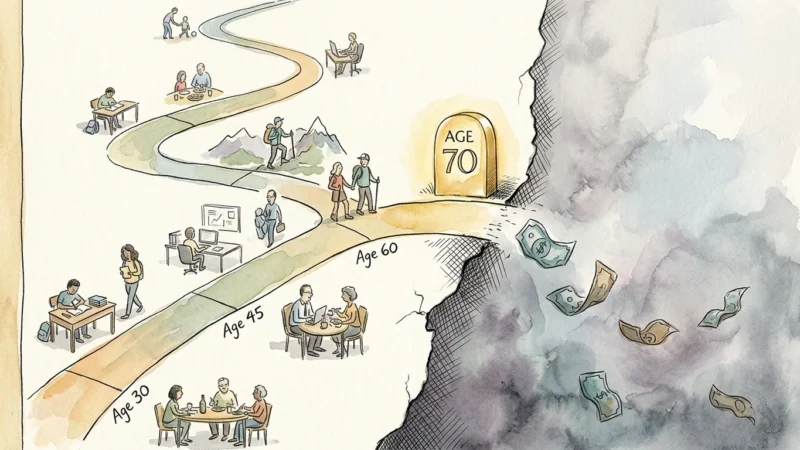
Mistake 1: Claiming at 62 Because “Tomorrow Isn’t Promised”
The earliest age you can claim Social Security retirement benefits is 62. For many people, the temptation to start collecting a check immediately is overwhelming. Human nature drives us to take cash in hand rather than wait for a larger future payout. Retirees often justify this decision by citing their health, family longevity, or a general distrust in the government’s ability to maintain the program.
While the fear of passing away before collecting your “fair share” is entirely valid, making a purely emotional decision ignores the mathematical reality of longevity risk. If you make it to age 65 in reasonably good health, statistical averages dictate you will likely live into your mid-80s. When you claim at 62, you accept a permanent reduction in your monthly benefit—up to 30% compared to waiting for your Full Retirement Age (FRA). Worse, you forfeit the delayed retirement credits that increase your benefit by 8% for every year you delay past your FRA up to age 70.
Consider the impact on a hypothetical monthly benefit. The table below illustrates how drastically your claiming age alters your permanent baseline income, assuming a Full Retirement Age of 67 and an unreduced benefit of $2,000 per month.
| Claiming Age | Percentage of Full Benefit | Monthly Payout | Annual Income |
|---|---|---|---|
| Age 62 | 70% | $1,400 | $16,800 |
| Age 67 (FRA) | 100% | $2,000 | $24,000 |
| Age 70 | 124% | $2,480 | $29,760 |
Retirees who claimed at 62 frequently report feeling the financial squeeze in their late 70s and 80s. As inflation degrades purchasing power and out-of-pocket medical expenses climb, that permanently reduced check fails to keep up. Before filing early, consult the Social Security Administration (SSA) calculators to determine your specific break-even point—the age at which delaying benefits results in more total lifetime wealth. For most healthy adults, that break-even age lands between 78 and 82.