A state with zero income tax looks like an automatic financial paradise on paper. However, simple headline rates often disguise substantial municipal fees that drain your nest egg.
Moving in retirement costs far more than the initial moving van receipt. A comprehensive cost of living comparison by state reveals subtle financial traps that catch many relocators completely off guard.
Evaluating the hidden costs of retiring before you purchase property protects your financial security. Look past destination marketing brochures to inspect the real price of changing your legal residency.

1. Property Tax Assessment Resets
You might look at a neighbor’s low tax bill and assume you will pay the same. That assumption often triggers a painful financial shock after closing.
Many states enforce statutory caps that restrict how fast taxable values rise for existing owners. California caps assessed value increases at 2% under Proposition 13; Florida caps homestead increases at 3% or the inflation rate.
When a property transfers to a new buyer, the tax assessment resets to 100% of fair market value. Your newly purchased home immediately faces taxation based on today’s full market price.
A longtime neighbor might pay $2,200 annually on an identical home. Meanwhile, your first annual bill could easily top $8,500.
Furthermore, local millage rates vary dramatically between adjacent municipal districts. Always contact the local county property appraiser to estimate your taxes before submitting a purchase offer.

2. Homeowners and Disaster Insurance Surges
Homeowners insurance premiums vary drastically across state borders. A sunny climate often carries severe weather risks that private insurance carriers price aggressively.
Florida homeowners pay between $8,400 and $8,700 per year on average. That is roughly three to four times the national average of $2,400 to $2,870.
States like Louisiana, Oklahoma, and Colorado also face steep costs, with premiums averaging over $5,000 per year. In weather-prone areas, private insurers frequently issue non-renewal notices or exit the state market entirely.
Many carriers also refuse to insure older homes unless you replace the roof. A mandatory roof replacement can cost you $15,000 to $30,000 upfront just to secure basic coverage.
Standard homeowners policies nationwide exclude damage caused by rising water. You must buy separate flood coverage through private carriers or the National Flood Insurance Program, adding thousands to your annual housing expenses.
In hurricane zones, policies often impose percentage-based deductibles rather than standard dollar amounts. A 5% hurricane deductible on a $500,000 home means you pay $25,000 out-of-pocket before insurance covers a single dollar.
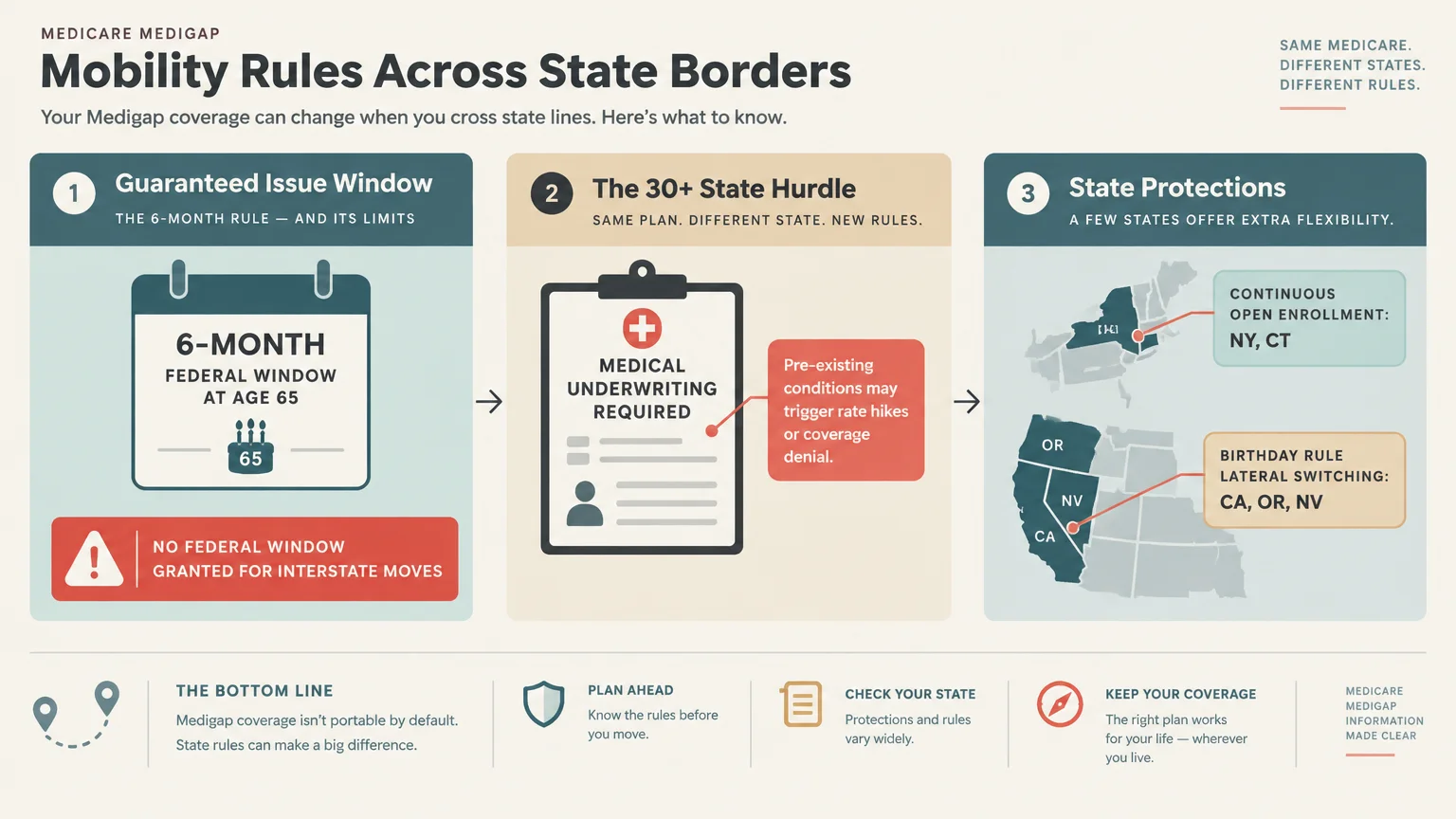
3. Healthcare Provider Networks and Medigap Underwriting
Relocating across state lines directly impacts your healthcare access and medical bills. Many retirees assume Medicare operates identically everywhere, but supplemental plan rules differ significantly by location.
Your federal guaranteed-issue window for Medigap lasts only six months starting when you are 65 and enrolled in Part B. Relocating to a new state does not grant you a new federal open enrollment window.
In more than 30 states, insurers require medical underwriting if you apply to switch Medigap carriers after moving. Pre-existing health conditions can cause carriers to charge substantially higher premiums or deny your application outright.
Only states like New York and Connecticut mandate continuous open enrollment. Others, such as California, Oregon, and Nevada, offer Birthday Rules that permit lateral plan changes without underwriting.
Research local options on the official Medicare Plan Finder before committing to a move. Confirming your supplemental insurance options prevents expensive coverage gaps.
Moving outside your Medicare Advantage service county triggers a Special Enrollment Period to choose a new plan. However, provider networks change entirely, and maximum out-of-pocket limits can exceed $8,800 to $9,300 annually.

4. Annual Vehicle Personal Property Taxes
Most people remember to update vehicle registrations when relocating. However, few expect an annual personal property tax bill simply for owning a car.
About half of U.S. states allow local governments to levy annual property taxes on personal vehicles. Municipalities determine these bills using your vehicle’s current assessed fair market value.
In states like Virginia, local vehicle tax rates commonly range from 3% to 4.5% of assessed value. A retired couple owning two late-model vehicles valued at $50,000 can owe $1,500 to $2,250 each year.
Moving from a state with flat $40 registration tags to a personal property tax state creates sudden budget friction. Always research local county vehicle tax rates alongside registration fees.

5. Sales Taxes on Groceries and Daily Essentials
States without personal income tax must fund essential services through other revenue sources. They frequently make up budget shortfalls by imposing higher state and local sales taxes.
Combined sales tax rates exceed 9.5% in parts of Tennessee and Louisiana. Every retail purchase you make claims a noticeable slice of your monthly disposable income.
Several states also levy sales tax on groceries and daily staples. Mississippi charges its full 7% state sales tax on groceries, while Alabama, Idaho, and South Dakota also tax food purchases.
Taxing food places a continuous financial drag on fixed-income households. A couple spending $750 monthly on groceries pays hundreds of dollars in extra taxes every year in these jurisdictions.

6. State-Level Estate and Inheritance Taxes
Federal estate tax thresholds currently protect most families from federal inheritance levies. However, state-level estate and inheritance taxes apply much lower exemption limits.
Twelve states plus Washington, D.C. impose separate estate taxes on transferred wealth. Oregon begins taxing estates at just $1 million, while Massachusetts sets its exemption threshold at $2 million.
Furthermore, Pennsylvania, New Jersey, and Maryland enforce inheritance taxes directly against beneficiaries. These levies tax transfers made to adult children, siblings, or domestic partners.
Moving into an inheritance tax state can expose your heirs to unexpected probate levies. Reviewing state tax codes protects the wealth you spent decades accumulating.
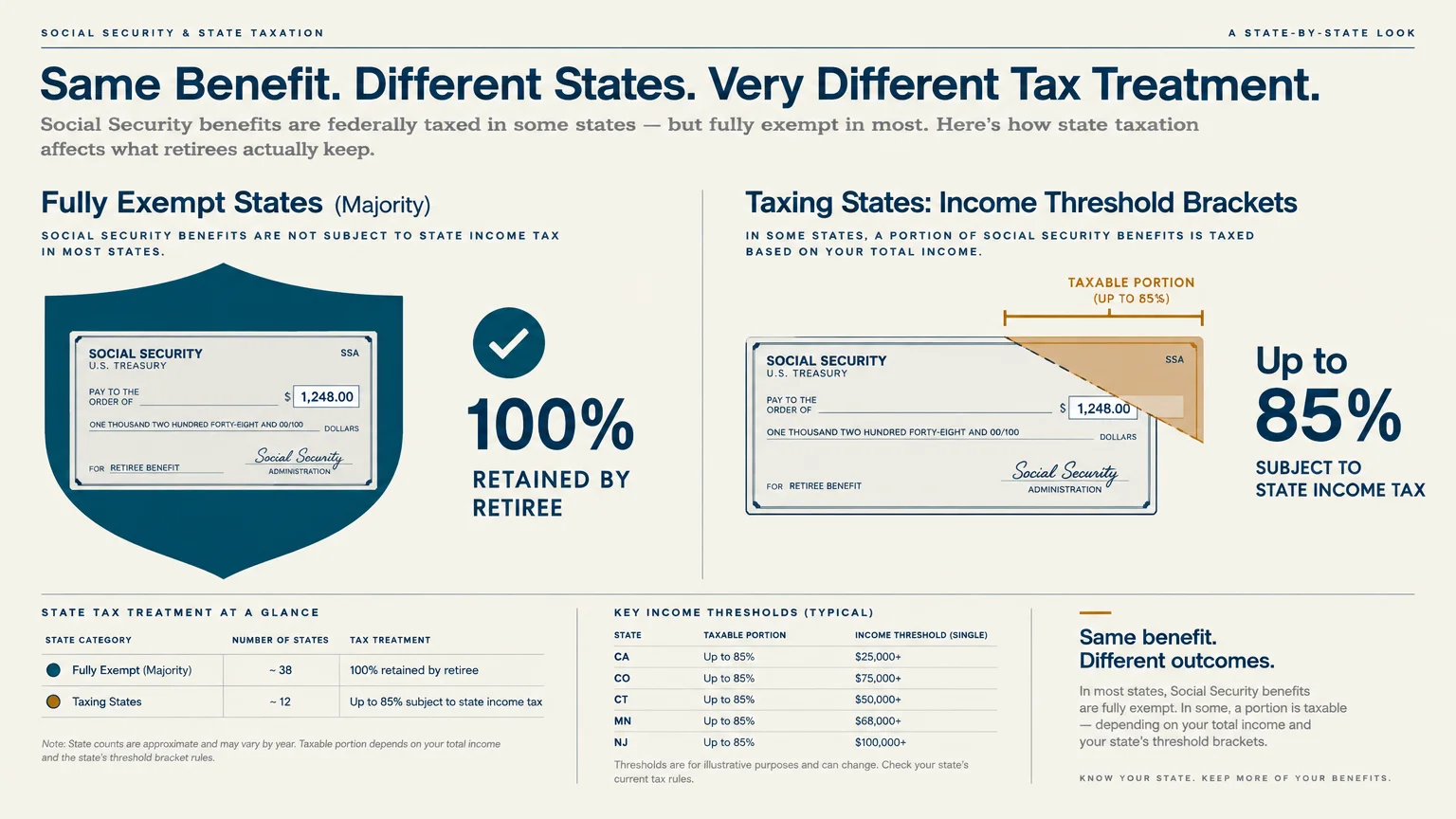
7. State Taxation of Social Security Benefits
Most states exempt Social Security benefits entirely from taxable income. However, eight states continue to tax benefits for recipients whose income exceeds statutory limits.
These states include Colorado, Connecticut, Minnesota, Montana, New Mexico, Rhode Island, Utah, and Vermont. West Virginia recently phased out this tax, while Kansas, Missouri, and Nebraska eliminated theirs in 2024.
Depending on your total distributions, state taxes can noticeably trim your net Social Security income. Check your benefit estimates using official resources on the Social Security Administration website.
Review how your target state treats other retirement streams like pensions and traditional IRAs. Some states that tax Social Security offer generous exclusions for military pensions or 401(k) withdrawals.

8. Travel Costs and Care Network Fragmentation
Relocating away from family creates emotional distance and significant recurring travel expenses. Trips back home to visit children and grandchildren quickly accumulate into thousands of dollars.
Multiple round-trip airline tickets, hotel accommodations, and rental cars often cost $4,000 to $7,000 annually. Many retirees spend more on family travel than they save on state income taxes.
Moving also severs your established local support system. Finding new primary doctors, dentists, contractors, and trusted mechanics requires time, effort, and occasional out-of-network fees.
You can locate regional aging services and community assistance programs through BenefitsCheckUp. Establishing local support connections early smooths your transition into a new community.
Severe weather differences also produce volatile utility bills. Running air conditioning constantly during southern summers or heating older northern homes can double your expected energy budget.

Key Cost Comparison Across Sample Retirement States
A direct side-by-side view shows why zero income tax does not always mean low total living costs. The table below illustrates how diverse municipal expenses balance out across five popular states.
| State | Social Security Taxed? | Average Home Insurance | Vehicle Property Tax | Major Hidden Cost Driver |
|---|---|---|---|---|
| Florida | No | $8,400 – $8,700/yr | None | Extreme property insurance premiums and mandatory flood policies |
| Virginia | No | $2,100 – $2,500/yr | 3.0% – 4.5% assessed value | Annual personal property taxes on owned vehicles |
| Oregon | No | $1,800 – $2,200/yr | None | State estate tax triggered at $1 million threshold |
| Pennsylvania | No | $1,700 – $2,100/yr | None | Inheritance tax charged on transfers to non-spousal heirs |
| Tennessee | No | $2,600 – $3,100/yr | None | High combined state and local sales taxes exceeding 9.5% |
Every state balances its municipal budget using a different combination of revenue tools. Examine your own spending patterns to see which tax combination benefits your financial situation.

Errors That Cost Retirees Thousands
Relocating without a complete balance sheet review leads to expensive surprises. Avoid these common errors when you compare states for retirement:
- Relying on statewide cost calculators that blend cheap rural areas with expensive coastal towns.
- Assuming a neighbor’s historical property tax bill reflects what you will pay on a new purchase.
- Canceling an existing Medigap policy before securing guaranteed underwriting approval in your destination state.
- Overlooking county-level personal property taxes on late-model vehicles, boats, and recreational vehicles.
- Failing to budget for separate flood and hurricane wind deductibles in storm-prone regions.
- Ignoring state-level estate tax exemptions that trigger at $1 million or $2 million.
Understanding these pitfalls helps you protect your hard-earned assets before finalizing a purchase. The Consumer Financial Protection Bureau provides helpful tools to evaluate long-term financial commitments.
“The goal of retirement is to live off your assets—not live off your regrets.”
Careful mathematical due diligence protects you from stressful relocations and regrets. Measure the complete price of residence before signing a binding closing document.

When to Get Expert Help
Coordinating multi-state taxes, insurance policies, and legal documents is complicated. Seeking advice from specialized professionals prevents costly miscalculations before you move.
Connect with a State Health Insurance Assistance Program (SHIP) counselor before changing state residency. SHIP advisors provide free, unbiased guidance on local Medigap underwriting rules and Medicare Advantage networks.
Consult a fee-only certified financial planner to run detailed multi-state cash flow models. They can project your distribution taxes, required minimum distributions, and local property taxes accurately.
Hire an elder law attorney licensed in your target state to review your estate plan. Powers of attorney, healthcare proxies, and trust structures must comply with specific state statutes.
“It’s not how much money you make, but how much money you keep, how hard it works for you, and how many generations you keep it for.” — Robert Kiyosaki
Professional advisors ensure your wealth works efficiently across state lines. A small investment in expert advice often prevents tens of thousands in unexpected expenses.
Frequently Asked Questions
How can I compare states for retirement accurately?
Build a personalized spending plan reflecting your specific income sources, vehicle values, and home price. Never rely on generic cost-of-living averages that mask steep local tax and insurance variations.
What is the most common hidden cost of retiring in a new state?
Property tax resets and homeowner insurance rate surges represent the largest unexpected expenses. Buyers often assume tax caps protect their purchase, but valuations reset to current market prices upon sale.
Can I transfer my Medigap coverage if I move across state lines?
Original Medicare and Medigap travel nationwide, but your carrier might recalculate your monthly premium by ZIP code. If you wish to switch companies, more than 30 states require medical underwriting.
Which states still tax Social Security benefits?
Only eight states tax Social Security: Colorado, Connecticut, Minnesota, Montana, New Mexico, Rhode Island, Utah, and Vermont. All other states exempt Social Security benefits entirely from state income taxes.
Taking Your Next Step
Test your destination state before selling your primary home. Renting a furnished home for several months gives you hands-on experience with local utility costs, grocery prices, and traffic.
Request exact insurance quotes and contact the county property appraiser during your trial period. Thorough preparation ensures your relocation enhances your retirement lifestyle rather than draining your savings.
Information in this article reflects current rules as of the publication date and may change. Always confirm benefit details directly with Social Security Administration, Medicare.gov, or relevant government agencies before making decisions.
Last updated: February 2026. Medicare and Social Security rules change annually—always verify current details at official government sources.