Federal projections confirm that the primary Social Security trust fund will exhaust its financial reserves by late 2032. Without swift congressional action, automatic statutory cuts will immediately trigger across the board.
A 24 percent benefit reduction means the typical American retiree stands to lose roughly 500 dollars every month. Nationwide, this shortfall represents an annual loss of 345 billion dollars across 60 million households.
The real-world impact varies significantly depending on your home state, local living costs, and lifetime earnings. Here is what you stand to lose and how to protect your cash flow.
The Bottom Line Up Front
You need clear facts to prepare your household budget for potential retirement benefit changes. Here are the core realities surrounding the 2032 solvency deadline:
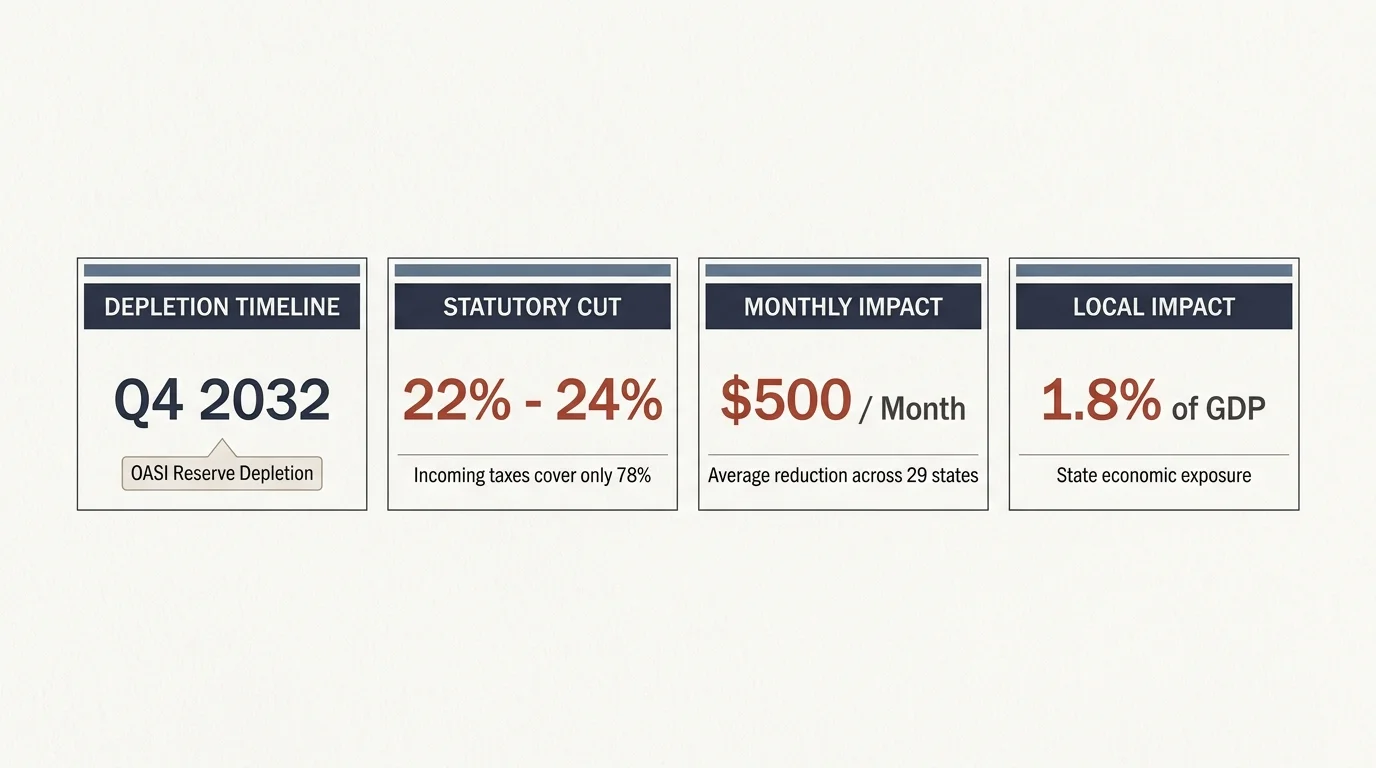
- The Depletion Timeline: The Old-Age and Survivors Insurance (OASI) Trust Fund depletes its reserves in the fourth quarter of 2032.
- The Benefit Haircut: Incoming payroll taxes will only cover 78 percent of scheduled benefits, creating an automatic 22 to 24 percent cut.
- Monthly Dollar Impact: Beneficiaries in 29 states face average reductions exceeding 500 dollars each month.
- Local Economic Exposure: Lower-income states face substantial economic disruption, with benefit losses exceeding 1.8 percent of state Gross Domestic Product (GDP).
- Actionable Protection: Proactive claiming strategies, tax diversification, and budget adjustments can offset potential losses before statutory deadlines arrive.

Why 2032 Matters: The Mechanics of Social Security Solvency
Social Security operates primarily on a pay-as-you-go system. Taxes collected from current workers immediately pay the benefits of current retirees.
For decades, revenue exceeded benefit payouts; the government stored the surplus in dedicated trust funds. That demographic balance has now shifted dramatically.
A generation of baby boomers is retiring rapidly, while national fertility rates hover near 1.75 births per woman. As a result, fewer active workers now support each retired beneficiary.
Recent tax adjustments, including enhanced standard deductions for seniors, have also reduced taxable income channeled into the program. Consequently, the program must draw down its cash reserves to pay full benefits.
Under federal law, the Social Security Administration (SSA) cannot borrow money or run a financial deficit. When trust fund reserves hit zero, the agency can only pay what it collects in payroll taxes.
If Congress combines the OASI fund with the Disability Insurance (DI) fund, solvency extends to 2034. However, that temporary merger only softens the cut to 17 percent rather than preventing it.
“The best time to plan for retirement was 20 years ago. The second best time is today.”
What Retirees Stand to Lose: State-by-State Breakdown
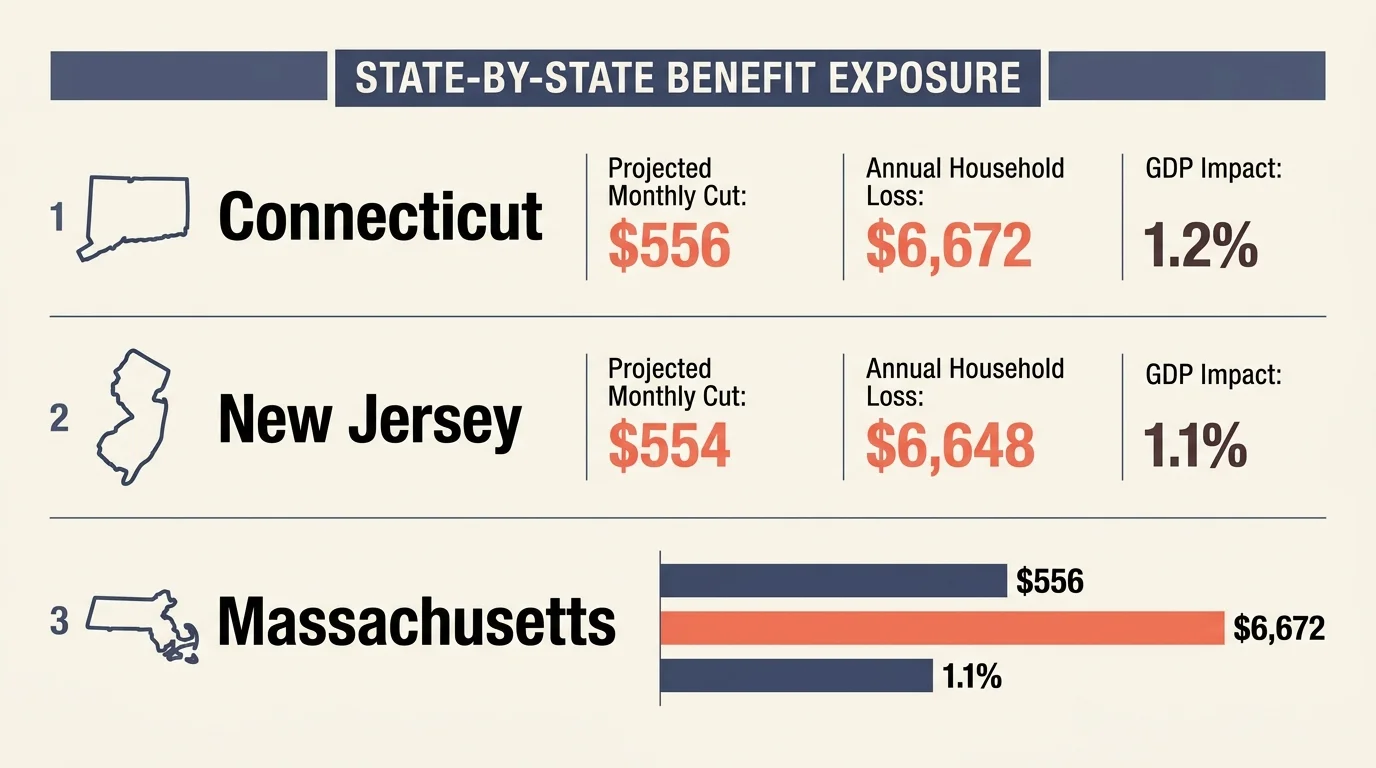
Benefit reductions will not affect every retiree equally. Because Social Security benefits reflect lifetime earnings, states with higher average wages will experience steeper raw dollar losses.
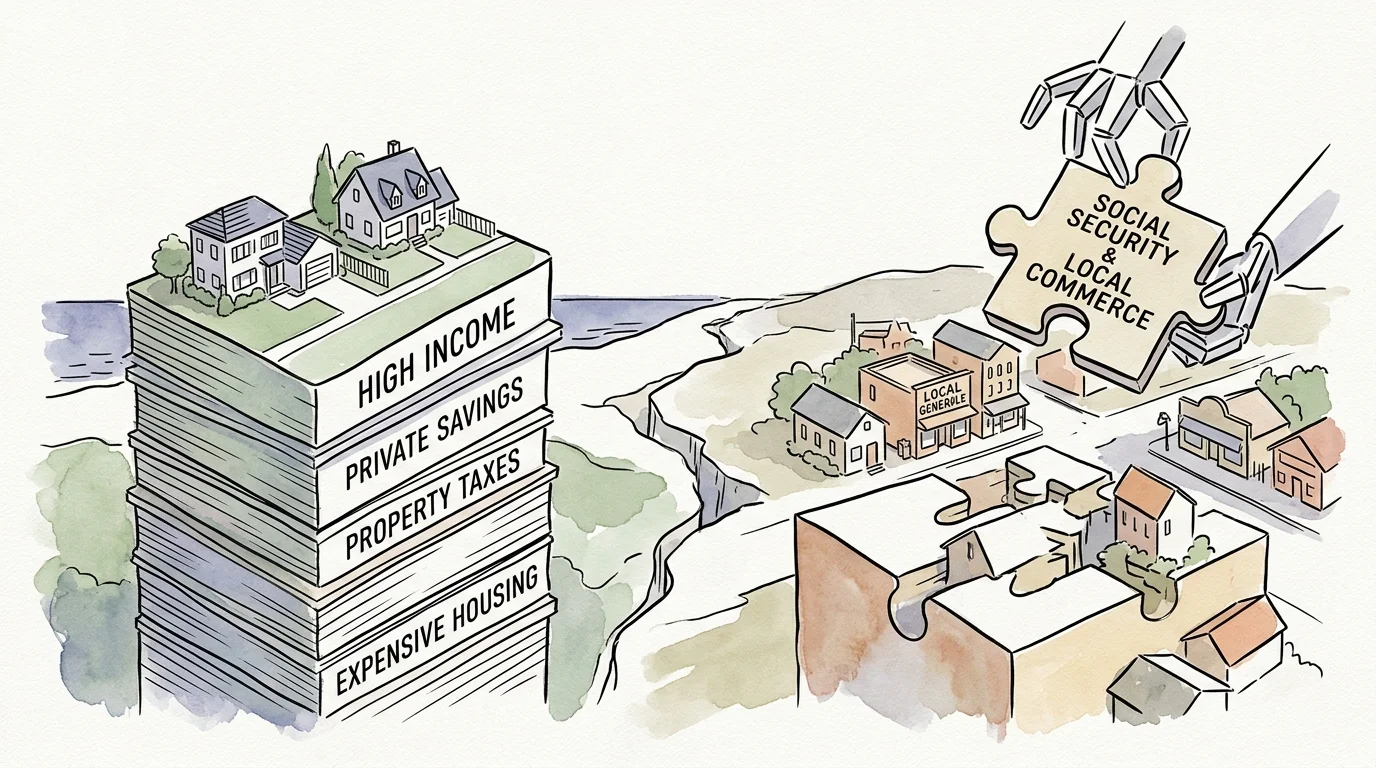
Conversely, states with lower median incomes and higher retiree concentrations face severe economic consequences. In these areas, Social Security income supports a large share of local commerce.
| State / Region | Projected Monthly Cut | Annual Household Loss | State Economic Impact (% of GDP) |
|---|---|---|---|
| Connecticut | $556 | $6,672 | 1.2% |
| New Jersey | $554 | $6,648 | 1.1% |
| Massachusetts | $527 | $6,324 | 1.0% |
| New York | $511 | $6,132 | 1.1% |
| California | $498 | $5,976 | 0.9% |
| Florida | $486 | $5,832 | 1.5% |
| Texas | $472 | $5,664 | 1.0% |
| Pennsylvania | $495 | $5,940 | 1.4% |
| West Virginia | $442 | $5,304 | 1.9% |
| Mississippi | $431 | $5,172 | 1.8% |
| Vermont | $478 | $5,736 | 1.8% |
| South Carolina | $469 | $5,628 | 1.7% |
| Maine | $462 | $5,544 | 1.7% |
| Michigan | $488 | $5,856 | 1.6% |
| Montana | $465 | $5,580 | 1.6% |
| Arkansas | $438 | $5,256 | 1.6% |
| Alabama | $447 | $5,364 | 1.6% |
| National Average | $500 | $6,000 | 1.1% |
High-cost northeastern states face the steepest nominal cuts per check. In contrast, southeastern and rural states suffer deeper macroeconomic losses relative to their total economic output.
Large states will see massive aggregate revenue vanish from their communities. California faces a total annual loss of 33 billion dollars, while Florida loses 27 billion dollars annually.
Why Your Location Alters Your Risk Profile
A monthly cut of 500 dollars carries different consequences depending on where you reside. State tax laws, regional housing costs, and healthcare expenses determine how painful benefit cuts will feel.
Certain states continue to tax Social Security income at the state level. If you live in one of these jurisdictions, a federal benefit reduction creates a double financial squeeze.
High-tax states reduce your net take-home payment even further. Meanwhile, states with no personal income tax allow you to retain more of your remaining benefits.
Housing affordability also shapes your vulnerability. Retirees who own their homes outright can absorb a 24 percent benefit drop far better than renters in high-cost metro areas.
You can review regional spending benchmarks using tools provided by the Consumer Financial Protection Bureau. Evaluating your geographic costs helps you identify where budget trims will hurt least.
“It’s not how much money you make, but how much money you keep, how hard it works for you, and how many generations you keep it for.” — Robert Kiyosaki

Don’t Make These Mistakes
Fear of future benefit cuts often causes retirees to make irreversible planning mistakes. Avoiding common missteps will protect your long-term security.
- Claiming Early Out of Fear: Filing for benefits at age 62 permanently locks in a 30 percent reduction against your full retirement benefit. Layering an automatic 2032 cut on top of early filing creates severe lifetime losses.
- Assuming Full Inaction: Counting on a sudden windfall or assuming Congress will do nothing can paralyze your planning. Build a flexible baseline budget that tolerates income swings.
- Ignoring Tax-Advantaged Withdrawals: Withdrawing from pre-tax retirement accounts without a clear bracket strategy increases your overall tax burden during critical years.
- Neglecting Supplemental Support: Many households qualify for utility, property tax, and medical assistance programs but never apply.
To check available local and federal relief programs that offset living expenses, visit BenefitsCheckUp by the National Council on Aging. Community benefits can buffer against federal check reductions.

Strategic Moves to Safeguard Your Retirement Income
You cannot control congressional legislation, but you can control your personal financial structure. Taking decisive steps today shields your monthly cash flow from trust fund volatility.
First, optimize your claiming age if you have not yet claimed. Delaying your claim past full retirement age increases your base benefit by 8 percent each year until age 70.
A higher starting base ensures that even if a 22 percent cut occurs, your check remains larger than an early-claim payout. Calculate your personal baseline using the official Social Security Retirement Estimator.
Second, prioritize systematic debt reduction before 2032. Eliminating credit card balances, personal loans, and auto debt frees up essential monthly cash flow.
Third, execute strategic Roth IRA conversions during lower-income years. Tax-free distributions in retirement give you spending flexibility without increasing your adjusted gross income.
Finally, examine non-correlated income streams such as fixed annuities, rental property income, or part-time consulting. Diverse income sources ensure you never depend solely on federal benefit schedules.
Advocacy groups like AARP continuously lobby lawmakers to protect benefit formulas. Staying informed on emerging legislative proposals allows you to adjust your plans well ahead of deadlines.

When Professional Advice Is Worth It
Navigating benefit reductions alongside private savings requires careful coordination. Specialized professional advice often pays for itself through tax savings and optimized claiming strategies.
Consider consulting a fee-only fiduciary financial planner to stress-test your portfolio against an automatic 24 percent benefit drop. A fiduciary models various tax and inflation scenarios tailored to your assets.
A Social Security claiming specialist can analyze spousal and survivor benefit options. This analysis ensures married couples maximize lifetime household payouts under changing solvency rules.
If you face estate or long-term care decisions, work with an elder law attorney. Legal professionals help protect your primary residence and assets while preserving your eligibility for vital support programs.
Frequently Asked Questions About 2032 Benefit Changes
Will Congress let Social Security cut benefits automatically in 2032?
Congress has historical precedent for intervening before statutory cuts occur, as seen in the 1983 Social Security amendments. However, future solutions may combine payroll tax increases, higher retirement ages, or reduced cost-of-living adjustments.
If I am already receiving benefits, can my check actually decrease?
Yes. Under current statutory law, the trust fund depletion triggers across-the-board reductions for all beneficiaries, regardless of when they claimed benefits.
How does combining the OASI and Disability funds change the outcome?
Merging the retirement and disability funds extends overall solvency from late 2032 to 2034. Once depleted, payable benefits would equal 83 percent instead of 78 percent.
Should I claim benefits at age 62 to get money before 2032?
Claiming early locks in permanent reductions of up to 30 percent for life. If insolvency cuts follow, your reduced payment drops even further, creating compounding losses over your retirement.
Next Steps for Your Retirement Plan
Review your annual Social Security statement online today to verify your projected earnings and baseline benefit estimates. Model your household budget with a 20 percent income reduction to locate flexible spending categories.
This article is for informational purposes only and does not constitute financial, legal, or medical advice. Medicare rules, Social Security benefits, and tax laws change regularly—verify current details at Medicare.gov, SSA.gov, or with a licensed professional.
Last updated: February 2026. Medicare and Social Security rules change annually—always verify current details at official government sources.