Moving to the coast in retirement does not have to drain your savings or compromise your healthcare access. By evaluating actual carrying costs, state taxes, and local medical networks, you can find vibrant waterfront communities that protect your fixed income.
Many retirees assume ocean living requires multi-million-dollar portfolios, but several overlooked coastal pockets offer attainable real estate. Exploring these locations reveals how strategic state tax policies can stretch your nest egg much further.
Whether you want year-round southern warmth or rugged Pacific Northwest scenery, practical options exist across the country. Here are ten exceptional coastal and island towns worth exploring for your retirement years.
What You Need to Know Before Choosing a Coastal Town
Relocating to the water requires looking beyond scenic beach walks and romantic ocean sunsets. You must examine the practical realities of everyday life on fixed retirement income.
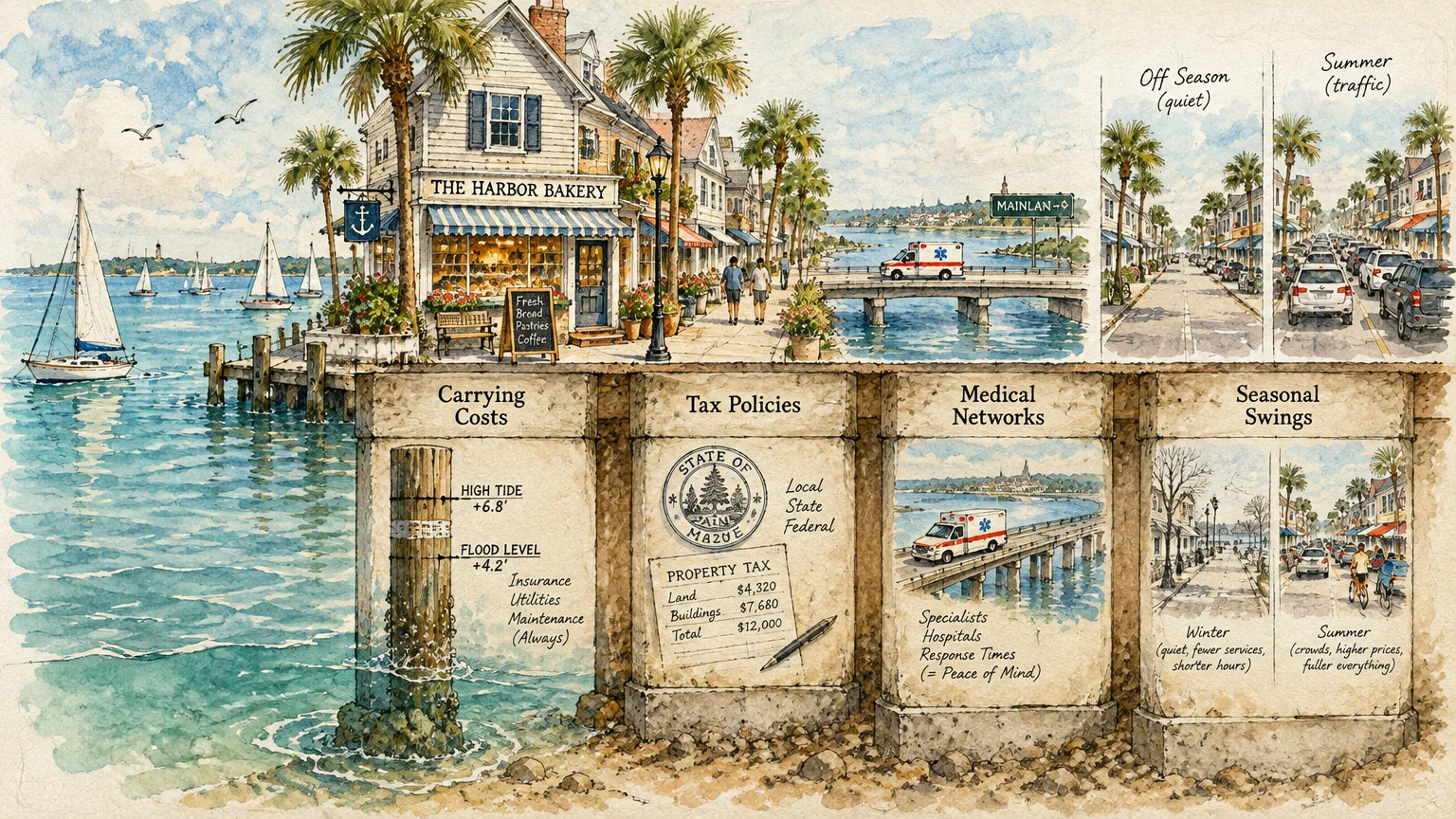
Several financial and logistical elements dictate whether a coastal community supports long-term stability:
- Carrying Costs: Windstorm insurance, flood premiums, and special assessments often exceed baseline mortgage payments.
- Tax Policies: State taxation on Social Security, private pensions, and traditional IRA withdrawals varies drastically between coastal states.
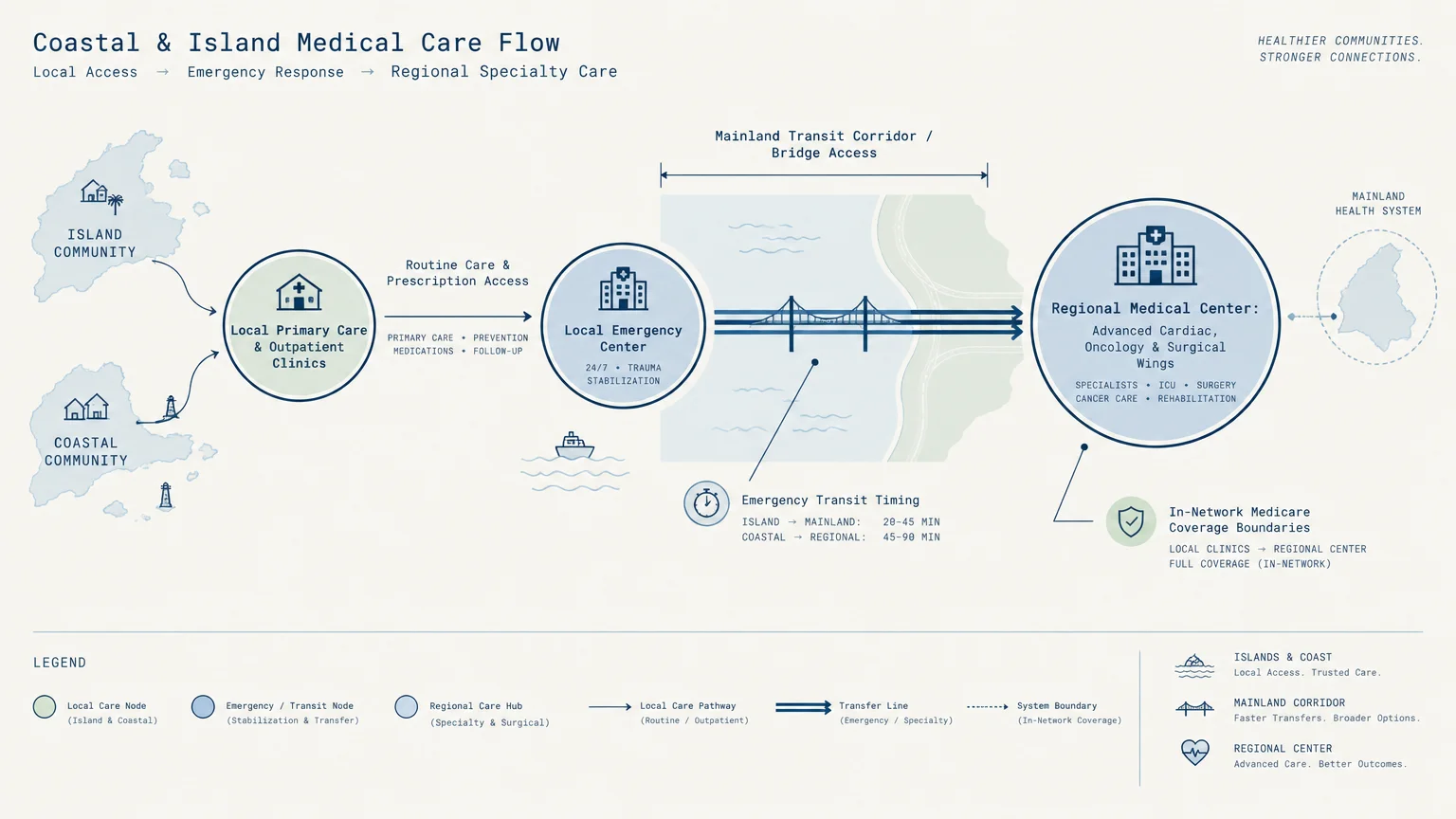
- Medical Networks: Island communities frequently rely on regional mainland hospitals for advanced cardiac, oncological, and surgical care.
- Seasonal Swings: Tourist congestion changes traffic patterns, utility costs, and local retail access during peak summer months.
Balancing these trade-offs ensures that your new home provides genuine security alongside coastal leisure.
“The goal of retirement is to live off your assets—not live off your regrets.”

10 Island and Coastal Towns Worth Considering for Retirement
These ten communities deliver distinct combinations of waterfront scenery, cultural recreation, and accessible infrastructure for retirees.
1. Gulfport and Biloxi, Mississippi
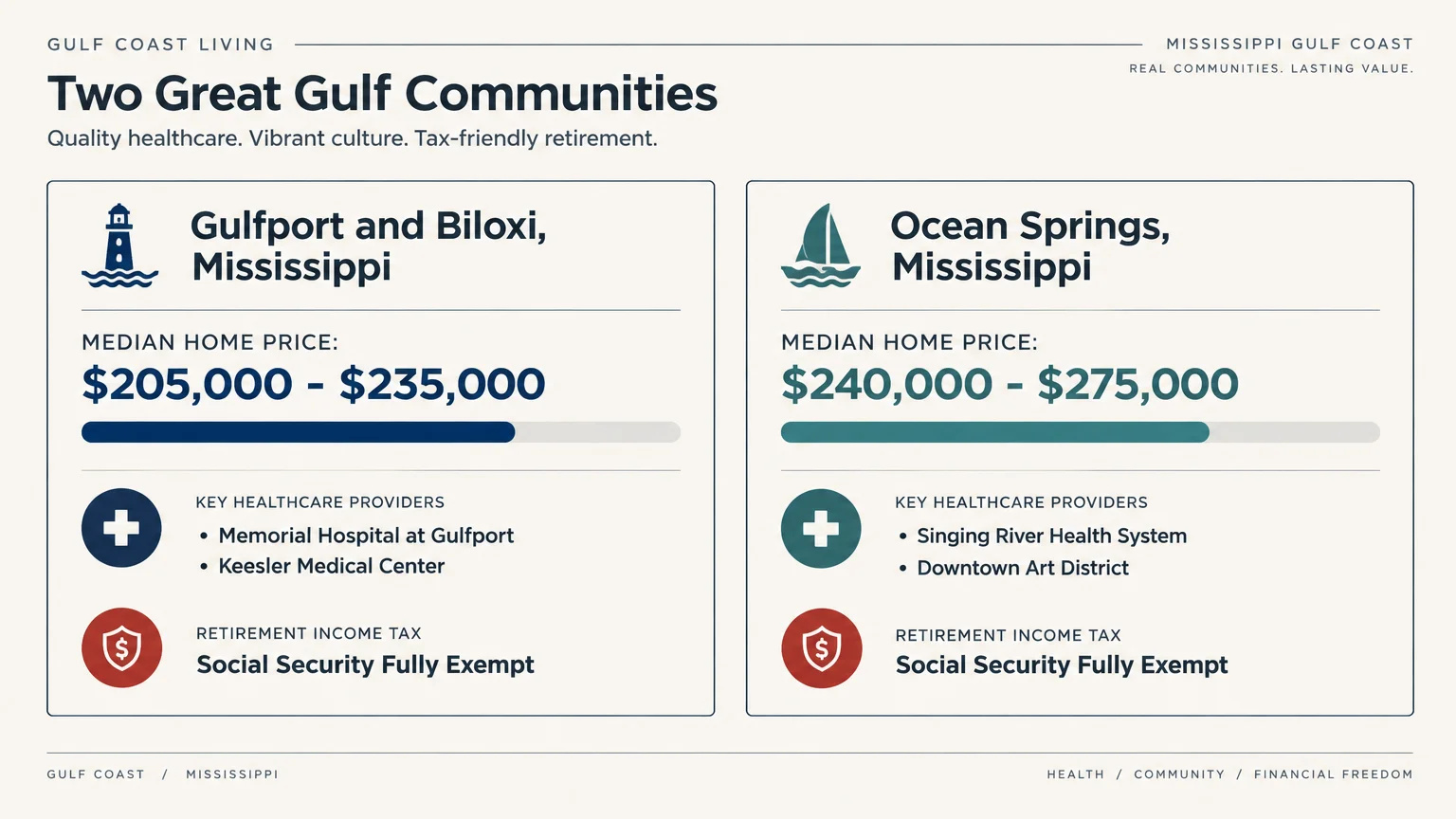
Gulfport and Biloxi deliver some of the lowest housing entry points on the entire American coastline. Median home sale prices hover between $205,000 and $235,000, creating exceptional value for budget-conscious buyers.
Retirees enjoy white-sand beaches, calm Gulf waters, and a rich local culinary culture. A thriving coastal art scene and commercial harbor districts keep daily life active and engaging.
Healthcare access remains strong through Memorial Hospital at Gulfport and Keesler Medical Center. Specialized physicians, emergency wings, and outpatient clinics serve the region without requiring travel to distant metropolitan areas.
Mississippi provides one of the nation’s most favorable retirement tax environments. The state fully exempts Social Security benefits along with public and private retirement distributions from personal income tax.
2. Ocean Springs, Mississippi
Located just across Biloxi Bay, Ocean Springs features a historic, tree-lined downtown filled with galleries and cafes. Century-old live oaks shade the streets, giving this community a distinct artistic character.
Median home prices typically range between $240,000 and $275,000 for quiet residential neighborhoods. The town offers pedestrian-friendly shopping and easy golf-cart access to front beaches.
Ocean Springs Hospital, part of the Singing River Health System, delivers comprehensive localized emergency and surgical care. Residents can manage ongoing healthcare needs without leaving their immediate community.
The town combines Mississippi’s total retirement income tax exemptions with a peaceful, small-town ambiance. It stands out as one of the most charming affordable coastal towns along the Gulf.
3. Pensacola, Florida
Pensacola sits on the western edge of the Florida Panhandle, blending historic architecture with turquoise waters. Median home prices sit between $310,000 and $340,000, remaining far below South Florida averages.
Residents enjoy direct access to the protected shorelines of Gulf Islands National Seashore. Downtown Pensacola offers walkable cultural districts, symphony performances, and active historical preservation efforts.
Healthcare infrastructure is a major regional strength. Baptist Hospital and Ascension Sacred Heart provide comprehensive tertiary care, trauma services, and advanced cardiology clinics.
Florida levies zero state income tax, allowing you to withdraw retirement funds without state deductions. However, you must carefully evaluate coastal homeowners insurance rates when calculating your monthly housing budget.
4. Myrtle Beach, South Carolina
Myrtle Beach serves as the energetic anchor of South Carolina’s sixty-mile Grand Strand. Median home sale prices average between $280,000 and $325,000 across a wide variety of established neighborhoods.
The area offers endless golf courses, public ocean piers, and organized recreation programs tailored to older adults. Extensive master-planned developments provide low-maintenance patio homes and active clubhouses.
Grand Strand Medical Center functions as a regional tertiary hub, specializing in heart surgery and neurosurgery. Plentiful outpatient physical therapy clinics and specialized practices support long-term active living.
South Carolina does not tax Social Security benefits. The state also provides a $10,000 retirement income deduction for residents aged 65 and older on other eligible distributions.
5. Calabash and Brunswick County, North Carolina
Brunswick County occupies the southernmost coastal corner of North Carolina, famous for the quiet fishing village of Calabash. Median home listing and sale prices range between $360,000 and $390,000.
The pace of life here is noticeably slower than in commercial tourist destinations. Uncrowded barrier beaches, seafood docks, and salt marsh creeks define everyday life for local residents.
Novant Health Brunswick Medical Center provides localized emergency and surgical care in nearby Bolivia. Residents also travel easily to major hospital networks in Wilmington or Myrtle Beach for advanced treatment.
North Carolina imposes a flat individual income tax and completely exempts Social Security benefits. Brunswick County maintains modest municipal property tax rates, keeping recurring annual overhead manageable.
6. Corpus Christi, Texas
Corpus Christi anchors the Texas Coastal Bend, offering warm weather and immediate access to Padre Island. Single-family homes trade at accessible median prices between $280,000 and $305,000.
Sailing, saltwater angling, and birdwatching serve as primary pastimes for local retirees. The community provides an authentic working waterfront atmosphere without inflated resort pricing.
CHRISTUS Spohn Health System operates extensive medical facilities throughout the city, providing comprehensive cardiac and oncology departments. Specialized physicians maintain extensive practices across the metropolitan area.
Texas does not collect state personal income tax on Social Security, pensions, or IRA withdrawals. However, effective property taxes often reach 1.7% to 2.1%, which requires careful cash-flow planning.
7. St. Simons Island, Georgia
St. Simons Island is the largest barrier island in Georgia’s Golden Isles, linked to the mainland by causeway. Median home values range from $580,000 to $660,000, reflecting premium island demand.
Canopies of live oaks, historic lighthouses, and miles of hard-packed sand beaches define the environment. Over thirty miles of paved bike paths allow residents to travel the island without using a car.
Southeast Georgia Health System operates a full-service hospital just across the causeway in Brunswick. The facility provides modern cancer care, joint replacement centers, and emergency services.
Georgia does not tax Social Security benefits and offers generous retirement income exclusions for seniors. The island balances upscale coastal leisure with accessible mainland services.
8. Whidbey Island, Washington
Whidbey Island lies in Puget Sound, accessible via the iconic Deception Pass bridge or regular state ferry service. Median home values range between $550,000 and $620,000.
The island offers dramatic marine views, temperate summers, and active farming communities. It is one of the most distinctive island towns to retire for lovers of maritime beauty.
WhidbeyHealth Medical Center serves the island as a dedicated Critical Access Hospital. For complex specialty procedures, residents take short trips across the water to regional medical centers in Everett and Seattle.
Washington levies no personal state income tax, protecting your investment returns and retirement distributions. The mild maritime climate avoids extreme summer heat, reducing seasonal cooling utility bills.
9. Belfast, Maine
Belfast sits along the picturesque shores of Penobscot Bay in Midcoast Maine. Median home values average between $420,000 and $450,000 in this historic shipbuilding community.
A thriving working waterfront, independent bookstores, and vibrant local food co-ops give Belfast a welcoming community feel. Summer temperatures remain comfortable, allowing for daily harbor walks along the municipal rail trail.
Waldo County General Hospital delivers award-winning primary care, emergency services, and inpatient treatment right in town. Advanced specialty networks operate within an hour’s drive in Bangor.
Maine exempts Social Security benefits from state income taxation. Belfast appeals directly to retirees who prefer crisp autumn breezes, snowy winters, and authentic coastal New England heritage.
10. Hilton Head Island, South Carolina
Hilton Head Island is a renowned barrier island celebrated for strict eco-friendly development standards and master-planned plantations. Median home values currently exceed $700,000.
Over sixty miles of multi-use pathways connect shaded residential neighborhoods to pristine Atlantic beaches. World-class tennis facilities, golf courses, and marina communities dominate the landscape.
Hilton Head Hospital delivers acute medical care, emergency services, and dedicated orthopedics directly on the island. Additional specialty care centers operate just off-island in Bluffton and Savannah.
South Carolina assesses legal primary residences at a favorable 4% property tax assessment ratio. This preferential rate helps keep annual property tax bills surprisingly modest on higher-value island real estate.
“Don’t simply retire from something; have something to retire to.” — Harry Emerson Fosdick
Comparison of Coastal Retirement Towns
Comparing key financial metrics and infrastructure details helps narrow your search among coastal retirement towns. The table below outlines real estate pricing, tax posture, and regional healthcare access across all ten markets.
| Town & State | Median Home Price | State Tax on Social Security | Primary Hospital Network | Hazard Insurance Profile |
|---|---|---|---|---|
| Gulfport/Biloxi, MS | $205,000 – $235,000 | Exempt | Memorial Hospital at Gulfport | Moderate to High Wind/Flood |
| Ocean Springs, MS | $240,000 – $275,000 | Exempt | Ocean Springs Hospital | Moderate Wind/Flood |
| Pensacola, FL | $310,000 – $340,000 | No State Income Tax | Baptist Hospital / Ascension | High Wind/Hail Exposure |
| Myrtle Beach, SC | $280,000 – $325,000 | Exempt | Grand Strand Medical Center | Moderate Coastal Wind |
| Calabash, NC | $360,000 – $390,000 | Exempt | Brunswick Novant Medical | Moderate Wind Exposure |
| Corpus Christi, TX | $280,000 – $305,000 | No State Income Tax | CHRISTUS Spohn Health System | High Windstorm (TWIA Area) |
| St. Simons Island, GA | $580,000 – $660,000 | Exempt | SE Georgia Health System | Moderate Hurricane Exposure |
| Whidbey Island, WA | $550,000 – $620,000 | No State Income Tax | WhidbeyHealth (Critical Access) | Low Storm / High Earthquake |
| Belfast, ME | $420,000 – $450,000 | Exempt | Waldo County General Hospital | Low Storm / Winter Freeze |
| Hilton Head, SC | $700,000+ | Exempt | Hilton Head Regional Hospital | Moderate to High Surge |
Healthcare and Medicare Realities on the Coast
Relocating across county or state lines triggers significant administrative updates for your healthcare coverage. Medicare Advantage plans and Part D drug plans maintain strict geographic service areas tied directly to specific counties.
When you relocate, you trigger a special enrollment window for healthcare coverage. You can compare provider networks in your new area through the official Medicare Plan Finder to avoid coverage interruptions.
If you notify Medicare before moving, your Special Enrollment Period runs from the month before your move through two months following it. Reporting after your move gives you the notification month plus two full months to pick a new plan.
Original Medicare provides nationwide flexibility without network restrictions, allowing you to visit any provider who accepts standard Medicare assignment. However, Medicare Supplement policies do not automatically offer open enrollment rights if you want to switch plans after crossing state boundaries.
Living on an island requires evaluating emergency transit logistics. While mainland communities have rapid ambulance routes, barrier islands occasionally depend on bridges, ferries, or aeromedical transport during specialized medical crises.

Managing Taxes, Flood Insurance, and Hidden Coastal Costs
The purchase price of a coastal home represents only part of your monthly living expenses. Insurance premiums and property taxes can quickly erode retirement savings if you do not plan ahead.
Forty-two states and Washington, D.C., completely exempt Social Security benefits from state taxation. Check your state’s specific status using the Social Security Administration resources before committing to a relocation plan.
Coastal real estate requires careful review of federal flood insurance rules. The Federal Emergency Management Agency prices flood risk through its Risk Rating 2.0 system, which assesses individual property elevation, foundation type, and distance to water.
Older shoreline properties face annual premium increases capped by federal law at 18% until reaching their true actuarial risk cost. Standard homeowners policies exclude flood damage entirely, requiring a dedicated policy backed by the government or private insurers.
Wind and hail deductibles represent another major out-of-pocket expense along hurricane-prone coasts. These deductibles are calculated as a percentage of your dwelling value, typically ranging from 2% to 5% rather than a flat dollar amount.
Learn to evaluate total borrowing and ongoing ownership costs using financial guides from the Consumer Financial Protection Bureau. Planning for these recurring line items ensures your dream home remains affordable permanently.

Don’t Make These Mistakes When Moving to the Coast
Many retirees encounter unexpected obstacles during their first year of coastal living. Avoiding common relocation traps will preserve your nest egg and peace of mind.
- Ignoring Elevation Certificates: Never buy a coastal home without reviewing its elevation profile and historical flood claims.
- Assuming Constant Sunshine: Coastal areas frequently deal with intense seasonal storms, salt-air corrosion, and high humidity that accelerates home maintenance.
- Overlooking Peak Tourist Traffic: Towns that feel tranquil in November can become intensely gridlocked with tourists during July and August.
- Failing to Test Healthcare Waitlists: Call local primary care doctors before moving to confirm they are actively accepting new Medicare patients.
Taking time to rent for an off-season trial run helps you verify daily realities before signing a long-term purchase contract.

When Professional Advice Is Worth It
Relocating your household across state borders introduces complex tax and legal questions. Working with certified experts prevents expensive administrative mistakes.
You can locate free, unbiased health insurance counseling through the Eldercare Locator network. State Health Insurance Assistance Program counselors clarify local Medicare Advantage network options at no cost.
A fee-only financial planner can calculate how moving between state tax jurisdictions changes your annual net retirement cash flow. They analyze retirement account drawdowns, local property taxes, and regional cost-of-living differences.
Finally, engage an independent insurance agent who lives in your target coastal community. Local agents understand regional flood maps, wind mitigation credits, and private surplus insurance lines far better than national call centers.
Frequently Asked Questions
Can you still retire by the beach on a modest budget?
Yes, communities along the northern Gulf Coast, such as Gulfport and Ocean Springs, offer median home prices well under $250,000. These towns provide true coastal access alongside low property taxes and favorable state retirement tax exemptions.
What is the difference between Medicare coverage on an island versus the mainland?
Original Medicare functions identically everywhere, but island communities often feature fewer specialized in-network providers. Moving triggers a Special Enrollment Period for Medicare Advantage, requiring you to choose a new plan operating within your new county.
How much does coastal homeowners insurance cost?
Coastal homeowners policies in storm-exposed regions typically cost between $4,000 and $8,000 annually. Separate flood insurance policies under FEMA Risk Rating 2.0 can add several hundred to several thousand dollars more per year.
Which states do not tax retirement income?
Florida, Texas, and Washington levy no state personal income tax, leaving Social Security, pensions, and retirement account withdrawals untaxed. Mississippi, Alabama, and South Carolina also provide substantial exemptions on qualified retirement distributions and Social Security.
Plan Your Next Steps
Schedule an extended four-week visit to your top town choice during its coldest or rainiest season. Experiencing real-world traffic, local clinics, and neighborhood grocery stores will show you whether the town truly fits your retirement lifestyle.
Information in this article reflects current rules as of the publication date and may change. Always confirm benefit details directly with Social Security Administration, Medicare.gov, or relevant government agencies before making decisions.
Last updated: February 2026. Medicare and Social Security rules change annually—always verify current details at official government sources.