Tossing the wrong envelope into your recycling bin can silently cancel your healthcare coverage or saddle you with lifetime penalties. Every autumn, mailboxes fill with mountains of glossy private insurance promotions that look identical to critical federal notices.
Sorting vital communication from aggressive private marketing protects your healthcare and your retirement savings. Knowing which official documents demand immediate action ensures you never lose access to your trusted doctors or forfeit guaranteed rights.
These seven Medicare letters frequently resemble unsolicited junk mail, but opening them immediately saves you thousands of dollars and endless administrative headaches.
The Bottom Line Up Front
Critical federal notices often arrive in plain envelopes without flashy colors or urgent exterior warnings. Private insurers also package statutory coverage notices inside bulky, generic-looking marketing envelopes that resemble promotional circulars.
Discarding these mailings can lead to canceled medical insurance, unexpected physician network exclusions, and lifetime financial penalties. Keep a designated folder for any mail bearing federal department seals or communications from your existing insurance carrier.
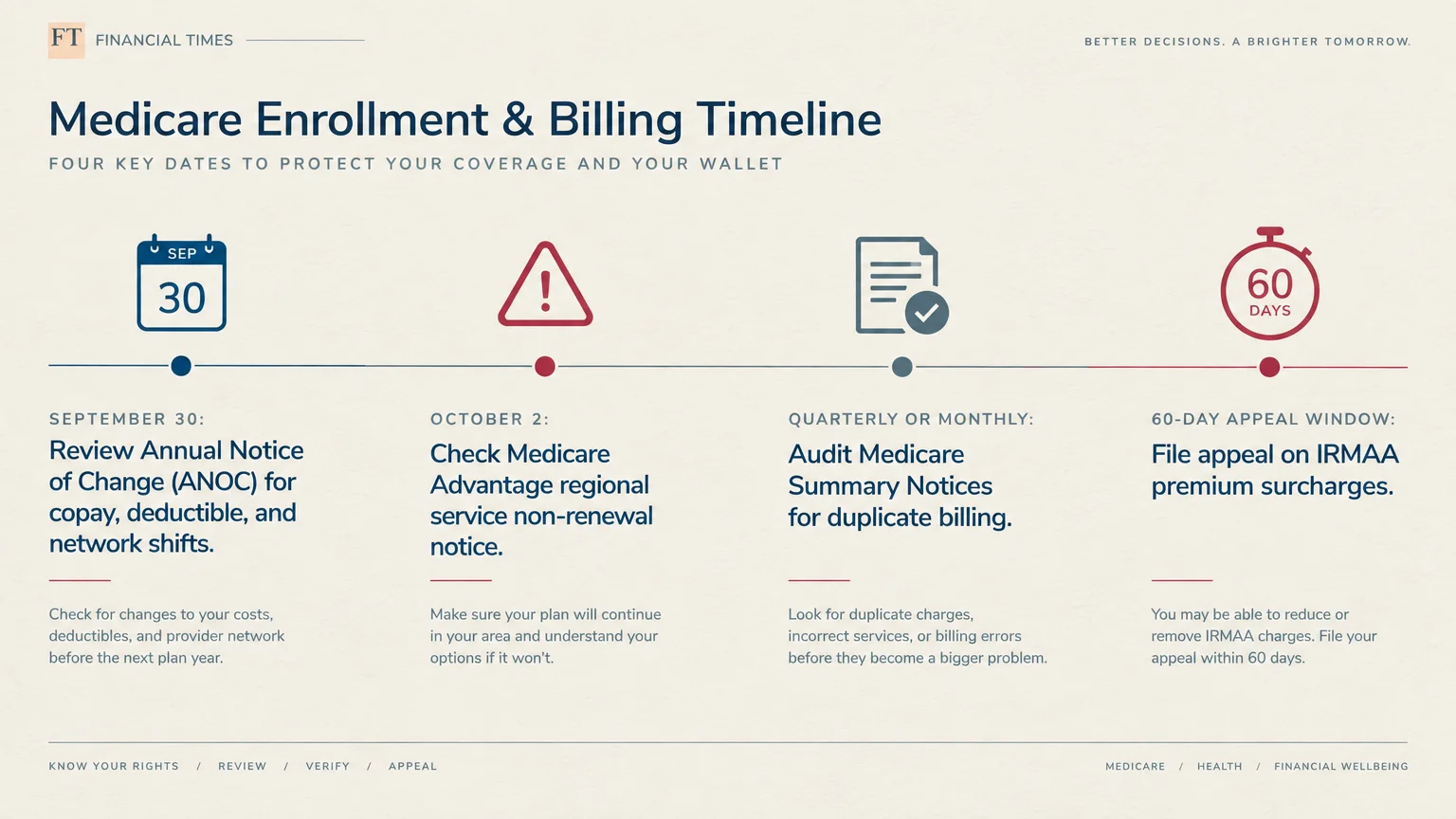
- September 30: Review your Annual Notice of Change for changes to your deductibles, copayments, and doctor networks.
- October 2: Check whether your Medicare Advantage plan is terminating its regional service contract for the coming year.
- Quarterly or Monthly: Verify medical claims on your summary notices to spot duplicate billing and medical identity theft early.
- 60-Day Appeal Window: Submit paperwork immediately if the government miscalculates your income-related Part B and Part D premium surcharges.
1. The Annual Notice of Change (ANOC)
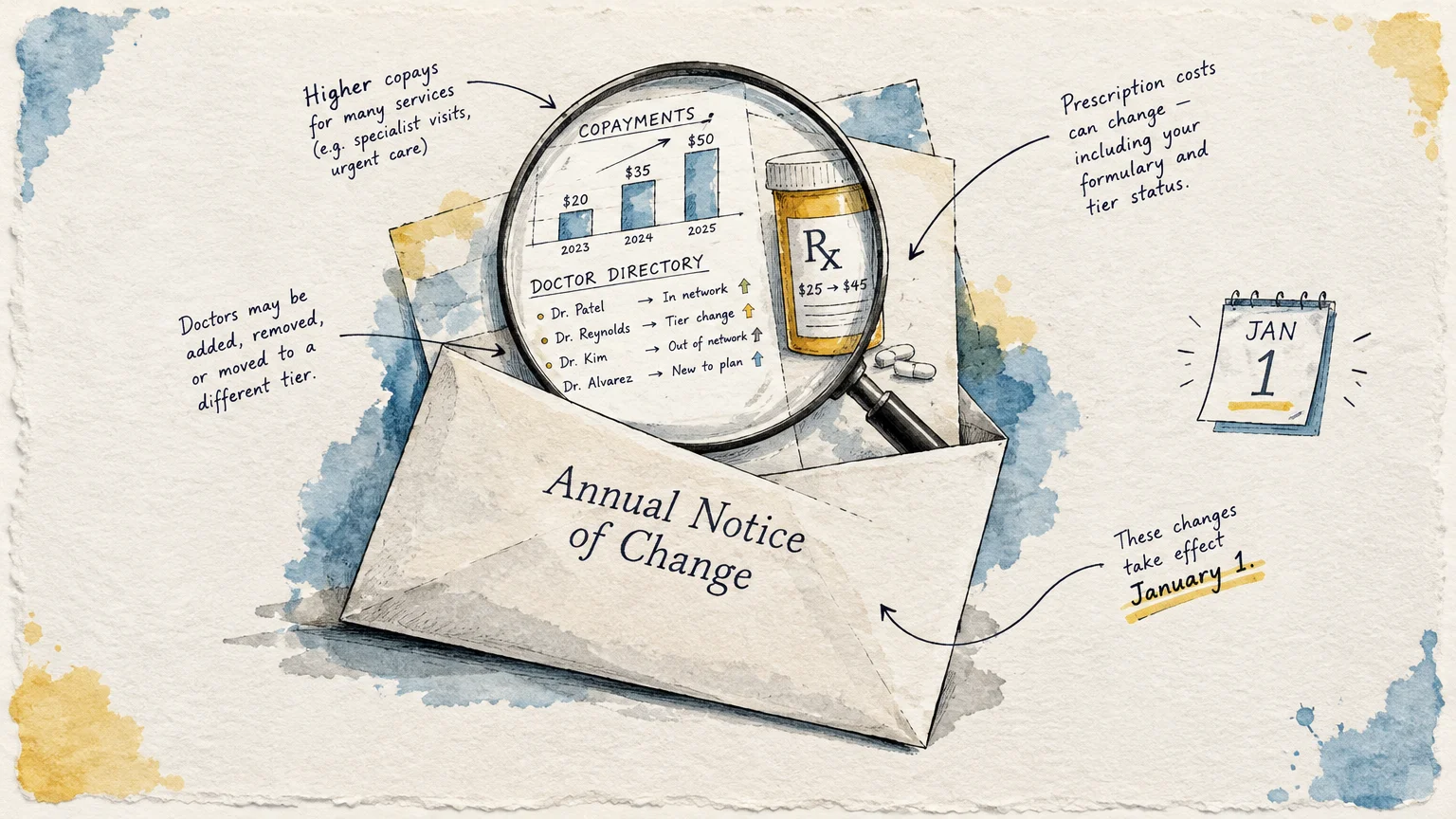
Federal regulations require private Medicare Advantage and standalone Part D drug plans to mail this document by September 30 each year. Because insurers often bundle it with thick marketing brochures, beneficiaries regularly mistake it for unwanted advertising.
This document highlights every single change your plan will implement on January 1. It details adjustments to your copays, deductibles, drug formularies, and in-network healthcare facilities.
Your monthly plan premium might remain unchanged while your prescription copays quadruple overnight. Your primary care physician or regional hospital system may also quietly exit your plan network.
Never assume your current plan will maintain its existing coverage terms into the coming year. Reviewing this document gives you time to explore options on the official Medicare Plan Finder before Open Enrollment ends on December 7.

2. The Evidence of Coverage (EOC) Packet
The Evidence of Coverage typically arrives alongside or shortly after your Annual Notice of Change in late September. It often looks like a bulky, 150-page telephone directory or an impersonal postcard providing a website link.
Many retirees toss this oversized packet into the trash without opening it because it feels like an unsolicited manual. In reality, the Evidence of Coverage serves as your legally binding insurance contract for the entire calendar year.
This comprehensive document outlines the fine print governing your medical care. It explains prior authorization requirements, out-of-pocket maximum caps, and mandatory grievance procedures.
Keep this document accessible rather than discarding it. When your insurer denies coverage for a specialized scan or physical therapy session, this text provides the exact rules needed to file an appeal.
“The goal of retirement is to live off your assets—not live off your regrets.”
3. Plan Non-Renewal and Service Area Termination Notice
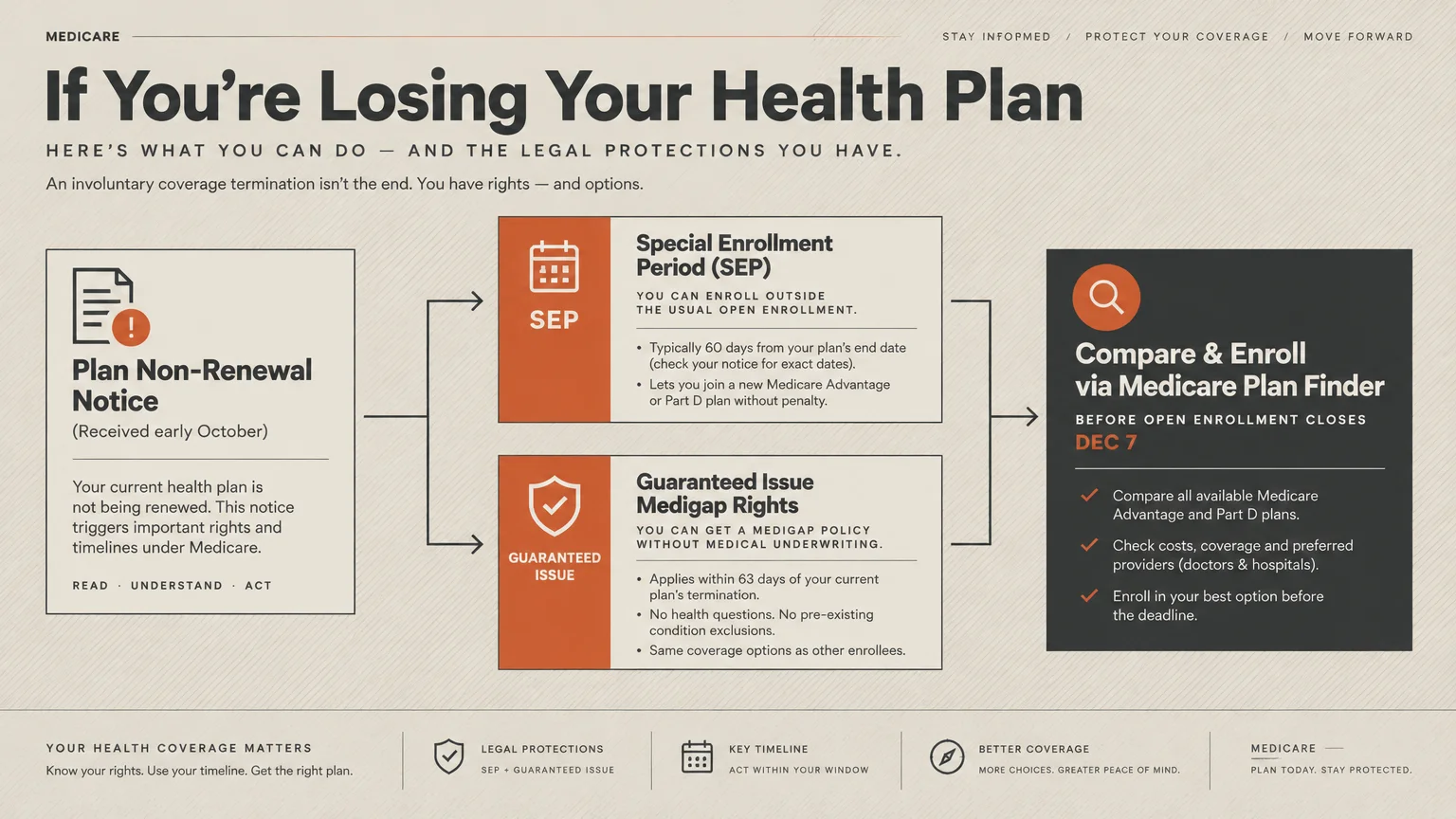
Insurers discontinuing a Medicare Advantage plan must deliver written notices to enrollees by October 2. Because private carriers print this notice on standard corporate stationery, recipients often brush it off as routine corporate literature.
Throwing away this letter can produce disastrous consequences for your continuity of care. If an insurer cancels your plan and you take no action, you will automatically default to Original Medicare without prescription drug coverage.
This specific document serves as your golden ticket to robust new healthcare protections. It grants you a Special Enrollment Period extending from December 8 through the end of February to select alternative coverage.
More importantly, this notification provides federal guaranteed-issue rights to purchase a Medigap supplemental policy. Insurers cannot reject your Medigap application or impose exclusions for preexisting conditions when your current plan terminates coverage.

4. The Medicare Summary Notice (MSN)
The federal government mails the Medicare Summary Notice every three months to beneficiaries enrolled in Original Medicare Parts A and B. A prominent label on the front envelope reads, “This is not a bill.”
Seeing that disclaimer tempts many retirees to discard the envelope without opening it. Beneficiaries enrolled in Medicare Advantage receive an equivalent monthly document called an Explanation of Benefits.
This statement details every medical service, laboratory test, and hospital stay billed under your personal identification number during the prior quarter. It lists what your healthcare provider billed, what Medicare approved, and what you may owe.
Reviewing this paperwork is your first line of defense against organized medical billing fraud and identity theft. You can detect billing errors or phantom medical services before statutory dispute deadlines expire.
5. Medicare Premium Bill (Form CMS-500)
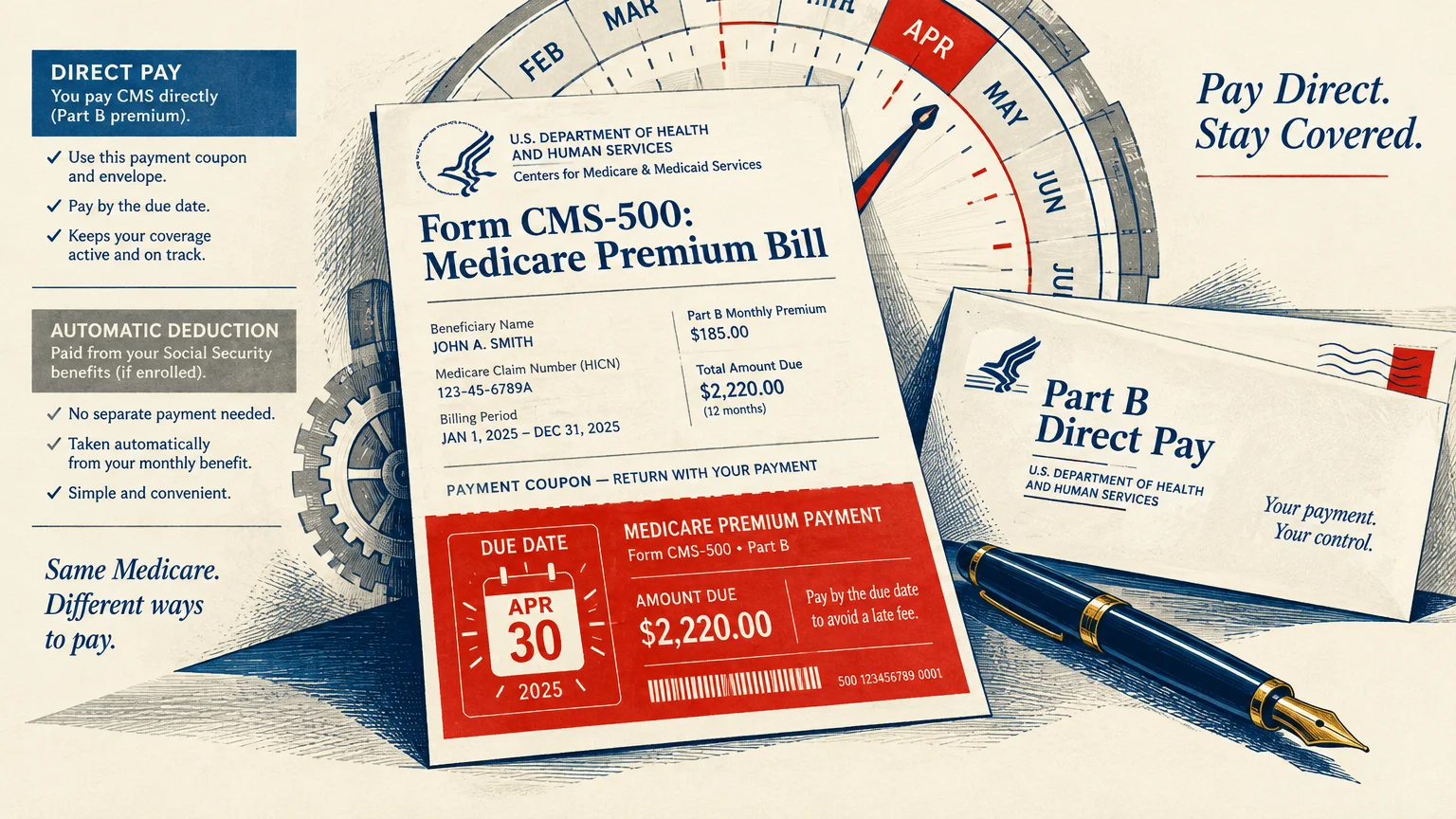
The Centers for Medicare & Medicaid Services mails Form CMS-500 to individuals who must pay their premiums directly. This occurs most commonly when beneficiaries enroll in Medicare at age 65 while delaying Social Security retirement benefits.
Because it arrives in a standard billing envelope with sparse government printing, some people mistake it for informational spam. If you do not collect monthly retirement checks, Medicare cannot automatically deduct your Part B or Part D premiums.
Ignoring this bill creates immediate peril for your medical access. Medicare gives you a brief grace period—typically 90 days—before administratively terminating your Part B outpatient coverage.
Losing Part B coverage leaves you fully responsible for doctor visits, emergency room treatment, and chemotherapy expenses. You can avoid billing lapses by setting up automated payments through your personal account at Medicare.gov.
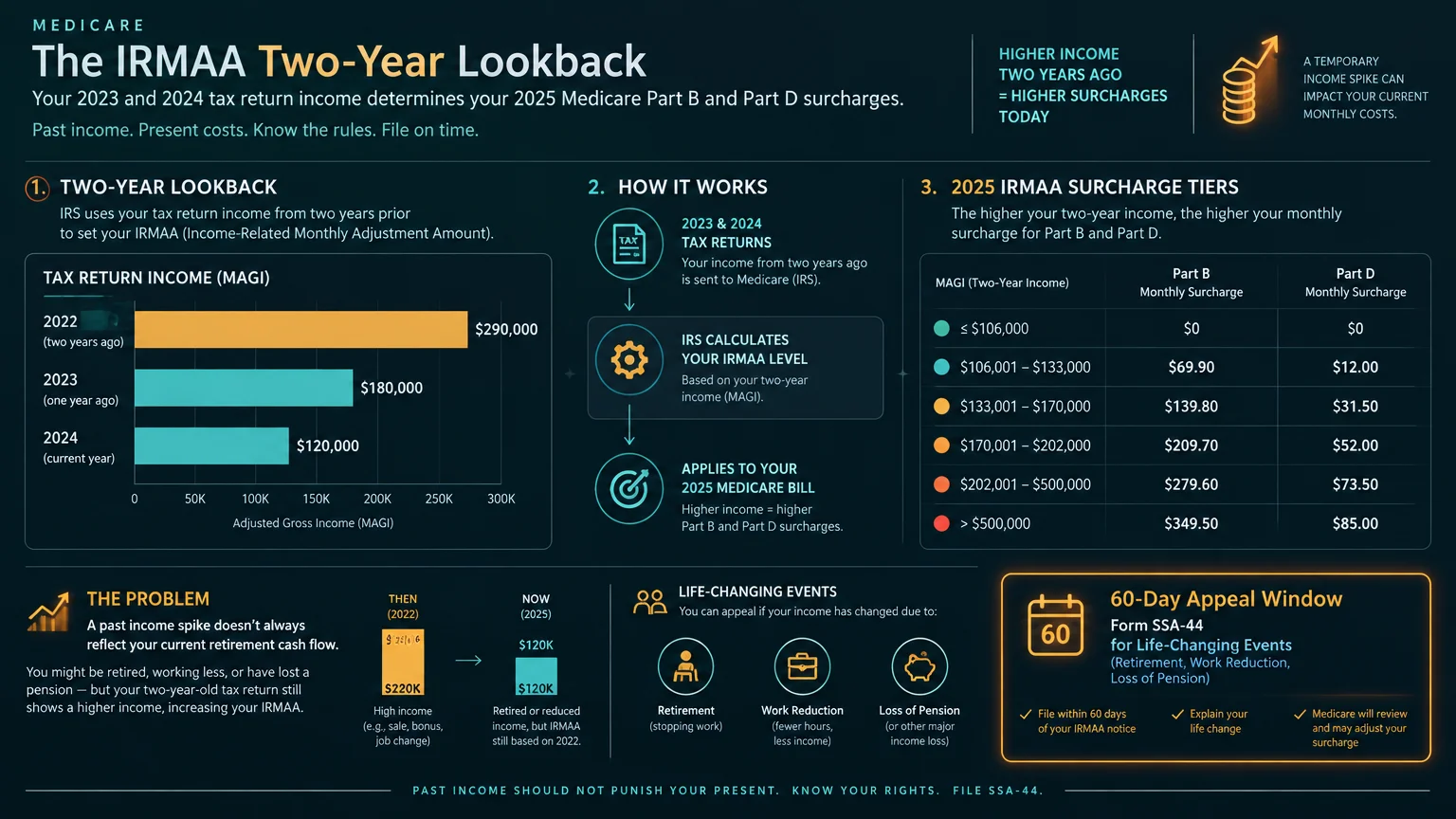
6. The IRMAA Determination Notice
The Social Security Administration (SSA) mails Income-Related Monthly Adjustment Amount notices in late November or December. It resembles an ordinary administrative update regarding your upcoming Social Security earnings.
This letter notifies higher-income beneficiaries of substantial monthly surcharges added to their standard Part B and Part D premiums. The government bases these surcharges on your federal tax returns from two years prior.
Discarding this letter closes your opportunity to correct outdated financial figures. Beneficiaries have a strict 60-day window from receipt to file an appeal or request a redetermination.
If your income declined due to a qualifying life-changing event—such as retirement, marriage, or spousal loss—you can dispute the charge. Submit Form SSA-44 with supporting documentation before this critical 60-day window expires.

7. Creditable Coverage Inquiry and Late Penalty Notice
When you enroll in a new prescription drug plan, Medicare verifies whether you maintained continuous drug coverage. If federal records indicate a gap of 63 consecutive days or more, your insurer mails a creditable coverage inquiry.
Because the inquiry looks like a routine insurance questionnaire, many retirees set it aside. Failing to complete and return this document triggers a permanent, lifetime late enrollment penalty.
Medicare calculates this penalty as 1% of the national base beneficiary premium for every uncovered month. The government tacks this surcharge onto your monthly drug premium for as long as you maintain coverage.
You can eliminate this penalty entirely by proving you had qualifying creditable coverage through an employer or union. Return the enclosed attestation form immediately alongside documentation from your former benefits administrator.
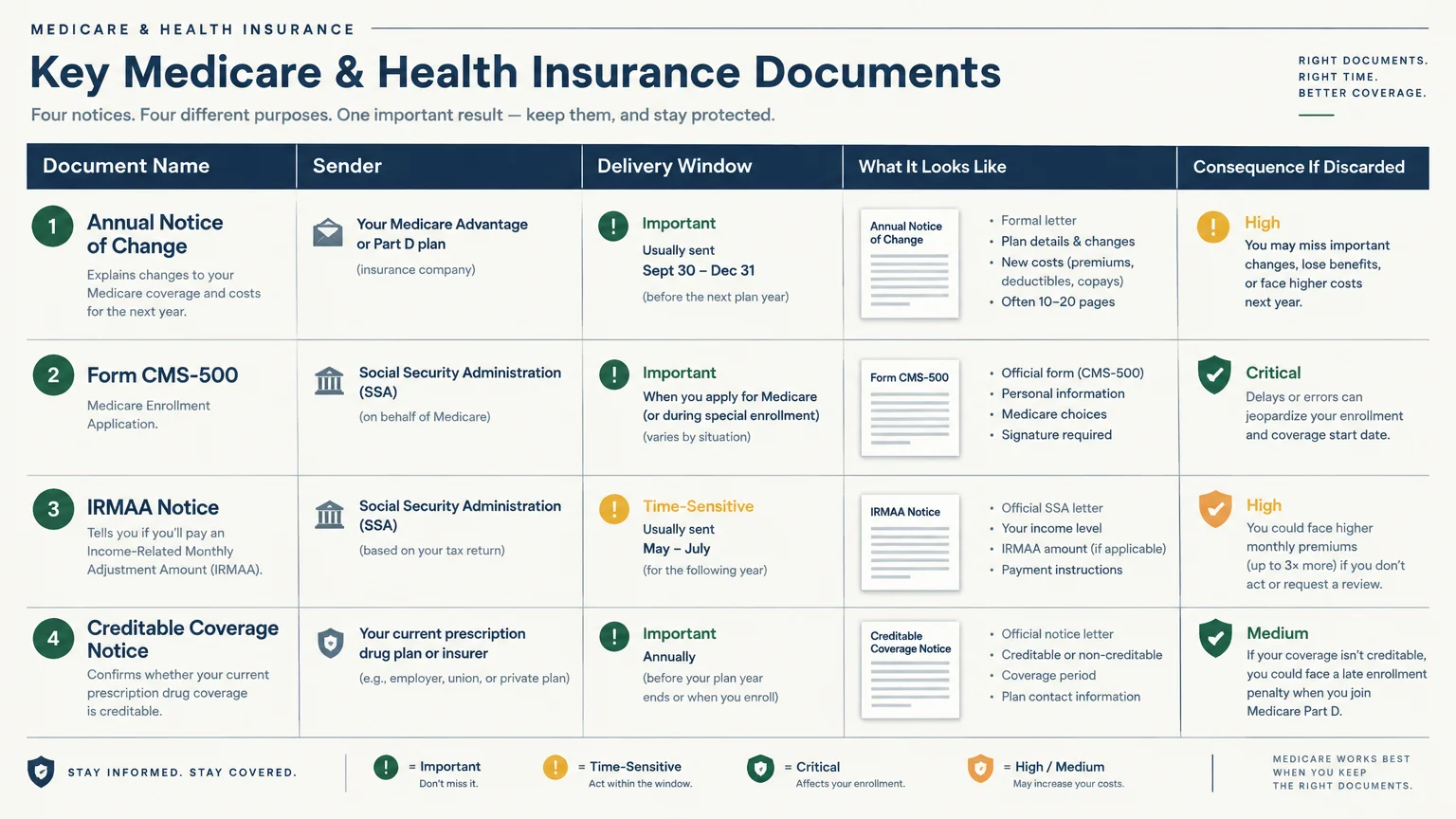
Comparison: Critical Medicare Letters at a Glance
The table below summarizes the key identifiers, timing, and action requirements for these essential mailings.
| Notice Name | Typical Arrival Window | Issuing Entity | What Is at Stake | Required Beneficiary Action |
|---|---|---|---|---|
| Annual Notice of Change (ANOC) | By September 30 | Medicare Advantage / Part D Plan | Copays, deductibles, and doctor networks change on Jan 1 | Compare your plan against new market options before Dec 7 |
| Evidence of Coverage (EOC) | September or October | Medicare Advantage / Part D Plan | Legal coverage terms and prior authorization requirements | Retain for reference when contesting medical denials |
| Plan Non-Renewal Notice | By October 2 | Discontinuing Insurance Carrier | Total termination of current health coverage | Use Special Enrollment Period to secure new coverage |
| Medicare Summary Notice (MSN) | Quarterly (every 3 months) | Centers for Medicare & Medicaid Services | Medical identity theft and fraudulent claims | Check dates of service and report unperformed procedures |
| Premium Bill (Form CMS-500) | Monthly or Quarterly | Centers for Medicare & Medicaid Services | Cancellation of Part B outpatient healthcare | Submit payment immediately or configure Medicare Easy Pay |
| IRMAA Determination Notice | Late November to December | Social Security Administration | Substantial monthly premium surcharges | File Form SSA-44 appeal within 60 days of receipt |
| Creditable Coverage Inquiry | Within weeks of plan enrollment | New Part D / Advantage Plan | Permanent lifetime monthly premium penalties | Return signed proof of past employer health coverage |
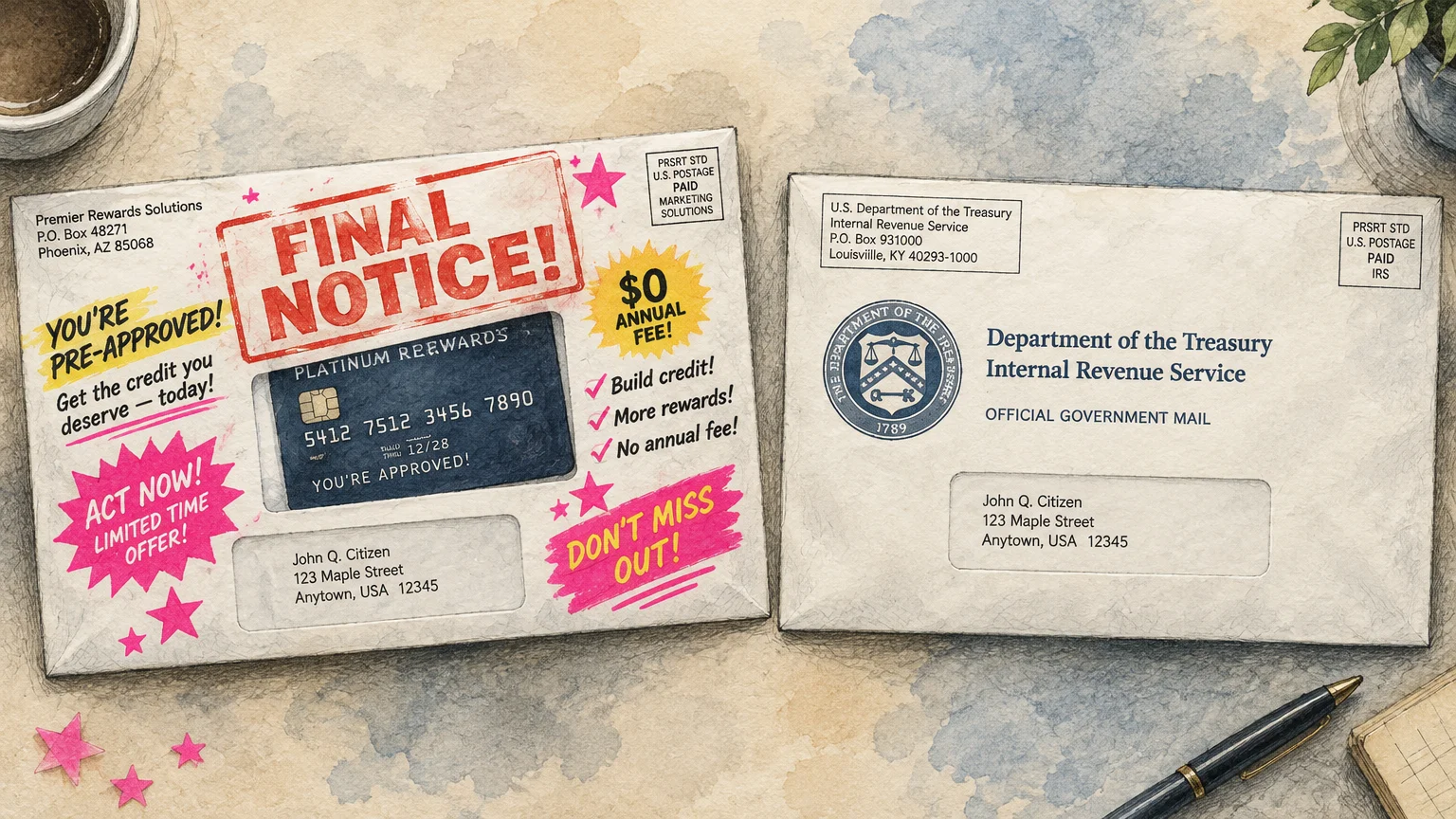
How to Spot Legitimate Medicare Mail Versus Aggressive Scams
Misleading marketing tactics make identifying legitimate government correspondence challenging. Deceptive companies deliberately design promotional advertisements to imitate official federal envelopes.
Official government letters feature genuine return addresses from the U.S. Department of Health and Human Services (HHS), CMS, or the Social Security Administration. Authentic correspondence never contains sensational headlines threatening immediate arrest or total loss of entitlement benefits.
Scam mailings frequently carry vague organizational names such as “Medicare Allocation Center” or “Senior Advisory Division.” They often include faux plastic identification cards designed to solicit personal information.
Federal agencies will never mail unsolicited requests demanding your bank routing details, credit card numbers, or full Social Security numbers. If a letter requests banking credentials to keep your Medicare active, discard it immediately.
“The best time to plan for retirement was 20 years ago. The second best time is today.”
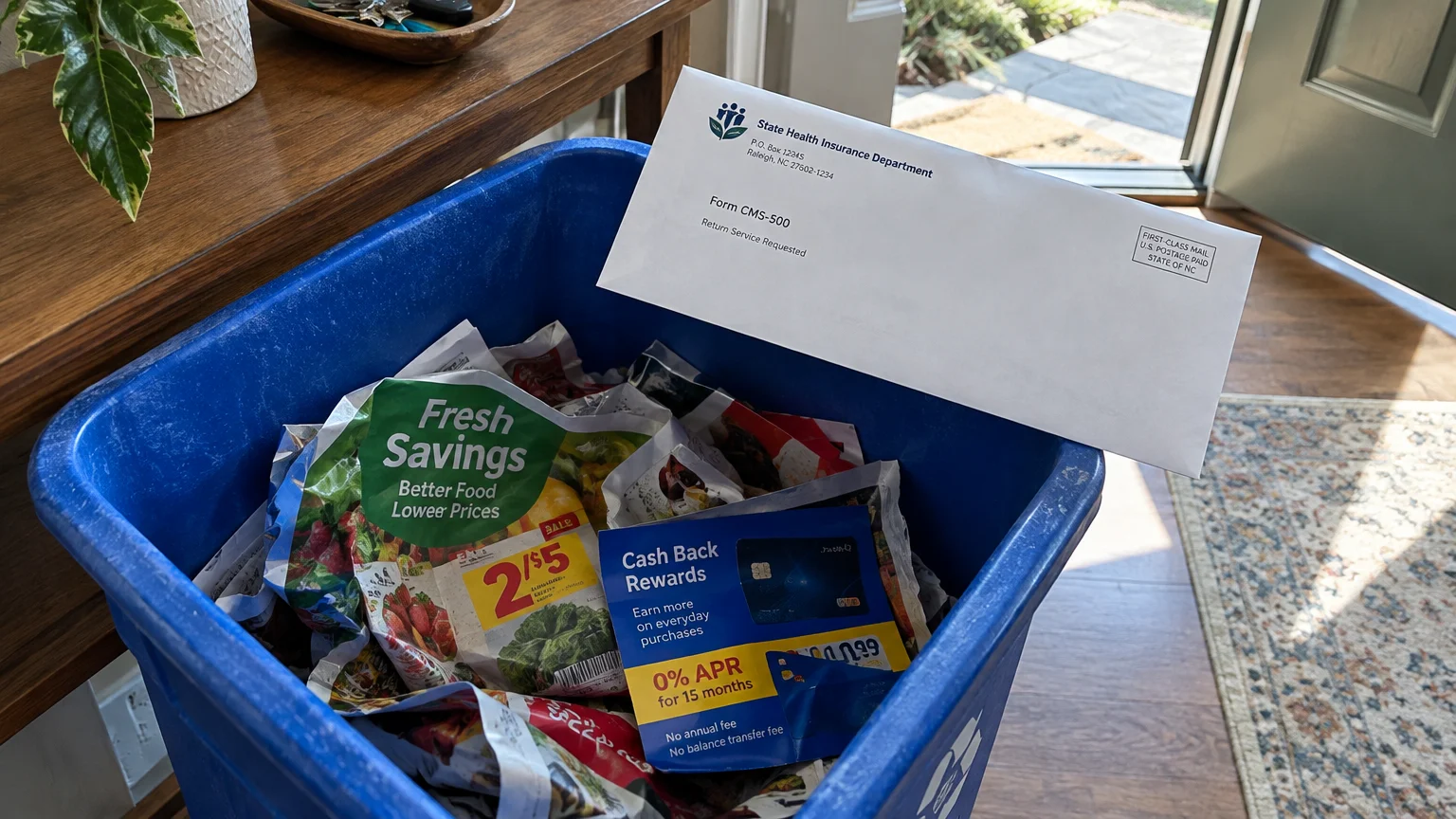
Common Retirement Traps
A frequent error involves tossing any envelope displaying the words “This is not a bill.” Disregarding these statements leaves you vulnerable to billing errors and fraudulent claims made under your federal number.
Another dangerous trap catches retirees who delay their Social Security retirement benefits past age 65. Because premiums are not automatically withheld from benefit checks, these individuals miss their initial CMS-500 premium notices.
Assuming your existing Medicare Advantage network remains identical each year creates costly surprises. Your preferred physician may terminate their contract while your drug copays escalate silently into higher tiers.
Finally, missing the 60-day IRMAA appeal deadline locks you into high monthly surcharges for a full year. Taking swift action protects your monthly cash flow during your retirement years.

When to Consult a Professional
Navigating conflicting mailings can feel overwhelming when private insurers bombard your home with promotional circulars. You do not need to decipher complex coverage changes entirely on your own.
Every state provides free, unbiased assistance through the State Health Insurance Assistance Program (SHIP). Local SHIP counselors can help you review an Annual Notice of Change or navigate a plan termination notice.
If you face complex income-related surcharges, consult a fee-only financial planner or tax advisor. They can help you document qualifying life events to challenge IRMAA calculations effectively.
You can also check available assistance programs through BenefitsCheckUp (NCOA) to determine if you qualify for state premium relief programs. Taking advantage of verified public programs ensures your hard-earned assets stay protected.
Frequently Asked Questions
How can I verify if a Medicare letter is genuine?
Look at the sender information and return address on the envelope. Legitimate federal correspondence comes directly from CMS, the Social Security Administration, or the Department of Health and Human Services.
If you remain uncertain, contact Medicare directly at 1-800-633-4227 to verify whether the agency dispatched a recent notice to your address.
What happens if I accidentally discard my Form CMS-500 bill?
Missing your payment deadline triggers warning letters and can lead to the administrative cancellation of your Part B medical coverage. You can check your outstanding balance immediately by logging into your secure online profile at Medicare.gov.
Can I reverse a Part D late enrollment penalty if I missed the questionnaire?
Yes, you can file a formal reconsideration request if you maintained creditable drug coverage through an employer or union. You must supply written documentation from your prior insurer proving you lacked coverage gaps exceeding 63 consecutive days.
Why does my insurance carrier send a 100-page book every autumn?
Federal guidelines require Medicare Advantage and Part D plans to provide the complete Evidence of Coverage annually. It serves as your official plan contract, detailing every benefit limitation, copayment schedule, and formal dispute procedure.
Take Control of Your Mailbox
Establish a dedicated processing bin for all healthcare correspondence arriving between September and January. Opening every letter from your insurer or the federal government safeguards your retirement healthcare from costly administrative surprises.
This article is for informational purposes only and does not constitute financial, legal, or medical advice. Medicare rules, Social Security benefits, and tax laws change regularly—verify current details at Medicare.gov, SSA.gov, or with a licensed professional.
Last updated: February 2026. Medicare and Social Security rules change annually—always verify current details at official government sources.