Your monthly Social Security check depends directly on your lifetime earnings record, yet millions of government statements contain costly clerical errors that permanently reduce monthly benefits. Checking your Social Security earnings history allows you to catch missing wages, misreported payroll data, and incorrect zero-income years before you file for retirement. Even a single omitted year can pull down your 35-year average indexed monthly earnings, resulting in thousands of dollars in lost lifetime income. If you spot discrepancies early, correcting Social Security earnings record errors is straightforward. Knowing the key red flags ensures you protect every dollar you earned over your working career.

Why Your Social Security Earnings Record Dictates Your Financial Future
The Social Security Administration (SSA) does not calculate your monthly retirement benefit based on a simple snapshot of your final working years. Instead, the agency applies a complex formula that indexes your highest 35 years of covered earnings to account for national wage growth. If your record contains fewer than 35 years of covered wages, the SSA enters a $0 for every missing year. These zero-dollar placeholders significantly depress your Average Indexed Monthly Earnings (AIME), which directly determines your Primary Insurance Amount (PIA)—the baseline monthly payment you receive at full retirement age.
To qualify for retirement benefits in the first place, you must accumulate at least 40 work credits over your career. In 2026, you earn one credit for every $1,890 in covered wages, up to the annual maximum of four credits for $7,560 in earnings. In 2025, one credit required $1,810, or $7,240 for the four-credit cap. If payroll processing errors leave wages uncredited, you might fall short of the required threshold or lose credit for high-earning years that should have boosted your baseline calculation.
Furthermore, your earnings are subject to the annual Social Security contribution and benefit base. In 2026, the maximum taxable earnings limit is $184,500 (up from $176,100 in 2025). Any wages you earn up to this cap should appear accurately on your statement. When employers misreport wages or submit incorrect payroll files, your official record suffers—and your lifetime retirement income drops permanently.
“The goal of retirement is to live off your assets—not live off your regrets.”

8 Signs You Should Request a Social Security Earnings Record Review
Errors occur far more often than most workers realize. From corporate mergers to transposed Social Security numbers, clerical mistakes slip through federal databases every day. Reviewing these eight specific warning signs will help you identify whether your record needs an immediate official review.
1. You Changed Your Legal Name or Marital Status
A legal name change following marriage, divorce, or a court decree represents one of the most common causes of uncredited wages. If you update your name with your employer’s human resources department before officially updating your Social Security card, your employer files Form W-2 under your new name while federal databases still recognize your prior name. When the IRS and SSA attempt to match these mismatched records, the automated system rejects the entry. As a result, the SSA moves your wages into the Earnings Suspense File—a massive holding database containing hundreds of billions of dollars in unallocated earnings—rather than posting them to your personal record.
2. You Worked for an Employer That Merged, Reorganized, or Went Out of Business
Corporate restructurings create substantial administrative turbulence. When companies merge, acquire subsidiaries, rebrand, or shutter operations entirely, payroll systems frequently switch to new Federal Employer Identification Numbers (FEINs). In the transition, final quarterly wage reports (Form 941) or annual W-2 wage summaries (Form W-3) can easily be misfiled or omitted. If you worked for a startup that failed, a regional retail chain that declared bankruptcy, or a corporation that underwent multiple acquisitions, you must closely verify that every single year of service appears with correct wage amounts.
3. You Transitioned Between W-2 Employment and 1099 Self-Employment
Moving from traditional payroll to independent contracting changes how federal agencies track your income. As a 1099 contractor or small business owner, you pay Self-Employment Contributions Act (SECA) taxes through Schedule SE on your federal tax return (Form 1040). If your tax preparer made a calculation error, if you filed an amended return that the SSA never received from the IRS, or if you had net earnings that were offset by heavy depreciation schedules, your Social Security record may show zero covered earnings for years when you worked full-time. Verifying that your net self-employment earnings match your filed Schedule SE ensures you receive proper credit.
4. You Worked Multiple Jobs or Freelance Gigs in a Single Year
Holding multiple jobs in a single calendar year multiplies the opportunities for payroll reporting mistakes. When you juggle concurrent W-2 positions or supplement a primary career with secondary gig work, each individual employer must submit an accurate wage report linked to your Social Security number. If one employer uses an incorrect digit on your W-2, only your other wages post to your record. Consequently, your annual earnings total will reflect only a fraction of what you actually earned, depriving your 35-year calculation of a potentially high-value year.
5. Your Statement Shows an Unexplained $0 or a Sharp, Unrealistic Dip
When reviewing your historical earnings report, any unexplained $0 entry during a year you know you worked is an immediate red flag. Similarly, if your salary followed a steady upward trajectory—for example, earning $65,000 in 2018, $12,000 in 2019, and $72,000 in 2020 while working the same full-time job—a data entry error likely occurred. Automated optical character recognition (OCR) scanners used by government agencies occasionally drop digits or misread scanned payroll forms, turning a $70,000 salary into $7,000 on your official ledger.
6. You Discovered a Typo on a Paycheck or Past Tax Document
A simple typo on a corporate onboarding form can follow you for years. If a human resources clerk accidentally swapped two digits of your Social Security number, your earnings were credited to someone else’s account or routed directly to the Earnings Suspense File. Even if your physical pay stubs displayed your correct name, the electronic W-2 file transmitted to the government relies primarily on the nine-digit identifier. If you ever received a corrected Form W-2c from an employer, check your SSA record to ensure the agency actually processed that correction.
7. Your Reported Earnings Stop Short of the Annual Maximum Despite High Compensation
If your compensation exceeds the annual Social Security wage cap ($184,500 in 2026; $176,100 in 2025), your statement should reflect the exact cap amount for that year. However, if your base salary, performance bonuses, or commissions exceeded the cap, but your statement lists a lower arbitrary figure, your employer may have miscategorized certain compensation types or excluded covered bonuses. Because high-earning years provide the highest possible baseline for your retirement calculations, an artificial reduction in these peak years lowers your monthly checks for life.
8. You Split Time Between Non-Covered Public Sector Work and the Private Sector
State, county, and municipal government employees often participate in separate public pension systems that do not pay into Social Security (non-covered employment). If you spent part of your career in non-covered public employment (such as teaching or law enforcement) and part in private industry, payroll departments sometimes apply incorrect FICA withholding codes. If your private wages were mistakenly classified as exempt public pension wages, you lose Social Security credits; conversely, uncorrected records can cause severe miscalculations when applying the Windfall Elimination Provision (WEP) or Government Pension Offset (GPO).
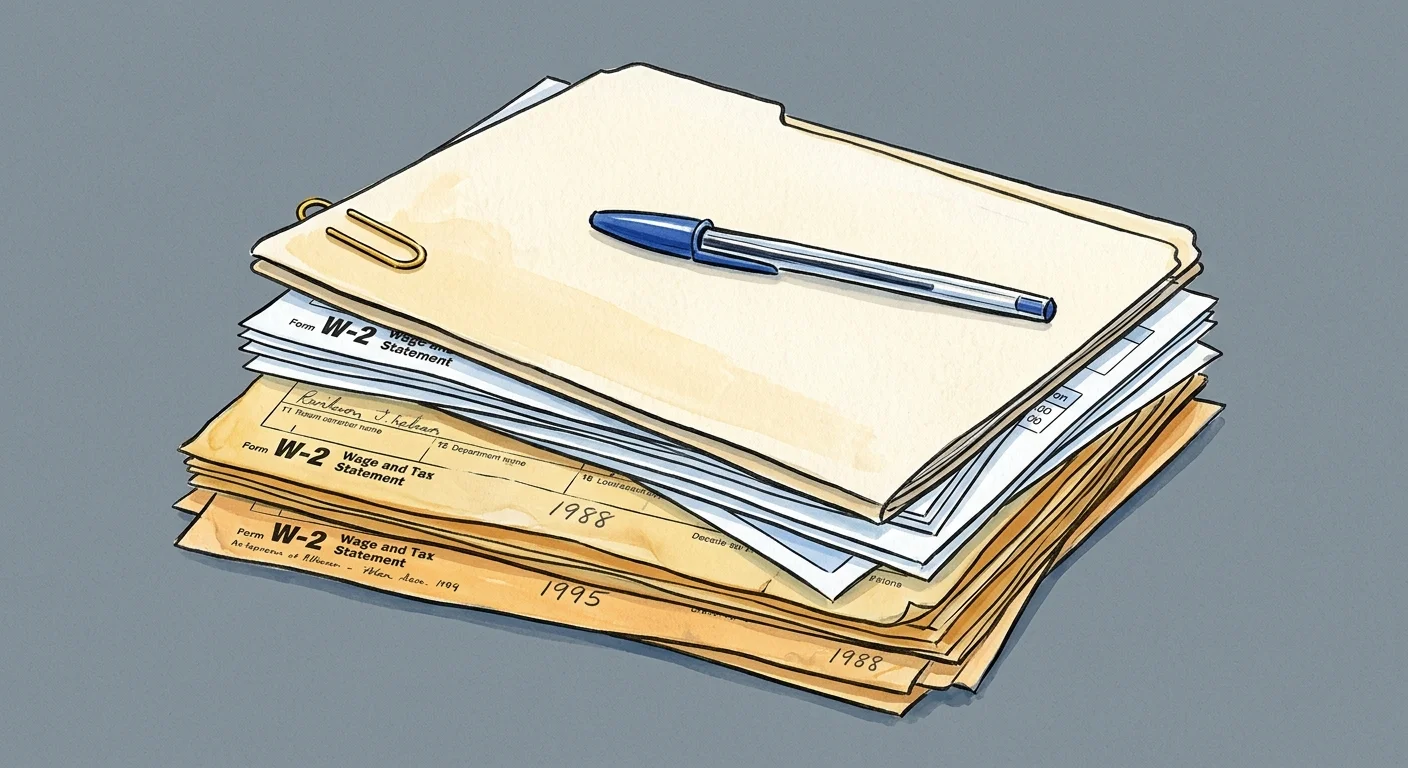
Evidence Required to Correct Social Security Earnings Statement Errors
When requesting Social Security earnings record review actions, the SSA requires tangible proof before altering their historical database. The table below outlines common discrepancy types alongside the specific documentation you must gather.
| Discrepancy Scenario | Primary Proof Required | Secondary Supporting Evidence | Form Needed |
|---|---|---|---|
| Missing W-2 Wages from a Closed Business | Original Form W-2 or W-2c | Year-end pay stubs, bank statements showing direct deposits, signed state tax returns | Form SSA-7008 |
| Uncredited Self-Employment Income | IRS Form 1040 with Schedule SE & Schedule C | Official IRS Tax Return Transcript, canceled checks paid to the IRS | Form SSA-7008 |
| Name Mismatch / Suspense File Wages | Marriage certificate, divorce decree, or court order + updated Social Security Card | W-2s showing prior name, employer payroll certification letter | Form SSA-7008 & Form SS-5 |
| Transposed Social Security Number | Form W-2c (Corrected Wage Statement) from employer | Affidavit from employer HR department detailing the clerical error | Form SSA-7008 |

How to Verify Social Security Earnings and Inspect Your History
Learning how to verify Social Security earnings is a straightforward process that every worker over age 50 should perform annually. You do not need to wait for paper statements to arrive in the mail.
- Access Your Online Account: Visit the official Social Security Administration (SSA) portal and log into your personal my Social Security account. If you have not created an account, you can establish one securely using Login.gov or ID.me credentials.
- Download Your Complete Statement: Once inside your dashboard, navigate to the “Earnings Record” tab. Review the full itemized list displaying every year you worked from your very first teenage job to the present.
- Cross-Reference with Past Tax Files: Compare each year’s listed “Social Security Taxed Earnings” against your historical tax returns, specifically Box 3 of your old W-2 forms or Line 3 of Schedule SE for self-employment.
- Examine Paper Statements (Age 60+): If you prefer physical mail and do not maintain an online account, the SSA automatically resumes mailing paper statements annually starting at age 60 until you claim benefits.
- Request Detailed Records if Discrepancies Exist: If you spot widespread errors across multiple decades, submit Form SSA-7050-F4 (Request for Social Security Earnings Information) to obtain an official certified, itemized earnings breakdown detailing every employer FEIN on record.
You can also test various claiming scenarios using the Social Security Retirement Estimator to see how correcting an omitted year immediately elevates your projected benefit.
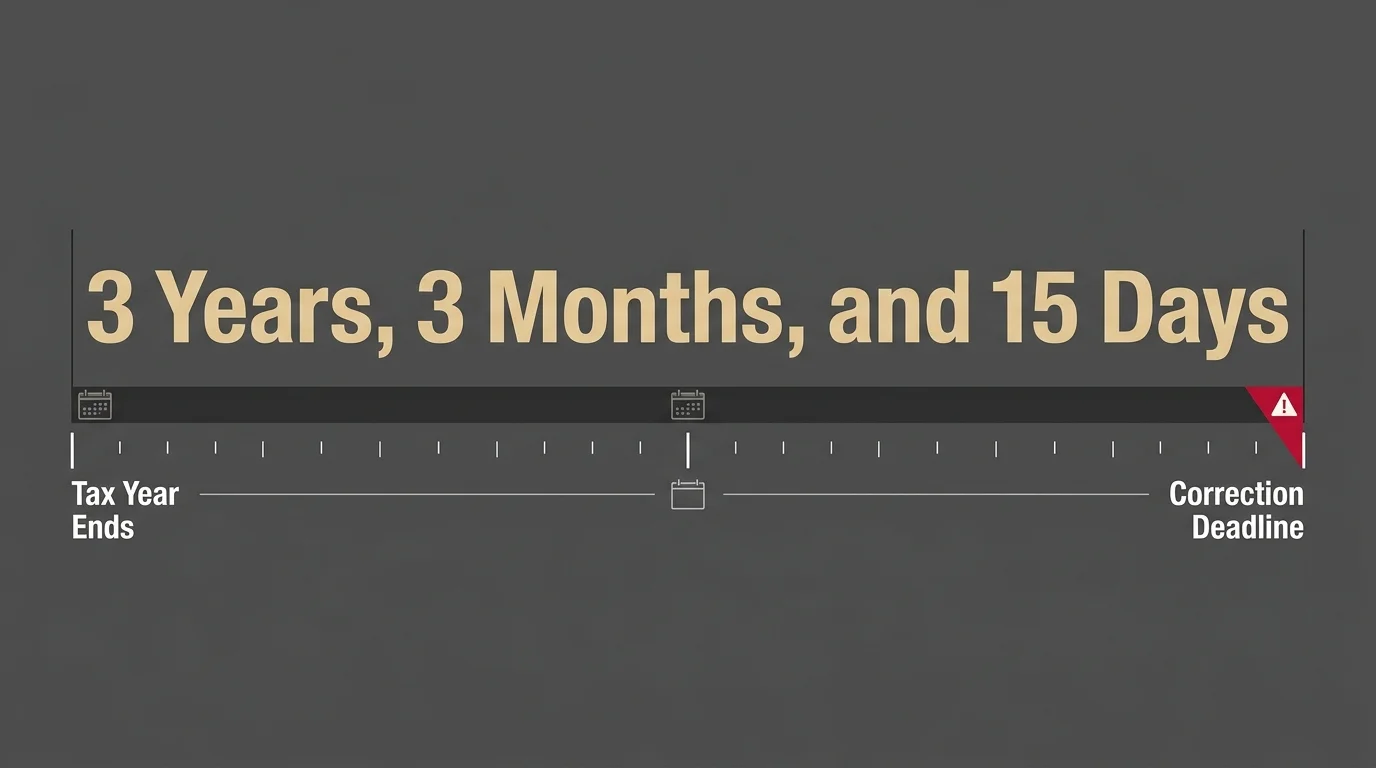
The Statute of Limitations: The 3-Year, 3-Month, and 15-Day Rule
Federal law establishes an official time limit for correcting Social Security earnings record errors. Under standard rules, you have 3 years, 3 months, and 15 days following the end of the calendar year in which the wages were earned to submit a correction request. For example, earnings generated in 2022 had an official correction deadline of April 15, 2026.
However, many workers panic when they discover errors that occurred ten or twenty years ago. Fortunately, federal regulations under 20 CFR § 404.822 provide crucial statutory exceptions that allow corrections well past the standard time limit:
- Matching Tax Return Evidence: If you filed a timely federal tax return with the IRS reporting your wages or self-employment income, the SSA can correct your earnings record at any time to match the IRS transcript.
- Missing Employer Reports: If an employer withheld Social Security taxes from your wages but failed to submit a W-2 or W-3 report to the government, you can rectify the record indefinitely by providing original pay stubs or W-2 copies.
- Mechanical and Clerical Errors: If the SSA made an internal transcription error, data-entry blunder, or system glitch, the agency is legally required to fix the mistake regardless of how many years have passed.
- Fraud or Misallocation: If wages were fraudulently credited to another individual’s record or misallocated due to duplicate records, the SSA will correct the assignment without time restrictions.
“The best time to plan for retirement was 20 years ago. The second best time is today.”
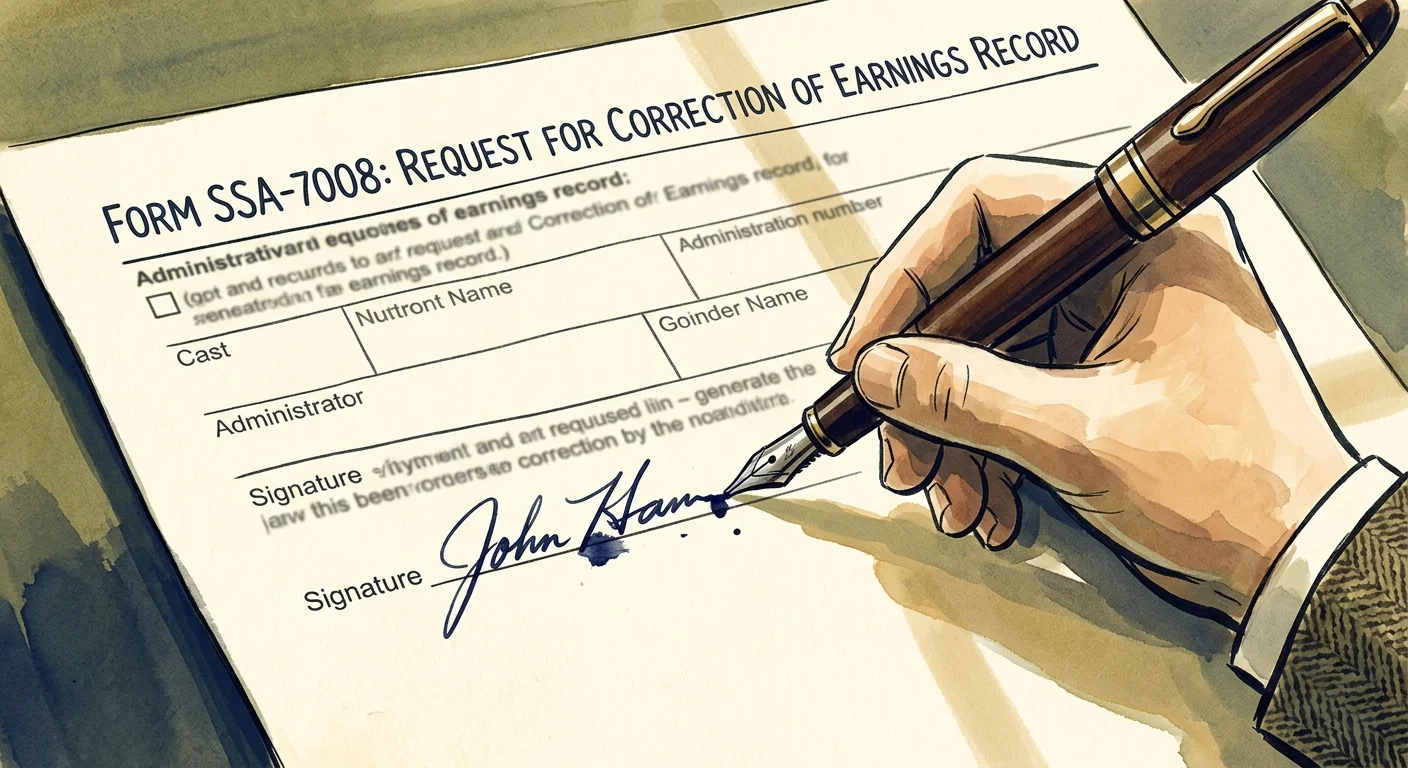
Step-by-Step: Correcting Social Security Earnings Record Using Form SSA-7008
If you identify an error, take immediate action to amend your record through formal channels. Do not simply call your local office and expect verbal promises to resolve the issue.
- Complete Form SSA-7008: Download and fill out Form SSA-7008 (Request for Correction of Earnings Record). List your exact personal details, the missing or inaccurate tax years, the correct gross earnings, and the names and addresses of your employers during those periods.
- Compile High-Quality Documentation: Attach clear photocopies of your W-2 forms, 1099 statements, final December pay stubs showing cumulative annual earnings, or signed copies of federal tax returns. Never mail your only original documents unless specifically instructed by an SSA representative.
- Submit to Your Local Field Office: Mail or deliver your completed packet to your local Social Security field office. Send physical mail via Certified Mail with Return Receipt Requested so you have legal proof of delivery.
- Track and Follow Up: Record adjustments typically take between 60 and 120 days to process. Monitor your my Social Security account periodically. If the correction does not appear within 90 days, contact your local representative with your certified mailing tracking number.

Costly Mistakes to Avoid
Navigating federal bureaucracy requires diligence. Avoiding these common traps will save you time, stress, and retirement income:
- Waiting Until Claiming Age to Check Your History: Attempting to reconstruct payroll records from 30 years ago while you are sitting in a Social Security office at age 66 is extraordinarily difficult. Former employers may have dissolved, bank archives become unreachable, and old payroll firms destroy records. Check your statement annually throughout your working life.
- Prematurely Shredding Tax Documents: While standard IRS audit guidelines suggest keeping tax records for three to seven years, your Social Security needs are different. Keep copies of every annual Form W-2, Form 1099, and Form Schedule SE indefinitely in a secure digital archive until you officially start receiving accurate retirement benefit checks.
- Assuming the IRS and SSA Automatically Fix Discrepancies: Although both agencies belong to the federal government, their computer networks do not continuously cross-audit historical files. If the IRS accepts an amended return or a corrected W-2c, do not assume they forwarded the data to the SSA. You must verify that the SSA updated their ledger.
- Overlooking Part-Time or Summer Employment: Early-career jobs from your college or teenage years might seem insignificant, but wage indexing adjusts those early dollars upward significantly. Earning $5,000 in 1982 carries substantial weight in today’s indexed formula. Make sure those foundational years are fully credited.

Don’t DIY These Decisions: When to Seek Professional Support
While correcting a simple W-2 transposition error is manageable on your own, complex earnings record disputes benefit from professional guidance. If your record involves complex multi-state corporate mergers, extensive uncredited self-employment schedules, foreign totalization agreements, or disputes involving public pension offsets, consider hiring an experienced professional.
A Fee-Only Certified Financial Planner (CFP) or a specialized Social Security claiming consultant can run detailed algorithmic projections to determine whether spending weeks tracking down an old W-2 will meaningfully alter your monthly check. For complex tax disputes involving unfiled Schedule SE forms or disputed employer classifications, an Enrolled Agent (EA) or Certified Public Accountant (CPA) can petition the IRS directly for historical transcripts. You can also explore free consumer guidance tools through the Consumer Financial Protection Bureau (CFPB) and tax planning resources at IRS Retirement Plans.
Frequently Asked Questions
How often should I check my Social Security earnings record?
You should inspect your earnings record once every year, ideally in late spring after your employer has submitted annual tax filings and you have filed your federal return. This regular check allows you to spot missing wages within the standard 3-year correction window while payroll stubs and employer records remain readily accessible.
What is the Social Security Earnings Suspense File?
The Earnings Suspense File (ESF) is an SSA holding database for reported wages that cannot be matched to a valid name and Social Security number. When employers make typos or workers change names without notifying the SSA, reported earnings sit in this file indefinitely rather than being credited to the worker’s retirement account.
Can I correct my earnings history if my former employer went out of business?
Yes. You do not need an existing employer to confirm past earnings if you possess secondary proof. You can submit old W-2 forms, final year-end pay stubs, certified IRS tax transcripts, or past bank statements showing regular payroll deposits to substantiate your claim using Form SSA-7008.
How long does the SSA take to process a Form SSA-7008 correction?
Processing times typically range from two to four months depending on whether the SSA must contact the IRS or search paper microfilm archives. Checking your online account periodically provides the fastest way to confirm when your updated earnings post.
Take Control of Your Social Security Record Today
Your Social Security benefits represent an earned asset built across decades of hard work. Never leave your lifetime retirement income to chance or assume federal payroll records are error-free. Log into your my Social Security account today, cross-reference your historical earnings against your tax records, and immediately flag any suspicious $0 entries or wage dips. Fixing these errors now guarantees that when you finally retire, your monthly check reflects the full value of your life’s work.
This article is for informational purposes only and does not constitute financial, legal, or medical advice. Medicare rules, Social Security benefits, and tax laws change regularly—verify current details at Medicare.gov, SSA.gov, or with a licensed professional.
Last updated: February 2026. Medicare and Social Security rules change annually—always verify current details at official government sources.