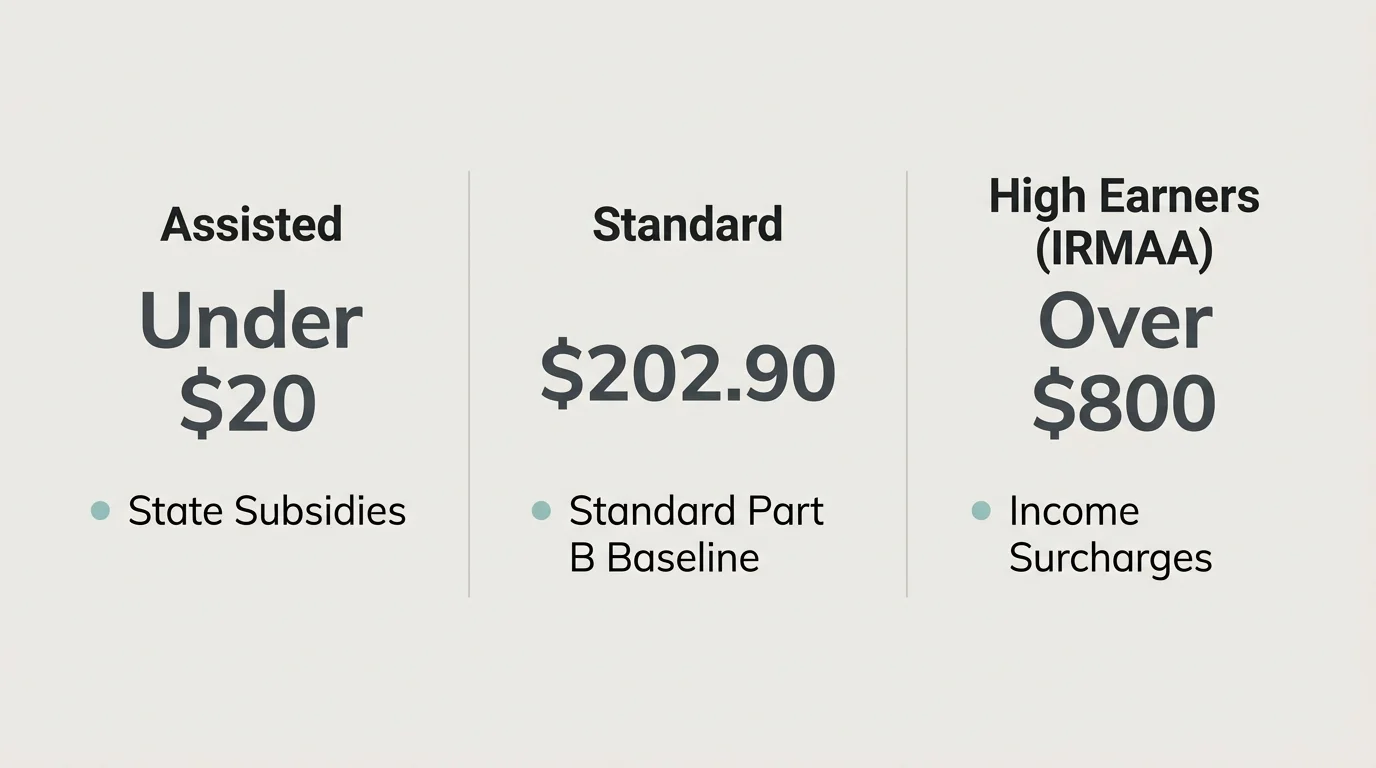
Two neighboring retirees can enroll in identical Medicare coverage, yet one pays under twenty dollars a month while the other writes a check for nearly eight hundred dollars. This dramatic financial gap leaves many older Americans confused, but it stems from specific income thresholds, tax rules, and assistance programs that govern your monthly costs. In 2026, the standard Medicare Part B premium sits at $202.90, yet your actual out-of-pocket bill depends on past tax returns, qualifying state subsidies, and plan selection. Understanding how federal formulas compute these individual rates enables you to manage your income strategically, access hidden subsidies, and avoid paying unnecessary surcharges throughout your retirement years.
The Baseline: Standard Medicare Costs in 2026
To understand why prices diverge so wildly, you must first look at standard Medicare baseline costs. Federal policy sets standard rates annually, but those baseline numbers serve as a launching pad rather than a universal price tag.
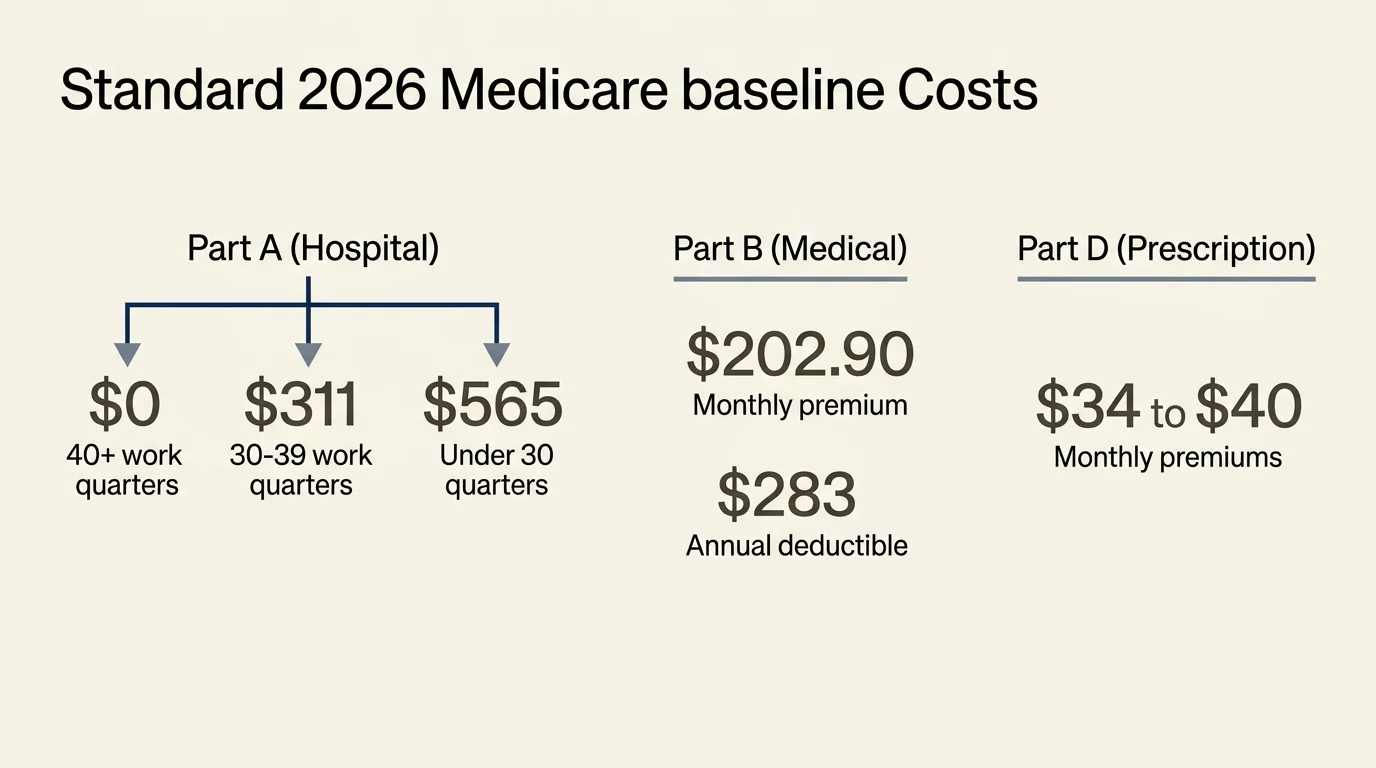
Most Americans earn premium-free Medicare Part A (hospital insurance) through their working years. If you or your spouse paid Medicare payroll taxes for at least 10 years (40 quarters), you pay $0 per month for Part A. However, if you fall short of 30 work quarters, Part A costs $565 per month in 2026. For those with 30 to 39 quarters, the monthly cost sits at $311.
Medicare Part B (medical insurance) covers outpatient doctor visits, preventive care, durable medical equipment, and lab tests. For 2026, the standard monthly Part B premium is $202.90, up from $185.00 in 2025. The annual Part B deductible rests at $283. Once you meet this deductible, you typically pay 20% coinsurance for Medicare-approved services.
Medicare Part D (prescription drug coverage) relies on private insurance carriers. Rates vary based on your geographic region and chosen formulary, but the national base beneficiary premium hovers around $34 to $40 per month. Combining standard Part B and basic Part D puts typical base costs around $240 per month before factoring in supplemental coverage, income surcharges, or financial aid.
The Upper End: How IRMAA Surcharges Drive Premiums to Hundreds
If your monthly Medicare bill turns out significantly higher than the standard $202.90, the Income-Related Monthly Adjustment Amount (IRMAA) is the reason. Congress designed IRMAA as a sliding-scale surcharge on higher-income beneficiaries, significantly raising costs for top earners.
Social Security calculates medicare cost by income using your Modified Adjusted Gross Income (MAGI) from your tax return two years prior. Therefore, your 2026 Medicare premiums rely entirely on the MAGI reported on your 2024 tax return. MAGI includes your adjusted gross income plus any tax-exempt interest income, such as municipal bond earnings.
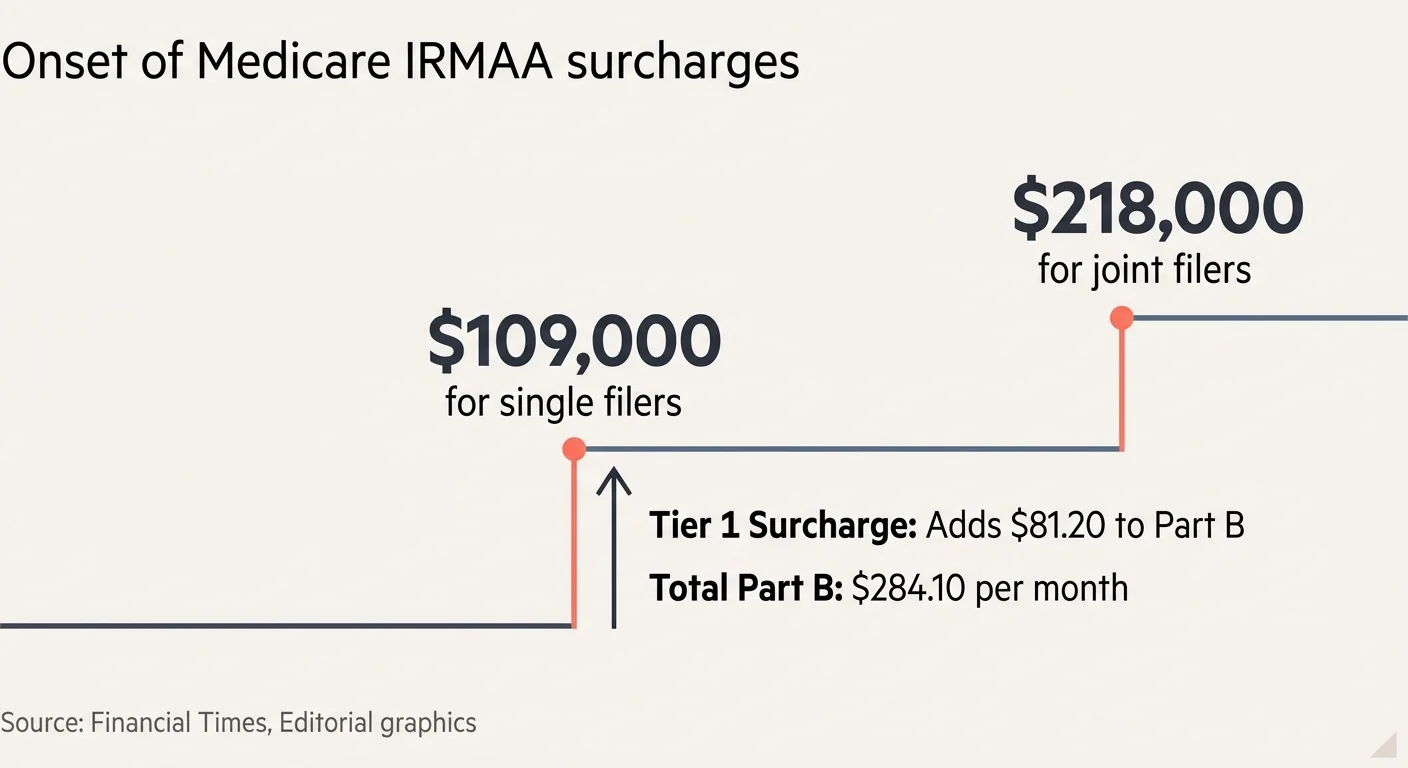
For 2026, irmaa explained simply means surcharges trigger once 2024 MAGI exceeds $109,000 for single filers or $218,000 for married couples filing jointly. The table below outlines how higher income brackets increase monthly Part B and Part D payments per person.
- Tier 1: Single MAGI over $109,000 up to $137,000 (Joint $218,000 to $274,000) adds $81.20 to Part B, making total Part B $284.10 per month. You also pay an extra $14.50 monthly for Part D.
- Tier 2: Single MAGI over $137,000 up to $171,000 (Joint $274,000 to $342,000) pushes total Part B to $405.80 per month plus a $37.50 Part D surcharge.
- Tier 3: Single MAGI over $171,000 up to $205,000 (Joint $342,000 to $410,000) raises total Part B to $527.50 per month plus a $60.40 Part D surcharge.
- Tier 4: Single MAGI over $205,000 up to $500,000 (Joint $410,000 to $750,000) pushes total Part B to $649.30 per month plus an $83.40 Part D surcharge.
- Tier 5: Single MAGI at or above $500,000 (Joint $750,000 or above) triggers the maximum Part B premium of $689.90 per month plus a $91.00 Part D surcharge.
A married couple in Tier 5 pays $1,379.80 monthly for Part B alone, plus $182.00 in Part D surcharges—totaling over $1,560 per month before paying their regular drug plan premiums or Medigap policies. Spotting these medicare premium differences helps explain why high-income retirees pay thousands more annually for standard coverage.
One-off financial events often trigger these surcharges unexpectedly. Selling a residence, taking a large traditional IRA withdrawal, executing a Roth conversion, or realizing capital gains in 2024 can spike your 2026 premiums even if your ongoing retirement income is modest.

The Lower End: How Assistance Programs Push Premiums Near Zero
While high earners pay elevated surcharges, other retirees pay zero or near-zero out of pocket. State and federal assistance programs eliminate or heavily subsidize standard premiums for lower-income seniors.
State-administered Medicare Savings Programs (MSPs) provide substantial relief for qualifying individuals. The primary program tiers include:
- Qualified Medicare Beneficiary (QMB): The state pays your full $202.90 Part B premium and eliminates Medicare deductibles, copayments, and coinsurance for covered services. Providers cannot balance-bill QMB enrollees.
- Specified Low-Income Medicare Beneficiary (SLMB): The state pays your full $202.90 Part B monthly premium. You remain responsible for standard deductibles and coinsurance.
- Qualifying Individual (QI): The state pays your full $202.90 Part B monthly premium on a first-come, first-served annual grant basis.
Additionally, Medicare Extra Help (also known as the Part D Low-Income Subsidy) assists with prescription medication costs. Expanded under recent federal legislation, full Extra Help is available to beneficiaries earning up to 150% of the Federal Poverty Level. This program pays your monthly Part D plan premium, eliminates your drug deductible, and caps prescription copays in 2026 at no more than $5.10 for generic drugs and $12.65 for brand-name drugs. You can check your eligibility across state and federal subsidy programs through BenefitsCheckUp.
Another option for reducing premiums is a Medicare Advantage “Giveback” benefit (also called a Part B Premium Reduction). Private insurance carriers offering certain Medicare Advantage (Part C) plans credit a portion—or sometimes the entirety—of the $202.90 Part B premium back to your monthly Social Security check. If a plan offers a $100 monthly rebate, your deducted Part B premium drops from $202.90 to $102.90 per month.
Side-by-Side Comparison: What Different Retirees Pay
To highlight how these rules apply in real-life scenarios, examine how three distinct retirees navigate Medicare costs in 2026.
| Cost Category | Retiree A (Low Income / QMB Eligible) | Retiree B (Average Income / Standard Rate) | Retiree C (High Income / Tier 3 IRMAA) |
|---|---|---|---|
| 2024 MAGI Tax Baseline | Under $18,000 / single | $45,000 / single | $185,000 / single |
| Monthly Part A Cost | $0 (40 work quarters) | $0 (40 work quarters) | $0 (40 work quarters) |
| Monthly Part B Premium | $0 (Paid by state MSP) | $202.90 (Standard) | $527.50 ($202.90 + $324.60 IRMAA) |
| Monthly Part D Cost | $0 (Covered by Extra Help) | $35.00 (Base plan) | $95.40 ($35 base + $60.40 IRMAA) |
| Part B Annual Deductible | $0 (Waived under QMB) | $283.00 out of pocket | $283.00 out of pocket |
| Prescription Drug Copays | Max $5.10 generic / $12.65 brand | Standard plan copays | Standard plan copays |
| Estimated Base Out-of-Pocket Cost | $0 – $15.00 / month | $237.90 / month | $622.90 / month |

Actionable Strategies to Reduce Your Medicare Expense
You can manage your lifetime healthcare costs through strategic tax management, timely appeals, and effective plan selections.
“The goal of retirement is to live off your assets—not live off your regrets.”
Consider implementing these proactive strategies to keep your Medicare costs as low as possible:
- Manage Roth Conversions and Asset Sales Strategically: Spread traditional IRA conversions over multiple tax years to keep your MAGI below the $109,000 single ($218,000 joint) threshold. Coordinate home sales, capital gain realization, and taxable distributions carefully.
- File an IRMAA Life-Changing Event Appeal: If your income dropped significantly after 2024 due to a qualifying life-changing event—such as retirement, reduction of work hours, marriage, divorce, or loss of income-producing property—you do not have to pay surcharges based on older tax records. Submit Form SSA-44 to the Social Security Administration with supporting documentation to request an adjustment based on your current, lower income.
- Apply for Medicare Premium Assistance: Income limits for Medicare Savings Programs vary by state, and several states have eliminated asset test requirements altogether. If your income sits near regional guidelines, submit an application to your local Medicaid or social services office.
- Evaluate Part B Giveback Plans Carefully: While a rebate plan reduces your monthly Part B deduction, verify that the provider network includes your trusted physicians and that drug copays do not wipe out your premium savings.
- Audit Your Part D Coverage Annually: Drug formularies and plan premiums change every October. Reviewing your drug coverage during Open Enrollment (October 15 to December 7) prevents unnecessary overpayment for prescriptions.

Costly Mistakes to Avoid
Failing to navigate Medicare rules carefully can trigger permanent financial penalties or unexpected bills. Avoid these common mistakes:
Mistake 1: Ignoring the Two-Year Look-Back Period. Many individuals retire at age 65, experience a income drop, and react with shock when high IRMAA charges appear on their Social Security statement. Remember that 2026 rates depend on 2024 income. Failing to file Form SSA-44 leaves you paying high surcharges unnecessarily.
Mistake 2: Incurring Late Enrollment Penalties. If you miss your Initial Enrollment Period and lack creditable employer coverage, you face lifelong penalties. Part B charges an additional 10% premium penalty for each full 12-month period you were eligible but unenrolled. Part D adds a cumulative penalty of 1% of the national base beneficiary premium per month of delayed enrollment.
Mistake 3: Overlooking State Subsidy Rule Changes. Many retirees assume past earnings permanently disqualify them from assistance. However, expanded eligibility thresholds and eliminated asset caps in several states mean you might qualify today even if you were turned down previously.
Mistake 4: Choosing Coverage Based Solely on Premiums. Selecting a $0-premium Medicare Advantage plan or a Giveback plan without evaluating deductibles, max out-of-pocket limits, or network restrictions can result in substantial expenses if you experience a major illness.

Don’t DIY These Decisions
Navigating Medicare options, tax rules, and appeals processes requires precise calculations. Working with qualified experts helps protect your nest egg and prevents financial mistakes.
Reach out to these certified resources when planning your Medicare enrollment strategy:
- SHIP Counselors: State Health Insurance Assistance Programs provide free, unbiased, localized Medicare counseling. They do not sell insurance or earn commissions. Connect with a counselor via the Eldercare Locator.
- Fiduciary Financial Advisors and CPAs: Consult a qualified tax professional before initiating large IRA withdrawals, executing Roth conversions, or selling real estate to evaluate potential IRMAA bracket impacts.
- Social Security Specialists: Contact Social Security directly to navigate formal IRMAA reconsiderations using Form SSA-44 or to apply for Extra Help.
Frequently Asked Questions
Why did my Medicare Part B premium increase even though my Social Security income stayed the same?
Your Part B premium may rise due to the annual national baseline adjustment (which increased to $202.90 in 2026) or because a higher tax return from two years prior triggered an IRMAA surcharge. A single financial transaction in 2024 can temporarily elevate your 2026 Medicare premiums.
Can I lower my IRMAA surcharge if I recently retired?
Yes. If your income decreased due to a major life event such as retirement or work reduction, you can file Form SSA-44 with the Social Security Administration. Providing evidence of your income reduction allows Social Security to calculate your premium using your current estimated income rather than your older tax return.
What is the difference between QMB and Extra Help?
Qualified Medicare Beneficiary (QMB) is a state-administered Medicare Savings Program that pays your monthly Part B premium and eliminates Part A and Part B deductibles and copays. Extra Help is a federal program that specifically lowers prescription drug costs under Medicare Part D by subsidizing plan premiums and capping copays.
Do Medicare Advantage “Giveback” plans reduce my medical coverage?
Not directly, but plans offering Part B rebate benefits often offset costs by utilizing tighter provider networks, requiring pre-authorizations, or establishing higher copays for specific outpatient services. Always review the plan’s Evidence of Coverage before enrolling.
Taking Control of Your Medicare Expenses
The gap between paying almost nothing for Medicare and paying hundreds of dollars every month comes down to income tracking, strategic tax planning, and taking advantage of available state benefits. By understanding how federal formulas review your tax returns, you can avoid unexpected surcharges and retain control over your health coverage costs throughout retirement.
Review your 2024 tax filings today to anticipate your current Medicare bracket. If you experienced a qualifying life event or meet low-income assistance criteria, take the necessary steps to file an appeal or submit an application for subsidies right away. Retirement rules and benefit amounts vary based on individual work history, income, and circumstances. This article provides general guidance only. Consult a SHIP counselor, financial advisor, or elder law attorney for advice specific to your situation.
Last updated: February 2026. Medicare and Social Security rules change annually—always verify current details at official government sources.