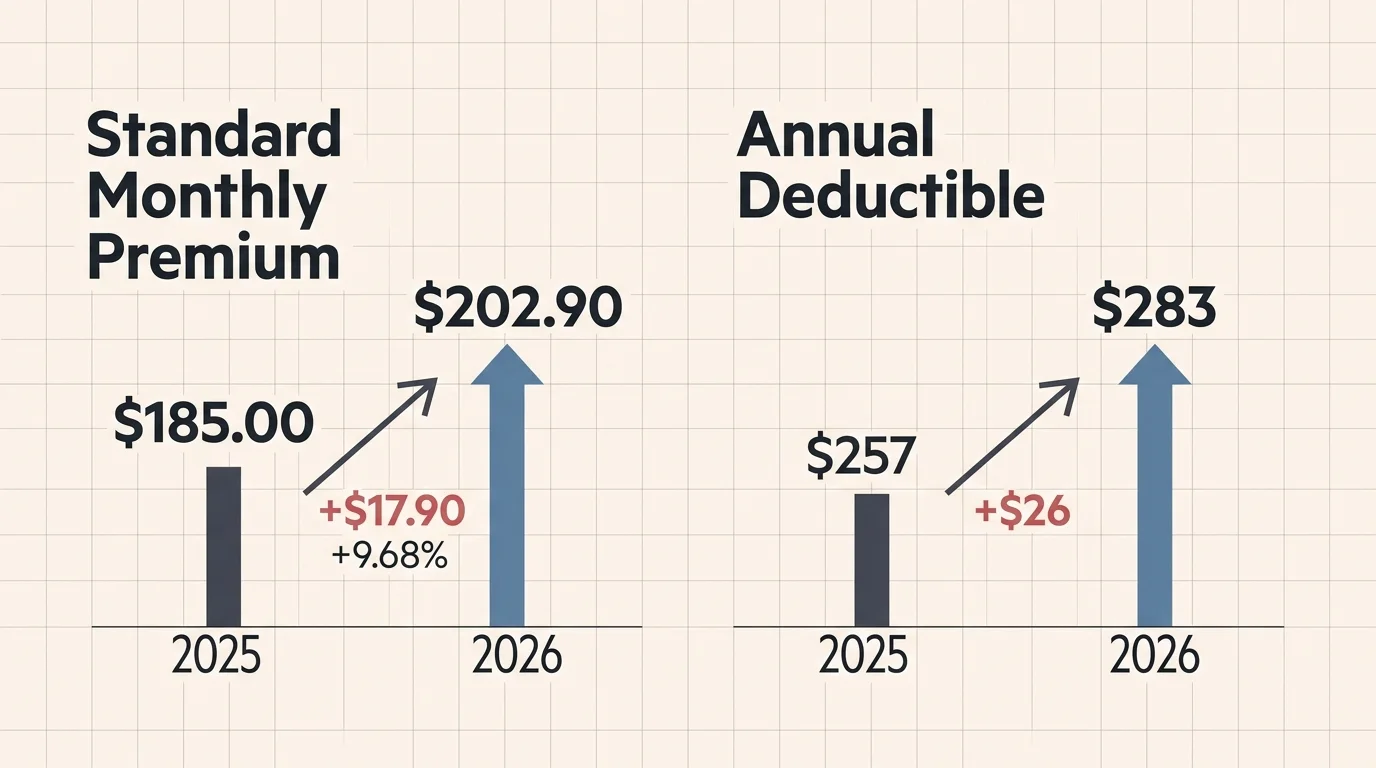
If your monthly Medicare Part B bill jumped unexpectedly this year, you are feeling the sharp bite of a 9.68% increase. CMS raised the standard monthly Part B premium from $185.00 to $202.90 for 2026, alongside a $26 rise in the annual deductible. This nearly 10% surge hits right as Social Security checks received a modest 2.8% cost-of-living adjustment, effectively wiping out much of your raise before the money ever reaches your bank account. Understanding why did my Medicare bill go up requires looking at surging outpatient medical care, skyrocketing specialty drug costs, and potential high-income surcharges. Here is precisely what drove this Medicare premium hike and how you can protect your retirement budget today.
The Anatomy of the 2026 Medicare Part B Premium Hike
The Centers for Medicare & Medicaid Services (CMS) set the standard monthly Medicare Part B premium at $202.90 for 2026. This reflects a direct $17.90 monthly increase over the $185.00 rate in 2025. Over the course of a full year, you will pay an additional $214.80 in premiums alone. For married couples who both collect Medicare Part B, that combined household increase climbs to $429.60 annually.
At the same time, the annual Medicare Part B deductible rose by $26, moving from $257 to $283 per beneficiary. You must pay this $283 out of pocket before Medicare Part B begins paying its standard 80% share for covered services.
Medicare Part B covers essential outpatient medical services, including:
- Doctor visits and specialist consultations
- Outpatient hospital services and surgery center care
- Diagnostic imaging, laboratory tests, and X-rays
- Preventive care services, vaccinations, and annual wellness visits
- Durable medical equipment like wheelchairs, walkers, and oxygen supplies
- Physician-administered specialty medications, including chemotherapy and complex infusions
When CMS adjusts Part B costs, the changes impact every beneficiary who relies on traditional Medicare or enrollment in a Medicare Advantage plan.
Behind the Numbers: Why Did Medicare Costs Surge This Year?
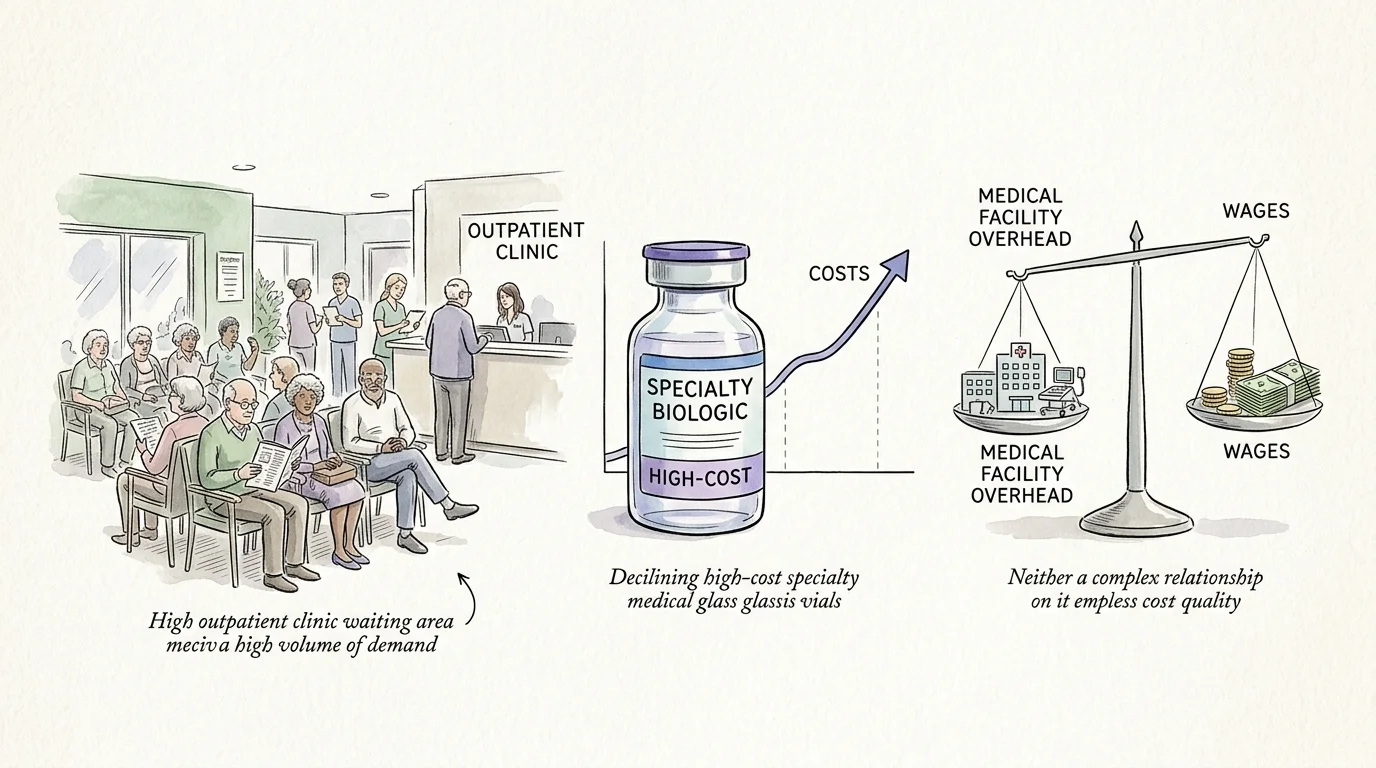
Understanding this sudden Medicare cost increase requires looking at broader healthcare consumption trends. Federal health actuary reports highlight three primary catalysts driving the 2026 price surge:
- Surging Outpatient Healthcare Utilization: Hospitals and outpatient centers experienced a significant rise in patient volume. Retirees scheduled delayed surgeries, specialist consultations, and diagnostic testing at higher rates than health actuaries originally forecasted.
- Rising Costs of Specialty Medications: Medicare Part B pays for high-cost drugs administered in clinical settings. Advanced biologic therapies, novel Alzheimer’s treatments, and breakthrough oncology drugs carry immense per-dose prices, pushing systemic program spending higher.
- Medical Inflation and Administrative Overhead: While general economic inflation stabilized in recent months, clinical medical inflation remains persistently elevated. Increased wages for nursing staff, rising facility overhead, and advanced technological equipment drove up the base operational costs for healthcare providers nationwide.
By law, Medicare Part B financing relies on a combination of beneficiary premiums and general federal tax revenues. Because beneficiary premiums must cover approximately 25% of estimated Part B expenditure, rising healthcare utilization translates directly into a higher base monthly premium for you.
The Social Security COLA Collision: How Premium Hikes Eat Your Raise
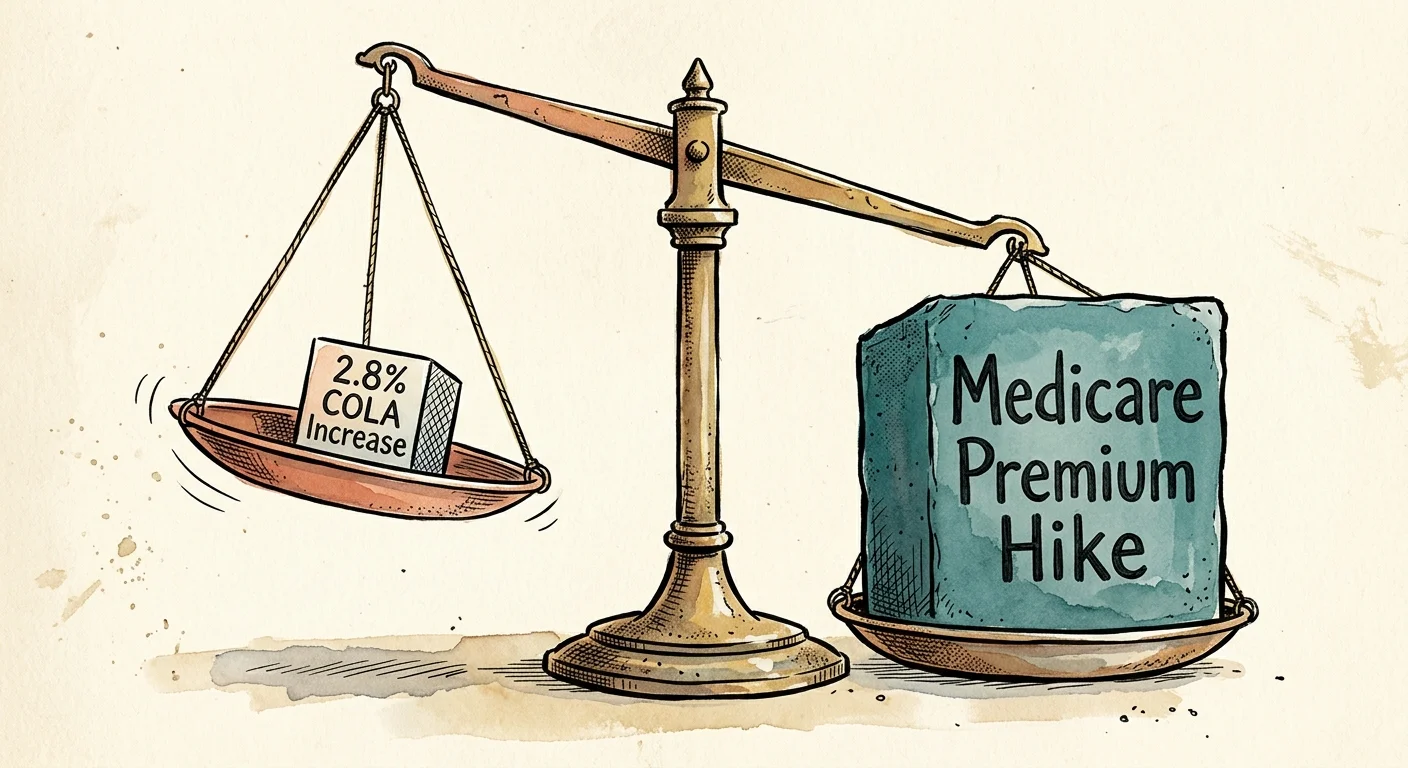
The timing of this Medicare premium hike created a financial bottleneck for millions of American households. Social Security benefits received a modest 2.8% Cost-of-Living Adjustment (COLA) for 2026. Because the Social Security Administration automatically deducts Medicare Part B premiums from monthly benefit payments, the $17.90 premium increase absorbs a heavy portion of that raise.
Consider a real-world scenario to see how this math plays out in your monthly budget:
- Average Gross Social Security Benefit (2025): $1,900.00 per month
- 2.8% COLA Increase for 2026: +$53.20 per month
- New Gross Monthly Benefit: $1,953.20 per month
- Medicare Part B Deduction Increase: -$17.90 per month (from $185.00 to $202.90)
- Net Monthly Increase Received: $35.30 per month
In this common situation, Medicare claims over 33% of your Social Security COLA raise before you receive your check. For retirees drawing lower monthly benefits—such as $1,000 per month—a 2.8% COLA adds only $28.00. In that case, the $17.90 Part B rate hike consumes roughly 64% of your total raise, leaving almost no extra cash to cover inflated grocery, utility, and housing bills.
The IRMAA Trap: Higher Earners Face Steeper Surcharges
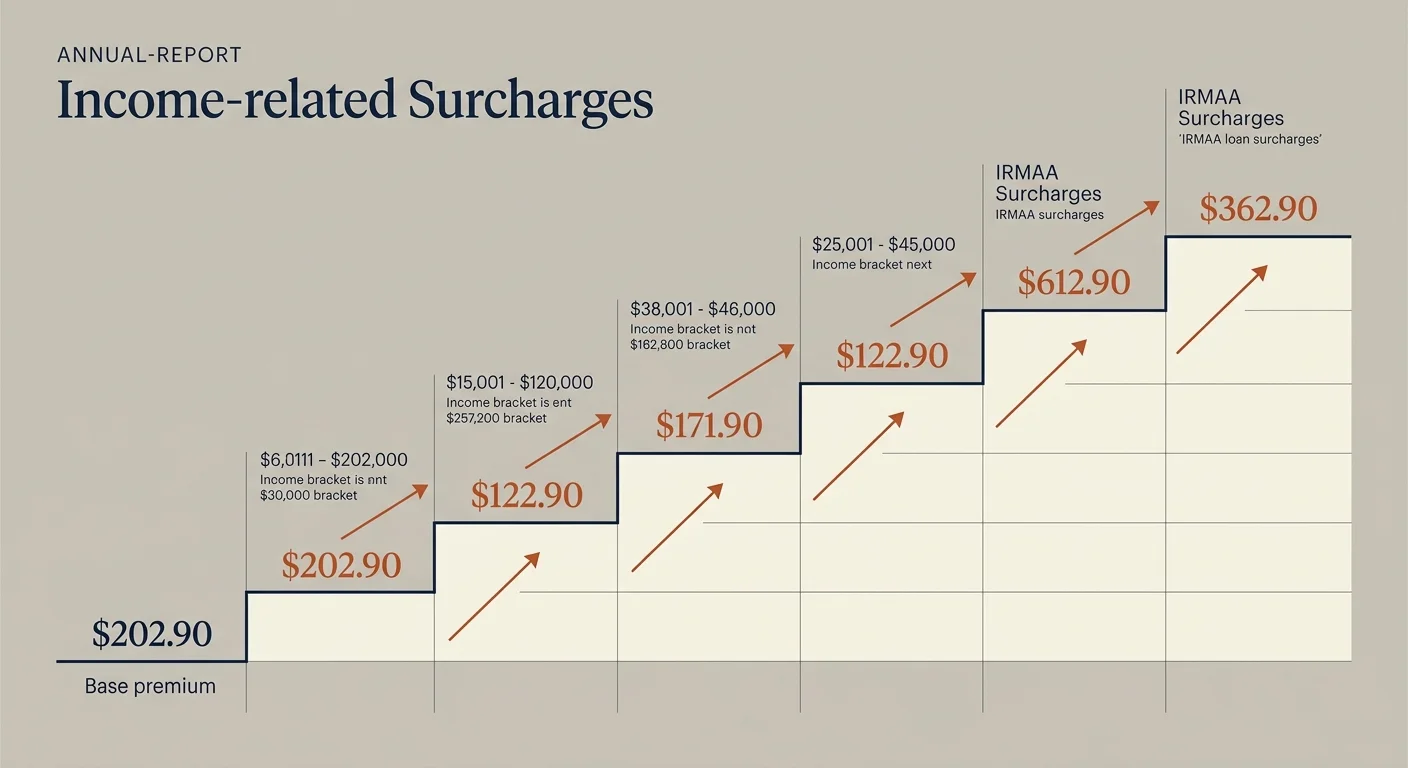
If your monthly Medicare bill increased significantly more than $17.90, you likely triggered the Income-Related Monthly Adjustment Amount, commonly known as an IRMAA surcharge. Federal law requires higher earners to pay a supplemental fee on top of the standard $202.90 Part B premium.
Social Security determines your 2026 IRMAA status using a two-year lookback rule. The government evaluates your Modified Adjusted Gross Income (MAGI) from your 2024 federal tax return to calculate your 2026 Medicare bills. For Medicare purposes, MAGI equals your adjusted gross income plus any tax-exempt interest income you received.
For 2026, IRMAA surcharges trigger when your 2024 MAGI exceeds $109,000 for individual tax filers or $218,000 for married couples filing jointly. The table below details the 2026 Part B premium tiers:
| 2024 Individual MAGI | 2024 Joint MAGI | Monthly IRMAA Surcharge | Total Monthly Part B Premium |
|---|---|---|---|
| $109,000 or less | $218,000 or less | $0.00 | $202.90 |
| $109,001 – $137,000 | $218,001 – $274,000 | +$81.20 | $284.10 |
| $137,001 – $171,000 | $274,001 – $342,001 | +$202.90 | $405.80 |
| $171,001 – $205,000 | $342,001 – $410,000 | +$324.60 | $527.50 |
| $205,001 – $500,000 | $410,001 – $750,000 | +$446.30 | $649.20 |
| Greater than $500,000 | Greater than $750,000 | +$487.00 | $689.90 |
Many middle-class retirees accidentally step into these elevated IRMAA tiers due to one-time financial events that occurred in 2024. Selling a home, executing a traditional IRA to Roth IRA conversion, taking large distributions to pay off a mortgage, or realizing capital gains on investments can temporarily boost your income and trigger a high IRMAA bill two years later.

How to Challenge an IRMAA Surcharge Using Form SSA-44
You do not have to accept an IRMAA surcharge if your financial situation changed since 2024. If your income dropped significantly due to a major life change, you can request an income recalculation from the Social Security Administration.
The law allows appeals under eight specific qualifying life-changing events:
- Work Stoppage: You retired or ended employment completely.
- Work Reduction: You transitioned from full-time to part-time work or reduced your hours.
- Marriage: You got married, altering your household filing status.
- Divorce or Annulment: Your marriage ended, changing your income and tax status.
- Death of a Spouse: You lost a spouse who contributed to household income or filing status.
- Loss of Income-Producing Property: You lost property income due to disaster, fraud, or theft.
- Loss or Reduction of Pension Income: Your pension plan terminated, reorganized, or reduced payouts.
- Employer Settlement Payment: You received a settlement payment due to employer bankruptcy or closure.
To file an appeal, download Form SSA-44 (Medicare Income-Related Monthly Adjustment Amount – Life-Changing Event) from the Social Security Administration website. Fill out the form with your estimated 2026 MAGI and attach supporting documentation, such as a retirement letter from your employer, W-2 statements, a marriage certificate, or a death certificate. Submit the completed package to your local Social Security office to request a downward adjustment of your Part B premium.

The Hold Harmless Provision: Who Is Protected and Who Isn’t?
You may have heard about a federal rule called the “Hold Harmless” provision. Encoded under Section 1839(f) of the Social Security Act, this rule protects certain retirees from net reductions in their monthly income. Specifically, Hold Harmless prevents your net Social Security payment from dropping year-over-year solely because the Medicare Part B premium increased.
Because the 2.8% COLA added roughly $53.20 to the average monthly Social Security payment, most standard beneficiaries received enough of a boost to absorb the $17.90 Part B premium hike. As a result, the Hold Harmless rule was not triggered for most people this year because net payments still moved upward slightly.
However, millions of Medicare recipients do not qualify for Hold Harmless protection under any circumstances. You are NOT protected by Hold Harmless if you fall into any of these categories:
- Higher Earners Subject to IRMAA: Anyone paying an IRMAA surcharge must pay the full increase out of pocket.
- New Enrollees: If you enroll in Medicare Part B for the first time in 2026, you pay the standard $202.90 rate regardless of your Social Security benefit history.
- Beneficiaries Not Collecting Social Security: If you pay your Medicare Part B bills directly via Medicare Easy Pay, credit card, or direct invoice because you postponed Social Security claims, Hold Harmless does not apply to you.
- Dual-Eligible Beneficiaries: If state Medicaid programs pay your Medicare premiums, state government budgets absorb the rate change rather than your personal benefit check.

Costly Mistakes to Avoid
Managing Medicare cost increases requires proactive attention. Avoiding these common financial errors will protect your retirement funds:
- Ignoring Form SSA-44 Notices: Assuming Social Security’s IRMAA calculation is final costs many retirees thousands of dollars. If your income fell due to retirement or working fewer hours, file an appeal immediately.
- Executing Unplanned Roth Conversions: Transferring traditional IRA funds into a Roth IRA creates taxable income. Converting large balances without accounting for the two-year IRMAA lookback can trigger unintended premium surcharges two years down the road.
- Assuming Medicare Advantage Shields You Entirely: Enrolling in a Medicare Advantage (Part C) plan does not exempt you from Medicare Part B costs. You must continue paying your $202.90 monthly Part B premium to stay enrolled, unless your plan offers a specific “Part B Giveback” benefit.
- Missing Enrollment Deadlines: If you delay Part B enrollment without having creditable coverage through an active employer, you face a permanent 10% late enrollment penalty for every 12-month period you were eligible but unenrolled.
- Failing to Audit Coverage Annually: Healthcare plans alter their drug formularies, deductibles, and network providers every year. Sticking with an outdated plan without reviewing alternative options can cause unnecessary out-of-pocket medical spending.

Don’t DIY These Decisions
Healthcare planning intersects directly with tax strategy, retirement cash flow, and estate protection. Navigating these rules alone often leads to costly missteps. Work alongside qualified specialists when evaluating your retirement healthcare strategy:
- SHIP Counselors: State Health Insurance Assistance Programs (SHIP) offer free, unbiased Medicare counseling tailored to your specific state and county. Locate your local assistance branch through the Eldercare Locator service managed by the Administration for Community Living.
- Fee-Only Financial Advisors: A certified financial planner can structure traditional IRA withdrawals, Roth conversions, and capital gain realization to keep your MAGI below IRMAA threshold cutoffs.
- Elder Law Attorneys: If you require long-term care planning or Medicaid coordination, an attorney ensures you structure assets legally while keeping coverage intact.
“It’s not how much money you make, but how much money you keep, how hard it works for you, and how many generations you keep it for.” — Robert Kiyosaki

Practical Action Steps to Protect Your Retirement Budget
Take concrete control of your healthcare spending with this strategic checklist:
- Inspect Your Benefit Statement: Log in to your personal Social Security account online or check your mail statement to verify the exact Part B deduction applied to your monthly check.
- Calculate Your 2024 MAGI: Review line 11 (Adjusted Gross Income) on your 2024 IRS Form 1040, add any tax-exempt interest income from line 2a, and confirm whether your total exceeds $109,000 (single) or $218,000 (joint).
- Submit Form SSA-44 Promptly: If you stopped working or experienced a qualifying life event after 2024, complete Form SSA-44, gather your proof documents, and mail or deliver them to your nearest Social Security office.
- Explore Assistance Programs: If your income is limited, visit BenefitsCheckUp to determine if you qualify for a Medicare Savings Program (MSP). These state programs can pay your $202.90 Part B premium and lower prescription drug costs.
- Adjust Your Monthly Cash Flow: Update your home expense budget to accommodate the $17.90 monthly premium surge and the $283 annual deductible.
“The goal of retirement is to live off your assets—not live off your regrets.”
Managing rising health costs demands proactive budgeting, but you hold the tools to keep your financial plan on track. Take time this week to review your monthly statements, check your tax records, and submit any necessary appeals to keep your hard-earned money working for you.
Retirement rules and benefit amounts vary based on individual work history, income, and circumstances. This article provides general guidance only. Consult a SHIP counselor, financial advisor, or elder law attorney for advice specific to your situation.
Frequently Asked Questions
Why did my Medicare Part B bill increase if I haven’t changed plans?
CMS adjusts standard Medicare Part B premiums annually based on national healthcare expenditures, outpatient service utilization, and specialty drug spending. Even if you maintain the exact same medical plan and doctors, the base federal Part B cost applies equally across traditional Medicare and Medicare Advantage plans.
Can I deduct my Medicare Part B premiums on my tax return?
Yes. If you itemize deductions on Schedule A of IRS Form 1040, you can include Medicare Part B premiums in your total medical expenses. You can deduct the portion of total qualifying medical costs that exceeds 7.5% of your Adjusted Gross Income (AGI).
What happens if I cannot afford the 2026 Medicare Part B increase?
If paying $202.90 per month creates financial hardship, explore state-level Medicare Savings Programs (MSPs). Depending on your income and assets, programs like the Qualified Medicare Beneficiary (QMB) or Specified Low-Income Medicare Beneficiary (SLMB) program can cover your entire monthly Part B premium.
Does the Medicare Part B increase affect my Medicare Advantage plan?
Yes. Medicare Advantage (Part C) plans operate as an alternative delivery system for Medicare Parts A and B. You must continue paying the standard $202.90 Part B premium to stay enrolled in Medicare Advantage, alongside any separate monthly premium your specific private plan charges.
Last updated: February 2026. Medicare and Social Security rules change annually—always verify current details at official government sources.