Most Americans plan obsessively for the financial transition into retirement, yet they overlook how they will actually spend their days. Discovering your retirement lifestyle archetype helps you build daily purpose and sidestep costly administrative mistakes.
Your daily habits, social priorities, and core values dictate your fulfillment far more than your investment portfolio balance ever will. Understanding what kind of retiree you are sharpens your personal and financial focus.
Whether you crave globe-trotting adventure, an encore business, or a quiet routine at home, categorizing retiree types creates a clear roadmap for this journey. Finding your personality archetype ensures you make the most of every single day.

Key Takeaways for Your Retirement Journey
- Retirement fulfillment depends on aligning your daily schedule with your authentic personality archetype.
- Working retirees must monitor the Social Security Retirement Earnings Test to avoid withheld benefits before full retirement age.
- Nomadic retirees need private travel medical coverage because Original Medicare offers zero regular overseas health benefits.
- Wealth preservers must plan for Required Minimum Distributions starting at age 73 to avoid steep tax penalties.
- Solo agers should execute durable powers of attorney and healthcare proxies early to safeguard their personal autonomy.

Understanding Retirement Personality Types
Leaving the workforce represents a massive psychological identity shift. When your former job title disappears, your core personality traits step forward to define your everyday existence.
Researchers have long studied how distinct behavioral patterns shape senior living. Recognizing your tendencies helps you allocate both your time and financial resources effectively.
Many individuals enter retirement expecting boundless leisure, only to experience boredom or anxiety within six months. Categorizing retiree types gives structure to this transition.
When you understand your natural motivations, you avoid adopting someone else’s dream. You can structure a balanced lifestyle that honors your personal aspirations and financial boundaries.
“Don’t simply retire from something; have something to retire to.” — Harry Emerson Fosdick

The 10 Different Types of Retirees
Every retiree brings unique values, anxieties, and ambitions to this stage of life. Review these ten distinct archetypes to determine which profile reflects your ideal lifestyle.
1. The Encore Careerist (The Working Retiree)
The Encore Careerist never fully leaves the working world. You view retirement as an opportunity to consult, launch a passion business, or work part-time on your own terms.
Staying engaged keeps your cognitive skills sharp and provides supplemental income. However, working while collecting early benefits requires careful tax and earnings monitoring.
If you collect Social Security before Full Retirement Age (FRA), the annual earnings limit is $23,400 in 2025 and rises to $24,480 in 2026. The Social Security Administration (SSA) withholds $1 in benefits for every $2 earned above this limit.
In the calendar year you reach FRA, higher thresholds apply. The limit is $62,160 in 2025 and rises to $65,160 in 2026, withholding $1 for every $3 over the limit.
Once you reach full retirement age—which is age 67 for anyone born in 1960 or later—the earnings cap vanishes completely. You can earn unlimited income without any benefit reduction.
2. The Global Nomad (The Adventurous Traveler)
The Global Nomad spends retirement exploring foreign countries, touring national parks, or living full-time in an RV. You prioritize experiences and culture over accumulated possessions.
While this wanderlust is invigorating, healthcare logistics can quickly complicate your travel dreams. Medical coverage outside standard domestic networks requires strict planning.
Many travelers are surprised to learn that Original Medicare provides zero overseas coverage for routine or emergency medical services. Hospital visits abroad require dedicated travel insurance or specific supplemental policies.
Standard Medigap Plans C, D, F, G, M, and N cover 80% of emergency foreign care after a $250 deductible. However, these policies feature a $50,000 lifetime maximum and only cover emergencies within your first 60 consecutive days abroad.
If you enroll in Medicare Advantage, staying outside your regional service area for more than six consecutive months triggers automatic disenrollment. Always check plan network rules on Medicare.gov before planning extended travel.
3. The Super-Accumulator (The Frugal Saver)
The Super-Accumulator spent decades diligently saving, clipping coupons, and maximizing retirement accounts. Now in retirement, your primary challenge is shifting from saving money to spending it.
You may feel intense anxiety when withdrawing funds from investment portfolios. You worry about inflation, market corrections, and running out of money prematurely.
This persistent frugality can sometimes trigger unintended tax complications. The federal government eventually mandates withdrawals whether you need the income or not.
Under the SECURE 2.0 Act, Required Minimum Distributions (RMDs) from traditional IRAs begin at age 73 for those born between 1951 and 1959. The threshold extends to age 75 starting in 2033 for individuals born in 1960 or later.
Missing an RMD deadline triggers a 25% excise tax penalty on the undistributed amount. Review distribution guidelines through IRS Retirement Plans resources to keep withdrawals on schedule.
4. The Generational Anchor (The Family Benefactor)
The Generational Anchor centers retirement life on family. You prioritize babysitting grandchildren, supporting adult children, and creating a lasting financial legacy.
You find deep joy in bringing multiple generations together for dinners, holidays, and family vacations. However, funding family requests can occasionally strain your long-term security.
Modern tax statutes provide tax-advantaged tools to help you support younger generations. Educational accounts offer compelling legacy planning opportunities.
Under Section 126 of the SECURE 2.0 Act, you can roll over leftover 529 college savings funds into a beneficiary’s Roth IRA. The lifetime rollover maximum is $35,000 per beneficiary without tax penalties.
To qualify, the 529 account must have been open for at least 15 years. Rollovers remain subject to annual IRA contribution limits, which stand at $7,000 in 2025 and $7,500 in 2026.
5. The Active Relocator (The Community Downsizer)
The Active Relocator craves a fresh start in an environment designed around social recreation. You downsize the family home and move toward resort-style, age-restricted communities.
You enjoy easy access to pickleball courts, community pools, and structured social events. This transition minimizes home maintenance responsibilities and broadens your circle of peers.
Federal law governs how these communities operate. Under the Housing for Older Persons Act (HOPA), at least 80% of occupied units must include one resident aged 55 or older.
Selling your primary residence to finance this move also provides valuable capital gains tax relief. Under Internal Revenue Code Section 121, you can exclude significant profits from income taxes.
Single filers can exclude up to $250,000 in capital gains, while married couples filing jointly can exclude up to $500,000. You must have owned and lived in the property for two of the five years preceding the sale.
6. The Purpose-Driven Giver (The Philanthropist)
The Purpose-Driven Giver dedicates post-career energy to community organizations, non-profit boards, and charitable missions. You derive fulfillment from contributing to causes larger than yourself.
You exchange corporate pressure for meaningful service. This lifestyle creates positive community change while maintaining an active sense of personal mission.
Charitable retirees can leverage specialized tax provisions to maximize their financial contributions. Direct distributions from retirement accounts deliver substantial tax advantages.
Once you reach age 70½, you can execute a Qualified Charitable Distribution (QCD) directly from a traditional IRA to an eligible charity. This transfer satisfies annual RMD rules without adding to your adjusted gross income.
The annual QCD limit is indexed for inflation, standing at $108,000 in 2025 and rising to $111,000 in 2026. A married couple with separate IRAs can exclude up to $222,000 collectively.
“The goal of retirement is to live off your assets—not live off your regrets.”
7. The Lifelong Scholar (The Curious Intellectual)
The Lifelong Scholar views retirement as an open campus. You spend your days auditing university lectures, reading extensive literature, mastering new languages, and exploring historical topics.
You seek mental stimulation rather than quiet relaxation. Challenging your brain with new disciplines preserves neural pathways and enhances cognitive reserve.
Many state university systems offer tuition waivers or steep discounts for senior residents auditing college courses. These programs allow you to pursue academic passions without high financial costs.
Intellectual retirees often build vibrant discussion groups or book circles. Engaging in scholarly discourse provides rewarding community without corporate politics.
8. The Wellness Crusader (The Fitness Purist)
The Wellness Crusader focuses daily energy on physical conditioning, nutrition, and longevity science. You view vitality as the ultimate asset required to enjoy every other retirement pursuit.
Your calendar revolves around morning gym sessions, yoga classes, cycling groups, and preparing wholesome, organic meals. You treat personal fitness like a fulfilling profession.
Staying active noticeably lowers long-term healthcare expenses. Routine preventive care complements your personal exercise habits.
Medicare Part B covers an annual “Wellness” visit alongside various preventive health screenings at zero out-of-pocket cost. Taking advantage of these clinical benefits ensures your physical conditioning stays on track.
9. The Independent Solo Ager (The Resilient Trailblazer)
The Independent Solo Ager navigates retirement without a spouse, partner, or adult children nearby. You value your self-reliance and structure your daily routine independently.
According to U.S. Census Bureau data, roughly 27% of community-dwelling Americans aged 65 and older live alone. Solo agers must approach legal and logistical planning with absolute clarity.
Living alone requires designating trusted individuals to assist if sudden health challenges arise. Waiting until an emergency occurs removes your autonomy.
Solo agers must execute a Durable Power of Attorney, a Healthcare Proxy, and a Living Will early in retirement. These documents guarantee your healthcare and financial preferences are strictly honored.
Local community resources can offer valuable guidance for independent seniors. Contacting the Eldercare Locator connects you directly to local support agencies and vetted transportation services.
10. The Homebody Recharger (The Mindful Minimalist)
The Homebody Recharger finds absolute contentment in peace, quiet, and domestic hobbies. After decades in stressful workplaces, you crave unhurried mornings and unstructured afternoons.
Your ideal schedule involves tending a garden, reading on the patio, baking, or completing home improvements. You avoid packed itineraries and complex social obligations.
This minimalist approach keeps living costs remarkably low. You preserve financial resources simply by avoiding expensive travel and keeping daily entertainment simple.
However, quiet living requires a conscious effort to avoid unwanted isolation. Establishing weekly social touchpoints ensures you maintain meaningful connections with friends and neighbors.
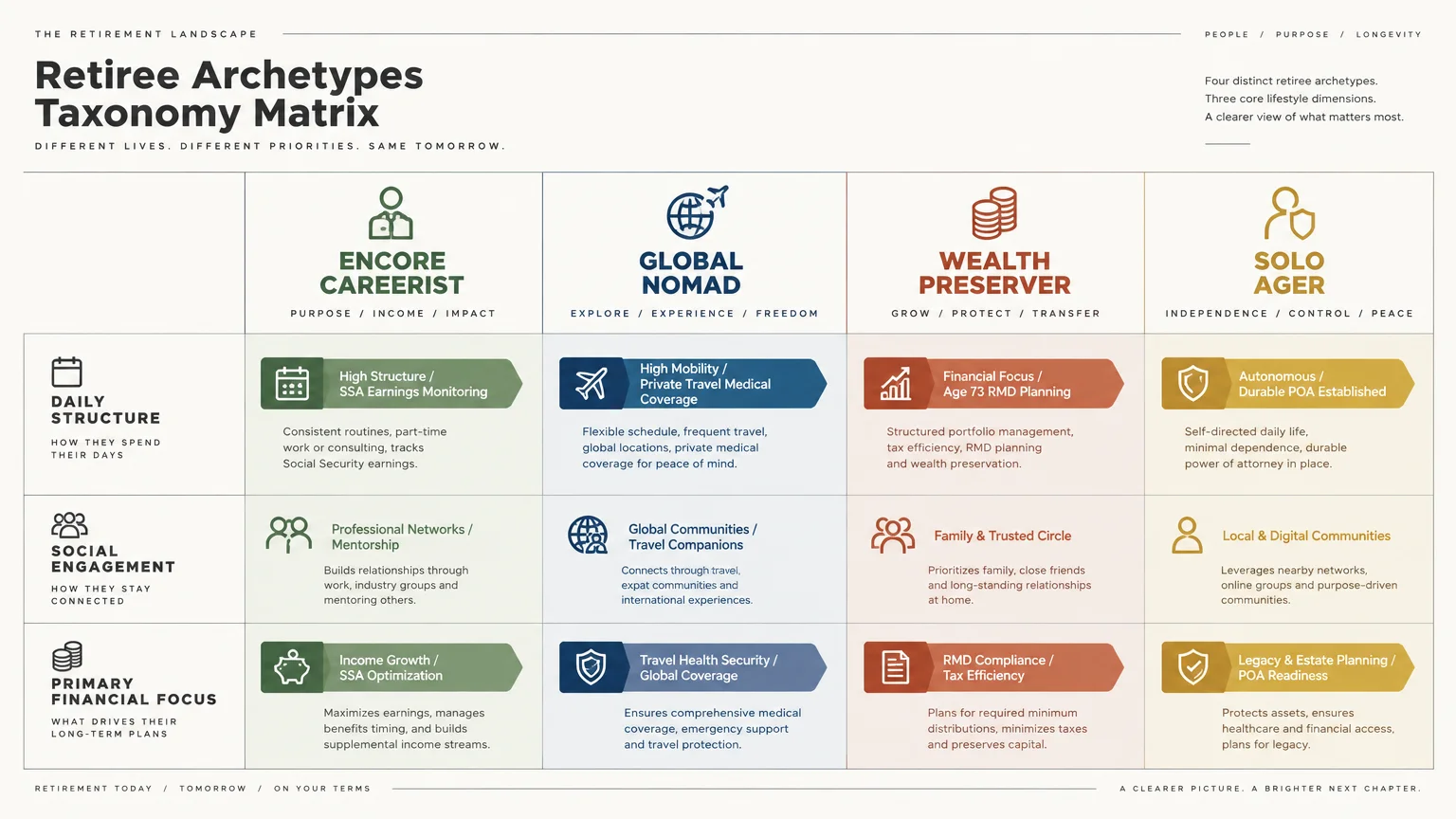
Comparing the 10 Retirement Lifestyle Types
Evaluating the key elements of each retirement profile helps you identify where your priorities lie. Review this reference table to compare goals, financial focuses, and potential pitfalls.
| Retirement Archetype | Core Lifestyle Focus | Primary Financial or Legal Priority | Potential Vulnerability |
|---|---|---|---|
| Encore Careerist | Part-time work and consulting | Social Security Earnings Limits | Burnout and unexpected benefit withholding |
| Global Nomad | International travel and exploration | Emergency foreign medical coverage | Medicare Advantage service area disenrollment |
| Super-Accumulator | Wealth preservation and saving | Required Minimum Distribution deadlines | Anxiety over spending accumulated assets |
| Generational Anchor | Family support and legacy building | 529-to-Roth rollovers and gifting rules | Depleting reserves to fund adult children |
| Active Relocator | Downsizing to active 55+ housing | Section 121 capital gains exclusions | HOA fees and social adjustment difficulties |
| Purpose-Driven Giver | Volunteering and community mission | Qualified Charitable Distributions (QCDs) | Overcommitting energy to volunteer boards |
| Lifelong Scholar | Continuing education and research | Auditing discounts and education costs | Sedentary routines and intellectual fatigue |
| Wellness Crusader | Physical conditioning and longevity | Preventive Medicare wellness coverage | Frustration when injuries require recovery |
| Solo Ager | Independent self-directed living | Durable PoA and Healthcare Proxies | Social isolation and lack of caregiving support |
| Homebody Recharger | Domestic hobbies and peaceful rest | Budget stability and low living overhead | Creeping loneliness and cognitive understimulation |

Common Retirement Traps to Avoid
Recognizing your retirement personality helps you sidestep behavioral traps that undermine your financial and emotional security. Many retirees fall into predictable mistakes based on their natural instincts.
Super-accumulators often live far below their means out of irrational fear. Hoarding funds deprives you of fulfilling experiences while guaranteeing a substantial tax bill for your heirs later.
Generational anchors frequently sacrifice their financial independence to help adult children. Providing excessive financial bailouts can jeopardize your own long-term healthcare reserves.
Global nomads often leave the country assuming their domestic health insurance travels with them. A single overseas medical emergency can erase years of savings without proper supplemental coverage.
Encore careerists sometimes take early Social Security while earning substantial wages. Having early benefits withheld due to the earnings test creates unnecessary administrative frustration.

When to Consult a Professional
Aligning your personality with financial and legal realities often requires specialized advice. Knowing when to engage an expert prevents costly oversights.
Consult a fee-only Certified Financial Planner (CFP) to build a sustainable distribution plan. A planner helps super-accumulators spend safely and assists encore careerists with tax projections.
If you plan to travel extensively or relocate, meet with a State Health Insurance Assistance Program (SHIP) counselor. These advisors explain Medicare network boundaries without charging commissions.
Solo agers and generational anchors should consult an elder law attorney. An attorney drafts ironclad powers of attorney, healthcare directives, and trusts tailored to your exact family dynamic.
Frequently Asked Questions About Retirement Personalities
Can you switch between retirement personality types over time?
Yes. Many retirees start as Global Nomads or Encore Careerists during their first active decade, then gradually transition into Homebody Rechargers or Lifelong Scholars as their priorities evolve.
How do spouses with different retirement personality types compromise?
Couples should schedule independent pursuits alongside shared goals. If one spouse is a Global Nomad and the other is a Homebody Recharger, planning shorter, focused trips offers a healthy balance.
How does your retirement type impact when you should claim Social Security?
Encore careerists who earn high incomes generally benefit from delaying claims until full retirement age. Solo agers without dependents often claim based on their personal health profile and immediate capital needs.
What is the most financially vulnerable retirement personality?
The Generational Anchor faces unique risks because emotional ties can lead to overspending on family members. Setting strict financial boundaries protects the assets you need for long-term care.
Embrace Your Authentic Retirement
Retirement is your opportunity to live intentionally on your own schedule. Take time to discuss your archetype with your partner or financial advisor to confirm your plans support your authentic goals.
Choose two concrete steps this week—whether updating your healthcare proxy, checking Medicare travel rules, or mapping out a new hobby. Defining what kind of retiree you are guarantees a fulfilling, worry-free chapter ahead.
Information in this article reflects current rules as of the publication date and may change. Always confirm benefit details directly with Social Security Administration, Medicare.gov, or relevant government agencies before making decisions.
Last updated: February 2026. Medicare and Social Security rules change annually—always verify current details at official government sources.