American retirees spend thousands annually on vacations, but a large portion of that money is wasted paying standard rates. You spent decades building your retirement savings; now leverage your age to protect it. While everyone knows about the standard hotel discounts, the most lucrative travel deals remain buried in fine print. From lifetime access to federal recreation sites to deep discounts on international rail passes and off-peak airfare, massive savings are hiding in plain sight. Uncovering these hidden travel discounts allows you to upgrade your trips, stay longer, or keep more cash in your portfolio for future adventures. Stop leaving money on the table and start taking advantage of the elite travel pricing you have rightfully earned.
“Retirement is not the end of the road. It is the beginning of the open highway.”

1. The Lifetime America the Beautiful Senior Pass
Many retirees assume national park entry fees are a fixed cost of doing business when executing a cross-country road trip. At $35 per vehicle for popular parks like Grand Canyon or Yosemite, visiting multiple parks rapidly drains your travel budget. The federal government offers an extraordinary alternative: the America the Beautiful Senior Pass. Available to U.S. citizens and permanent residents aged 62 and older, this pass costs a one-time fee of $80 and grants lifetime access to more than 2,000 federal recreation sites.
The true value of this pass extends far beyond the entrance gate. It covers standard amenity fees and day-use fees for a driver and all passengers in a personal vehicle. Even better, pass holders frequently receive a 50% discount on select federal amenity fees, including camping, swimming, boat launching, and guided tours. If you prefer to test the waters before committing to a lifetime pass, an annual senior pass is available for $20, which can later be applied toward the purchase of the lifetime version.

2. Unadvertised Airline Age-Based Fares
Airlines systematically removed highly publicized senior discounts over the last decade, leading most travelers to believe cheap travel for seniors via air no longer exists. While sweeping blanket discounts are gone, targeted age-based fares remain active—you just have to know where to look and how to ask.
United Airlines offers discounted fares to passengers aged 65 and older on select routes. To find them, you cannot use the standard homepage search bar; you must navigate to their “Advanced Search” page and specifically select the 65+ demographic from the passenger dropdown menu. Delta Air Lines similarly maintains senior fares in certain markets, but they rarely publish them online. Calling the Delta reservation line and directly asking the agent to check for senior fare availability on your specific route often yields savings. For international travel, British Airways partners directly with AARP to offer members up to $200 off transatlantic flights, a benefit that can easily offset the minor cost of the membership on a single trip.

3. Cruise Line “55+” Fare Codes
The cruise industry heavily courts the retirement demographic, yet thousands of older adults overpay for their cabins by booking standard retail rates. Major operators—including Carnival, Royal Caribbean, and Norwegian Cruise Line—utilize dynamic pricing models that feature dedicated “55+” fare codes. These discounts often slash 5% to 20% off the standard rate.
Cruise lines purposefully keep these discounts separated from their massive homepage banner sales. To access retirement travel savings on the high seas, you must actively check the “55+” box when inputting your initial search criteria on the booking engine. If you are working with a travel agent, explicitly instruct them to run your quote with the senior resident discount applied. These age-based discounts frequently stack with state residency discounts; a 60-year-old booking a cruise out of Port Canaveral who selects both the “55+” and “Florida Resident” filters can unlock combinations that significantly undercut advertised sale prices.

4. The Amtrak 10% Concession
Train travel offers a relaxed, scenic alternative to highway driving and airport security lines, making it an ideal mode of transportation for older adults. Amtrak rewards this demographic with a blanket 10% discount on most rail fares for travelers aged 65 and over.
To secure this discount, use the traveler dropdown menu on the Amtrak website or app to select “Senior” rather than “Adult.” The system automatically recalculates the fare. Note that the discount applies primarily to standard coach fares; it does not apply to the premium Acela First Class, sleeping accommodations, or certain auto train fares. However, if you are booking a standard seat on a beautiful daytime route—such as the Pacific Surfliner along the California coast or the Adirondack through upstate New York—the 10% savings directly impacts your bottom line.
5. Deep Cuts on European Rail Passes
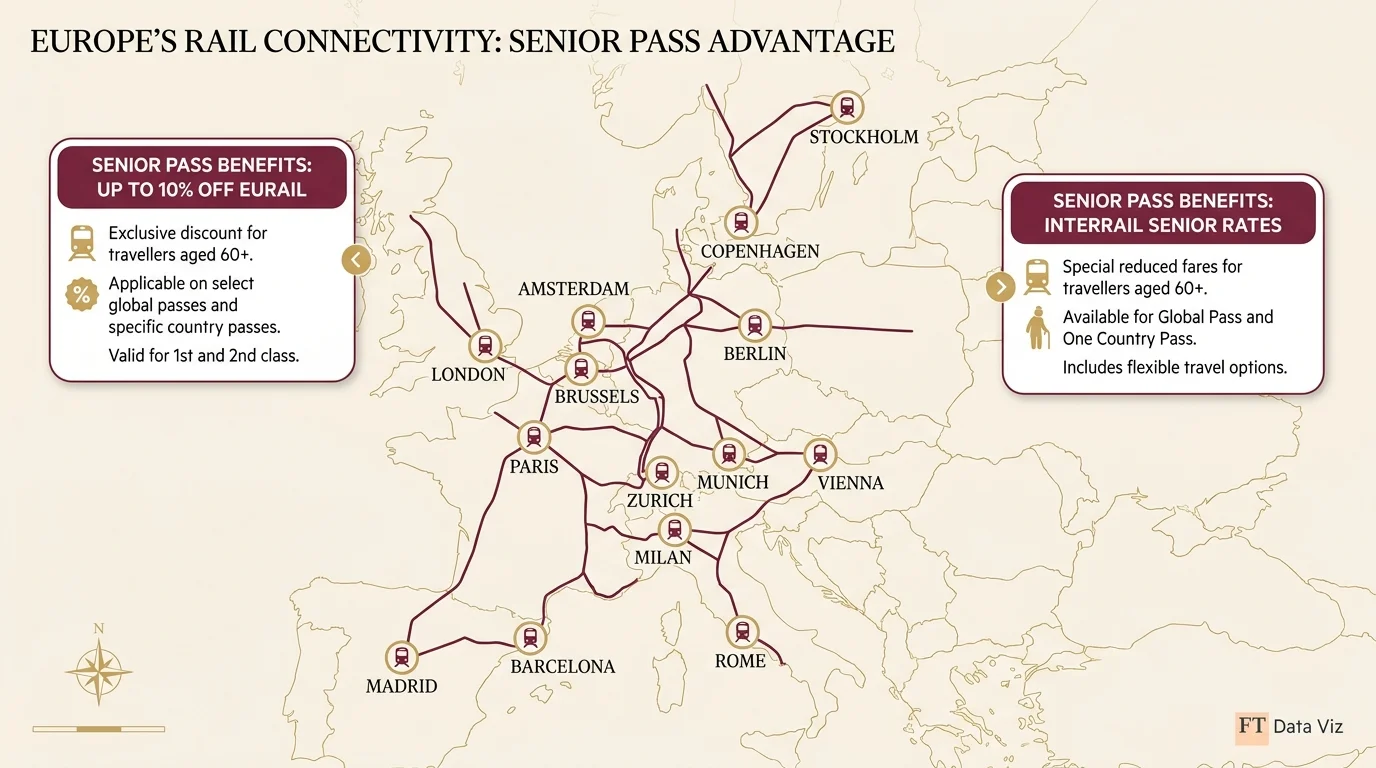
International travel tops many bucket lists, but navigating transportation costs across Europe quickly becomes daunting. If you plan to explore Europe by train, age provides a massive financial advantage. Eurail—the master ticket granting flexible access to most European national rail networks—offers a dedicated senior pass for travelers aged 60 and older, automatically applying a 10% discount across both first-class and second-class global passes.
Individual countries offer even deeper domestic incentives. In the United Kingdom, purchasing a Senior Railcard for £30 grants anyone 60 and older a massive one-third off standard train fares across Britain for an entire year. France and Italy offer similar national discount cards for older travelers. When planning European travel discounts retirees USA should map out their itinerary first; purchasing one or two specific country senior cards is often cheaper than a comprehensive multi-country pass.

6. Local and Regional Transit “Free Ride” Programs
While planning grand vacations is exciting, local travel and day trips represent the bulk of movement in retirement. Many major American cities and regional transit authorities subsidize or completely eliminate public transportation costs for older residents. In Pennsylvania, the Senior Free Transit Program allows residents aged 65 and older to ride local buses and rapid transit lines for free. The Chicago Regional Transportation Authority offers a Reduced Fare Permit, cutting costs in half for older adults.
To find out what your local city offers, you can uncover localized transportation benefits using BenefitsCheckUp, a free, confidential tool provided by the National Council on Aging. Securing these transit cards usually requires an in-person visit to a local transit office with a valid ID, but the resulting ability to navigate urban centers for pennies transforms how you explore cities during retirement.

7. Hotel Loyalty Senior Rates
Third-party booking sites like Expedia and Booking.com dominate the travel industry, but they rarely pass through the best age-based hotel rates. The true senior travel deals America has to offer are found by booking directly with the hotel chains.
Marriott Bonvoy offers discounts of up to 15% for guests aged 62 and older, depending on the property and the season. Choice Hotels (which includes Comfort Inn, Quality Inn, and Econo Lodge) offers a robust senior discount program, providing up to 10% to 30% off standard rates for travelers aged 60 and older. Wyndham properties similarly reward guests 60 and up with dedicated promotional rates. The key to unlocking these rates is utilizing the “Special Rates” or “Corporate/Promo” dropdown menu on the hotel’s direct website and selecting the senior option before initiating the search.
8. Rental Car Upgrades and Fee Waivers
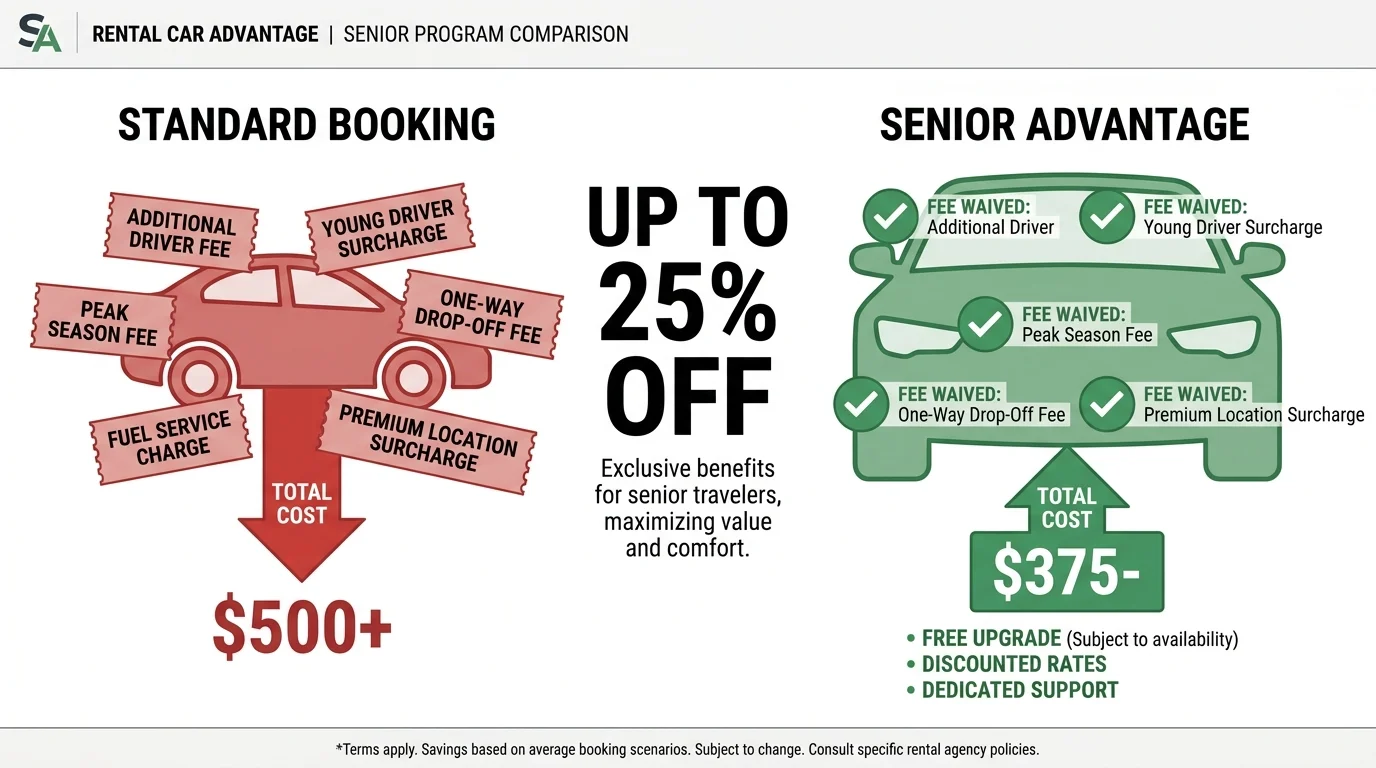
Rental car pricing relies heavily on dynamic algorithms, but specific memberships establish price ceilings and guarantee benefits. Securing a membership through AARP grants you access to highly aggressive auto rental contracts negotiated on behalf of millions of older Americans.
When booking Avis or Budget through an AARP portal, travelers can save up to 30% off base rates. However, the most valuable part of this discount isn’t the percentage off the base rate—it is the waiver of additional fees. The AARP code automatically waives the “additional driver fee” for a spouse or domestic partner, which typically costs $10 to $15 per day. Furthermore, the code frequently triggers a complimentary single-car-class upgrade, turning a cramped compact rental into a comfortable midsize vehicle for long drives.

9. Resident State Park Senior Passes
While the federal recreation pass gets the glory, individual state park systems hold incredible hidden travel discounts retirees consistently overlook. Because state park systems are funded by state taxpayers, local governments frequently reward older residents with aggressive discounts on camping and entry fees.
In Texas, residents 65 and older can secure a Texas State Parks Pass for a significantly reduced rate, granting free entry and discounts on camping. New York’s Golden Park Program allows state residents 62 and older free vehicle access to most state parks, boat launch sites, and arboretums on weekdays. If you own an RV or enjoy camping, verify your home state’s specific Department of Natural Resources policies. Securing a resident senior pass often cuts seasonal camping costs entirely in half.

10. Extended-Stay RV and Snowbird Resort Discounts
The travel industry recognizes that retirees possess a unique asset: schedule flexibility. Independent resorts, luxury RV parks, and private campgrounds operate on thin margins during their shoulder seasons. To guarantee income, these properties offer deeply discounted “snowbird” or extended-stay monthly rates to older adults who can commit to 30, 60, or 90-day stays.
These rates are almost never advertised on standard booking engines. To secure them, you must call the property directly and ask to speak with the manager regarding their off-season monthly rates. A waterfront RV site that costs $100 per night in July might be negotiated down to $800 for the entire month of October. Before finalizing your long-term travel plans and extended stays, consult USA.gov Retirement Resources to ensure your broader financial strategy seamlessly supports your life on the road.
Comparing Booking Strategies: The Senior Advantage
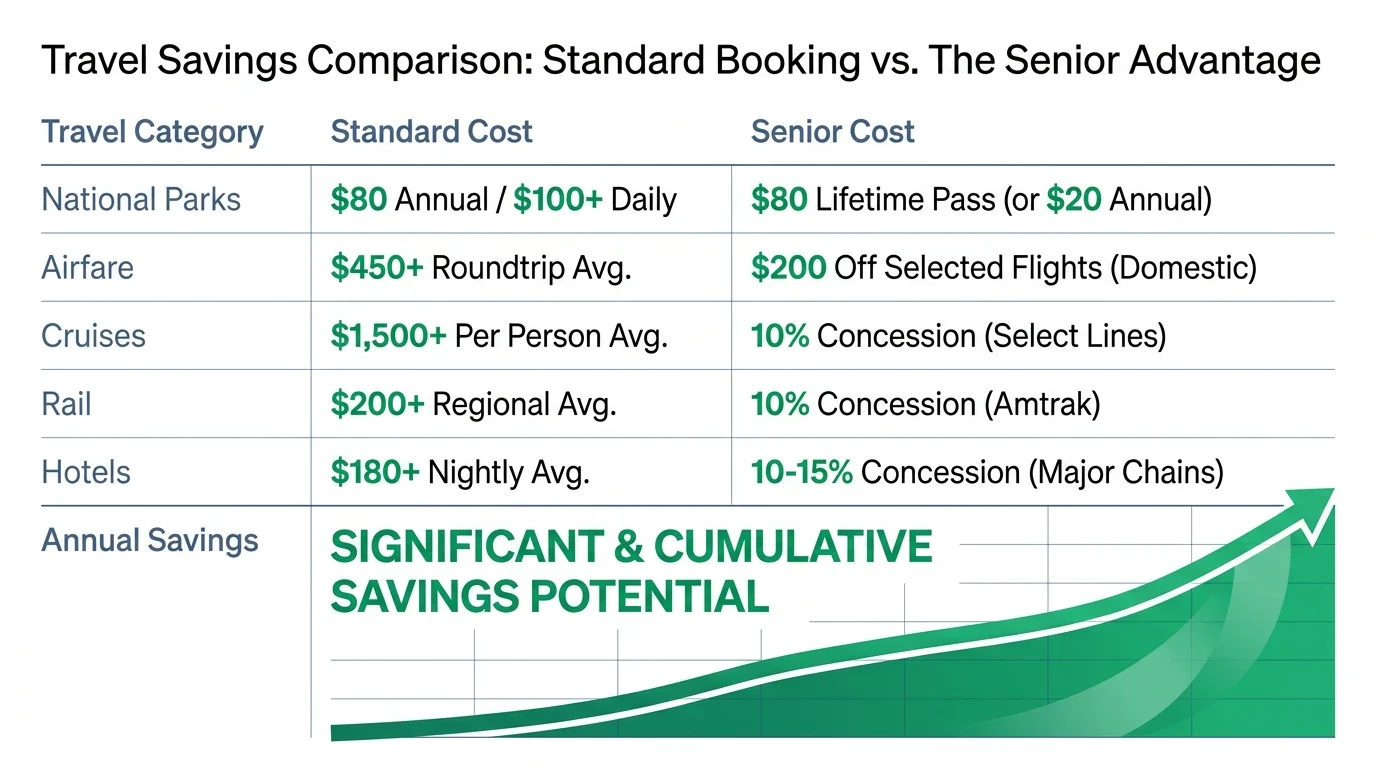
Changing your booking habits is the single most effective way to capture these discounts. Review the comparison table below to see how standard booking methods compare to senior-optimized strategies.
| Travel Category | Standard Booking Habit | Actionable Senior Strategy | Potential Savings |
|---|---|---|---|
| National Parks | Paying $35 per vehicle at the gate | Buying the $80 Lifetime Senior Pass at age 62 | Hundreds of dollars over a lifetime |
| Cruises | Booking the homepage sale banner | Selecting the “55+” and resident search filters | 5% to 20% off the standard cabin rate |
| Rental Cars | Booking via an OTA (Expedia/Kayak) | Booking direct with the AARP discount code | Up to 30% off, plus waived additional driver fees |
| Hotels | Accepting the default daily rate | Using the “Special Rates” dropdown for 60+ | 10% to 15% off nightly rates |
| Amtrak | Booking as an “Adult” passenger | Selecting the “Senior” passenger option | 10% off standard coach fares |

Costly Mistakes to Avoid When Booking Senior Travel
Securing retirement travel savings requires diligence; the travel industry will happily charge you full price if you make logistical errors during the booking process. Avoid these common traps to keep your travel budget intact.
- Relying on Online Travel Agencies (OTAs): Websites like Kayak, Expedia, and Priceline streamline the search process, but their interfaces rarely support specialized age-based promotional codes. Always use OTAs to compare general prices, but execute the actual booking directly on the airline, hotel, or car rental website where you can apply your senior credentials.
- Waiting Until Check-in to Ask: Airfare, cruise pricing, and train tickets utilize dynamic pricing models. You cannot show your driver’s license at the boarding gate and expect a refund for the senior discount you missed. You must secure the age-based fare code at the exact moment of booking.
- Assuming the Senior Rate is Always the Best Rate: The senior discount is a baseline; it is not always the absolute floor. Hotels and cruise lines frequently run aggressive flash sales, holiday promotions, or military/veteran discounts that exceed the standard senior discount. Always run two quotes—one standard and one senior—to ensure you capture the lowest available price.
- Failing to Carry Physical Proof of Age: Digital wallets are convenient, but transit authorities and park rangers routinely demand physical identification. Always carry a government-issued photo ID. If traveling internationally, your passport serves as undeniable proof of age for rail concessions.
Frequently Asked Questions
What age is officially considered a “senior” for travel discounts?
The travel industry does not use a standardized age. Cruise lines typically recognize “senior” starting at age 55. Hotel chains and European rail networks often use age 60. The U.S. federal government uses age 62 for national park passes, while Amtrak and some airlines require travelers to be 65. Always check the specific terms of the provider.
Can I apply a senior discount to a trip I have already booked?
In most cases, no. Airlines and cruise operators strictly prohibit applying age-based discounts retroactively. Some hotel chains may adjust the rate if you call the front desk prior to check-in, but this is entirely at the discretion of the property manager. Secure your discount during the initial transaction.
Do senior travel discounts apply to traveling companions?
It depends entirely on the service. The America the Beautiful Senior Pass covers all passengers in your vehicle. AARP rental car codes waive fees for a spouse. However, airline, train, and cruise discounts are almost universally tied strictly to the individual passenger who meets the age requirement; a 65-year-old cannot buy a discounted senior train ticket for their 40-year-old child.
Your Next Adventure Awaits
You have successfully transitioned from a life of mandatory work schedules to an era of total flexibility. By refusing to pay standard retail prices and adopting a proactive approach to your travel booking habits, you can dramatically expand your retirement horizons. Make it a permanent habit to check the “advanced search” tabs, directly call reservation desks, and proudly claim the pricing tiers designed specifically for your demographic. Pack your bags, update your memberships, and enjoy the journey.
Retirement rules and benefit amounts vary based on individual work history, income, and circumstances. This article provides general guidance only. Consult a SHIP counselor, financial advisor, or elder law attorney for advice specific to your situation.
Last updated: May 2026. Medicare and Social Security rules change annually—always verify current details at official government sources.