Making an uninformed Social Security claim can permanently slash your lifetime retirement income by tens of thousands of dollars. You must verify your numbers before locking in a monthly benefit that finances your household.
More than half of near-retirees fail basic benefit quizzes, leaving critical cash on the table. Testing your knowledge today ensures you protect your household against unexpected taxes and penalty withholdings.
Whether you plan to work part-time or delay filing, mastering two critical Social Security tests will determine your financial security. Here is how you can evaluate your situation and secure every dollar you earned.

The Official Social Security Retirement Earnings Test
The federal government applies an official earnings test if you collect retirement benefits before reaching your Full Retirement Age (FRA). This statutory rule limits how much earned income you can generate while receiving monthly checks.
The Social Security Administration deducts money from your benefit payments if your employment wages exceed strict annual thresholds. The government measures earned income using gross wages from a job or net earnings from self-employment.
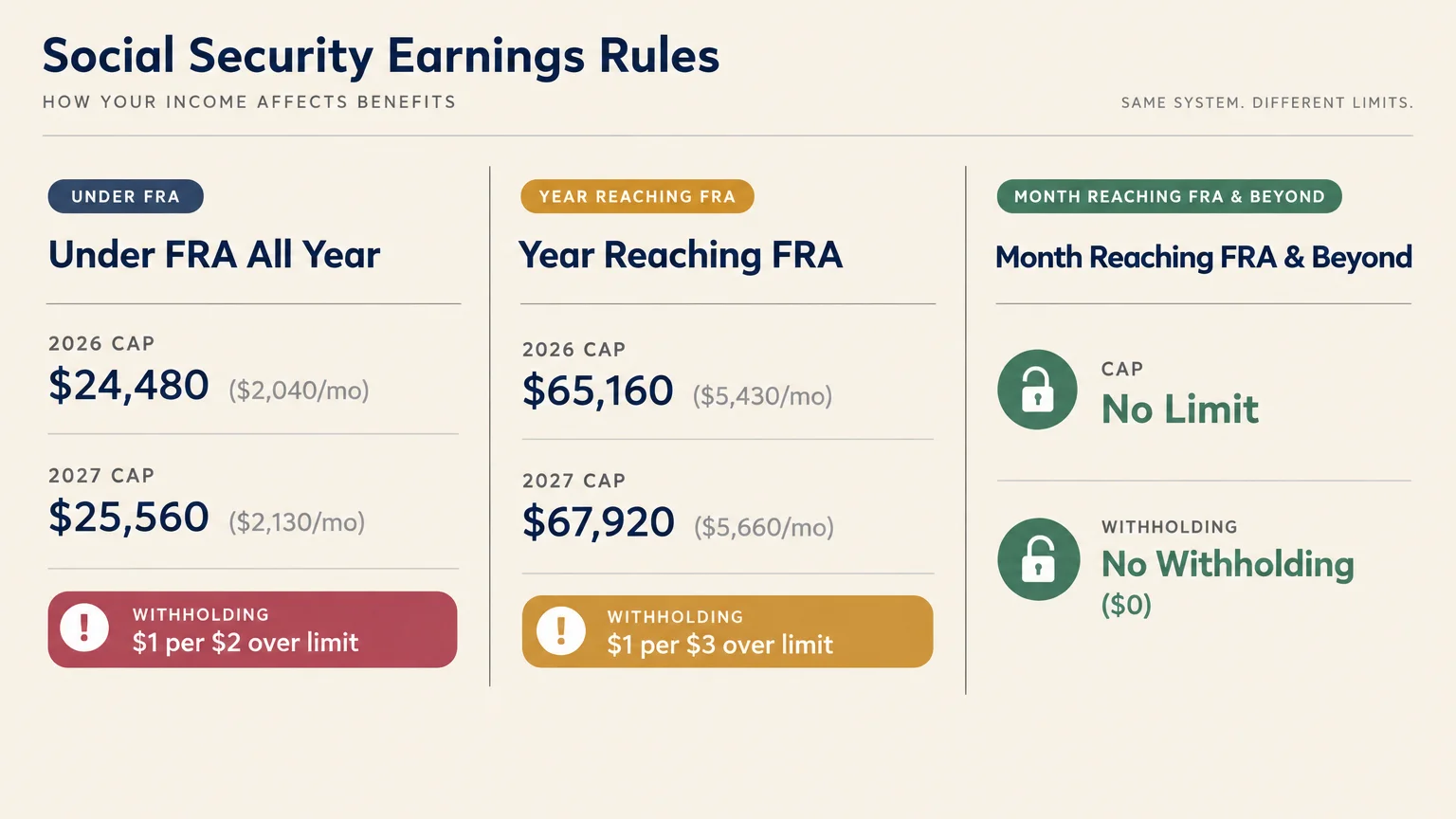
For 2026, the annual earnings limit stands at $24,480, which equals $2,040 per month. If you earn more than this cap, the agency withholds $1 in benefits for every $2 you earn above the threshold.
The earnings cap increases to $25,560 per year in 2027, allowing you to earn up to $2,130 monthly. Any earned income past that figure triggers the same fifty percent withholding penalty on your early payments.
Investment returns, pensions, capital gains, and IRA withdrawals do not count toward this limit. The agency only evaluates active labor when deciding whether to withhold your monthly checks.
A higher limit applies during the calendar year in which you attain your Full Retirement Age. In that specific year, the earnings cap rises significantly to shield more of your income before your birthday.
During 2026, the pre-FRA limit is $65,160 per year, or $5,430 per month. The agency withholds $1 in benefits for every $3 you earn above this elevated limit during those transitional months.
In 2027, this transition threshold jumps to $67,920 annually, which translates to $5,660 per month. The reduced withholding penalty applies only to the months prior to your actual birth month.
The earnings test terminates permanently the exact month you reach your Full Retirement Age. From that day forward, you can earn an unlimited salary without losing a single dollar of your monthly check.
Crucially, the government does not keep this withheld money forever. When you reach Full Retirement Age, the agency recalculates your benefit upward to credit back the months where they withheld checks.
Comparing the Retirement Earnings Test Rules
Understanding the exact thresholds for your age bracket prevents unpleasant surprises when filing taxes. Review this comparison to see how the agency calculates withholdings across both years.
| Retirement Age Category | 2026 Annual Cap | 2027 Annual Cap | Withholding Ratio |
|---|---|---|---|
| Under FRA All Year | $24,480 ($2,040/month) | $25,560 ($2,130/month) | $1 withheld for every $2 over limit |
| Year Reaching FRA (Months Prior) | $65,160 ($5,430/month) | $67,920 ($5,660/month) | $1 withheld for every $3 over limit |
| Month Reaching FRA and Beyond | No Limit | No Limit | No withholding ($0 withheld) |
The agency enforces these limits rigorously through employer W-2 reports and tax returns. Failing to notify the agency about active work can trigger demands for immediate overpayment repayments.
Always notify your local field office whenever your projected earnings fluctuate during an active claim. Proactive reporting keeps your cash flow predictable and prevents administrative withholding headaches down the road.
The 8-Question Social Security Knowledge Quiz
While the earnings test regulates your wages, your personal retirement knowledge dictates your lifetime wealth. National surveys show that millions of retirees claim benefits early simply because they misunderstand key program formulas.
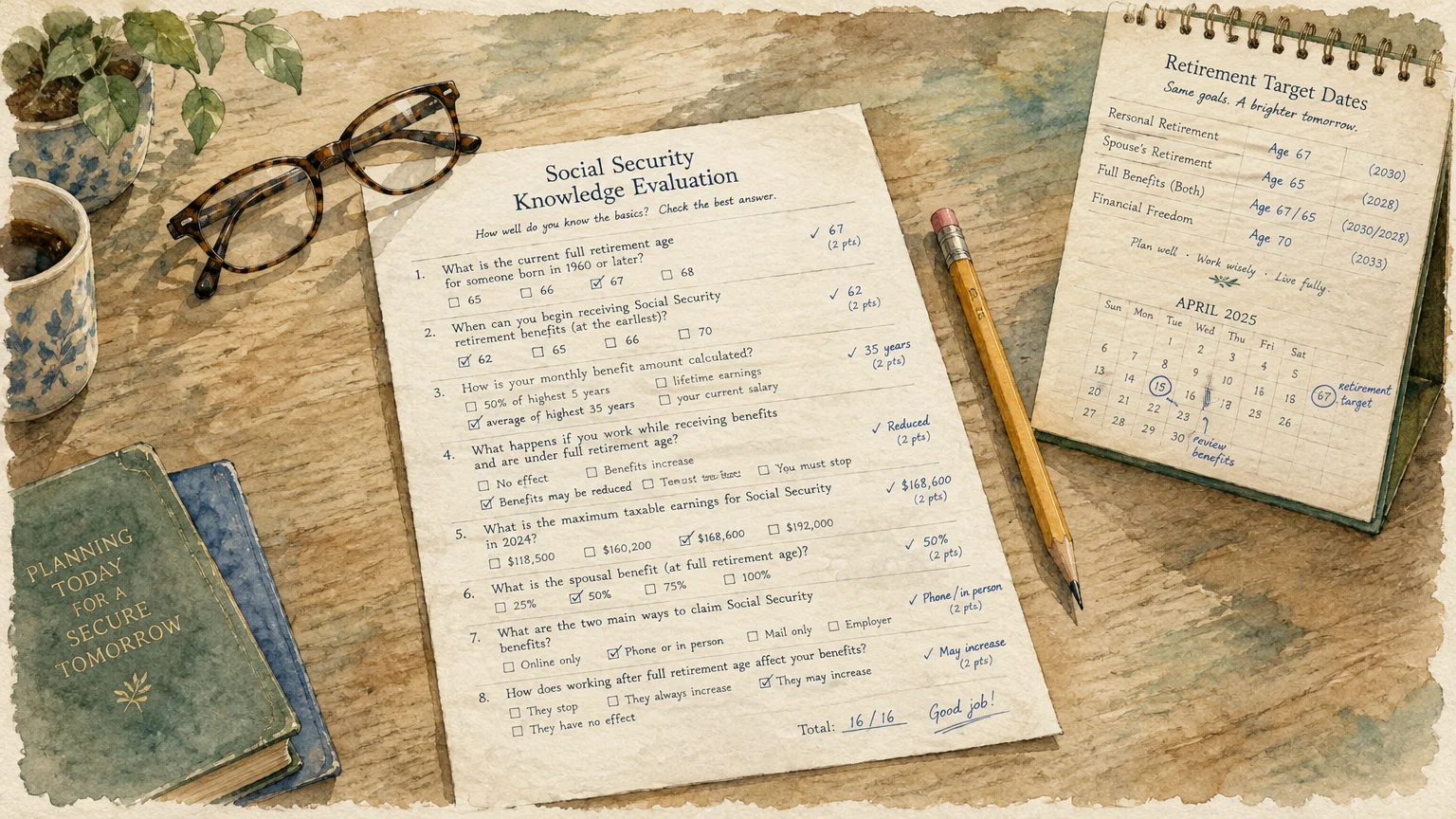
Take this comprehensive test to measure your current Social Security literacy. Score one point for every correct answer you identify before reading the full explanation.
Question 1: What Is Your Exact Full Retirement Age?
Many Americans still assume that Full Retirement Age arrives on their sixty-fifth birthday. Congress altered this schedule decades ago to reflect increasing life expectancies across the national population.
If you were born in 1960 or later, your official Full Retirement Age is 67. If your birth year is 1959, your Full Retirement Age is 66 years and 10 months.
Claiming prior to your statutory age reduces your baseline payout permanently; claiming afterward expands it. Knowing your exact month of eligibility remains the anchor of any sound retirement income roadmap.
Question 2: How Much Does Early Filing Reduce Your Check?
You can claim your worker benefit starting at age 62, but doing so carries a permanent financial penalty. Many claimants fail to appreciate the compounding effect of this early reduction over a thirty-year retirement.
Filing at age 62 when your Full Retirement Age is 67 slashes your monthly benefit by 30%. A monthly baseline check of $2,000 drops immediately to $1,400 for the remainder of your life.
Conversely, delaying benefits past Full Retirement Age earns you delayed retirement credits of 8% per year. These simple-interest increases accumulate until you hit age 70, establishing a permanently higher benefit foundation.
Question 3: How Does the Agency Calculate Your Benefit Amount?
The Social Security Administration does not base your benefit check on your final five years of earnings. Instead, the agency applies an indexed wage formula across your entire work history.
Your primary benefit reflects your highest 35 years of wage-indexed earnings. If you only worked for 30 years, the agency averages in five zero-dollar years, dragging down your baseline calculation.
The government caps taxable earnings subject to the 6.2% payroll tax at $184,500 in 2026. This maximum taxable wage base rises to $192,300 in 2027 as national average wages climb.
Because of these caps, the maximum monthly benefit at Full Retirement Age is $4,152 in 2026. That maximum monthly payout rises to $4,188 in 2027 for top-tier earners.
Question 4: What Are You Entitled to Receive on a Spouse’s Record?
Spousal benefits allow one partner to boost their monthly cash flow based on the other’s career earnings. A spouse can claim up to 50% of the higher earner’s Full Retirement Age benefit amount.
You must reach your own Full Retirement Age to claim the complete 50% spousal payout. Filing earlier reduces the spousal payment percentage according to standard early claiming reductions.
Divorced spouses can also claim on an ex-partner’s record if the marriage lasted at least 10 consecutive years. The claimant must remain unmarried and have attained at least age 62 to qualify for these funds.
“The goal of retirement is to live off your assets—not live off your regrets.”
Question 5: How Do Survivor Benefits Protect a Household?
Survivor rules function differently from standard spousal benefits and require careful coordination. When a spouse passes away, the surviving partner generally inherits the larger of the two monthly benefit payments.
The household forfeits the smaller check completely; the two checks never combine into a single giant payment. This sudden reduction in household income often shocks surviving spouses who carry fixed housing costs.
For this reason, the higher earner should consider delaying their claim as close to age 70 as possible. Maximizing the primary earner’s benefit guarantees the surviving partner the highest possible lifelong safety net.
Question 6: How Does the IRS Tax Your Monthly Benefits?
Social Security checks are not automatically tax-free income at the federal level. Your total tax exposure depends on a specific formula known as your provisional or combined income.
You calculate provisional income by adding your adjusted gross income, tax-exempt municipal bond interest, and half of your Social Security benefits. Congress established these statutory thresholds in 1983 and never adjusted them for inflation.
For single filers, provisional income between $25,000 and $34,000 exposes up to 50% of benefits to income taxation. Earning over $34,000 exposes up to 85% of your benefits to federal tax brackets.
For married couples filing jointly, provisional income between $32,000 and $44,000 triggers taxation on up to 50% of benefits. Exceeding $44,000 leaves up to 85% of your joint benefits subject to federal income tax.
Question 7: How Do Cost-of-Living Adjustments (COLA) Function?
Annual cost-of-living adjustments protect retirees against purchasing power erosion caused by inflation. The government measures annual changes in consumer price indices during the third quarter of every calendar year.
Beneficiaries received a 2.8% benefit bump in January 2026 to offset prevailing economic trends. On October 14, 2026, the administration announced a 3.6% COLA for 2027 payments.
In late 2026, the estimated average monthly check for all retired workers stands at $2,095. With the 3.6% adjustment, that average payment climbs by $75 per month to reach $2,170 in January 2027.
For an aged couple where both partners receive payments, average benefits increase from $3,238 to $3,355 per month in 2027. This adjustment applies automatically to your benefit base, regardless of whether you claim early or delay.
Question 8: How Many Work Credits Must You Earn to Qualify?
You cannot qualify for retirement benefits on your own record without accumulating sufficient work history. The administration tracks your career participation using a system of quarterly coverage credits.
You need 40 lifetime credits to secure retirement benefits, which translates to ten full years of covered employment. You can accumulate a maximum of four work credits during any single calendar year.
In 2026, you earn one credit for every $1,890 in covered wages, requiring $7,560 for four credits. In 2027, that threshold increases to $1,970 per credit, requiring $7,880 in annual earnings.
Evaluating Your Score and Readiness
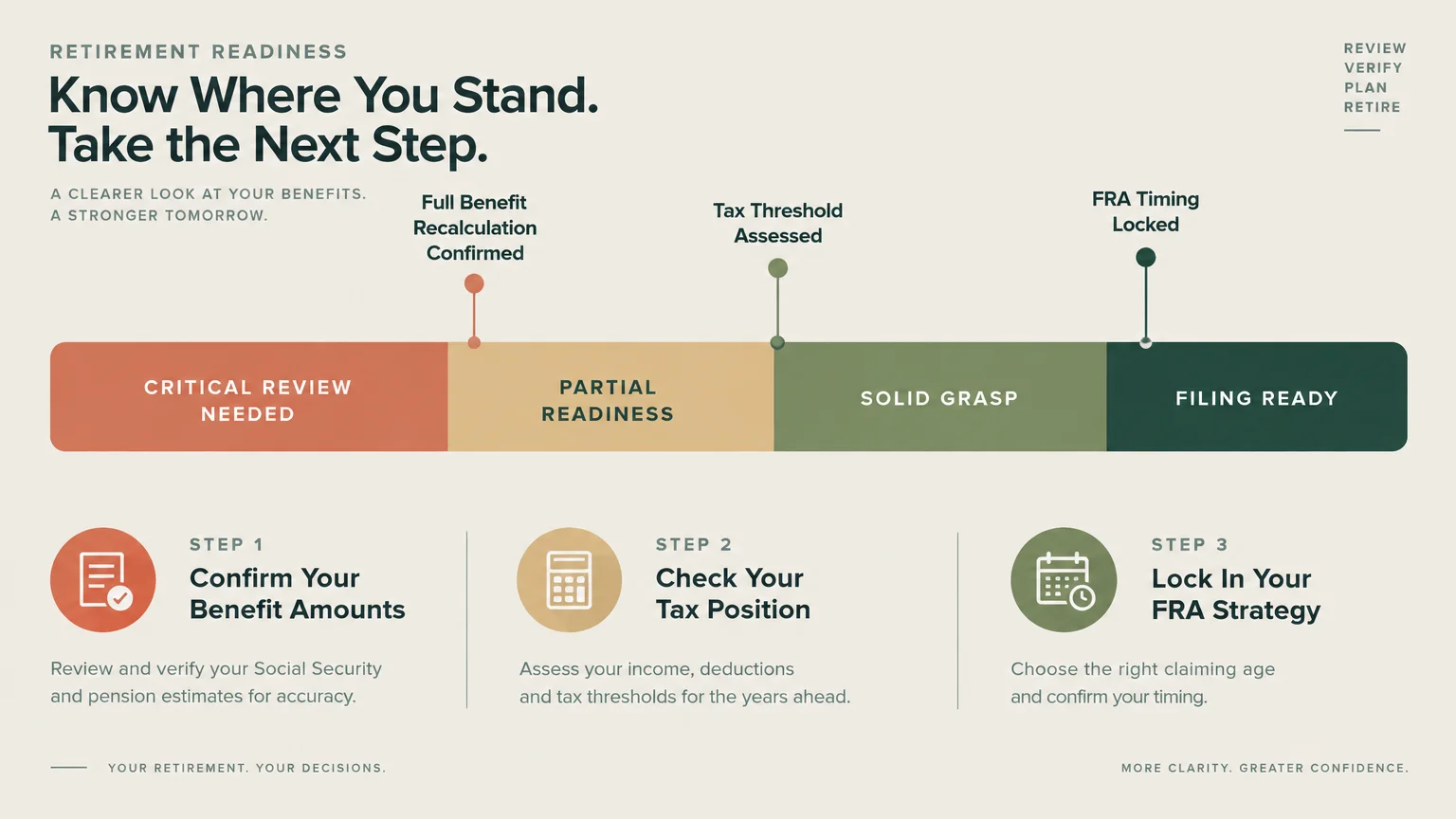
Now that you have worked through the core concepts, calculate your total score out of eight possible points. This diagnostic assessment reveals whether you are truly prepared to execute your filing strategy.
- 7 to 8 Points: Retirement Master. You possess an exceptional grasp of federal benefit formulas. You can confidently optimize claiming timelines, navigate spousal opportunities, and mitigate retirement tax brackets.
- 5 to 6 Points: Proficient Planner. You understand the baseline rules but may have blind spots regarding taxation or earnings thresholds. Review your weaker areas before submitting paperwork to the agency.
- 0 to 4 Points: Critical Risk. You risk forfeiting substantial guaranteed income through premature filing or unanticipated tax liabilities. Delay your application until you study official materials or consult an expert.
In MassMutual’s recurring national Social Security surveys, more than half of near-retirees fail or barely pass basic benefit tests. Common misconceptions regarding spousal eligibility and earnings caps cause thousands of retirees to miss vital payments.
Furthermore, the 2026 EBRI Retirement Confidence Survey reveals that 70% of current retirees worry about policy shifts. Educating yourself on current law remains the most effective antidote to retirement uncertainty and financial anxiety.
“The best time to plan for retirement was 20 years ago. The second best time is today.”

Costly Mistakes to Avoid
Even small errors during the application process can produce permanent monthly reductions. Watch out for these widespread traps when structuring your retirement timing.
First, never assume the agency’s records of your historical earnings are completely error-free. Employers occasionally misreport annual wages, and uncorrected transcription errors depress your baseline benefit calculations forever.
Log into your personal account at SSA.gov annually to inspect your historical earnings ledger. Dispute any missing or inaccurate numbers immediately using old W-2 forms or tax filings.
Second, do not trigger the earnings test penalty without calculating your immediate net cash flow. If you plan to work significant hours prior to your Full Retirement Age, early filing often proves counterproductive.
Third, beware of the retirement tax torpedo caused by poorly coordinated retirement account distributions. Pulling substantial sums from tax-deferred IRAs alongside your benefits can push your provisional income into the 85% taxable bracket.
Finally, avoid filing early simply because your friends or siblings chose to do so. Your health profile, marital status, age gap with your spouse, and outside assets demand an individualized claiming timeline.

Don’t DIY These Decisions
Certain claiming scenarios involve overlapping rules that make independent planning risky. Knowing when to hire professional assistance can protect your estate and save your household thousands of dollars.
If you possess significant assets inside traditional retirement accounts, consult a fee-only Certified Financial Planner (CFP). A skilled advisor models withdrawal sequencing to prevent your Social Security from triggering excessive taxation.
If you navigate blended families, special needs dependents, or second marriages, consult an experienced elder law attorney. These legal specialists ensure your benefits coordinate properly with trusts, inheritances, and Medicaid asset protection boundaries.
You can also access free, objective guidance through nonprofit networks like the National Council on Aging. These organizations help older adults identify supplemental benefit programs and evaluate comprehensive community resources.
Before making a final choice, experiment with the Consumer Financial Protection Bureau retirement planning tool. This interactive public resource illustrates how claiming age adjustments impact monthly income across various longevity scenarios.
Do not rely on informal advice from coworkers or well-meaning family members when evaluating claiming ages. Benefit regulations contain unique technical nuances that require precise, personalized analysis.
Frequently Asked Questions About Social Security Rules
Here are direct answers to common questions retirees ask when evaluating their benefits and claiming timelines.
Does the earnings test withhold money permanently?
The agency never keeps earnings test withholdings permanently. When you reach Full Retirement Age, the government recalculates your monthly benefit to credit back the months you went unpaid.
This upward adjustment raises your permanent monthly check for the rest of your life. Over an average lifespan, you generally recover the money that the agency withheld during your working years.
Can I change my mind after claiming Social Security early?
You can withdraw your application once within the first twelve months of filing using official form SSA-521. This option allows you to reset your benefit path as though you never filed.
However, you must repay every dollar received, including spousal payouts and withheld taxes. After twelve months have elapsed, your claiming decision remains irreversible until you reach Full Retirement Age.
How does working after age 70 affect my benefits?
Delayed retirement credits cease accumulating once you celebrate your seventieth birthday. There is no financial benefit to postponing your application past age 70 under any circumstance.
However, if you continue working, those earnings can still replace an earlier, lower-earning year in your top 35-year record. If your current wages exceed an earlier indexed year, the agency automatically boosts your benefit.
How does provisional income determine if benefits are taxable?
Provisional income combines your adjusted gross income, nontaxable interest, and half of your annual Social Security benefit. The resulting figure determines what portion of your monthly check faces federal income tax.
Staying below $25,000 for single filers or $32,000 for joint filers keeps benefits completely tax-free. Crossing those thresholds subjects between 50% and 85% of your benefits to standard federal income tax rates.
Taking Charge of Your Retirement Future
Your Social Security check provides a rare source of guaranteed, inflation-protected income that you cannot outlive. Treat your claiming decision like a major investment portfolio allocation rather than an administrative routine.
Start by creating your personal portal account and reviewing your estimated benefits across ages 62, 67, and 70. Model different claiming timelines alongside your other income streams to craft a resilient retirement budget.
Information in this article reflects current rules as of the publication date and may change. Always confirm benefit details directly with Social Security Administration, Medicare.gov, or relevant government agencies before making decisions.
Last updated: October 2026. Medicare and Social Security rules change annually—always verify current details at official government sources.