Starting in 2027, the federal government can deposit up to $1,000 directly into your retirement account—or $2,000 if you file a joint return with your spouse. Unlike older tax breaks, this SECURE 2.0 Saver’s Match pays out even when you owe zero income tax.
If you are working part-time in your late 50s, 60s, or 70s, this government retirement match could give your nest egg a meaningful boost. Strict income caps and a three-year withdrawal lookback apply, so planning ahead matters.
How the 2027 Saver’s Match Works—and Why It Beats the Old Credit
Created by Section 103 of the SECURE 2.0 Act of 2022 under Internal Revenue Code Section 6433, the Saver’s Match takes effect for tax years beginning after December 31, 2026. You will claim the match on your 2027 federal tax return filed in 2028 using new Form 8880-A.
Once the IRS processes your return, the U.S. Treasury sends the match directly into an eligible retirement account. The first federal deposits are expected to arrive in 2028.
The program matches up to 50% of the first $2,000 you contribute to a qualifying retirement account each year. That creates a maximum $1,000 retirement match per individual, or $2,000 for a married couple filing jointly when each spouse contributes.
There is no minimum contribution required to participate. Even if you can only set aside $300 or $500 from part-time earnings, the Treasury matches your eligible percentage on every dollar.
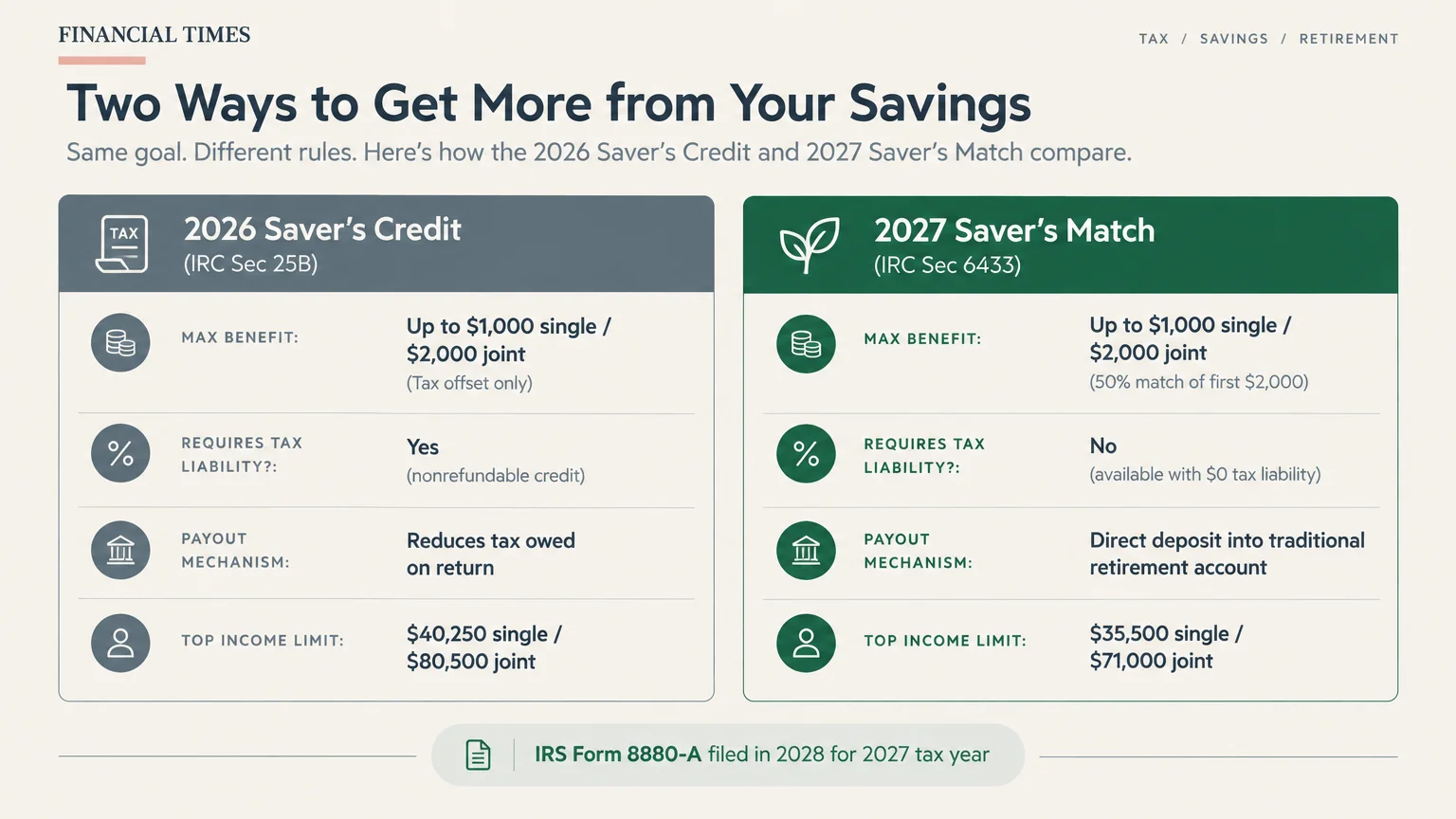
For older adults with modest earnings, the biggest upgrade over older retirement savings incentives is how the money arrives. The Saver’s Match replaces the nonrefundable Saver’s Credit for retirement accounts after the 2026 tax year.
Under the outgoing Saver’s Credit, millions of lower-income workers received nothing because the credit only offset federal income tax owed. Per the Congressional Research Service, the Saver’s Credit averaged just $186 across 9.4 million tax filers in 2020.
By contrast, IRS Notice 2026-48 confirms you can receive the Saver’s Match 2027 benefit even if you have little or no federal income tax liability. The Employee Benefit Research Institute, cited by the U.S. Department of the Treasury, projects the program could benefit 21.9 million eligible Americans out of 69 million income-eligible filers.
If your calculated match comes out above $0 but less than $100, a special rule helps simplify things. Rather than routing a small transfer into a retirement account, you can elect to take that amount as a refundable tax credit on your return.
Keep in mind that 2026 is your final year to claim the old Saver’s Credit on IRA or 401(k) contributions. However, under IRS Notice 2026-66, the Saver’s Credit remains available in 2027 and beyond for contributions to ABLE accounts for individuals with disabilities.
| Program Feature | 2026 Saver’s Credit (Final Year for IRAs/401(k)s) | 2027 Saver’s Match |
|---|---|---|
| Governing Tax Provision | Internal Revenue Code Section 25B | Internal Revenue Code Section 6433 (SECURE 2.0) |
| Maximum Benefit | Up to $1,000 single / $2,000 married filing jointly (tax offset only) | Up to $1,000 single / $2,000 married filing jointly (50% of first $2,000) |
| Requires Tax Liability? | Yes; nonrefundable credit cannot exceed tax owed | No; available even with zero federal income tax liability |
| How Funds Are Paid | Reduces your federal income tax bill on your return | Deposited into a traditional retirement account (or refundable credit if under $100) |
| Top Income Limit (Single / Joint) | $40,250 single / $80,500 married filing jointly | $35,500 single / $71,000 married filing jointly |
| 2027 ABLE Account Availability | Still available for ABLE accounts (up to $41,500 single / $83,000 joint) | Applies to retirement plans and IRAs only |
Do You Qualify? 2027 Income Limits and Age Rules
While the Saver’s Match removes the tax-liability hurdle, it introduces tighter income limits than the credit it replaces. Eligibility depends on your Modified Adjusted Gross Income, known as MAGI, and your tax filing status.
Your MAGI starts with your adjusted gross income and adds back pre-tax retirement contributions plus certain excluded foreign income or housing exclusions. That add-back rule means putting money into a traditional 401(k) will not artificially lower your MAGI to qualify for a bigger match.
| 2027 Filing Status | Full 50% Match (MAGI Up To) | Partial Match Phaseout Range | Match Drops to $0 At |
|---|---|---|---|
| Single or Married Filing Separately | $20,500 | $20,501 – $35,499 | $35,500 |
| Head of Household | $30,750 | $30,751 – $53,249 | $53,250 |
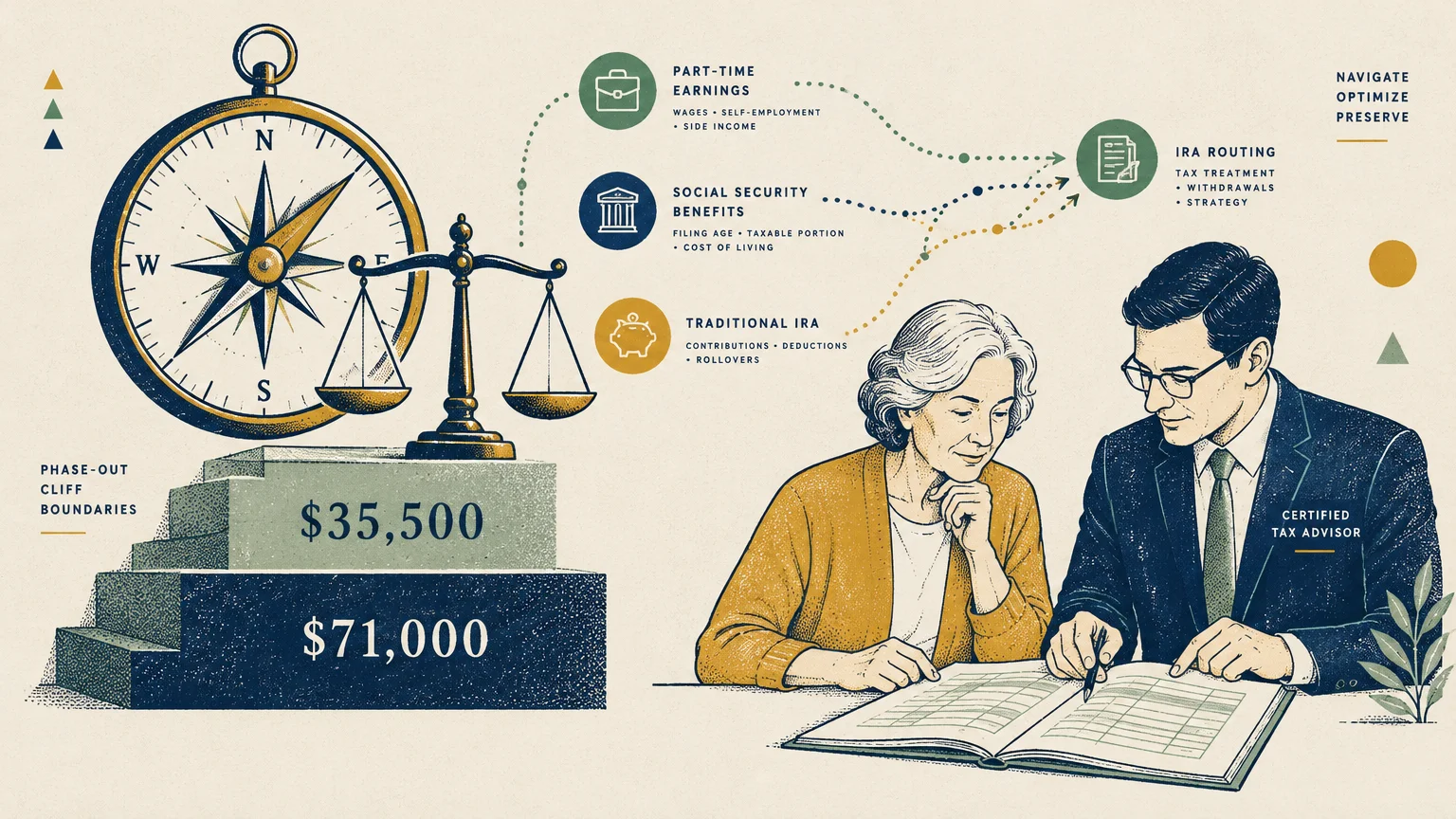
| Married Filing Jointly or Qualifying Surviving Spouse | $41,000 | $41,001 – $70,999 | $71,000 |
Once your MAGI crosses the full-match ceiling, your match rate shrinks gradually rather than dropping off a cliff. Under IRS Notice 2026-48, the percentage steps down in whole percentage points as your income rises through the phaseout zone.
For example, calculations from Thomson Reuters and UBS under those rules show a single filer earning $30,000 in MAGI receives a 19% match. On a $2,000 contribution, that still puts $380 of federal money into your retirement account.
Beyond income, four basic eligibility rules apply for the 2027 tax year:
- Minimum age with no upper cap: You must be at least 18 years old by year-end, and there is no maximum age limit to claim the match.
- Residency requirement: You must be a U.S. resident for federal tax purposes.
- Not a dependent: Nobody else can claim you as a dependent on their 2027 tax return.
- Not a full-time student: You cannot be enrolled as a full-time student during any part of five calendar months in 2027.
Having no upper age limit is welcome news for adults in their 60s and 70s who enjoy working. However, you still must meet the earned income requirement to contribute to an IRA or workplace retirement plan.
Taxable compensation includes wages, salaries, tips, or net self-employment income from consulting or gig work. Income from Social Security benefits, pensions, annuities, dividends, and IRA withdrawals does not count as earned income.
If you are retired and living exclusively on Social Security and portfolio withdrawals, you cannot contribute to an IRA or claim the match. On a joint return, though, a non-working spouse may still contribute to a spousal IRA if the other spouse has enough earned income.
Older women working part-time or running small businesses may be especially well positioned to benefit. U.S. Treasury research from September 2024 found that among Saver’s Match-eligible single and head-of-household filers ages 56 to 65, women were slightly more likely than men to contribute to qualified accounts.
Some lawmakers have pushed to expand these limits through the Saver’s Match Enhancement Act, S. 5507, introduced in September 2026. Because that bill remains in committee and has not passed, you should plan strictly around the current $35,500 and $71,000 ceilings.
The Catch Older Savers Must Watch: The Three-Year Withdrawal Lookback
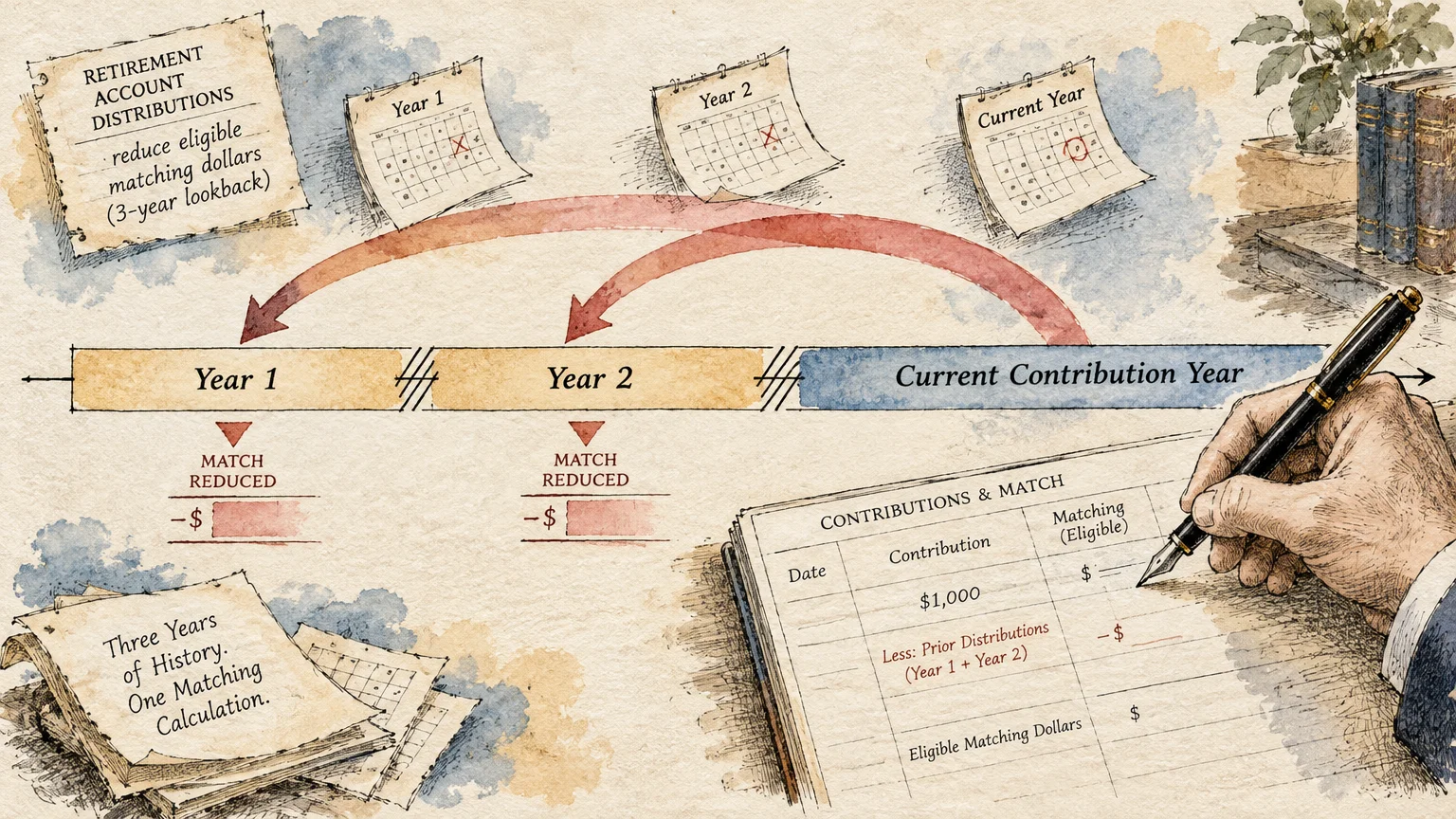
If you are age 55 or older, one rule can quietly erase your Saver’s Match before you ever file Form 8880-A. Under IRC Section 6433(d)(2) and IRS Notice 2026-48, recent retirement withdrawals reduce your qualifying contributions dollar-for-dollar.
The IRS applies a testing period that spans more than three full years. It covers the two tax years before your contribution year, the contribution year itself, and the window up to your tax return filing due date, including extensions.
For a 2027 Saver’s Match claim, the testing period includes any non-rollover retirement distributions received in 2025, 2026, 2027, and early 2028 before your filing deadline. Worse for married couples, distributions received by your spouse on a joint return count against your contributions too.
Consider a concrete example to see how quickly this adds up. Suppose you are 64, work part-time, and contribute $2,000 to an IRA in 2027 expecting a $1,000 federal match.
If you withdrew $2,500 from an old 401(k) in 2025 to pay for roof repairs—or your spouse took a $2,000 IRA withdrawal in 2026—your qualifying 2027 contribution drops to zero. Rollovers moved directly into another eligible retirement plan or IRA are excluded from this reduction.
This lookback rule creates a major hurdle if you or your spouse are age 73 or older and taking Required Minimum Distributions. Because RMDs count as distributions during the testing period, even modest required withdrawals can wipe out the match on part-time wages.
If you are under age 59½ and still building savings, early withdrawals carry an extra penalty. Distributions before 59½ that trigger the standard 10% early distribution tax also trigger Saver’s Match recovery rules that claw back the federal match.
Before you put money in one retirement door to chase a government match, check whether you or your spouse opened the withdrawal door during the past two years.
Which Retirement Accounts Qualify—and Where the Money Goes
Not every retirement account works the same way under the SECURE 2.0 Saver’s Match rules. You need to separate which accounts count for your own contributions from which accounts can receive the government’s deposit.
Your own qualifying contributions can go into a traditional IRA, Roth IRA, 401(k), 403(b), or governmental 457(b) plan. Remember that you can make 2027 IRA contributions up to the April 2028 tax filing deadline if you designate them for 2027.
By law, however, the Treasury can only deposit the Saver’s Match into a traditional, non-Roth IRA or the pre-tax portion of a 401(k), 403(b), or governmental 457(b) plan. Direct federal deposits into a Roth account are prohibited.
What if you prefer contributing to a Roth IRA, as many retirees in lower tax brackets do? IRS Notice 2026-48 outlines a proposed solution for savers who still want their match inside a Roth account.
Under that proposal, the Treasury would open a conduit traditional IRA to receive the federal match and execute an immediate trustee-to-trustee transfer into your designated Roth IRA. That transfer counts as a taxable Roth conversion in the year it occurs, so you would owe ordinary income tax on the converted match.
Once deposited into a traditional account, the Saver’s Match money and its investment earnings grow tax-deferred. Just like your own pre-tax contributions, you will pay ordinary income tax when you withdraw those funds later in retirement.
Another practical detail involves your plan provider. Workplace plan sponsors and IRA custodians are allowed—but not required—to accept Saver’s Match deposits from the Treasury.
If your current 401(k) or brokerage custodian chooses not to handle federal match deposits, you will need an alternate traditional IRA that accepts them. Following Executive Order 14403 in April 2026, the Treasury is launching TrumpIRA.gov in 2027 to help workers without workplace plans—such as part-time staff and independent contractors—locate low-cost IRAs built to receive the match.
Even if you are focused on maximizing the $1,000 retirement match, knowing the broader 2027 contribution limits helps you plan. Under IRS Notice 2026-66, the 2027 employee deferral limit for 401(k), 403(b), 457(b), and TSP plans rises to $25,500.
Workers age 50 and older can add an $8,500 catch-up contribution in 2027, while those ages 60 through 63 qualify for an enhanced $11,750 catch-up. The 2027 IRA limit stays at $7,500, plus a $1,100 catch-up for savers age 50 and up.
You can review current plan rules directly through the IRS Retirement Plans portal as new regulations finalize. Keeping an eye on official updates prevents surprises when your custodian updates its forms.
How to Prepare Now for Your 2027 Claim
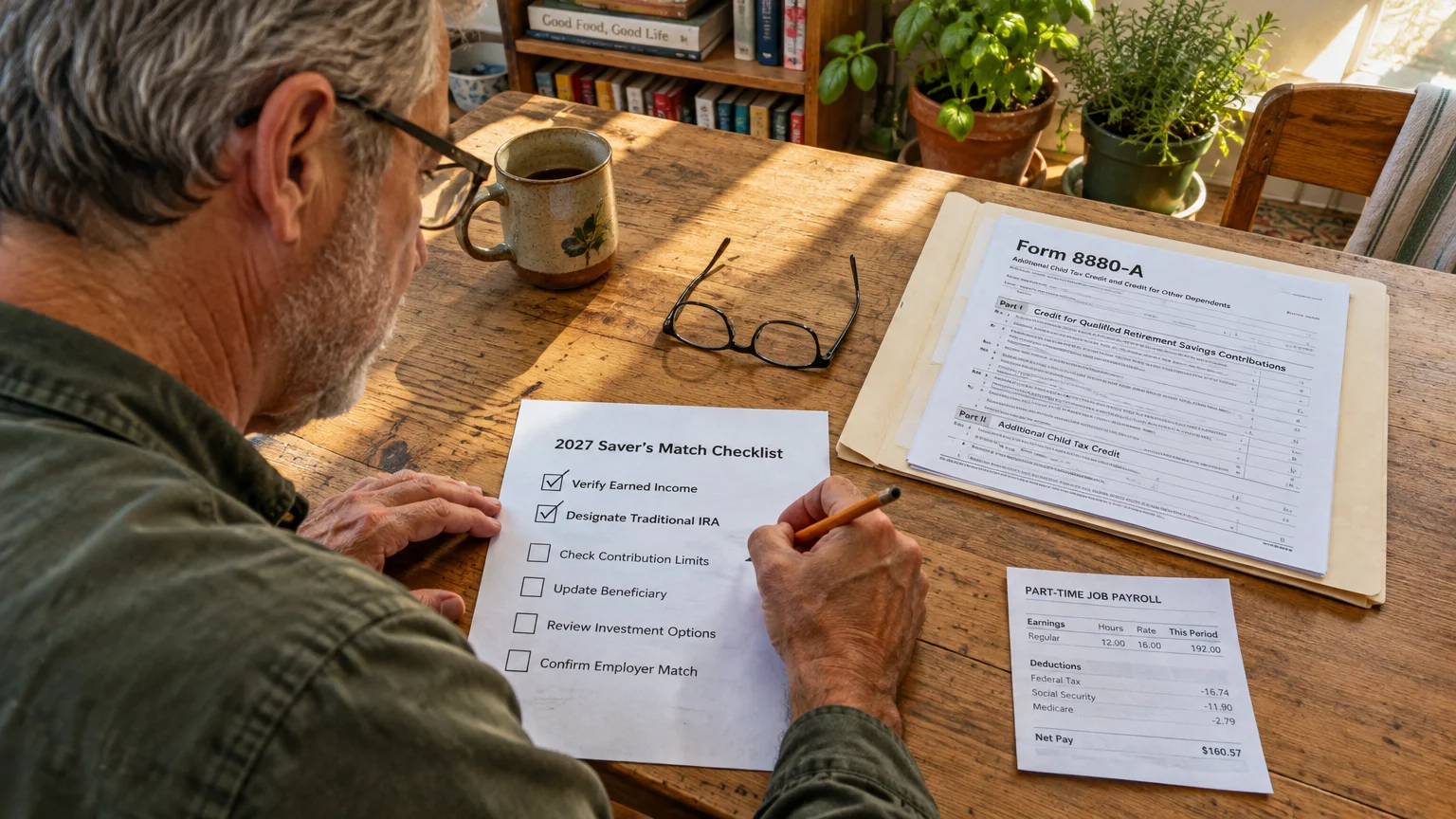
Because the Saver’s Match starts in January 2027 and pays out in 2028, smart planning right now can protect your eligibility. Follow these five steps to put yourself in position for the full match.
- Check your mail for IRS Notice CP321J: In September 2026, the IRS began mailing informational CP321J letters to people who claimed the 2025 Saver’s Credit or had income in the Saver’s Match range; keep that notice with your tax records and make any final 2026 Saver’s Credit contributions before the deadline.
- Audit all 2025–2027 retirement withdrawals: List every non-rollover distribution you or your spouse took in 2025 and 2026, and avoid taking discretionary IRA or 401(k) withdrawals in 2027 if you plan to claim the match.
- Confirm your account accepts federal deposits: Ask your 401(k) administrator or IRA custodian whether they will accept Saver’s Match transfers starting in 2028, or plan to open a compatible traditional IRA through a low-cost provider or TrumpIRA.gov once it launches.
- Time your part-time earnings and taxable income: Track your 2027 wages alongside Social Security, capital gains, and interest so your MAGI stays below $35,500 if single or $71,000 if married filing jointly; check Social Security Administration rules to see how wages affect benefits if you claimed before full retirement age.
- Use free filing software that includes Form 8880-A: Paying $150 or $200 to a tax preparer eats deeply into a $1,000 match, so check whether you qualify for IRS Free File, which covers filers with adjusted gross income of $89,000 or less for 2026 returns.
In October 2026, The Pew Charitable Trusts and the Bipartisan Policy Center urged the IRS to include Form 8880-A across all IRS Free File software options. They noted that only 3% of eligible taxpayers used Free File between 2020 and 2024, leaving significant money on the table.
For broader guidance on protecting your savings from unnecessary fees as you compare accounts, explore the Consumer Financial Protection Bureau retirement tools. Adult children helping aging parents organize accounts can use those checklists to review fee disclosures together.
Errors That Cost Retirees Thousands
Even well-informed savers can lose out on government retirement match dollars through simple timing or filing oversights. Watch closely for these common mistakes:
- Forgetting your spouse’s withdrawals on a joint return: If your spouse takes a $3,000 IRA distribution in 2026 while you contribute $2,000 in 2027, that withdrawal cancels out your match on a joint return.
- Confusing 2026 and 2027 income ceilings: A married couple with $76,000 in income qualifies for a partial 2026 Saver’s Credit because the joint limit is $80,500, yet earns too much for the 2027 Saver’s Match cutoff of $71,000.
- Assuming Social Security counts as earned income: Contributing to an IRA when you have zero wages or self-employment income triggers excess contribution penalties and disqualifies you from the match.
- Overlooking taxes on Roth IRA conversions: Routing your match into a Roth IRA via a conduit traditional IRA creates taxable income in the year of conversion, which could nudge your MAGI higher or affect Medicare IRMAA calculations down the road.
- Treating a $1,000 match as a complete retirement plan: Modeling from the Employee Benefit Research Institute shows SECURE 2.0 auto-enrollment and the Saver’s Match shrink retirement savings deficits by 14.4% for workers ages 35 to 39, but only 0.3% for workers ages 55 to 59 because fewer compounding years remain.
That 0.3% figure does not mean you should skip free federal money if you qualify. Rather, it is a reminder that in your late 50s and 60s, working longer, delaying Social Security, and trimming fixed expenses move the needle far more than a single $1,000 match.
When to Get Expert Help
Most straightforward Saver’s Match claims will only require entering your 2027 contributions on Form 8880-A. Still, older adults juggling multiple income streams often benefit from speaking with a qualified professional before year-end.
Consider sitting down with a CPA or tax preparer if you are balancing part-time wages, Social Security benefits, and IRA withdrawals in the same year. They can model whether delaying a planned withdrawal past your 2028 tax filing date preserves a $1,000 or $2,000 federal match.
A fee-only financial planner is especially helpful if you are deciding between claiming Social Security early, working part-time, or converting traditional IRA balances to Roth accounts. Managing your MAGI carefully can simultaneously preserve your Saver’s Match, reduce taxes on Social Security, and protect health care subsidies.
If you or an aging parent live with a disability or assist a disabled adult child, ask a benefits specialist about ABLE accounts versus traditional IRAs. Because the old Saver’s Credit continues after 2026 for ABLE contributions with higher income limits, a specialist can help choose the better fit.
Older adults looking for free local tax filing help, Medicare counseling, or broader benefit screening can also connect with the National Council on Aging. Finding just one overlooked tax credit or utility program alongside the Saver’s Match can stretch a modest retirement budget much further.
Frequently Asked Questions About the 2027 Saver’s Match
Do I still qualify for the 2027 Saver’s Match if I am over age 65 or 70?
Yes, there is no upper age limit for the Saver’s Match, as long as you are at least 18 and meet income and residency rules. You still must have earned income from wages or self-employment to make a qualifying contribution, and any RMDs taken during the three-year testing window will reduce your eligible match.
Can I get the $1,000 government retirement match if my only income is Social Security?
No, Social Security benefits, pensions, and investment income do not count as earned compensation for IRA or 401(k) contributions. You or your spouse must earn wages or net self-employment income during 2027 to contribute and claim the match.
When will the 2027 Saver’s Match money actually hit my account?
You will claim the match for your 2027 contributions when you file your 2027 federal tax return in early 2028 using Form 8880-A. The first Treasury deposits into qualifying retirement accounts are expected to arrive in 2028 after returns are processed.
What happens if my match is under $100 or my workplace plan refuses deposits?
If your calculated match is more than $0 but under $100, you can choose to take it as a refundable credit on your tax return instead of waiting for a retirement deposit. If your employer’s 401(k) declines to accept Saver’s Match transfers, you can direct the deposit to an eligible traditional IRA that accepts them.
Your Next Step Before 2027 Arrives
Start by reviewing your 2025 and 2026 retirement account statements for any withdrawals, and check whether your current IRA custodian or workplace plan plans to accept Saver’s Match deposits. If you are working part-time in 2026, make sure you capture the outgoing Saver’s Credit this year before the new 2027 rules take effect.
Information in this article reflects current rules as of the publication date and may change. Always confirm benefit details directly with Social Security Administration, Medicare.gov, or relevant government agencies before making decisions.
Last updated: November 2026. Medicare and Social Security rules change annually—always verify current details at official government sources.