Most Americans picture a single personal nest egg funding their entire retirement. In practice, your monthly cash flow almost always blends up to six distinct retirement income sources.
Knowing what each stream typically pays—and how federal tax and claiming rules interact—helps you spot cash gaps before leaving work. You can compare your projections against current national benchmarks right away.
Explore the real retiree income breakdown below, grounded in the latest household data. You will learn what each source delivers and how to strengthen your income for over 65.
Key Takeaways
Before diving into the details of each income stream, keep these core national benchmarks in mind as you map out your own budget.
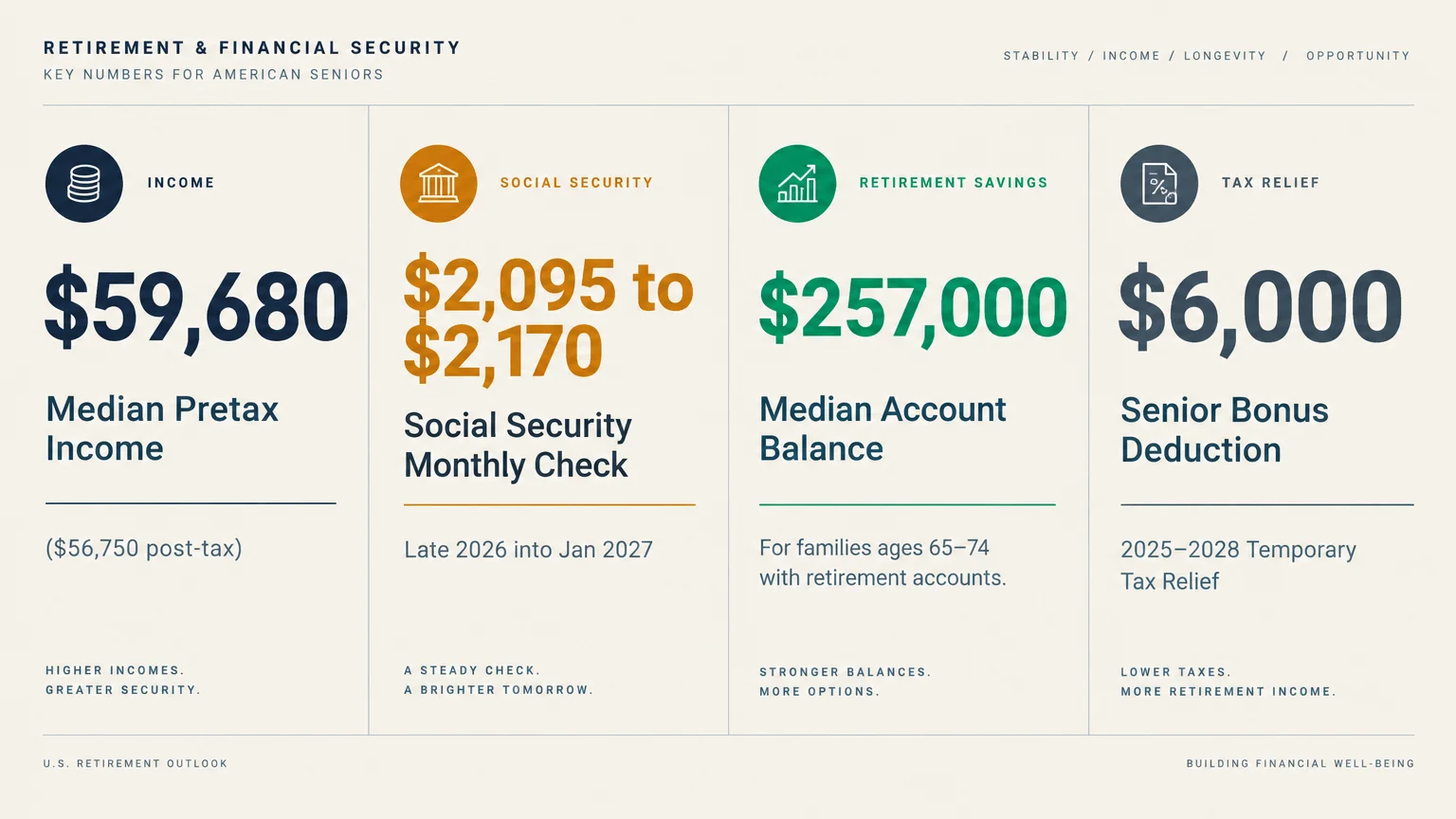
- Typical household income: The U.S. Census Bureau reports a 2025 median pretax household income of $59,680 ($56,750 post-tax) for households led by someone 65 or older.
- Social Security leads the way: Nearly three out of four adults age 60 and older receive Social Security, with retired worker checks averaging $2,095 a month in late 2026 and rising to $2,170 in January 2027.
- Pensions remain meaningful for a third of seniors: While fewer private employers offer them today, government, military, and legacy corporate pensions deliver reliable median payouts ranging from $11,440 to $33,310 a year.
- Savings and investments vary widely: Nearly half of families ages 65 to 74 hold no retirement account at all, while those who do hold a median balance of $257,000.
- Work and taxes reshape the picture: Roughly one in five seniors still earn wages, and a temporary $6,000 senior bonus tax deduction for 2025 through 2028 helps many retirees keep more of what they earn.
The Big Picture: Retirement Income Averages by Age and Household
When you look up retirement income averages, two households can look dramatically different depending on whether you measure individuals, couples, or total family wealth. Sorting out those differences keeps you from comparing your budget to the wrong benchmark.
According to the U.S. Census Bureau report on 2025 income, households headed by someone age 65 or older earned a median pretax income of $59,680, up 3.1% from $57,880 in 2024. After taxes, that typical household brought home $56,750.
The Federal Reserve’s 2025 Survey of Consumer Finances shows slightly higher figures when grouping broader family units together. Families ages 65 to 74 recorded a median pretax income of $69,400, while families age 75 and older posted a median of $66,800.
Notice the wide gap between median and average (mean) numbers in the Federal Reserve survey. For ages 65 to 74, the mean family income jumps to $138,400, and for ages 75 and older, it reaches $125,100.
High-earning households with large portfolios pull the mean upward, so the median is a far more realistic yardstick for everyday planning. Looking at individual income rather than shared household totals makes that contrast even clearer.
An analysis of March 2025 Census data by the Pension Rights Center found that half of all adults age 65 and older had less than $33,310 in personal yearly income in 2024. Among the four-fifths of older adults with no work earnings, median personal income stood at $26,770.
Even with modest personal totals, retirement cash flow tends to feel steadier than working-age paychecks. In the Federal Reserve’s 2025 household well-being survey, only 17% of retirees said their income varied from month to month, compared with 34% of non-retirees.
True retirement security rarely depends on one massive account—it comes from layering reliable monthly checks with flexible savings and smart tax timing.
How the 6 Retirement Income Sources Compare
According to the Federal Reserve’s 2025 survey of U.S. adults age 60 and older (including spousal income), 91% receive at least one non-labor income source. Here is how the six major streams stack up side by side.
| Income Source | Share Receiving | Typical Payout | Key Rule to Watch |
|---|---|---|---|
| Social Security | 74% of adults 60+ (with spouse) | $2,095/mo late 2026 ($2,170/mo in 2027) | Part B premiums ($202.90/mo in 2026) are usually deducted first |
| Employer Pensions | Nearly 1/3 of 65+; 49% of 60+ households | $11,440/yr (private) to $33,310/yr (federal) | Some public pensions do not include Social Security coverage |
| 401(k)s & IRAs | 54.9% of families 65–74 own an account | ~$10,023/yr on a $257,000 median balance (at 3.9%) | RMDs begin at age 73 or 75 depending on birth year |
| Continued Work | 23% of 65+ (2024); ~20% (2025) | $41,110/yr median overall ($42,680 for 65–74) | Earnings test applies if you claim Social Security before FRA |
| Savings, Dividends & Rent | 71% of 65+ (asset income); 50% of 60+ households | $2,023/yr median among recipients | Nearly 30% of seniors 65+ receive zero asset income |
| SSI / Public Assistance & Home Equity | 2.5% of 65+ (public aid); 5% of 60+ households | $7,955/yr median public aid; $994/mo 2026 max federal SSI | SSI limits countable assets to $2,000 individual / $3,000 couple |

1. Social Security: The Bedrock Paycheck for Most Retirees
For the vast majority of older Americans, Social Security is the single most dependable pillar of income for over 65. Nearly 72 million beneficiaries receive monthly payments backed by inflation adjustments.
Benefits increased by a 2.8% cost-of-living adjustment (COLA) in 2026 and will rise another 3.6% in January 2027. According to the Social Security Administration (SSA), the average retired worker received $2,074.53 a month in January 2026 and an estimated $2,095 by late 2026.
That average monthly check is set to climb roughly $75 to $2,170 in January 2027. For an aged couple where both spouses receive benefits, the SSA estimates an average combined check of $3,355 per month in 2027.
Your personal benefit depends heavily on your 35 highest-earning years and the age you claim. A worker retiring at full retirement age (67 for anyone born in 1960 or later) can receive a maximum of $4,152 a month in 2026, or $4,188 in 2027.
Waiting until age 70 boosts that ceiling considerably through delayed retirement credits. In 2026, the maximum monthly benefit for someone who waited until 70 reaches $5,181.
For most households, Social Security replaces only part of a working paycheck—roughly 35.2% of pre-retirement earnings for a worker retiring at normal retirement age in 2024, per SSA replacement tables cited by the Pension Rights Center. Yet more than half of beneficiaries rely on it for at least 50% of their income, and about 25% rely on it for 90% or more.
Keep two crucial deductions and long-term realities in mind when budgeting your net check:
- Medicare Part B deductions: The standard Part B premium is $202.90 a month in 2026 and is projected by the 2026 Medicare Trustees Report to rise to $209.50 in 2027. Higher earners face Income-Related Monthly Adjustment Amount (IRMAA) surcharges adding $81.20 to $487.00 per month above $109,000 MAGI (single) or $218,000 (joint).
- Trust fund outlook: Social Security’s Old-Age and Survivors Insurance trust fund reserves are projected to deplete in 2032. Even if Congress has not acted by then, ongoing payroll taxes will continue funding the majority of scheduled benefits.
Before picking a claiming date, review your personalized numbers directly through the Social Security Administration. You can also test different retirement ages using the official Social Security Retirement Estimator.
2. Employer Pensions: Steady Income for Nearly a Third of Seniors
Traditional defined-benefit pensions have faded from many private-sector workplaces, yet Social Security and pensions still form a powerful pair for millions of current retirees. Nearly one-third of Americans age 65 and older received pension income in 2024, according to the Pension Rights Center.
What a pension pays depends largely on who you worked for during your career. Median annual payouts among recipients age 65 and older in 2024 break down as follows:
- Private pensions and annuities: $11,440 per year
- Veterans benefits: $14,790 per year
- State or local government pensions: $24,930 per year
- Military pensions: $26,310 per year
- Federal government pensions: $33,310 per year
Public-sector pensions often pay noticeably more than private plans for a straightforward reason. Certain state, local, and pre-1984 federal employees worked in positions not covered by Social Security, meaning their pension had to shoulder a larger share of retirement support.
If you or your spouse holds a pension, inspect your payout election paperwork before your final day on the job. Choosing a single-life annuity gives you the largest monthly check, but payments stop completely when the covered worker dies.
Selecting a joint-and-survivor option trims your current check slightly so your spouse keeps receiving income if you pass away first. Also confirm whether your pension includes automatic cost-of-living raises, since many private pensions stay flat for life while inflation erodes purchasing power.
3. Retirement Accounts and Portfolio Withdrawals: Turning Savings Into Paychecks
If you saved through a 401(k), 403(b), or IRA, turning a lump sum into a steady monthly paycheck can feel trickier than collecting a pension. You have to balance spending enough to enjoy retirement against making the account last 25 or 30 years.
National savings figures reveal a sharp divide among older Americans. According to the Federal Reserve’s 2025 Survey of Consumer Finances, 45.1% of families ages 65 to 74 held no retirement account at all.
Among the 54.9% of families in that age group who did own an account, the median balance was $257,000. Across all U.S. families with retirement accounts, the median balance stood at $106,000, while the mean reached $451,100.
How much monthly income does a $257,000 portfolio actually generate? In its December 2025 retirement income study, Morningstar estimated a 3.9% starting safe withdrawal rate for a 30-year retirement—slightly higher than the prior year’s 3.7%, though just under the classic 4% guideline.
That 3.9% benchmark assumes a balanced portfolio holding 30% to 50% stocks, annual inflation adjustments, and a 90% probability of not running dry. Here is how that rate translates into annual and monthly cash flow:
- On a $257,000 balance: A 3.9% first-year withdrawal provides $10,023 per year, or roughly $835 per month.
- On a $1,000,000 balance: That same 3.9% rate produces $39,000 per year, or $3,250 per month before taxes.
Eventually, federal tax law steps in to dictate your minimum withdrawal pace. Under the SECURE 2.0 Act and IRS rules, Required Minimum Distributions (RMDs) from traditional pre-tax accounts start at age 73 if you were born between 1951 and 1959, and age 75 if you were born in 1960 or later.
Your first RMD at age 73 typically equals about 3.8% of your prior year-end account balance based on a 26.5-year life expectancy factor. Roth IRAs carry no RMDs during your lifetime, giving you extra flexibility to manage taxable income.
If you are still working and saving in 2026, you can shelter substantial amounts before retiring. Maximum 2026 contribution limits are $24,500 for 401(k) plans—plus an $8,000 catch-up at age 50 or older, or $11,250 specifically for ages 60 through 63—and $7,500 for IRAs with a $1,100 catch-up at age 50 and up.
You can review current contribution caps, RMD tables, and rollover rules directly through the IRS Retirement Plans portal.

4. Part-Time and Continued Work: Bridging the Gap After 65
Retirement no longer means flipping a light switch from full-time work to zero earnings. Consulting, seasonal jobs, or part-time roles serve as a practical bridge that lets you delay Social Security and leave investments untouched longer.
Census data analyzed by the Pension Rights Center shows that 23% of adults age 65 and older had work earnings in 2024, while a separate analysis of Census data put overall 65-plus employment near 20% in 2025 (and dropping to 10% among widowed adults). Those who did work earned substantial sums.
Overall median annual work earnings for workers 65 and older reached $41,110 in 2024. Broken down by age bracket, workers ages 65 to 74 earned a median of $42,680, while workers 75 and older earned a median of $30,270.
Before taking a job while collecting benefits, check how the Social Security earnings test affects your paycheck. If you claim Social Security prior to full retirement age, the SSA temporarily withholds benefits above specific annual thresholds:
- Years before full retirement age: The SSA withholds $1 in benefits for every $2 you earn above $24,480 ($2,040 a month) in 2026, rising to $25,560 ($2,130 a month) in 2027.
- The calendar year you reach full retirement age: The limit jumps to $65,160 in 2026 and $67,920 in 2027, with $1 withheld for every $3 earned above the cap during months before your birthday milestone.
- Once you reach full retirement age: There is no earnings limit at all, and the SSA recalculates your monthly benefit upward to credit you for any months withheld earlier.
5. Savings, Dividends, and Rental Income: Helpful Extras, Modest Averages
Many future retirees hope bank interest, stock dividends, or rental properties will fund their everyday lifestyle. National figures show that while most seniors hold some financial assets, those accounts rarely replace a primary paycheck.
In the Pension Rights Center’s review of 2024 income data, 71% of adults age 65 and older received at least some income from interest, dividends, rents, or royalties, while roughly 30% received none. Among those who did collect asset income, the median payout was just $2,023 per year ($1,997 for ages 75 and older).
Looking at broader 60-plus households including spouses, the Federal Reserve’s 2025 household survey found that 50% received interest, dividends, or rental income. High-yield savings accounts and dividend funds work best as a cash buffer for home repairs, travel, or irregular bills rather than your core monthly lifeline.
Keeping one to two years of expected spending in liquid cash or short-term certificates helps you avoid selling stocks during a market downturn. Just remember that interest and non-qualified dividends count toward taxable income every year, whether you spend the money or reinvest it.

6. Public Assistance and Home Equity: Safety Nets and Hidden Wealth
Rounding out the six retirement income sources are means-tested safety nets and the equity locked inside your home. Even if neither shows up in a standard retirement paycheck forecast, both play critical roles for millions of families.
Roughly 2.5% of adults age 65 and older received public cash assistance—primarily Supplemental Security Income (SSI)—in 2024, with a median annual benefit of $7,955 ($8,991 for ages 65 to 74 and $6,713 for 75 and older). Among all adults age 60 and older including spouses, 5% received SSI, TANF, or other cash assistance in 2025.
Under SSA rules, the maximum federal SSI payment is $994 per month for an individual and $1,491 per month for an eligible couple in 2026, rising to $1,029 and $1,544 in 2027. To qualify, countable resources remain capped at $2,000 for an individual and $3,000 for a couple, excluding your primary home and one vehicle.
Millions of eligible older adults miss out on food, utility, prescription, and Medicare premium help simply because they never apply. You can screen privately for federal, state, and local programs using the National Council on Aging’s BenefitsCheckUp tool.
On the opposite side of the balance sheet, housing wealth often dwarfs liquid retirement savings. The Federal Reserve’s 2025 Survey of Consumer Finances places median net worth at $431,300 for families ages 65 to 74 and $504,900 for families 75 and older—up 37% since 2022.
Close to two-thirds of a middle 65-to-74 household’s net worth sits in home equity rather than spendable cash. You cannot buy groceries with bricks and mortar unless you downsize, rent out a room, or tap equity cautiously, so review unbiased housing-finance guides from the Consumer Financial Protection Bureau before making major moves.
How 2026 Tax Rules Affect Your Retiree Income Breakdown
How much you keep from your retirement income sources matters just as much as your gross total. Recent federal tax changes create new planning opportunities for older households through 2028.
Under the One Big Beautiful Bill Act signed in July 2025, taxpayers age 65 and older can claim a temporary senior bonus deduction of up to $6,000 per eligible person—or $12,000 for married couples filing jointly when both spouses are 65 or older—for tax years 2025 through 2028.
Per IRS guidance, this bonus stacks directly on top of the existing senior standard deduction and is available whether you itemize or take the standard deduction. It begins phasing out at a 6% rate once Modified Adjusted Gross Income (MAGI) exceeds $75,000 for single filers (fully phased out at $175,000) or $150,000 for joint filers (fully phased out at $250,000).
Even with that extra deduction lowering overall taxable income, Social Security’s own tax thresholds remain unchanged. Up to 50%—and at higher levels, up to 85%—of your benefits can still be taxed when provisional income exceeds $25,000 for singles or $32,000 for married joint filers.
Coordinate Roth conversions, capital gains, and IRA withdrawals carefully around those MAGI cliffs. Staying just under the $75,000 or $150,000 bonus deduction thresholds—and well below the $109,000 single or $218,000 joint Medicare IRMAA tiers—can save thousands of dollars in combined taxes and premiums.
Common Retirement Traps That Shrink Your Monthly Cash Flow
Even well-funded retirees lose hard-earned income to avoidable timing and budgeting mistakes. Watch out for these frequent pitfalls as you organize your six income streams:
- Planning around average instead of median numbers: Using mean net worth ($1.9 million for ages 65 to 74) or mean income ($138,400) skews expectations; build your budget around your own actual guaranteed checks and safe withdrawal capacity.
- Claiming Social Security early while still working full time: Taking benefits before full retirement age locks in a permanent reduction and triggers earnings-test withholdings if your wages exceed $24,480 in 2026.
- Ignoring future Required Minimum Distributions: Letting pre-tax 401(k)s and IRAs grow untouched until age 73 or 75 can push you into higher tax brackets, phase out your $6,000 senior deduction, and trigger Medicare IRMAA surcharges.
- Treating home equity like a checking account: High net worth does not pay monthly utility bills unless you plan ahead to downsize or lower housing costs.
- Overestimating safe portfolio withdrawals: Pulling 6% or 7% a year early in retirement risks depleting your savings if markets dip; anchor near Morningstar’s 3.9% benchmark for a 30-year horizon.

When to Consult a Professional
Mapping out basic income numbers on your own is a smart first step, yet complex intersections between Social Security, taxes, and healthcare often warrant personalized advice. Consider bringing in a specialist in four specific situations.
Work with a fee-only financial planner if you are deciding how to blend pension survivor options, Roth conversions, and portfolio withdrawals over a 25-to-30-year span. Consult a CPA or tax professional before selling property or taking large IRA distributions so you do not accidentally lose the $6,000 senior bonus deduction.
If you and your spouse have wide age gaps or prior marriages, a Social Security claiming specialist can compare spousal and survivor scenarios before you file. Finally, reach out to your state’s free State Health Insurance Assistance Program (SHIP) or check Medicare.gov whenever your income changes enough to trigger or appeal Part B IRMAA surcharges.
Frequently Asked Questions
What is the average retirement income for someone over 65?
According to the U.S. Census Bureau, median pretax income for households headed by someone 65 or older was $59,680 in 2025, or $56,750 after taxes. On an individual level, median personal income for adults 65 and older was $33,310 in 2024.
How much does Social Security pay per month in 2026 and 2027?
The average retired worker check was $2,074.53 per month in January 2026, reached an estimated $2,095 in late 2026, and rises to $2,170 in January 2027 following a 3.6% COLA. An aged couple both receiving benefits averages an estimated $3,355 per month in 2027.
How much monthly income does a $257,000 retirement account provide?
Using Morningstar’s 3.9% starting safe withdrawal rate for a 30-year retirement, a $257,000 balance—the 2025 median for 65-to-74 families owning an account—generates $10,023 in the first year, or about $835 per month adjusted for inflation.
Does the new $6,000 senior tax deduction make Social Security tax-free?
No—while the temporary $6,000 senior bonus deduction ($12,000 for qualifying couples) lowers overall taxable income from 2025 through 2028, Social Security’s provisional income thresholds of $25,000 (single) and $32,000 (joint) remain in effect.
Your Next Step
Grab a blank sheet of paper today and list your expected annual payout across all six retirement income sources, starting with your latest Social Security statement and retirement account balances. Comparing your guaranteed monthly floor against your essential bills gives you a clear roadmap well before your next milestone.
This article is for informational purposes only and does not constitute financial, legal, or medical advice. Medicare rules, Social Security benefits, and tax laws change regularly—verify current details at Medicare.gov, SSA.gov, or with a licensed professional.
Last updated: November 2026. Medicare and Social Security rules change annually—always verify current details at official government sources.