If you reach Full Retirement Age in January 2027 after earning top wages for decades, you could collect Social Security’s $4,188 monthly maximum benefit. That top payout climbs from $4,152 in 2026.
Most retirees collect far less than that top Social Security check; in fact, the average retired worker receives $2,170 per month in 2027. Understanding how the formula works helps you capture every dollar you earned.
Below, you will see exact qualification rules, how claiming age shifts your payout, and how taxes and Medicare affect your net check.
What You Need to Know About the 2027 Social Security Max
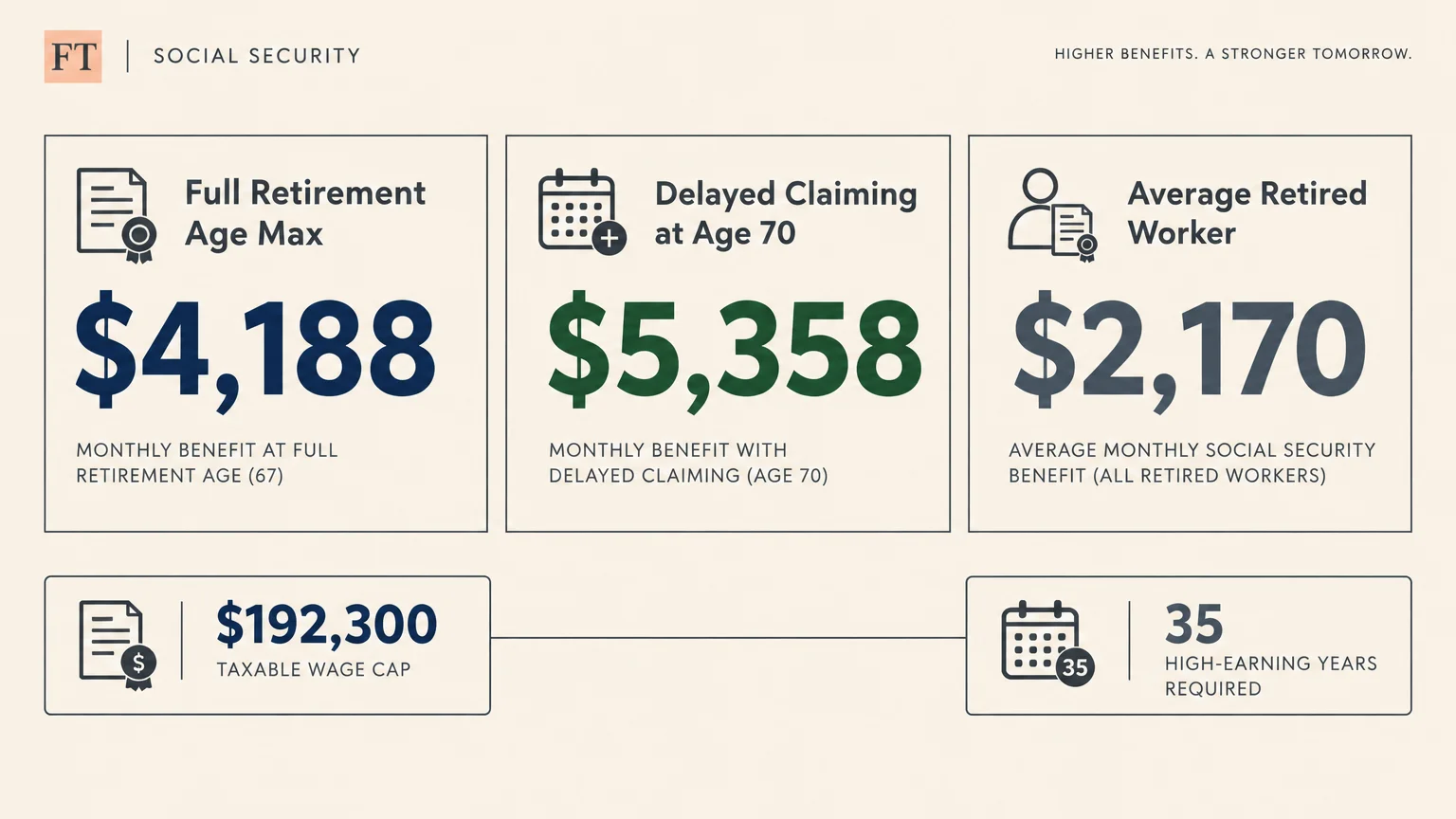
Headline numbers around the 2027 Social Security max often blur together because the agency publishes separate ceilings for different claiming ages. Keep these verified benchmarks in mind as you review your personal benefit statement.
- $4,188 per month at Full Retirement Age: This is the maximum benefit for a top earner who retires at Full Retirement Age in January 2027.
- $5,358 per month at age 70: Delaying benefits past Full Retirement Age unlocks credits that push a 2027 maximum earner’s starting check well above $4,188.
- $2,170 per month on average: Even after a $75 monthly boost in 2027, the typical retired worker receives less than 52% of the Full Retirement Age maximum.
- $192,300 taxable wage cap: Earnings above this 2027 ceiling face no Social Security payroll tax and add nothing to your future check.
- 35 high-earning years: Reaching the top payout requires earning at or above the annual taxable maximum for at least 35 covered working years.
Separating the $4,188 Full Retirement Age figure from the $5,358 age-70 figure prevents costly claiming errors. Your birth year, career earnings path, and filing month all determine where your check lands between zero and the ceiling.
Who Qualifies for the $4,188 Full Retirement Age Benefit
Qualifying for the maximum Social Security benefit in 2027 comes down to two strict mathematical tests. Falling short on either test—even by a single year or a few thousand dollars—drops your payout below $4,188.
First, the Social Security Administration builds your retirement benefit from your 35 highest-earning years of covered work. The agency adjusts your historical wages using the national average wage index so older paychecks reflect modern wage levels.
If you worked fewer than 35 years in jobs covered by Social Security, the agency enters zero for every missing year. Even a couple of zero-income years—for caregiving, school, or early retirement—drag down your 35-year average permanently.
Second, you must earn at or above the annual taxable wage cap in every single one of those 35 years. For a worker retiring at Full Retirement Age in January 2027, SSA assumes maximum taxable earnings every year since age 22.
That career trajectory produces an Average Indexed Monthly Earnings figure of $11,848 for a 2027 Full Retirement Age retiree. Only workers whose indexed 35-year average matches that level qualify for the full $4,188 monthly payment.
The 2027 Taxable Wage Cap and Payroll Tax Math
In 2027, Social Security payroll taxes apply to wages up to $192,300, up $7,800 from the $184,500 cap in 2026. Any salary or bonus you earn above $192,300 in 2027 does not increase your future Social Security check.
Employees pay 6.2% on earnings up to that $192,300 limit, and employers match that 6.2% contribution. That puts the maximum employee Social Security tax at $11,922.60 in 2027, while self-employed workers pay the combined 12.4% rate.
Medicare payroll taxes work differently because they carry no annual wage ceiling. Workers and employers each pay 1.45% on all covered wages, plus an extra 0.9% surtax on earned income above $200,000 single or $250,000 joint.
To qualify for any retirement benefit at all, you still need 40 work credits—roughly 10 years of covered employment. In 2027, you earn one credit for every $1,970 in wages, up from $1,890 in 2026, capped at four credits annually.
How Rare Is a 35-Year Maximum Earnings Record?
Very few Americans ever meet the earnings threshold required for Social Security’s $4,188 check. According to SSA’s Population Profile on Taxable Maximum Earners, roughly 6% of covered workers earn above the taxable cap in any single year.
Fewer than 20% of covered workers are projected to cross that taxable ceiling in even one year of their careers. Sustaining top-tier earnings across 35 separate years without career gaps puts a retiree in a tiny slice of the workforce.
Remember that hitting the wage cap late in your career still helps if those high-earning years replace older, lower-paying jobs. You do not need to reach $4,188 for an extra year of strong wages to raise your retirement income.
How Your Claiming Age Shifts the Top Social Security Check
Your Full Retirement Age depends strictly on the year you were born, and 2027 marks an important milestone. Workers born in 1960 reach Full Retirement Age at exactly age 67 during 2027.
If you were born between 1943 and 1954, your Full Retirement Age is 66. For birth years 1955 through 1959, Full Retirement Age rises in two-month steps from 66 and 2 months up to 66 and 10 months.
Anyone born on January 1 falls under the prior year’s birth cohort under SSA rules. For everyone born in 1960 or later, Full Retirement Age stays at 67.
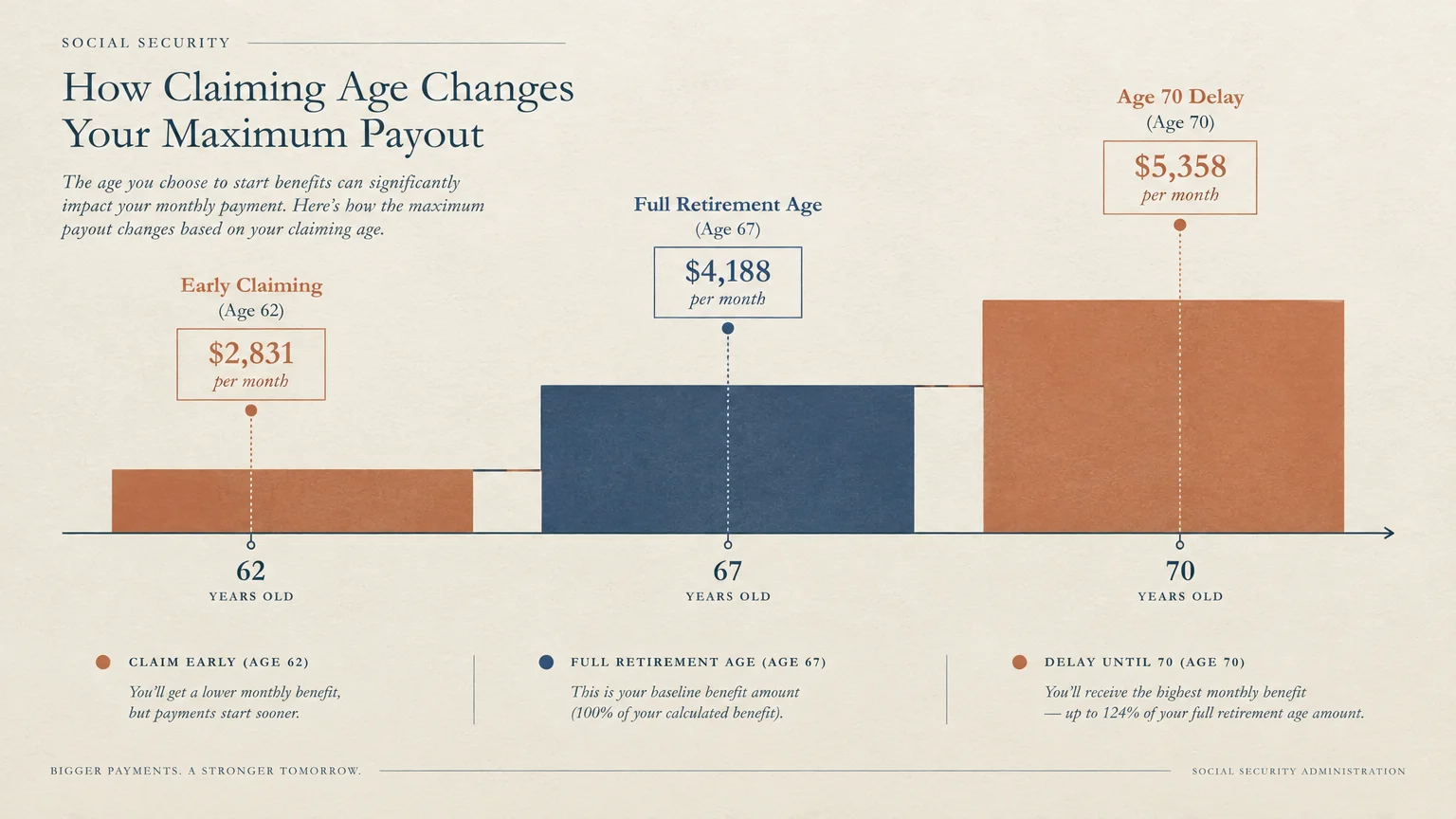
| Claiming Age in January 2027 | 2027 Maximum Monthly Benefit | 2026 Maximum Comparison | Assumed 2027 AIME | How Timing Affects Your Benefit |
|---|---|---|---|---|
| Age 62 (and 1 month) | $3,094 | $2,969 | $14,966 | Permanent 30% worker reduction for FRA 67 |
| Age 65 | $3,666 | Early claiming reduction applies | Varies by birth cohort | Reduced for claiming before FRA |
| Age 66 | $3,883 | Early claiming reduction applies | Varies by birth cohort | Reduced for claiming before FRA 67 |
| Full Retirement Age (67) | $4,188 | $4,152 | $11,848 | 100% of Primary Insurance Amount |
| Age 70 | $5,358 | $5,181 | $11,004 | 24% boost above FRA 67 from delayed credits |
Claiming early at age 62 with a Full Retirement Age of 67 cuts your monthly worker benefit permanently by 30%. Early claiming hits spousal benefits even harder, locking in a permanent 35% reduction at age 62.
Waiting past Full Retirement Age rewards your patience with Delayed Retirement Credits. Your benefit grows by 8% per year—or two-thirds of 1% per month—for every month you delay up to age 70.
For someone with a Full Retirement Age of 67, holding out until age 70 increases the monthly check by 24%.
Notice one subtle detail if you already claimed at age 70 in January 2026. A top earner who started at $5,181 in 2026 receives $5,368 per month in 2027 once the 3.6% cost-of-living adjustment applies.
Delayed Retirement Credits stop completely at age 70, so waiting past your 70th birthday never increases your benefit. Also keep in mind that delayed credits raise your own check and survivor benefits, but they do not enlarge spousal benefits.
Treat the $4,188 headline figure as a planning benchmark rather than a personal target—your claiming age, 35-year earnings record, and tax strategy determine how much money you actually keep each month.
Inside the 2027 Benefit Formula: Bend Points and the 3.6% COLA
Social Security does not replace a flat percentage of your pre-retirement salary. Instead, the formula uses progressive tiers called bend points that replace a larger share of income for lower-wage workers than for high earners.
For workers turning age 62 in 2027, the Primary Insurance Amount formula replaces 90% of the first $1,340 of Average Indexed Monthly Earnings. It then replaces 32% of earnings between $1,340 and $8,077, and 15% of anything above $8,077.
If you reach Full Retirement Age 67 in 2027, your calculation anchors to the year you turned 62, which was 2022. Your base formula used 2022 bend points of $1,024 and $6,172, then compounded through the annual adjustments from 2022 through 2026.
Those five annual adjustments totaled 8.7%, 3.2%, 2.5%, 2.8%, and finally 3.6% for 2027. That compounding explains why people with identical career earnings receive slightly different checks depending on their birth year.
How the 3.6% Adjustment Rolls Out for 2027
On October 14, 2026, SSA announced a 3.6% cost-of-living adjustment for 2027 based on consumer price index increases from third-quarter 2025 through third-quarter 2026. That increase steps up from the 2.8% adjustment applied in 2026.
Roughly 76 million Americans see higher payments because of the 2027 adjustment. Nearly 72 million Social Security beneficiaries receive the higher rate starting in January 2027, while about 7.3 million Supplemental Security Income recipients see it on December 31, 2026.
Here is how the 3.6% adjustment changes typical retirement payouts across the country:
- Average retired worker: Monthly checks climb by $75, moving from roughly $2,095 in 2026 to $2,170 in 2027.
- Average married couple receiving benefits: Combined monthly checks rise by $117, moving from $3,238 to $3,355.
- Online and paper notices: People who set up a my Social Security account and chose paperless notices by November 18, 2026 can read their 2027 letters online in late November, while paper letters mail in December 2026.
Working Before Full Retirement Age: The 2027 Earnings Test
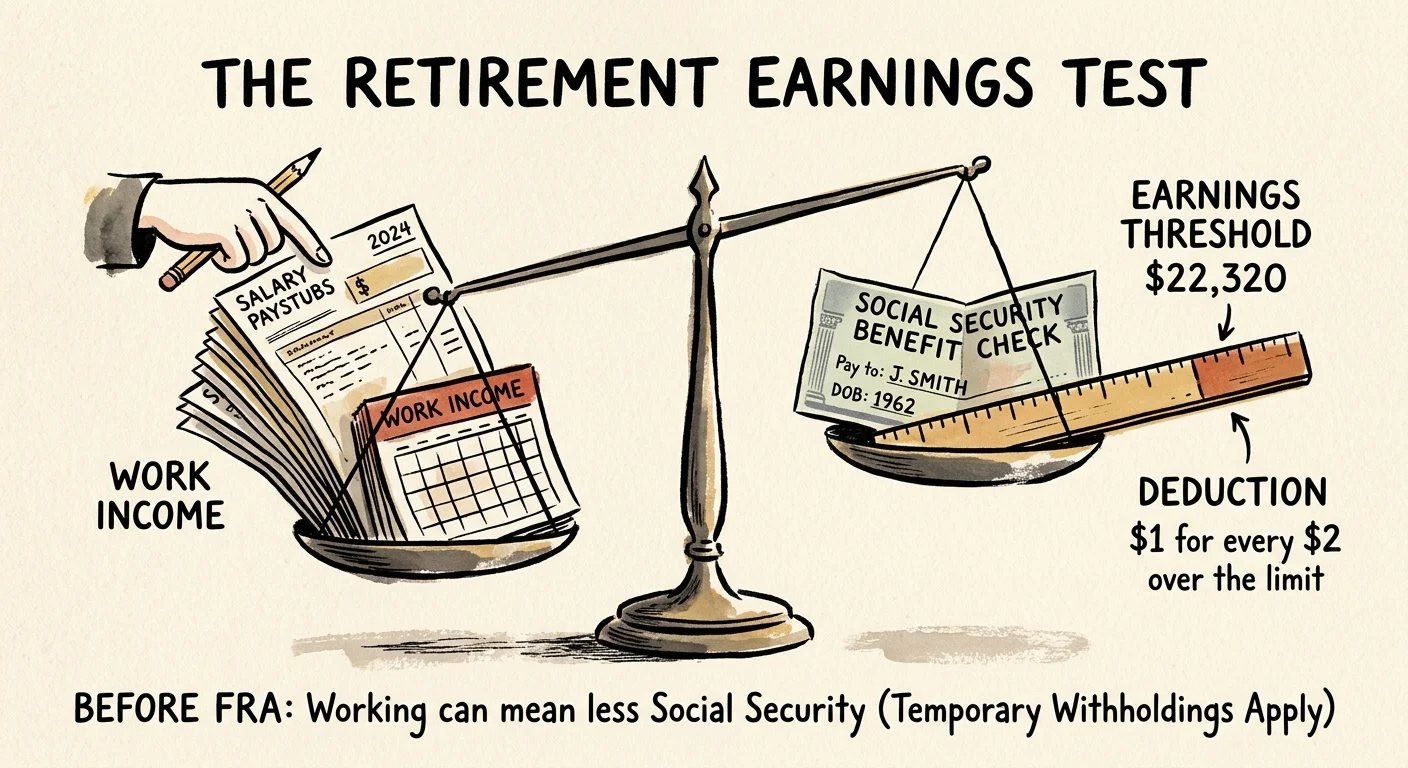
Many high earners keep working past 62 because they enjoy their careers or want to replace earlier lower-paid years. If you claim Social Security before Full Retirement Age while still earning substantial wages, the Retirement Earnings Test temporarily reduces your checks.
In 2027, workers who remain under Full Retirement Age for the entire calendar year face an annual earnings cap of $25,560, or $2,130 per month. That threshold rises from $24,480 in 2026.
If your wages exceed $25,560, SSA withholds $1 in benefits for every $2 you earn above that limit. Someone still earning near the $192,300 wage cap would see their entire early Social Security benefit withheld.
The rules ease during the calendar year you reach Full Retirement Age. In 2027, SSA withholds $1 for every $3 you earn above $67,920, or $5,660 per month, counting only earnings before your Full Retirement Age month.
That mid-year threshold increases from $65,160 in 2026. Once you enter the month you hit Full Retirement Age, the earnings test vanishes completely—you can earn any salary with zero benefit withholding.
Money withheld under the earnings test is not gone forever because SSA recalculates your benefit at Full Retirement Age to credit missed months. Still, most high earners avoid filing early while working full time so they can capture delayed credits instead.
Net Income Reality: Federal Taxes and Medicare Deductions in 2027
Seeing $4,188 on a benefit estimate feels rewarding, yet that gross figure rarely matches your monthly bank deposit. Federal income taxes and Medicare premiums both take predictable slices out of top-tier checks.
A monthly check of $4,188 adds up to $50,256 in gross annual Social Security income. Under federal tax rules, the IRS uses a provisional income formula to decide how much of your benefit becomes taxable.
Provisional income equals your adjusted gross income excluding Social Security, plus any tax-exempt interest, plus half of your annual Social Security benefits. Those statutory thresholds have never been indexed for inflation.
- Single filers: Up to 50% of benefits become taxable once provisional income tops $25,000, and up to 85% becomes taxable above $34,000.
- Married couples filing jointly: Up to 50% becomes taxable above $32,000, and up to 85% becomes taxable above $44,000.
Run the quick math on a $4,188 single recipient with zero outside income. Half of $50,256 equals $25,128, which already crosses the $25,000 single threshold before you add a single dollar from pensions, dividends, or IRA withdrawals.
How 2027 Deductions Cushion the Tax Bite
Crossing the provisional income threshold makes part of your Social Security taxable, but deductions still shield a substantial share of your income. For tax year 2027, the regular federal standard deduction rises to $16,600 for single filers and $33,200 for married couples filing jointly.
Taxpayers age 65 and older also qualify for a newer temporary break active from 2025 through 2028 under the Working Families Tax Cuts legislation. This Enhanced Deduction for Seniors adds up to $6,000 per eligible person—or $12,000 for a couple both 65 or older—on Schedule 1-A.
You can claim that senior deduction alongside either itemized deductions or your standard deduction, including the existing additional standard deduction for age 65 and older. However, the break phases out above $75,000 in modified adjusted gross income for single filers and $150,000 for joint filers.
Be careful not to misread headlines about senior tax relief: the enhanced deduction does not alter the provisional income formula or automatically make Social Security tax-free. Review official guidance at IRS Retirement Plans or speak with a tax preparer before adjusting withholding.
Medicare Part B Deductions and 2027 Rate Projections
Most retirees enrolled in Original Medicare have Part B premiums subtracted automatically from their monthly Social Security deposits. As of mid-November 2026, federal health officials have not yet finalized the official 2027 Part B premium rates.
For comparison, the standard 2026 Part B premium is $202.90 per month with a $283 annual deductible. The 2026 Medicare Trustees Report projects a 2027 standard Part B premium of $209.50 per month and a $292 deductible.
High-income retirees who qualified for Social Security’s $4,188 check frequently owe extra Medicare surcharges known as IRMAA. Any 2027 IRMAA surcharges look back at the modified adjusted gross income reported on your 2025 federal tax return.
Even if you plan to delay Social Security until age 67 or 70, SSA advises enrolling in Medicare at age 65 unless you carry qualifying employer coverage. Check enrollment timelines directly on Medicare.gov so you never trigger lifelong late-enrollment penalties.

Five Practical Steps to Boost Your Social Security Check
You cannot rewrite your twenties or thirties, yet smart moves between ages 55 and 70 still add meaningful monthly dollars to your retirement income. Work through these five steps before submitting your application.
- Audit your complete earnings record: Log into your online SSA account and verify every single year of reported wages against old W-2s or tax returns so missing employer reports do not lower your 35-year average.
- Replace zero or low-wage years: Working two or three additional years in your sixties at a strong salary swaps out lower indexed wages from your youth and lifts your lifetime average.
- Model claiming ages side by side: Plug your current pay expectations into the Social Security Retirement Estimator to compare exact monthly payouts at age 62, Full Retirement Age, and age 70.
- Coordinate spousal and survivor benefits: Have the higher-earning spouse weigh delaying until age 70 because that larger benefit becomes the permanent survivor check if the higher earner passes away first.
- Sequence retirement withdrawals early: Consider tapping IRA balances or completing partial Roth conversions before claiming Social Security so lower required distributions later keep you below higher tax and IRMAA cliffs.
If your spouse also worked a long career, map out both claiming timelines together on a single sheet. Optimizing a household’s combined Social Security cash flow often matters far more than chasing an individual ceiling.
Don’t Make These Mistakes
High-earning pre-retirees often leave thousands of lifetime dollars behind because of a handful of persistent myths. Watch out for these five common errors as you approach your filing window.
- Mistaking $4,188 for the absolute ceiling: Treating the Full Retirement Age maximum as the top possible payment causes people to overlook the $5,358 monthly maximum available by waiting until age 70 in 2027.
- Delaying Medicare at age 65 without qualifying job coverage: Waiting for Social Security at 67 or 70 does not exempt you from Medicare’s initial enrollment window if you have already retired or lack active qualifying employer insurance.
- Assuming your benefit is automatically tax-free: Even with the 2027 standard deduction and the temporary $6,000 senior deduction, retirees with pensions, capital gains, or large IRA distributions still owe federal taxes on up to 85% of benefits.
- Retiring early with 32 or 33 years on record: Leaving the workforce just shy of 35 covered years leaves two or three zeros baked into your formula permanently, even though a part-time role could replace them.
- Claiming spousal benefits at 62 without checking the penalty: Filing for a spousal benefit at age 62 locks in a 35% permanent cut when your Full Retirement Age is 67, and spousal benefits never earn delayed credits past Full Retirement Age.

When Professional Advice Is Worth It
Simple retirement timelines—such as a single worker retiring at Full Retirement Age with straightforward savings—often need little more than SSA’s online calculators. More complex households benefit from targeted guidance before locking in irreversible choices.
Consider consulting a Social Security claiming specialist or fee-only financial planner if you and your spouse have a wide age gap, uneven lifetime earnings, or prior divorces from marriages lasting 10 years or more. A single coordinated filing adjustment frequently adds tens of thousands of dollars in lifetime survivor protection.
High earners approaching the $4,188 threshold should also sit down with a CPA or tax advisor several years before claiming. Modeling how 2025 through 2028 senior deductions interact with Roth conversions and 2025-based IRMAA brackets saves money across both taxes and Medicare premiums.
When sorting out Medicare Part B timing alongside delayed Social Security filing, free unbiased help is available through your state’s State Health Insurance Assistance Program (SHIP). Trained SHIP counselors walk you through enrollment rules and plan comparisons without selling products.
Frequently Asked Questions About the $4,188 Social Security Benefit
Can anyone get more than $4,188 a month from Social Security in 2027?
Yes, retirees who earned the taxable maximum for 35 years and wait until age 70 to claim in January 2027 can receive up to $5,358 per month. Someone who already started at age 70 in January 2026 receives $5,368 per month in 2027 after the 3.6% cost-of-living adjustment.
How much do you have to earn in 2027 to qualify for the maximum Social Security benefit?
In 2027, you must earn at least $192,300 to hit the annual Social Security taxable wage cap. However, hitting the limit in 2027 alone is not enough—you need to match or beat each year’s taxable cap across at least 35 working years.
What is the average Social Security check in 2027 compared to the $4,188 maximum?
After the 3.6% cost-of-living adjustment takes effect in January 2027, the average retired worker’s benefit rises by $75 to roughly $2,170 per month. Average combined benefits for married couples climb by $117 to $3,355 per month, well below the $4,188 individual Full Retirement Age maximum.
Will my $4,188 Social Security check be taxed by the IRS in 2027?
Part of your benefit will likely count toward taxable income if you have other retirement income, because $4,188 per month equals $50,256 per year. Half of that amount ($25,128) already exceeds the $25,000 provisional income threshold for single filers, though standard and senior deductions reduce what you owe.
Take Your Next Step Today
Open your my Social Security account this week to inspect your 35-year earnings history and verify what your personal checks look like at age 62, Full Retirement Age, and age 70. Even if you sit well below $4,188, spotting a missing year or delaying a few extra months can meaningfully raise your guaranteed monthly income.
Information in this article reflects current rules as of the publication date and may change. Always confirm benefit details directly with Social Security Administration, Medicare.gov, or relevant government agencies before making decisions.
Last updated: November 2026. Medicare and Social Security rules change annually—always verify current details at official government sources.