A single missing year on your Social Security earnings record can quietly reduce your monthly retirement check for life. The government calculates your benefit using your highest 35 years of indexed earnings, substituting a zero for any missing year.
That single zero pulls down your lifetime earnings average and directly shrinks your monthly payout. Discovering and fixing these reporting mistakes before you claim ensures you receive every dollar you earned.
Reviewing your statement takes only minutes, but waiting too long can make past wages difficult to restore. Here is how missing earnings happen and the exact steps to protect your check.

How the 35-Year Benefit Formula Treats Missing Wages
The Social Security Administration bases your retirement benefit on your 35 highest-earning years, adjusted for wage growth. If you have only 34 recorded years, the agency inserts a zero for that final missing year.
That zero gets factored into your Average Indexed Monthly Earnings alongside your best working years. Over decades of retirement, a single uncounted year can cost you thousands of dollars in permanent monthly income.
For workers reaching age 62 in 2026, the primary benefit calculation applies bend points of $1,286 and $7,749. Those formula thresholds rise to $1,340 and $8,077 for individuals reaching age 62 in 2027.
Any artificially low earnings average drags down your base payment before annual cost-of-living adjustments ever apply.
The $2.4 Trillion Wage Black Hole: Why Earnings Disappear
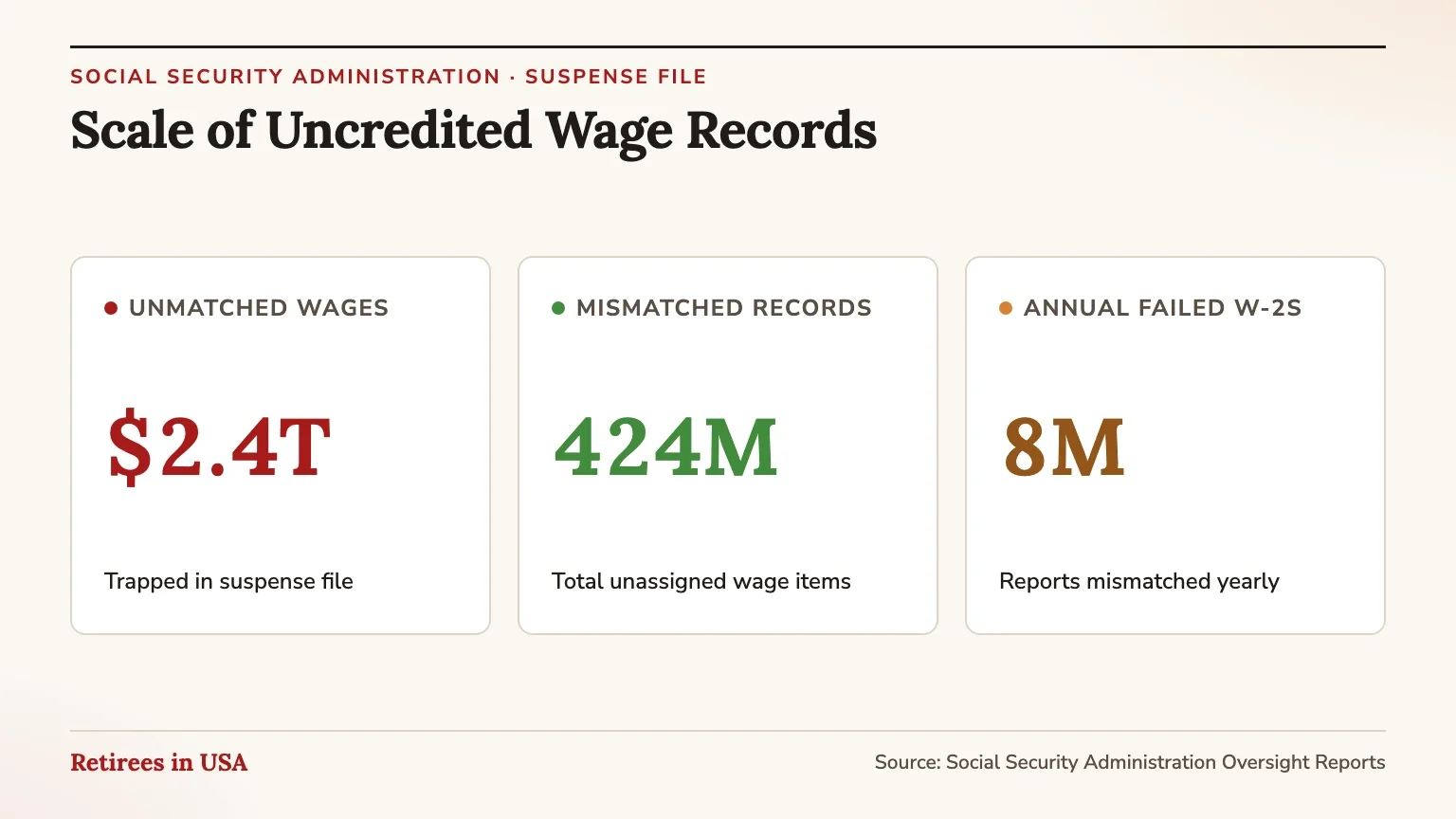
Wage errors happen far more frequently than most workers realize. According to agency oversight reports, the SSA Earnings Suspense File holds over $2.4 trillion in unmatched wages across more than 424 million wage items.
Roughly 8 million W-2 reports fail to match government records each year. When an employer mistypes your Social Security number or misspells your legal name, your earnings land in this electronic holding pen.
Name changes after marriage or divorce cause many of these reporting mismatches. If an employer submits earnings under a surname that differs from your Social Security card, your file receives no credit.
Clerical errors by outside payroll processors also misplace millions of dollars in wages every year. A single misplaced digit in an Employer Identification Number can leave your earnings record completely blank.
Key Benchmarks for Your Earnings Statement
Not every dollar you make counts toward your monthly retirement calculation. Earnings above the annual taxable maximum do not count as covered wages and will not appear on your earnings statement.
| Benchmark Category | 2026 Standard | 2027 Standard |
|---|---|---|
| Maximum Taxable Earnings Cap | $184,500 | $192,300 |
| Earnings Required per Work Credit | $1,890 | $1,970 |
| Average Monthly Retired-Worker Benefit | $2,095 | $2,170 |
| Maximum Monthly Benefit at Full Retirement Age | $4,152 | $4,188 |
| Annual Cost-of-Living Adjustment (COLA) | 2.5% | 3.6% |
Knowing these annual limits helps you distinguish between legitimate wage caps and actual reporting errors on your statement.
When and How to Verify Your Earnings Record
You should inspect your earnings statement at ssa.gov at least once every calendar year. The agency recommends reviewing your record each August to confirm that your employer accurately posted prior-year wages.
Effective June 7, 2025, the agency retired legacy usernames and passwords. You must now access your personal my Social Security account using Login.gov or ID.me credentials with multi-factor authentication.
The SSA only mails automatic paper statements to workers aged 60 and older who do not have an online account. These statements arrive approximately three months before your birthday.
Workers under age 60 who prefer physical mailings must submit Form SSA-7004 to request a paper statement.

Step-by-Step: Correcting Errors and the 3-Year Deadline
Federal law imposes a strict statutory timeline to dispute mistakes on your record. Under Section 205(c) of the Social Security Act, you generally have 3 years, 3 months, and 15 days from the earnings year to correct discrepancies.
Crucial exceptions apply if you have concrete proof of your income. The agency will accept corrections beyond the statutory window when supported by forms such as a W-2, W-2c, or signed tax return.
- Review your statement: Locate unrecorded years or zero-dollar entries in your my Social Security wage table.
- Gather proof: Collect relevant W-2 forms, pay stubs, or IRS tax returns showing covered wages and withholdings.
- Submit Form SSA-7008: File a Request for Correction of Earnings Record online or through your local Social Security office.
- Request missing W-2 records: If past employer forms are lost, submit Form SSA-7050 to retrieve wage records dating back to 1978.
Once the agency approves your correction, its Automatic Earnings Reappraisal Operation processes the change. This automated system runs twice each year, typically in spring and fall, to recalculate affected benefits.
“The goal of retirement is to live off your assets—not live off your regrets.”
Common Retirement Traps
Postponing your earnings record review until you file for retirement can cause lengthy processing delays. Tracking down payroll documentation from past decades becomes harder with each passing year.
Discarding old tax returns prematurely is another critical mistake. Always store physical or electronic copies of all W-2s until you formally claim your retirement benefits.
Do not confuse regular wage updates with government database maintenance. The agency’s October 2026 administrative update resolved citizenship and death records, not individual wage histories.
Frequently Asked Questions
What if my former employer went out of business?
You can still correct your record without your former employer. Provide old W-2s, pay stubs, or request your past wage history directly from the agency using Form SSA-7050.
Can missing wages be corrected if I am already receiving benefits?
Yes, you can request an earnings correction even after claiming retirement payments. When validated earnings raise your top 35-year average, the agency automatically adjusts your ongoing monthly check and pays back benefits.
Why do my recent earnings not show on my statement yet?
Employer wage filings take several months to process through the tax system. Check your online earnings statement in August to confirm your earnings from the previous calendar year.
Securing Your Earned Benefit
Take control of your future monthly check by verifying your wage history today. Correcting an erroneous zero now guarantees you receive the full income you spent decades earning.
For additional retirement tools and guidance, review resources provided by the Consumer Financial Protection Bureau.
Retirement rules and benefit amounts vary based on individual work history, income, and circumstances. This article provides general guidance only.
Consult a SHIP counselor, financial advisor, or elder law attorney for advice specific to your situation.
Last updated: November 2026. Medicare and Social Security rules change annually—always verify current details at official government sources.