Americans reaching age 65 in 2024 can expect another 19.7 years of life on average, bringing total life expectancy to 84.7. Yet where you spend those decades strongly influences both how long you live and how well you age.
Official state life tables reveal a 3.9-year gap in remaining life expectancy at age 65 between top-performing and bottom-ranking states. That difference shapes everything from your healthcare budget to your Social Security claiming strategy.
Examining the states where retirees live longest—alongside senior health rankings and Medicare care quality—gives you practical benchmarks. You can use this data to evaluate a retirement move or strengthen your plans right where you live.
What National Longevity Data Means for Your Retirement
Planning a retirement budget starts with knowing how long your savings may need to last. According to the CDC/NCHS United States Life Tables, 2024, overall U.S. life expectancy at birth reached a record 79.0 years in 2024, up 0.6 year from 78.4 in 2023.
That national gain reflects encouraging health trends across the country. Age-adjusted U.S. death rates fell 3.8% from 2023 to 2024, while COVID-19 deaths dropped 37.1% and age-adjusted overdose deaths declined 26.2%, per CDC/NCHS.
Even with that progress, heart disease, cancer, and unintentional injuries remained the top three leading causes of death in 2024. Suicide moved into the tenth spot as COVID-19 dropped out of the top ten.
For anyone approaching retirement, life expectancy at birth tells only part of the story. Once you survive to age 65, your statistical odds shift dramatically upward.
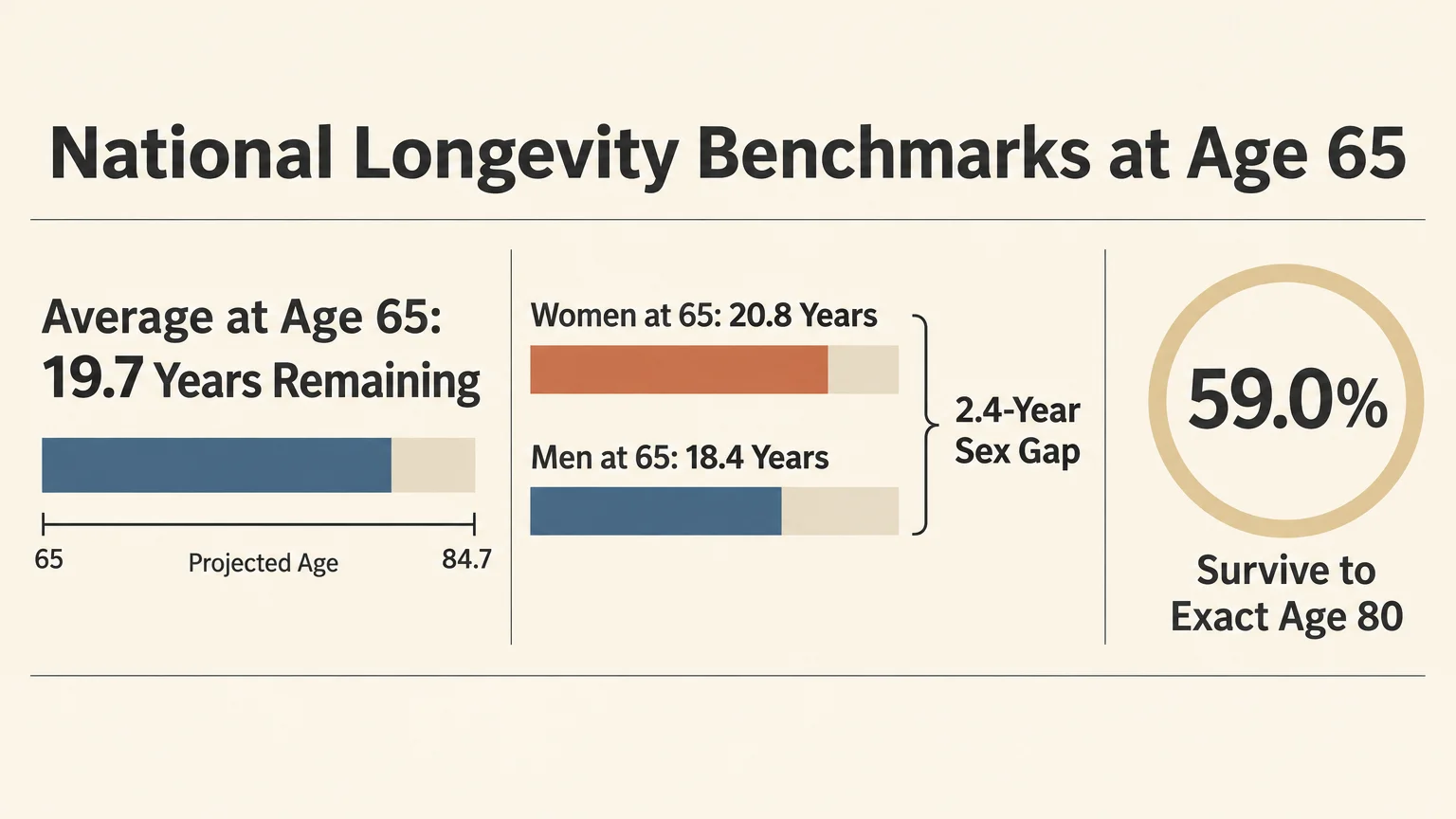
CDC/NCHS figures show that Americans who reached 65 in 2024 have an average remaining life expectancy of 19.7 years, up 0.2 year from 2023. Based on 2024 mortality rates, 59.0% of a U.S. birth cohort survives to exact age 80.
Gender continues to play a major role in retirement planning horizons. In 2024, life expectancy at birth stood at 81.4 years for women versus 76.5 years for men—a 4.9-year sex gap.
At age 65, that gap narrows to 2.4 years, with women averaging 20.8 remaining years and men averaging 18.4 years. Married couples especially need to plan around the likelihood that one spouse will live well into their late eighties or beyond.
States Where Retirees Live the Longest at Age 65
National averages smooth over wide regional differences in retirement longevity. The CDC/NCHS 2022 U.S. State Life Tables—published in December 2025 as the latest complete official state-by-state figures—show how dramatically location shapes life expectancy by state.
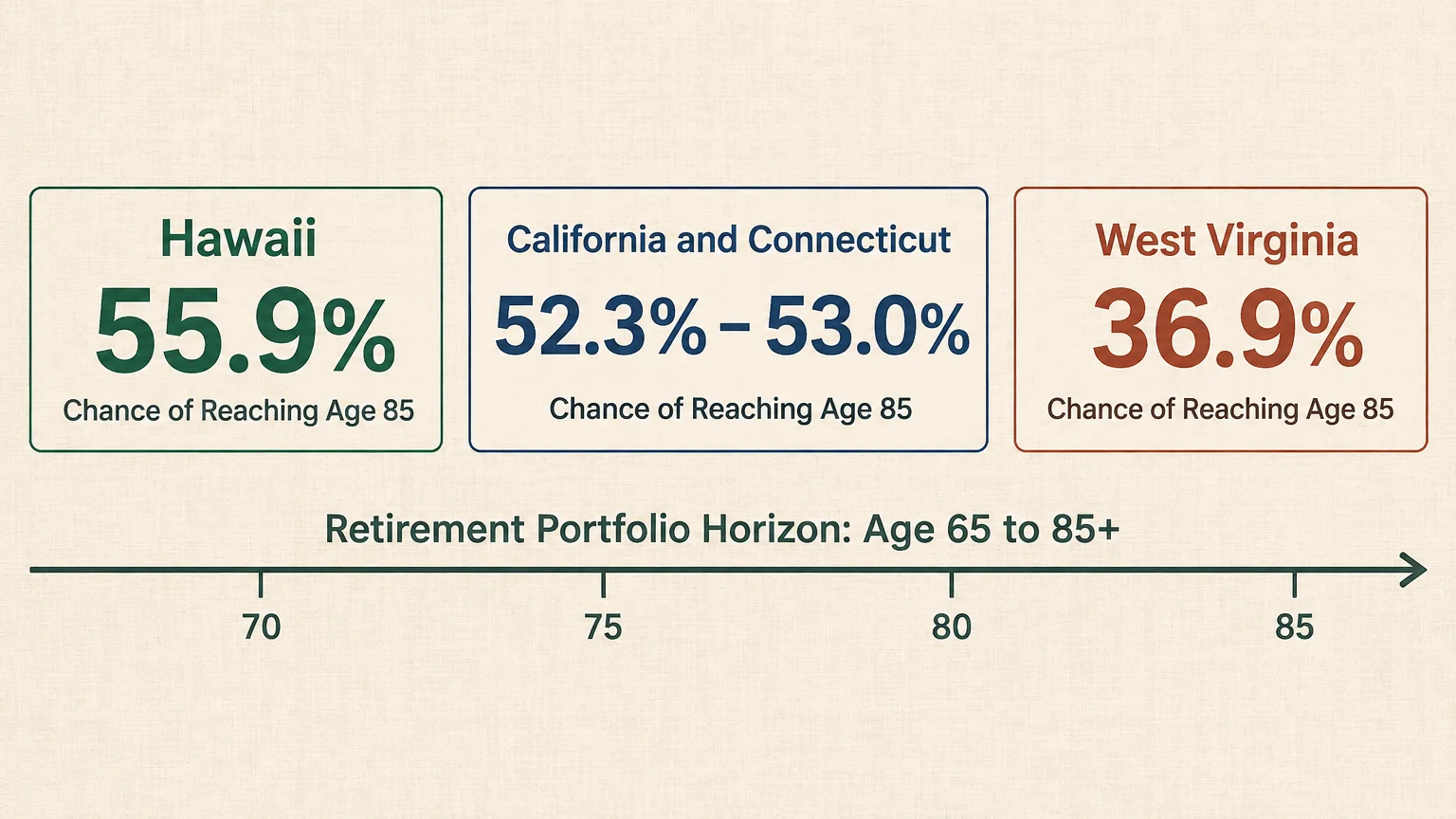
Against a 2022 national average of 18.9 remaining years at age 65, Hawaii led the nation at 20.5 years. Women turning 65 in Hawaii averaged 22.1 more years, men averaged 18.8 more years, and 55.9% of 65-year-olds there are projected to reach age 85.
Several Northeastern, Upper Midwestern, and Western states clustered closely behind Hawaii at age 65:
- 1. Hawaii: 20.5 years remaining at age 65
- 2 (tie). Connecticut and New York: 19.8 years (with a 53.0% and 52.5% chance of reaching 85, respectively)
- 4 (tie). Massachusetts and California: 19.7 years (California gives 65-year-olds a 52.3% chance of reaching 85)
- 6 (tie). Minnesota and New Jersey: 19.6 years
- 8 (tie). North Dakota and Vermont: 19.5 years
- 10 (tie). Colorado, Florida, Rhode Island, and South Dakota: 19.4 years
At the opposite end of the spectrum, Southern and Appalachian states posted the shortest remaining life expectancy at 65. West Virginia ranked lowest at 16.6 years—a 3.9-year gap behind Hawaii—with only a 36.9% chance of reaching 85.
Mississippi followed closely at 16.7 years remaining at age 65 and recorded the lowest figure for men at 15.3 years. Kentucky and Oklahoma tied at 16.8 years, while Arkansas ranked fifth lowest at 17.0 years.
Life expectancy at birth in 2022 followed a similar geographic pattern against the 77.5-year U.S. average. Hawaii again ranked first at 80.0 years, followed by Massachusetts (79.8), New Jersey (79.6), New York (79.5), and Connecticut (79.4).
California and Minnesota tied at 79.3 years, while Rhode Island (79.2), Utah (79.0), and New Hampshire (78.7) rounded out the top ten at birth. West Virginia ranked last at 72.2 years—a 7.8-year gap behind Hawaii—followed by Mississippi (72.6) and Kentucky (73.6).
Women outlived men at birth in every state and Washington, D.C., though the size of that gap varied by region. Utah posted the smallest gender gap at 3.6 years, while New Mexico had the largest at 6.9 years.
| State | Remaining Years at Age 65 (2022) | Life Expectancy at Birth (2022) | 2026 Senior Health Rank | Medicare Performance Rank |
|---|---|---|---|---|
| Hawaii | 20.5 years (#1) | 80.0 years (#1) | #10 | — |
| Connecticut | 19.8 years (tie #2) | 79.4 years (#5) | #8 | — |
| New York | 19.8 years (tie #2) | 79.5 years (#4) | — | — |
| Massachusetts | 19.7 years (tie #4) | 79.8 years (#2) | #6 | — |
| California | 19.7 years (tie #4) | 79.3 years (tie #6) | — | — |
| Minnesota | 19.6 years (tie #6) | 79.3 years (tie #6) | #4 | #3 |
| Vermont | 19.5 years (tie #8) | — | #1 | #1 |
| Colorado | 19.4 years (tie #10) | — | #5 | #5 |
| Florida | 19.4 years (tie #10) | — | — | #40 |
| West Virginia | 16.6 years (#50) | 72.2 years (#50) | #46 | — |
Notice how consistently states like Minnesota, Vermont, Colorado, Connecticut, and Massachusetts appear across multiple measures. Checking all three yardsticks—longevity, senior wellness, and Medicare quality—gives a far clearer picture than looking at raw lifespan alone.

Healthiest States for Older Adults vs. Raw Life Expectancy
Living longer only feels rewarding if you stay active, independent, and well-supported. That is why evaluating the healthiest states for retirees adds vital context beyond mortality tables.
The United Health Foundation’s America’s Health Rankings 2026 Senior Report, published in May 2026 across 56 measures and 25 data sources, ranked Vermont number one for adults 65 and older for the second consecutive year.
Utah claimed second place, followed by New Hampshire, Minnesota, Colorado, Massachusetts, Washington, Connecticut, Maryland, and Hawaii. At the bottom of the rankings sat Louisiana (#50), Mississippi (#49), Kentucky (#48), Arkansas (#47), and West Virginia (#46).
Recent national shifts highlighted in the 2026 Senior Report show encouraging momentum in preventive health. Between 2023 and 2024, early deaths among adults aged 65 to 74 fell 2%, while physical inactivity among seniors in fair or better health dropped 16%.
Supportive medical capacity is also expanding modestly. The home health workforce grew 5%, and geriatric clinicians reached 41.5 per 100,000 adults aged 65 and older as of September 2025.
Still, the report flags two troubling trends that retirees and families should watch closely. Drug-related deaths among older adults surged 38% between 2019–2021 and 2022–2024, underscoring the need for careful prescription management.
Food insecurity among adults 60 and older also climbed 6% from 2022 to 2023, reaching 7.4 million older Americans. Rising grocery prices make nutrition planning an essential part of healthy aging.
Demographic shifts also affect local senior services when you pick among the best states to retire. U.S. Census Bureau Vintage 2025 estimates show that 18.9% of all Americans were 65 or older in 2025.
Maine recorded the oldest population with a median age of 44.9 and 24.6% of residents aged 65 and up, followed by Vermont (median age 44.4; 24.1% age 65+) and New Hampshire (44.1; 23.0%). Meanwhile, Hawaii led the nation in residents aged 85 and older at 3.0%.
States with large shares of older adults often develop strong community aging networks and senior centers. At the same time, high senior populations can strain local caregiver supply and clinic wait times.
Where Retirees Get the Best Medicare Performance
High-quality medical access often bridges the gap between average longevity and thriving late in life. The Commonwealth Fund’s State Scorecard on Medicare Performance, released in October 2025 across 31 indicators of access, quality, affordability, and population health, reveals stark state divides.
Vermont ranked first overall for Medicare performance, followed by Utah (#2), Minnesota (#3), Rhode Island (#4), and Colorado (#5). Louisiana, Mississippi, Kentucky, Oklahoma, and Arkansas ranked lowest—mirroring the bottom tier of life expectancy.
Florida offers a striking cautionary example for anyone researching where to retire. Although Florida tied for tenth in life expectancy at age 65 (19.4 years), it ranked 40th overall in Medicare performance and 47th for care quality.
That split likely reflects selective migration, since healthier and wealthier retirees often relocate to Florida in their sixties. Once serious health needs arise in their eighties, however, regional care quality and coordination gaps become much more visible.
Another surprising pattern emerged in the Commonwealth Fund analysis. States with the lowest age-65 life expectancy often had the highest traditional Medicare spending per beneficiary.
High spending frequently signals reactive hospital care and poorly managed chronic disease rather than better outcomes. Before relocating, compare local hospital ratings and plan choices using the official Medicare Plan Finder.
How Retirement Longevity Changes Your Financial Plan
Adding extra years to your life is wonderful news, yet every additional year requires reliable income and healthcare funding. A financial plan built for a 15-year retirement can crack under a 25-year lifespan.
Healthcare premiums and deductibles keep edging upward. CMS announced in November 2026 that the standard monthly Medicare Part B premium will rise 3.2% from $202.90 in 2026 to $209.40 in 2027.
The annual Part B deductible will increase from $283 to $292 in 2027. Roughly 9% of enrollees with modified adjusted gross income above $112,000 (single) or $224,000 (joint) will pay IRMAA-adjusted Part B premiums reaching up to $711.80 per month.
Inpatient recovery costs are climbing as well. Under Medicare Part A, skilled nursing facility coinsurance for days 21 through 100 after a qualifying three-day hospital stay rises from $217 per day in 2026 to $222 per day in 2027.
Social Security benefits help anchor lifelong cash flow, especially when you live into your late eighties. Full Retirement Age is 67 for everyone born in 1960 or later, and claiming early at 62 permanently cuts monthly checks by 30%.
Annual inflation adjustments help preserve purchasing power over long retirements. In October 2026, the Social Security Administration announced a 3.6% cost-of-living adjustment (COLA) for 2027—up from 2.8% in 2026—adding about $75 per month to the average retired worker’s benefit starting January 2027.
That adjustment lifts the average monthly benefit from roughly $2,095 to about $2,170. Still, the 2026 Social Security Trustees Report projects Old-Age and Survivors Insurance (OASI) trust fund depletion in the fourth quarter of 2032, when ongoing revenue would cover 78% of scheduled benefits.
You can model different claiming ages against your expected lifespan using the Social Security Retirement Estimator. Delaying benefits often pays off handsomely if you enjoy good health or live in a high-longevity state.
Planning for longevity means building a retirement budget that supports your health, independence, and care needs well into your eighties and nineties—not just the first decade after you stop working.
Long-term care represents the single largest blind spot in many longevity plans. Original Medicare pays $0 for ongoing custodial care or assisted living room and board.
Yet the U.S. Administration for Community Living estimates that nearly 70% of 65-year-olds will eventually need long-term care, averaging 3.7 years for women and 2.2 years for men.
The CareScout 2025 Cost of Care Survey, released in March 2026, highlights how steep those bills have grown. National median costs reached $74,400 per year for assisted living and $10,798 per month for a private nursing home room.
Hiring a non-medical home caregiver carries a national median rate of $35 per hour, totaling $80,080 annually at 44 hours per week. Exploring local aging services early through the federal Eldercare Locator helps you understand community support options before a crisis strikes.
Practical Steps to Add Healthy Years Wherever You Live
You do not need to buy a plane ticket to Hawaii or move to Vermont to improve your retirement longevity. Daily habits and preventive medical care drive a huge share of your personal odds regardless of your state.
Here are concrete, verified steps you can put into practice this month:
- Meet weekly aerobic targets: CDC and HHS Physical Activity Guidelines for Americans recommend at least 150 minutes per week of moderate-intensity aerobic movement—such as 30 minutes of brisk walking five days a week—or 75 minutes of vigorous activity.
- Build muscle twice a week: Add muscle-strengthening exercises targeting all major muscle groups on at least two days each week to protect mobility and bone density.
- Train your balance regularly: Practice standing on one foot, heel-to-toe walking, or tai chi to lower fall risks as you age.
- Schedule your $0 Medicare Annual Wellness Visit: Original Medicare covers a yearly wellness visit at $0 out-of-pocket with no deductible, along with recommended cancer screenings and flu, pneumonia, and COVID vaccines.
- Review every medication annually: Bring all prescriptions and over-the-counter supplements to your doctor or pharmacist to prevent dangerous interactions, especially given the 38% rise in senior drug-related deaths.
Keep one important Medicare billing rule in mind when booking your checkup. Routine physical exams are excluded from Medicare coverage by statute, so specifically ask for your covered Annual Wellness Visit when scheduling.
For science-backed guides on nutrition, sleep, cognitive health, and staying active after 60, explore resources from the National Institute on Aging. Pairing consistent daily movement with reliable preventive visits works in every zip code.

Costly Mistakes to Avoid
Relocating or budgeting without factoring in longevity data can lock you into expensive traps. Watch out for these common errors as you map out your next decade.
Choosing a State Solely for Sunshine or Low Taxes
Warm winters and zero state income tax look appealing on paper at age 63. Yet if your new county lacks primary care doctors, geriatric clinicians, or strong home health staffing, managing chronic conditions at 83 becomes stressful and expensive.
Compare state senior health rankings and Medicare care quality scores before buying a home. A modest tax savings disappears fast if you must travel hours for specialists or pay premium rates for scarce local caregivers.
Claiming Social Security Early Without Checking Spousal Longevity
Taking Social Security at 62 looks tempting when you want immediate cash flow. However, accepting a permanent 30% reduction shrinks not only your own check at age 85, but also the survivor benefit your spouse may rely on later.
Look at both spouses’ family health history and state longevity benchmarks before locking in an early claim. Often, having the higher earner wait until Full Retirement Age or 70 provides valuable longevity insurance.
Assuming Medicare Covers Assisted Living or Home Help
Many retirees assume Medicare will step in once daily bathing, dressing, or memory care becomes necessary. Relying on that myth leaves families scrambling when $74,400 annual assisted living bills or $35 hourly caregiver fees arrive.
Separate medical coverage from custodial long-term care inside your written retirement plan. Review dedicated savings, home equity, long-term care insurance, or family support arrangements while you are still healthy.
Moving Far From Support Networks Late in Retirement
Relocating across the country at 78 can leave you isolated just when driving becomes harder or health declines. Rebuilding trusted friendships, finding reliable doctors, and hiring vetted home helpers takes energy.
If you plan to move to a high-longevity state, aim to settle in early while you can easily build community ties. Otherwise, prioritize proximity to adult children or dependable friends over state rankings.
Don’t DIY These Decisions
Relocating across state lines or planning for a 25-year retirement triggers interconnected Medicare, tax, and legal rules. Getting unbiased professional guidance early prevents expensive mistakes.
Work with a free, trained counselor through your local State Health Insurance Assistance Program (SHIP) whenever you compare Medicare Advantage networks or Medigap rules in a new state. Moving out of a plan’s service area triggers special enrollment rights that have strict deadlines.
Consult a fee-only financial advisor when coordinating Social Security claiming ages, portfolio withdrawals, and tax brackets. Proper income planning can help you avoid crossing IRMAA thresholds that push Part B premiums up toward $711.80 per month.
Hire an elder law attorney licensed in your state of residence before finalizing estate plans or long-term care strategies. Medicaid long-term care eligibility rules, probate procedures, and power-of-attorney laws vary sharply from state to state.
Frequently Asked Questions About Retirement Longevity by State
Which state has the longest life expectancy for retirees at age 65?
Hawaii ranks first in the CDC/NCHS 2022 state life tables, giving 65-year-olds an average of 20.5 remaining years—22.1 for women and 18.8 for men. About 55.9% of 65-year-olds in Hawaii are projected to reach age 85.
Do you automatically live longer if you move to a top-ranked state?
Moving to states like Hawaii, Vermont, or Minnesota does not guarantee extra years on its own, though strong healthcare access and active local cultures help. Your personal habits—especially 150 weekly minutes of exercise and preventive medical care—remain powerful drivers anywhere.
Why does Florida rank high for longevity at 65 yet low for Medicare quality?
Florida tied for tenth in remaining life expectancy at 65 (19.4 years), partly because relatively healthy, financially stable retirees move there. Even so, the Commonwealth Fund ranked Florida 40th overall and 47th for care quality in its Medicare scorecard.
How many years should I plan for if I retire at age 65?
Americans turning 65 in 2024 average 19.7 additional years—20.8 for women and 18.4 for men—while top states exceed 20 years. Because averages leave half of retirees living even longer, budgeting for 25 to 30 years provides a safer cushion.

Your Next Step Toward a Longer, Healthier Retirement
Longevity data works best when you turn statistics into action. This week, look up your state’s Medicare plans, run your personal Social Security estimates, and put your $0 Annual Wellness Visit on the calendar.
Retirement rules and benefit amounts vary based on individual work history, income, and circumstances. This article provides general guidance only. Consult a SHIP counselor, financial advisor, or elder law attorney for advice specific to your situation.
Last updated: November 2026. Medicare and Social Security rules change annually—always verify current details at official government sources.