Over a long career, it is easy to lose track of an old utility deposit, a small 401(k), or a paper savings bond tucked in a drawer. Across the United States, billions of dollars in unclaimed property sit waiting for rightful owners and their families.
Finding missing money does not require paying a private locator or buying special software. Official state and federal databases let you search your own name—and the names of aging or deceased parents—completely free.
Knowing exactly where to check saves hours of guesswork. Below are the eight primary places where forgotten retirement funds, refunds, and payouts actually live.
Key Takeaways
No single national database holds every dollar you might be owed. Running a thorough unclaimed money search means checking state treasuries alongside separate federal and industry portals.
- Start with state portals: Roughly 1 in 7 Americans has unclaimed cash or property, and states hold an estimated $70 billion indefinitely at no cost to claim.
- Check retirement accounts separately: Old 401(k)s and terminated pensions live on federal Department of Labor and Pension Benefit Guaranty Corporation databases rather than state websites.
- Watch hard federal deadlines: While state funds never expire, IRS tax refunds and Department of Labor back wages carry strict three-year claiming windows.
- Never pay to search: Official government and state searches are always free, and urgent texts demanding upfront processing fees are scams.
1. State Unclaimed Property Offices
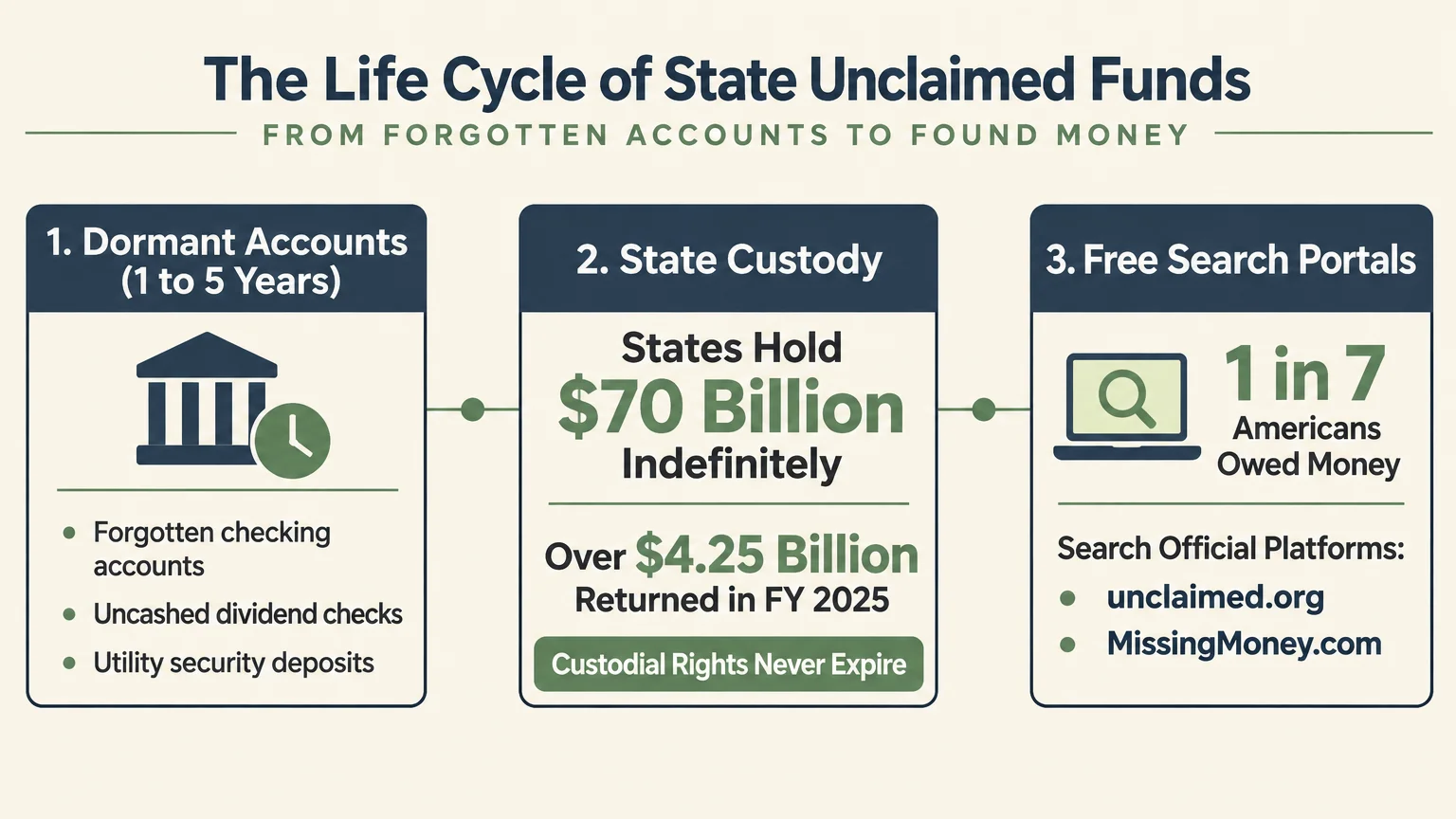
Your first stop should be the state treasury unclaimed funds office in every state where you or your parents have lived. Banks, insurers, utilities, and former employers turn over dormant accounts after an inactivity period of one year or longer—typically three to five years.
According to the National Association of Unclaimed Property Administrators (NAUPA), roughly 1 in 7 Americans has money waiting. State programs returned over $5 billion in fiscal year 2023, over $4.49 billion in fiscal year 2024, and $4.25 billion across 49 reporting offices in fiscal year 2025.
Common items held by states include forgotten checking accounts, uncashed dividend checks, utility security deposits, insurance overpayments, and contents from abandoned safe deposit boxes. States act as custodians indefinitely, meaning your legal right—or an heir’s right—to claim the money never expires.
Keep in mind that most states pay zero interest on returned funds, so claiming sooner puts that cash back to work for you. Start at unclaimed.org, which links directly to official portals in all 50 states, Washington, D.C., and Puerto Rico.
You can also search multiple states at once using NAUPA’s free MissingMoney.com database. Because Hawaii does not participate in MissingMoney.com, check Hawaii’s state portal directly if you ever lived, worked, or held an account there.

2. Forgotten 401(k)s and Terminated Pensions
Job changes are one of the biggest sources of lost retirement savings. A 2023 Department of Labor (DOL) report found that younger Baby Boomers born between 1957 and 1964 held an average of 12.7 jobs between ages 18 and 56.
When companies merge, rebrand, or close, former employees often lose touch with old plan administrators. A September 2025 estimate by Capitalize and Boston College’s Center for Retirement Research put forgotten 401(k)s at 31.9 million accounts holding about $2.1 trillion, averaging $66,691 per account.
To help workers find lost money, the SECURE 2.0 Act of 2022 required the government to build a central tool. On December 27, 2024, the DOL’s Employee Benefits Security Administration launched the Retirement Savings Lost and Found Database at lostandfound.dol.gov.
Searching this database requires an identity-verified Login.gov account using a driver’s license photo, Social Security number, date of birth, and mobile device. It covers private-sector and union 401(k)s and pensions, though it excludes Social Security, government plans, and certain religious employer plans.
Since 2017, DOL enforcement has recovered more than $7 billion in retirement benefits for missing participants. For additional guidance on tracking down old workplace accounts, review the retirement plan resources on the IRS Retirement Plans portal.
If an employer went out of business and terminated its pension, check a second federal agency: the Pension Benefit Guaranty Corporation (PBGC) at pbgc.gov. PBGC’s Missing Participants Program holds unclaimed benefits from terminated private-sector defined-benefit pensions and, since 2018, certain terminated 401(k) plans.
Per PBGC’s audited fiscal year 2025 Annual Report, the program held $519 million in liabilities for 58,000 participants as of September 30, 2025. You can search by last name and the last four digits of your Social Security number; PBGC updates the list quarterly.

3. Unclaimed Life Insurance Policies and Annuities
Life insurance payouts frequently go unclaimed when policyholders pass away without telling heirs which insurer issued the policy. If an adult child does not know where to look, millions in death benefits and annuity contracts can sit untouched.
The National Association of Insurance Commissioners (NAIC) operates a free Life Insurance Policy Locator at naic.org under Consumer Tools. As of July 31, 2026, the tool had matched beneficiaries with roughly $16.99 billion across more than 780,000 matches since its November 2016 launch.
Unlike an open search engine, the NAIC locator is an encrypted request portal. Participating insurers check your submission against their records and contact verified beneficiaries directly—usually within 90 days—while making no contact if no policy match exists.
If an insurer cannot locate beneficiaries after a policy matures, those proceeds eventually escheat to state unclaimed property offices. That transfer typically happens after three years in most states, two years in Florida and Virginia, and five years in Georgia and South Carolina.
Veterans and their families should also check a separate federal database for older military policies. The U.S. Department of Veterans Affairs maintains a free Unclaimed Insurance Funds search covering legacy programs such as USGLI, NSLI, and VSLI.

4. Matured Paper U.S. Savings Bonds
For decades, grandparents, parents, and payroll savings plans handed out paper U.S. savings bonds for birthdays and graduations. Many of those certificates ended up in lockboxes, books, or filing cabinets and were simply forgotten.
According to the U.S. Treasury’s Monthly Statement of the Public Debt and matured unredeemed debt records, 102,886,481 paper savings bonds and notes worth $34.73 billion had reached final maturity without being cashed as of late summer 2026. Series EE and Series I bonds stop earning interest after 30 years.
Older Series E bonds stopped earning interest after 40 years if issued before December 1965, or 30 years if issued later. Even after interest stops, savings bonds never expire and have no redemption deadline.
Note a major recent tool change: TreasuryDirect retired its online Treasury Hunt lookup service on September 30, 2025, so it is no longer available. If you hold paper bonds, use TreasuryDirect’s free Savings Bond Calculator to verify their current value and maturity date.
You can cash valid paper bonds at a participating local bank or mail them to TreasuryDirect using FS Form 1522, which requires a certified signature for totals above $1,000. If you have bond records or know a deceased parent owned bonds that went missing, file FS Form 1048 with a certified death certificate to claim lost, stolen, or destroyed bonds.
5. Unclaimed Federal Tax Refunds and Undelivered Checks
Many retirees stop filing federal tax returns once their income drops below standard thresholds. However, skipping a return when taxes were withheld from part-time wages, pension distributions, or estimated payments means leaving refund money on the table.
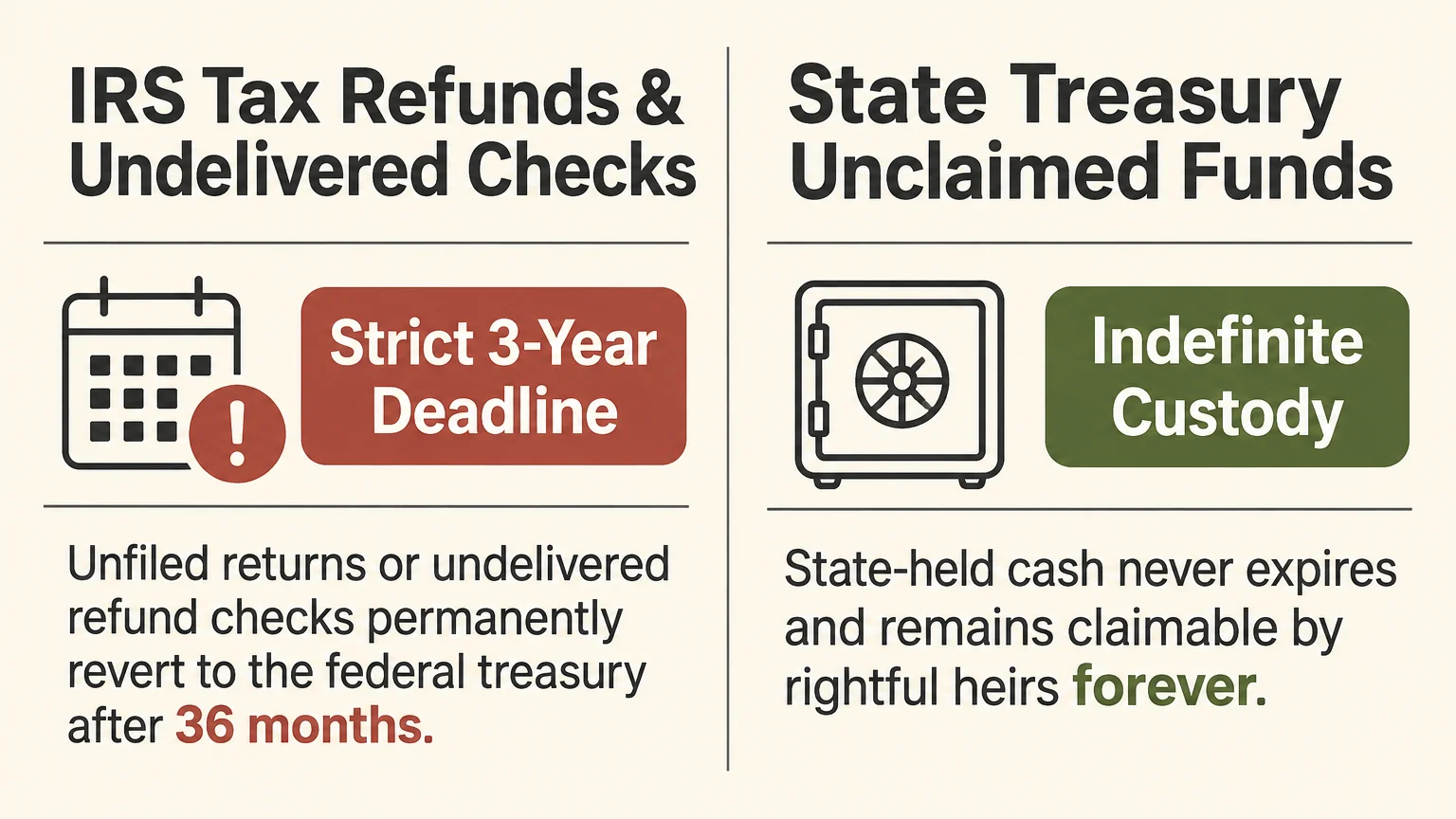
Under IRS law, taxpayers generally have three years from the original due date to file a return and claim a refund. Once that three-year window closes, unclaimed funds permanently become property of the U.S. Treasury, though there is never a late-filing penalty when the IRS owes you money.
In a March 20, 2026 release, the IRS estimated that over 1.3 million taxpayers had not claimed roughly $1.2 billion in tax year 2022 refunds—a median refund of $686—ahead of the April 15, 2026 deadline. The prior year saw a similar gap, with more than 1.14 million taxpayers leaving about $1.03 billion unclaimed ahead of April 15, 2025.
If you moved and never received a mailed refund check, the IRS sends Notice CP237A for uncashed checks; calling 1-800-829-0115 typically resolves payment within 30 days. For lost or stolen checks, you can initiate a refund trace through the IRS Where’s My Refund? tool, by calling 800-829-1954, or by filing Form 3911.

6. Unpaid Back Wages
If you worked hourly or salaried jobs late in your career and left before an employer resolved a pay dispute, you might be owed back wages. When the DOL’s Wage and Hour Division (WHD) recovers unpaid wages or overtime, it holds funds for unlocatable workers.
In January 2024, the DOL reported over $161.4 million waiting for more than 222,000 workers nationwide. Just like federal tax refunds, however, these funds carry a strict three-year holding window before transferring permanently to the U.S. Treasury.
You can search by former employer and your name on the free Workers Owed Wages (WOW) portal at dol.gov. After submitting Form WH-60 to verify your identity, eligible claimants typically receive their payout within six weeks.
Effective October 1, 2025, WHD issues all back-wage payments electronically rather than by paper check. Having your current routing and account numbers ready speeds up your claim.
7. Failed Banks and Closed Credit Unions
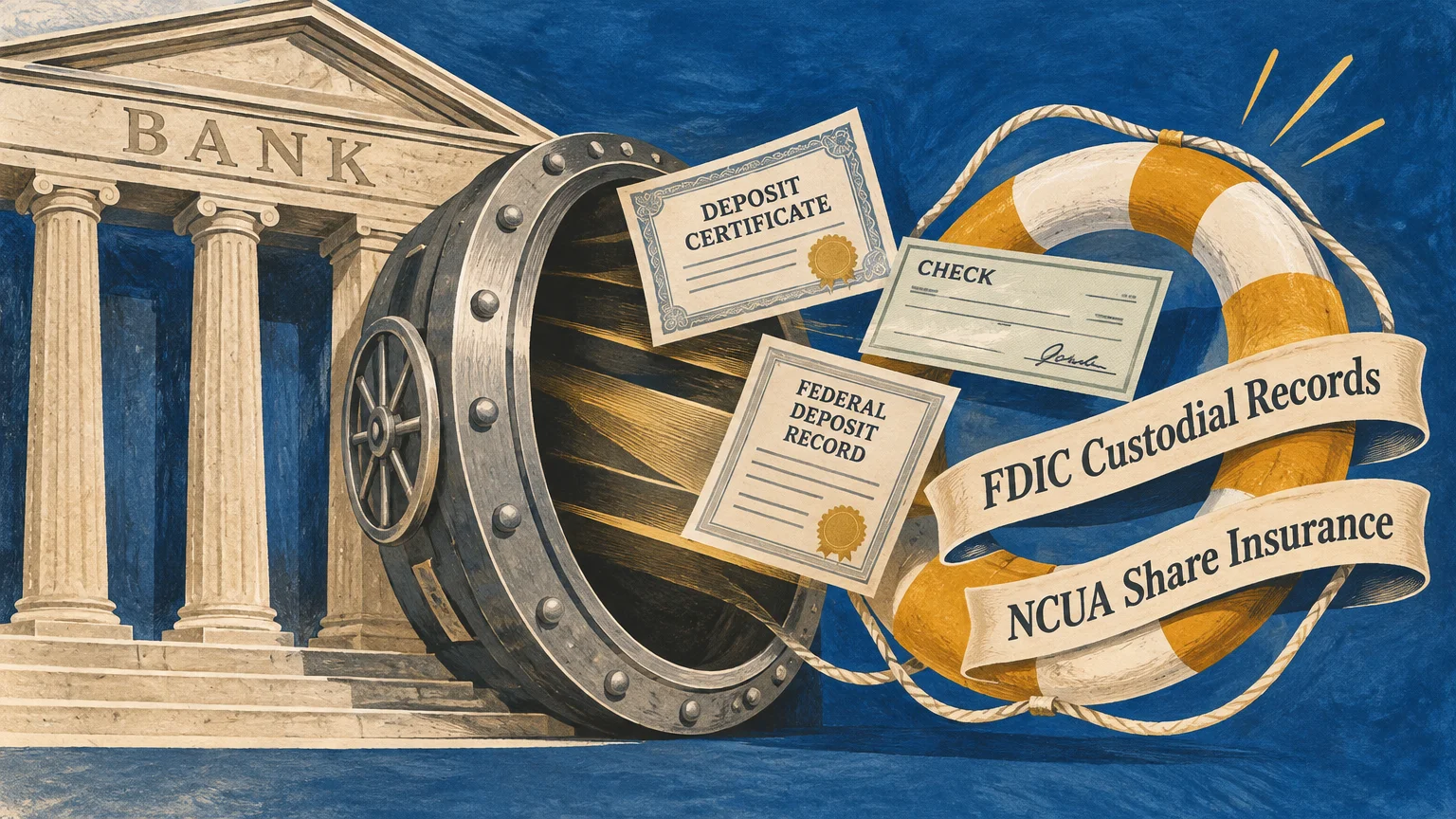
Bank consolidations and closures can leave behind small dormant certificates of deposit or checking balances, especially when an account holder moves without updating their mailing address. Two separate federal agencies handle deposits from failed institutions.
For failed FDIC-insured banks, federal law under 12 U.S.C. section 1822(e) gives depositors 18 months to claim insured deposits directly from the FDIC. After 18 months, unclaimed funds transfer to the state or territory of the depositor’s last known address—or to California if no address or a foreign address is listed.
Once you submit a claimant verification form to the FDIC, the agency states it responds within 30 days. Searching both the FDIC unclaimed funds list and the relevant state portal covers your bases if a bank closed years ago.
Credit union closures follow a slightly different rule under the National Credit Union Administration (NCUA). Its Asset Management and Assistance Center posts unclaimed shares from liquidated federally insured credit unions, paying the full insured amount during the 18-month insurance period before shifting any remaining late claims to an uninsured pro-rata payout based on available funds.
8. FHA Mortgage Insurance Refunds
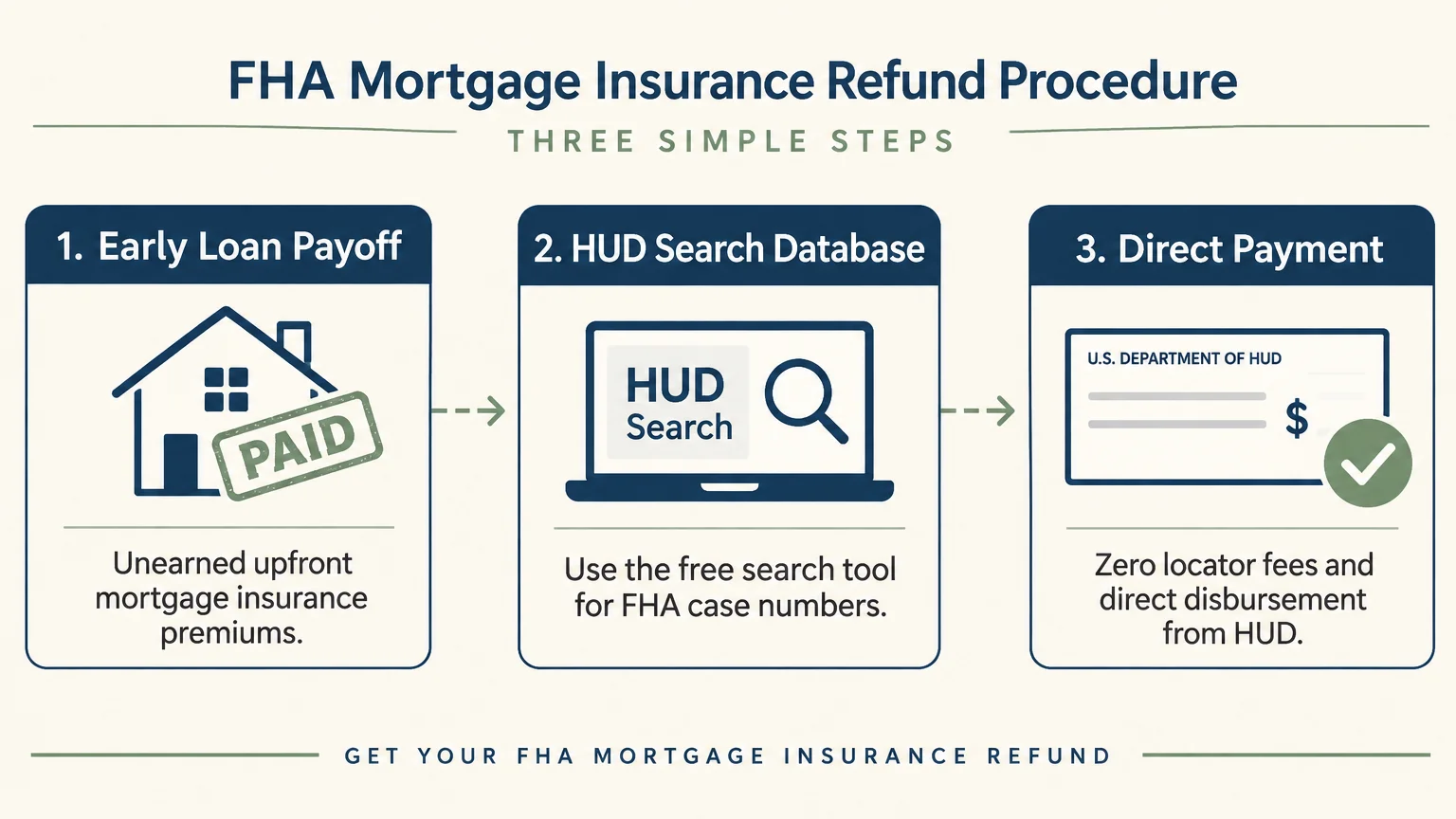
Homeowners who financed or refinanced a home with a Federal Housing Administration (FHA) loan may be owed a refund of upfront Mortgage Insurance Premiums (MIP). When you pay off an FHA mortgage early or refinance, part of that upfront premium or a distributive share can come back to you.
To qualify through the U.S. Department of Housing and Urban Development (HUD) database—titled Does HUD Owe You a Refund?—you must have acquired the loan after September 1, 1983, paid an upfront MIP at closing, and avoided defaulting on the mortgage. Eligibility depends strictly on when your loan closed and was endorsed.
- Closed before January 1, 2001 (endorsed before December 8, 2004): No longer eligible after the seventh year of mortgage insurance.
- Closed January 1, 2001 or later (endorsed before December 8, 2004): No longer eligible after the fifth year of mortgage insurance.
- Endorsed on or after December 8, 2004: Eligible only if refinanced into another FHA-insured loan, with a cutoff after the third year.
You can search using your FHA case number at hud.gov or by calling 1-800-697-6967. If HUD asks you to complete Form HUD-27050-B, refunds of $2,000 or less do not require notarization, and HUD emphasizes that you never need to pay a third-party tracer.
Quick Reference: Where to Run Your Unclaimed Money Search
Keeping track of eight different portals is much easier when you see them side by side. Use the comparison table below to check off each database for yourself, your spouse, and your parents.
| Source of Funds | Official Agency / Portal | What Is Held | Key Deadline or Rule |
|---|---|---|---|
| State Treasuries | unclaimed.org / MissingMoney.com | Dormant bank accounts, utility deposits, dividends, safe deposit boxes | Held indefinitely; Hawaii must be searched directly |
| Lost 401(k)s & Pensions | DOL (lostandfound.dol.gov) & PBGC (pbgc.gov) | Private-sector/union 401(k)s and terminated pensions | DOL requires verified Login.gov; PBGC uses name and last 4 of SSN |
| Life Insurance & Annuities | NAIC (naic.org) & VA (va.gov) | Unclaimed death benefits and annuity contracts | Insurers contact verified heirs within ~90 days if matched |
| Paper U.S. Savings Bonds | TreasuryDirect (FS Forms 1522 & 1048) | Matured paper Series E, EE, and I savings bonds | Never expire; Treasury Hunt retired Sept. 30, 2025 |
| Federal Tax Refunds | IRS (Where’s My Refund? / 800-829-1954) | Unclaimed tax refunds and undelivered checks | 3-year statutory cutoff from original return due date |
| Unpaid Back Wages | DOL Wage & Hour Division (dol.gov) | Recovered overtime and unpaid wages | 3-year cutoff; electronic payout only since Oct. 1, 2025 |
| Failed Banks & Credit Unions | FDIC & NCUA | Unclaimed deposits from closed insured institutions | 18-month federal window before state transfer or pro-rata rules |
| FHA Mortgage Insurance | HUD (hud.gov / 800-697-6967) | Upfront MIP refunds and distributive shares | 3-, 5-, or 7-year cutoffs based on loan closing and endorsement dates |
Recovering forgotten assets is rarely about luck—it is about methodically checking the official records tied to every job you held, every home you owned, and every state you called home.
For an overview of other federal benefit and retirement recovery tools, bookmark the USA.gov Retirement Resources hub and the Consumer Financial Protection Bureau retirement tools page.
Don’t Make These Mistakes
Scammers routinely target older adults with fake unclaimed money alerts. The Federal Trade Commission (FTC) warns that government agencies never send text messages about missing cash, never pressure you with urgent expiration threats, and never charge upfront processing fees.
If someone contacts you demanding a gift card, wire transfer, or upfront payment to release funds, stop immediately and report the attempt at ReportFraud.ftc.gov. Every official state and federal search listed in this guide costs nothing.
Be cautious around legitimate third-party asset locators as well. Roughly 40 states cap finder fees—most commonly at 10 percent of the recovered amount—and many impose waiting periods of 24 months before a locator may even contact an owner.
Paying 10 percent to a middleman makes little sense when you can submit the exact same online form yourself in ten minutes. Save your money and keep 100 percent of what belongs to you.
Another common slip is searching only under your current legal name and current zip code. Always run separate searches using maiden names, previous married names, middle initials, and every prior city or state where you lived.
Finally, do not assume the retired Treasury Hunt tool is still online or skip checking a deceased parent’s paperwork. Old tax returns, W-2s, and mortgage closing folders often contain the exact case numbers or employer names needed to unlock dormant accounts.
When Professional Advice Is Worth It
Most simple claims—like a $150 utility deposit at a state treasury or an uncashed dividend check—are easy to handle on your own. Still, certain recoveries create legal or tax wrinkles where professional help pays off.
Consider consulting an elder law or probate attorney if you uncover significant unclaimed property belonging to a deceased parent whose estate was closed years ago. Reopening a small estate or filing small-estate affidavits across multiple states requires following specific state probate rules.
A fee-only fiduciary financial advisor or tax professional is also worth calling if you recover a forgotten pension or large 401(k). Taking a lump-sum distribution directly could push you into a higher tax bracket or increase your Medicare premiums, whereas rolling eligible funds into an IRA can preserve tax deferral.
Frequently Asked Questions
Can I search for unclaimed money for my aging or deceased parents?
Yes. State databases, the NAIC life insurance locator, and PBGC allow family members to search on behalf of living parents with permission or as heirs of deceased parents. Claiming funds for a deceased owner typically requires a certified death certificate and proof of your legal authority as executor or heir.
Do I have to pay taxes when I find lost money?
Tax rules depend on the original source of the cash. Returned bank balances, utility deposits, and principal from life insurance death benefits are generally not taxable, while recovered pre-tax 401(k) distributions, pension payouts, back wages, and savings bond interest usually count as taxable income.
How long does it take to receive money after filing a claim?
Timelines vary by agency. DOL back wages typically arrive electronically within six weeks, the FDIC responds to claim verifications within 30 days, and uncashed IRS checks resolved by phone usually pay within 30 days, while complex state claims can take longer and NAIC insurer contacts usually come within 90 days.
Is MissingMoney.com safe to use?
Yes. MissingMoney.com is officially sponsored by NAUPA and connects directly to participating state unclaimed property programs for free. Just remember to check non-participating states like Hawaii directly through the links on unclaimed.org.
Your Next Step Today
Set aside 30 minutes this week to run a quick search on unclaimed.org, lostandfound.dol.gov, and pbgc.gov using every name and state tied to your working years. If you help an aging parent manage their finances, gather their past addresses and old employer names to run the same checks on their behalf.
This article is for informational purposes only and does not constitute financial, legal, or medical advice. Medicare rules, Social Security benefits, and tax laws change regularly—verify current details at Medicare.gov, SSA.gov, or with a licensed professional.
Last updated: November 2026. Medicare and Social Security rules change annually—always verify current details at official government sources.