Warren Buffett stepped back as Berkshire Hathaway’s chairman in September 2026 at age 96, leaving behind six decades of lessons on keeping wealth intact. Those proven principles point directly to the biggest retirement money mistakes draining older Americans’ nest eggs today.
High-interest credit cards, steep fund fees, idle cash, and mistimed Social Security choices quietly erode decades of careful saving. Protecting your purchasing power matters more in your sixties and seventies than chasing hot stock picks.
Applying Warren Buffett money advice helps you keep more of what you earned while avoiding costly traps in 2027 and beyond. Here are seven pitfalls the Oracle of Omaha would urge you to sidestep right now.
1. Carrying High-Interest Credit Card Debt Into Retirement
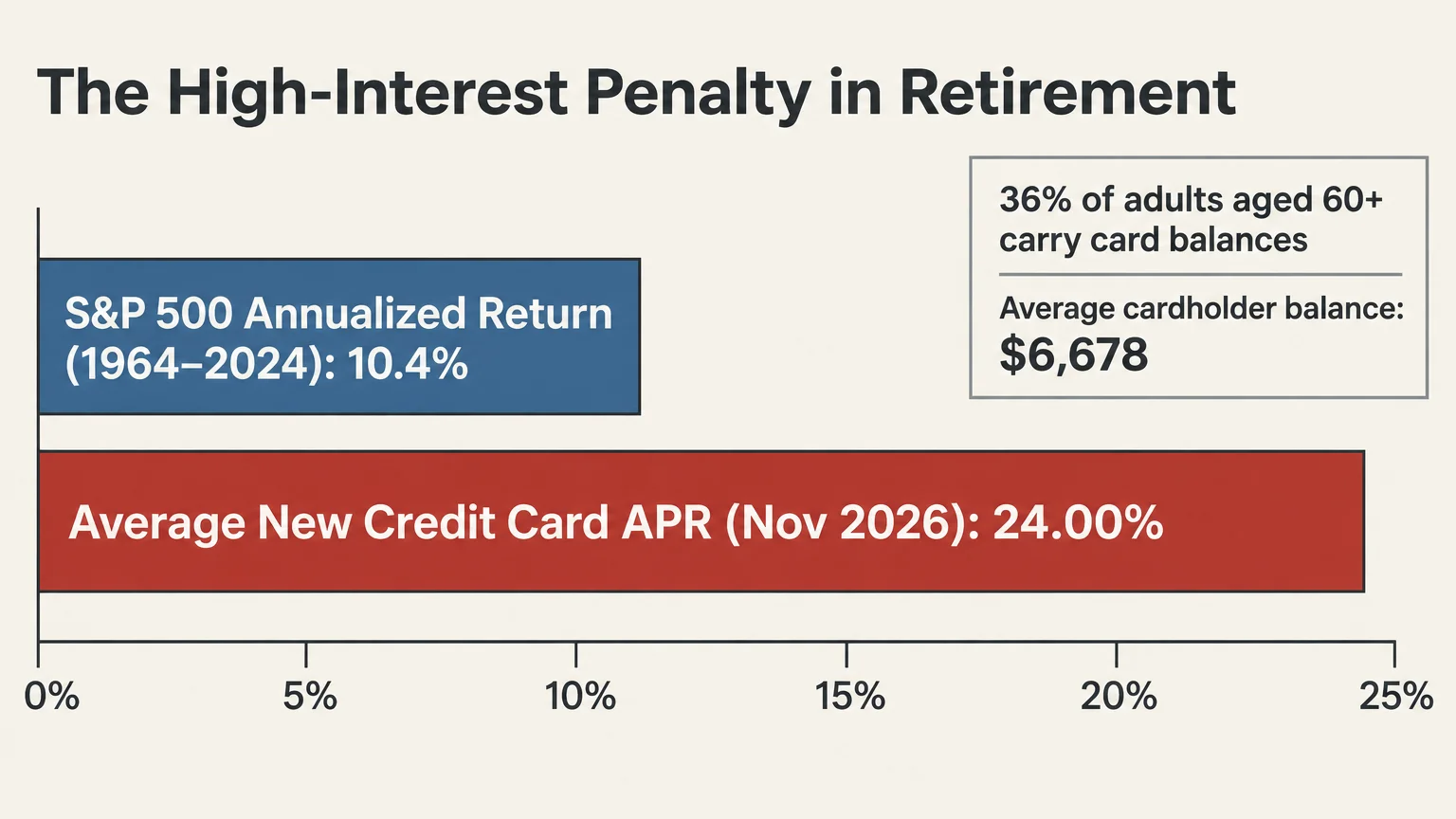
Few habits wreck a fixed income faster than paying revolving interest every month. While Berkshire Hathaway compounded at 19.9% annually from 1964 through 2024 compared with 10.4% for the S&P 500, modern credit cards charge far more than even elite investors routinely earn.
Preliminary Federal Reserve G.19 data from November 2026 put the average U.S. credit card rate at 22.36% on accounts assessed interest, and 21.19% across all accounts. LendingTree reported that new credit card offers averaged 24.00% APR in November 2026.
“If I owed any money at 18%, the first thing I’d do with any money I had would be to pay it off… it’s going to be way better than any investment idea I’ve got” — Warren Buffett, Berkshire Hathaway 2020 Annual Meeting
Older households are not immune to this squeeze. According to the Federal Reserve’s 2025 Survey of Household Economics and Decisionmaking, 36% of adults aged 60 and older carried a credit card balance at least once during the prior year.
Across the broader economy, the Federal Reserve Bank of New York reported $19.1 trillion in total household debt and $1.28 trillion in credit card debt in the third quarter of 2026, with 5.0% of debt in delinquency. TransUnion data cited by Forbes in November 2026 showed an average balance of $6,678 per cardholder.
When you try to avoid debt in retirement, every dollar of card balance paid off locks in a guaranteed, tax-free return above 20%. Take these steps before putting new cash into speculative investments:
- List every balance by APR: Rank credit cards, personal loans, and retail accounts from highest interest rate to lowest so your extra payments target the costliest debt first.
- Redirect nonessential cash flow: Pause taxable brokerage contributions—other than capturing an employer 401(k) match—until revolving balances hit zero.
- Beware high-rate borrowing late in life: Avoid financing vehicles, home remodels, or family gifts on credit cards when new offers average 24.00% APR.
2. Paying Steep Fees to Active Fund Managers
Many retirees assume complex, actively managed portfolios protect them better than simple index funds. Buffett spent decades proving the opposite, arguing that layers of advisory and management fees strip away returns you never get back.
In 2008, Buffett bet Protégé Partners $1 million that a low-cost Vanguard S&P 500 index fund would beat five funds of hedge funds over 10 years net of fees. By the end of 2017, the index fund gained 125.8% cumulatively while the five hedge-fund pools earned between 2.8% and 87.7%, allowing Buffett to donate roughly $2.22 million to Girls Incorporated of Omaha.
Recent scorecard data from S&P Dow Jones Indices confirms that active managers still struggle to justify their price tags. In 2025, 79% of active U.S. large-cap equity funds underperformed the S&P 500, and 67% trailed during the first half of 2026.
Over longer stretches through June 30, 2026, 83.33% of active U.S. large-cap funds lagged the index over 10 years, and 92.61% lagged over 20 years. Over the 15-year window ending December 2025, most active managers trailed their benchmarks across all 22 U.S. equity categories.
In his 2013 shareholder letter, Buffett laid out remarkably simple instructions for the trust left to his wife, recommending a 90/10 split rather than expensive Wall Street handlers.
“Put 10% of the cash in short-term government bonds and 90% in a very low-cost S&P 500 index fund. (I suggest Vanguard’s.)” — Warren Buffett, Berkshire Hathaway 2013 Shareholder Letter
Today, low-cost index funds such as the Vanguard S&P 500 ETF charge just 0.03% per year. Keeping fees near zero is one of the cleanest buffett investing tips you can apply to your 401(k) or IRA, even if you adjust the stock-to-bond mix to match your own risk tolerance.

3. Letting Cash Sit Idle While Inflation Erodes Your Purchasing Power
Keeping every retirement dollar in a traditional checking or savings account feels safe because the balance never drops on paper. Yet inflation quietly shrinks what that balance can actually buy at the grocery store, pharmacy, and utility company.
Bureau of Labor Statistics figures show U.S. headline inflation stood at 3.7% year-over-year in September 2026, with core consumer prices up 2.6%. In October 2026, consumer prices climbed another 0.4% from the prior month.
Over longer periods, that steady climb adds up fast. Between October 2016 and October 2026, consumer prices jumped roughly 39.6%, meaning goods that cost $100 a decade earlier required $139.62 in October 2026.
Compare that price growth with what standard bank accounts pay. The FDIC national average savings account rate sat at just 0.39% as of November 16, 2026—a roughly negative 3.2% real return against 3.7% inflation.
Meanwhile, the Federal Reserve Bank of Cleveland projected in November 2026 that inflation will average 2.67% annually over the next decade. Even moderate inflation cuts deeply into stagnant cash over a 20- or 30-year retirement.
Buffett keeps substantial liquidity for emergencies and opportunities, yet he holds it in short-term U.S. Treasury bills rather than zero-yield accounts. With the federal funds target range at 3.75% to 4.00% as of late October 2026, you have far better places for safe reserves:
- Short-term U.S. Treasuries: Put the safe bond portion of your portfolio in Treasury bills or short-term government bond funds instead of letting cash languish at 0.39%.
- Series I Savings Bonds: Consider I Bonds for dedicated inflation protection; bonds issued between November 1, 2026, and April 30, 2027, pay a 5.51% composite rate, including a 1.40% fixed rate.
- Separate spending buckets: Keep one to two years of living expenses in liquid, interest-bearing cash equivalents so you never have to sell stocks during a downturn.
4. Panicking During Market Drops—or Chasing Market Hype
Emotional timing is one of the most damaging retirement money mistakes, especially when a sudden market drop hits right as you stop working. Selling stocks after prices fall turns temporary paper losses into permanent damage.
In his 2013 shareholder letter, Buffett noted that the main danger for timid or inexperienced investors is buying during moments of extreme exuberance and then getting disillusioned when paper losses appear. Four years later, in his 2017 letter, he reminded shareholders that sharp drops will keep happening and no one can tell you when they will arrive.
Recent market swings prove his point. During 2025, the S&P 500 suffered a steep sell-off in April, yet investors who stayed put watched the index finish the year up 18%.
Retirees who bailed out during that spring drop locked in losses and missed the rebound. Those who stayed diversified—with enough bonds and cash to cover immediate bills—rode out the storm without disrupting their monthly lifestyle.
When you follow disciplined retiree financial advice, you stop treating stock quotes like a daily report card. Instead, review your asset mix once or twice a year, rebalance calmly when markets swing far from your target, and tune out scary cable-news predictions.
5. Ignoring Healthcare, Social Security, and Tax Rules That Drain Income
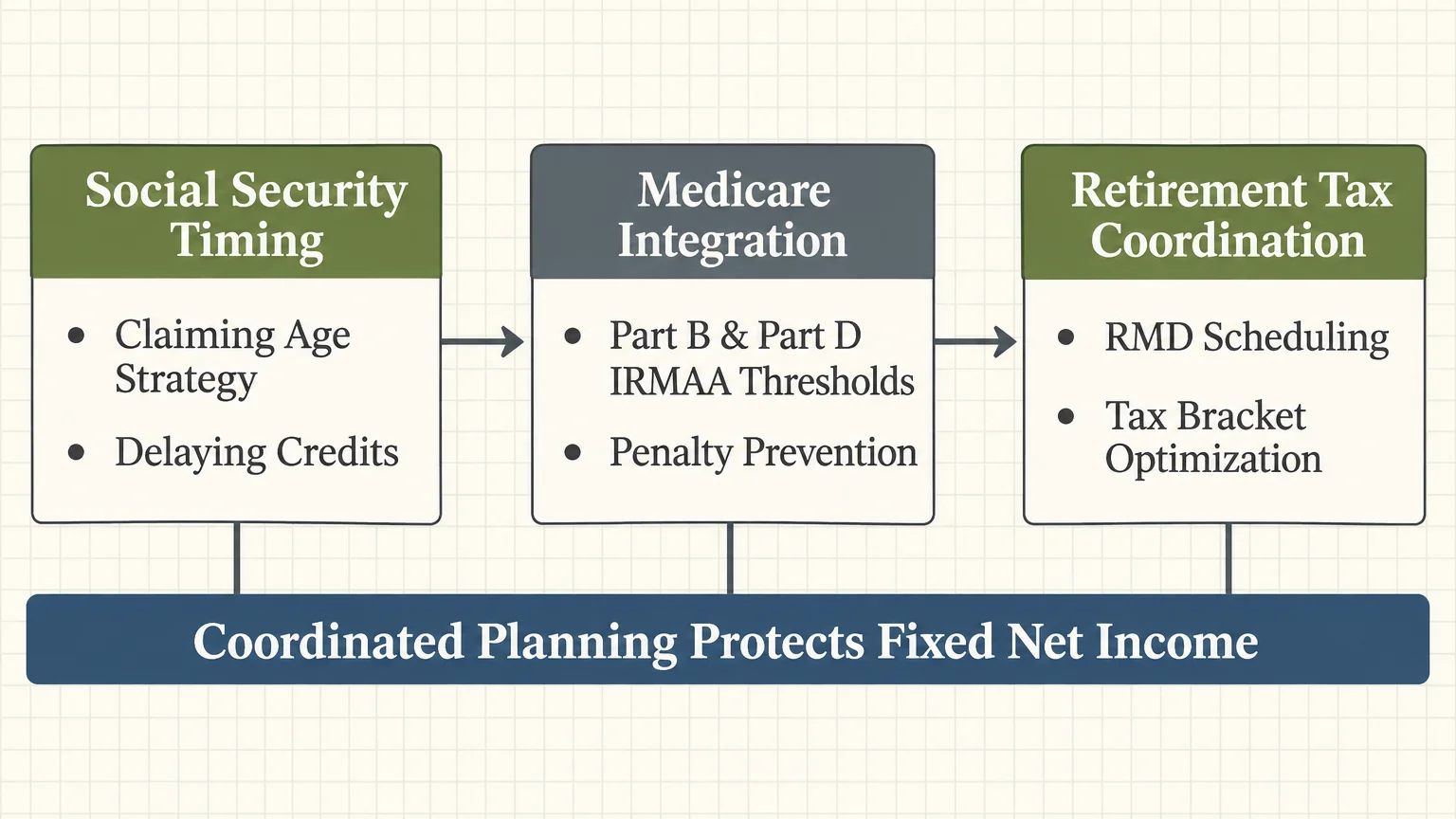
Buffett often emphasizes looking at after-tax, real-world cash flow rather than headline numbers. For Americans aged 55 to 75, coordinating Social Security, Medicare, and IRS retirement accounts protects far more money than guessing next year’s stock market winner.
Start with Social Security timing, because nearly half of retirees leave work earlier than planned and three in five retire before age 65, with a median retirement age of 62 according to the 2026 EBRI/Greenwald Retirement Confidence Survey. Claiming at 62 locks in a permanent 30.0% benefit reduction for workers—and 35.0% for spouses—compared with waiting until Full Retirement Age of 67 for anyone born in 1960 or later.
Working while collecting early benefits triggers another trap. In 2027, the Social Security Administration withholds $1 for every $2 you earn above $25,560 if you are under Full Retirement Age, and $1 for every $3 earned above $67,920 during the year you reach Full Retirement Age.
Next, watch how Medicare costs eat into annual cost-of-living raises. In January 2027, a 3.6% Social Security COLA lifts the average retired-worker benefit by about $75 a month, from $2,095 to $2,170.
However, Centers for Medicare & Medicaid Services figures released in November 2026 raise the standard Medicare Part B premium from $202.90 to $209.40 per month in 2027, absorbing nearly 9% of that average COLA increase. The Part B deductible also climbs from $283 to $292, the Part A inpatient hospital deductible rises from $1,736 to $1,776, and skilled nursing coinsurance for days 21 through 100 increases from $217 to $222 per day.
Looking further ahead, Medicare Trustees project Part B premiums could hit $272.10 per month by 2031, making healthcare budgeting essential. You can review your personalized benefit estimates at the Social Security Retirement Estimator and check annual coverage rules directly on Medicare.gov.
Finally, use the IRS catch-up windows available in your fifties and sixties if you are still working. Under IRS guidance for 2027, 401(k), 403(b), 457, and TSP deferral limits rise from $24,500 to $25,500, while age 50-plus catch-up contributions increase from $8,000 to $8,500—letting eligible workers save up to $34,000.
If you are aged 60 through 63, the SECURE 2.0 super catch-up jumps from $11,250 to $11,750 in 2027, allowing $37,250 in total deferrals. Meanwhile, IRA limits hold at $7,500 plus a $1,100 catch-up for age 50 and older, and HSA limits rise to $4,500 self-only or $9,000 family plus a $1,000 catch-up at age 55 and up, all detailed on the IRS Retirement Plans portal.
6. Lifestyle Creep and Overbuying Housing in Your Later Years
Despite a net worth estimated by Forbes at $148.9 billion in October 2026 and donating roughly $5.5 billion in Berkshire shares to family foundations in November 2026, Buffett still lives in the Omaha house he bought in 1958 for $31,500. His enduring point is simple: bigger houses and status purchases rarely raise happiness, yet they permanently inflate taxes, insurance, utilities, and upkeep.
Many older Americans face steep housing costs right as paychecks end. The Federal Reserve’s 2025 Survey of Consumer Finances showed that 42% of U.S. families still held debt on their primary residence, carrying a median mortgage of $183,600 and a mean of $239,700 as 30-year mortgage rates averaged 6.7%.
Even more troubling, 8.6% of families spent over 40% of their income on debt payments—the highest share since 2010—and 19.6% reported late loan payments. Carrying an oversized mortgage into retirement forces larger portfolio withdrawals every month, shrinking your margin of safety.
Before upgrading to a pricier home or keeping a house with heavy maintenance demands, run the true annual cash cost. Downsizing, relocating to a lower-tax area, or paying off your remaining mortgage often frees far more monthly breathing room than chasing higher investment returns.

7. Trusting Unvetted Voices and Falling for Modern Financial Scams
Buffett has long warned investors to work only with people of high integrity, and that rule carries extra urgency as technology advances. At Berkshire Hathaway’s 2024 annual meeting, he cautioned that AI-generated voices and images could turn impersonation fraud into a booming criminal industry.
That risk hits retirees at a vulnerable moment. According to the 2026 EBRI/Greenwald Retirement Confidence Survey, 61% of workers and 73% of retirees feel confident they will have enough money to live comfortably—down from 67% and 78% in 2025—and more than one in four retirees say they do not know where to turn for financial planning advice.
When savers feel uncertain, slick pitches promising guaranteed double-digit returns or urgent callers impersonating banks and government agencies find easy targets. With a median Vanguard retirement plan balance of $44,115 in 2025, one fraudulent wire transfer can wipe out years of hard work.
Protect yourself by adopting strict family verification rules before moving money. Set a private family code word to verify emergency requests by phone, freeze your credit files, and explore fraud prevention guides from the Consumer Financial Protection Bureau retirement tools.
Costly Mistakes to Avoid When Implementing Your Plan
Good intentions still backfire when small administrative rules catch you off guard. Paying attention to tax, account, and withdrawal mechanics keeps your retirement blueprint running smoothly.
- Missing Required Minimum Distributions (RMDs): RMDs begin at age 73 for anyone born from 1951 through 1959, and age 75 starting in 2033 for those born in 1960 or later; missing an RMD triggers a 25% IRS penalty, reduced to 10% only if corrected promptly.
- Overlooking Qualified Charitable Distributions (QCDs): If you are 70½ or older and give to charity, sending gifts directly from an IRA—capped at $111,000 in 2026 and $114,000 in 2027—can satisfy RMDs without raising taxable income.
- Ignoring Roth catch-up wage rules: Workers whose prior-year FICA wages exceed $150,000 in 2026 or $155,000 in 2027 must direct workplace plan catch-up contributions into Roth accounts rather than pre-tax buckets.
- Chasing complex products you cannot explain: Skip annuities, private placements, or leveraged funds whose fees, surrender charges, and tax rules take an expert to decode.
| Area | Common Retiree Mistake | Buffett-Inspired Approach |
|---|---|---|
| Debt | Carrying balances at 22.36% average APR | Pay off high-interest debt before investing |
| Investments | High-fee active funds that mostly lag benchmarks | Low-cost S&P 500 index funds around 0.03% |
| Cash Reserves | Leaving cash in 0.39% savings while CPI hits 3.7% | Hold short-term U.S. Treasuries or 5.51% I Bonds |
| Market Volatility | Selling during drops like April 2025 | Stay invested through storms to capture recovery |
| Housing & Lifestyle | Stretching for larger homes at 6.7% mortgage rates | Live comfortably below your means |

Don’t DIY These Decisions
Simple index investing works wonders, yet several legal, healthcare, and tax junctions require specialized human guidance. Trying to guess your way through irreversible rules can cost far more than paying for an hour or two of expert advice.
Bring in qualified professionals for these four high-stakes choices:
- Medicare plan enrollment and appeals: Work with a free State Health Insurance Assistance Program (SHIP) counselor to compare Original Medicare, Medigap, and Medicare Advantage plans without sales pressure.
- Spousal and survivor Social Security timing: Consult a Social Security claiming specialist if you are married, divorced after a 10-year marriage, or widowed, so you do not forfeit lifetime household benefits.
- Tax-efficient withdrawal sequencing and Roth conversions: Hire a fee-only fiduciary financial advisor or CPA to coordinate 401(k) drawdowns, IRMAA Medicare surcharges, and RMD planning.
- Long-term care and estate documents: Meet an elder law attorney to draft powers of attorney, healthcare directives, and Medicaid-compliant asset protection plans before a health crisis strikes.
Frequently Asked Questions
Does Warren Buffett’s 90/10 rule work for every retiree?
Buffett’s 90% S&P 500 index fund and 10% short-term government bond split works best when you have a large cushion, pensions, or guaranteed income covering daily bills. If a 30% stock drop would force you to sell shares for groceries, holding a higher share in short-term Treasuries and cash helps protect your lifestyle.
Should I pay off my mortgage or invest spare cash in retirement?
Credit cards above 20% APR should always be wiped out immediately before investing. For a mortgage, compare your loan rate against safe Treasury yields and whether freeing up monthly cash flow gives you greater peace of mind.
How much does inflation really hurt retirees who hold too much cash?
At September 2026 inflation of 3.7%, a typical 0.39% savings account loses roughly 3.2% of real purchasing power every year. Moving excess cash into short-term Treasuries or Series I Savings Bonds helps your safe money keep pace.
When should I start preparing for Required Minimum Distributions?
Start planning in your early sixties, well before RMDs begin at age 73 or 75. Spreading out modest withdrawals or Roth conversions during lower-tax years between retirement and RMD age can prevent painful tax spikes later.
Pick one area from this list today—pay down a high-rate balance, check your fund expense ratios, move stagnant savings into higher-yielding Treasuries, or map out your Social Security claiming age. Small, steady improvements compound just as reliably in retirement as Buffett’s favorite businesses do.
Retirement rules and benefit amounts vary based on individual work history, income, and circumstances—this article provides general guidance only. Consult a SHIP counselor, financial advisor, or elder law attorney for advice specific to your situation.
Last updated: November 2026. Medicare and Social Security rules change annually—always verify current details at official government sources.