Your Social Security check is getting a 3.6% boost for 2027, yet your grocery, utility, and medical bills still seem to outpace it. That gap is not in your head.
Over the decade ending in 2026, Social Security benefits lost 13.7% of their real purchasing power. Even with annual cost-of-living adjustments, your monthly check buys less than it did ten years ago.
Understanding why benefits are losing value—and what lawmakers would need to change to fix Social Security—helps you plan with clear eyes. Here is how the math breaks down and how you can protect your budget right now.
What You Need to Know
Before diving into the policy fixes, keep these core numbers in mind as you plan your 2027 household budget.
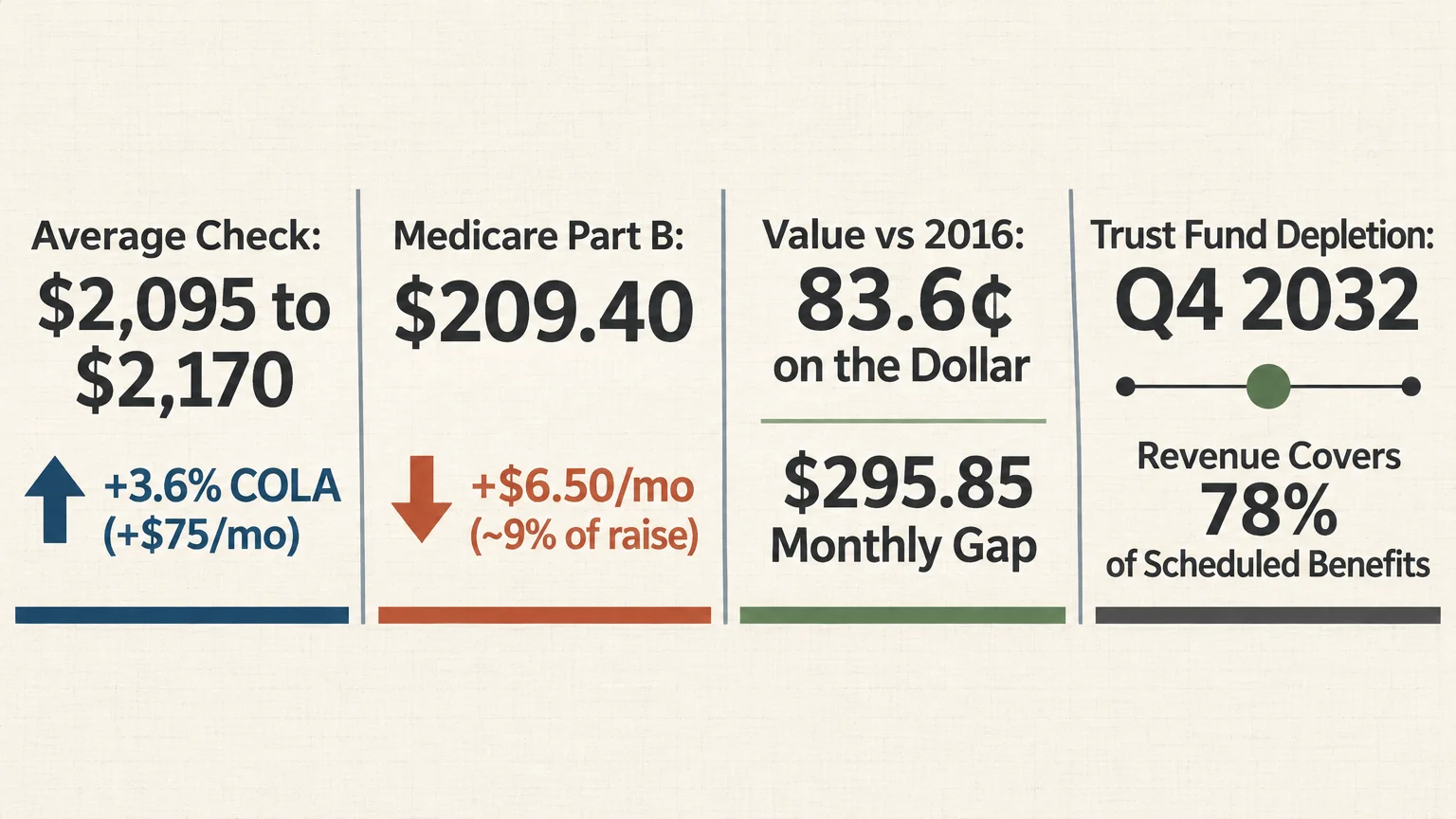
- The 2027 raise is modest in net dollars: A 3.6% cost-of-living adjustment (COLA) adds about $75 to the average retired worker’s monthly check, raising it from roughly $2,095 to $2,170 in January 2027.
- Healthcare takes an immediate bite: Standard Medicare Part B premiums rise $6.50 per month in 2027 to $209.40, absorbing nearly 9% of the average COLA increase before you see a dime.
- A decade of erosion has added up: Research from The Senior Citizens League shows 2026 benefits were worth roughly 83.6 cents on the dollar compared to 2016, requiring an extra $295.85 per month to catch up.
- The trust fund clock is ticking: The 2026 Social Security Trustees Report projects the retirement trust fund will deplete reserves in the fourth quarter of 2032, leaving enough ongoing revenue to pay 78% of scheduled benefits.
- Turning it around requires dual action: Changing the inflation index alone would actually widen Social Security’s deficit unless Congress pairs it with higher payroll tax revenue or benefit formula adjustments.
Why Social Security Benefits Are Losing Value Despite Annual COLAs
On October 14, 2026, the Social Security Administration (SSA) announced a 3.6% COLA for nearly 72 million Social Security beneficiaries and roughly 7.3 million Supplemental Security Income recipients. That total reaches about 76 million Americans when accounting for overlap.
For the average retired worker, that increase lifts monthly payments from about $2,095 in 2026 to $2,170 in January 2027. Workers retiring at Full Retirement Age with maximum earnings see their cap rise from $4,152 to $4,188 per month.
Yet strong headline adjustments—including 5.9% payable in 2022, 8.7% in 2023, 3.2% in 2024, 2.5% in 2025, and 2.8% in 2026—have not stopped Social Security buying power from slipping. You can trace that persistent gap directly to how the government measures inflation.
The CPI-W Mismatch
By law, Social Security COLA inflation adjustments rely on the Consumer Price Index for Urban Wage Earners and Clerical Workers (CPI-W), published by the Bureau of Labor Statistics. The SSA compares third-quarter CPI-W readings from July through September against the same quarter a year earlier.
If prices do not rise by at least 0.1%, the COLA stays at 0%, which happened in 2010, 2011, and 2016, with only a 0.3% bump in 2017. While your check cannot drop from a negative inflation reading, a zero-percent year leaves you falling behind on rising local costs.
The bigger flaw is who the CPI-W actually tracks. That index only reflects households earning wages or clerical salaries—about 29% to 30% of the U.S. population—and excludes retirees entirely.
Working commuters spend more of their budgets on gasoline, work attire, and electronics, whose prices fluctuate differently than senior essentials. Retirees devote far larger shares of income to housing, medical care, and household services.
What Retirees Actually Pay vs. Official Adjustments
To measure real-world costs for older Americans, The Senior Citizens League tracks a market basket of 70 essential goods and services weighted for retirees who shop affordably. According to its 2026 Loss of Buying Power report, those senior costs jumped 43.55% between 2016 and 2026.
Over that exact same ten-year span, the official CPI-W rose only 37.60%. Housing and transportation recorded the sharpest increases inside the retiree basket, driving the wedge wider year after year.
As a result, benefits lost 13.7% of their buying power from 2016 to 2026, leaving a 2026 benefit dollar worth roughly 83.6 cents. Restoring 2016 purchasing power would take an immediate 15.8% raise—about $295.85 more per month, or $3,550 per year, for the average beneficiary.
That erosion hits hard because so few retirees treat Social Security as pocket change. Pew Research Center data shows 63% of beneficiaries rely on Social Security for at least half their income, while 27% depend on it as their sole income source.
In The Senior Citizens League’s 2026 Senior Survey of 904 older Americans, 39% reported relying on Social Security for all of their income. Only 13% said they felt satisfied with their benefits, and 89% said the 2.8% adjustment for 2026 fell short.
Looking ahead, the 2026 Social Security Trustees Report projects COLAs averaging just 2.4% annually from 2027 through 2031, including 2.4% for 2028. By contrast, The Senior Citizens League’s initial November 2026 estimate for 2028 points to another 3.6% adjustment.
The Silent Squeeze: Medicare Part B Deductions and Unindexed Taxes
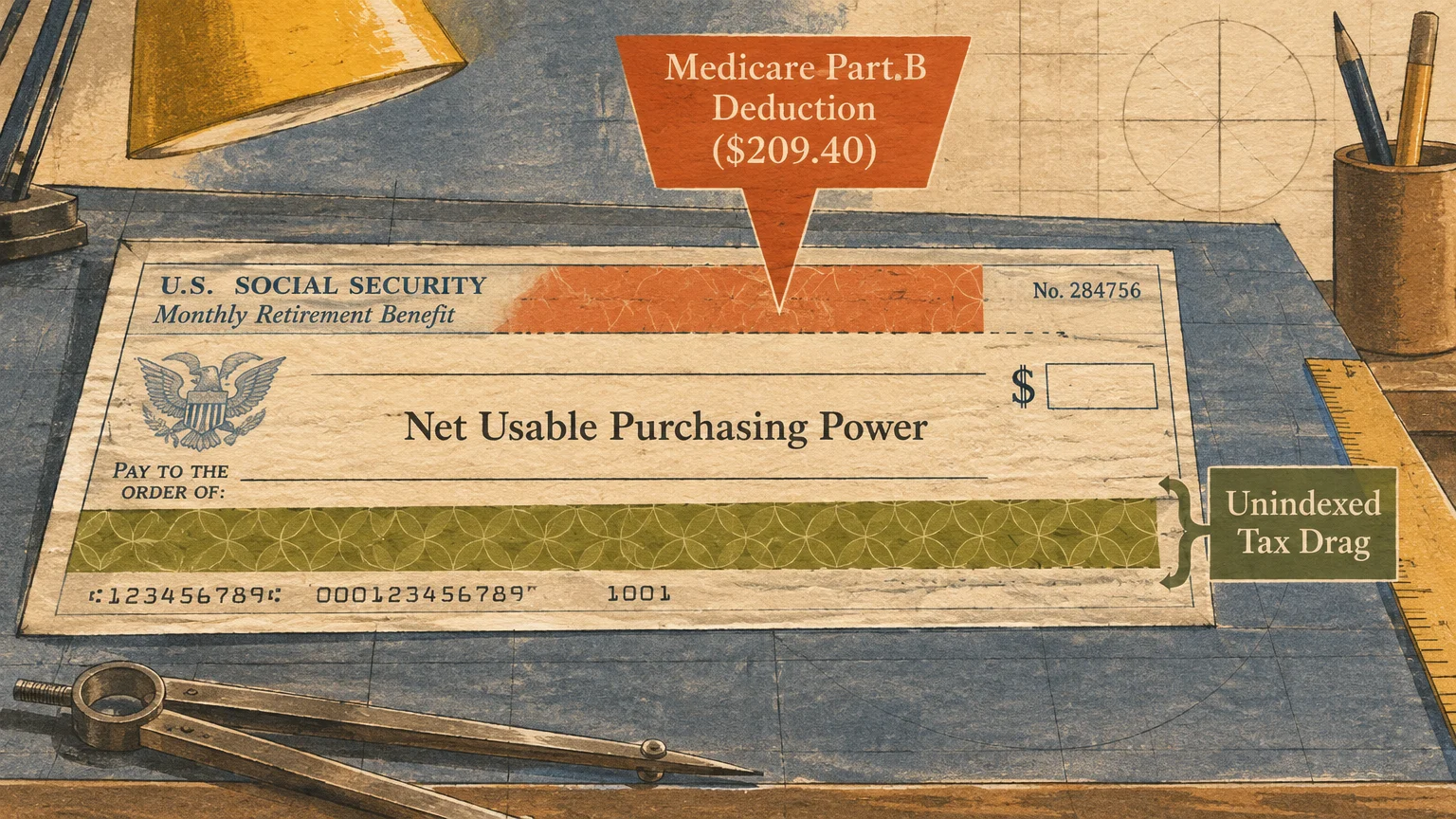
Even when Social Security announces a respectable raise, two automatic deductions quietly shrink what lands in your bank account. Rising Medicare premiums and frozen federal tax thresholds turn gross COLAs into much smaller net gains.
Medicare Part B Premiums Eat Into Your Raise
On November 17, 2026, the Centers for Medicare & Medicaid Services announced that the standard monthly Medicare Part B premium will climb 3.2% in 2027. The base premium rises $6.50 per month, moving from $202.90 in 2026 to $209.40 in 2027—or $2,512.80 per year.
That increase follows a much steeper $17.90 jump in 2026, when Part B crossed the $200 threshold for the first time after sitting at $185.00 in 2025. Meanwhile, the annual Part B deductible climbs $9 in 2027, from $283 to $292.
Because most retirees have Part B premiums deducted straight from Social Security, that $6.50 increase cuts the average $75 COLA down to $68.50 per month. One healthcare line item alone absorbs nearly 9% of your annual raise.
Over longer periods, healthcare inflation averages roughly 5.8% per year, according to Retirable data cited by CBS News. Medicare Trustees project the standard Part B premium could reach $272.10 per month by 2031, outpacing projected 2.4% COLAs.
Federal law includes a hold harmless rule under Social Security Act Section 1839(f) that prevents Part B hikes from reducing your net Social Security check from one year to the next. That safeguard protects roughly 70% of Medicare beneficiaries.
However, you lose hold harmless protection if you are new to Part B, delay claiming Social Security, receive dual Medicaid coverage, or pay high-income surcharges. Single filers with 2025 modified adjusted gross income (MAGI) above $112,000 owe Income-Related Monthly Adjustment Amount (IRMAA) surcharges adding $83.70 to $502.40 monthly in 2027.
Frozen Tax Thresholds Trigger Bracket Creep
Federal income taxes create a second silent leak in your Social Security buying power. Under Internal Revenue Code Section 86, up to 50% or 85% of your benefits become taxable once your provisional income passes $25,000 for single filers or $32,000 for married couples filing jointly.
Congress set those dollar thresholds decades ago and never indexed them for inflation. Every time a COLA pushes your gross benefit higher, more of your check crosses those frozen lines and gets pulled into taxable income.
In July 2025, the One Big Beautiful Bill Act (Public Law 119-21) left Section 86 untouched, so those base thresholds remain intact. However, the law added a temporary deduction of up to $6,000 per person age 65 and older, or $12,000 for qualifying joint filers, for tax years 2025 through 2028.
That temporary senior deduction phases out by 6% of MAGI above $75,000 for single taxpayers and $150,000 for joint filers. In addition to federal rules, nine states still tax Social Security benefits in 2026, depending on your income and age.
The Looming Solvency Cliff: What Happens in 2032 and 2034
Any plan to restore lost purchasing power must also confront a hard financial deadline. Social Security already pays out more in benefits than it collects in payroll taxes, drawing down trust fund reserves to cover the difference.
Combined trust fund reserves stood at $2.56 trillion at the end of 2025, after falling by $160 billion during that single year. According to the 2026 Social Security Trustees Report released on June 9, 2026, the depletion timeline just moved closer.
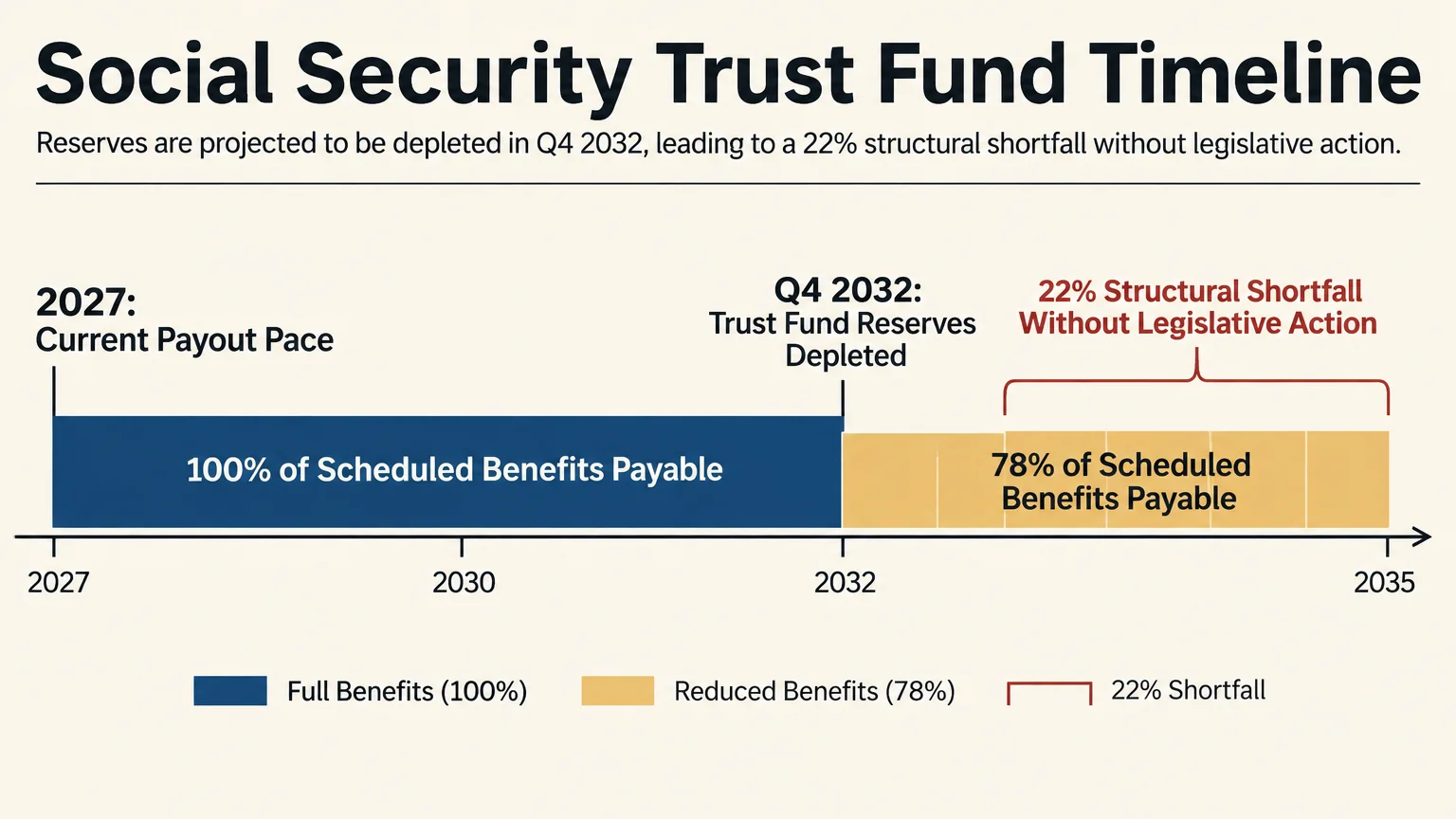
The Old-Age and Survivors Insurance (OASI) trust fund—which pays retirement and survivor benefits—is now projected to run dry in the fourth quarter of 2032, one quarter earlier than estimated in 2025. Without congressional action, ongoing tax revenue would only cover 78% of scheduled benefits, forcing an automatic 22% cut.
If Congress allows transfers from the Disability Insurance fund, which stays solvent through 2100, combined reserves would hold out until the third quarter of 2034. At that point, revenue would cover 83% of scheduled benefits—an immediate 17% cut—falling gradually to 65% by 2100.
Over a 75-year window, the actuarial deficit grew from 3.82% of taxable payroll in 2025 to 4.42% in 2026. The Congressional Budget Office estimates the 75-year unfunded OASI obligation at $30.3 trillion, widened by lower fertility and immigration projections plus reduced tax revenue under the 2025 tax law.
Long-term demographic math drives this squeeze. Data from the Bipartisan Policy Center shows the ratio of workers paying into Social Security per beneficiary fell from more than 5-to-1 in 1960 to 2.9-to-1 in 2026, heading toward 2.2-to-1 by the 2070s.
At the same time, inequality has eroded the payroll tax base. Because top salaries climbed faster than the statutory wage cap, the share of covered U.S. wages subject to Social Security payroll taxes dropped from 90% in 1983 to 83% today.
What It Would Take to Fix Social Security and Restore Buying Power
Turning Social Security around requires solving two competing problems at the same time. Lawmakers must protect seniors from losing ground to healthcare and housing inflation while closing a multi-trillion-dollar funding gap before 2032.
Protecting your retirement check requires looking beyond next year’s COLA headline to the net dollars left after healthcare premiums, taxes, and long-term solvency reforms.
No single policy solves both challenges alone. Below is how the major proposals on the table in 2026 compare in their impact on retirees and the trust fund.
| Reform Option | Impact on Retiree Buying Power | Impact on 75-Year Solvency Gap |
|---|---|---|
| Switch COLA from CPI-W to R-CPI-E | Raises benefits ~0.2% faster per year (~4% higher after 20 years) | Widens shortfall by roughly 10% unless paired with new revenue |
| Switch COLA to Chained CPI | Lowers annual COLA growth by ~0.3 percentage points | Closes 14%–15% of the funding shortfall |
| Eliminate Payroll Tax Cap (no extra benefit credit) | Protects current scheduled benefits without cutting middle-class checks | Closes 65%–67% of gap; delays combined insolvency to 2055 |
| Eliminate Payroll Tax Cap (with benefit credit) | Increases future benefits for high earners above the cap | Closes roughly 48% of the funding shortfall |
| Progressive Price Indexing | Slows initial benefit growth for higher earners; protects lower earners | Closes 50% of shortfall alone; 110% if paired with lifting the tax cap |
| Raise Full Retirement Age to 70 | Functions as a benefit cut for cohorts born 1964–1981 | Substantially reduces long-term outlays (scored by CBO) |
| Repeal Federal Taxes on Benefits | Raises net take-home checks for middle- and upper-income retirees | Worsens Social Security shortfall by 20%; doubles Medicare HI gap |
1. Fixing the Inflation Formula With CPI-E
To stop benefits losing value over a 20- or 30-year retirement, advocates frequently call for replacing CPI-W with the Bureau of Labor Statistics’ experimental Consumer Price Index for the Elderly (R-CPI-E). That index tracks spending patterns for Americans age 62 and older.
Because R-CPI-E gives healthcare a roughly 12% weight—compared to about 7% for the general urban population—and weighs housing more heavily, it tracks senior inflation more accurately. Social Security actuaries estimate CPI-E rises about 0.2 percentage points faster per year than CPI-W.
According to Bipartisan Policy Center analysis, that small annual edge compounds to roughly 4% higher benefits after 20 years in retirement. That makes CPI-E especially helpful for retirees in their eighties and nineties whose savings have thinned.
However, adopting CPI-E without adding revenue would widen Social Security’s 75-year deficit by roughly 10%. By contrast, switching to Chained CPI—which grows about 0.3 percentage points slower by assuming shoppers substitute cheaper goods—would close 14% to 15% of the shortfall while accelerating buying-power loss.
2. Raising or Removing the Payroll Tax Cap
Workers and employers currently split a 12.4% payroll tax—6.2% each—on covered earnings up to $184,500 in 2026, rising to $192,300 in 2027. Any wages earned above that cap escape Social Security payroll taxation entirely, benefiting roughly the top 6% of earners.
Applying payroll taxes to all earnings above the cap without granting extra future benefits—the structure used in proposals like the Moreno-Warren plan—would raise an estimated $2.5 trillion to $3.2 trillion over ten years. That revenue alone closes 65% to 67% of the 75-year gap and delays combined insolvency by about 21 years, to 2055.
If Congress instead grants benefit credit on those newly taxed higher wages, the reform still closes about 48% of the long-term deficit. Either approach shifts the funding burden onto top earners rather than cutting existing retiree checks.
3. Adjusting Initial Benefits and the Full Retirement Age
Because lifting the payroll tax cap alone still leaves roughly a third of the 75-year gap open, budget analysts often examine benefit formula changes. Under current law, Full Retirement Age is 67 for anyone born in 1960 or later.
One option scored by the Congressional Budget Office would gradually lift the Full Retirement Age to 70 by adding two months per birth year for workers born from 1964 through 1981. While that reduces program costs, it hits workers in physically demanding jobs who cannot easily work past 67.
Another approach—progressive price indexing—links initial benefit growth to prices rather than wages for higher earners while shielding lower-income workers. Estimates from the Committee for a Responsible Federal Budget based on SSA actuarial data show progressive price indexing closes 50% of the shortfall by itself.
When paired with eliminating the payroll tax cap, progressive price indexing closes 110% of the 75-year funding gap and prevents insolvency altogether. That combination could even leave fiscal room for targeted COLA improvements.
4. Targeted Relief and Proposals That Backfire
Several active legislative proposals aim directly at boosting retiree cash flow alongside tax changes. The Social Security 2100 Act would raise payroll taxes on top earners while expanding benefits and switching to a senior-friendly COLA index.
Advocacy groups have also floated short-term catch-up measures, such as the Council of Seniors’ proposed Social Security Restitution Act, which calls for a one-time $970 payment to retired workers to offset past COLA shortfalls. While helpful for immediate bills, one-time checks do not fix ongoing index lag.
At the same time, one popular idea—repealing all federal income taxes on Social Security benefits under bills like the You Earned It, You Keep It Act—carries steep solvency risks. Taxes on benefits brought in $99 billion in 2025, representing 5% of dedicated trust fund revenue.
Committee for a Responsible Federal Budget projections show that repealing benefit taxation outright would worsen Social Security’s 75-year shortfall by 20% and double Medicare Hospital Insurance’s deficit. Replacing that $99 billion annual revenue stream would be essential before eliminating Section 86 taxes.

Practical Steps to Protect Your Own Retirement Buying Power Today
Lawmakers may debate how to fix Social Security for several more years before reaching a compromise ahead of 2032. While Congress deliberates, you can take concrete steps right now to defend your household purchasing power.
- Verify your exact benefit outlook: Create or log into your personal account and run scenarios with the Social Security Retirement Estimator. Seeing how claiming at 62 versus 67 or 70 changes your monthly base helps you lock in larger annual COLA dollars over time.
- Shop your Medicare coverage every fall: Review Part D prescription plans and supplemental policies annually through Medicare.gov. Saving $40 a month on out-of-pocket drug costs offsets more than six times the 2027 Part B premium increase.
- Coordinate withdrawals around tax and IRMAA cliffs: Track how IRA distributions, Roth conversions, and capital gains affect your MAGI against the $112,000 single IRMAA threshold and the 2025–2028 senior deduction phaseouts starting at $75,000 single or $150,000 joint.
- Check for overlooked cost-saving programs: If Social Security provides most of your income, run a free confidential screening through BenefitsCheckUp. Programs covering Medicare Part B premiums, prescriptions, utilities, and property taxes can add hundreds back into your monthly budget.
- Build a personal inflation buffer: Aim to keep 12 to 24 months of essential gap expenses in liquid, interest-bearing accounts alongside diversified long-term investments. Relying solely on COLAs leaves you vulnerable whenever healthcare or housing spikes past 3.6%.
Don’t Make These Mistakes
When inflation squeezes fixed incomes and headlines warn about trust fund depletion, rushed decisions can cost you thousands over a 25-year retirement. Watch out for these common errors.
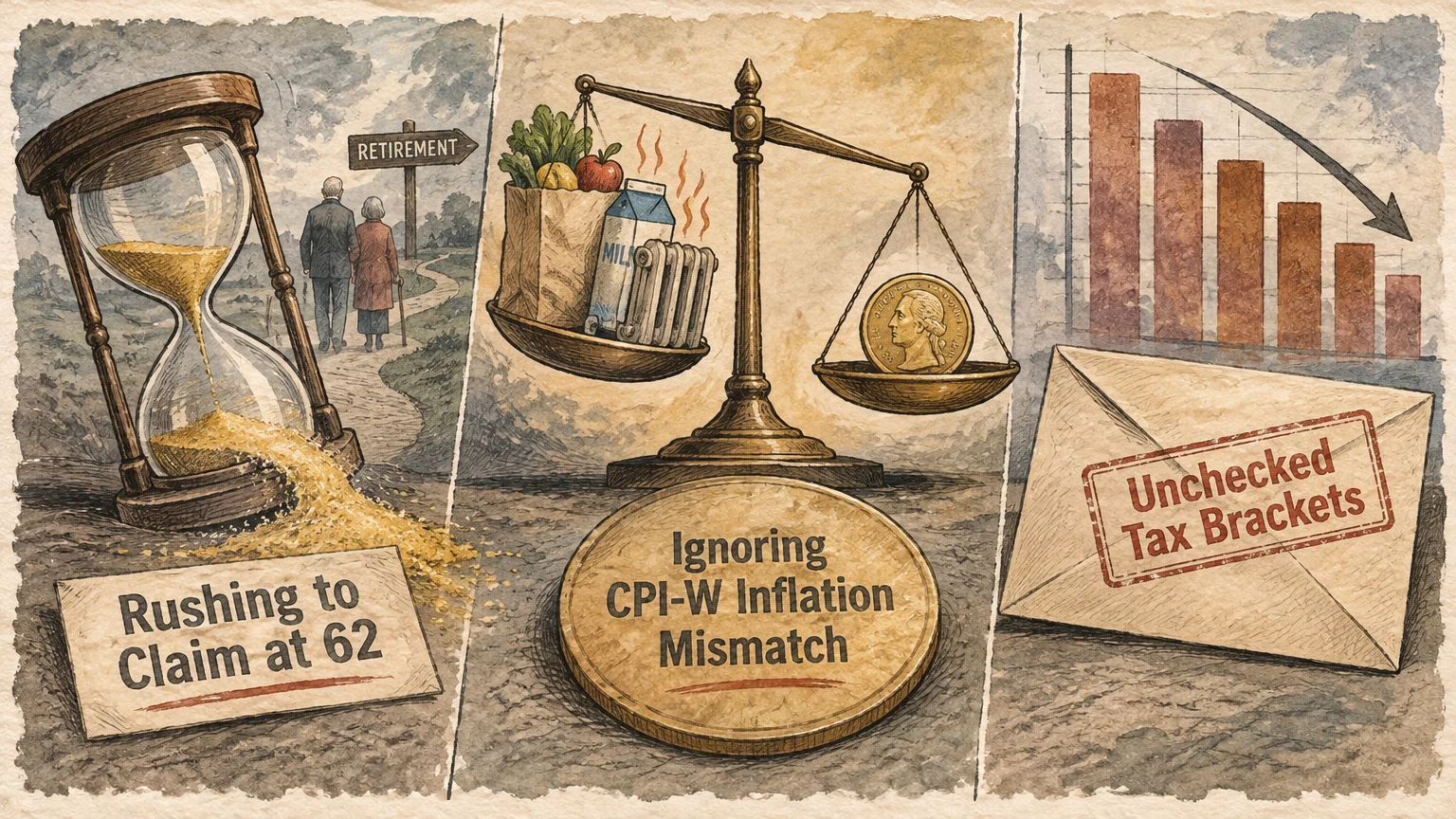
- Budgeting from your gross COLA percentage: Never spend a 3.6% increase before subtracting Medicare Part B hikes, Part D premium changes, and federal or state income taxes. Always plan your January budget around your net deposit.
- Claiming early solely out of trust fund panic: Taking benefits at 62 locks in a permanent monthly reduction for life just to beat 2032. Even in a worst-case no-action scenario, ongoing payroll taxes still fund 78% to 83% of scheduled checks, not zero.
- Ignoring state benefit taxes when relocating: Nine states still tax Social Security benefits in 2026 under varying income rules. Check state retirement tax rules alongside property taxes and Medigap pricing before moving.
- Triggering accidental IRMAA surcharges: A one-time Roth conversion or large home-sale gain can push your MAGI over $112,000 and trigger $83.70 to $502.40 in extra monthly Part B surcharges two years later. Plan lump-sum income carefully.
When Professional Advice Is Worth It
If your household relies heavily on Social Security or sits near key tax and Medicare thresholds, paying for objective guidance can quickly pay for itself. Consider working with a fee-only Certified Financial Planner or a Social Security claiming specialist if you are deciding when to file, coordinating spousal or survivor benefits, or stress-testing your portfolio against a potential 17% to 22% benefit cut in the 2030s.
A CPA or enrolled agent can map out multi-year withdrawal strategies to maximize the temporary 2025–2028 senior deduction without triggering unnecessary Section 86 benefit taxes. For Medicare Part B, Part D, and Medicaid savings programs, you can also get free, unbiased help from your local State Health Insurance Assistance Program (SHIP) counselor.
Frequently Asked Questions About Social Security Buying Power
Why doesn’t the Social Security COLA keep up with senior expenses?
The SSA calculates COLAs using the CPI-W, an index based on urban wage earners and clerical workers rather than retirees. Because retirees spend more on healthcare and housing—costs that rose 43.55% in The Senior Citizens League’s 2016–2026 senior basket versus 37.60% in CPI-W—official raises trail real senior inflation.
How much of my 2027 COLA goes toward Medicare Part B?
The standard Medicare Part B premium rises by $6.50 per month in 2027, from $202.90 to $209.40. For an average retired worker receiving a $75 monthly COLA increase, that Part B hike absorbs nearly 9% of the raise, leaving $68.50 in net monthly relief.
Will switching to the CPI-E index automatically fix Social Security?
No. While switching to R-CPI-E would better reflect senior medical and housing costs and boost benefits by roughly 4% over 20 years, it would also widen Social Security’s 75-year funding shortfall by about 10% unless Congress adds new payroll tax revenue at the same time.
Should I claim Social Security early because of the 2032 trust fund deadline?
Claiming early out of fear usually backfires, because filing at 62 permanently shrinks your monthly baseline and every future COLA dollar attached to it. Even if Congress fails to act before Q4 2032, ongoing payroll taxes would still support 78% of OASI benefits, and any future benefit cut would apply proportionally to lower early-claimed checks too.

Taking Charge of Your Net Retirement Income
Log into your SSA account this week, calculate your net 2027 deposit after Medicare Part B and taxes, and test how your budget holds up if Congress delays action past 2032. Small adjustments to your claiming age, tax withdrawals, and Medicare plan choices give you immediate control while lawmakers work toward a long-term fix.
Information in this article reflects current rules as of the publication date and may change. Always confirm benefit details directly with Social Security Administration, Medicare.gov, or relevant government agencies before making decisions.
Last updated: November 2026. Medicare and Social Security rules change annually—always verify current details at official government sources.