If you rely on S&P 500 funds for retirement income, shifting interest rates and recent market swings give you good reason to reassess your holdings. Heavy exposure to one cap-weighted index exposes your nest egg to concentrated risks you may not expect.
Between an autumn stock pullback, historically elevated valuations, and certificates of deposit paying over five percent, the balance between stocks and safe cash looks very different today. Reviewing your allocation now helps protect your monthly paycheck before the next downturn arrives.
Why the S&P 500 Looks Different in Late 2026
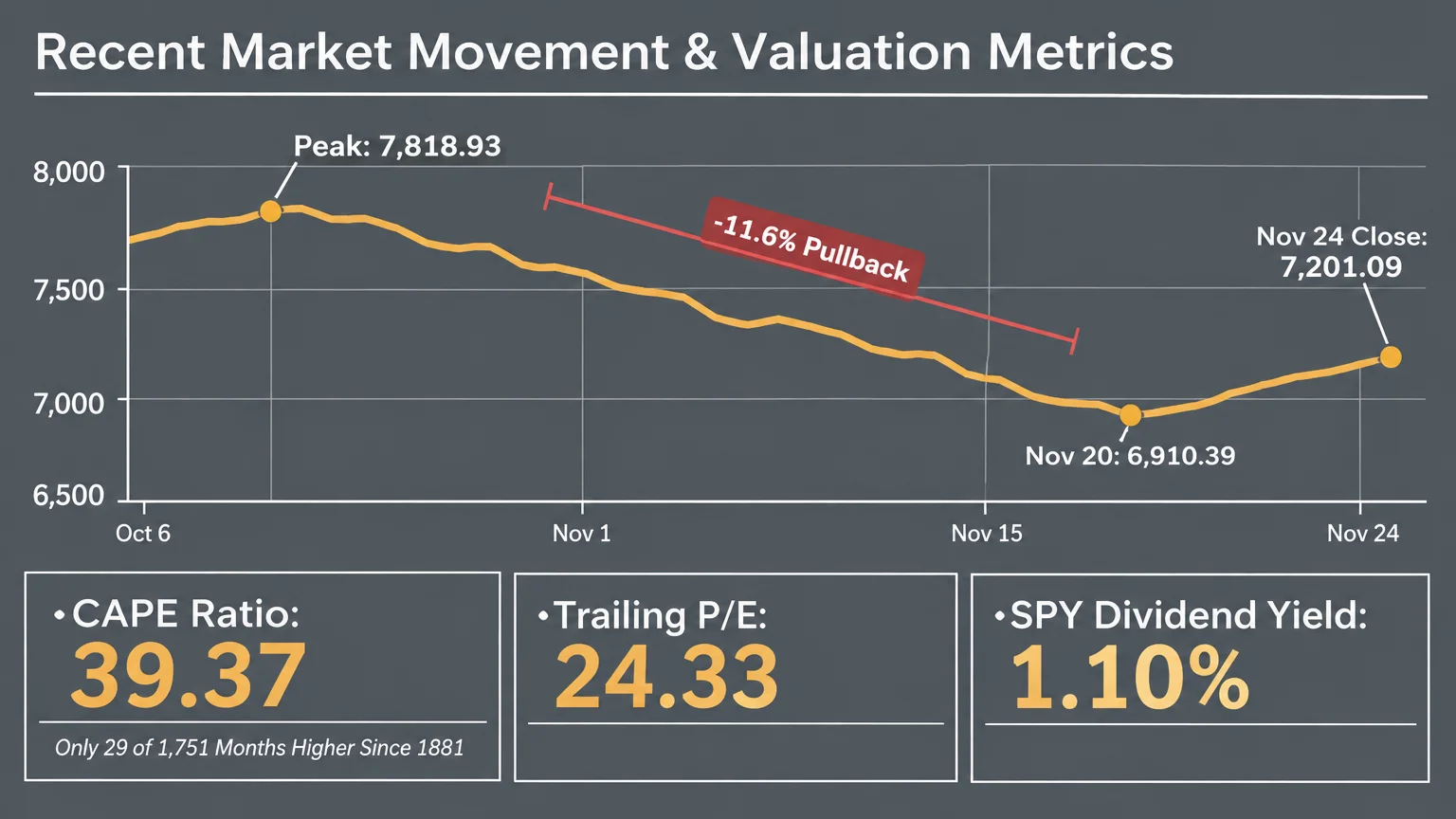
The S&P 500 closed at 7,201.09 on November 24, 2026, leaving the index up 5.2% year-to-date and 7.4% year-over-year, according to Macrotrends. Yet that figure sits 7.9% below its October 6 record close of 7,818.93.
Between October 6 and November 20, the index dropped 11.6% to 6,910.39 before rebounding sharply on November 23, per Trefis and Investing.com data. Swings like that remind retirees how quickly paper gains can vanish when withdrawals are due.
Stock valuations also sit near historic highs. GuruFocus tracked the S&P 500 trailing price-to-earnings ratio at 24.33 on November 24, 2026, while the SPDR S&P 500 ETF (SPY) traded at 19 times forward 12-month earnings according to Motley Fool.
Meanwhile, Robert Shiller’s cyclically adjusted P/E (CAPE) ratio stood at 39.37 for November 2026 after crossing 40 in October, based on Yale dataset figures via MacroRadar. Only 29 of 1,751 months since 1881 have recorded higher CAPE readings.
High valuations shrink your margin of safety when you enter retirement investing for income rather than rapid growth. Expensive markets historically leave less room for error when you sell shares every month to cover living expenses.
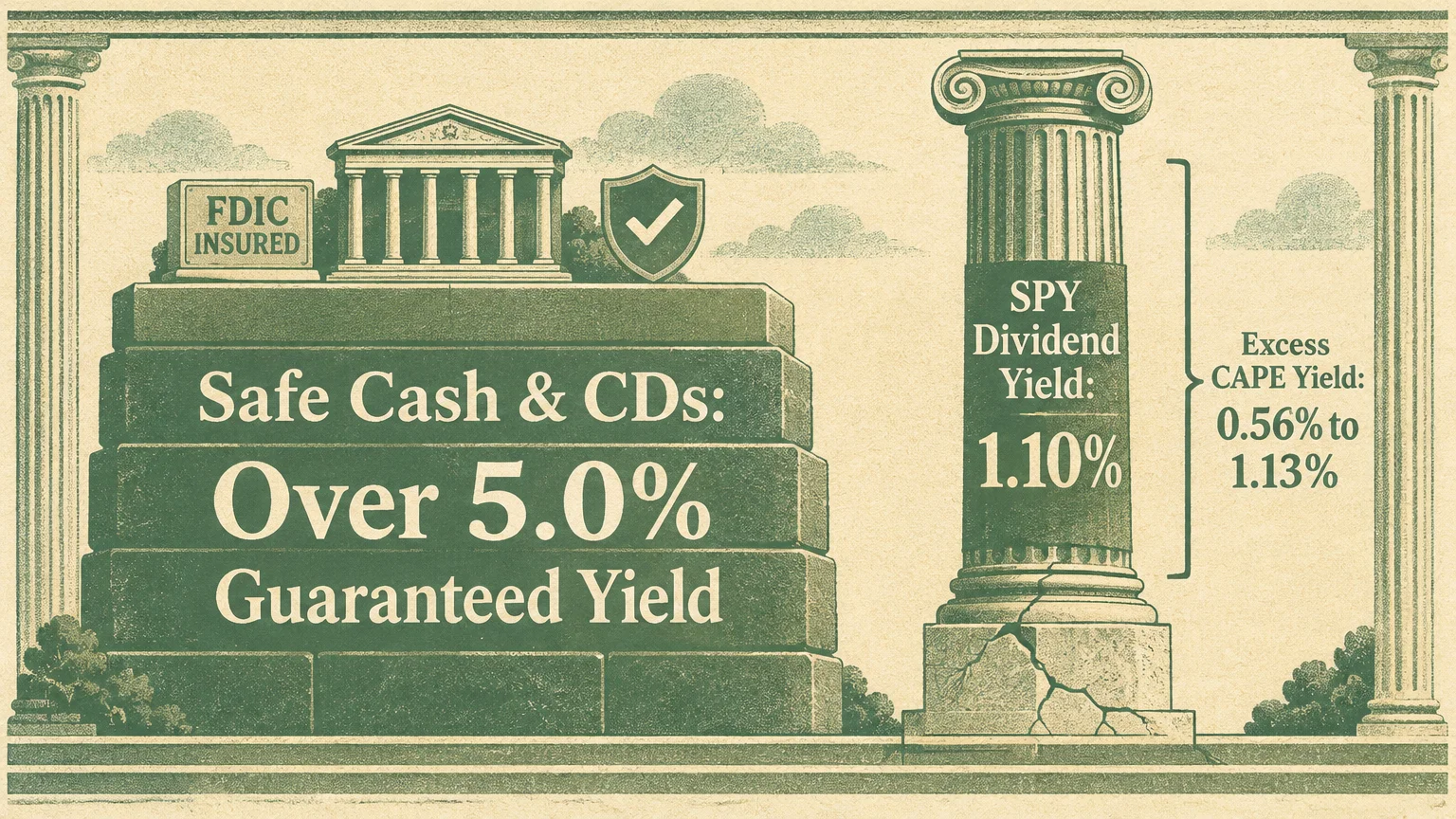
Dividend income from the broad index offers little cushion right now. SPY’s trailing 12-month dividend yield measured just 1.10% in late November 2026, according to Motley Fool and Dividend-Wealth.
At the same time, the excess CAPE yield—comparing cyclically adjusted stock earnings yields against real 10-year Treasury yields—narrowed to 0.56 percentage points in October 2026 before reading 1.13% in November, per The Trading Tools. Stocks no longer enjoy the massive yield advantage over safe bonds they held a decade ago.
The Hidden Concentration Risk Inside Your Index Funds
Many people choose index funds in retirement because they expect broad diversification across 500 major U.S. companies. Under the hood, however, market-capitalization weighting currently concentrates your money in just a handful of giant corporations.
As of November 12, 2026, State Street Global Advisors data showed that the 10 largest stocks accounted for roughly 36.9% of SPY. More than one-third of every dollar you hold in a standard S&P 500 fund rides on just 10 businesses.
The seven largest technology and consumer leaders—Apple, Microsoft, Nvidia, Alphabet, Amazon, Meta, and Tesla—represented 33.2% of total S&P 500 market capitalization on November 24, 2026. That share climbed sharply from 13.0% at year-end 2018.
Seven-stock concentration now sits at its highest mark since the 1970s Nifty Fifty era, according to History of Market calculations summing SPY holdings. Instead of owning a balanced slice of the American economy, you own a portfolio heavily tilted toward mega-cap growth stocks.
Single-company headlines can jolt your entire balance in hours. Apple carries roughly an 8% weight in the index, while Nvidia accounts for roughly 6% to 8%, based on State Street, Motley Fool, and PrimeXBT figures.
When Nvidia CEO Jensen Huang abruptly resigned on November 12, 2026, Nvidia shares fell 4.34% that day before he was reinstated on November 23, per Form 8-K filings and Trefis reporting. One executive announcement at one firm can ripple immediately through millions of retirement accounts.
True diversification means your retirement paycheck never depends on the fortunes of seven mega-cap stocks moving in lockstep.
Recognizing this concentration helps you evaluate market risk for retirees honestly. You do not need to abandon U.S. stocks, yet you should verify whether one-third of your equity sleeve belongs in seven companies.
How Safe Cash and Bonds Compete With Stocks Today
For much of the past two decades, near-zero interest rates forced conservative savers into stocks just to earn a modest return. Today’s rate landscape gives you genuine fixed-income choices again.
On September 16, 2026, the Federal Reserve raised its federal funds target range by 25 basis points to 3.75%–4.00%, marking its first rate hike since 2023. Policymakers held that range steady on October 28, with median projections pointing toward 4.1% at year-end 2026 and 2027.
Longer-term government debt reflects those higher rates. The 10-year U.S. Treasury yield reached 4.92% on November 20–23, 2026, climbing 0.86 percentage points from 4.06% a year earlier according to Federal Reserve H.15 data.
Bank and brokerage cash accounts now pay meaningful income too. Top certificates of deposit yielded up to 5.10% APY as of November 25, 2026, according to Curinos data reported by Fortune.
Leading high-yield savings accounts offered up to 4.70% APY in mid-November, while money market funds averaged roughly 4.25% according to Vanguard Lab. Compare those rates with the 0.38%–0.39% national average savings rate tracked by the FDIC.
Keeping emergency reserves or near-term spending money in a traditional bank account forfeits substantial guaranteed interest. Moving idle cash into top-yielding accounts lets you fund living expenses without selling equities during a downturn.
Tax-sensitive investors also have renewed opportunities in municipal debt. Following September losses, the Bloomberg Municipal Bond Index returned 3.62% in October 2026—its strongest October on record—while the Bloomberg High Yield Municipal Index stood up 1.67% year-to-date.
| Asset Class (Nov 2026) | Current Yield or Return | Concentration / Risk Profile | Best Retirement Role |
|---|---|---|---|
| Cap-Weighted S&P 500 (SPY) | 1.10% trailing dividend yield | 36.9% in top 10 stocks; high volatility | Long-term growth sleeve |
| Equal-Weight S&P 500 (RSP) | 1.53% trailing dividend yield | 2.7% in top 10 stocks; broader sector mix | Diversified large-cap core |
| 10-Year U.S. Treasury | 4.92% yield | Backed by U.S. government; price moves with rates | Income ladder and ballast |
| Top Certificates of Deposit | Up to 5.10% APY | FDIC-insured; early withdrawal penalties apply | 1- to 5-year spending buffer |
| Top High-Yield Savings | Up to 4.70% APY | FDIC-insured; variable rate, instant access | Emergency fund and monthly bills |
This comparison highlights why S&P 500 funds retirees hold face real competition right now. Locking in 4.70% to 5.10% on short-term cash reduces pressure on your stock portfolio during bumpy markets.
Cap-Weighted vs. Equal-Weight S&P 500 Funds
Scaling back concentration risk does not require abandoning large U.S. companies altogether. Shifting a portion of your S&P 500 exposure toward an equal-weight index fund spreads your money evenly across all 500 member businesses.
In the Invesco S&P 500 Equal Weight ETF (RSP), the top 10 holdings make up just 2.7% of the portfolio, compared with 36.9% in SPY. No single company dominates your daily results.
Market leadership showed signs of broadening during autumn 2026. After the ratio of RSP to SPY touched a post-2003 low on October 7, RSP gained roughly 4.9% in October while SPY slipped about 0.9%, per Bloomberg and Seeking Alpha data.
That 5.8-percentage-point monthly gap marked equal weight’s strongest outperformance since April 2009. From October 6 through November 24, 2026, SPY fell 7.7% while RSP rose 0.77%, according to Trefis.
Equal-weight funds carry clear trade-offs you should weigh before swapping shares. RSP charges a 0.20% expense ratio compared with 0.09% for SPY, though RSP also delivers a higher 1.53% trailing dividend yield versus SPY’s 1.10%, per Dividend-Wealth.
Over longer bull runs driven by giant tech firms, traditional cap-weighted funds have led. SPY delivered a 56.9% five-year total return compared with 40.7% for RSP, and SPY finished ahead after full recoveries in 8 of 9 completed 10%-plus sell-offs since May 2003.
Blending both styles gives you a practical middle ground. You keep upside participation in market leaders while dampening the jolt if mega-cap tech stumbles.

Aligning Withdrawals, Inflation, and Social Security
Your ideal stock allocation depends directly on how much annual cash you pull from your accounts. Before adjusting any fund, calculate what your portfolio must cover beyond guaranteed monthly checks.
Morningstar’s latest State of Retirement Income report estimates 3.9% as the highest safe starting withdrawal rate for steady, inflation-adjusted spending over 30 years at a 90% success rate, assuming a 30% to 50% equity allocation. That figure rose from 3.7% the prior year.
Flexible spending rules allow higher starting income. Morningstar notes that retirees who use spending guardrails—trimming withdrawals slightly during down market years—can safely start as high as 5.7% to nearly 6%.
Other leading benchmarks point to similar ranges. William Bengen, creator of the original four percent rule, places his revised worst-case safe starting rate at 4.7%, while Vanguard, Fidelity, and T. Rowe Price cite 4.0% to 4.5% for retirees with Social Security coverage and spending flexibility.
Notice the equity share behind Morningstar’s baseline estimate: 30% to 50% in stocks. If steady bull-market gains pushed your S&P 500 funds well above half of your total portfolio, your current risk exceeds what many retirement income models assume.
Inflation and healthcare costs add another layer to your math. U.S. headline Consumer Price Index inflation ran at 3.7% year-over-year in September 2026, with core inflation at 2.6%, per the Bureau of Labor Statistics.
On October 14, 2026, the Social Security Administration announced a 3.6% cost-of-living adjustment (COLA) for 2027. That raise lifts the average retired worker’s check by $75 per month, from $2,095 to $2,170 starting January 2027.
Yet healthcare premiums absorb part of that boost. On November 17, 2026, the Centers for Medicare & Medicaid Services announced that the standard 2027 Medicare Part B premium will climb $6.50, or 3.2%, to $209.40 per month—eating roughly 9% of the average COLA increase.
You can verify benefit estimates and plan changes directly through SSA.gov and Medicare.gov. Roughly 44% of senior Americans in 2026 relied on Social Security as their sole income source, according to the American Legion, underscoring how crucial it is to protect supplemental savings.
Practical Steps for Portfolio Rebalancing and Tax Planning
Effective portfolio rebalancing lowers risk without creating surprise tax bills or disrupting your lifestyle. Follow this step-by-step sequence to evaluate and adjust your S&P 500 holdings.
- Measure your total equity weight: Add up your S&P 500 funds, target-date funds, and individual stocks across every IRA, 401(k), and taxable brokerage account to find your true stock percentage.
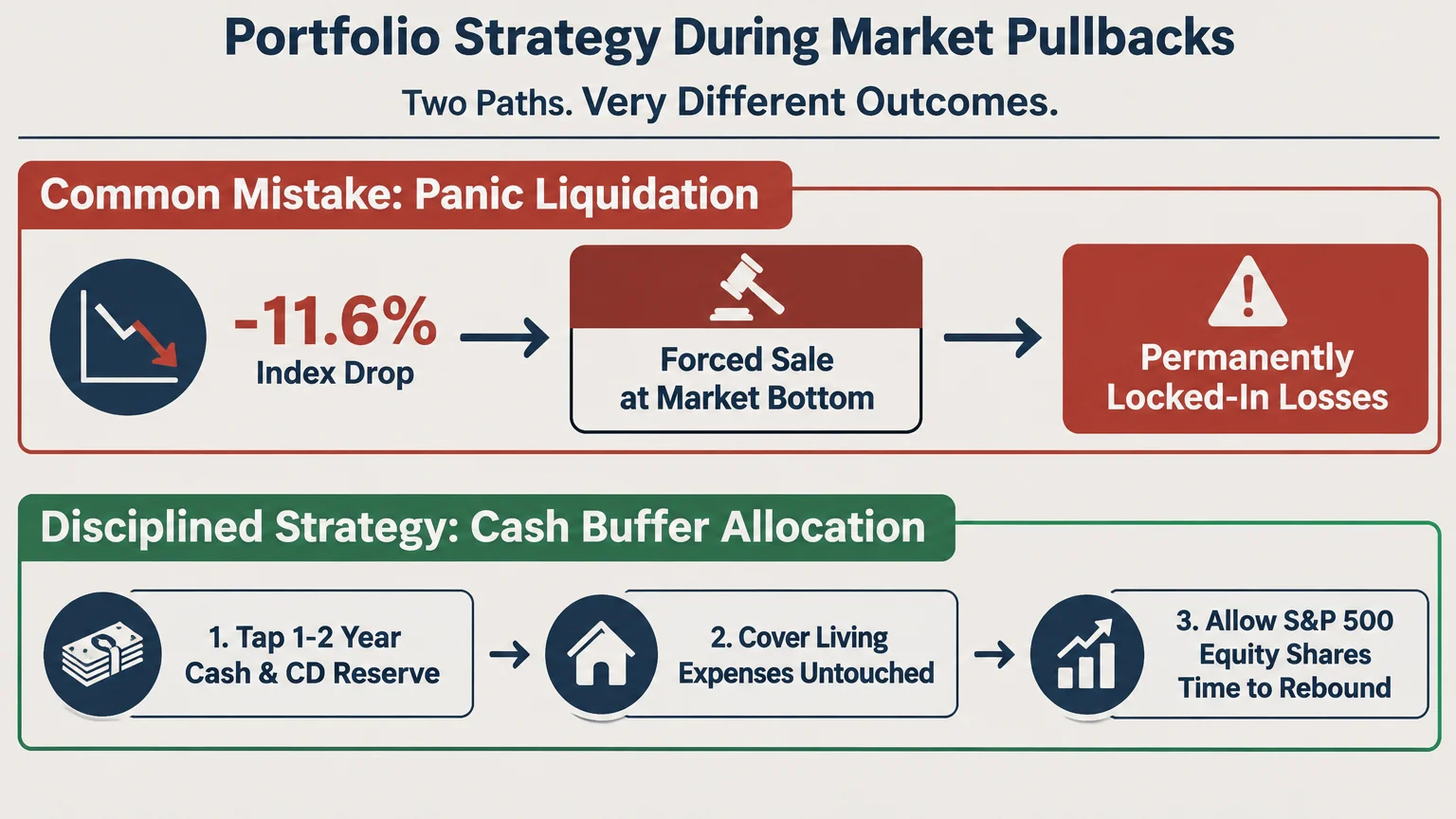
- Build a near-term cash buffer: Move upcoming spending cash from low-interest checking accounts into high-yield savings up to 4.70% APY, money market funds near 4.25%, or CDs up to 5.10% APY so you never sell stocks during an 11% slump.
- Rebalance inside tax-deferred accounts first: Trim overweight SPY or S&P 500 shares inside traditional IRAs or 401(k)s, where trades trigger zero capital gains taxes, and shift proceeds into Treasuries, CDs, or equal-weight equities.
- Direct new dividends and deposits away from overweight funds: Turn off automatic dividend reinvestment on cap-weighted S&P 500 shares in taxable accounts and route that cash toward underweighted bonds or cash reserves.
- Coordinate Required Minimum Distributions (RMDs): Under the SECURE 2.0 Act, RMDs begin at age 73 for people born 1951–1959 and rise to age 75 in 2033 for those born in 1960 or later, while Roth IRAs and Roth workplace plans require no lifetime RMDs for original owners.
- Use Qualified Charitable Distributions (QCDs): If you are age 70½ or older, you can transfer up to $111,000 in 2026 directly from an IRA to qualified charities, satisfying RMD rules without adding taxable income.
If you are still working part-time or approaching retirement, updated IRS contribution limits give you extra room to fortify safe buckets. Under IRS Notice 2026-66, standard 401(k), 403(b), and 457(b) limits sit at $24,500 in 2026 and rise to $25,500 in 2027.
Workers age 50 and older can add an $8,000 catch-up contribution in 2026, increasing to $8,500 in 2027 for a $34,000 total. Those aged 60 through 63 qualify for a higher super catch-up limit of $11,250 in 2026 and $11,750 in 2027.
Note a key tax change starting in 2026: employees age 50 and older whose prior-year FICA wages with their employer topped $150,000—rising to $155,000 for 2027—must direct workplace catch-up contributions into Roth after-tax accounts. Traditional and Roth IRA limits stay at $7,500 plus a $1,100 age-50-plus catch-up for both 2026 and 2027.
Review current contribution and distribution rules anytime at IRS Retirement Plans. You can also explore plain-language retirement planning guides through the Consumer Financial Protection Bureau.
Costly Mistakes to Avoid
Even disciplined savers stumble when markets turn choppy or interest rates shift. Watch out for these frequent errors when adjusting your index funds.
- Panic-selling during a pullback: Exiting S&P 500 funds after an 11% slide locks in temporary losses and causes you to miss sharp rebounds like the recovery in late November 2026.
- Leaving cash in near-zero bank accounts: Accepting the 0.38%–0.39% national average savings rate quietly erodes purchasing power when inflation runs at 3.7% and FDIC-insured alternatives pay 4.70% to 5.10%.
- Dumping all equities at once: Cutting your stock allocation to zero leaves a 30-year retirement defenseless against long-term inflation.
- Triggering avoidable capital gains in taxable accounts: Selling decades-old S&P 500 shares in a brokerage account without checking tax brackets can push you into higher capital gains tiers and increase Medicare Part B premiums.
- Missing RMD deadlines: Overlooking a required IRA or 401(k) withdrawal triggers a 25% IRS penalty on the shortfall, reduced to 10% only if you fix the mistake within two years.
Avoiding these missteps often saves more money than trying to time short-term market peaks. Steady, tax-aware adjustments keep your plan intact through every market cycle.
Don’t DIY These Decisions
Managing basic portfolio rebalancing inside an IRA is straightforward for many retirees. Still, several high-stakes moves justify partnering with a fee-only financial planner, CPA, or benefits specialist.
Seek professional guidance before selling large blocks of appreciated S&P 500 shares held in a taxable brokerage account. A tax advisor can map out multi-year sales or charitable giving strategies that minimize federal taxes and protect your Medicare premium brackets.
Work with a specialist if you are planning Roth IRA conversions between retirement and age 73 or 75 when RMDs begin. Calculating exact bracket thresholds prevents unintended tax spikes on Social Security benefits.
Consult a qualified advisor or Social Security claiming specialist if you and a spouse hold uneven work histories, pensions, or survivor benefit questions. Coordinating claiming ages alongside your portfolio withdrawal rate strengthens lifetime household security.
Finally, have an elder law or estate attorney review account beneficiaries and titling alongside your investment changes. Updating beneficiary forms ensures your retirement accounts pass smoothly without probate delays.
Frequently Asked Questions About S&P 500 Funds in Retirement
Should retirees sell all their S&P 500 index funds right now?
No, abandoning stocks completely exposes a multi-decade retirement to 3.7% inflation eating away at fixed-income purchasing power. Instead, verify whether mega-cap growth gains pushed your stock allocation above your target and trim only the excess into safer assets.
How much of a retiree’s portfolio should stay in stocks?
Morningstar’s baseline 3.9% safe withdrawal model assumes a 30% to 50% equity allocation, while flexible retirees with strong Social Security coverage sometimes hold more. Your exact share depends on how much monthly spending comes from guaranteed checks versus portfolio withdrawals.
Are equal-weight S&P 500 funds safer than traditional index funds?
Equal-weight funds reduce single-company risk dramatically, holding just 2.7% in their top 10 stocks compared with 36.9% in cap-weighted SPY. However, they still fall during broad market recessions and charge slightly higher annual fees, so treat them as equity diversifiers rather than cash substitutes.
Where can retirees move trimmed S&P 500 money for reliable yield?
Depending on when you need the cash, current options include high-yield savings up to 4.70% APY, money market funds near 4.25%, certificates of deposit up to 5.10% APY, or 10-year U.S. Treasuries yielding 4.92%. Retirees in higher tax brackets may also consider municipal bond funds for tax-exempt interest.

Your Next Step This Week
Log in to your retirement accounts today and check two numbers: your overall stock percentage and the interest rate on your cash reserves. If S&P 500 gains pushed your risk above your comfort zone or your bank pays under 1%, make one measured rebalancing move inside an IRA or shift idle cash into higher-yielding accounts.
This article is for informational purposes only and does not constitute financial, legal, or medical advice. Medicare rules, Social Security benefits, and tax laws change regularly—verify current details at Medicare.gov, SSA.gov, or with a licensed professional.
Last updated: November 2026. Medicare and Social Security rules change annually—always verify current details at official government sources.