Lawmakers are advancing plans to raise Social Security taxes on higher-earning workers to avert automatic benefit cuts. If you earn above the annual wage cap or run a business, these legislative proposals could significantly increase your tax bill.
Without congressional intervention, the retirement trust fund faces depletion by late 2032, triggering a painful 22% across-the-board benefit reduction. Washington’s primary solution focuses on closing that gap through targeted payroll tax increases.
Understanding these proposals helps you adjust your tax planning, protect your retirement income, and make informed claiming decisions. Here is how the numbers break down and what they mean for your wallet.
What You Need to Know
Congress faces an urgent deadline to fix Social Security’s long-term financing before trust fund reserves run out. Several competing legislative proposals aim to raise social security taxes on top earners to plug the shortfall.
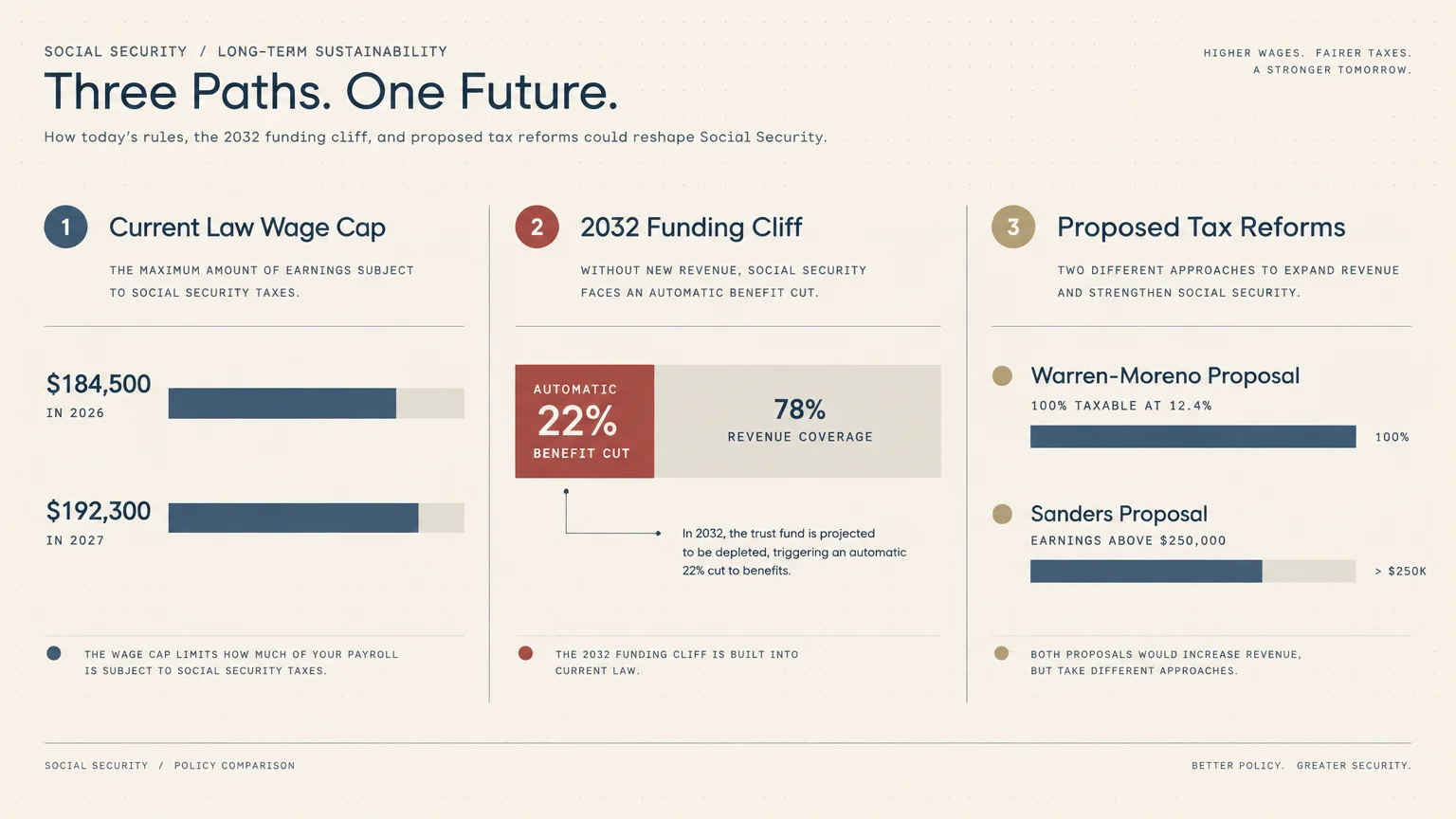
- The Old-Age and Survivors Insurance (OASI) trust fund will exhaust its reserves in the fourth quarter of 2032 without legislative reform.
- The taxable wage cap is $184,500 in 2026 and rises to $192,300 in 2027.
- The bipartisan Warren-Moreno proposal would eliminate the earnings cap entirely, subjecting all wages to the 12.4% payroll tax.
- Senator Bernie Sanders proposes applying the tax to all earnings and net investment income above $250,000.
- If lawmakers fail to act, retirees face an automatic 22% benefit cut starting in late 2032.
These policy shifts could fundamentally alter tax planning for individuals earning over the threshold. Evaluating these changes now gives you time to adapt your financial plans.
Why Social Security Faces an Impending Funding Cliff
The Social Security program operates on a pay-as-you-go structure where current workers fund today’s retiree benefits. Demographic shifts have placed an unprecedented strain on this foundational system.
Tens of millions of baby boomers are leaving the workforce while birth rates remain historically low. Consequently, fewer active workers now support each retired beneficiary.
According to the June 2026 Social Security Trustees Report, the OASI trust fund will deplete its asset reserves in the fourth quarter of 2032. That projection moved up from early 2033 in the prior report.
Once reserves run dry, incoming payroll tax revenues will only cover 78% of scheduled retirement benefits. That dynamic triggers an automatic, across-the-board cut of 22% for every beneficiary.
The Committee for a Responsible Federal Budget calculates that a 22% cut would cost a typical newly retired dual-income couple roughly $16,900 per year in lost benefits. For single earners, the reduction would total thousands of dollars annually.
The program faces a massive 75-year actuarial deficit of 4.42% of taxable payroll. In dollar terms, that equals a present-value cash shortfall between $29.3 trillion and $30 trillion.
If Congress combines the retirement fund with the Disability Insurance trust fund, insolvency pushes back to the third quarter of 2034. At that stage, incoming revenues would cover 83% of benefits, creating a 17% automatic cut.
Lawmakers understand that allowing benefit reductions of this magnitude would devastate millions of American households. Because benefit cuts remain politically toxic, Congress has focused heavily on revenue-raising alternatives.
How the Social Security Payroll Tax Works Right Now
Workers currently pay into the system through Federal Insurance Contributions Act (FICA) deductions on their paychecks. Understanding the baseline mechanics shows why reform proposals target high earners.
The statutory Social Security payroll tax rate stands at 12.4%. Traditional W-2 employees pay 6.2% out of their paychecks, while their employers match that with another 6.2% contribution.
Self-employed professionals cover both sides through the Self-Employment Contributions Act, paying the full 12.4% out of pocket. In contrast, the 1.45% Medicare payroll tax applies to every single dollar you earn without any ceiling.
Social Security taxes stop once your earnings exceed the taxable wage base limit for the calendar year. In 2026, the maximum amount of annual earnings subject to the tax is $184,500.
An employee hitting the 2026 wage cap pays a maximum tax of $11,439. A self-employed worker earning at or above that ceiling pays $22,878.
On October 14, 2026, the government announced the taxable wage limit for 2027 will increase by $7,800 to $192,300. That adjustment accompanied a 3.6% Cost-of-Living Adjustment (COLA) that raises the average monthly benefit from $2,095 to $2,170.
In 2027, high earners at or above the cap will pay up to $11,922.60 in payroll taxes. Self-employed individuals will face a maximum bill of $23,845.20, representing an extra $967.20 over 2026.
Roughly 6% of covered workers earn above the wage cap each year. Because executive pay and top-tier wages have grown much faster than average wages, fewer total earnings face taxation today.
In 1983, the payroll tax covered 90% of all wages earned across the United States. Today, the tax reaches only about 83% of covered earnings, creating a wider revenue gap.
The Warren-Moreno Proposal: Eliminating the Wage Cap Completely
In June 2026, Senators Elizabeth Warren and Bernie Moreno unveiled a bipartisan plan to eliminate the taxable wage ceiling entirely. The joint proposal represents a rare moment of cross-party alignment on entitlement reform.
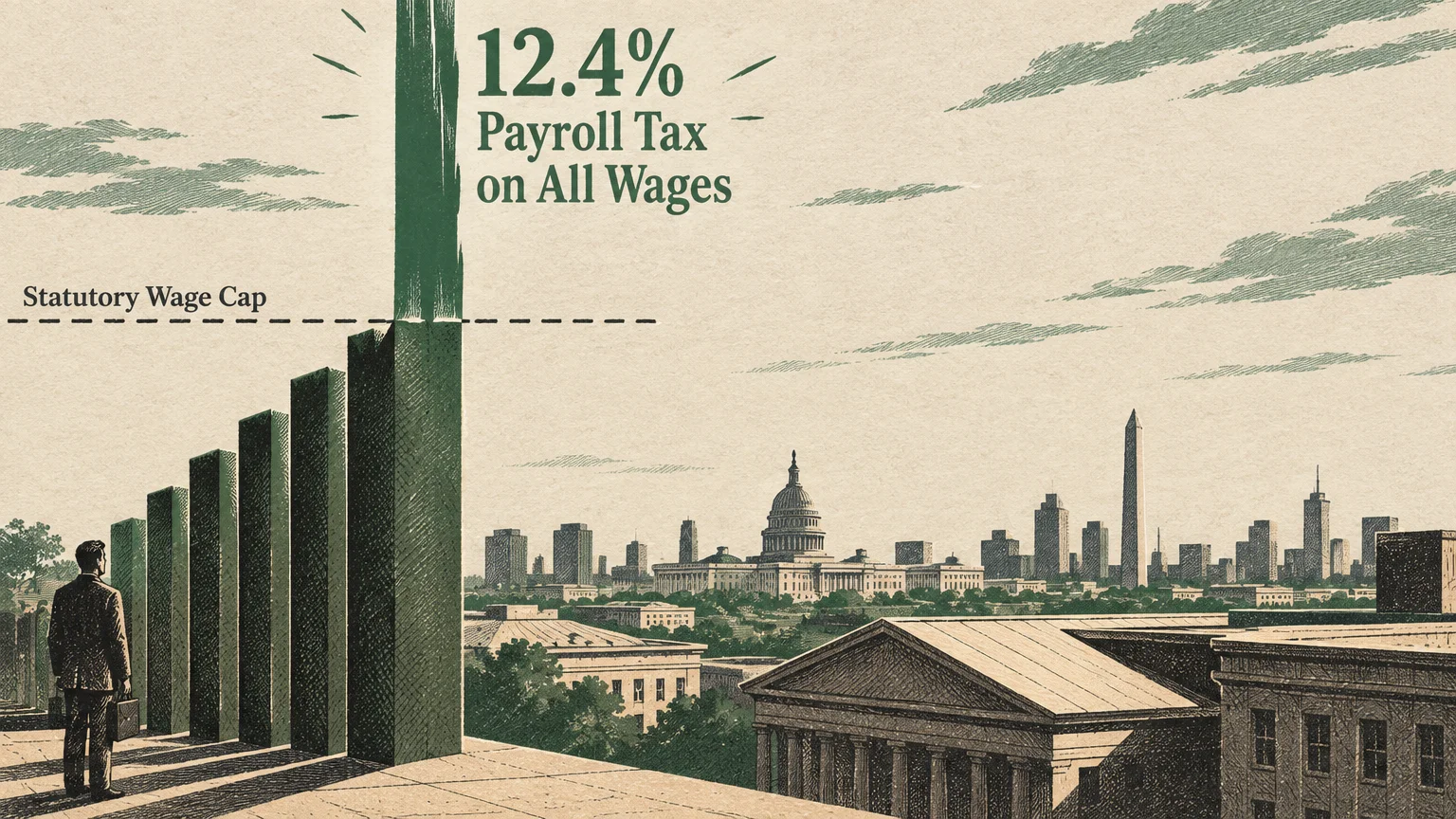
Under this approach, lawmakers would remove the wage cap Social Security relies on, subjecting 100% of earned income to the 12.4% payroll tax. Every dollar earned above the current limit would face full taxation.
High earners would receive no additional retirement benefit credits for the extra taxes they contribute. The primary objective is shoring up system solvency rather than expanding individual payouts.
Policy analysts estimate that eliminating the cap without granting extra benefit credits would close roughly 58% of the program’s 75-year shortfall. That move alone would push trust fund exhaustion deep into the future.
However, this proposal creates significant tax consequences for higher-income professionals. Adding a 12.4% tax on top-tier wages pushes the top combined federal marginal tax rate to 49.4%.
That calculation combines the existing 37% federal income tax bracket with the 12.4% payroll assessment. When factoring in state income taxes, high-earning residents in states like California or New York could see marginal tax rates exceed 60%.
Business owners who employ high-salaried staff would also absorb substantial costs. Employers would have to contribute their 6.2% matching share on all executive compensation without limitation.
The Social Security Expansion Act: The Donut Hole Approach
Senator Bernie Sanders renewed his push for the Social Security Expansion Act following the November 2026 midterm elections. This bill outlines a different method to raise social security taxes while boosting benefits.
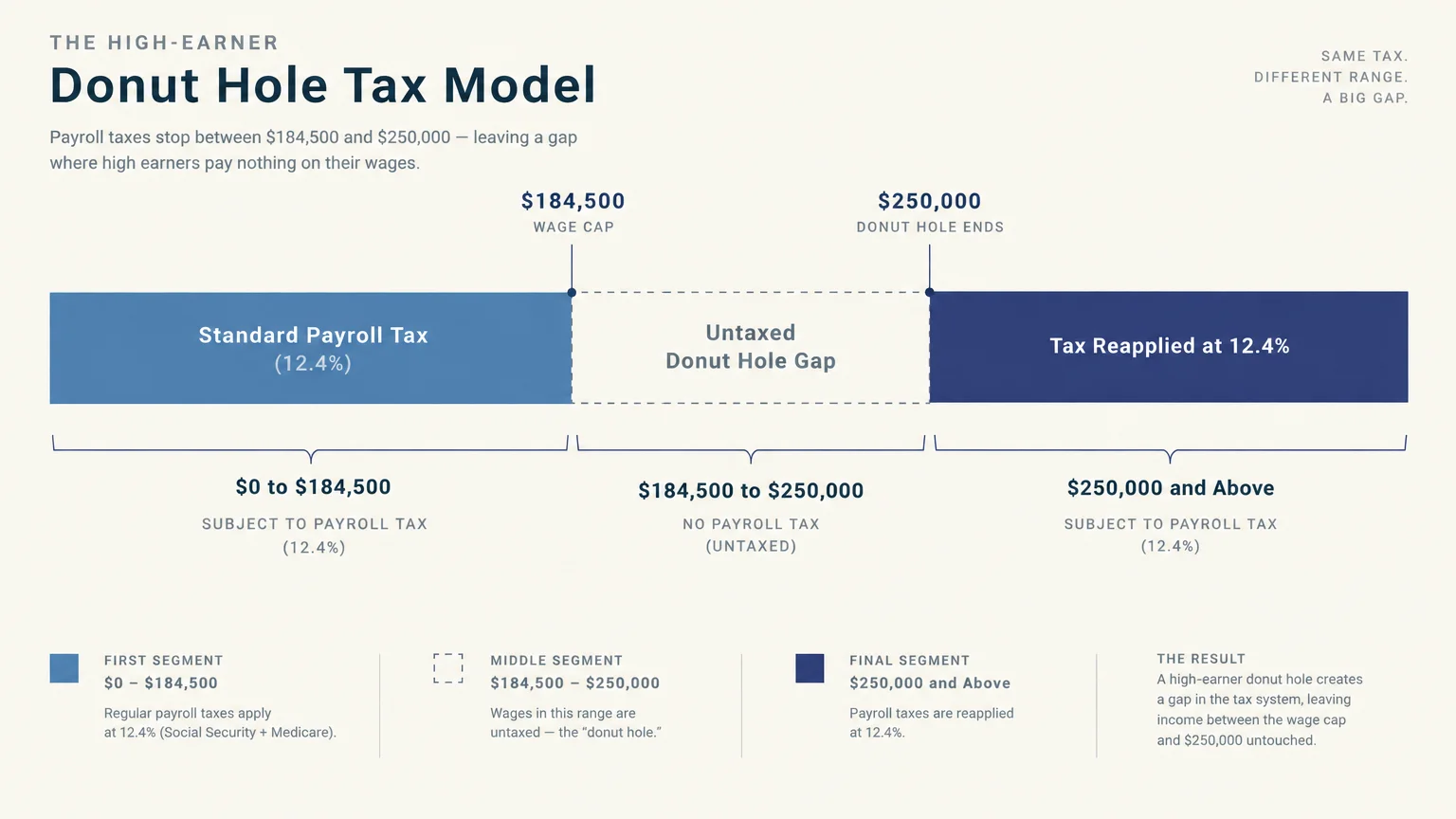
Instead of eliminating the cap immediately, this proposal establishes a temporary “donut hole.” Income between the regular wage cap ($192,300 in 2027) and $250,000 remains exempt from payroll taxes.
Once your earnings exceed $250,000, the 12.4% tax kicks back in completely. Over time, as the regular wage cap climbs with national wage growth, the donut hole naturally narrows and disappears.
The Sanders proposal also targets unearned revenue by applying the 12.4% tax to net investment income for high earners. That provision would hit dividends, capital gains, and rental income for households earning over $250,000.
Unlike the Warren-Moreno plan, this measure uses new revenues to expand monthly payouts for current and future beneficiaries. It provides an across-the-board benefit increase of $2,400 per year, delivering an extra $200 each month.
The bill also shifts annual COLA calculations to the Consumer Price Index for the Elderly (CPI-E). The CPI-E places greater weight on healthcare and housing expenses, typically generating higher annual increases.
The Social Security 2100 Act: Targeted High-Earner Contributions
Representative John Larson continues to champion the Social Security 2100 Act in the House of Representatives. This long-standing proposal creates a higher income threshold before reapplying payroll taxes.
Under Larson’s framework, earnings up to the standard wage cap face normal taxation, while earnings between the cap and $400,000 remain untaxed. The 12.4% tax applies only to earned income exceeding $400,000.
This structure shields upper-middle-class earners and managers from immediate tax hikes. It focuses the revenue collection purely on top corporate executives, physicians, and business owners.
The plan also includes targeted benefit enhancements for low-income retirees and surviving spouses. It aims to eliminate senior poverty while maintaining long-term trust fund solvency.
Because the $400,000 threshold sits higher than the $250,000 limit, it generates less revenue than the Sanders plan. Consequently, lawmakers often debate combining this threshold with gradual tax rate increases.
Comparing the Reform Plans: Who Pays and What Changes
Evaluating each legislative model side by side clarifies how these changes could impact your household finances. The plans balance tax increases against potential benefit improvements in distinct ways.
| Proposal / Framework | Taxable Earnings Threshold | Applies to Investment Income? | Benefit Increases Included? | Impact on 75-Year Deficit |
|---|---|---|---|---|
| Current Law (2026/2027) | Up to $184,500 (2026) / $192,300 (2027) | No | No (scheduled 22% cut in late 2032) | None (leaves $30T funding shortfall) |
| Warren-Moreno Proposal | All earnings (100% of wages, no cap) | No | No additional benefit credits granted | Closes roughly 58% of the shortfall |
| Social Security Expansion Act (Sanders) | Earnings and unearned income above $250,000 | Yes (applies 12.4% to net investment income) | +$2,400 per year ($200/mo) and CPI-E COLA | Closes the long-term funding gap |
| Social Security 2100 Act (Larson) | Earnings above $400,000 (creates donut hole) | No | Targeted bumps for lower-income seniors | Extends solvency for multiple decades |
Each option requires tradeoffs between individual tax liability and program solvency. High earners shoulder most of the financial burden across all leading legislative proposals.
Taxpayers must recognize that these bills reflect serious legislative momentum. As the 2032 deadline approaches, Congress will face intense pressure to enact one of these models.
Who Would Feel the Financial Squeeze Most?
A social security tax increase would hit several groups of Americans far harder than the average wage earner. Identifying whether you fall into these categories helps you adapt your financial roadmap.
W-2 corporate managers, attorneys, software engineers, and medical professionals earning above $200,000 would see immediate reductions in net take-home pay. Their employers would withhold an extra 6.2% on earnings above the enacted threshold.
Self-employed freelancers, independent contractors, and solo practitioners face double the exposure. Because they pay both the employee and employer portions, their tax bill climbs by 12.4% on those excess earnings.
Consider an independent consultant netting $350,000 per year under the Warren-Moreno framework. Lifting the 2027 cap of $192,300 leaves $157,700 in previously untaxed income subject to the 12.4% levy.
That business owner would owe an extra $19,554 in annual self-employment taxes. That represents a significant reduction in discretionary cash flow that could otherwise fund retirement savings.
Older workers between ages 60 and 70 who delay claiming while earning high salaries would also face these deductions. Working late in your career to maximize your eventual benefit check could carry higher tax costs.
Retirees who rely heavily on taxable brokerage accounts could feel the impact under bills taxing investment income. A 12.4% surtax on capital gains and dividends would drastically alter safe withdrawal rates.

How Higher Taxes Could Reshape Your Retirement Strategy
If Congress implements any version of these proposals, you will need to re-evaluate your income and asset locations. Traditional retirement rules of thumb may require significant adjustments.
High earners approaching retirement might consider shifting more compensation into tax-deferred retirement vehicles. Maximizing traditional 401(k), 403(b), or defined-benefit plans lowers your taxable earned income base.
Reviewing contribution guidelines through the IRS Retirement Plans portal helps ensure you leverage available tax deductions. Reducing your reported income helps minimize exposure to newly enacted payroll tax thresholds.
Business owners operating as sole proprietorships might examine whether an S-corporation structure provides tax efficiency. S-corporations divide income into W-2 wages and shareholder distributions, though distributions must reflect reasonable compensation guidelines.
Tax diversification across tax-deferred, Roth, and taxable accounts becomes essential when federal tax rates increase. Drawing income from Roth accounts during retirement creates zero earned income and avoids triggering payroll tax liabilities.
Understanding these dynamics is vital for preserving wealth across multiple decades of life after work. Careful planning protects your hard-earned savings from excessive taxation.
“It’s not how much money you make, but how much money you keep, how hard it works for you, and how many generations you keep it for.” — Robert Kiyosaki
Preserving your wealth requires proactive management rather than passive acceptance of changing tax codes. Reviewing your asset location today prevents unnecessary losses tomorrow.
Don’t Make These Mistakes
Policy debates in Washington often create anxiety that leads individuals into rash financial decisions. Avoiding common missteps protects your long-term economic security.
Do not claim your Social Security benefits early simply because you fear trust fund insolvency. Claiming at age 62 permanently reduces your monthly check by up to 30% compared to full retirement age.
Even if Congress allowed the projected 22% cut to occur in late 2032, claiming early locks in an even steeper permanent reduction. Delaying until age 70 guarantees an 8% annual delayed retirement credit up to your cap.
Do not assume that Social Security reform will only affect traditional corporate employees. Independent contractors, partners, and LLC members often face the heaviest tax burden under expanded payroll assessments.
Do not ignore the timing of business income recognition or bonus payouts if Congress debates active tax legislation. Moving earnings across tax years can sometimes keep you under newly enacted thresholds.
Do not overlook the resources provided by the Consumer Financial Protection Bureau Retirement planning hub. Utilizing validated planning tools keeps you grounded in verified numbers rather than sensationalized headlines.
Failing to review your personalized earnings record represents another frequent error. You should regularly check your statements on the official government website to verify that past earnings are accurate.
Use the Social Security Retirement Estimator to calculate your projected benefits under various claiming ages. Having precise baseline figures makes adapting to legislative changes far easier.

When Professional Advice Is Worth It
Navigating complex tax legislation and retirement claiming strategies often requires specialized professional assistance. Knowing when to engage an expert saves you money and prevents irreversible errors.
If you earn more than $200,000 annually or manage a business, consulting a Certified Public Accountant (CPA) is invaluable. A CPA models the direct impact of proposed payroll tax changes against your entity structure.
Fee-only financial planners help you coordinate asset location strategies across taxable, tax-deferred, and Roth accounts. They analyze whether Roth conversions before legislative changes take effect could save you thousands.
Individuals approaching age 62 should consider consulting a dedicated Social Security claiming specialist. These professionals evaluate spousal benefits, survivor rights, and optimal claiming ages tailored to your health and family history.
If you need assistance navigating healthcare expenses alongside retirement taxes, State Health Insurance Assistance Program (SHIP) counselors offer free guidance. They clarify how Medicare premiums interact with your adjusted gross income.
Professional advice provides clarity when federal policy changes threaten your financial stability. Investing in expert analysis helps you retain control over your retirement lifestyle.
Frequently Asked Questions
Will my current monthly Social Security check decrease if taxes are not raised?
Your current benefits remain safe today, but the OASI trust fund will deplete its reserves in late 2032. If Congress takes no action, benefits will drop automatically by 22% in the fourth quarter of 2032.
What is the maximum earnings cap subject to Social Security tax right now?
The taxable wage cap is $184,500 in 2026. On October 14, 2026, the government established the 2027 limit at $192,300, an increase of $7,800.
Would lifting the wage cap give high earners higher monthly retirement checks?
Under the leading Warren-Moreno proposal, high earners would receive no additional benefit credits for paying taxes above the cap. The Sanders plan pairs tax increases with a flat $2,400 annual increase for all recipients.
Does the Social Security payroll tax apply to 401(k) withdrawals or pensions?
No, payroll taxes apply only to earned wages and net self-employment earnings under current law. Withdrawals from retirement accounts are subject to regular income taxes, not payroll taxes.
Preparing for the Road Ahead
Social Security remains the cornerstone of financial security for American retirees, but its funding deficit demands legislative action. While high-earning households face potential tax increases, program stability benefits the broader economy.
Take time this week to review your Social Security statements and model your retirement cash flow against different tax scenarios. Staying informed and building flexibility into your financial plan ensures you thrive regardless of political shifts.
“The best time to plan for retirement was 20 years ago. The second best time is today.”
Information in this article reflects current rules as of the publication date and may change. Always confirm benefit details directly with Social Security Administration, Medicare.gov, or relevant government agencies before making decisions.
Last updated: November 2026. Medicare and Social Security rules change annually—always verify current details at official government sources.