Moving into retirement transforms your entire financial structure, family dynamic, and daily lifestyle. A will drafted during your peak earning years often reflects outdated priorities, such as guardian appointments for young children or old asset distributions, rather than current realities like tax-efficient wealth transfers and healthcare decisions. Failing to execute timely will updates for retirees can cause costly probate delays, unexpected tax bills for heirs, and family disputes. Updating your will after retirement ensures your estate plan mirrors your modern life, aligns with recent legislative changes like the SECURE Act, and distributes your hard-earned assets precisely according to your present wishes.

Key Takeaways
- Outdated wills cause unnecessary costs: Documents written decades ago rarely reflect your current assets, family structure, or state laws.
- Beneficiary designations override wills: Primary assets like IRAs, 401(k)s, and bank accounts transfer directly through named beneficiaries, bypassing your will entirely.
- Tax laws changed dramatically: The SECURE Act eliminated the traditional stretch IRA, requiring most non-spouse beneficiaries to drain inherited retirement accounts within 10 years.
- State relocations require document reviews: Moving to a new state in retirement can invalidate specific legal clauses due to local probate code differences.
- Comprehensive planning goes beyond wills: Estate planning in retirement requires financial powers of attorney, healthcare proxies, and digital asset management.
Why Updating Your Will After Retirement Is Essential
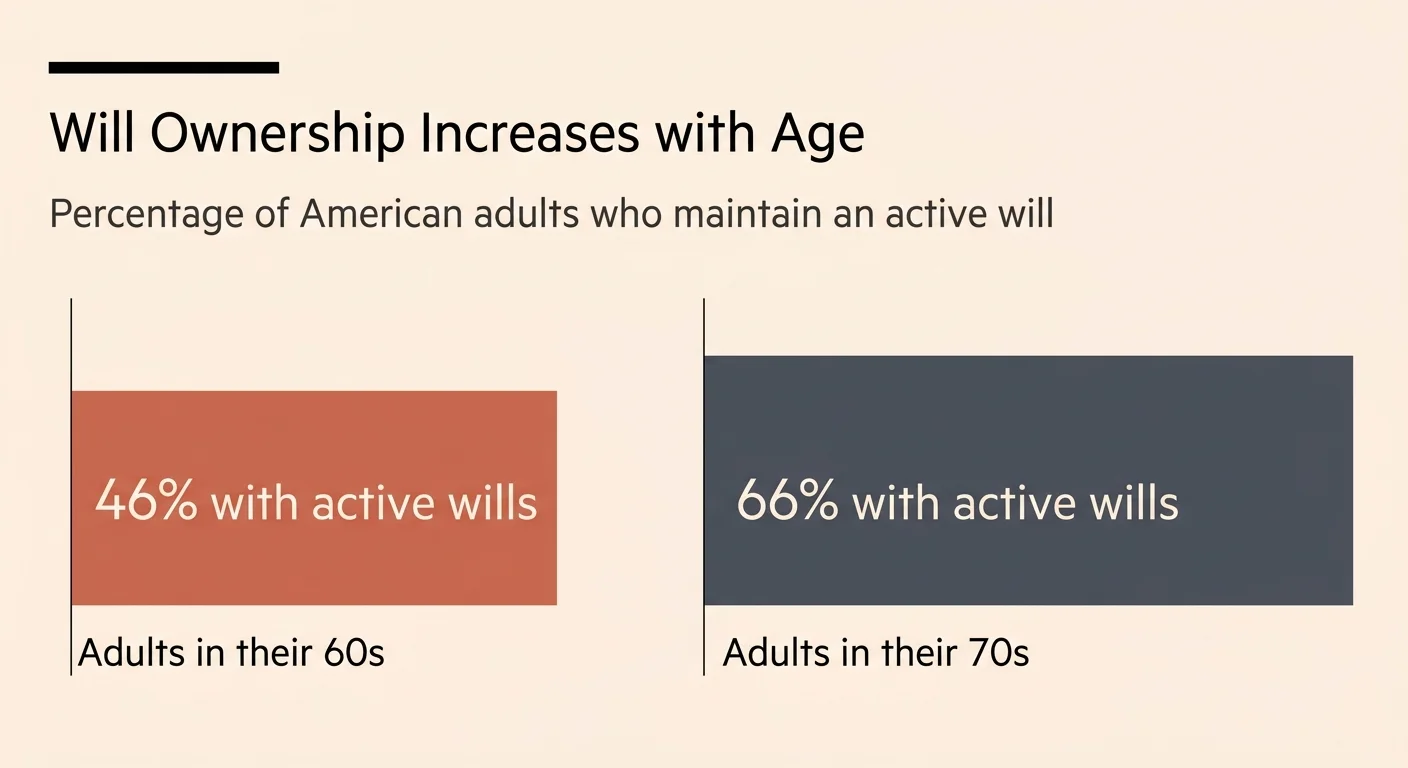
Retirement marks a permanent shift from asset accumulation to asset distribution. While you spent decades building your nest egg, your primary goal now centers on preserving capital, managing distribution strategies, and transferring remaining wealth smoothly. Legal statistics reveal that while only 24% to 32% of all American adults maintain an active will, participation increases significantly with age—reaching roughly 46% for adults in their 60s and 66% for those in their 70s. However, possessing an outdated will can sometimes prove as troublesome as having no will at all.
Federal tax legislation and federal retirement regulations undergo frequent revisions. For instance, the SECURE 2.0 Act set the Required Minimum Distribution (RMD) age at 73, which will rise to 75 in 2033. If your legal documents rely on outdated distribution frameworks or old tax thresholds, your beneficiaries could face heavy administrative burdens. Reviewing your documents serves as a vital component of your retirement estate planning checklist.
“It’s not how much money you make, but how much money you keep, how hard it works for you, and how many generations you keep it for.” — Robert Kiyosaki
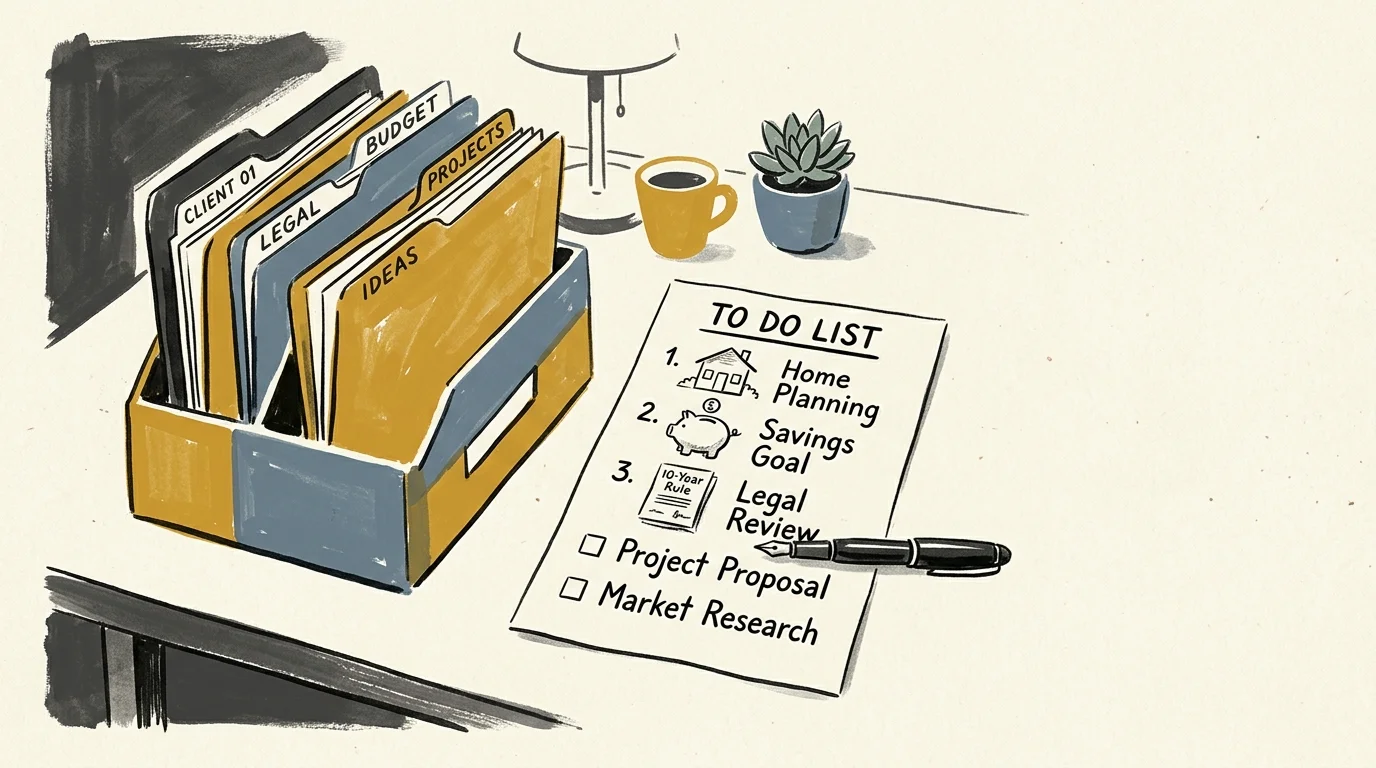
9 Things to Review in Your Will During Retirement
1. Beneficiary Designations on Retirement Accounts
Many retirees assume their will dictates who inherits every asset they own. In reality, accounts with named beneficiary designations—such as traditional IRAs, Roth IRAs, 401(k)s, annuities, and Payable-on-Death (POD) bank accounts—completely bypass the probate process and override instructions in your will. If your will leaves everything equally to your three children, but your IRA still lists an ex-spouse or only one child, the institution must pay the named account beneficiary regardless of your will’s text.
Review every financial account directly through your institution or online portal. Verify current regulations with the IRS Retirement Plans Division to understand how non-probate asset transfers function alongside your primary legal documents.
2. The SECURE Act 10-Year Rule for Inherited IRAs
Congress fundamentally altered inherited account distributions through the original SECURE Act and SECURE 2.0. Before these changes, non-spouse beneficiaries could stretch distributions out over their own lifetime, allowing tax-deferred growth for decades. Today, most non-spouse beneficiaries must withdraw the entire balance of an inherited IRA within 10 years of your death.
If your children inherit large tax-deferred IRAs during their peak earning years, forced withdrawals could push them into significantly higher tax brackets. Consider adjusting your overall estate mix, converting traditional IRA funds to Roth IRAs during lower-income retirement years, or balancing tax-deferred assets with taxable or tax-free assets for specific heirs.
3. Your Designated Executor and Powers of Attorney
An executor you named 20 or 30 years ago may no longer represent the right choice today. Your designated individual may have advanced in age, moved across the country, experienced health issues, or passed away. Managing an estate requires administrative precision, time, and attention to legal detail.
Evaluate whether your named executor possesses the willingness and capability to fulfill these duties today. Name alternate executors in your document to ensure a smooth transition if your primary choice cannot serve. Additionally, re-evaluate your durable financial power of attorney and healthcare proxy, selecting trusted individuals who live nearby and understand your personal preferences.
4. Out-of-State Relocation and Local Probate Laws
Retirement frequently brings a change of scenery. Whether moving full-time to Florida, Arizona, or North Carolina, or splitting time between two states, your move can impact your estate plan. Probate laws, state estate tax exemptions, execution requirements, and power of attorney forms vary significantly by state jurisdiction.
While a valid will written in one state generally remains recognized in another, local probate courts require strict adherence to state-specific procedural rules. If you buy real estate in a new state while retaining property in your former home state, your heirs could face multiple probate proceedings—known as ancillary probate—unless you structure title ownership or living trusts properly.
5. Specific Bequests Versus Percentage Distributions
Drafting a will mid-career often involves specific dollar amounts, such as leaving $25,000 to a relative or $50,000 to a favorite charity. Over time, financial markets fluctuate, medical expenses arise, and overall portfolio values change. A specific cash gift written decades ago might now represent a far larger—or far smaller—percentage of your estate than you originally intended.
Shift your estate instructions toward percentage allocations rather than fixed dollar values. For example, leaving 10% of your residual estate to a charity ensures the gift scales automatically based on your final account balance, protecting your primary heirs from unintended shortfalls.
6. Digital Assets and Online Financial Accounts
Modern estate planning demands explicit strategies for digital assets. Older wills rarely grant executors legal authorization to manage online bank accounts, investment portals, cloud storage, email accounts, cryptocurrency wallets, or social media pages. Federal data privacy laws forbid institutions from releasing account access without clear legal authority.
Include explicit language in your estate documents granting your fiduciary authority under the Revised Uniform Fiduciary Access to Digital Assets Act (RUFDAA). Keep a secure, encrypted digital inventory of online accounts, usernames, and two-factor authentication recovery protocols stored in a safe location for your executor.
7. Funeral and Memorial Preferences
Placing detailed funeral or burial instructions exclusively inside your primary will creates practical challenges. Probate courts often do not open or formally read a will until several weeks or months after a person passes away—long after family members complete funeral services.
Separate your immediate final wishes from your legal will. Create a standalone “Letter of Instruction” stored alongside your critical papers. This letter should clearly outline your preferences regarding cremation, burial plots, memorial services, and organ donation, allowing your family to access immediate guidance without waiting on legal court proceedings.
8. Strategic Lifetime Gifting Limits
Waiting until death to distribute wealth is no longer the only or most efficient option. Lifetime gifting allows you to assist children or grandchildren when they need support most—such as purchasing a first home or funding higher education—while observing your wealth work during your lifetime.
The federal annual gift tax exclusion stands at $19,000 per recipient for an individual or $38,000 for married couples splitting gifts. Gifts below these limits do not require filing IRS Form 709 or reducing your lifetime exemption limit. The federal estate tax exemption limit remains extremely high ($13.99 million per individual in 2025; $15 million in 2026), but strategic lifetime gifting helps reduce overall estate administration burdens regardless of portfolio size.
9. Contingency Plans for Blended Families
Second marriages, stepchildren, and remarriages late in life require clear estate wording. Leaving your entire estate to a surviving spouse via a simple will gives that spouse complete freedom to leave those assets to their own biological children upon their death, unintentionally disinheriting your biological children.
Reviewing things to review in your will becomes critical in blended family scenarios. Using tools like QTIP (Qualified Terminable Interest Property) trusts or specialized living trusts allows you to provide full income and financial support to your surviving spouse during their lifetime while guaranteeing that remaining principal assets pass to your biological children afterward.
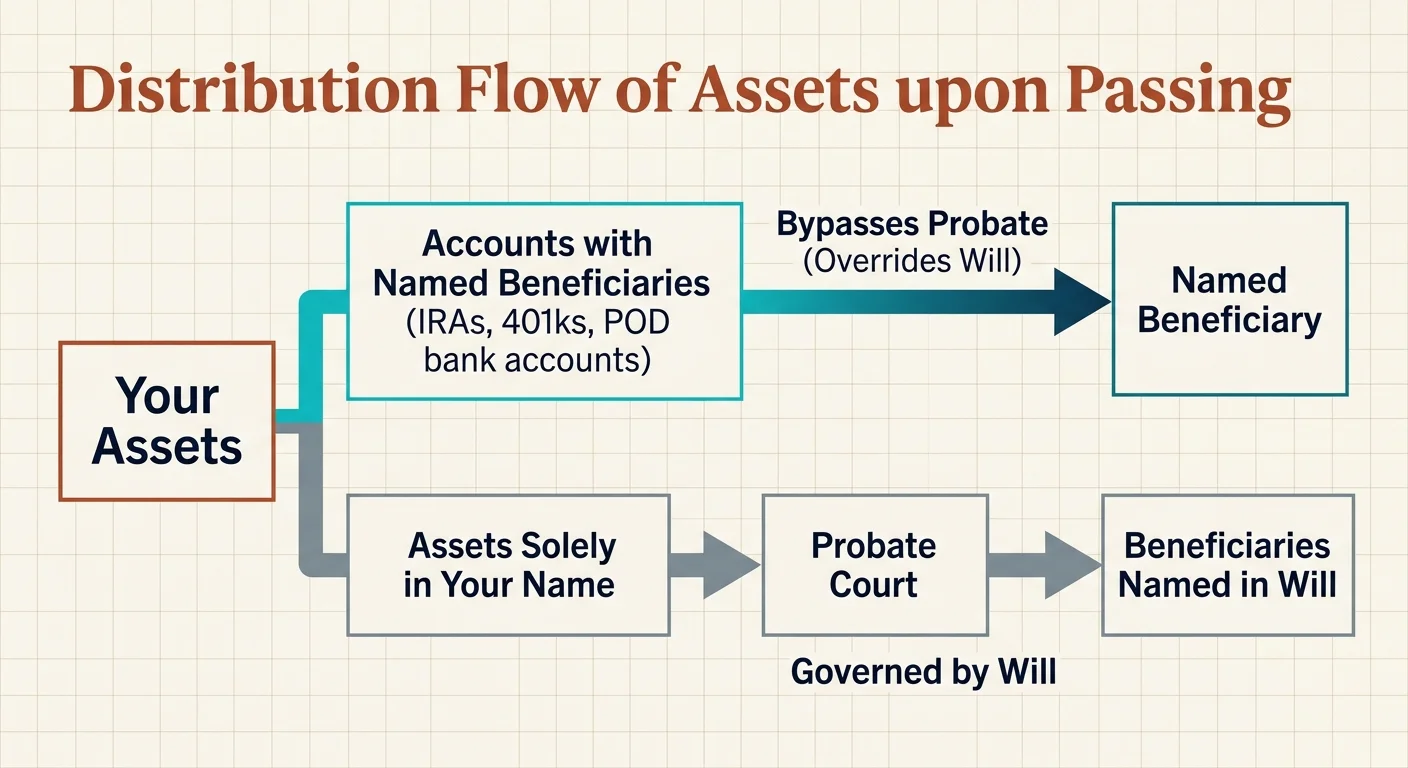
Will Provisions vs. Non-Probate Beneficiary Designations
Understanding which legal mechanism controls each asset forms the foundation of estate planning in retirement. The comparison table below highlights how common assets transfer upon death:
| Asset Category | Primary Transfer Instrument | Probate Required? | How to Update Instructions |
|---|---|---|---|
| IRAs, 401(k)s, & Roth Accounts | Institutional Beneficiary Form | No | Submit updated form to custodian |
| Bank Accounts (Checking/Savings) | Payable-on-Death (POD) Designations | No | Complete POD card at bank branch |
| Individual Real Estate | Will or Transfer-on-Death Deed | Yes (Unless TOD deed/trust used) | Update will or record new deed |
| Brokerage Accounts (Individual) | Transfer-on-Death (TOD) Registration | No (If TOD set up) | Update TOD registration with broker |
| Personal Belongings & Vehicles | Last Will and Testament | Yes | Execute codicil or new will |
Common Retirement Traps in Estate Planning
Avoid these frequent mistakes when conducting will updates for retirees:
- Assuming a will prevents probate court: A will acts as a guide for probate court; it does not bypass the court process entirely. Revocable living trusts or direct TOD/POD designations are required to avoid probate.
- Forgetting to coordinate beneficiary forms: Writing new instructions in a will without updating IRA or life insurance beneficiary forms creates legal conflicts that beneficiary forms will win.
- Ignoring state-level estate and inheritance taxes: While the federal estate tax exemption ($13.99M in 2025; $15M in 2026) affects few families, several states levy their own estate or inheritance taxes at much lower asset thresholds.
- Neglecting incapacity planning: A standard will takes effect only after you die. Failing to create financial durable powers of attorney and medical advance directives leaves you unprotected if you experience cognitive decline or medical incapacity.

When to Consult a Professional
While online templates exist for basic document preparation, retirement estate planning involves complex tax laws, multi-state real property considerations, and unique family dynamics. Working with qualified specialists ensures your documents stand up in court and reflect current legislation.
Consider consulting with the following professionals:
- Elder Law or Estate Planning Attorney: Drafts customized wills, revocable trusts, and healthcare proxies compliant with your state’s specific probate statutes. Find local resources via the official Eldercare Locator.
- Certified Financial Planner (CFP) or CPA: Coordinates withdrawal schedules, evaluates lifetime gifting options, and minimizes income tax impacts caused by the SECURE Act 10-year rule.
- Senior Advocacy Organizations: Non-profit groups like AARP offer legal education tools, estate planning checklists, and referrals to accredited legal specialists in your state.
Frequently Asked Questions
How often should you review your will during retirement?
Review your estate plan every 3 to 5 years, or immediately following significant life events such as moving states, experiencing a change in marital status, welcoming new grandchildren, losing a named executor, or receiving a major inheritance.
Does a will control how my Social Security or Medicare benefits pass to heirs?
No. Social Security administration benefits do not pass through a will. Survivor benefits follow federal statutory guidelines managed directly through the Social Security Administration. Medicare coverage ends entirely upon death and offers no survivor payout value.
What is the difference between a will and a revocable living trust?
A will takes effect only after your death and must pass through public probate court to transfer assets. A revocable living trust takes effect upon creation, holds legal title to your assets during your lifetime, avoids probate completely, and provides private asset management if you become incapacitated.
Can I update my will by hand writing notes on the original document?
No. Making handwritten alterations, crossing out text, or adding notes directly on an existing legal will can invalidate the entire document or spark court litigation. Always execute a formal legal amendment (a codicil) or draft an entirely new will through a legal professional.
Next Steps for Your Estate Plan
Updating your will after retirement protects your hard-earned assets and provides peace of mind for your loved ones. Gather your current estate documents, financial account statements, and beneficiary forms today. Create a simple inventory, compare named accounts against your current intentions, and schedule a consultation with an estate attorney to make necessary adjustments.
This article is for informational purposes only and does not constitute financial, legal, or medical advice. Medicare rules, Social Security benefits, and tax laws change regularly—verify current details at Medicare.gov, SSA.gov, or with a licensed professional.
Last updated: February 2026. Medicare and Social Security rules change annually—always verify current details at official government sources.