When your primary care doctor stops accepting new Medicare patients, your routine healthcare suddenly feels uncertain. Federal payment reductions taking effect on January 1, 2027, threaten to shrink retiree medical access even further.
The Centers for Medicare & Medicaid Services recently finalized a 2.31% cut to baseline physician reimbursements. At the same time, the overhead expenses required to operate a clinical medical practice continue to climb.
These reimbursement shifts directly influence physician availability, appointment wait times, and out-of-pocket medical bills. Understanding these changes helps you protect your healthcare access and retirement budget before treatment delays occur.
The 2027 Medicare Physician Fee Schedule: What Changed
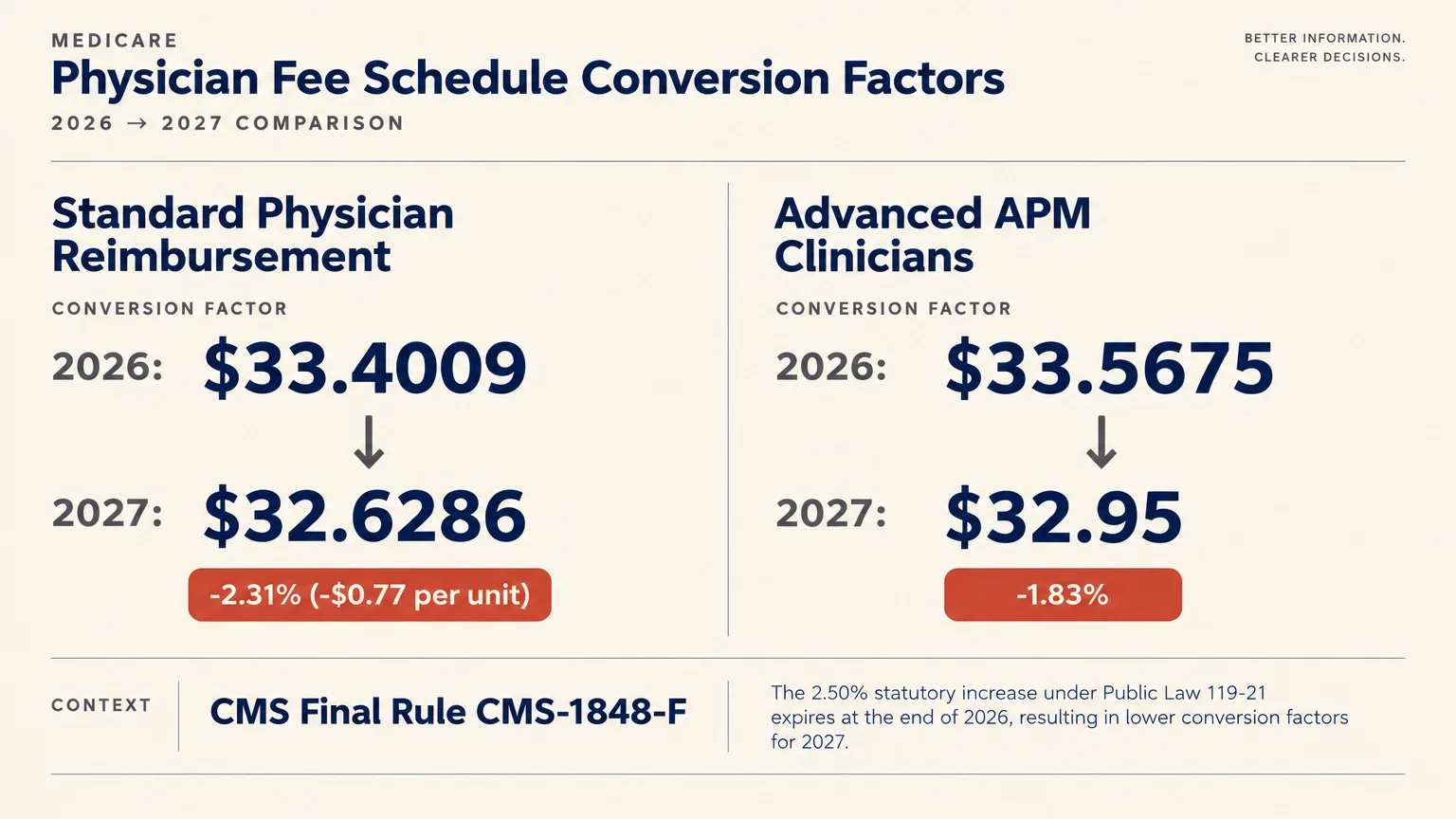
On November 4, 2026, the Centers for Medicare & Medicaid Services released its Calendar Year 2027 Medicare Physician Fee Schedule Final Rule. Officially designated as CMS-1848-F, this sweeping policy update takes effect on January 1, 2027.
The central mechanism of this annual rule is the conversion factor, which translates clinical work units into exact dollar reimbursements. Each adjustment directly shifts what doctors receive for office visits, diagnostic evaluations, and surgical treatments.
For most American physicians, the standard conversion factor drops by 2.31%, or $0.77 per unit. The reimbursement rate falls from $33.4009 in 2026 down to $32.6286 for 2027.
Clinicians enrolled in qualifying Advanced Alternative Payment Models face a slightly smaller reduction of 1.83%. Their conversion multiplier decreases from $33.5675 in 2026 to $32.95 in 2027.
This federal reduction stems primarily from the expiration of a temporary 2.50% statutory increase enacted under Public Law 119-21. Congress passed that short-term patch for 2026 without establishing a permanent funding extension.
Federal budget-neutrality mandates also forced additional downward adjustments across specialized medical services. When Medicare increases payments for certain clinical services, federal law requires proportional reductions across others.
Physician advocacy groups like the American Medical Association are actively lobbying congressional leaders for an emergency legislative fix before January. However, medical practices must plan their clinical operations around the lower rates.
Without an eleventh-hour congressional override, American physicians will absorb their fifth straight year of real reimbursement cuts. These reductions force medical practices to make difficult operational decisions that directly touch your care.
The Widening Gap Between Clinic Overhead and Medicare Rates
While federal reimbursement rates decrease, the real-world expenses required to operate medical practices are surging. Healthcare clinics face relentless inflationary pressure on clinical staff wages, facility rent, malpractice premiums, and medical supplies.
To evaluate these operational pressures, Medicare tracks practice inflation through the Medicare Economic Index. CMS projects this clinical cost index will rise by 2.6% in 2027.
A 2.31% payment cut paired with 2.6% practice cost inflation represents a severe functional shortfall for independent clinicians. Medicare physician reimbursements do not feature the automatic annual cost-of-living adjustments that Social Security benefits provide.
This divergence between rising costs and flat or falling pay has compounded over decades. According to data from the American Medical Association, inflation-adjusted Medicare physician payments fell 33% between 2001 and 2026.
Beyond general office visits, specialized medical procedures face even steeper reductions in the 2027 fee schedule. Reimbursement for major orthopedic operations, including total hip and knee replacements, drops by roughly 18%.
The new rule also modifies indirect practice expense calculations and terminates geographic work floor adjustments across 49 regions. This regional change disproportionately impacts medical clinics serving mid-sized cities and suburban communities.
Furthermore, Medicare reduced reimbursements when physicians bill standalone evaluation and management visits on the same day as minor procedures. These bundled payment restrictions sharply diminish clinic revenue on comprehensive, multi-issue appointments.
As profit margins evaporate, medical practices face severe financial stress that threatens their ongoing viability. Independent community clinics often lack the financial reserves necessary to absorb consecutive years of federal reimbursement cuts.
How Physician Payment Reductions Directly Impact Retirees
Federal payment formulas may sound like abstract bureaucratic accounting, but their consequences ripple directly into your healthcare experience. When clinical revenue drops below operating costs, doctors must alter how they interact with patients.
According to research from KFF, 98% of non-pediatric physicians in the United States currently participate in Medicare. While total participation remains high, an active enrollment does not guarantee that a physician accepts new patients.
Many established doctors have implemented strict enrollment quotas to protect their financial stability. A clinic might restrict Medicare beneficiaries to a fixed percentage of its overall active patient roster.
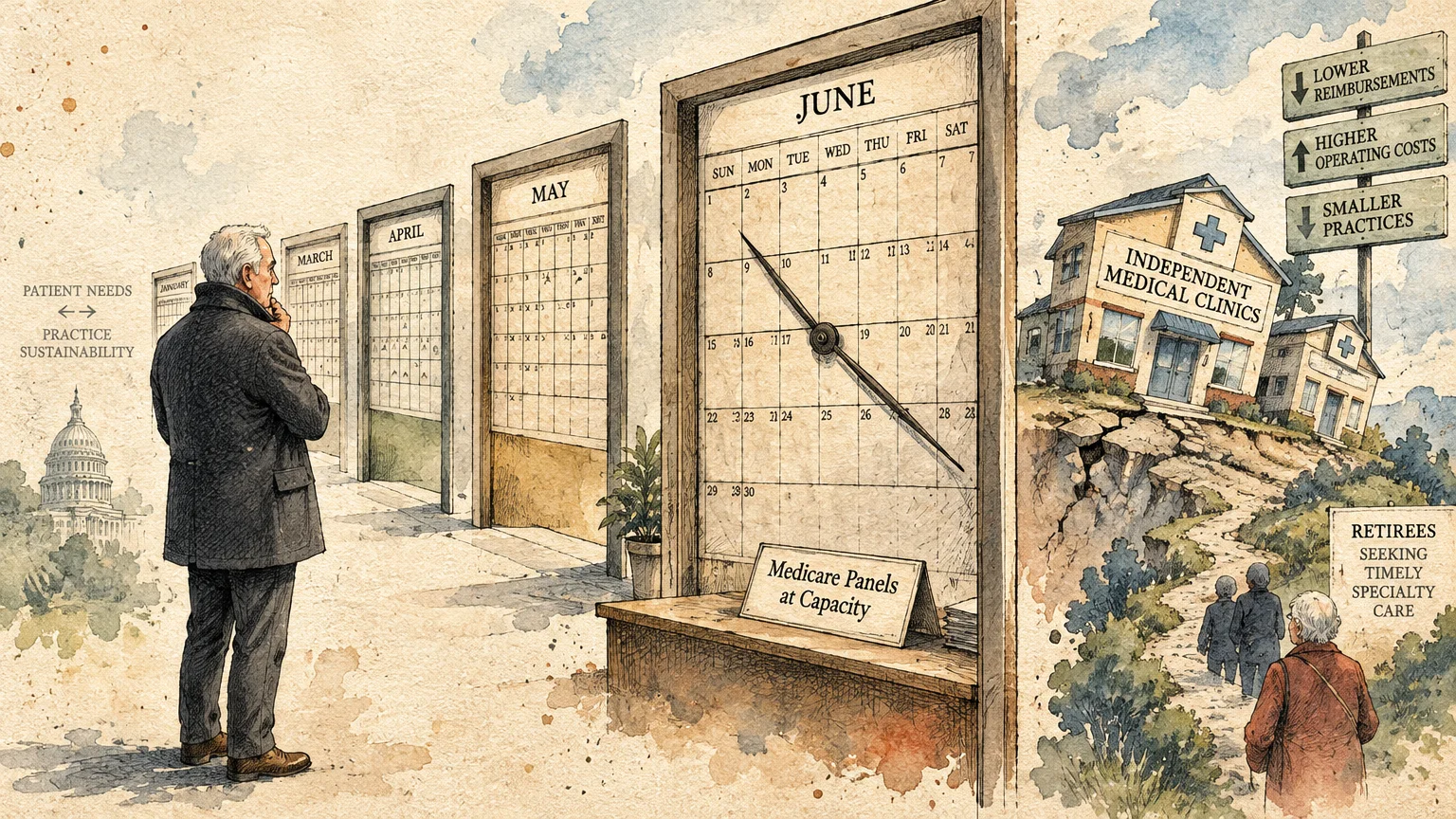
If you relocate during retirement or need a new local physician, finding a primary care practice accepting Medicare can prove frustrating. Waiting lists for routine intake physicals frequently stretch four to six months.
Payment pressures also accelerate early physician retirements, depleting the experienced clinical workforce just as baby boomers age. Doctors spend more time managing bureaucratic billing hurdles and less time delivering patient care.
Access constraints are hitting rural communities with exceptional severity. A comprehensive JAMA analysis found that physicians practicing in nonmetropolitan counties exit Medicare at significantly higher rates than their urban counterparts.
Clinics operating within federal Health Professional Shortage Areas face the steepest financial hurdles. When rural physicians retire or relocate, entire communities lose immediate access to essential medical specialists.
To survive mounting overhead, independent physicians increasingly sell their practices to large regional hospital systems or private equity groups. While corporate acquisition keeps the clinic doors open, it alters your medical bills.
When a hospital system buys an independent clinic, it often redesignates the office as an outpatient hospital facility. This reclassification allows the system to bill separate facility fees alongside the physician fee, raising your out-of-pocket costs.
“The goal of retirement is to live off your assets—not live off your regrets.”
Monitoring local healthcare consolidation helps you avoid billing surprises. You must remain vigilant about who owns your local clinics and how their billing structures affect your retirement budget.
Understanding Provider Status: Participating, Non-Participating, and Opt-Out
To protect your retirement savings, you must understand how Medicare categorizes medical providers. Medicare establishes three distinct provider classifications, each carrying completely different financial liabilities for you.
Participating providers sign formal agreements to accept Medicare assignment on every claim. They agree to accept the Medicare-approved amount as full payment for all covered services.
When you consult a participating doctor, you pay only your standard 20% Part B coinsurance after meeting your annual deductible. The doctor cannot balance bill you for any amount above the approved rate.
Non-participating providers enroll in Medicare, but they choose whether to accept assignment on a claim-by-claim basis. Medicare pays non-participating clinicians 95% of the standard physician fee schedule amount.
To recover that difference, non-participating physicians can legally bill you up to 15% above Medicare’s reduced allowance. This legally permitted surcharge is known as a limiting charge or a Part B excess charge.
Unless your supplemental insurance covers excess charges, you must pay this additional 15% bill entirely out of pocket. For instance, Medigap Plan G covers excess charges completely, whereas Medigap Plan N excludes them.
Certain states protect residents from excessive billing practices through state-level statutes. For example, New York state law caps the maximum limiting charge at just 5% above the approved rate.
Opt-out providers represent the third category and have signed a formal exclusion affidavit with CMS. These physicians completely detach their medical practices from the federal Medicare program.
Medicare pays zero dollars toward care delivered by an opt-out doctor, except during severe medical emergencies. To receive treatment, you must sign a private contract agreeing to pay the doctor’s full cash fees.
Nationally, only about 1% of non-pediatric physicians have formally opted out of Medicare entirely. However, opt-out rates reach 3% in Alaska and Washington, D.C., and 2% in California, Colorado, and New York.
Opt-out providers concentrate heavily within specialized fields, especially outpatient psychiatry and behavioral health. If you seek private mental healthcare, you will encounter opt-out cash contracts far more frequently than in primary care.
| Provider Category | Assignment Agreement | Excess Charges Allowed? | Retiree Financial Responsibility |
|---|---|---|---|
| Participating | Accepts assignment on all Medicare claims | No excess charges permitted | 20% coinsurance after meeting annual Part B deductible |
| Non-Participating | Accepts assignment on a claim-by-claim basis | Yes, up to a 15% limiting charge | 20% coinsurance plus up to 15% excess charges out of pocket |
| Opt-Out | Does not participate in Medicare | Not applicable (private contract) | 100% of all medical fees paid directly to the physician |
Reviewing this provider structure ensures you avoid unexpected charges before receiving outpatient treatments. Always verify assignment terms when booking an appointment with an unfamiliar specialist.
Medicare Advantage vs. Original Medicare: Network Realities in 2027
As doctor payment cuts take effect, your choice between Original Medicare and Medicare Advantage significantly impacts your clinical access. Each coverage model handles physician reimbursements and provider networks through fundamentally different mechanisms.
Traditional Original Medicare allows you to consult any participating doctor or hospital across the entire United States without requiring a referral. Because 98% of doctors participate, network restrictions rarely interfere with your care.
Medicare Advantage plans operate through private insurance companies that utilize restricted provider networks. These HMO and PPO plans contract with specific local doctors, setting their own private reimbursement terms.
A nationwide analysis by KFF found that Medicare Advantage enrollees have access to an average of just 48% of physicians in their county. Over half of local doctors fall outside the typical Medicare Advantage network.
When federal reimbursement drops, private insurers frequently trim their own doctor payment rates to protect profit margins. In response, private physician groups regularly cancel their contracts with regional Medicare Advantage plans.
A doctor can drop out of your Medicare Advantage network in the middle of a coverage year. If this happens, you may lose access to your primary specialist or face substantial out-of-network costs.
Advantage plans also utilize strict prior authorization protocols, requiring insurance approval before approving advanced scans, surgeries, or therapies. Independent reports from consumer groups like AARP emphasize how coverage delays disrupt ongoing treatment plans.
Meanwhile, baseline traditional Medicare expenses continue their steady upward trend. For 2026, the standard Part B premium was $202.90 monthly, alongside a $283 annual deductible.
The Medicare Board of Trustees projects the standard Part B premium will rise to $209.50 monthly for 2027. The annual Part B deductible will increase to an estimated $292.
You can compare plan structures and local network rules using the official Medicare Plan Finder tool during open enrollment. Researching network breadths before choosing a plan prevents severe disruption to your medical care.

Practical Strategies to Protect Your Access to Doctors
You cannot control congressional legislation or federal reimbursement rates, but proactive management protects your medical access. Taking deliberate steps ensures you maintain continuous access to top-tier healthcare professionals.
Begin by auditing your current medical team’s billing status before your next scheduled appointment. Inquiring about participation early prevents unexpected out-of-pocket bills and administrative headaches.
Adopt these practical healthcare management steps right away:
- Verify assignment status annually: Ask office administrators if your physician continues to accept Medicare assignment on all services.
- Schedule early in the year: Book routine annual physicals and preventative screenings during January and February to secure preferred appointment slots.
- Establish specialist relationships early: Secure referrals to cardiologists, dermatologists, and orthopedists before acute medical problems arise.
- Evaluate Medigap Plan G coverage: Consider policies that absorb Part B excess charges if you frequently consult non-participating specialists.
- Track practice ownership changes: Inquire whether your independent clinic has joined a hospital system that bills separate outpatient facility fees.
Scheduling an annual wellness exam during the first quarter of the calendar year provides significant security. Clinicians prioritize existing patients on their schedules, shielding you from new-patient access caps.
If you rely on traditional Medicare, consider pairing it with a robust supplemental policy. Medigap Plan G remains a premier option because it eliminates out-of-pocket exposure to Part B excess charges.
Community health resources can also provide high-quality primary care when private medical offices become overcrowded. The National Council on Aging (NCOA) offers local program directories that connect retirees with affordable community wellness clinics.
Don’t Make These Mistakes
Navigating physician reimbursement shifts requires careful planning and informed decision-making. Avoid these critical mistakes to protect your personal savings and ensure timely medical treatments.
Mistake 1: Assuming all Medicare providers bill the same rates.
Failing to verify whether a physician accepts assignment can leave you responsible for 15% limiting charges. Always verify participation before scheduling specialized consultations or diagnostic procedures.
Mistake 2: Picking supplemental insurance based solely on monthly premiums.
Medigap Plan N offers lower monthly premiums than Plan G, but it does not cover Part B excess charges. If your local specialists decline assignment, Plan N could cost you more overall.
Mistake 3: Delaying primary care appointments until chronic symptoms worsen.
Finding a new doctor while experiencing an acute medical emergency is stressful and challenging. Establish active relationships with internists, cardiologists, and other core specialists well before serious medical conditions arise.
Mistake 4: Missing the annual Medicare Open Enrollment window.
The Medicare Open Enrollment Period runs strictly from October 15 through December 7, 2026. If your doctor drops your Advantage plan, you must switch policies during this window to preserve continuous in-network care.
Mistake 5: Overlooking hospital facility fee disclosures.
When independent practices join large hospital networks, office visits often trigger separate outpatient facility charges. Always ask if your appointment will generate an extra facility fee before receiving routine care.

When Professional Advice Is Worth It
Managing healthcare insurance, provider networks, and out-of-pocket medical expenses can quickly become overwhelming. Professional advisors provide specialized expertise that prevents costly healthcare errors.
Your State Health Insurance Assistance Program provides free, confidential insurance counseling. Local SHIP counselors provide unbiased guidance on navigating supplemental coverage, network disruptions, and Medicare appeals.
You can locate your local SHIP counselor by visiting Medicare.gov or calling their dedicated support line. Their localized insight proves invaluable when evaluating provider availability in your county.
Consulting a fee-only certified financial planner helps you integrate projected healthcare cost increases into your retirement portfolio. A skilled advisor models how Part B premiums, deductibles, and supplemental plans affect your long-term cash flow.
Working with an elder law attorney becomes essential when dealing with complex, chronic medical issues. These legal professionals structure healthcare directives, powers of attorney, and long-term care plans to safeguard family assets.
“The best time to plan for retirement was 20 years ago. The second best time is today.”
Professional guidance pays for itself by preventing costly gaps in coverage and protecting your financial independence. As Medicare payment rules evolve, having trusted experts in your corner preserves your peace of mind.
Frequently Asked Questions About Medicare Doctor Payment Changes
Can my doctor refuse to see me because I have Medicare?
Yes, private physicians can legally choose not to enroll in Medicare or opt out of the system entirely. Additionally, participating doctors can close their practices to new Medicare patients while retaining their current patient roster.
What is a Medicare Part B excess charge?
The limiting charge is a federal cap on how much a non-participating Medicare doctor can bill you above the approved rate. Non-participating doctors can charge up to 15% more than the reduced Medicare-allowable amount.
How do the 2027 Medicare doctor pay cuts affect my Part B premium?
The physician fee schedule cuts do not directly lower your monthly premium. The Medicare Board of Trustees projects standard Part B premiums will rise to $209.50 monthly in 2027 due to general healthcare inflation.
How can I tell if my physician is dropping Medicare?
Doctors who opt out of Medicare must provide you with a written private contract before rendering non-emergency medical treatment. Contact your physician’s billing office each autumn during open enrollment to confirm their upcoming Medicare participation status.
Protecting Your Healthcare Security Going Forward
Contact your primary care clinic and key specialists to confirm their Medicare participation status for 2027. Review your supplemental coverage to confirm you have adequate financial protection against excess provider charges.
This article is for informational purposes only and does not constitute financial, legal, or medical advice. Medicare rules, Social Security benefits, and tax laws change regularly—verify current details at Medicare.gov, SSA.gov, or with a licensed professional.
Last updated: November 2026. Medicare and Social Security rules change annually—always verify current details at official government sources.