Staying on the job past age 65 can supercharge your personal savings and keep your mind sharp. However, drawing a paycheck while claiming retirement benefits can disrupt your finances if you act without a clear strategy.
Many working seniors assume that age 65 unlocks full government benefits without penalty. That assumption often triggers surprise benefit clawbacks, unnecessary income taxes, and unexpected health insurance penalties.
You can easily protect your hard-earned dollars by adjusting your Social Security timeline today. Discover how working past 65 changes the rules so you keep more money in your pocket.
The Medicare Age Versus Full Retirement Age Mismatch
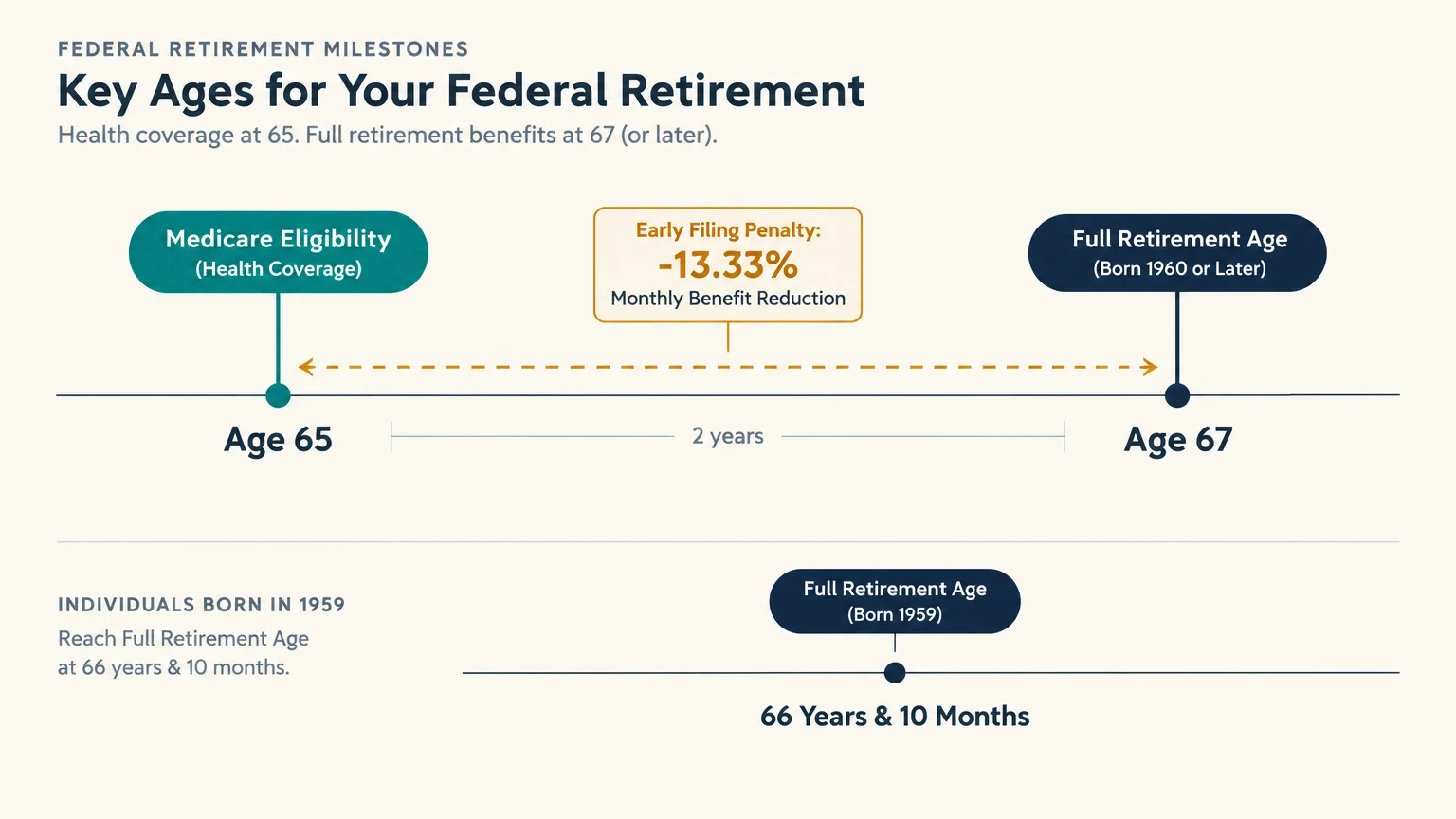
Many people treat age 65 as the official milestone for full retirement. While that was true decades ago, federal law permanently separated health benefits from income benefits.
You qualify for Medicare at age 65, but your Social Security timeline follows a completely different schedule. Conflating these two ages remains one of the most common retirement missteps.
Your full retirement age depends entirely on the year you were born. If you were born in 1960 or later, your full retirement age is 67.
For individuals reaching age 65 in 2026, birth records date back to 1961. That means you must wait two additional years past your Medicare eligibility to reach full retirement age.
If you were born in 1959, your full retirement age is 66 and 10 months. This cohort reaches full benefit maturity throughout late 2025 and 2026.
Claiming retirement checks at age 65 locks in an early filing penalty. Filing at 65 when your full retirement age is 67 causes a permanent 13.33% reduction in your monthly payment.
Continuing to work while taking early benefits creates even more complications. You immediately run headfirst into federal earnings limitations that can freeze your benefit checks.
The Retirement Earnings Test: How Working Cuts Your Checks
If you claim benefits before your full retirement age while continuing to earn wages, your benefits face the retirement earnings test. The Social Security Administration monitors your work wages through this mandatory screening.
The rules impose strict income ceilings if you collect checks and work under full retirement age all year. For 2026, the annual social security earnings limit is $24,480.
If you continue working into 2027, that annual ceiling rises to $25,560. Any money you earn above these thresholds triggers automatic benefit withholding.
The government withholds $1 in benefits for every $2 you earn over the annual threshold. For example, earning $10,000 above the limit results in $5,000 withheld from your benefits.
The rules ease substantially during the specific calendar year you reach your full retirement age. During that transition year, the earnings threshold jumps dramatically.
In 2026, the threshold for that transition year reaches $65,160 before benefits are touched. For 2027, that upper ceiling increases to $67,920.
The government withholds $1 for every $3 you earn above this higher threshold. More importantly, they only evaluate the earnings you accumulate during the months prior to reaching your birthday month.
Once you reach the exact month of your full retirement age, the earnings cap vanishes completely. You can earn an unlimited salary without losing a single dollar from your monthly benefit.
To examine your projected benefits under varying filing ages, review the tools provided on the Social Security Retirement Estimator before locking in a date.
Why Withheld Benefits Are Not Actually Lost Forever
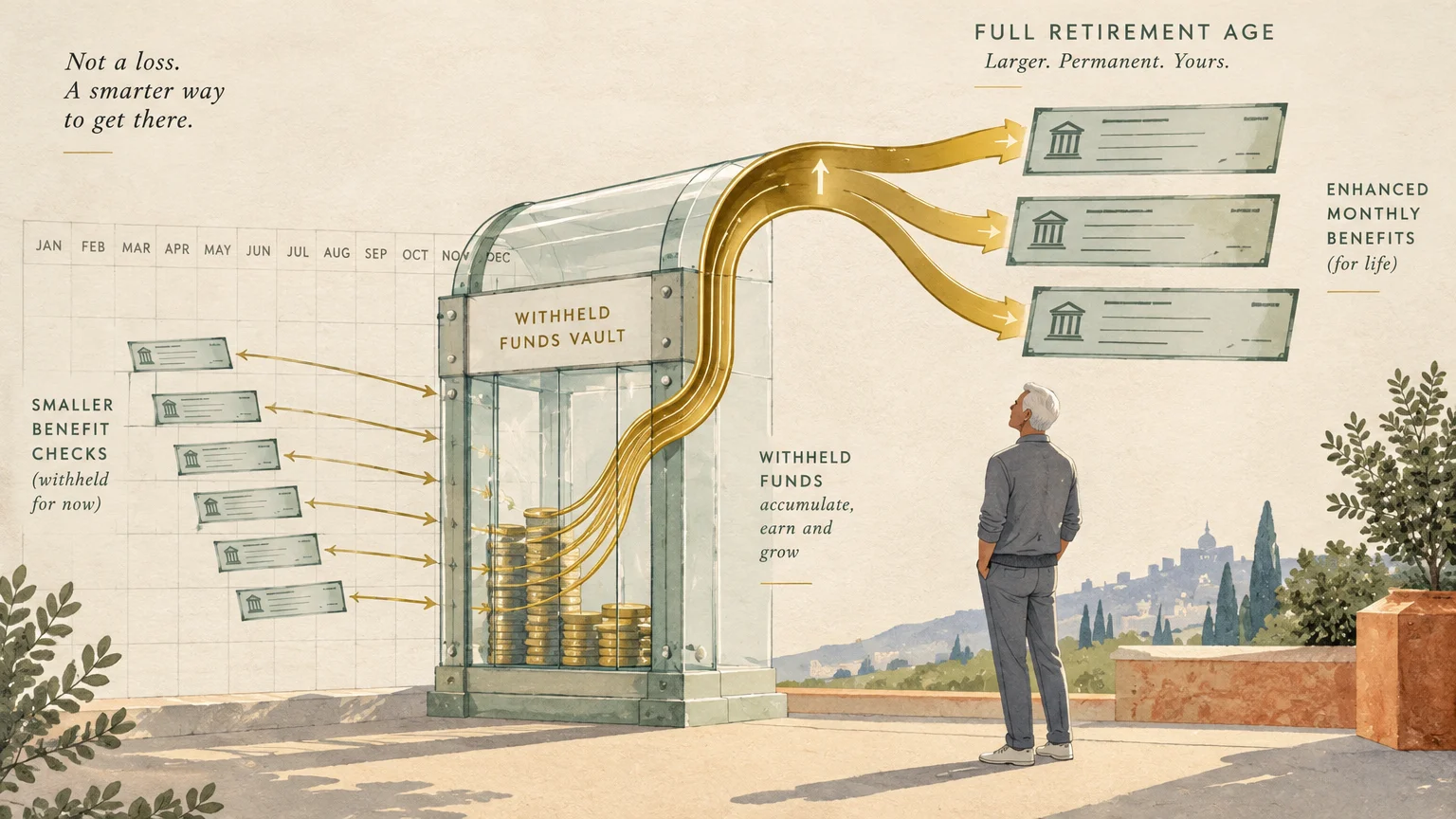
Many older workers panic when they learn the government will withhold their Social Security payments. Fortunately, withheld benefits do not disappear into a government black hole.
The earnings test operates as a temporary benefit deferral rather than a permanent monetary forfeiture. The Social Security Administration tracks every single dollar withheld from your monthly checks.
When you reach your full retirement age, the agency recalculates your baseline monthly benefit. They adjust your monthly payment upward to credit you for every month benefits were withheld.
Suppose you filed at age 65, and your wages caused the government to withhold twelve total months of payments. At age 67, your monthly benefit adjusts upward as if you originally claimed at age 66.
This recalculation increases your monthly check for the rest of your life. Over an average lifespan, you will likely recoup the entire withheld balance.
However, claiming early just to have benefits withheld remains an inefficient financial choice. You lose control of your cash flow while navigating unnecessary government administrative paperwork.
“The goal of retirement is to live off your assets—not live off your regrets.”
Leaving your benefits unclaimed until you stop working often provides a much smoother financial journey. You avoid withholding headaches and collect an unreduced baseline payment later.
Earning More Can Permanently Increase Your Future Payouts
Working past age 65 offers a major benefit formula advantage that many workers overlook. Your continued salary can actively increase your primary insurance amount.
The Social Security Administration calculates your baseline benefit using your highest 35 years of indexed earnings. Years with zero earnings or low entry-level wages pull down your average career calculation.
Many professionals earn their highest career salaries after age 60. A strong salary earned at age 66 directly replaces a meager wage earned decades earlier.
The agency automatically recalculates your benefit record every autumn following your tax filings. If your current salary replaces a lower historical year, your monthly check increases automatically.
Your current wages face Social Security payroll taxes up to the statutory wage base limit. In 2026, the taxable wage maximum is $184,500.
For 2027, the taxable wage base cap increases to $192,300. Earnings above these annual caps do not pay Social Security taxes or add to your benefit formula.
Furthermore, delaying your claim allows your baseline calculation to absorb cost-of-living adjustments. The 2026 cost-of-living adjustment added 2.8%, followed by an additional 3.6% boost in 2027.
You receive these cost-of-living increases even if you have not yet claimed your first check. Your future benefit baseline expands in the background while you continue working.
Delayed Retirement Credits: The 8% Annual Pay Raise
If you can afford to delay claiming Social Security past full retirement age, the financial incentives multiply. You unlock delayed retirement credits for every month you postpone benefits.
Benefits grow by two-thirds of 1% for each month you delay between full retirement age and age 70. This translates to a guaranteed 8% annual boost in your monthly benefit.
For an individual with a full retirement age of 67, waiting until age 70 locks in a permanent 24% raise. That guaranteed return outpaces almost any low-risk investment available on the market.
This 24% enhancement attaches permanently to your monthly check. It also establishes a substantially higher lifetime survivor benefit for your surviving spouse.
Delayed retirement credits stop accumulating once you reach age 70. There is zero financial incentive to delay claiming Social Security past your 70th birthday.
If you work past 70, you should file for benefits immediately. Working past 70 while collecting your maximum check gives you the dual benefit of full salary and peak retirement income.
“The best time to plan for retirement was 20 years ago. The second best time is today.”
Delaying benefits requires sufficient current income or outside savings to cover living expenses. If your employment salary pays the bills, delaying your filing represents a wise choice.
The Tax Bite: Provisional Income and the $6,000 Senior Deduction
Combining salary income with Social Security benefits frequently produces a frustrating tax surprise. Claiming social security while working pushes many seniors into higher federal income tax brackets.
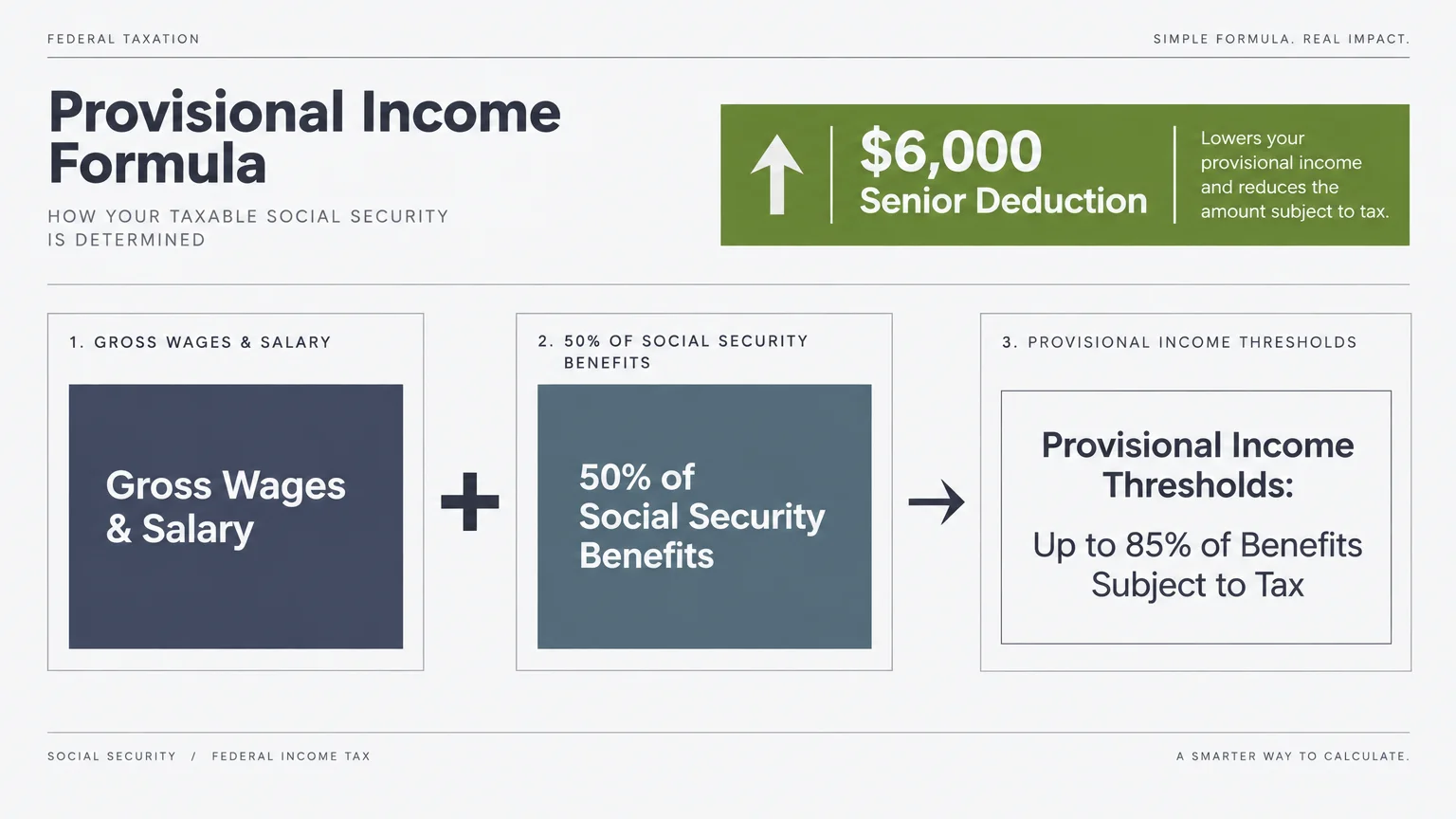
The IRS uses a specific formula called provisional or combined income to determine whether your benefits face taxation. This calculation looks at your adjusted gross income, nontaxable interest, and half of your Social Security payment.
If you file as an individual, combined income between $25,000 and $34,000 makes up to 50% of your benefits taxable. Exceeding $34,000 pushes up to 85% of your benefits into taxable territory.
For married couples filing jointly, combined income between $32,000 and $44,000 exposes up to 50% of benefits to income taxes. Crossing $44,000 renders up to 85% of your benefits taxable.
Congress established these static dollar thresholds in 1983 and never adjusted them for inflation. Because wages have risen over time, almost every working senior crosses these income triggers.
Fortunately, current tax rules provide meaningful relief through an expanded tax deduction for older Americans. Taxpayers age 65 and older receive a $6,000 bonus senior deduction through 2028.
This deduction helps lower your overall adjusted gross income when you file your annual tax return. However, it does not alter the underlying statutory thresholds for provisional benefit taxation.
You can review tax treatment details and plan distributions directly through the IRS Retirement Plans portal. Proactive planning helps you avoid paying unnecessary taxes on double income streams.
Medicare Part A, HSAs, and Social Security Interlocking Rules
Health insurance rules create an unexpected obstacle for working seniors who use Health Savings Accounts. If you work past 65 and carry high-deductible health coverage, take extra caution.
When you file for Social Security benefits at age 65 or older, you automatically enroll in Medicare Part A. You cannot decline Part A coverage while receiving monthly Social Security payments.
Furthermore, Medicare Part A coverage backdates up to six months when you claim benefits after age 65. The government will not backdate coverage prior to your 65th birthday month, however.
Federal tax law strictly prohibits making Health Savings Account contributions while enrolled in any part of Medicare. Contributing to an HSA while having Part A triggers severe IRS tax penalties.
The IRS assesses a 6% excise penalty each year on excess contributions until you remove them. To protect yourself, stop all HSA contributions at least six months before applying for Social Security.
Managing Medicare Part B requires equal diligence when you remain actively employed past age 65. The standard monthly Medicare Part B premium is $202.90 in 2026, rising to an estimated $209.50 in 2027.
You can safely delay enrolling in Part B if your employer provides creditable coverage with 20 or more employees. Small business plans with fewer than 20 workers do not provide primary coverage once you reach 65.
Failing to enroll without qualifying employer coverage triggers a permanent 10% late enrollment penalty for every full year delayed. You can verify enrollment protocols directly on Medicare.gov before making changes.
Comparing Your Working Options at Age 65 and Beyond
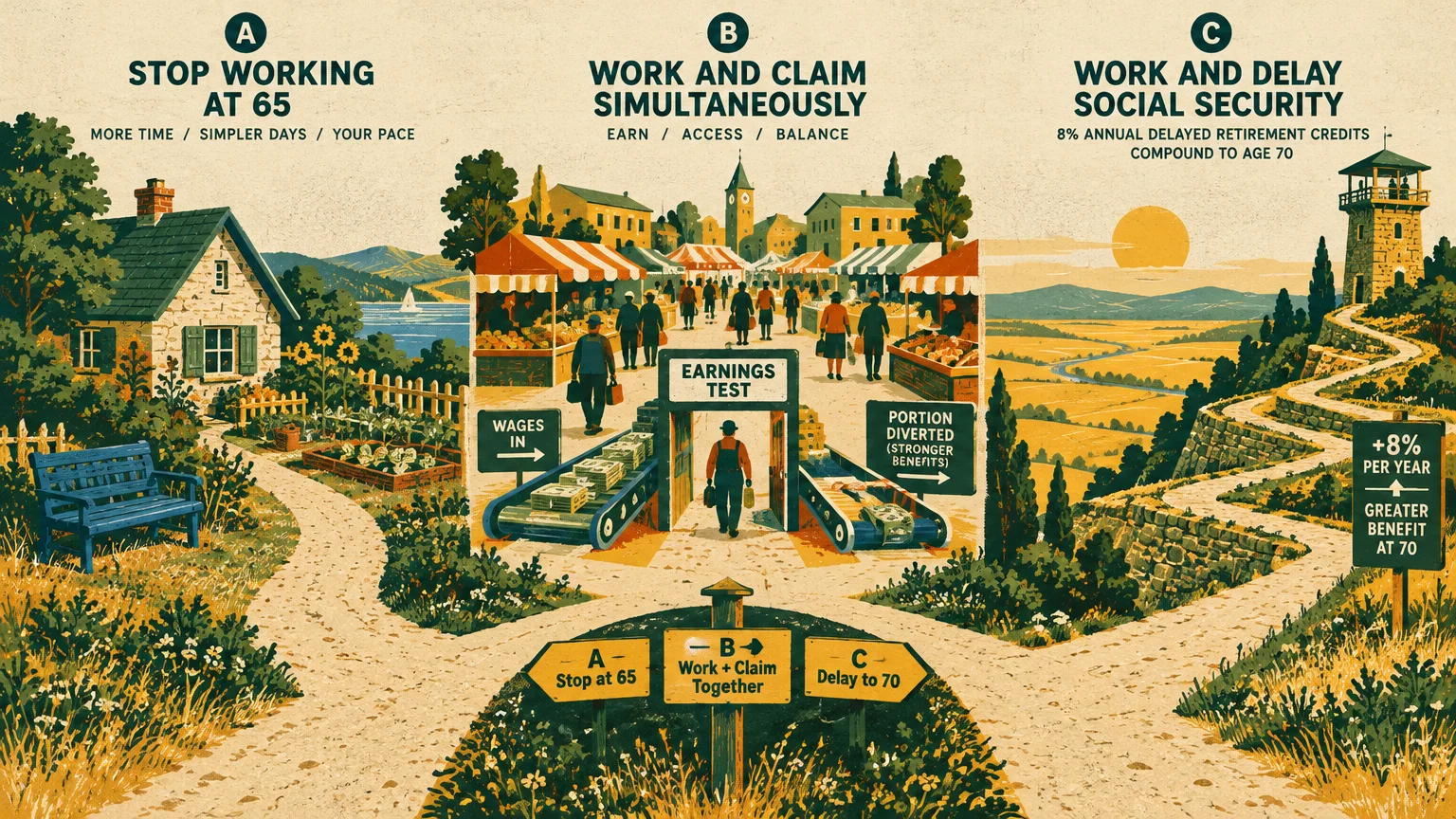
Choosing when to claim benefits while working requires weighing immediate cash needs against long-term financial growth. Each pathway presents distinct trade-offs regarding earnings tests, tax exposure, and cumulative returns.
Review the primary pathways below to evaluate how continuing your employment interacts with your benefit timeline.
| Claiming Strategy | Earnings Test Impact | Benefit Growth Rate | Tax Exposure Risk |
|---|---|---|---|
| Claim at 65 While Working | Subject to $24,480 annual limit; $1 withheld per $2 earned over limit. | Permanent reduction of roughly 13.33% below full baseline benefit. | High risk; combines wages and benefits into higher tax bracket. |
| Claim at FRA (Age 67) While Working | Zero earnings restrictions; keep full salary and full benefit check. | Collect 100% of earned primary insurance amount without penalty. | Moderate to high; benefits likely face up to 85% taxability. |
| Delay to Age 70 While Working | Zero earnings restrictions apply at any point after reaching FRA. | Earns 8% annual delayed retirement credits; 24% total boost. | Lowest risk during working years; taxes deferred until benefit starts. |
Workers who do not require supplemental income almost always benefit by deferring their claim until stopping work or reaching 70. You dodge earnings withholding and bypass aggressive combined-income tax brackets.
If you face a cash shortfall or health concerns, claiming earlier may remain necessary. Simply ensure you budget for temporary benefit withholdings if your earnings exceed the statutory cap.
Common Retirement Traps When Working Past 65
Navigating employment and retirement benefits simultaneously involves navigating numerous administrative hazards. Watching out for common miscalculations can save you thousands of dollars.
Keep these frequent errors on your radar to avoid costly missteps with your benefits:
- Contributing to an HSA after filing: Overlooking the six-month retroactive Medicare Part A enrollment creates accidental, penalized HSA contributions.
- Fearing withheld benefits are destroyed: Assuming the retirement earnings test steals your money leads many seniors to quit jobs prematurely.
- Trusting small-employer coverage: Staying on a plan from a firm with under 20 workers without Part B triggers lifetime Medicare penalties.
- Ignoring tax bracket creep: Failing to withhold taxes from retirement checks while drawing a salary creates painful tax bills in April.
- Leaving money past age 70: Forgetting to claim benefits at age 70 forfeits guaranteed monthly payments with zero added incentive.
Take time to audit your workplace benefits and planned claim dates every year. Routine reviews ensure unexpected rule changes do not derail your overall retirement budget.

When to Consult a Professional
Decisions surrounding Social Security claiming timing, employer health plan transitions, and tax efficiency often overlap. In many situations, self-guided research benefits from professional validation.
You should consider speaking with an independent financial advisor if you hold complex retirement assets. Coordinated strategies for withdrawals, salary income, and Social Security help minimize your lifetime tax burden.
A State Health Insurance Assistance Program counselor offers free, unbiased Medicare guidance in every state. They can confirm whether your employer health plan meets federal requirements for delaying Part B.
If you inadvertently made improper HSA contributions after Medicare enrollment, consult a certified public accountant. A tax expert can help you withdraw excess funds safely and complete IRS Form 5329 properly.
Official agency representatives at the Social Security Administration can provide detailed earnings records and personal benefit projections. Always verify your recorded earnings history to guarantee calculations reflect your true work record.
Frequently Asked Questions
Can I collect my full Social Security check while working full-time at age 65?
Only if your annual earned income remains below the retirement earnings limit ($24,480 in 2026). Wages exceeding that cap trigger withholding until you reach full retirement age.
What types of income count toward the Social Security earnings test?
Only earned wages from an employer or net earnings from self-employment count toward the limit. Pensions, 401(k) distributions, dividends, and interest do not count as earnings.
Does working after 65 increase my monthly benefit check?
Yes, if your current earnings rank among your top 35 career wage years. Higher earnings replace lower historical years, triggering an automatic benefit increase.
Can I pause my Social Security benefits if I go back to work?
If you have reached full retirement age, you can suspend benefit payments to earn 8% delayed retirement credits up to age 70. Before full retirement age, you can only withdraw an application within the first twelve months.
Next Steps for Your Retirement Plan
Working past age 65 provides a tremendous opportunity to bolster your wealth and stay engaged in your profession. Taking control of your timeline ensures you reap the full financial rewards of your labor.
Log in to your online Social Security account to review your earnings history and obtain your latest benefit estimates. Compare your anticipated wages against annual earnings caps before submitting any benefit paperwork.
Information in this article reflects current rules as of the publication date and may change. Always confirm benefit details directly with Social Security Administration, Medicare.gov, or relevant government agencies before making decisions.
Last updated: November 2026. Medicare and Social Security rules change annually—always verify current details at official government sources.