Every January resets critical retirement rules, directly impacting your monthly cash flow, tax liability, and healthcare coverage. Understanding the major 2027 financial updates helps you safeguard your fixed income and avoid surprise expenses.
Significant policy updates are arriving this year, including a revised Social Security cost-of-living bump, shifting Medicare out-of-pocket thresholds, and generous senior tax deductions. These shifts will immediately alter how far your hard-earned dollars stretch each month.
Taking time to examine these changes allows you to adjust your budget with complete confidence. Here are the seven essential money updates you must review to protect your nest egg this year.
1. Social Security Delivers a 3.6% COLA and Higher Earnings Thresholds
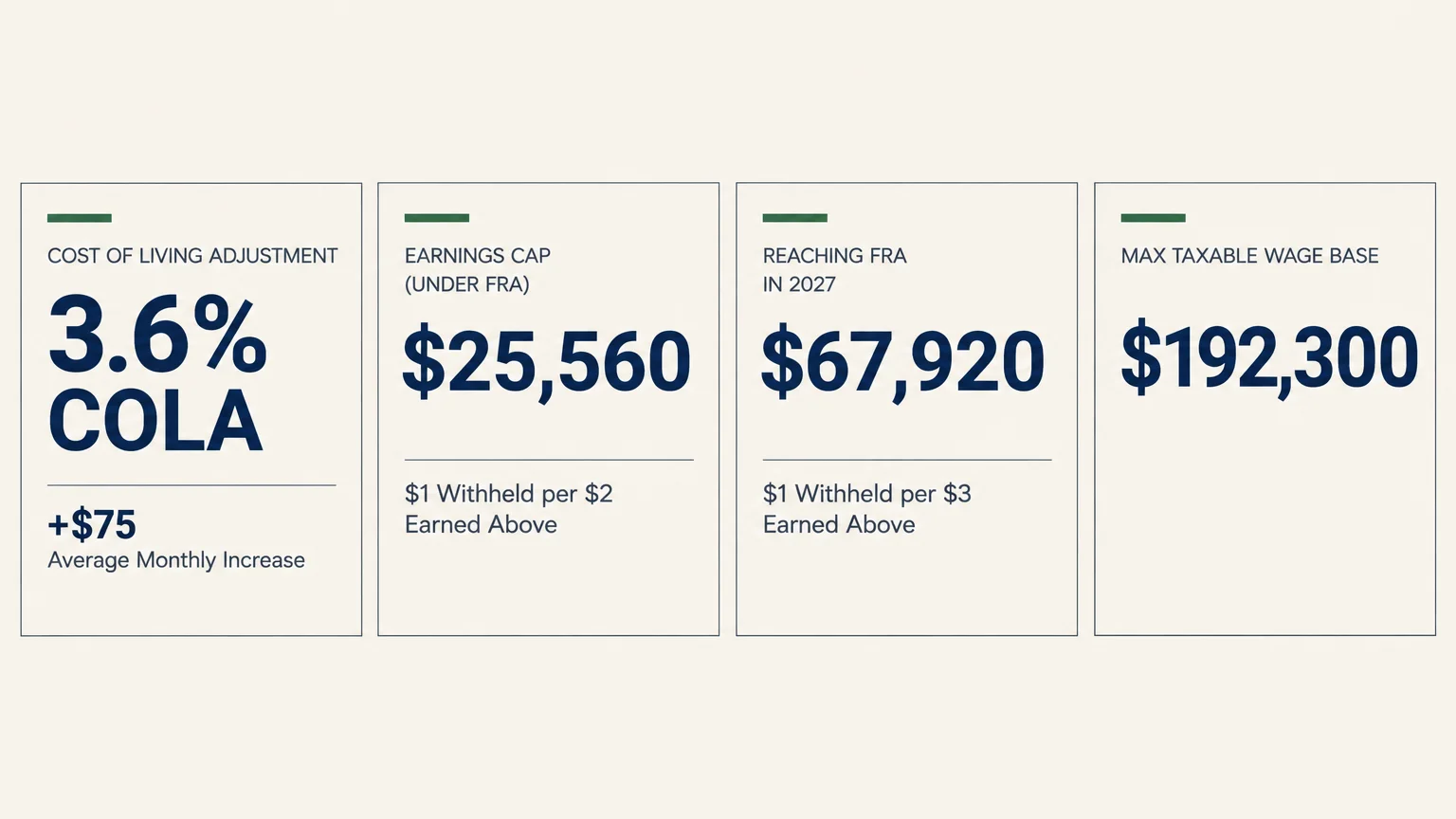
The Social Security Administration announced a 3.6% Cost-of-Living Adjustment (COLA) for 2027. This adjustment raises the average monthly benefit for retired workers by roughly $75 per month.
Supplemental Security Income recipients receive their first increased payment on December 31, 2026. All other beneficiaries will notice the higher deposits arriving on their standard January payment schedule.
If you continue working while collecting benefits before reaching full retirement age, the annual retirement earnings test limit increases to $25,560. The government withholds $1 in benefits for every $2 earned above that cap.
For workers reaching full retirement age during 2027, the separate earnings limit jumps to $67,920. In that transitional year, the withholding drops to $1 for every $3 earned above the limit.
Older professionals who remain fully employed will also face a higher maximum taxable earnings base of $192,300. You can review your personal benefit estimates directly through the Social Security Administration website.
Meanwhile, the maximum possible monthly benefit for a worker claiming at full retirement age increases to $4,188. Factoring these specific adjustments into your January budget prevents unexpected cash flow surprises.
2. Full Retirement Age Hits the Permanent Age 67 Finish Line
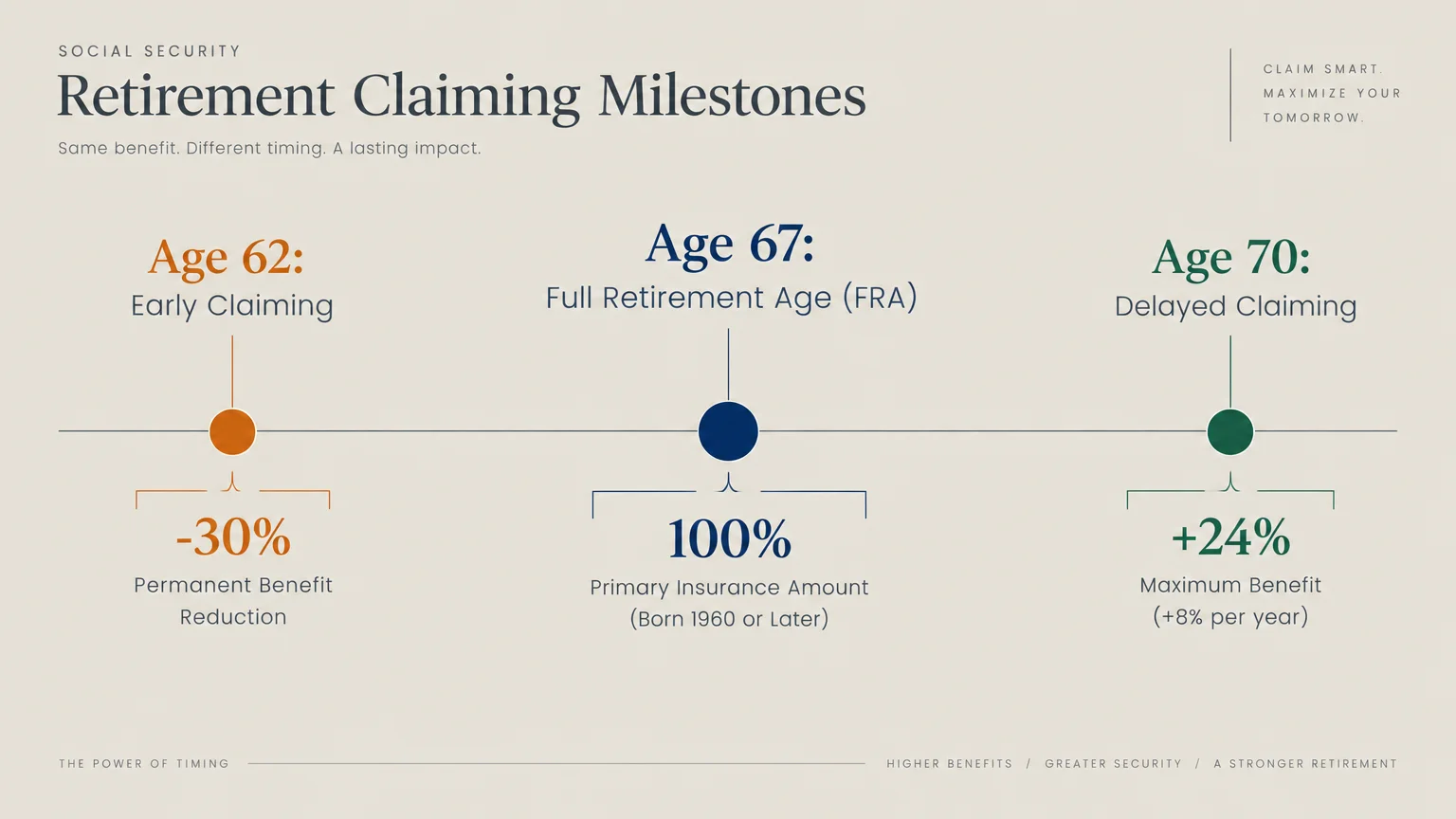
A historic milestone arrives this year as the gradual increase in Full Retirement Age (FRA) completes its decades-long phase-in. Anyone born in 1960 or later now faces a permanent full retirement age of 67.
Claiming benefits at age 62 remains an option, but doing so triggers a permanent 30% reduction in your monthly check. Filing early also reduces potential spousal survivor benefits down the road.
If your birth year is 1960, you reach age 67 during 2027, finally qualifying for 100% of your earned primary insurance amount. Delaying your claim past age 67 continues to yield delayed retirement credits of 8% per year.
Those credits accumulate until age 70, creating a maximum benefit boost of 24% above your baseline amount. Deciding when to claim requires balancing your family longevity, current health status, and cash reserves.
“The goal of retirement is to live off your assets—not live off your regrets.”
Rushing to claim benefits early often locks in lower lifetime income; waiting guarantees higher permanent cash flow. Take time this January to confirm your official FRA before filing any paperwork.

3. Medicare Part D Updates Drug Caps and Negotiated Pricing
Prescription drug coverage undergoes significant structural adjustments under ongoing Inflation Reduction Act implementations. The annual out-of-pocket spending cap for covered Part D prescription drugs rises to $2,400 in 2027.
While higher than the previous $2,100 threshold, this hard ceiling continues protecting seniors from catastrophic medication expenses. Once your covered out-of-pocket costs hit $2,400, your plan covers 100% of formulary drug expenses.
The maximum standard Part D deductible increases to $700 this year, up from $615 in 2026. Meanwhile, the national base beneficiary premium is set at $41.33 per month.
A major win for retirees arrives through Medicare’s second round of negotiated drug prices. Beginning January 1, 2027, newly negotiated rates take effect for 15 high-cost medications, including popular treatments like Ozempic, Wegovy, and Rybelsus.
Review your annual coverage paperwork directly through Medicare.gov to ensure your prescriptions remain on your plan formulary. Verifying pharmacy network tiers can save you hundreds of dollars in copayments.
You can also utilize the Medicare Prescription Payment Plan to spread drug costs evenly across calendar months. Spreading these expenses prevents substantial out-of-pocket hits during the first quarter of the year.
4. Projected Medicare Part B Premiums and Deductibles Rise
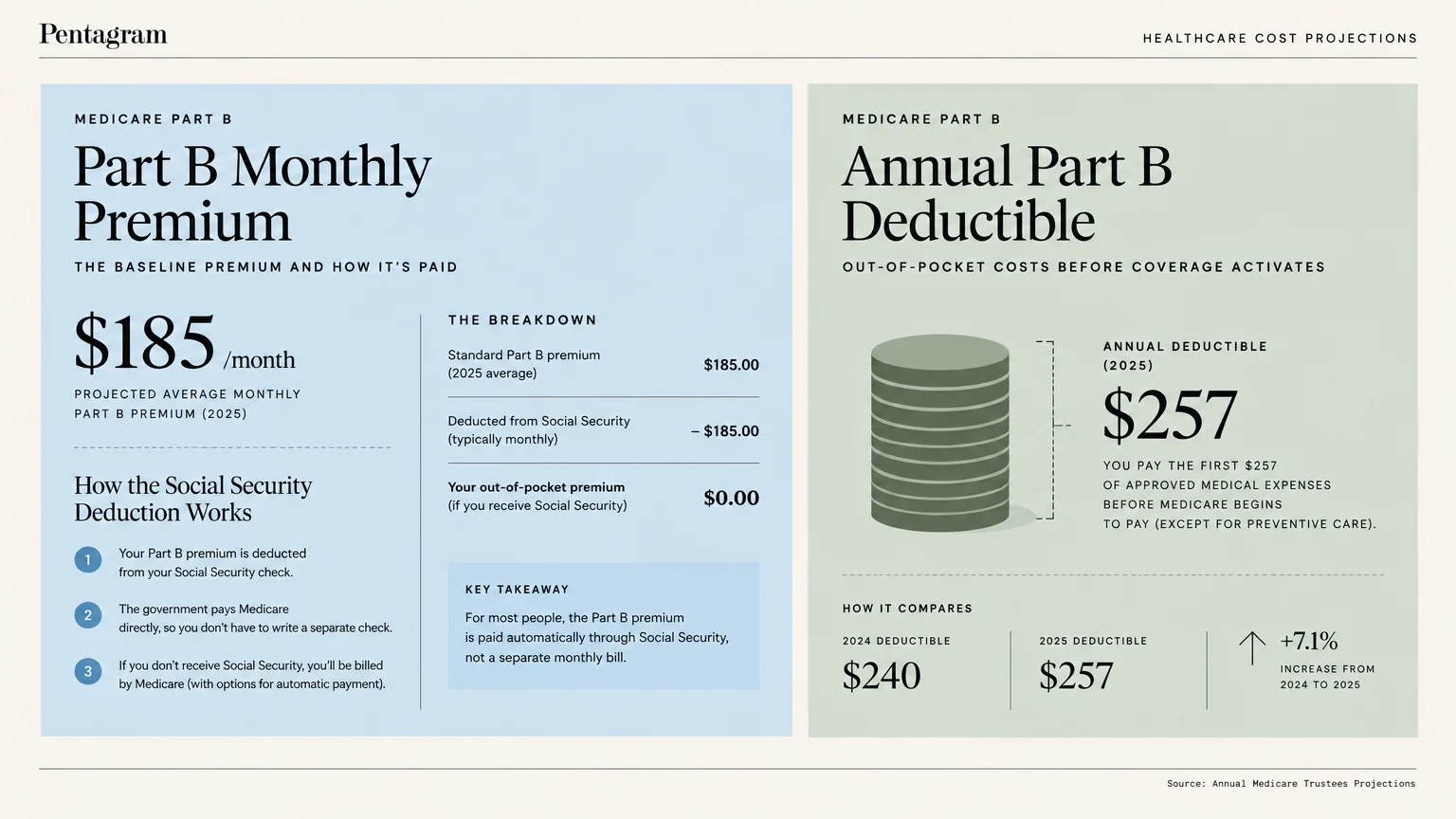
While Social Security checks are rising, healthcare deductions will absorb a measurable portion of that increase. According to Medicare Trustees projections, the standard monthly Part B premium rises to $209.50 in 2027.
The annual Part B deductible also increases to a projected $292. Because Medicare Part B premiums are deducted directly from Social Security checks, your net increase will be lower than the headline 3.6% COLA.
A retiree receiving the average $75 monthly Social Security bump will surrender roughly $6.60 of that raise to higher Part B premiums. That leaves an actual net cash improvement of approximately $68.40 per month.
Higher-income retirees must also account for Income-Related Monthly Adjustment Amounts (IRMAA). These surcharges apply to Part B and Part D premiums based on modified adjusted gross income from two years prior.
If your 2025 tax return reported elevated income from property sales or Roth conversions, prepare for higher monthly healthcare deductions. Monitoring these thresholds prevents unexpected drops in take-home retirement pay.

5. Expanded Standard Deductions and New Senior Bonus Relief
Tax season brings substantial relief for retirees thanks to annual inflation adjustments and enhanced senior deductions. Under IRS Revenue Procedure 2026-35, the base standard deduction rises to $33,200 for married couples filing jointly.
Single filers and married individuals filing separately receive a base standard deduction of $16,600. Heads of household see their standard deduction climb to $24,925 for the 2027 tax year.
Retirees aged 65 and older qualify for the traditional additional standard deduction. Single seniors receive an extra $2,100, while married seniors filing jointly gain $1,700 per qualifying spouse.
Recent federal legislation provides an additional $6,000 bonus deduction per qualifying senior aged 65 and older. A married couple where both partners have reached age 65 can claim a combined $12,000 bonus deduction.
This bonus deduction phases out at a rate of 6% for incomes exceeding $75,000 for single filers and $150,000 for joint filers. For qualifying joint filers below the phase-out limit, the total potential standard deduction reaches an impressive $48,600.
“It’s not how much money you make, but how much money you keep, how hard it works for you, and how many generations you keep it for.” — Robert Kiyosaki
This elevated deduction shields substantial retirement income from federal taxation. Work closely with your tax preparer to leverage these expanded deductions when planning IRA withdrawals.
6. The Federal Saver’s Match Replaces Old Retirement Credits
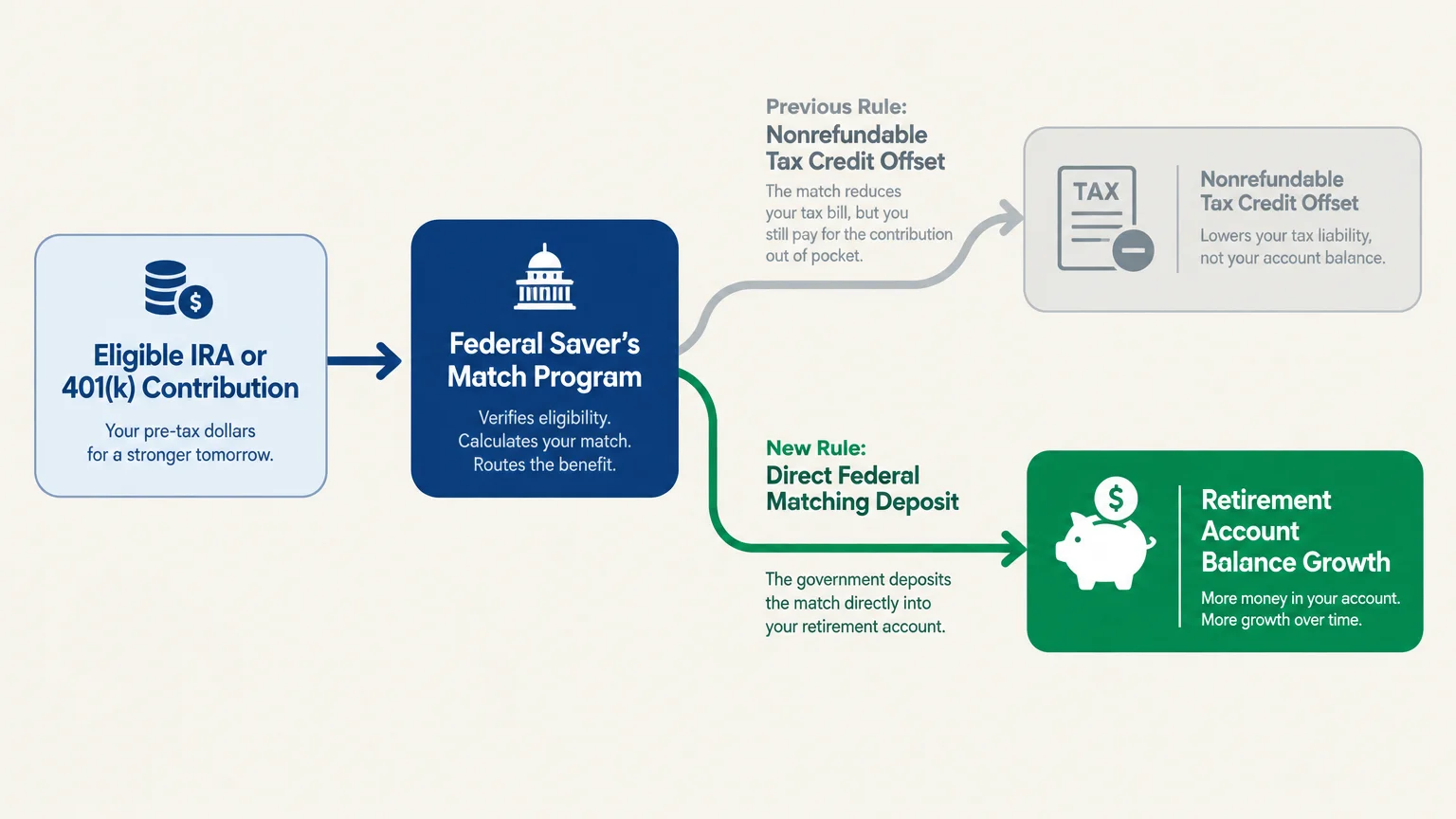
Starting January 1, 2027, the federal government officially launches the Saver’s Match, replacing the older nonrefundable Saver’s Tax Credit. This SECURE 2.0 provision transforms how lower- and middle-income Americans build retirement security.
Instead of receiving a simple tax credit, qualifying contributors receive an immediate 50% federal matching deposit. The government matches retirement contributions up to $2,000, providing a maximum deposit of $1,000 per person.
This match is deposited directly into your designated IRA or employer-sponsored retirement account. Many semi-retirees working part-time or consulting can utilize this incentive to rebuild personal savings.
The match begins phasing out at an adjusted gross income of $41,000 for married couples filing jointly. Single filers face an income phase-out threshold starting at $20,500.
Even modest contributions generate a direct 50% return through federal funds. Reviewing this incentive provides an excellent reason to maintain earned income through part-time consulting or passion projects.

7. Mandatory QCD Reporting and Projected Contribution Ceilings
Philanthropic retirees must note a mandatory administrative shift affecting Qualified Charitable Distributions (QCDs). Starting in 2027, the IRS requires custodians to report all QCDs using Code Y on Form 1099-R.
Retirees aged 70½ and older can transfer funds directly from traditional IRAs to qualifying 501(c)(3) charities tax-free. The projected QCD limit rises to $114,000 per individual for the 2027 tax year.
Standardized Code Y reporting eliminates previous confusion where tax software occasionally treated tax-free charitable gifts as taxable distributions. Always confirm your custodian assigns Code Y before filing your returns.
Actuarial projections also point toward higher employer plan contribution limits. The 401(k), 403(b), and 457 employee deferral ceiling is projected to rise to $25,500.
The standard catch-up limit for workers aged 50 and older reaches an estimated $8,500. Additionally, the special “super catch-up” contribution limit for employees aged 60 through 63 is projected at $11,250.
Remember that you have until April 15, 2027, to finalize 2026 IRA contributions of $7,500, or $8,600 if aged 50 or older. You can review official contribution frameworks on the IRS Retirement Plans portal.
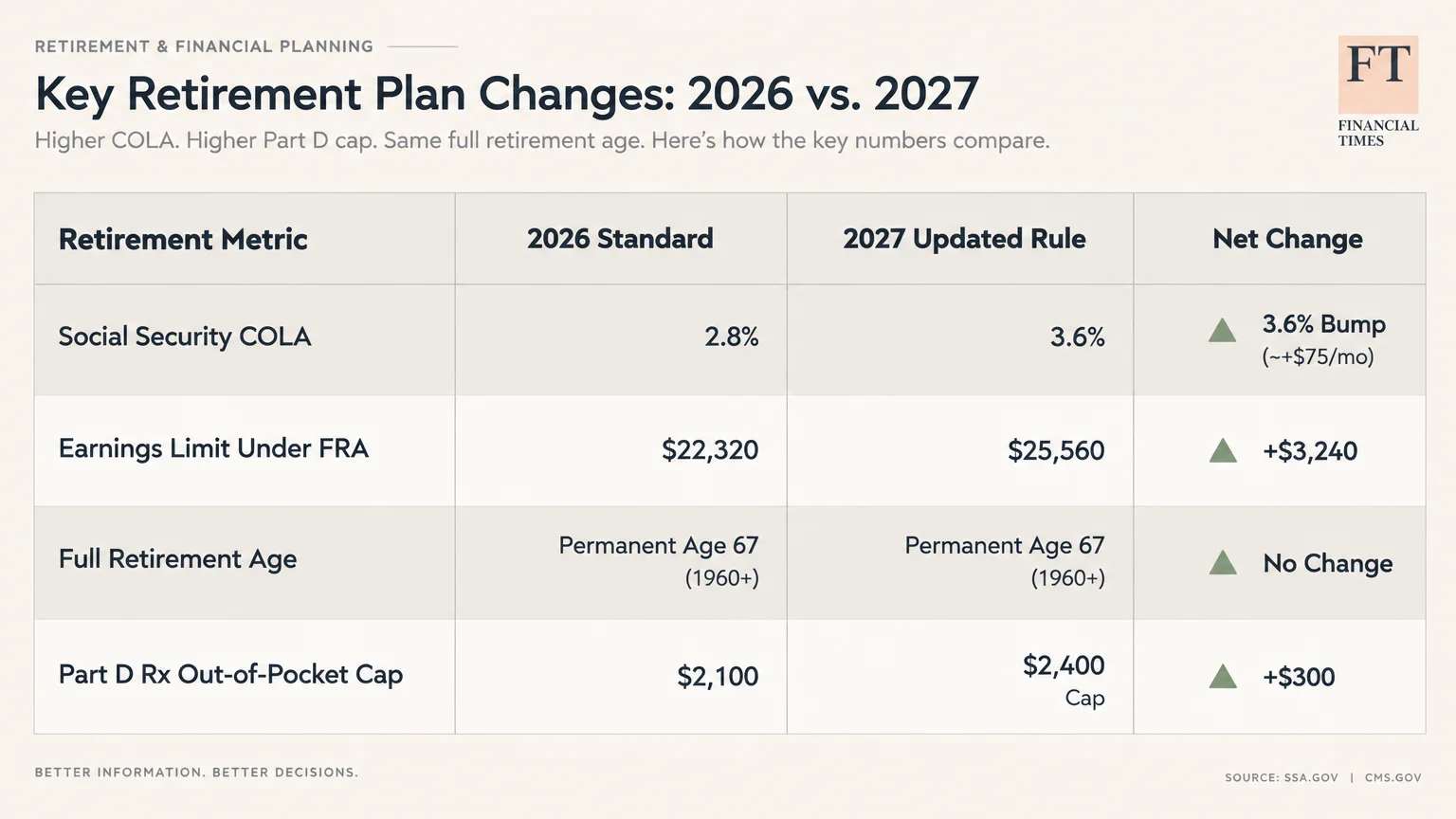
Comparing Key 2026 vs. 2027 Financial Figures
Comparing baseline numbers across calendar years clarifies where to adjust your household budget. The following overview outlines the confirmed and projected financial figures impacting retirees this year.
| Financial Category | 2026 Level | 2027 Level | Net Impact on Retirees |
|---|---|---|---|
| Social Security COLA | 2.5% | 3.6% | Average $75 monthly benefit increase |
| Earnings Test Limit (Under FRA) | $24,480 | $25,560 | Allows $1,080 more in penalty-free earnings |
| Full Retirement Age Milestone | 66 years, 10 months | Age 67 (Born 1960+) | Completes federal FRA phase-in schedule |
| Medicare Part D Out-of-Pocket Cap | $2,100 | $2,400 | $300 increase in maximum annual drug cap |
| Standard Part D Deductible | $615 | $700 | $85 increase in upfront prescription costs |
| Projected Part B Standard Premium | $202.90 | $209.50 | $6.60 monthly increase deducted from checks |
| Married Joint Standard Deduction | $32,200 | $33,200 | $1,000 base increase plus age 65+ senior bonuses |
| Saver’s Match Maximum | Tax Credit | $1,000 Direct Deposit | Direct 50% federal matching deposit replaces credit |
Studying these side-by-side shifts helps identify whether your net take-home income will increase or shrink. Use these verified benchmarks to rebalance your savings accounts and recurring bills.

Don’t Make These Mistakes
Financial rule shifts frequently catch retirees off guard, leading to avoidable tax penalties and benefit reductions. Avoiding several common missteps keeps your retirement assets secure.
- Assuming your Social Security raise is pure profit: Medicare Part B premium increases are deducted automatically, reducing your actual take-home gain.
- Ignoring the earnings test while working part-time: Exceeding $25,560 before reaching full retirement age triggers mandatory benefit withholdings.
- Missing the Medicare Part D deductible reset: Deductibles reset every January 1, meaning early-year pharmacy visits require higher initial out-of-pocket cash.
- Overlooking the new Code Y reporting for QCDs: Verify that your IRA custodian properly reports charitable gifts to avoid paying income taxes on those donations.
- Neglecting senior bonus deduction phaseouts: Incomes above $75,000 for singles or $150,000 for married couples begin losing the new $6,000 senior tax bonus.
Carefully reviewing these potential pitfalls shields your portfolio from unnecessary friction. A proactive review each January ensures you retain control over your money.

When Professional Advice Is Worth It
Navigating multiple overlapping regulatory updates can prove challenging when managing substantial retirement assets. Partnering with qualified professionals ensures you capitalize on fresh opportunities while mitigating risks.
State Health Insurance Assistance Program (SHIP) counselors offer free, unbiased guidance on Medicare plan options. They help you analyze whether newly negotiated drug pricing affects your specific prescription list.
A fee-only fiduciary financial advisor helps coordinate portfolio withdrawals around the new senior standard deductions. They can structure tax-bracket management strategies without triggering unexpected IRMAA healthcare penalties.
Elder law attorneys assist in aligning your long-term care plans with updated statutory limits and estate protections. You can explore additional planning tools through the Consumer Financial Protection Bureau retirement portal.
Scheduling a brief review with trusted specialists early in the year prevents costly misunderstandings. Objective professional advice consistently pays dividends in peace of mind.
Frequently Asked Questions
Will the 3.6% Social Security COLA push me into a higher tax bracket?
A higher benefit check increases your gross income, which can subject a larger percentage of your benefits to taxation. However, expanded standard deductions and senior bonuses help offset this income gain.
How does the new $2,400 Part D cap work if I take brand-name medications?
All payments made toward covered Part D prescription drugs—including deductibles, copayments, and coinsurance—count toward the $2,400 cap. Once your spending reaches $2,400, your plan pays 100% of covered drug costs for the rest of the year.
Can a married couple claim both the traditional senior deduction and the bonus deduction?
Yes, qualifying married couples aged 65 and older can stack both deductions. You claim the base deduction of $33,200, plus $1,700 per spouse, and up to $6,000 per spouse in bonus deductions.
What happens to the Social Security benefits withheld under the earnings test?
Withheld benefits are not permanently lost. When you reach your full retirement age, the Social Security Administration recalculates your monthly benefit upward to credit you for the months benefits were withheld.
Your Next Steps for the New Year
Take time this week to review your January bank deposits and Medicare statements to verify your adjusted benefit numbers. Updating your annual household budget now ensures your cash flow remains resilient all year long.
Retirement rules and benefit amounts vary based on individual work history, income, and circumstances. This article provides general guidance only. Consult a SHIP counselor, financial advisor, or elder law attorney for advice specific to your situation.
Last updated: November 2026. Medicare and Social Security rules change annually—always verify current details at official government sources.