Claiming every legal deduction protects your hard-earned retirement nest egg. However, aggressive write-offs immediately raise red flags with IRS automated processing systems.
While the overall individual audit rate sits at just 0.3%, claiming disproportionate deductions increases your tax breaks audit risk. Roughly 89% of these examinations happen entirely through the mail.
Understanding risky tax deductions allows you to claim legitimate tax relief while maintaining rigorous tax compliance. Learn how to protect your wealth without inviting unwanted scrutiny.
How IRS Audit Triggers Actually Work in Retirement
The IRS uses automated screening software to evaluate every tax return. This system assigns a Discriminant Information Function (DIF) score to your filing.
A high DIF score means your deductions deviate significantly from national averages for your income bracket. An IRS agent then manually reviews the return to decide whether to open an examination.
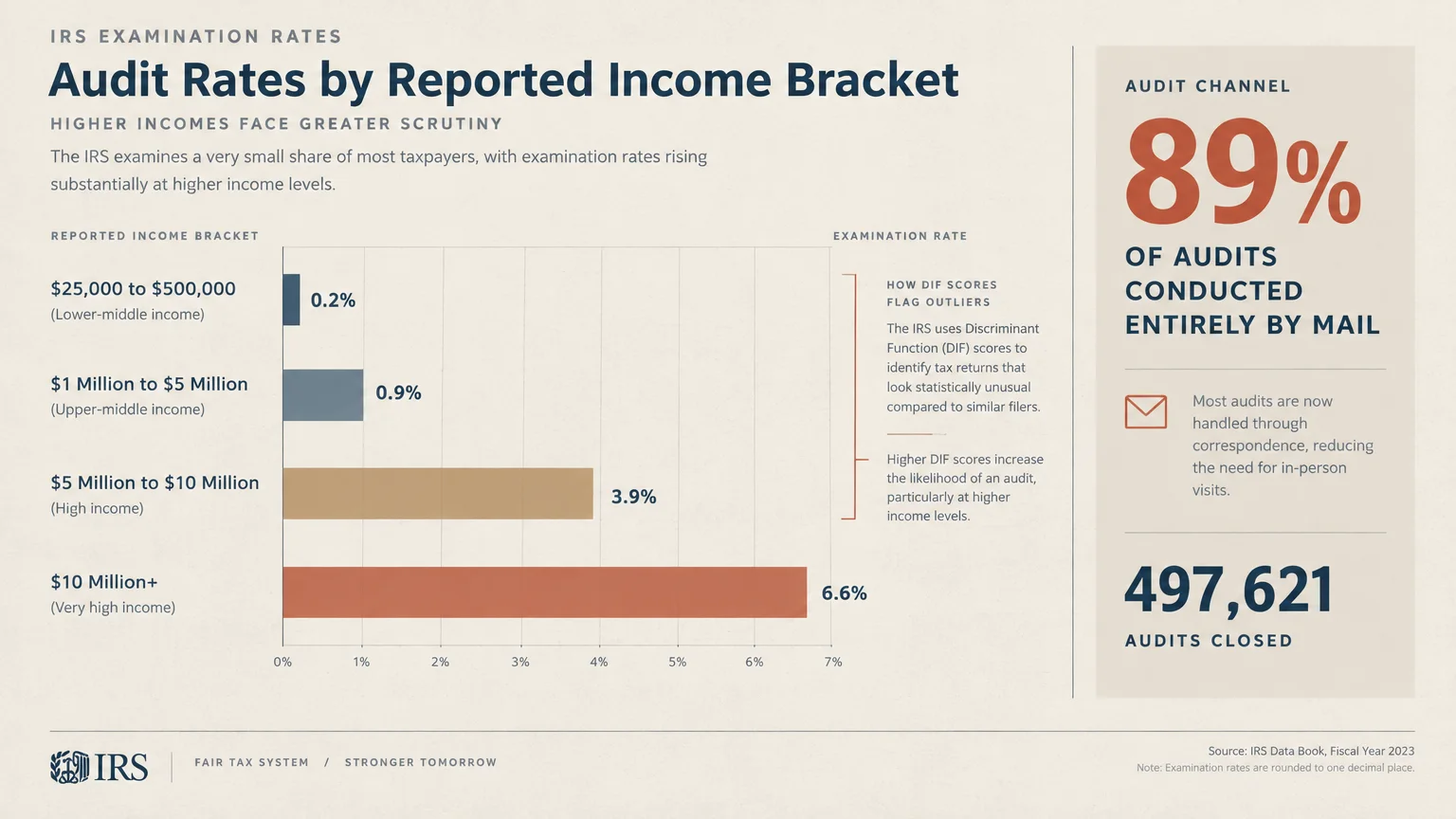
In fiscal year 2025, the IRS closed 497,621 individual audits. These examinations resulted in $26.8 billion in recommended additional tax.
Audit rates vary dramatically depending on your reported income. For taxpayers reporting between $25,000 and $500,000, the audit rate remains modest at 0.2%, or one in 500 returns.
Scrutiny climbs sharply once your adjusted gross income exceeds seven figures. Filers earning between $1 million and $5 million face a 0.9% audit rate.
Audit rates jump to 3.9% for incomes between $5 million and $10 million. For filers reporting $10 million or more, the examination rate reaches 6.6%.
Most retirees fall well below these ultra-wealthy thresholds. Even so, specific IRS red flags can pull an ordinary return out of the processing pipeline.
You can check reliable federal resources through USA.gov Retirement Resources to understand how your retirement income gets classified. Knowing your baseline helps you identify potential triggers early.
1. Large or Disproportionate Charitable Deductions
Donating to worthy causes supports your community and lowers your taxable balance. However, outsized charitable deductions serve as primary IRS audit triggers.
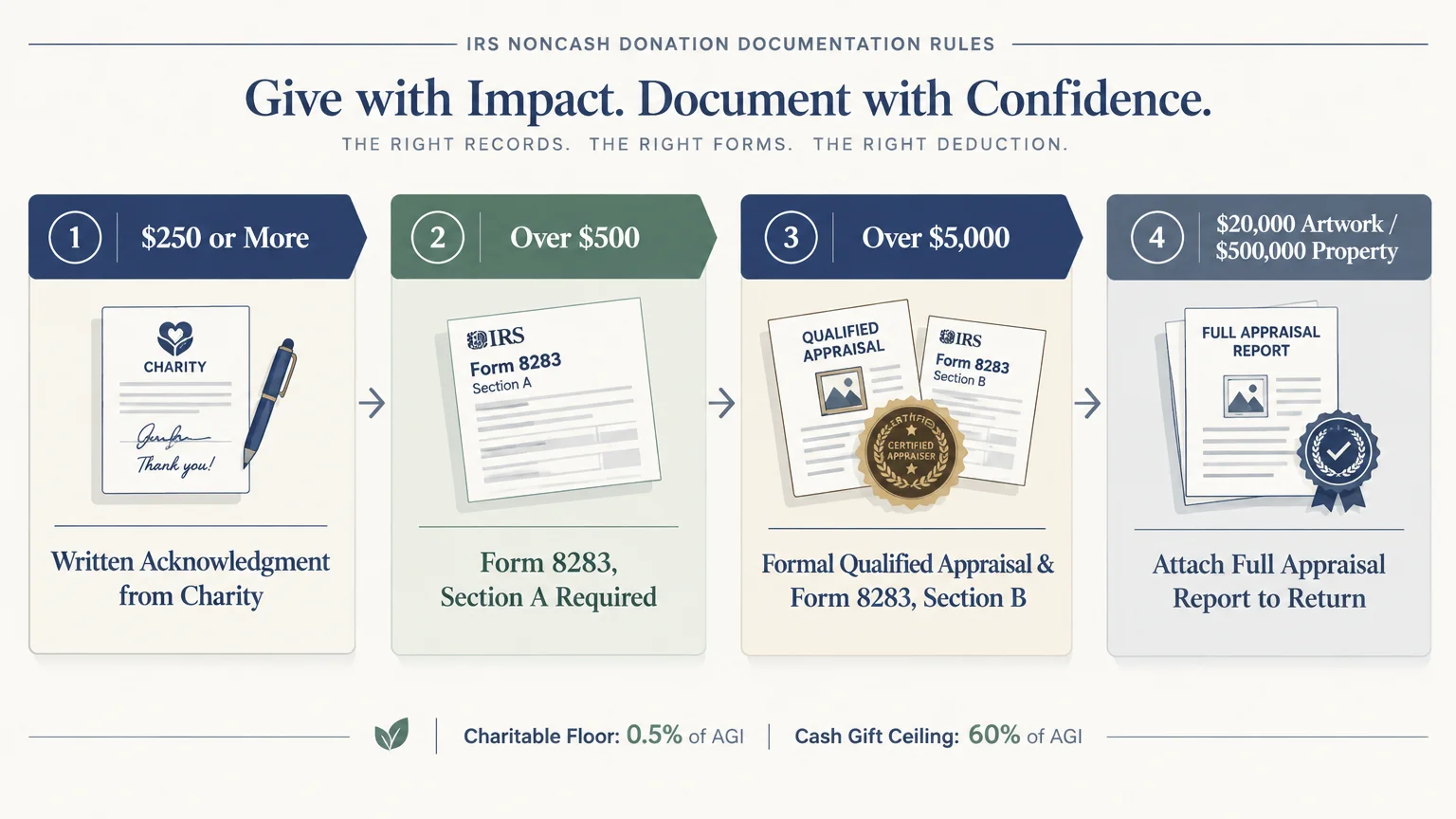
Tax rules establish an explicit itemized deduction threshold for charitable giving. Taxpayers who itemize can only deduct charitable donations to the extent they exceed a floor of 0.5% of their adjusted gross income (AGI).
Cash gifts remain capped at 60% of your AGI. Deductions that approach these statutory ceilings immediately invite automated verification notices.
Noncash donations face even tighter scrutiny from tax examiners. The IRS requires strict documentation based on the exact dollar value of property donated.
- Donations of $250 or more: You must obtain a contemporaneous written acknowledgment from the charity before filing your tax return.
- Total noncash donations over $500: You must file IRS Form 8283, Section A, detailing how you acquired the items and their fair market value.
- Single items or groups over $5,000: You must obtain a formal qualified appraisal from an independent appraiser and complete Form 8283, Section B.
- Artwork over $20,000 or property over $500,000: You must attach the entire physical appraisal report directly to your filed return.
Donating used clothing or household goods valued at thousands of dollars raises instant questions. IRS algorithms compare your giving patterns against standard donation ratios for your demographic peer group.
Retirees frequently donate valuable collections, vehicles, or antique furniture when downsizing their homes. If you fail to attach the required appraisal paperwork, the IRS will automatically disallow your deduction.

2. Outsized Medical and Dental Expense Claims
Healthcare costs represent one of the largest expenses for retirees. Claiming these costs provides welcome relief, but medical deductions feature built-in restrictions.
You can only deduct unreimbursed medical expenses on Schedule A if you itemize deductions. Furthermore, you can only write off the portion of expenses that exceeds 7.5% of your AGI.
Claiming substantial medical deductions relative to a modest retirement income often triggers correspondence inquiries. The IRS frequently requests proof that insurance did not reimburse these out-of-pocket costs.
Assisted living and nursing home fees represent a common pitfall for older adults. The medical component of long-term care qualifies as a deductible expense, but basic room and board fees do not.
To deduct the full cost of assisted living, an individual must be certified as chronically ill by a licensed healthcare practitioner. The resident must also receive services under a prescribed plan of care.
Home modifications also attract IRS examination notices. Installing wheelchair ramps, widening doorways, or lowering cabinets for medical accessibility qualifies as a deductible medical expense.
However, you must subtract any increase in your home’s overall property value from the deduction amount. Maintain written doctor recommendations and contractor invoices to substantiate every dollar you deduct.
The Consumer Financial Protection Bureau Retirement Portal offers helpful guides on managing unexpected healthcare outlays during retirement. Adequate preparation prevents reporting errors on your return.

3. The Home Office Deduction for Consulting and Bridge Jobs
Many older adults transition into independent consulting, freelance writing, or part-time business ventures. Writing off home office expenses reduces self-employment taxes, but it remains a classic audit trigger.
The Tax Cuts and Jobs Act permanently suspended unreimbursed employee expenses for W-2 workers. You cannot claim a home office deduction if you receive standard W-2 wages from an employer.
This deduction belongs exclusively to self-employed individuals and sole proprietors filing Schedule C. To qualify, your workspace must satisfy two mandatory legal tests.
First, you must use the space exclusively for business activities. If your home office doubles as a guest bedroom, exercise area, or TV den, it fails the exclusivity test.
Second, you must use the dedicated space regularly as your principal place of business. Conducting occasional administrative tasks at your dining room table will not survive an IRS examination.
Tax filers can choose between two calculation methods for the deduction. The simplified option allows you to deduct $5 per square foot up to 300 square feet, yielding a maximum deduction of $1,500.
The actual expense method requires calculating a percentage of your overall mortgage interest, property taxes, utilities, and homeowners insurance. Claiming high utility allocations or home repairs on Schedule C often leads to documentation requests.
“It’s not how much money you make, but how much money you keep, how hard it works for you, and how many generations you keep it for.” — Robert Kiyosaki

4. Excessive Business Mileage and Travel Claims
Tracking vehicle mileage allows self-employed retirees to offset consulting income. However, vehicle deductions attract intense agency scrutiny because personal driving often blurs into business tasks.
The IRS business mileage rate changes periodically to reflect fluctuating fuel and vehicle ownership costs. For 2026, the standard business mileage rate is 72.5 cents per mile from January 1 through June 30, and 76 cents per mile from July 1 through December 31.
These figures represent an increase from the 70 cents per mile rate in 2025. Medical travel carries a lower mileage rate of 20.5 cents per mile for early 2026 and 23.5 cents per mile for the second half of the year.
Volunteer travel using your personal vehicle remains fixed at the statutory rate of 14 cents per mile. Mixing these separate mileage categories together creates immediate calculation errors.
Claiming that a personal vehicle was used 100% for business purposes almost guarantees an audit notice. IRS agents know that nearly all sole proprietors use their primary vehicle for personal errands.
Reporting round numbers, such as exactly 8,000 business miles, signals to automated filters that you estimated your mileage. Tax compliance requires maintaining a contemporaneous driving log detailing dates, destinations, exact mileage, and specific business purposes.
5. The Expanded State and Local Tax (SALT) Deduction
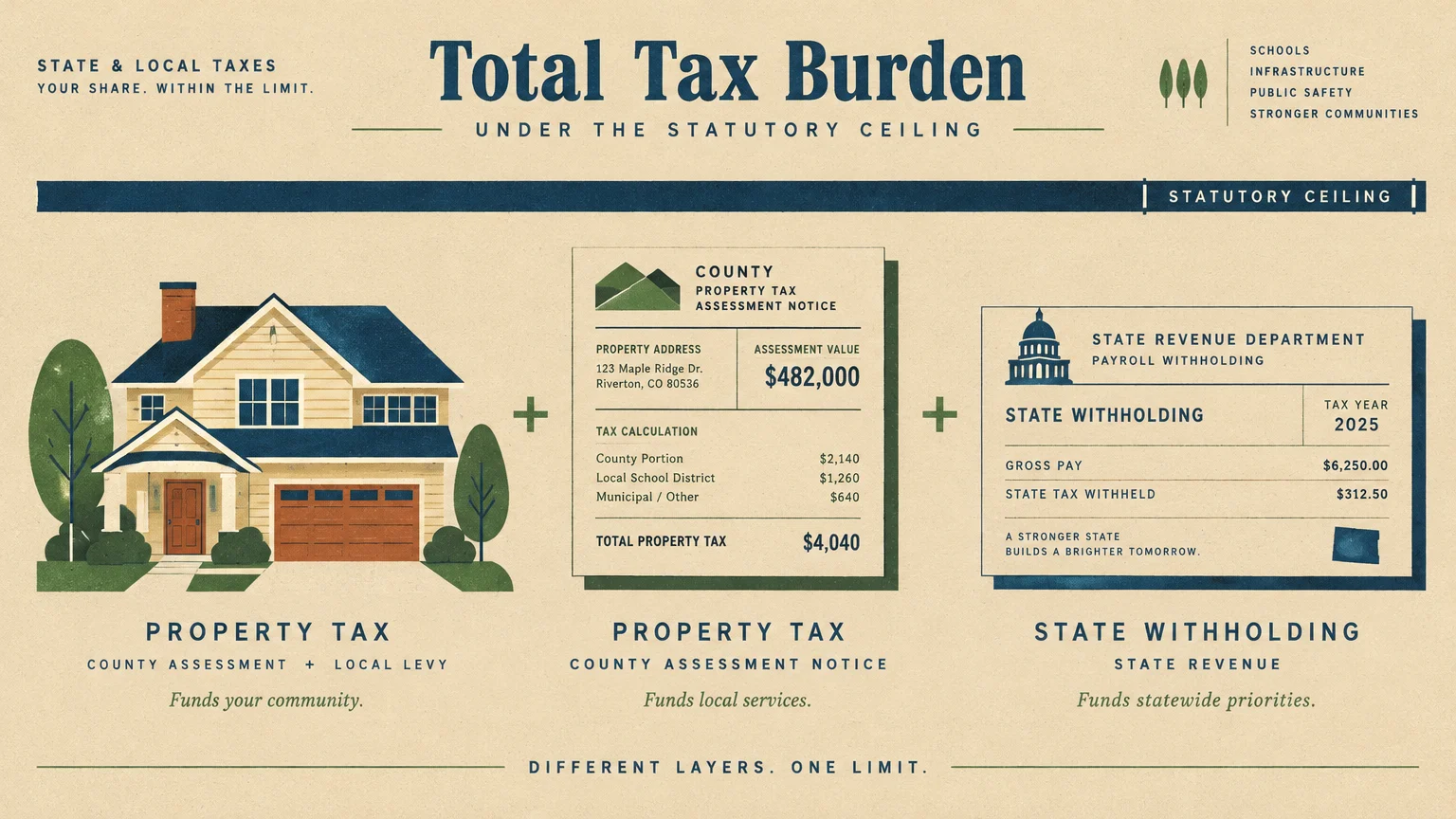
Federal tax legislation significantly expanded the itemized deduction limit for state and local taxes. For tax year 2026, the SALT deduction cap stands at $40,400, up slightly from $40,000 in 2025.
Married individuals filing separately face a SALT deduction cap of $20,200 in 2026. This cap covers cumulative property taxes, state income taxes, or local sales taxes paid during the calendar year.
This expanded cap provides welcome relief for retirees living in high-tax jurisdictions. However, it also pushes hundreds of thousands of seniors back into itemizing their deductions on Schedule A.
Statistically, filing Schedule A carries higher audit exposure than claiming the standard deduction. Itemized returns present more opportunities for classification errors and mathematical discrepancies.
High-income retirees must also monitor complex income phaseouts. The 2026 SALT cap phases out by 30% for taxpayers with modified adjusted gross income above $505,000, decreasing to a $10,000 minimum deduction at $606,300.
Furthermore, taxpayers in the top 37% tax bracket face an itemized deduction limit. The tax benefit of their itemized deductions is capped at 35 cents on the dollar for incomes exceeding $640,600 for singles and $768,700 for joint filers.
If you own multiple properties, deducting personal real estate taxes as business expenses will raise red flags. Always verify that your property tax assessments match local county records precisely before filing.
6. Misreported Qualified Charitable Distributions (QCDs)
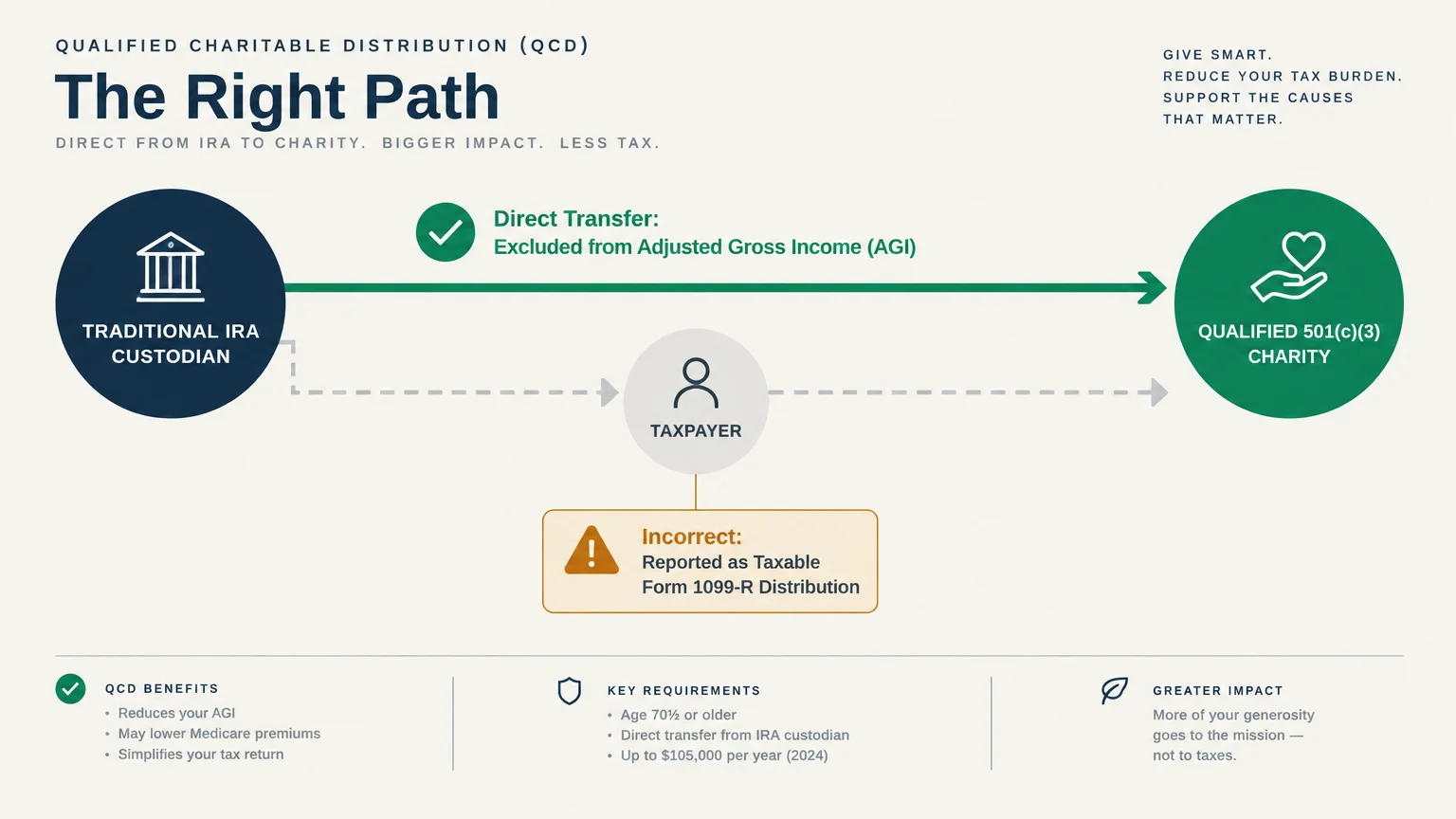
Retirees age 70½ and older can transfer funds directly from a traditional IRA to an eligible 501(c)(3) charity. These transfers count toward satisfying annual Required Minimum Distributions (RMDs) without increasing your adjusted gross income.
For tax year 2026, the annual QCD limit is $111,000 per individual, an increase from $108,000 in 2025. You can also make a one-time QCD of up to $55,000 to fund a charitable remainder trust or gift annuity.
QCDs avoid the new 0.5% charitable deduction floor because they reduce income before AGI is calculated. Learn more about distribution rules directly through the IRS Retirement Plans Portal.
Despite their popularity, QCDs cause frequent processing mismatches. When your IRA custodian sends you Form 1099-R, Box 1 reflects the total gross distribution taken from the account.
Custodians rarely indicate whether a distribution went to a charity or directly to your bank account. Box 2a often displays the full distribution amount as taxable income.
If you fail to adjust the taxable total on Form 1040, the IRS may classify the transfer as standard income. Conversely, adjusting Line 4b without writing “QCD” triggers automated CP2000 underreporting notices.
Never claim an itemized charitable deduction on Schedule A for money distributed via a QCD. Taking both tax breaks constitutes illegal double-dipping and results in substantial accuracy-related penalties.
“The goal of retirement is to live off your assets—not live off your regrets.”
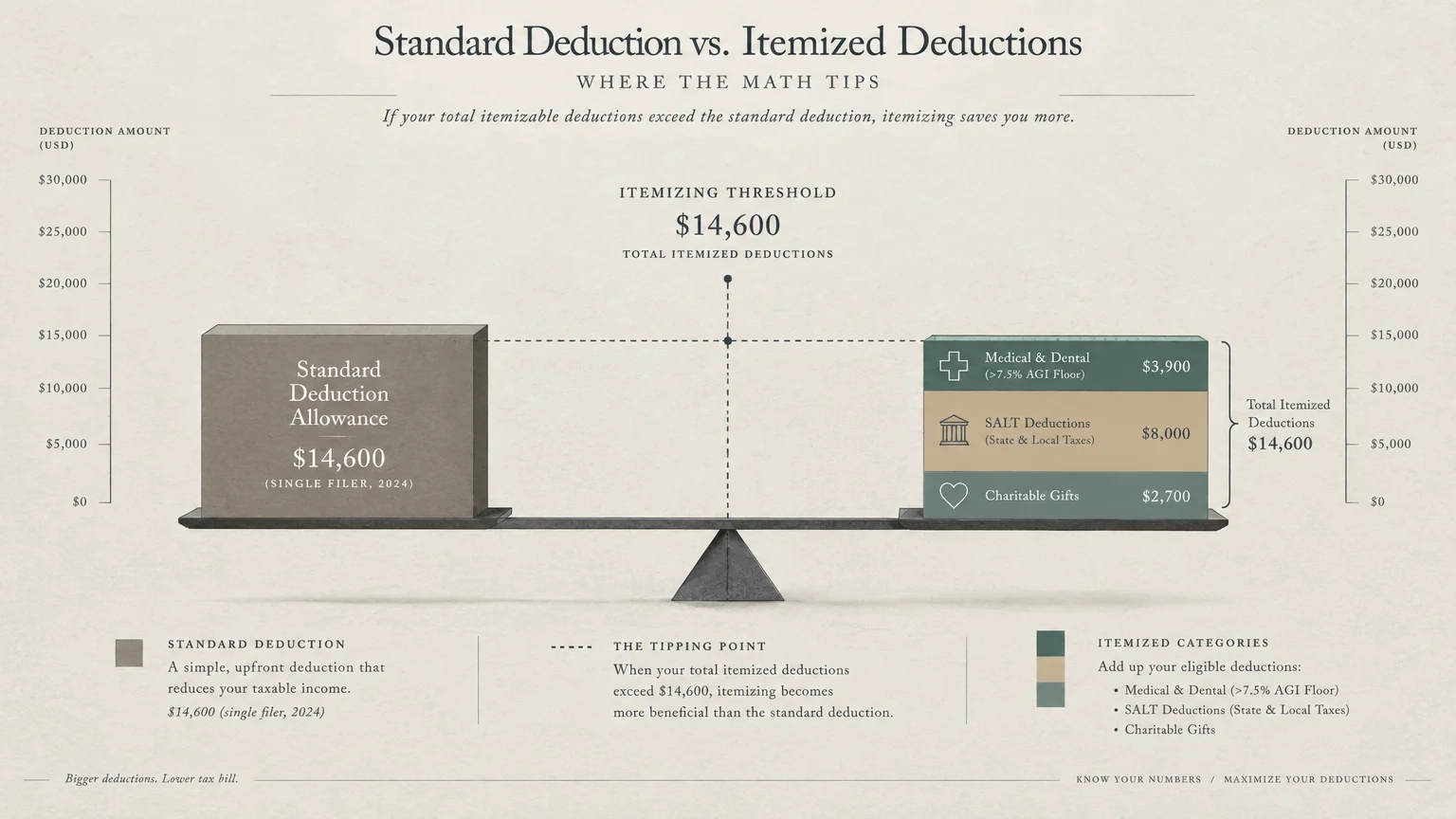
Comparing Itemized Deductions Against Standard Allowances
Choosing between itemizing and claiming the standard deduction determines your overall audit profile. Recent tax reforms created generous baseline write-offs specifically designed for older Americans.
For 2026, the basic standard deduction is $16,100 for single filers and $32,200 for married couples filing jointly. Filers age 65 and older receive an additional traditional standard deduction of $2,050 for singles or $1,650 per qualifying spouse.
The Enhanced Senior Deduction provides an additional $6,000 deduction per person age 65 or older through Schedule 1-A. Married couples where both spouses are 65 or older receive a $12,000 enhanced deduction.
This enhanced deduction phases out at a 6% rate for single filers with MAGI above $75,000 and joint filers above $150,000. It remains available whether you take the standard deduction or itemize.
| Tax Deduction Category | 2026 Standard or Statutory Limit | Audit Risk Level | Primary Documentation Required |
|---|---|---|---|
| Single Standard Deduction (Age 65+) | $18,150 base allowance | Extremely Low | Proof of age only (Form 1040) |
| Married Joint Deduction (Both 65+) | $35,500 base allowance | Extremely Low | Proof of age only (Form 1040) |
| Enhanced Senior Deduction | Up to $6,000 single / $12,000 joint | Low | Schedule 1-A MAGI calculation |
| Itemized Medical Expenses | Expenses exceeding 7.5% of AGI | Moderate to High | Receipts, doctor letters, insurance EOBs |
| Itemized Charitable Gifts | Exceeding 0.5% AGI floor; max 60% | Moderate to High | Form 8283, bank records, appraisals |
| State and Local Taxes (SALT) | Capped at $40,400 ($20,200 MFS) | Moderate | County property tax bills, W-2 forms |
| Home Office Deduction | $5/sq ft (simplified) or actual costs | High | Floor plans, utility bills, business logs |
Claiming standard allowances dramatically reduces the chance of receiving an audit letter. Consider itemizing only when your documented deductions substantially exceed your combined senior standard allowances.
Additional advice on balancing write-offs against retirement income is available through advocacy resources like AARP. Evaluating your cumulative allowances protects your overall financial plan.

Don’t Make These Mistakes
Avoiding common filing errors ensures your return passes through automated filters without manual intervention. Small discrepancies often trigger wide-ranging inquiries into your financial affairs.
Be vigilant about these frequent reporting blunders:
- Reporting Estimated Round Numbers: Submitting expenses ending in double zeros suggests guesswork. Always report actual costs down to the exact cent.
- Treating a Hobby as a Business: Deducting expenses for woodworking, gardening, or photography without demonstrating profit intent triggers Schedule C audits. The IRS requires showing an actual profit in three out of five consecutive years.
- Overlooking Form 1099-R Mismatches: Automated matching programs compare 1099 forms submitted by financial institutions against your return. Any discrepancy between your reporting and institutional filings generates immediate inquiry letters.
- Claiming Dual Vehicle Deductions: You cannot deduct actual vehicle depreciation and operating expenses while simultaneously claiming standard mileage rates. Select one method and follow it consistently.
- Ignoring the Charitable Floor: Forgetting to apply the 0.5% AGI floor to itemized charitable donations will result in automated adjustments and interest charges.
Addressing these errors before submitting your annual return preserves your peace of mind. Thorough recordkeeping remains your strongest defense against agency scrutiny.

When Professional Advice Is Worth It
Tax legislation changes rapidly, making self-preparation risky for individuals with diverse retirement income streams. Complex returns benefit significantly from licensed professional oversight.
Hire a Certified Public Accountant (CPA) or an Enrolled Agent (EA) if you manage rental real estate, consulting activities, or private investments. These practitioners hold unlimited representation rights before the IRS if your return faces examination.
Professional guidance proves especially valuable when you execute substantial Qualified Charitable Distributions or multi-state property sales. A professional ensures your disclosures adhere to current regulatory guidelines.
Tax advisors also assist with correspondence audits. Because 89% of examinations occur via written letters, having an authorized representative draft your formal response prevents administrative missteps.
Frequently Asked Questions About IRS Red Flags
What percentage of retirees get audited each year?
The overall individual audit rate is approximately 0.3%, or about one in 300 returns. For taxpayers earning between $25,000 and $500,000, the rate drops to roughly 0.2%.
What happens during an IRS correspondence audit?
The IRS sends a letter, such as a CP2000 notice, requesting specific documentation to support reported numbers. You resolve these inquiries by mailing receipts, bank statements, or official forms directly to the assigned processing center.
Can I deduct home renovations made for medical accessibility?
Yes, you can deduct the cost of ramps, handrails, widened doorways, and modified bathrooms. However, you must deduct only expenses exceeding 7.5% of AGI, minus any increase in home market value.
Does taking the Enhanced Senior Deduction increase audit risk?
No, the Enhanced Senior Deduction is a statutory deduction created under federal law. Provided your modified adjusted gross income matches reported figures on Schedule 1-A, it does not trigger audits.
Are Qualified Charitable Distributions subject to the new 0.5% charitable floor?
No, QCDs bypass Schedule A entirely. Because the distribution transfers directly from your IRA to the charity, it simply lowers your taxable income without being subject to itemized deduction floors.
Take an hour this week to organize your receipts, mileage logs, and donation receipts into organized digital folders. Maintaining complete paper trails ensures you can claim every deduction you deserve with complete confidence.
Retirement rules and benefit amounts vary based on individual work history, income, and circumstances. This article provides general guidance only. Consult a SHIP counselor, financial advisor, or elder law attorney for advice specific to your situation.
Last updated: November 2026. Medicare and Social Security rules change annually—always verify current details at official government sources.