Walking away from full-time work changes how your money must function. When you transition from earning a paycheck to spending down assets, cutting wasteful purchases preserves your lifestyle and protects your long-term independence.
Unnecessary spending drains your nest egg faster and increases sequence-of-returns risk during market downturns. Eliminating outdated financial habits leaves more money available for healthcare, meaningful travel, and personal peace of mind.
Top wealth planners highlight eight recurring expenses that needlessly deplete retirement budgets after age 65. Stopping these purchases today strengthens your cash flow and safeguards your wealth for the decades ahead.
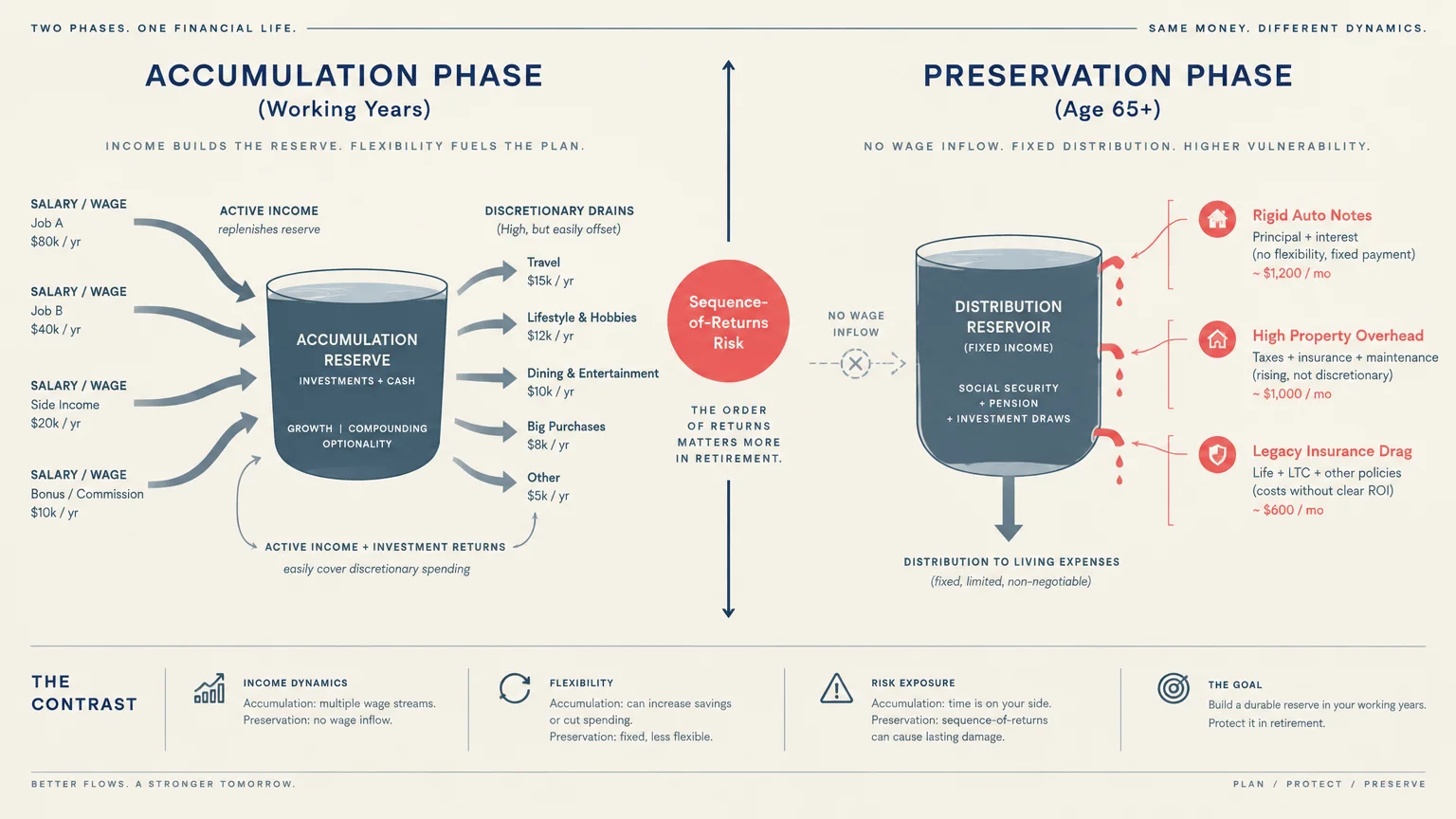
Why Retirement Spending Requires a New Playbook
Transitioning into retirement means your financial strategy must shift from wealth accumulation to wealth preservation. Every dollar you spend now represents money that cannot easily be replaced with overtime or wage increases.
Inflation, fluctuating markets, and unexpected medical bills pose distinct threats to retirees on fixed distributions. Protecting your cash flow requires auditing routine purchases that offer little tangible value in this new chapter.
“The goal of retirement is to live off your assets—not live off your regrets.”
Making deliberate adjustments to your spending habits keeps your portfolio intact for thirty years or longer. Strategic eliminations provide the margin you need to enjoy retirement without persistent financial anxiety.
1. Brand-New Vehicles with Expensive Financing
Buying a brand-new car off the dealership lot represents an immediate loss of hard-earned capital. A new vehicle loses roughly twenty percent of its market value within the first twelve months alone.
Commuting ends once you leave the workforce, which drastically reduces your annual mileage. Paying steep monthly financing notes for a depreciating asset that sits parked in a garage makes little practical sense.
Auto loans extending sixty or seventy-two months also lock you into high fixed monthly overhead. Those rigid obligations restrict your flexibility when living on fixed retirement distributions and Social Security income.
Newer models also demand higher annual registration fees and significantly higher comprehensive auto insurance premiums. These recurring administrative expenses quietly erode your monthly cash cushion year after year.
Car dealerships also push costly dealer add-ons like fabric protection, paint sealants, and rust proofing. These dealer markups inflate vehicle purchase prices by hundreds or thousands of dollars with virtually no return.
Instead, maintain your reliable current vehicle or purchase a two- to three-year-old certified pre-owned car with cash. You avoid the steepest depreciation curve while retaining modern safety features and dependable transportation.
2. Oversized Homes and High-Maintenance Real Estate
Maintaining the sprawling family home where you raised children often becomes an unnecessary financial drain. Many retirees find themselves heating, cooling, and insuring square footage they enter only once or twice a month.
Property taxes continue climbing across the country, creating an unpredictable expense that strains fixed budgets. Major structural upkeep, such as roof replacements, exterior painting, and landscaping, also demands continuous cash outlays.
Multi-story layouts create physical safety hazards as your mobility needs change over time. Climbing stairs to access bedrooms or laundry facilities increases fall risks, which can trigger catastrophic health setbacks.
Selling an oversized house allows you to harvest accumulated equity and eliminate costly maintenance contracts. You can relocate to a single-story home, a modern condominium, or a vibrant active adult community.
Downsizing reduces utility bills, simplifies your daily routine, and frees up substantial liquid capital. Those recovered dollars can bolster your investment portfolio or fund meaningful travel ambitions.
If you prefer staying in your home, consider adapting only the ground floor for single-level living. Modifying your existing space cuts ongoing maintenance costs while allowing you to remain in a familiar neighborhood.

3. Obsolete Whole Life Insurance Policies
Life insurance serves a vital purpose during your working years by replacing your earned income if you die prematurely. It protects young children, pays off residential mortgages, and covers lingering educational debts.
Once you reach age 65, your financial landscape typically looks very different. Your children are financially independent adults, and your major household debts are often settled.
Continuing to pay massive monthly premiums for permanent or whole life insurance drains cash you should be using today. Financial advisors frequently point out that you no longer have an earned income that requires replacement.
Whole life policies often carry annual administrative fees that eat away at your returns. If your policy has built substantial cash value, those management charges quietly erode capital that could generate safe yield elsewhere.
Consult a fee-only fiduciary advisor to evaluate surrendering the policy for its cash surrender value. You might also explore a tax-free 1035 exchange into an asset that provides dedicated long-term care protection.
4. Unreviewed Medicare Plans and Automatic Rollovers
Sticking with the same Medicare Advantage or Part D prescription drug plan year after year is a silent budget killer. Insurance carriers adjust their pricing, doctor networks, and drug formularies every single autumn.
According to Fidelity, an average 65-year-old retiring in 2026 needs $185,500 in after-tax savings for healthcare, or $371,000 for a married couple. Allowing coverage to roll over automatically guarantees you overpay for essential care.
The standard Medicare Part B monthly premium is $202.90 in 2026, with an annual deductible of $283. These base expenses are mandatory, but your supplemental drug and private plan choices remain under your control.
The Medicare Part A hospital deductible is $1,736 per benefit period in 2026. Understanding these baseline cost-sharing figures helps you evaluate whether Medigap or an Advantage plan offers superior out-of-pocket protection.
Under federal reforms, out-of-pocket spending on covered Part D prescription drugs is capped at $2,100 in 2026 and $2,400 in 2027. However, individual plan deductibles can reach $615 in 2026 and $700 in 2027.
Compare available coverage each year during Medicare Open Enrollment, which runs from October 15 to December 7. Use the official Medicare Plan Finder to confirm that your specific medications remain covered at the lowest cost.
5. Timeshares and Restrictive Vacation Club Contracts
Vacation timeshares and points-based resort clubs are marketed as prestigious family investments. In reality, they are illiquid liabilities that lock you into perpetual annual maintenance assessments.
Maintenance fees consistently rise faster than general inflation, regardless of whether you use your allotted week. Aging owners who wish to travel less find themselves trapped with non-negotiable yearly bills.
Timeshare contracts frequently include binding perpetuity clauses that legally extend maintenance obligations to your heirs. Your children could inherit these recurring assessment fees unless you take proper legal steps to divest the property.
Reselling a timeshare on the secondary market is notoriously difficult; many owners discover their contracts carry zero monetary value. Disreputable exit companies frequently exploit seniors with upfront fees and empty promises.
Modern travel offers far more flexibility through boutique hotels, short-term vacation rentals, and senior discounts. You retain complete freedom to choose where you go without paying perpetual property assessments.

6. Retail Extended Warranties and Protection Plans
Cashiers at big-box electronics and appliance stores routinely push extended service contracts and protection plans at checkout. These products generate massive profit margins for retailers while providing minimal practical value to consumers.
Most modern household appliances have standard manufacturer warranties that cover defective parts and labor for the first year. The likelihood of an appliance malfunctioning during years two or three remains statistically very low.
Extended protection plans often contain extensive exclusions, high deductibles, and complex claim filing requirements. Many service claims are routinely denied due to normal wear and tear exclusions.
Instead of paying for speculative protection on individual gadgets, self-insure through your liquid emergency fund. Setting aside a few thousand dollars in a high-yield savings account handles occasional repairs without recurring fees.
Many major credit cards also offer complimentary purchase protection and extended warranty benefits when you use them to buy goods. Check your card agreements before spending extra cash on duplicate retail plans.
7. High-Fee, Opaque Financial Products
Retirees seeking safety frequently fall prey to complex financial products promising guaranteed returns without market risk. Many equity-indexed annuities and structured notes carry confusing fee layers that quietly siphon away your returns.
These products often come with steep surrender charges that last seven to ten years. If you need sudden access to your principal for a medical emergency, the penalties can be devastating.
“It’s not how much money you make, but how much money you keep, how hard it works for you, and how many generations you keep it for.” — Robert Kiyosaki
Beware of free-dinner financial seminars targeted at retirees that pitch complex financial contracts. Presenters often emphasize market upside while downplaying strict caps, participation rates, and substantial surrender penalties.
Complicated investment products also make it difficult to calculate your true net yield. Sales agents earn generous commissions on these transactions, creating an inherent conflict of interest.
Stick with transparent, liquid investments such as low-cost index funds, Treasury securities, and standard certificates of deposit. Simplicity gives you complete visibility and immediate access to your capital when life demands it.

8. Financial Lifelines and Cosigned Loans for Adult Children
Supporting your adult children during sudden hardships is a natural instinct for any caring parent. However, routinely paying their rent, cell phone bills, or credit card debt imperils your own retirement solvency.
Never cosign private student loans, auto financing, or mortgages for family members. If the primary borrower misses payments, creditors will legally pursue your assets and damage your credit standing.
Adult children have decades of wage-earning potential ahead to recover from financial errors or pay off obligations. Retirees living on finite assets lack the runway to replenish a depleted retirement portfolio.
Repeatedly bailing out adult children can also foster long-term financial dependency and strain family dynamics. Setting healthy financial boundaries preserves both your wealth and your personal relationships.
The Consumer Financial Protection Bureau encourages open family conversations regarding boundaries and budget limits. Protecting your financial independence ensures you will not become a financial burden on your children later in life.
Smarter Swaps for Common Retirement Expenses
Replacing wasteful purchases with cost-effective alternatives protects your cash flow without diminishing your daily comfort. Redirecting wasted dollars into interest-bearing reserves immediately strengthens your overall financial foundation.
| Expense Category | What to Stop Buying | Smarter Financial Alternative | Potential Annual Savings |
|---|---|---|---|
| Transportation | Brand-new vehicle with a 6-year loan | Certified pre-owned car purchased with cash | $6,000 – $9,000 |
| Housing | Oversized multi-story family home | Rightsized single-story home or condo | $4,000 – $12,000 |
| Insurance | Unneeded whole life insurance policies | Self-insuring with existing portfolio assets | $1,800 – $4,500 |
| Healthcare | Defaulting to unreviewed Medicare plans | Annual comparisons during Open Enrollment | $500 – $2,000 |
| Travel | Timeshares with rising maintenance fees | Pay-as-you-go rentals and off-peak travel | $1,200 – $3,000 |
| Consumer Goods | Extended retail warranties on electronics | Dedicated cash emergency buffer | $300 – $800 |
Reviewing these categories annually ensures your retirement budget stays aligned with your actual lifestyle needs. Eliminating two or three of these items can liberate thousands of dollars each year.
Developing disciplined spending habits allows you to allocate more resources toward personal health, leisure, and lasting family memories. Mindful spending creates true financial freedom during your retirement years.
Errors That Cost Retirees Thousands
Overspending is not the only threat to your retirement security; administrative missteps can be equally damaging. Failing to understand official deadlines and tax regulations can trigger severe penalties from government agencies.
One costly misstep is missing Required Minimum Distribution (RMD) deadlines. You must begin taking mandatory RMDs from traditional retirement accounts at age 73.
Missing an RMD triggers a stiff 25% tax penalty on the amount not withdrawn. That penalty is reduced to 10% if you correct the error within two years, but prompt action is critical.
Another frequent error involves misunderstanding Social Security claiming rules while still working. Full Retirement Age is 67 for anyone born in 1960 or later, though Medicare eligibility begins at 65.
If you claim Social Security before reaching Full Retirement Age, the annual earnings test limit for 2027 is $25,560. Earning above that threshold results in a temporary deduction of $1 for every $2 earned over the limit.
For those reaching Full Retirement Age in 2027, the earnings limit is $67,920 until the exact month you reach full age. Knowing these limits prevents unexpected benefit withholding when continuing part-time employment.
Retirees also lose money by ignoring annual benefit changes. The Social Security Cost-of-Living Adjustment was 2.8% in 2026 and rises to 3.6% for 2027, lifting the average benefit from $2,095 to $2,170 monthly.
Verify your projected benefits through the Social Security Administration before submitting a permanent claim. Making an informed claiming decision prevents permanent reductions in your monthly lifetime income.

When to Get Expert Help
Managing retirement finances involves navigating intricate rules spanning taxation, healthcare, and estate distribution. Seeking specialized counsel at key transition points protects your assets and saves you from costly trial and error.
Connect with a State Health Insurance Assistance Program (SHIP) counselor for unbiased Medicare plan comparisons. These trained professionals provide free, objective guidance without selling insurance products or collecting carrier commissions.
Hire a fee-only fiduciary financial advisor when structuring your annual portfolio withdrawal strategy. Fiduciary advisors are legally obligated to work in your best interest and do not profit from high-commission annuity sales.
Work with an experienced elder law attorney to establish updated medical directives, durable financial powers of attorney, and trusts. Proper legal documents ensure trusted individuals can manage your affairs if health challenges arise.
Low-income seniors should also check eligibility for support programs through BenefitsCheckUp, operated by the National Council on Aging. This resource connects older adults to vital assistance for prescriptions, food, and home utilities.
Frequently Asked Questions
Many retirees share similar concerns when reevaluating their spending patterns and restructuring their post-career budgets. Here are straightforward answers to common questions about managing money effectively after age 65.
Why is managing spending after 65 more critical than seeking high investment returns?
During retirement, you face sequence-of-returns risk, meaning market drops early in retirement can permanently impair your portfolio. Controlling spending reduces the need to liquidate depressed assets during market corrections.
How does reviewing Medicare coverage each year actually save money?
Prescription drug formularies and tier classifications shift annually, often doubling copays for identical medications. Comparing plans ensures your specific prescriptions fall under the most favorable cost-sharing structure available.
What is the cleanest way to surrender an unwanted life insurance policy?
Contact your policy provider to request the current cash surrender value and tax breakdown. You can also execute a 1035 exchange to transfer cash value into a qualified long-term care policy without triggering immediate taxes.
How do I tell adult children that I can no longer support them financially?
Frame the conversation around protecting your future autonomy rather than withholding affection. Explain that exhausting your nest egg today means you could become a financial liability to them in advanced age.
What should I do with the money I save by cutting these expenses?
Direct your recovered funds into a liquid emergency reserve or short-term Treasury bills. Building an accessible cash buffer shields you from needing to sell equities when stock markets drop.
Once you establish an adequate emergency reserve, you can redirect extra savings into discretionary spending on travel, hobbies, and grandchildren. You earned your retirement, so spend your money on experiences that bring genuine joy.
Take Control of Your Retirement Cash Flow
Auditing your monthly expenses gives you immediate control over your retirement destiny. Take a morning this week to review your bank and credit card statements from the past ninety days.
Identify recurring subscriptions, unnecessary insurance premiums, and impulse retail purchases that fail to enrich your life. Eliminating those expenditures puts money directly back into your pocket.
This article is for informational purposes only and does not constitute financial, legal, or medical advice. Medicare rules, Social Security benefits, and tax laws change regularly—verify current details at Medicare.gov, SSA.gov, or with a licensed professional.
Last updated: November 2026. Medicare and Social Security rules change annually—always verify current details at official government sources.