Stepping away from the workforce a single year later can permanently transform your financial security and lifestyle quality in retirement. If you feel uncertain about your monthly cash flow, health insurance bridging, or accumulated savings, postponing your exit date grants you compounding advantages that hard-coded timelines cannot match. Extra working months let you stack high-yield contributions, boost guaranteed Social Security payouts, and enter your next chapter with genuine peace of mind. By evaluating your actual financial readiness against key operational milestones, you can spot the subtle warning signs that call for a temporary pause on your exit strategy.

1. You Have Not Reached Age 65 and Lack Affordable Health Insurance
Retiring before age 65 creates a critical health coverage gap that can destroy even a meticulous financial plan. Because Medicare eligibility begins at age 65, leaving employer-sponsored medical insurance early forces you to secure private healthcare on the open market. Many pre-retirees severely underestimate out-of-pocket healthcare costs during these bridge years. COBRA coverage allows you to remain on your former employer’s group policy for up to 18 months, but you pay 102% of the full premium cost. For a couple in their early sixties, COBRA premiums routinely exceed $1,500 to $2,500 per month.
Purchasing an individual policy through the Affordable Care Act (ACA) marketplace provides another alternative, but premiums and deductibles fluctuate based on household taxable income. If you draw heavily from traditional 401(k) or IRA accounts to cover living costs, that extra taxable income reduces your ACA premium tax credits, driving healthcare costs sharply upward. Postponing your exit date until age 65 allows you to maintain employer-subsidized health benefits and transition seamlessly into Medicare without burning through cash reserves.
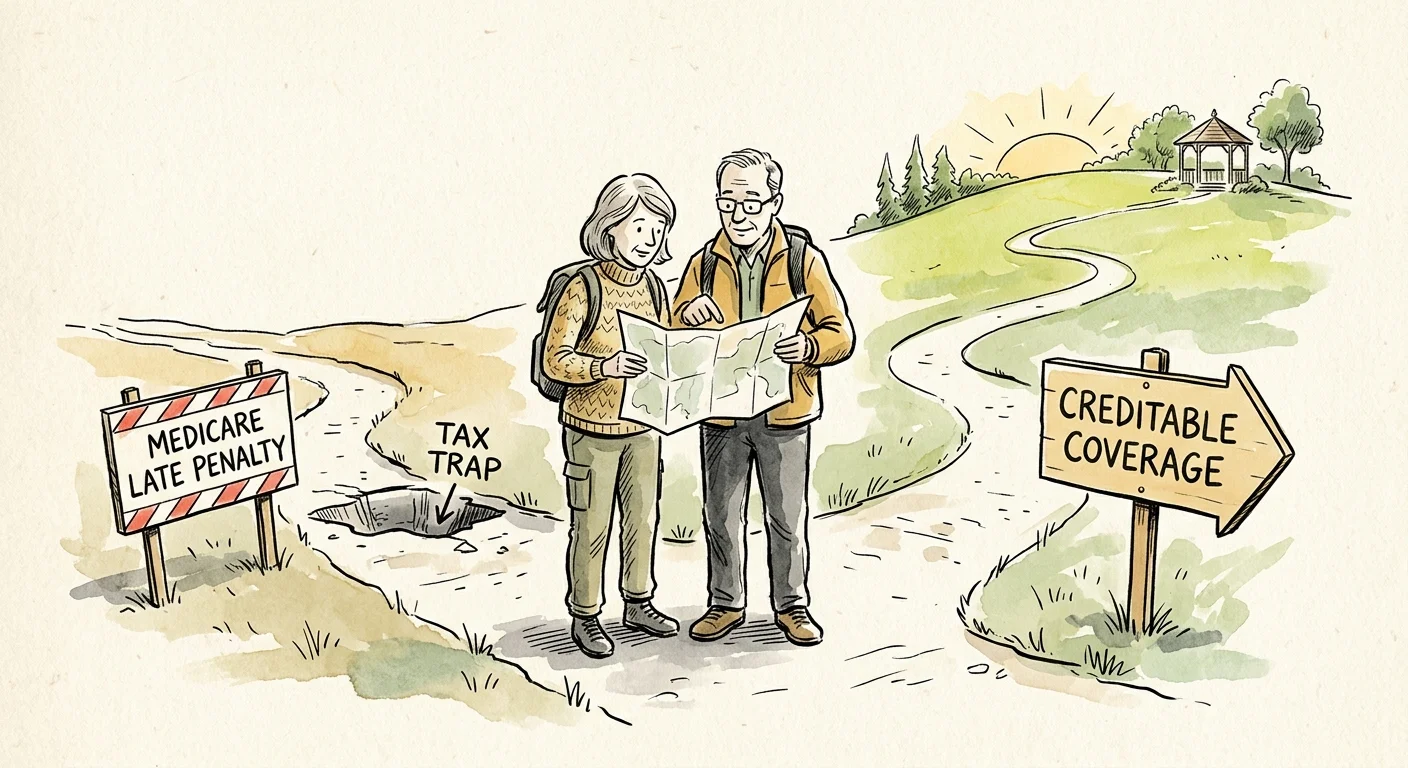
Working past age 65 under an active group health plan at a company with 20 or more employees also permits you to delay Medicare Part B without incurring penalties. However, if you drop employer coverage at age 65 without enrolling in Medicare Part B during your Initial Enrollment Period, you face a permanent 10% late enrollment penalty for every 12-month period you were eligible but unenrolled. You can verify coverage rules directly at Medicare.gov to ensure your health plan qualifies as creditable coverage.

2. You Want to Maximize SECURE 2.0 “Super Catch-Up” Contributions
Current tax laws offer unprecedented catch-up contribution opportunities for older workers nearing the finish line. For 2026, the standard contribution limit for workplace 401(k), 403(b), and 457 plans stands at $24,500. Workers aged 50 and older can normally make an additional standard catch-up contribution of $8,000, bringing their maximum tax-deferred saving potential to $32,500 per year.
However, under the SECURE 2.0 Act, employees aged 60, 61, 62, and 63 qualify for an enhanced “Super Catch-Up” contribution limit. In 2026, eligible workers in this four-year age window can make an expanded catch-up contribution of $11,250 instead of the standard $8,000. This boosts your total allowable workplace retirement contribution to $35,750 in a single calendar year.
A new tax provision taking effect in 2026 affects higher earners utilizing catch-up contributions. If your FICA wages from your employer exceeded $150,000 in the previous calendar year, tax law mandates that all age-50+ catch-up contributions must go into a Roth (after-tax) account. Although you pay upfront income taxes on those catch-up dollars, all investment earnings and future withdrawals compound entirely tax-free. Working one additional year in your early sixties allows you to pump thousands of additional tax-advantaged dollars into your portfolio at the exact moment your earning power reaches its peak. You can review current workplace retirement contribution rules at IRS Retirement Plans.
3. Claiming Social Security Now Permanently Reduces Your Lifetime Benefit
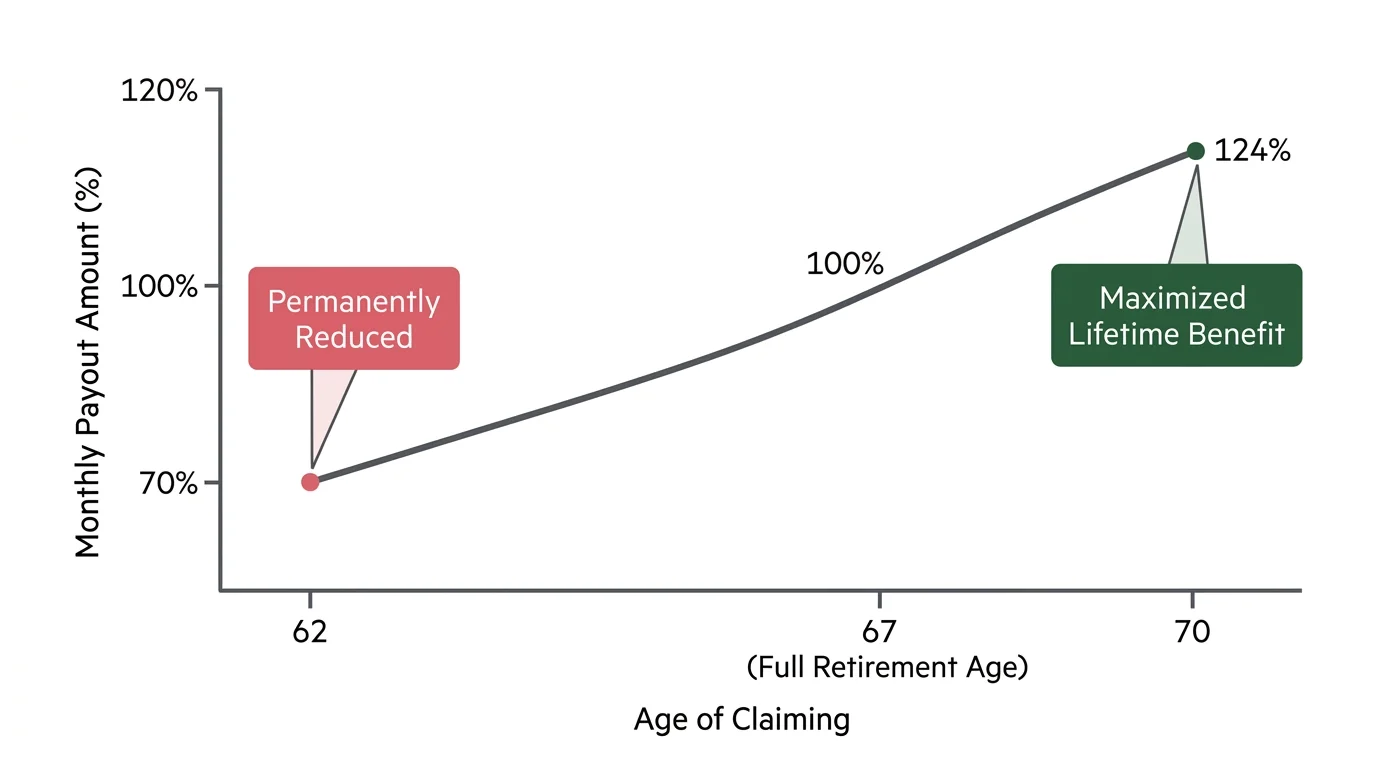
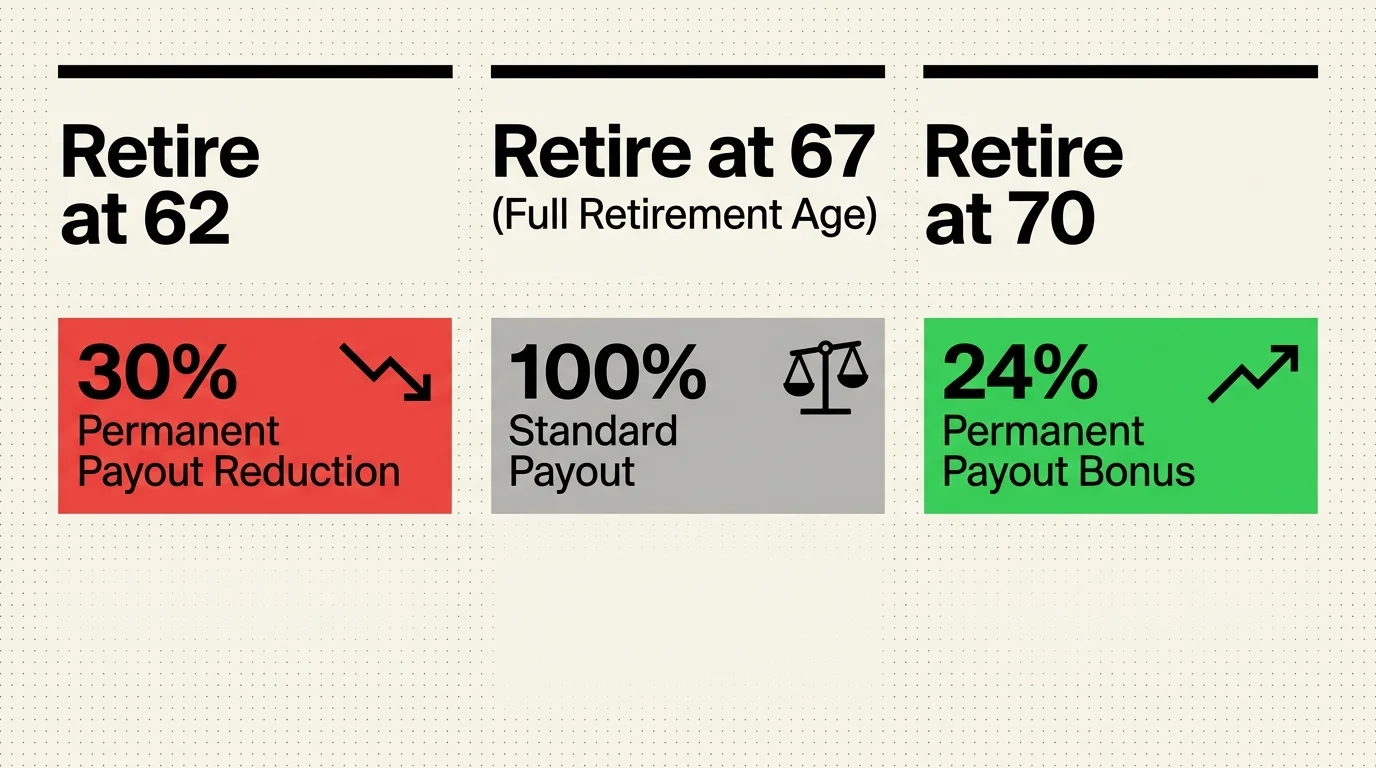
Your Full Retirement Age (FRA) is 67 if you were born in 1960 or later. Filing for Social Security at age 62—the earliest eligible age—permanently slashes your monthly benefit check by 30% compared to your FRA baseline. If your primary insurance amount at age 67 is $2,000 per month, claiming at age 62 shrinks your baseline payment to $1,400 per month for life.
Postponing your benefit claim past Full Retirement Age earns you Delayed Retirement Credits at a rate of 8% per year (0.667% per month) up to age 70. Waiting from age 67 to age 70 delivers a 24% permanent boost to your monthly income. In that same scenario, delaying your claim until age 70 elevates your baseline benefit from $2,000 to $2,480 per month. That creates a $1,080 monthly payout difference between filing at 62 and waiting until 70.
Continuing to work while claiming Social Security early triggers the Social Security Earnings Test. In 2026, if you are under your Full Retirement Age for the entire year, the Social Security Administration (SSA) withholds $1 in benefits for every $2 you earn above $24,480. In the calendar year you reach FRA, the earnings limit increases to $65,160, with $1 withheld for every $3 earned above the limit. Postponing retirement timing advice helps you avoid these immediate benefit withholdings and locks in higher guaranteed, inflation-indexed lifetime income.
4. High-Interest Debt or Major Capital Expenses Threaten Your Cash Flow
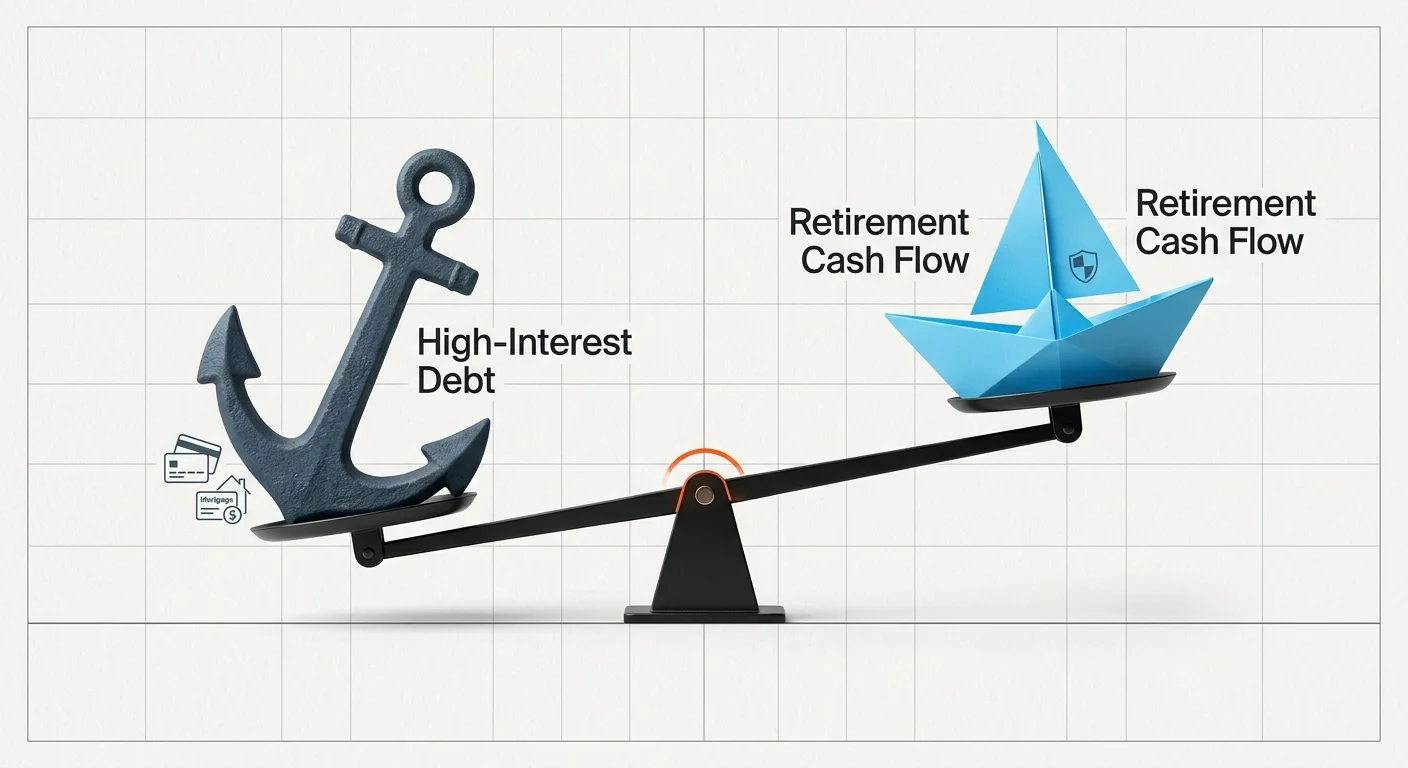
Carrying high-interest consumer debt into retirement creates severe stress on liquid portfolio assets. Revolving credit card balances, personal consolidation loans, or high-rate auto loans require steady monthly cash outflows. If you enter retirement with active debt, every payment forces higher monthly withdrawals from your retirement accounts, accelerating portfolio depletion.
Paying off a credit card balance with an 18% or 22% interest rate delivers a guaranteed, risk-free return equivalent to that interest rate. No stock or bond investment can deliver a guaranteed return of that magnitude. Delaying your exit by 12 months allows you to direct active salary toward completely wiping out high-interest debts before your paychecks stop.
Similarly, major home maintenance expenses can destabilize early retirement budgets. Replacing a roof, installing a new HVAC unit, or repaving a driveway shortly after leaving work drains cash reserves meant for ongoing living expenses. Working one extra year lets you absorb these major capital expenditures out of current employment income, leaving your retirement nest egg intact.

5. Market Downturns Put Your Portfolio at Risk for “Sequence of Returns” Losses
Sequence of returns risk occurs when stock market declines hit your investment portfolio during the final years of your career or the early years of retirement. Making required withdrawals from an account during a down market forces you to sell assets at depressed valuations. This locks in capital losses and permanently impairs your portfolio’s ability to compound when market conditions recover.
Consider a pre-retiree holding a $1,000,000 portfolio who experiences a 15% market decline in Year 1 of retirement. If they withdraw $50,000 for annual living expenses, their portfolio balance drops to $800,000. To recover that loss while continuing to withdraw $50,000 every year, the remaining portfolio requires unrealistic annual investment returns. Delaying retirement by just one year provides two distinct benefits:
- Eliminates immediate withdrawals: You pay ongoing living costs using your job earnings rather than selling depreciated stocks.
- Enables dollar-cost averaging: New contributions buy quality investment assets at discounted market prices, positioning your portfolio for maximum growth when the market rebounds.

6. You Lack a Concrete Plan for Daily Purpose, Structure, and Social Connection
Financial metrics represent only half of retirement readiness; lifestyle preparation matters just as much. Many professionals sprint toward retirement simply to escape job stress, only to find that the sudden absence of structure causes boredom, loss of identity, and social isolation.
“Don’t simply retire from something; have something to retire to.” — Harry Emerson Fosdick
Work provides routine, daily social interaction, problem-solving opportunities, and personal identity. Ceasing work abruptly without replacement activities increases the risk of cognitive decline and depressive symptoms. If you cannot describe what a typical Tuesday morning will look like six months after leaving work, postpone your exit strategy.
Use an additional year in the workforce to build a deliberate lifestyle transition plan. Test-drive new hobbies, initiate volunteer commitments, build community connections, or negotiate a phased retirement schedule with your employer. Stepping away with a structured, purposeful plan ensures a rewarding transition.

7. Your Spouse Is Still Working or Facing a Different Career Timeline
Coordinating retirement timelines with a spouse prevents tax complications and maximizes household social benefits. If one spouse continues working at a high salary while the other retires and begins taking taxable distributions from traditional 401(k) or IRA accounts, those withdrawals get added to high earned income. This extra income can push your household into higher federal tax brackets and increase Medicare Part B premiums through Income-Related Monthly Adjustment Amount (IRMAA) surcharges.
Aligning exit dates also optimizes spousal and survivor Social Security strategies. Because a surviving spouse inherits the larger of the couple’s two Social Security payouts, delaying the higher earner’s benefit until age 70 establishes the highest possible lifelong benefit for both individuals. Staying in the workforce another year allows couples to synchronize health insurance coverage, coordinate tax brackets, and step into retirement together.
Financial Comparison: Retiring at 62 vs. Full Retirement Age (67) vs. Age 70
Deciding when to postpone retirement requires evaluating how timeline shifts affect monthly income, health coverage, and savings potential. The following table highlights key operational differences across three common retirement ages for individuals born in 1960 or later.
| Metric / Factor | Retiring at Age 62 | Retiring at Age 67 (FRA) | Retiring at Age 70 |
|---|---|---|---|
| Social Security Benefit (% of PIA) | 70% of baseline payout (30% permanent reduction) | 100% of baseline payout | 124% of baseline payout (24% delayed credit boost) |
| Medicare Status | Ineligible (Requires COBRA, ACA, or private plan) | Fully eligible for Medicare Part A & Part B | Fully eligible (Defer Part B penalty-free if working) |
| 2026 Workplace Catch-Up Limit | Up to $35,750 (Super Catch-Up eligible for ages 60–63) | Up to $32,500 ($24,500 base + $8,000 standard catch-up) | Standard catch-up limit applies if still working |
| Social Security Earnings Test | Subject to $24,480 limit ($1 withheld per $2 earned over) | No earnings test restrictions apply | No earnings test restrictions apply |
| Sequence-of-Returns Vulnerability | High risk (Drawdowns start during early portfolio phase) | Moderate risk (Shorter timeline to absorb market drops) | Low risk (Assets compound longer without withdrawals) |
Errors That Cost Retirees Thousands
Timing errors and misunderstandings about benefit rules permanently diminish retirement income. Avoid these costly mistakes when evaluating whether to work another year:
- Filing for Social Security early while working full-time: Exceeding the 2026 earnings test limit of $24,480 causes benefit withholdings and creates tax headaches without increasing your payout.
- Dropping employer health coverage before age 65: Assuming individual private health policies are cheap leads to massive out-of-pocket medical bills and high deductibles during pre-Medicare years.
- Incurring Medicare Part B late penalties: Failing to enroll in Medicare Part B at age 65 without qualifying creditable employer group coverage results in a permanent 10% premium surcharge for every 12 months missed.
- Missing SECURE 2.0 Super Catch-Up opportunities: Workers aged 60 to 63 often forget to increase their 401(k) contributions to the expanded $11,250 catch-up threshold in 2026.
- Selling stocks in a down market: Drawing income from an equities-heavy portfolio during a market dip permanently destroys portfolio recovery potential.

When to Get Expert Help
Navigating benefit rules and cash flow modeling requires specialized expertise. Consider consulting professional advisors before finalizing your exit date:
- State Health Insurance Assistance Program (SHIP) Counselors: Free, unbiased local assistance to help you compare Medicare Advantage, Supplemental (Medigap), and Part D prescription plans without sales pressure.
- Fee-Only Fiduciary Financial Advisors: Independent financial planners who design distribution strategies, manage tax brackets, and model sequence-of-returns protection without taking product commissions.
- Social Security Claiming Specialists: Analysts who evaluate complex spousal, survivor, and delayed credit scenarios to maximize lifetime family payouts.
- Elder Law Attorneys: Legal specialists who update estate plans, draft healthcare proxies, structure durable powers of attorney, and protect assets.
You can research financial security tools and educational resources through the Consumer Financial Protection Bureau (CFPB) Retirement Resources.
Frequently Asked Questions
How much does delaying retirement by one year increase my monthly Social Security check?
If you delay claiming Social Security past your Full Retirement Age (age 67 for those born in 1960 or later), your monthly benefit increases by 8% for each full year you wait up to age 70. If you are under Full Retirement Age, delaying your claim by one year avoids the step-down reduction, preserving roughly 6% to 7% in annual benefit value.
What is the SECURE 2.0 Super Catch-Up limit for 2026?
In 2026, employees aged 60, 61, 62, and 63 can make an expanded catch-up contribution of $11,250 into workplace 401(k), 403(b), or 457 plans. Combined with the standard 2026 contribution limit of $24,500, eligible workers in this age bracket can save up to $35,750 per year.
Can I work full-time past age 65 without enrolling in Medicare Part B?
Yes. If you work for an employer with 20 or more employees and maintain active group health coverage, you can defer Medicare Part B without incurring late enrollment penalties. Once you leave that job, you receive an 8-month Special Enrollment Period to sign up for Part B penalty-free.
How does the Social Security Earnings Test work in 2026?
If you claim Social Security early and earn employment income, the SSA withholds benefits if your earnings exceed annual limits. In 2026, if you are under Full Retirement Age all year, $1 is withheld for every $2 earned above $24,480. In the year you reach FRA, $1 is withheld for every $3 earned above $65,160.
Taking Control of Your Retirement Timing
Deciding when to postpone retirement represents one of the most powerful financial choices of your life. Working one extra year generates cash flow, lowers portfolio drawdown risks, optimizes tax-advantaged accounts, and boosts lifetime Social Security income. Re-evaluate your budget, debt balances, and health insurance options today to confirm whether postponing your exit date delivers the long-term freedom you deserve.
Retirement rules and benefit amounts vary based on individual work history, income, and circumstances. This article provides general guidance only. Consult a SHIP counselor, financial advisor, or elder law attorney for advice specific to your situation.
Last updated: February 2026. Medicare and Social Security rules change annually—always verify current details at official government sources.