A resilient retirement distribution strategy must protect your purchasing power, minimize lifetime taxes, and adapt to shifting healthcare expenses. If your current blueprint relies on static assumptions, ignores legislative overhauls, or leaves you feeling uneasy every time market volatility strikes, you likely need a fresh perspective. Finding blind spots before you encounter sequence-of-returns risk or unexpected tax penalties can preserve hundreds of thousands of dollars over a thirty-year retirement. Reviewing your retirement income strategy with an independent fee-only fiduciary helps verify whether your money will actually outlast you. Here are seven clear indicators that it is time for a professional second opinion.

1. Outdated Legislative Rules and Required Minimum Distribution (RMD) Timelines
Retirement tax legislation evolved dramatically in recent years. If your financial documents still calculate withdrawals based on older rules, your portfolio operates on an obsolete foundation. The SECURE 2.0 Act established that Required Minimum Distributions (RMDs) begin at age 73 for individuals reaching that age after December 31, 2022; this threshold climbs to age 75 starting in 2033. Furthermore, the penalty for failing to take a complete RMD dropped from a punitive 50% to 25%, with a further reduction to 10% if corrected within two years.
An income plan that still cites age 70½ or age 72 reveals that your advisor has not actively calibrated your projections against current federal statutes. You can review the latest distribution tables directly through IRS Retirement Plans to see how mandatory distributions affect your annual tax exposure. Working with outdated distribution dates creates unnecessary tax liabilities and prevents you from capitalizing on multi-year tax planning windows prior to your mandatory withdrawal age.
2. Reliance on a Rigid 4% Withdrawal Rule in a Dynamic Market
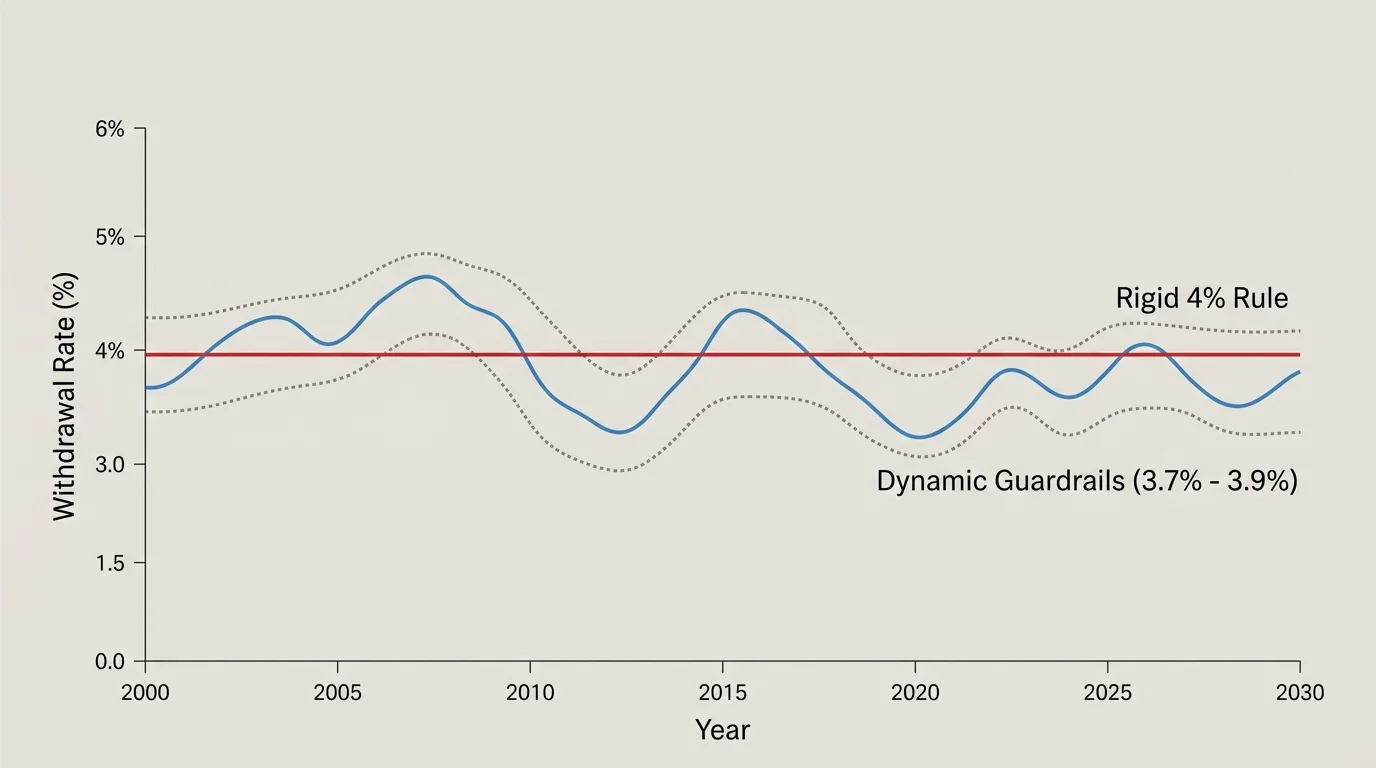
For decades, retirees relied on William Bengen’s classic 4% rule as an unbreakable standard for sustainable distributions. Modern market dynamics, elongated lifespans, and economic swings make rigid static withdrawal rules dangerously simplistic. Morningstar’s comprehensive research in their annual State of Retirement Income reports demonstrates that initial safe withdrawal rates typically fluctuate between 3.7% and 3.9% for a balanced 30-year retirement horizon, depending on equity valuations, inflation rates, and bond yields.
A resilient plan utilizes guardrails and dynamic spending rules rather than an inflexible, mechanical percentage. Dynamic strategies allow you to increase spending slightly during strong market expansions while making minor downward adjustments during prolonged market contractions. If your advisor uses a fixed withdrawal rate without stress-testing for severe multi-year downturns, you face unnecessary sequence-of-returns risk during your vulnerable early retirement years.
“The goal of retirement is to live off your assets—not live off your regrets.”
3. Ignoring the Tax Torpedo and Medicare IRMAA Surcharges
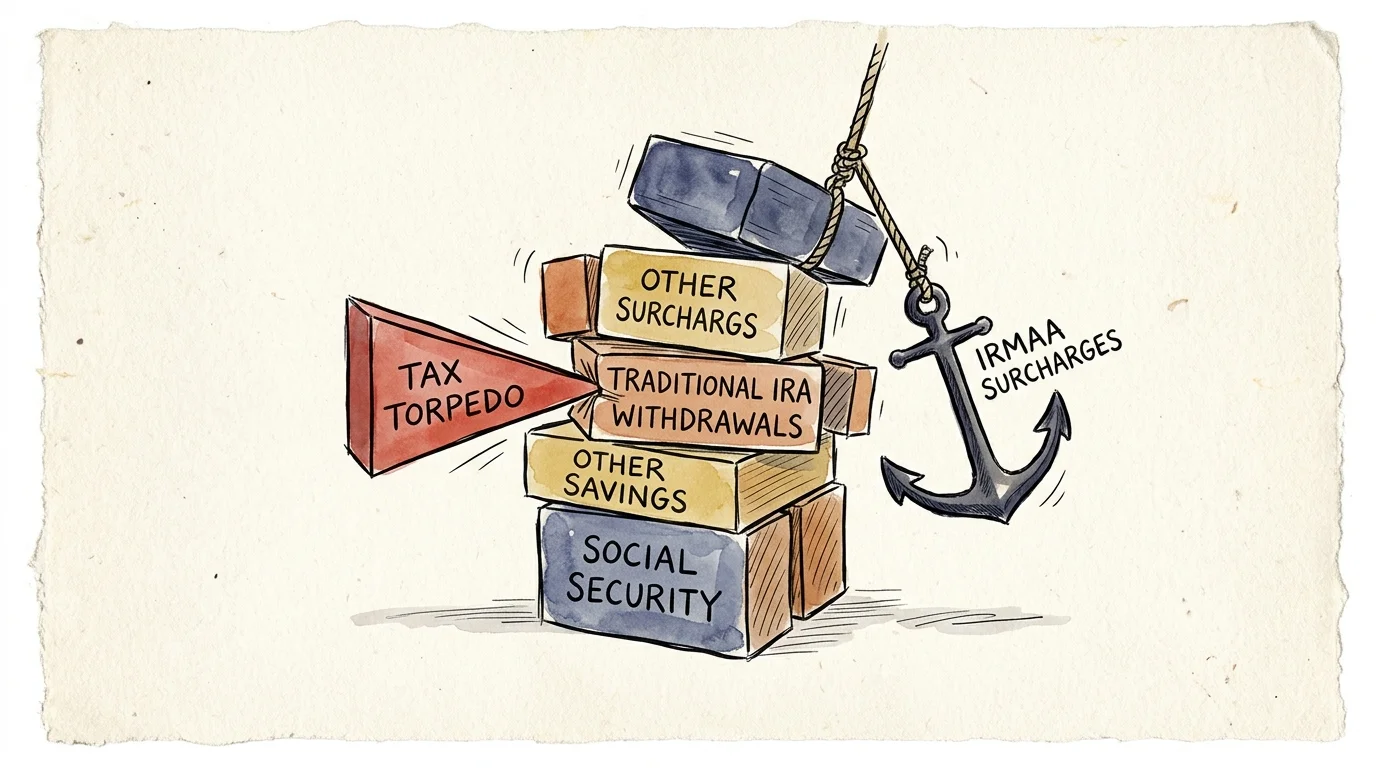
A frequent blind spot in conventional retirement design is failing to coordinate withdrawals across taxable, tax-deferred, and tax-exempt accounts. When you withdraw substantial sums from traditional IRAs or 401(k)s, you increase your Modified Adjusted Gross Income (MAGI). This surge can trigger the “tax torpedo”—a scenario where additional retirement income causes up to 85% of your Social Security benefits to become taxable while pushing your marginal income into higher tax brackets.
Additionally, uncoordinated withdrawals directly impact your healthcare costs through the Medicare Income-Related Monthly Adjustment Amount (IRMAA). The federal government calculates IRMAA surcharges on Medicare Part B and Part D premiums using your tax return from two years prior. You can verify current surcharge brackets through Medicare.gov to understand how your distributions influence monthly premiums. If your income strategy fails to account for this two-year look-back rule or misses proactive Roth conversion opportunities during low-income gap years, you are paying excessive taxes and healthcare surcharges.

4. Suboptimal Social Security Claiming Sequences
Social Security remains one of the few inflation-adjusted, guaranteed income streams available to American retirees. Yet many plans treat claiming timing as a casual afterthought rather than an integrated mathematical calculation. For individuals born in 1960 or later, Full Retirement Age (FRA) is age 67. Claiming benefits at the earliest eligibility age of 62 locks in a permanent monthly benefit reduction of up to 30%.
Conversely, delaying your claim past your Full Retirement Age up to age 70 generates guaranteed delayed retirement credits of 8% per year—amounting to a permanent 24% increase above your FRA baseline. You can examine your formal earnings record and baseline estimates through the official Social Security Administration portal. An income blueprint that defaults to claiming at age 62 without evaluating joint marital longevity, surviving spouse protection, and tax integration requires an immediate second opinion.

5. Underestimating Lifetime Healthcare and Long-Term Care Costs
Many pre-retirees assume Medicare covers all medical needs without substantial out-of-pocket costs. In reality, traditional Medicare does not cover routine dental, vision, hearing care, or custodial long-term care services. According to empirical findings from the Employee Benefit Research Institute (EBRI), approximately 45% of American retirees discover that their overall living expenses in retirement are significantly higher than they projected before leaving the workforce, with medical care and housing driving the disparity.
If your plan allocates a generic, flat inflation rate to your entire budget instead of applying an elevated inflation multiplier to healthcare, your purchasing power will deteriorate over time. A comprehensive retirement income plan checkup models potential custodial care events, evaluates hybrid long-term care insurance solutions, and establishes dedicated reserves to insulate your core lifestyle assets from catastrophic medical bills.
“The best time to plan for retirement was 20 years ago. The second best time is today.”

6. Heavy Exposure to Sequence-of-Returns Risk and Asset Location Mismatches
Sequence-of-returns risk represents the danger of encountering a severe market downturn during the initial five to seven years of retirement while taking regular distributions. Liquidating equities when asset prices are depressed permanently impairs your portfolio’s ability to recover, rapidly shortening the longevity of your nest egg. Sound portfolio design mitigates this hazard through structured asset location and dedicated liquidity buffers.
Your capital should be organized across three distinct functional tiers:
- Immediate Liquidity (Years 1–2): Cash equivalents, high-yield savings accounts, and short-term Treasury bills to fund ongoing monthly spending regardless of broader market conditions.
- Intermediate Stability (Years 3–7): High-quality short-to-intermediate duration bonds, certificates of deposit (CDs), and defined-maturity bond ladders providing steady yields and capital preservation.
- Long-Term Growth (Years 8+): Diversified domestic and international equity holdings designed to outpace inflation over multi-decade horizons.
The Consumer Financial Protection Bureau provides educational resources on managing portfolio distributions safely. If your investments are lumped into a single generic portfolio without deliberate asset location separating short-term cash needs from growth assets, your strategy leaves you exposed to forced asset sales during market corrections.

7. Product-Driven Recommendations Over Holistic Planning
One of the clearest signs to get a second financial opinion occurs when your advisor prioritizes high-commission financial products over comprehensive wealth management. If your plan relies almost exclusively on complex proprietary annuities with lengthy surrender charge periods, high internal fee structures, and restrictive liquidity limits, you may be working with a salesperson operating under the suitability standard rather than a fiduciary held to the legal standard of acting in your best interest.
While certain fixed-indexed or immediate annuities can serve a legitimate role as an income floor, they must integrate seamlessly into your overall tax, estate, and liquidity architecture. When an advisor cannot explain the total annual fee load—including management fees, underlying fund expenses, mortality and expense charges, and administrative riders—it is time to seek an unconflicted evaluation.

Comparing Outdated Approaches vs. Modern Retirement Income Architecture
Evaluating your current wealth distribution strategy against modern financial planning benchmarks clarifies whether your portfolio is built to withstand real-world retirement risks.
| Strategic Element | Outdated / Flawed Strategy | Modern Resilient Blueprint |
|---|---|---|
| RMD Planning | Reacts to mandatory withdrawals at age 73 without prior tax management. | Executes strategic partial Roth conversions during low-bracket years between retirement and age 73/75. |
| Withdrawal Rate | Applies a rigid 4% static withdrawal regardless of market performance. | Implements dynamic guardrails (3.7%–3.9% baseline) with upward and downward spending adjustments. |
| Social Security | Claims early at age 62 without evaluating joint spousal longevity. | Optimizes claiming timing (often delaying higher earner to age 70) to maximize surviving spouse benefits. |
| Healthcare & IRMAA | Ignores Medicare surcharge brackets and out-of-pocket medical inflation. | Proactively monitors the two-year MAGI look-back window and models separate healthcare inflation buffers. |
| Market Downturn Defense | Sells blended investments indiscriminately during bear markets to fund living expenses. | Draws spending from a 2-to-5-year liquidity bucket, leaving depressed equity assets intact to recover. |

Common Retirement Traps
Even diligent savers can stumble into structural traps that quietly erode their wealth. Recognizing these missteps is the first step toward building a durable income plan.
- Treating Tax-Deferred Accounts as Pure Spending Money: A $1,000,000 traditional IRA balance does not equal $1,000,000 in spendable capital. Failing to subtract embedded state and federal tax liabilities leads to significant overspending in early retirement.
- Neglecting the “Widow’s Penalty”: When one spouse passes away, the surviving spouse transitions from the Married Filing Jointly tax status to the Single filing status. This shift cuts tax bracket thresholds in half and standard deductions nearly in half, pushing identical income into dramatically higher tax rates.
- Maintaining a “Set-It-and-Forget-It” Mindset: Accumulating wealth requires saving consistently; decumulating wealth requires continuous adjustments for tax law changes, investment performance, and changing health conditions. Static plans break down under shifting economic realities.

When to Consult a Professional
Knowing when to reassess retirement income plan architecture can prevent compounding financial mistakes. You should seek an objective second opinion if you are within five years of retirement, experienced a major life transition such as widowhood or divorce, or realized your current advisor rarely discusses tax planning, Medicare IRMAA, or distribution sequencing.
When searching for a second opinion, focus on fee-only Certified Financial Planner (CFP®) practitioners or members of the National Association of Personal Financial Advisors (NAPFA). Fee-only fiduciaries do not accept commissions on financial products, eliminating the structural incentive to steer you toward high-fee insurance contracts or proprietary investment vehicles. Prepare for your consultation by gathering your two most recent federal tax returns, current Social Security benefit statements, comprehensive investment account statements, and an itemized breakdown of baseline essential living expenses.
Frequently Asked Questions
How much does a retirement income plan second opinion typically cost?
Independent fee-only fiduciary financial planners generally charge between $1,500 and $3,500 for a comprehensive, standalone retirement income plan review. Some advisors also offer hourly consultations ranging from $250 to $450 per hour. Many firms provide an initial diagnostic review at no cost to identify structural gaps before engaging in deeper planning work.
How often should I conduct a formal retirement income plan checkup?
You should review your overarching income strategy annually to account for portfolio rebalancing, tax law adjustments, and inflation shifts. Additionally, schedule an immediate reassessment whenever major life events occur—such as the death of a spouse, receiving an inheritance, downsizing a primary residence, or experiencing a major health change.
Will getting a second financial opinion offend my existing advisor?
No. Professional financial management is a business relationship concerning your lifetime financial security. Competent, ethical advisors welcome second opinions because they validate sound planning. If an advisor reacts defensively or discourages you from seeking an independent review, that reaction itself serves as a compelling sign to reassess the relationship.
What primary documents should I bring to an independent income plan review?
To receive an accurate and actionable assessment, bring your last two years of completed tax returns (including all 1099s and schedules), current account statements for all taxable and tax-deferred accounts, your latest Social Security earnings statements from SSA.gov, pension documentation, and policy statements for any existing life, disability, or long-term care insurance policies.
Take Control of Your Retirement Horizon
Your retirement income plan must provide peace of mind throughout every market cycle and life transition. If you notice any of these warning signs in your current financial strategy, arrange an independent review to stress-test your distributions, optimize your tax posture, and safeguard your future.
This article is for informational purposes only and does not constitute financial, legal, or medical advice. Medicare rules, Social Security benefits, and tax laws change regularly—verify current details at Medicare.gov, SSA.gov, or with a licensed professional.
Last updated: February 2026. Medicare and Social Security rules change annually—always verify current details at official government sources.