A single delayed Medicare application can quietly drain thousands of dollars from your fixed retirement income. Missing critical enrollment dates triggers federal surcharges that attach to your premiums permanently.
Unlike conventional late fees, these Medicare penalties do not disappear after one payment. The federal government tacks them onto your healthcare bill every single month for the rest of your life.
Understanding exactly how these deadlines work shields your savings from expensive, compounding penalties. You can easily protect your retirement budget by learning which enrollment dates demand your immediate attention.

The True Lifetime Cost of Medicare Penalties
The federal government designed Medicare late enrollment penalties to encourage healthy people to enroll as soon as they become eligible. This shared risk pool keeps program costs stable for everyone.
When you delay enrollment without qualified coverage, Medicare views your delay as a major financial risk. To offset that risk, Medicare imposes surcharges directly on your monthly coverage costs.
These penalties do not function like a library fine or a late utility fee. They follow you through your entire retirement journey, eroding your monthly disposable income.
Every percentage point added to your premium compounds whenever the government raises standard rates. As baseline healthcare expenses climb, the dollar amount of your monthly penalty rises right alongside them.
“The goal of retirement is to live off your assets—not live off your regrets.”
Paying an extra penalty month after month eats into the money you set aside for travel, hobbies, and family support. Protecting your hard-earned assets requires staying ahead of strict enrollment calendars.
Fortunately, you can avoid these financial traps entirely by mastering a few clear rules. Knowing your specific enrollment windows ensures you never pay a single extra dollar in surcharges.
The Part B Late Penalty: A Permanent Surcharge on Outpatient Care
Medicare Part B covers essential outpatient services, doctor visits, preventive screenings, and durable medical equipment. Delaying Part B without creditable coverage triggers one of the most punitive surcharges in federal healthcare.
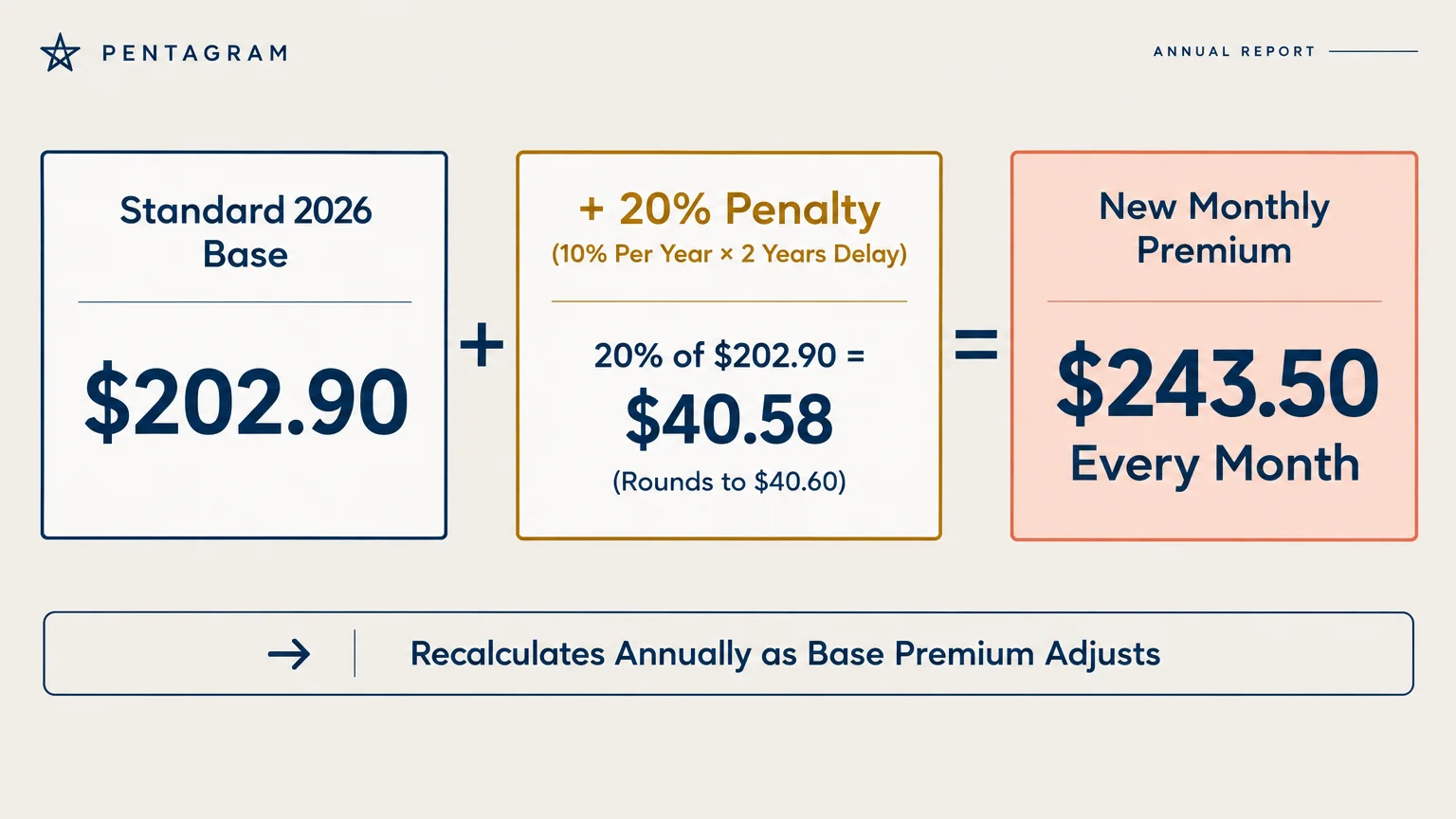
The Part B late enrollment penalty adds an extra 10% to your standard monthly premium for every full 12-month period you were eligible but failed to enroll. This penalty remains attached to your premium for as long as you maintain Part B coverage.
For 2026, the standard monthly premium for Medicare Part B is $202.90. That baseline serves as the starting point for all penalty calculations throughout the year.
If you delay enrollment for two full years, Medicare assesses a 20% permanent penalty on your monthly premium. Twenty percent of $202.90 equals $40.58, which rounds up to an additional $40.60 each month.
Your adjusted 2026 Part B premium would jump to $243.50 every month. That penalty costs you nearly $500 in unnecessary extra payments during your first year alone.
The financial damage worsens as the years pass. The Medicare Board of Trustees projects the standard Part B premium will rise to $209.50 in 2027.
Because your 20% penalty recalculates against the new standard rate, your monthly surcharge would increase to $41.90 in 2027. Your penalty continues to increase in actual dollars year after year, even though the penalty percentage remains fixed.
If you live twenty years in retirement with that two-year delay, you will hand over more than $10,000 in avoidable penalties. That substantial sum leaves your pocket solely because of a missed initial deadline.

The Part D Late Penalty: The Compounding Drug Coverage Trap
Medicare Part D covers prescription medications, which represent a significant portion of healthcare costs for older Americans. Missing your drug coverage deadline incurs a permanent surcharge calculated on a monthly schedule.
You face a Part D late enrollment penalty if you go 63 or more consecutive days without creditable prescription drug coverage after your initial window closes. Medicare calculates this fee by multiplying 1% of the national base beneficiary premium by your total uncovered months.
Medicare defines creditable coverage as prescription insurance that pays, on average, at least as much as standard Medicare drug coverage. Employer plans, union plans, and VA benefits frequently meet this legal threshold.
For 2026, the national base beneficiary premium sits at $38.99. Every month you spend without creditable drug coverage adds approximately $0.39 directly to your future monthly drug plan premium.
If you wait 24 months to enroll in a drug plan, your penalty equals 24% of the national base. That calculation yields $9.36, which rounds to the nearest ten cents as a permanent $9.40 monthly surcharge.
The Centers for Medicare and Medicaid Services officially established the 2027 national base beneficiary premium at $41.33. This change reflects the maximum 6% annual increase allowed under the Inflation Reduction Act.
When that new base takes effect, your 24% penalty recalculates against the higher $41.33 rate. Your monthly surcharge immediately jumps to $9.90, compounding your ongoing drug expenses.
Even if you select a bare-bones Part D plan with a zero-dollar premium, you must still pay this penalty. The federal government collects the surcharge directly through your plan carrier or deducts it from your monthly Social Security check.
Part A Late Penalty: The Costly but Temporary Exception
Most Americans do not pay a monthly premium for Medicare Part A because they paid Medicare payroll taxes for at least ten years. Those 40 work quarters grant you premium-free inpatient hospital coverage.
Individuals who accumulated fewer than 30 work quarters must purchase Part A coverage outright. In 2026, the full monthly Part A premium can reach as high as $565.
If you must purchase Part A and fail to enroll when first eligible, you face a 10% penalty on your monthly premium. A 10% surcharge on a $565 premium adds an extra $56.50 to your bill each month.
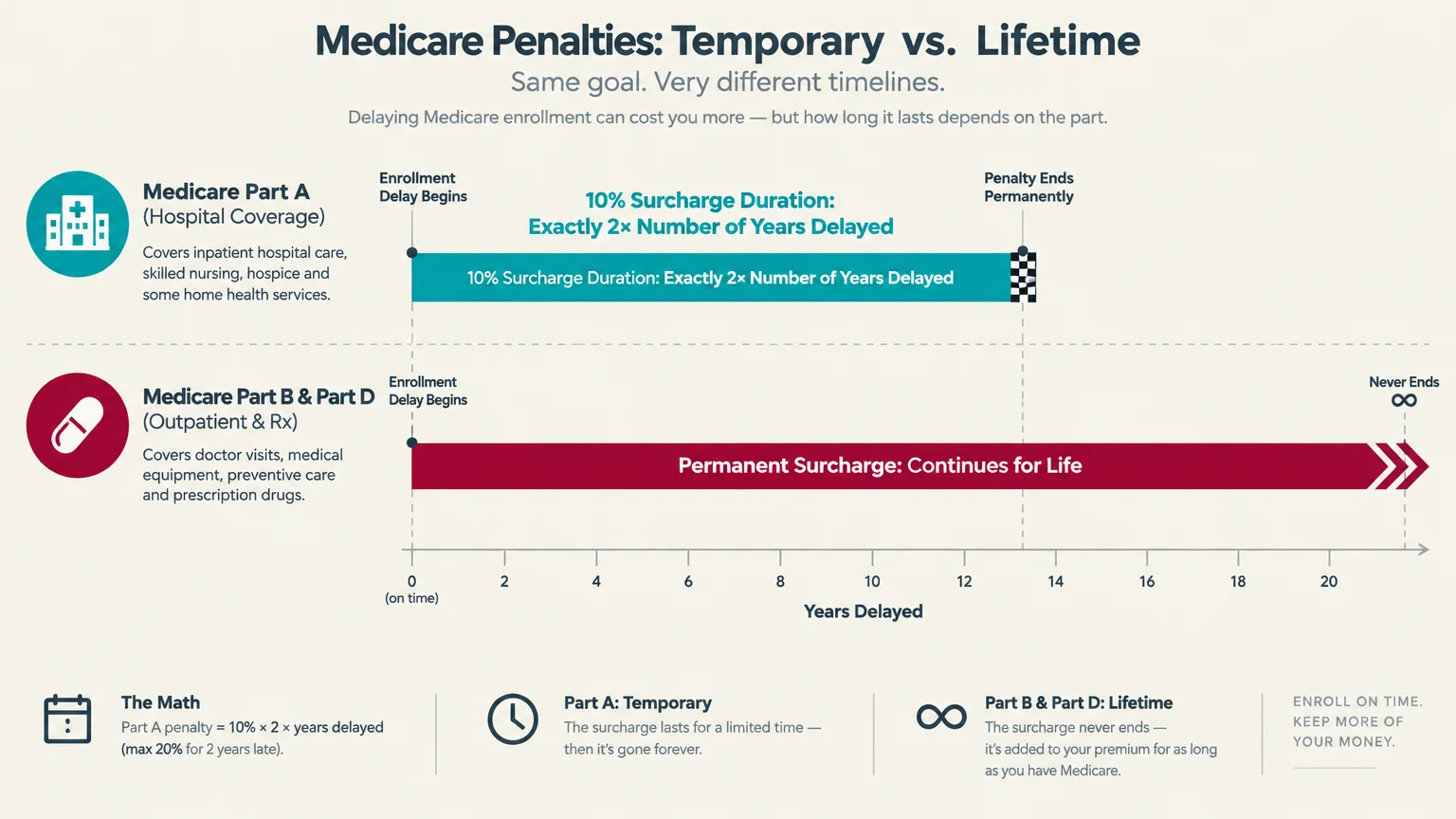
Unlike the lifelong penalties tied to Parts B and D, the Part A late enrollment penalty is strictly temporary. You only pay the penalty for twice the number of full years you delayed your enrollment.
If you delayed enrollment for two full years, you will pay the extra 10% surcharge for four years. Once that four-year penalty window concludes, your Part A premium returns to the standard rate.
While the temporary nature provides relief, paying an extra $56.50 every month for several years remains a major drain on retirement income. Reviewing your Social Security earnings record helps you verify whether you owe any Part A premiums.

The Critical Medicare Enrollment Windows You Must Track
Avoiding lifelong financial surcharges requires knowing the official enrollment calendars established by federal law. Missing these enrollment windows locks you out of coverage and starts the penalty clock ticking.
Your journey begins with the Initial Enrollment Period, a personalized seven-month window centered around your 65th birthday. This window begins three months before the month you turn 65, includes your birth month, and concludes three months after.
Under the updated BENES Act rules, your Medicare coverage begins on the first day of the month after you sign up. If you enroll during the three months leading up to your 65th birthday, your benefits start on the first day of your birthday month.
If you miss your Initial Enrollment Period and lack qualifying employer insurance, you must wait for the General Enrollment Period. This nationwide sign-up window runs annually from January 1 through March 31.
When you enroll during the General Enrollment Period, your coverage takes effect on the first day of the following month. However, Medicare evaluates your delay and applies permanent penalties for every full year missed.
Beneficiaries seeking prescription drug plans must follow the Fall Open Enrollment Period, running from October 15 through December 7 each year. Drug coverage chosen during this window begins on January 1 of the coming calendar year.
You can review official enrollment guidance and compare approved plan options directly on Medicare.gov. Logging into your account shows your personalized deadlines based on your verified birth date.
Medicare Penalty Rules Comparison
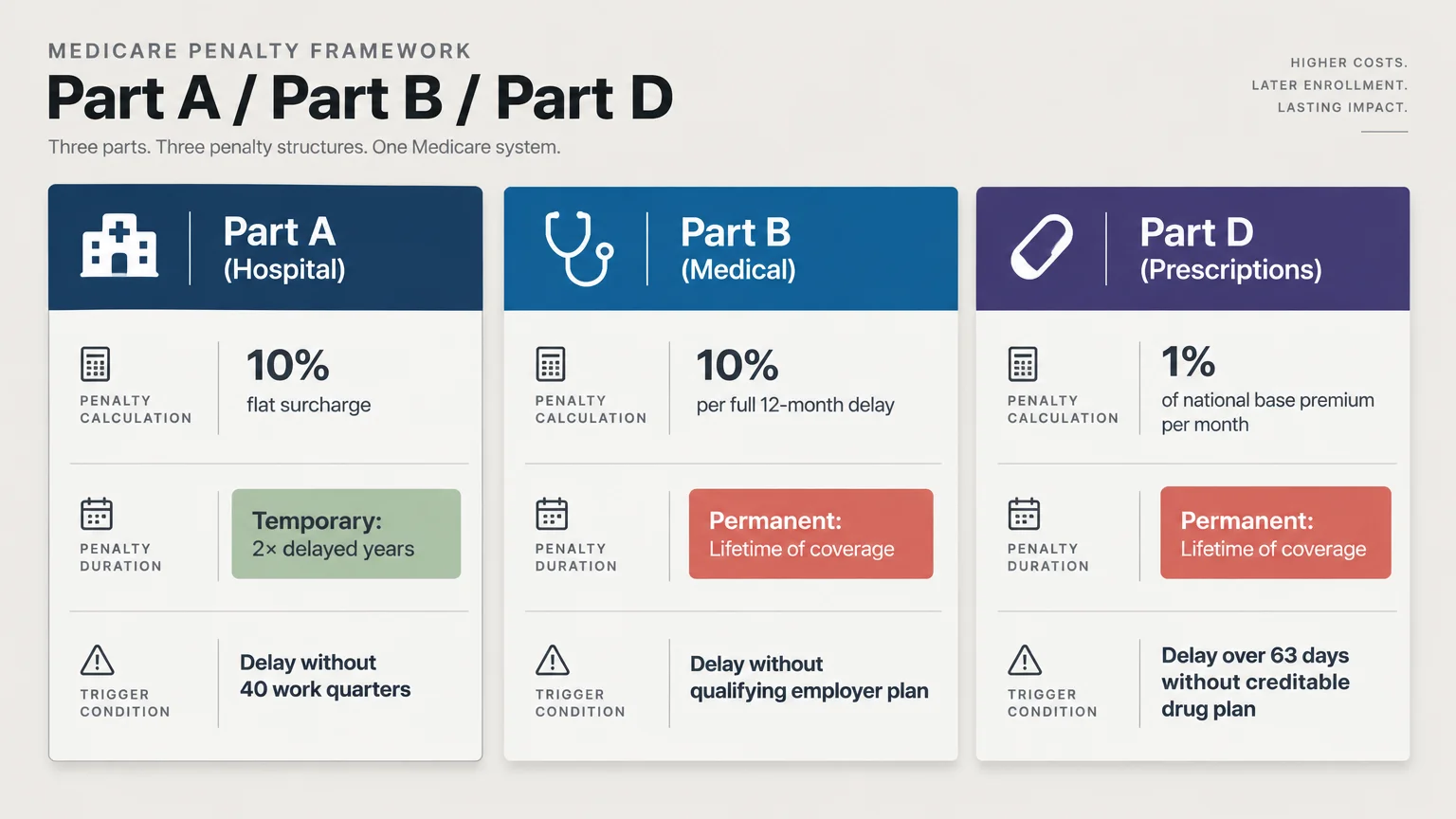
Comparing penalty calculations side by side reveals how different parts of Medicare treat late enrollment. The table below outlines how each surcharge functions across the program.
| Medicare Program | Penalty Calculation Formula | Duration of Penalty | Baseline Rate Used | Critical Grace Period |
|---|---|---|---|---|
| Part A (Hospital) | 10% added to monthly premium | Twice the number of delayed years | Up to $565 monthly (2026) | Initial 7-month IEP window |
| Part B (Medical) | 10% per full 12-month delay | Permanent for life of coverage | $202.90 standard (2026) | 8-month Special Enrollment Period |
| Part D (Prescription) | 1% per month without coverage | Permanent for life of coverage | $38.99 base (2026) / $41.33 (2027) | 63 consecutive days maximum |
As the table demonstrates, Parts B and D present the greatest long-term financial hazards to retirees. Their permanent nature means a single delay drains your retirement accounts indefinitely.
Part A carries a steep dollar cost for those who must buy it, but its sunset provision limits total exposure. Prioritizing Parts B and D sign-ups provides the strongest protection against uncontrollable lifetime expenses.

Common Retirement Traps That Trigger Lifetime Fines
Many retirees stumble into lifelong penalties by relying on faulty health insurance assumptions. Avoiding these common traps keeps your healthcare transition smooth and inexpensive.
The COBRA Continuation Trap
Leaving employment often comes with an offer to continue your workplace health coverage under COBRA. Many retirees assume COBRA satisfies Medicare requirements because it provides identical benefits to their prior job coverage.
Medicare does not classify COBRA as active employment coverage. Relying on COBRA beyond your Initial Enrollment Period causes your penalty-free enrollment window to slip away unnoticed.
The eight-month Special Enrollment Period for Part B starts the day your active employment ends, regardless of COBRA status. Waiting until COBRA runs out after 18 months guarantees a permanent Part B penalty.
The Retiree Health Insurance Fallacy
Generous employer retiree health plans create a similar false sense of security among retiring workers. While these plans provide exceptional supplemental support, they almost never replace primary Medicare coverage.
Retiree health policies coordinate with Medicare and expect you to enroll in Parts A and B at 65. If you fail to sign up, your retiree plan may deny your claims entirely while Medicare penalizes you for late entry.
Always request a written explanation of how your retiree insurance coordinates with federal benefits. Confirming these rules protects you from unexpected medical bills and lifelong premium penalties.
The Small Employer Size Rule
Working past age 65 can allow you to postpone Medicare Part B safely, but only under specific employer guidelines. The company providing your coverage must employ 20 or more individuals.
If you work for a company with fewer than 20 employees, Medicare automatically becomes your primary insurer at age 65. Your small employer plan becomes secondary and will refuse to pay primary claims if you lack Part B.
Staying on a small employer plan without Part B triggers the late enrollment penalty for every year you delay. Workers at smaller companies must enroll in Medicare during their Initial Enrollment Period to remain fully protected.
The 63-Day Prescription Gap
The Part D creditable coverage deadline allows a grace period of only 63 consecutive days. Exceeding this brief window by even 24 hours locks in a permanent monthly surcharge on future drug plans.
Every September, your employer or private insurer must send you an official Notice of Creditable Coverage. Keep this legal document in your records as proof that your drug coverage met federal standards.
If you change health plans or retire mid-year, track your 63-day calendar with absolute precision. Transitioning directly into a standalone Part D plan prevents an irreversible gap in coverage.
Assuming Social Security Automatically Enrolls You
Decades ago, most Americans claimed Social Security retirement benefits at age 65. That claiming action prompted the government to enroll beneficiaries into Medicare automatically.
Today, Full Retirement Age sits at 66 or 67, leading many workers to delay claiming Social Security benefits. If you are not collecting Social Security at age 65, the government will not enroll you automatically.
You must actively submit an application through the Social Security Administration (SSA) during your enrollment window. Taking manual initiative ensures you receive your Medicare card on time without administrative delays.

Legal Exceptions and How to Erase Existing Penalties
While Medicare penalties are designed to be permanent, federal law offers specific avenues for relief under certain conditions. Learning these legal exceptions can save you from paying unnecessary fees.
Beneficiaries who qualify for Medicare before age 65 due to a qualifying disability receive a complete penalty reset at 65. Once you reach your 65th birthday, all prior Part B and Part D late penalties are permanently wiped clean.
Turning 65 gives you a fresh Initial Enrollment Period regardless of your previous enrollment history. You start retirement healthcare with a clean slate and standard monthly premium rates.
State assistance programs offer another powerful way to eliminate ongoing penalties. If your income and financial resources fall within certain state guidelines, you may qualify for a Medicare Savings Program.
Enrolling in a Medicare Savings Program legally eliminates the Part B late enrollment penalty. The state pays your monthly Part B premium on your behalf and wipes out any accumulated late surcharges.
Similarly, qualifying for the federal Extra Help program eliminates the Part D late enrollment penalty entirely. Extra Help assists with prescription drug copayments, deductibles, and monthly premiums.
You can explore income limits and check eligibility for public assistance through National Council on Aging (NCOA) resources. Their benefits screening tools help retirees identify programs that lower healthcare overhead.
“The best time to plan for retirement was 20 years ago. The second best time is today.”
If federal officials or employer representatives gave you incorrect enrollment instructions, you can pursue an administrative appeal called Equitable Relief. Medicare grants Equitable Relief when official government error causes an individual to miss an enrollment deadline.
To win an Equitable Relief appeal, you must present written documentation showing bad guidance from a government agency. Successful appeals eliminate the late penalty and grant immediate enrollment access.

When to Consult a Professional
Medicare regulations involve complex state and federal statutes that do not fit every household situation. Reaching out to qualified specialists prevents costly misunderstandings before your deadlines expire.
The State Health Insurance Assistance Program, funded through the Administration for Community Living (ACL), provides free, unbiased counseling. SHIP counselors do not sell insurance policies, ensuring their guidance serves your best financial interests.
You should contact a SHIP counselor at age 64 to review your specific health plans and timeline. Their counselors help you confirm whether your current employer drug coverage meets creditable coverage definitions.
Consult an elder law attorney if you manage complex family estates, trust assets, or Medicaid long-term care planning. An attorney ensures your healthcare transitions align with your broader asset protection strategies.
Fee-only financial planners also assist by integrating Medicare premiums and potential IRMAA surcharges into your retirement cash-flow projections. Professional oversight guarantees your healthcare budget remains stable throughout retirement.

Action Steps to Protect Your Retirement Income
Avoiding Medicare penalties requires a structured approach before you turn 65. Follow these concrete steps to safeguard your retirement savings.
- Mark your calendar six months before your 65th birthday to review your health insurance standing.
- Request a written Notice of Creditable Coverage from your employer human resources department.
- Confirm whether your employer has 20 or more active workers on its payroll.
- Create a secure online account at Medicare.gov to track your official enrollment windows.
- Submit your Part B and Part D applications during your Initial Enrollment Period if you lack active employer coverage.
Taking control of these deadlines eliminates stress and protects your monthly budget from unnecessary deductions. Consistent preparation guarantees that every dollar of your retirement income works directly for your future.
Frequently Asked Questions About Medicare Penalties
Can I appeal a Medicare late enrollment penalty if I forgot my deadline?
Medicare does not accept simple forgetfulness or misunderstanding as a valid ground for an appeal. You can only appeal if you prove that an employer or federal agency provided provably false enrollment information.
Does marketplace insurance from the Affordable Care Act count as creditable coverage for Part B?
Individual policies purchased through the healthcare marketplace do not count as active employer group coverage. You must transition to Medicare when you turn 65 to prevent permanent late penalties and benefit overlaps.
How does Medicare deduct late enrollment penalties once they are applied?
The federal government deducts Part B penalties directly from your monthly Social Security benefit payment. Part D penalties are added directly to the monthly premium bill sent by your private prescription insurance carrier.
Do Veterans Affairs healthcare benefits exempt me from the Part B penalty?
VA healthcare coverage does not count as creditable coverage for Medicare Part B. Delaying Part B while relying solely on VA care triggers permanent late penalties if you enroll later in life.
Retirement rules and benefit amounts vary based on individual work history, income, and circumstances. This article provides general guidance only. Consult a SHIP counselor, financial advisor, or elder law attorney for advice specific to your situation.
Last updated: October 2026. Medicare and Social Security rules change annually—always verify current details at official government sources.