Your monthly Social Security check will increase by 3.6% starting in January 2027. This Cost-of-Living Adjustment adds meaningful dollars to your retirement budget each month.
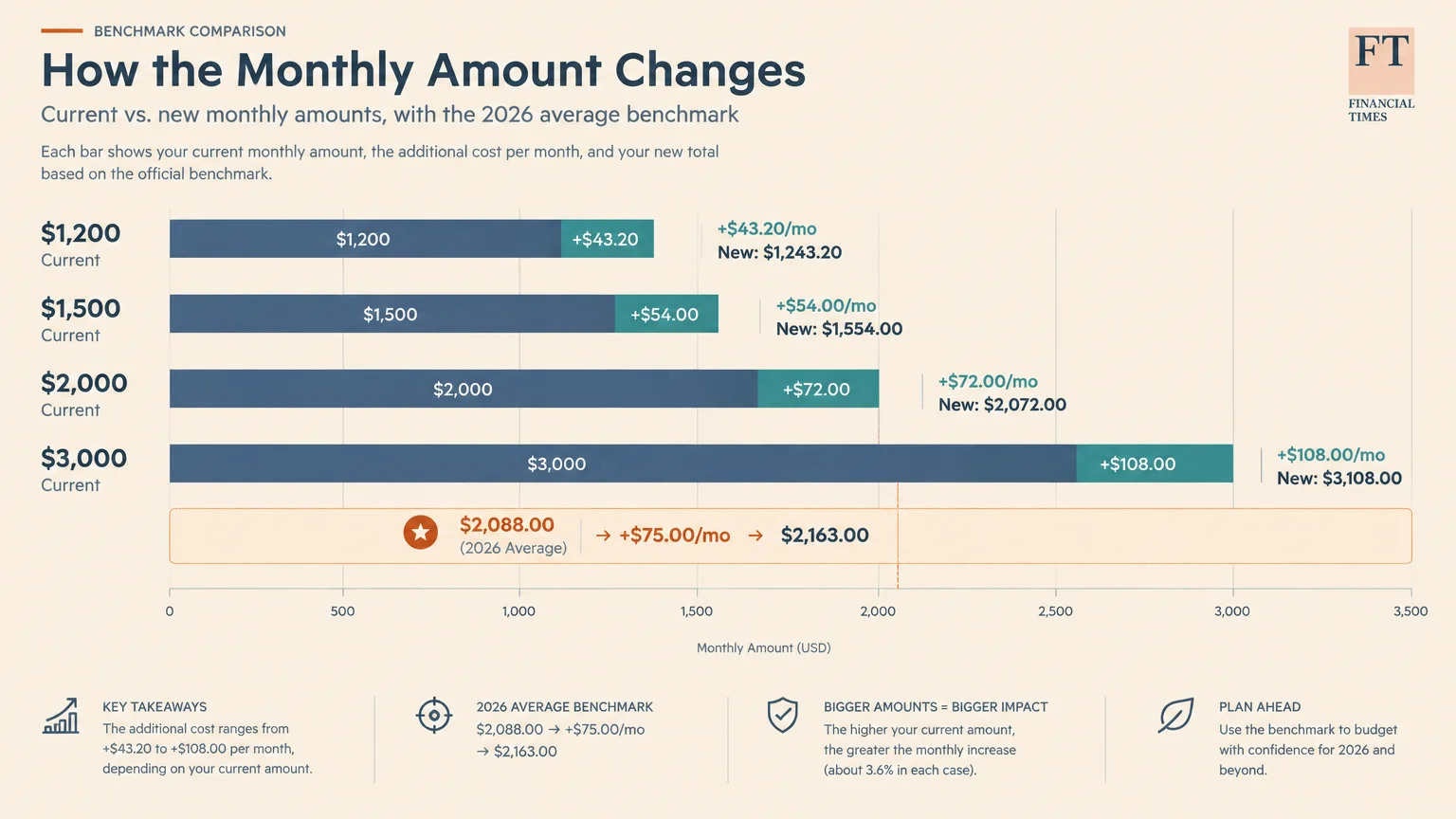
For a $1,500 monthly benefit, that equals an extra $54 each month. If you currently receive $2,000, your check grows by $72; a $3,000 check expands by $108.
However, rising Medicare Part B premiums will directly offset a portion of your gross raise. Knowing your exact net increase helps you protect your household cash flow ahead of time.
The 2027 Social Security COLA: The Official 3.6% Increase Explained
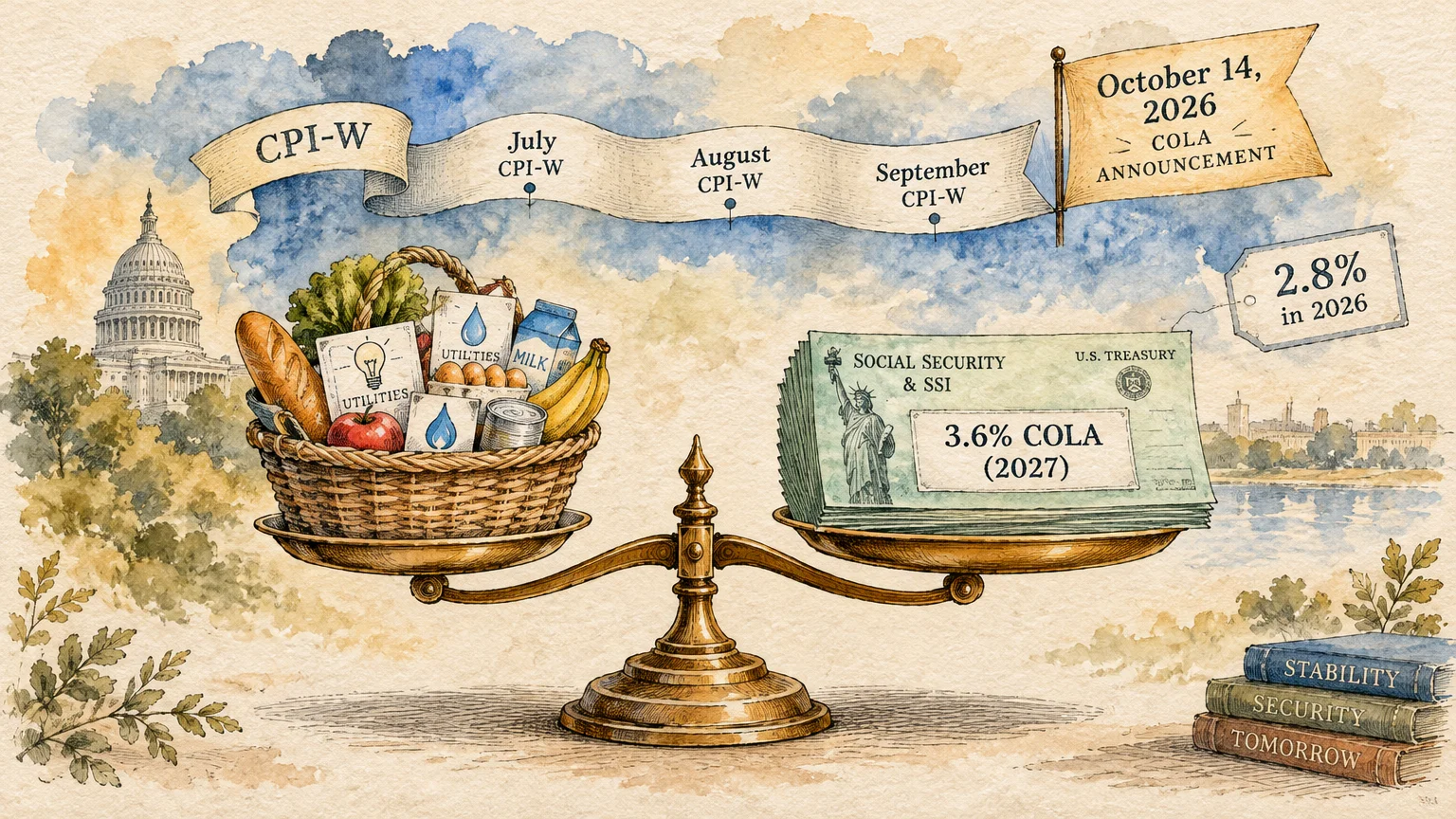
The Social Security Administration officially announced the 2027 Cost-of-Living Adjustment on October 14, 2026. The 3.6% increase marks a notable bump from the 2.8% adjustment retirees received in 2026.
This annual adjustment protects your purchasing power against persistent inflation. It directly impacts approximately 76 million Americans across the nation.
That total includes roughly 72 million Social Security beneficiaries and about 7.3 million Supplemental Security Income recipients. Some individuals qualify for both programs simultaneously.
Federal law ties COLA directly to changes in the Consumer Price Index for Urban Wage Earners and Clerical Workers, known as the CPI-W. The government measures third-quarter inflation data from July, August, and September to calculate the final percentage.
When third-quarter consumer prices climb compared to the previous year, your monthly benefit rises by the exact same proportion. If prices stay flat or fall, benefits remain unchanged rather than declining.
COLA Increase by Amount: Exact Dollar Gains for Common Benefit Levels
Percentages can feel abstract when you are managing everyday grocery bills, utility costs, and prescription refills. Calculating your exact dollar increase gives you the numbers you need to budget accurately.
The 3.6% adjustment applies directly to your primary insurance amount before any mandatory deductions. Because Social Security rounds down to the nearest dime at each calculation step, individual checks may differ by pennies.
The table below provides a quick benchmark showing how much will Social Security increase 2027 across various common check sizes.
| Current Monthly Benefit (2026) | Gross Monthly Increase (3.6%) | Gross Annual Increase | New 2027 Monthly Benefit (Before Deductions) |
|---|---|---|---|
| $1,200.00 | $43.20 | $518.40 | $1,243.20 |
| $1,500.00 | $54.00 | $648.00 | $1,554.00 |
| $1,800.00 | $64.80 | $777.60 | $1,864.80 |
| $2,000.00 | $72.00 | $864.00 | $2,072.00 |
| $2,088.00 (2026 Average) | $75.00 | $900.00 | $2,163.00 |
| $2,500.00 | $90.00 | $1,080.00 | $2,590.00 |
| $3,000.00 | $108.00 | $1,296.00 | $3,108.00 |
| $3,500.00 | $126.00 | $1,512.00 | $3,626.00 |
Examining this COLA increase by amount demonstrates how baseline check sizes affect dollar growth. Beneficiaries with higher lifetime earnings naturally receive larger monthly cash increases.

Detailed Breakdown: What Happens to a $1,500 Social Security Check
If your monthly gross check sits at $1,500 in 2026, the 3.6% COLA adds exactly $54.00 each month. Over a full twelve-month calendar year, that delivers an extra $648.00 into your gross household budget.
Your gross baseline check will adjust upward from $1,500.00 to $1,554.00 beginning with your January 2027 distribution. That additional cash can help offset higher utility rates or grocery costs.
However, you must account for healthcare deductions before planning your spending. Most beneficiaries have their Medicare Part B premiums deducted automatically from their Social Security checks.
When healthcare premiums rise, they consume a larger percentage of modest checks than larger checks. Monitoring your net deposit ensures you do not inadvertently overdraft your checking account.

Detailed Breakdown: What Happens to a $2,000 Social Security Check
Receiving $2,000 per month places you very close to the national average for retired American workers. The 3.6% COLA provides a $72.00 monthly boost to this payment tier.
Annually, this adjustment adds $864.00 to your gross retirement income. Your check will climb from $2,000.00 to $2,072.00 per month starting in January 2027.
This $72.00 monthly boost offers greater financial breathing room against daily living expenses. It easily outpaces the $56.00 average monthly increase delivered by the 2026 adjustment.
You can use this extra income to build an emergency fund or pay down revolving credit card balances. Even modest extra cash flow creates useful flexibility when utility bills spike during winter months.

Detailed Breakdown: What Happens to a $3,000 Social Security Check
Beneficiaries collecting $3,000 monthly delayed their claims toward age 70 or maintained high lifetime earnings. For this group, a 3.6% increase generates $108.00 in extra monthly income.
Over the entire year, this 2027 benefit increase injects an additional $1,296.00 into your retirement cash flow. Your monthly gross payment will expand from $3,000.00 to $3,108.00.
Higher benefit amounts absorb Medicare premium hikes much more comfortably. A projected Medicare increase takes a far smaller bite out of a $108.00 raise than a $54.00 raise.
However, receiving a $3,108 monthly payment increases your exposure to federal income taxes. You should review your combined income to see if this raise triggers unexpected tax liabilities.
Average and Maximum Payment Benchmarks for 2027
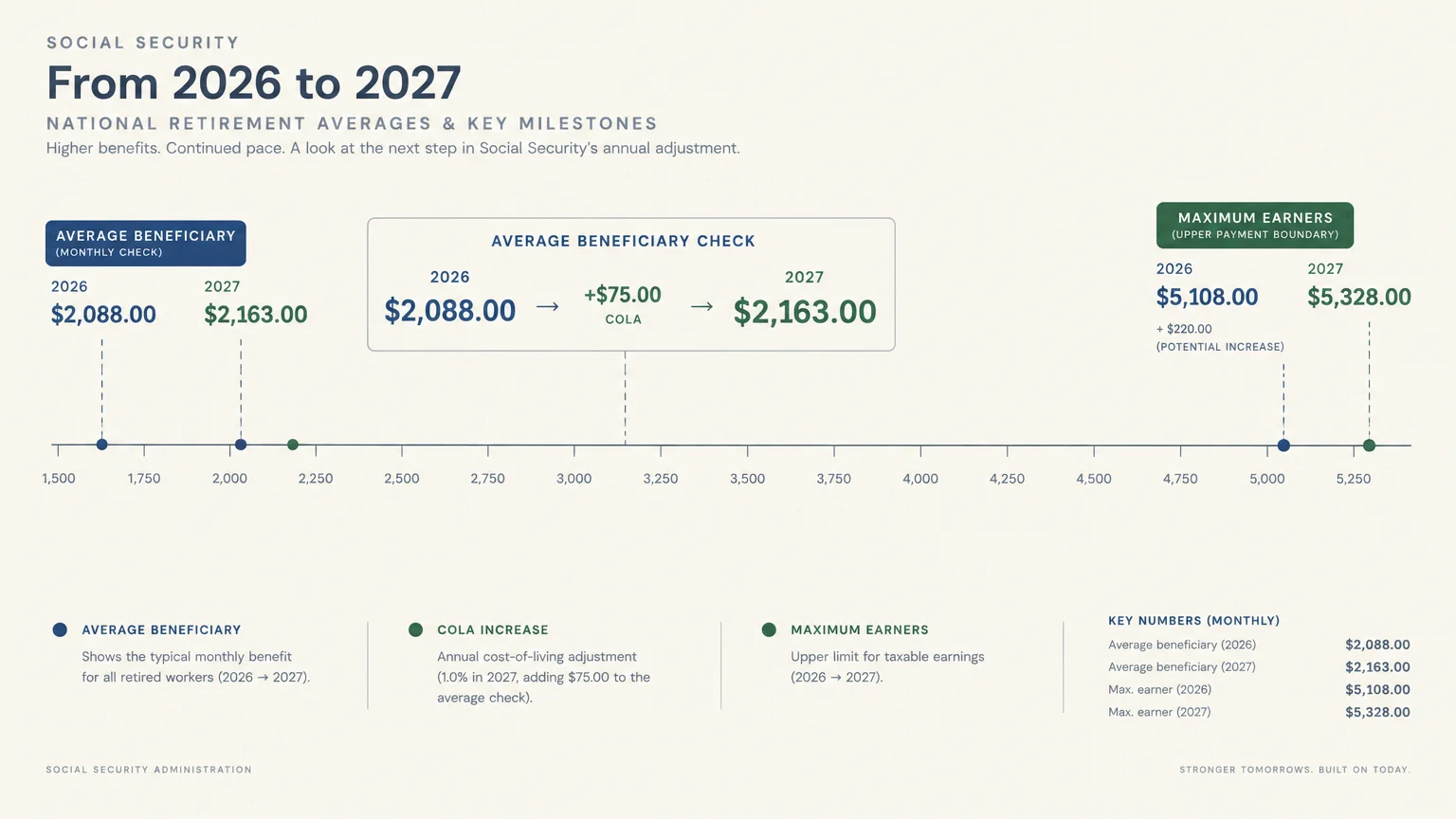
The estimated average monthly check for a retired worker was approximately $2,088 throughout 2026. The 3.6% adjustment raises that national average by $75.00, pushing it to roughly $2,163.00 in 2027.
Over the year, an average retiree receives an additional $900.00 in total gross retirement benefits. That provides substantial relief compared to the previous year’s smaller percentage adjustment.
Supplemental Security Income recipients also see their maximum statutory payment limits climb on December 31, 2026. These maximums rise to $1,029.00 for eligible individuals and $1,544.00 for eligible couples.
For essential persons providing necessary care to SSI recipients, the maximum federal monthly limit increases to $516.00. These SSI increases take effect one business day before regular retirement benefits update.
Workers currently paying into the system will also see changes in the maximum taxable earnings limit. The taxable wage base rises from $184,500 in 2026 to $192,300 in 2027.
Earnings up to $192,300 will face the standard 6.2% Social Security payroll tax. Any wages earned beyond that threshold remain exempt from further Social Security payroll taxation.
The Medicare Part B Deduction: How Rising Healthcare Costs Affect Net Checks
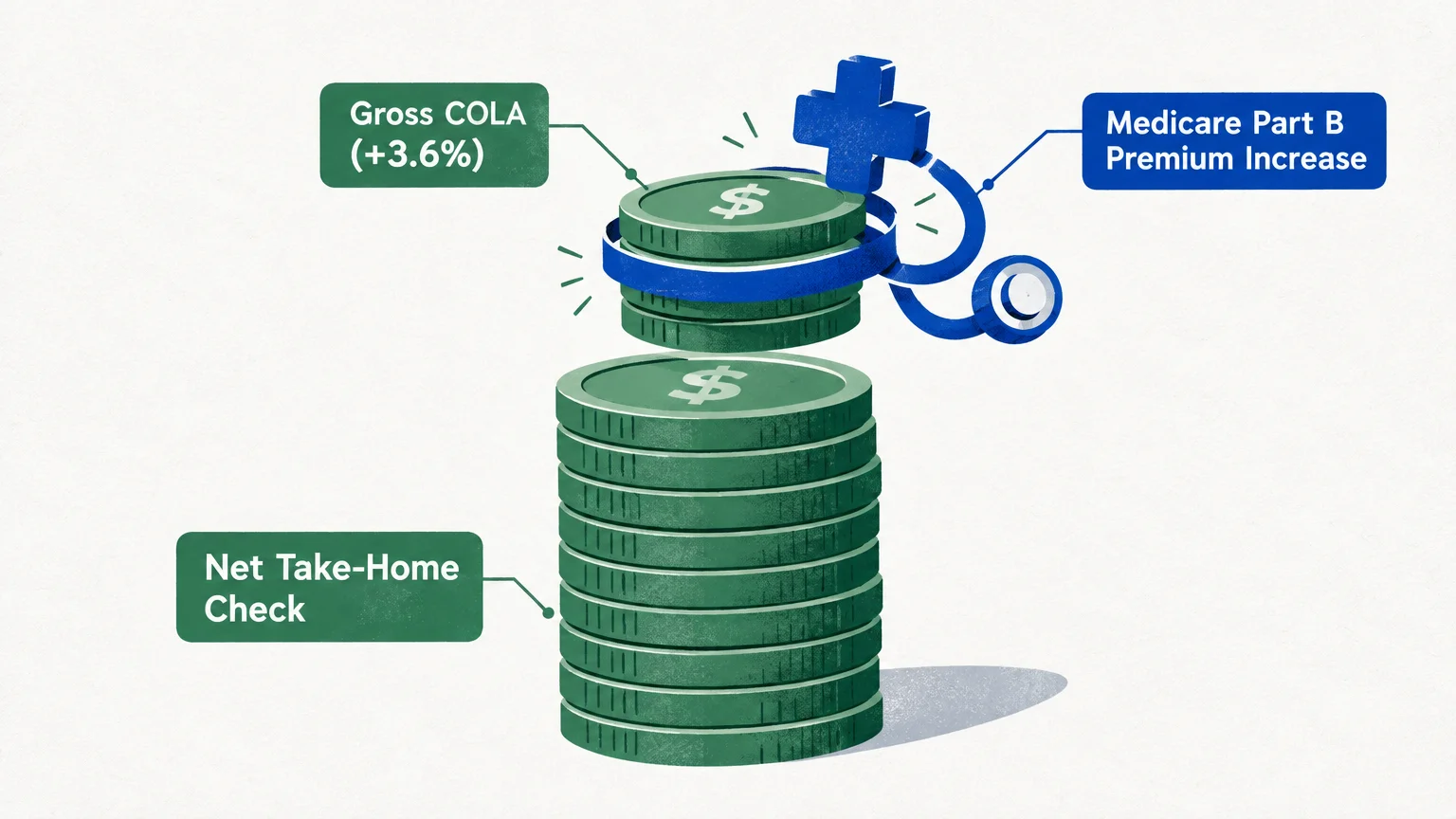
Your gross COLA raise never tells the entire story regarding your actual take-home pay. For millions of retirees, the Centers for Medicare & Medicaid Services deducts Part B premiums directly from Social Security.
In 2026, the standard monthly Medicare Part B premium stood at $202.90, alongside a $283 annual deductible. The 2026 Medicare Trustees Report projected the 2027 standard premium to rise by $6.60 to roughly $209.50.
The annual Part B deductible is likewise projected to climb to $292 in 2027. Independent forecasters warn that faster healthcare spending could push standard Part B premiums higher, potentially between $216 and $219.
CMS typically announces final, official Medicare Part B premium rates in November. You can check official updates directly on Medicare.gov once the government releases final figures.
Whenever your Medicare Part B premium rises, that increase gets subtracted from your Social Security raise first. Only the remaining cash lands in your bank account each month.
“The goal of retirement is to live off your assets—not live off your regrets.”
Keeping close tabs on your net benefit prevents uncomfortable surprises when the January deposit arrives. Always base your upcoming household budget on net receipts rather than gross percentages.
Gross vs. Net Growth: What Actually Lands in Your Bank Account
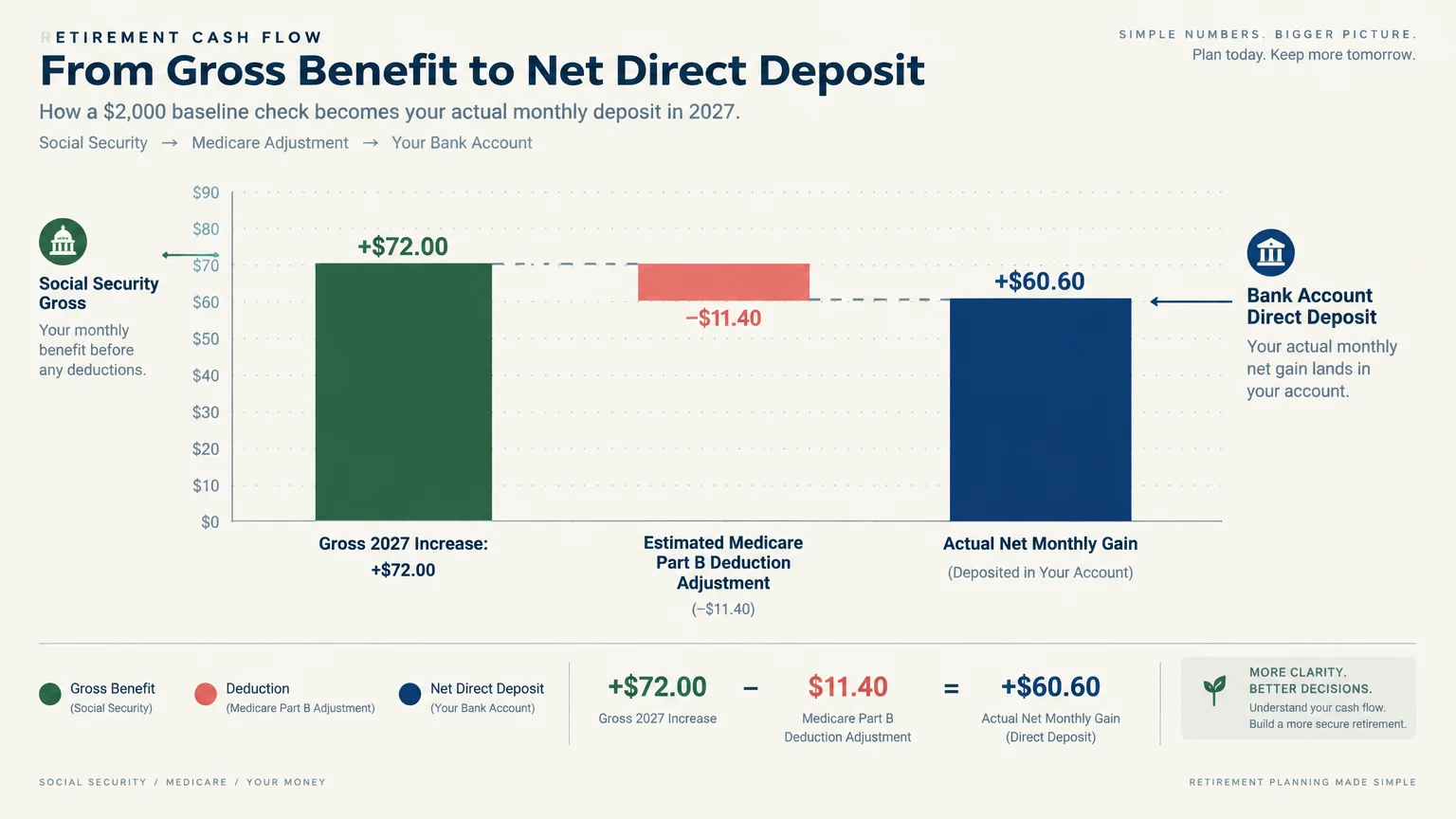
To see what your real raise looks like, you must subtract the projected Medicare Part B premium increase. Assuming the Trustees’ projected $6.60 monthly Part B increase holds true, here is how take-home checks change.
A retiree with a $1,500 check receives a gross raise of $54.00 minus the $6.60 Part B hike. That leaves a net monthly gain of $47.40, totaling $568.80 in real cash for the year.
For a $2,000 check, the gross $72.00 increase drops to a net increase of $65.40 each month. That delivers $784.80 in fresh annual spending money after covering your basic Medicare premium.
Beneficiaries receiving a $3,000 monthly check keep $101.40 after the $6.60 Medicare deduction. That results in an annual net cash gain of $1,216.80 deposited into checking accounts.
| Gross 2026 Benefit | Gross 3.6% COLA Raise | Projected Part B Hike | Estimated Net Monthly Gain | Estimated Net Annual Gain |
|---|---|---|---|---|
| $1,500.00 | $54.00 | -$6.60 | $47.40 | $568.80 |
| $2,000.00 | $72.00 | -$6.60 | $65.40 | $784.80 |
| $2,088.00 (Avg) | $75.00 | -$6.60 | $68.40 | $820.80 |
| $3,000.00 | $108.00 | -$6.60 | $101.40 | $1,216.80 |
Notice how Medicare costs consume a larger share of smaller checks. The $6.60 hike eats over 12% of the $1,500 recipient’s raise, but only 6% of the $3,000 recipient’s increase.
Fortunately, the federal “hold harmless” provision protects existing beneficiaries from having their checks reduced if Part B spikes dramatically. By law, a Part B increase cannot cause your net monthly benefit to drop below its prior level.
Critical Dates and Deadlines for the 2027 Benefit Increase
You do not need to submit any paperwork to receive your 2027 benefit increase. The Social Security Administration updates payment records automatically across its computer systems.
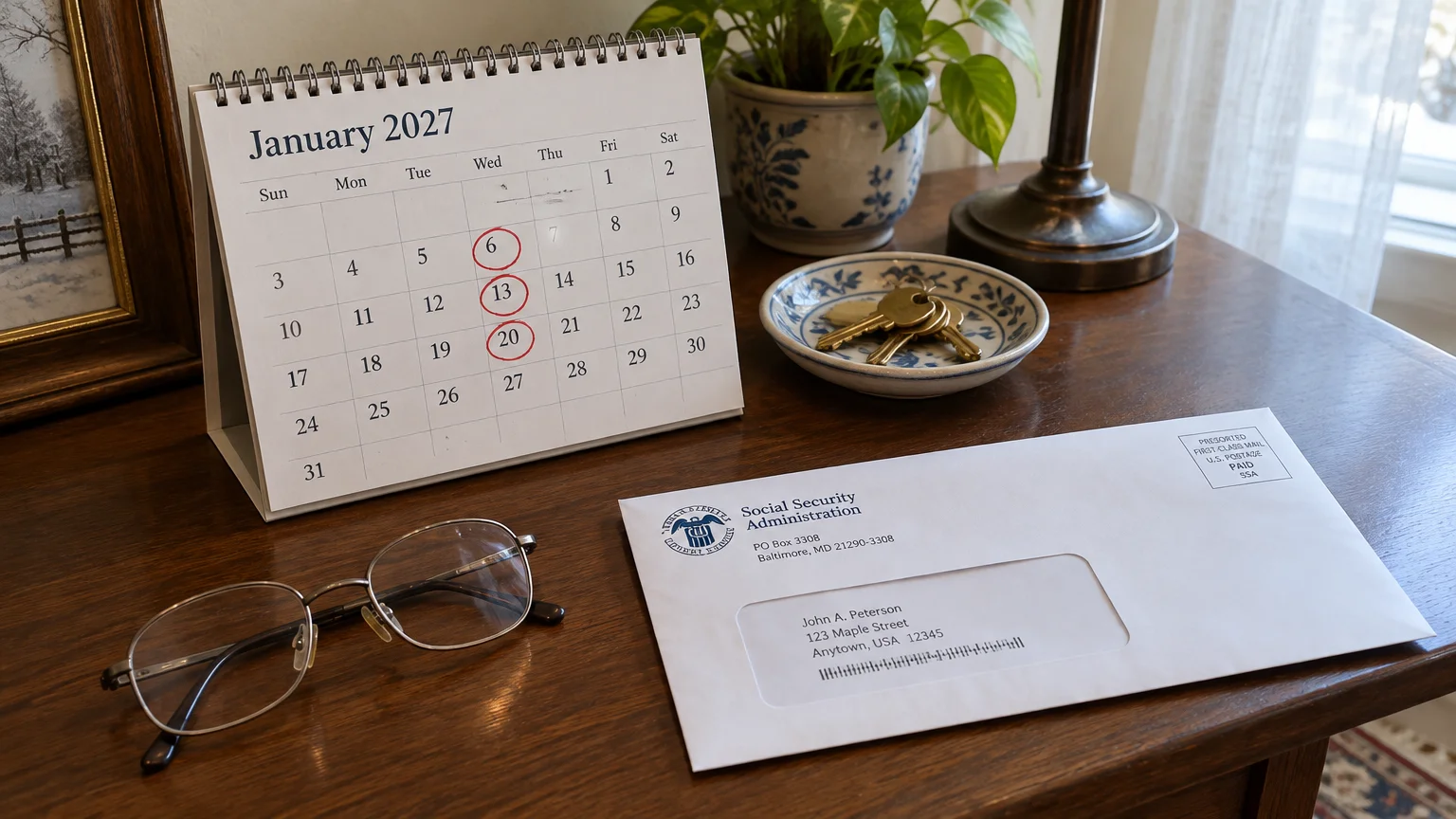
However, specific calendar dates dictate when you can view your official notice and when money arrives. Marking these dates on your calendar ensures you stay ahead of administrative changes.
- October 15 through December 7, 2026: Medicare Open Enrollment runs nationwide, allowing you to compare Part D and Medicare Advantage plans.
- November 18, 2026: The final deadline to create or log into your my Social Security account and choose paperless notifications.
- Late November 2026: Official, personalized 2027 COLA notices become visible inside your online account message center.
- December 2026: Traditional paper COLA notices are printed and mailed to beneficiaries who did not opt for paperless delivery.
- December 31, 2026: Supplemental Security Income recipients receive their first adjusted payment featuring the 3.6% increase.
- January 2027: Standard Social Security checks arrive on their designated payment Wednesdays based on your date of birth.
Beneficiaries born between the 1st and 10th of the month receive payments on the second Wednesday of January. Those born between the 11th and 20th receive funds on the third Wednesday.
If your birthday falls between the 21st and 31st, your updated deposit arrives on the fourth Wednesday. Beneficiaries who began receiving payments before May 1997 receive their checks on the third day of the month.
Will Your 2027 Benefit Increase Trigger Higher Federal Taxes?
A higher monthly check provides welcome relief at the cash register, but it can create unexpected federal income tax liability. Social Security taxation rules do not adjust for annual inflation.
Congress established the income thresholds for taxing Social Security benefits back in 1983 and never indexed them to inflation. As annual COLAs push incomes upward, more seniors find their benefits subject to federal taxation.
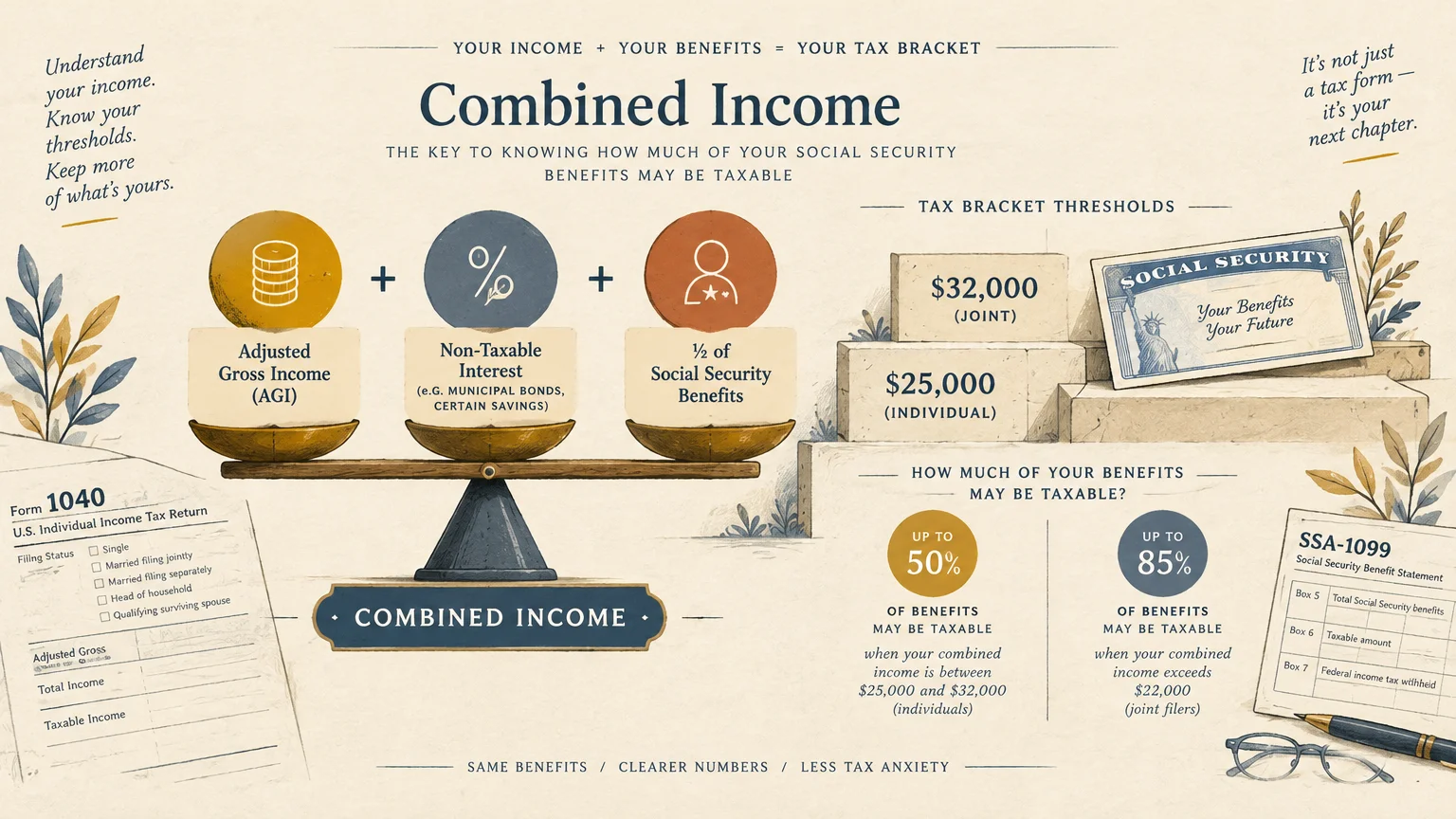
The IRS uses a specific formula called “combined income” to determine benefit taxation. Combined income equals your adjusted gross income, plus nontaxable interest, plus exactly half of your annual Social Security benefits.
If you file as an individual and your combined income sits between $25,000 and $34,000, up to 50% of your benefits face taxation. Above $34,000, up to 85% of your benefits become taxable.
For married couples filing jointly, combined income between $32,000 and $44,000 subjects up to 50% of benefits to tax. When combined income exceeds $44,000, up to 85% is subject to federal income tax.
Because the 3.6% COLA raises your baseline income, it may push you across one of these rigid thresholds. You can learn more about managing tax rules through the Consumer Financial Protection Bureau retirement tools.
To avoid a surprise tax bill in April, you can request voluntary tax withholding from your check. Simply submit IRS Form W-4V to your local Social Security office to withhold 7%, 10%, 12%, or 22% automatically.
How to Use a Social Security COLA 2027 Calculator and Online Tools
You do not have to guess what your exact check will be once government agencies finalize all rates. Using an online social security COLA 2027 calculator or estimating tool clarifies your exact monthly numbers.
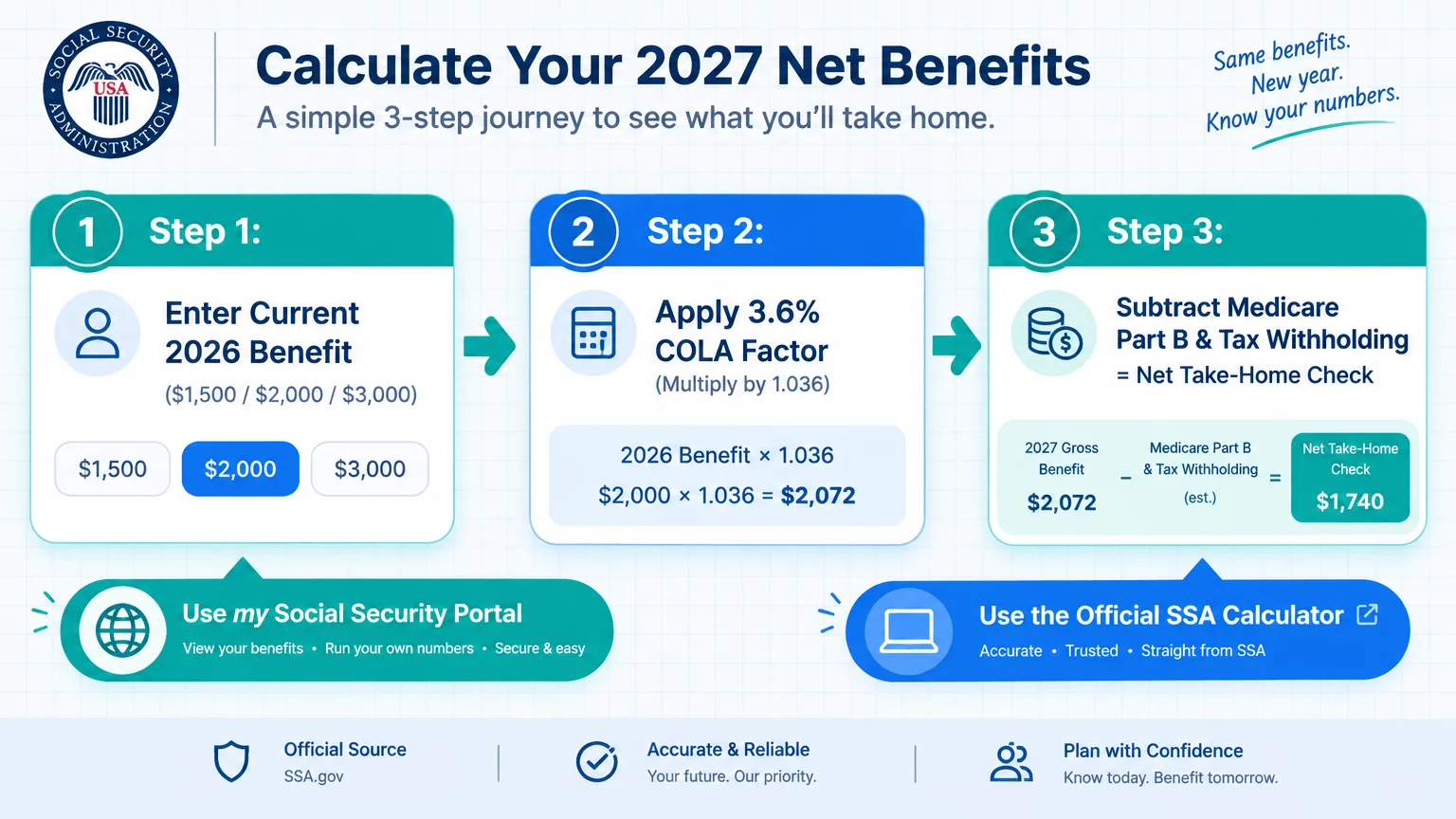
The easiest method requires taking your current gross monthly benefit and multiplying it by 1.036. For example, a $2,450 monthly check multiplied by 1.036 yields $2,538.20 gross.
Next, subtract the official Medicare Part B premium announced by CMS in November. Subtract any voluntary federal income tax withholding you established through Form W-4V.
The final figure represents the actual net social security check 2027 deposited into your bank account each month. Verifying this number beforehand prevents budget shortfalls.
You can also use the official tools hosted at the Social Security Retirement Estimator portal. Logging into your account provides your exact primary insurance amount and full earnings history.

Don’t Make These Mistakes
Navigating annual benefit changes requires careful attention to rules and deadlines. Avoid these common financial missteps to protect your monthly income.
- Budgeting based on gross numbers: Never plan spending around your gross 3.6% increase. Always account for Medicare Part B deductions and taxes first.
- Ignoring Medicare Open Enrollment: Overlooking the October 15 through December 7 window prevents you from shopping for lower-cost Part D prescription plans.
- Overlooking tax threshold creep: Failing to monitor combined income can result in unexpected tax bills if your raise pushes you past the $25,000 or $32,000 thresholds.
- Missing the November 18 paperless deadline: Waiting too long to create your online account delays access to your personalized 2027 COLA notice.
- Failing to update direct deposit details: Switching banks without updating Social Security at least 30 days ahead can delay your January payment.
Addressing these issues in October and November ensures a smooth transition into the new payment year. Proactive planning eliminates unnecessary stress when schedules reset.

When Professional Advice Is Worth It
While calculating your COLA increase is straightforward, integrating it into a comprehensive retirement plan can prove complex. Certain situations justify consulting a credentialed specialist.
If you are trying to evaluate Medicare Advantage versus Original Medicare and Part D, contact your State Health Insurance Assistance Program (SHIP). SHIP provides free, unbiased counseling from trained volunteers.
Consult a fee-only Certified Financial Planner or CPA if your benefit increase threatens to push you into a higher tax bracket. A tax professional can recommend strategies like Roth conversions or charitable distributions to manage taxable income.
If you are navigating spousal benefits, survivor claims, or divorce benefits, speak with a Social Security claiming specialist. Claiming at the right time significantly impacts your baseline benefit for the rest of your life.
Frequently Asked Questions About the 2027 Social Security COLA
How much will Social Security increase 2027 for an average retired worker?
The average retired worker benefit increases by approximately $75.00 per month, rising from an estimated $2,088 in 2026 to $2,163 in 2027. This gross annual raise equals $900.00 before Medicare deductions.
When will I see the 2027 benefit increase in my bank account?
Supplemental Security Income recipients receive their increased payment on December 31, 2026. Regular Social Security retirement and disability recipients receive their higher payments on the second, third, or fourth Wednesday of January 2027.
Why is my net increase lower than the announced 3.6% rate?
Most retirees have their monthly Medicare Part B premiums deducted directly from their Social Security checks. When Medicare Part B premiums rise each January, that hike reduces your take-home cash gain.
How can I view my official 2027 COLA notice online?
Log into your personal my Social Security account starting in late November 2026. You must create your account and opt into digital notices by November 18, 2026, to skip paper mail delivery.
Next Steps for Your 2027 Retirement Budget
Take time this week to review your current monthly Social Security statement and calculate your expected 3.6% bump. Multiply your gross check by 0.036 to determine your gross dollar increase.
Next, review your Medicare coverage before Open Enrollment closes on December 7, 2026. Selecting an efficient drug plan can help preserve more of your hard-earned COLA raise.
Information in this article reflects current rules as of the publication date and may change. Always confirm benefit details directly with Social Security Administration, Medicare.gov, or relevant government agencies before making decisions.
Last updated: October 2026. Medicare and Social Security rules change annually—always verify current details at official government sources.