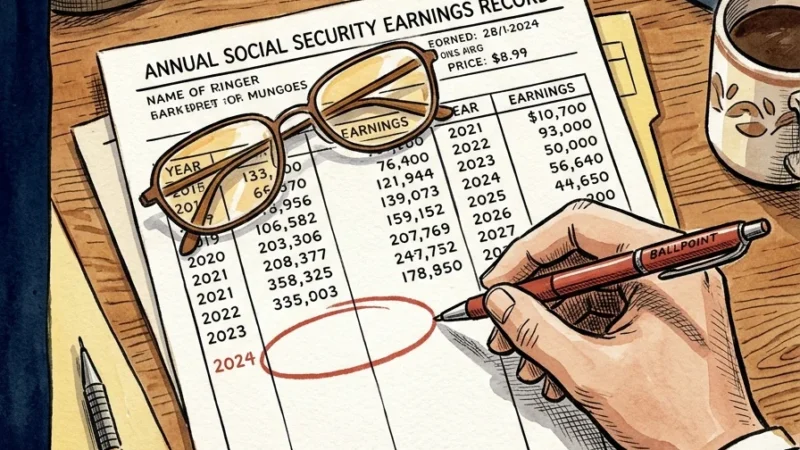
The Social Security wage cap increases significantly on January 1, 2027, exposing more of your earned income to payroll taxes. If you earn above the prior threshold, your paycheck will shrink as withholding takes a larger bite.
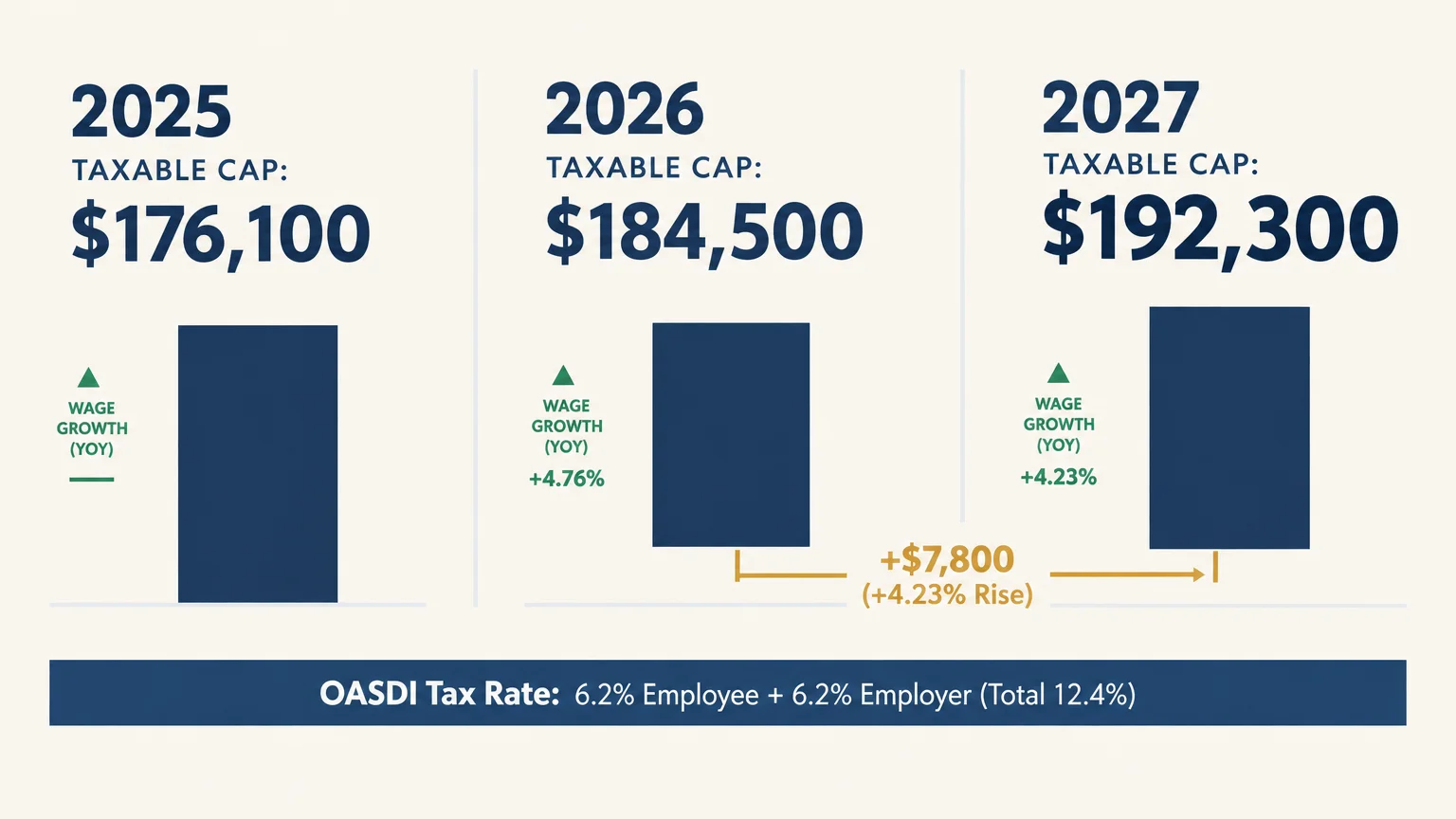
The Social Security Administration announced that the maximum taxable earnings limit rises to $192,300 for 2027. This adjustment marks an increase of $7,800 over the 2026 cap of $184,500.
Understanding how this shift impacts your take-home pay helps you budget effectively and adjust your retirement contributions. Here is everything you need to know about who pays more and how to protect your wealth.
Understanding the 2027 Social Security Wage Base
The federal government sets an annual cap on the amount of earnings subject to the Social Security payroll tax. Lawmakers call this threshold the taxable wage base.
On October 14, 2026, the federal government officially announced that the 2027 wage base will hit $192,300. This is a substantial jump from the 2026 threshold of $184,500 and the 2025 limit of $176,100.
The annual wage cap increase equals $7,800, which represents a rise of roughly 4.23%. Any wages you earn above $192,300 in 2027 remain completely free from the Social Security tax.
Automatic formulas determine this adjustment each autumn rather than discretionary congressional votes. The calculation directly reflects changes in the National Average Wage Index.
When national average wages rise across the workforce, the government raises the taxable maximum proportionally. This mechanism ensures that tax collections keep pace with national wage growth.
The statutory tax rate for Old-Age, Survivors, and Disability Insurance (OASDI) remains unchanged at 6.2% for employees. Employers match this deduction with an identical 6.2% contribution from company funds.
If you work for an employer, your payroll department stops withholding the 6.2% tax once your year-to-date earnings pass $192,300. For individuals earning below that mark, the tax applies to every single dollar earned.
Who Pays More Under the 2027 Payroll Tax Cap?
Not every worker will experience a tax increase under the new limit. Your exact financial impact depends strictly on how much earned income you collect throughout the calendar year.
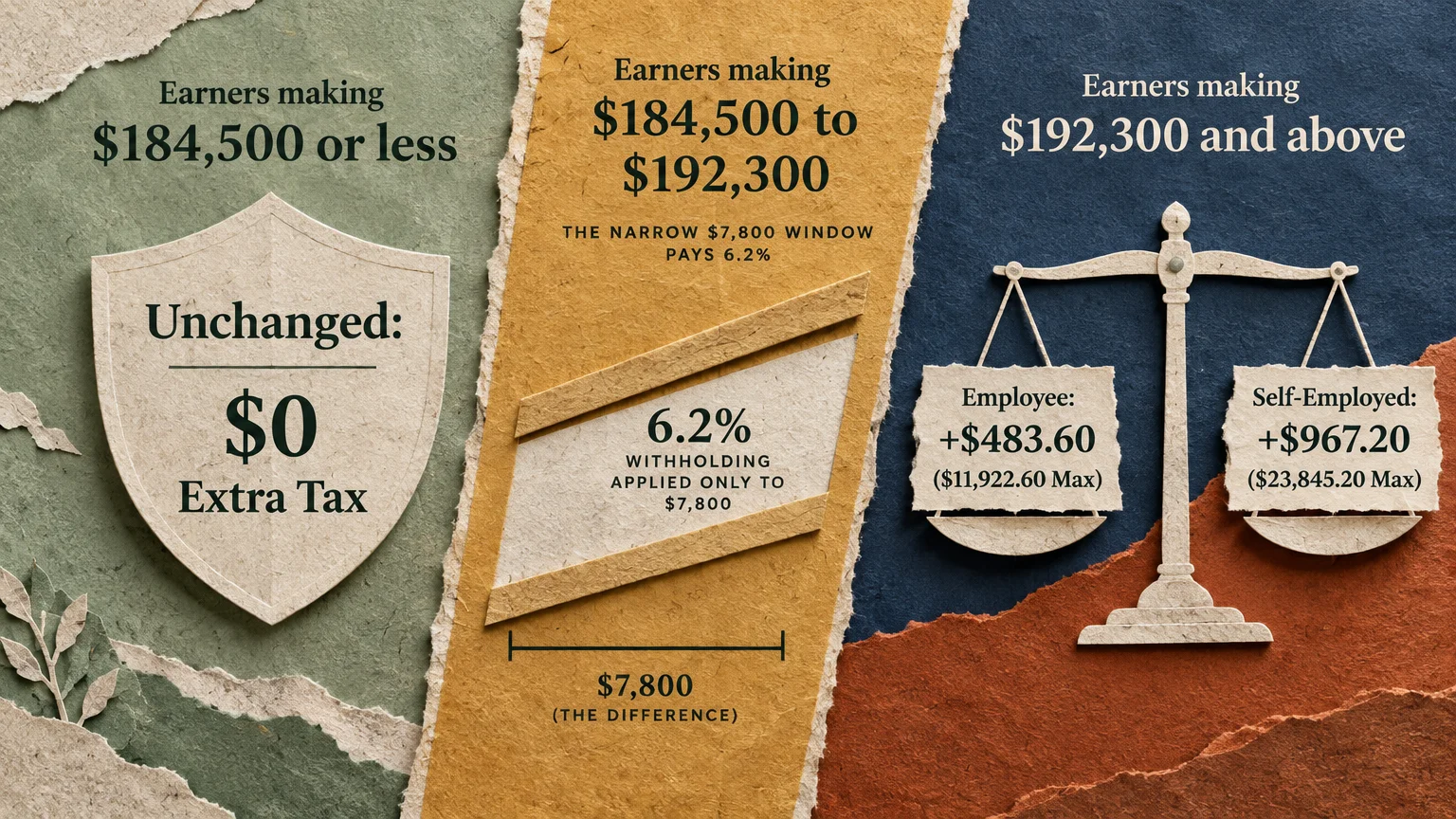
If you earn $184,500 or less in 2027, your Social Security tax obligations do not increase by a single penny. You will continue paying the exact same 6.2% rate on your wages as you did before.
Workers earning between $184,500 and $192,300 face a partial tax increase on the earnings that fall inside that gap. Every dollar earned in that $7,800 window faces the 6.2% payroll tax for the first time.
High-earning employees who make $192,300 or more will pay the full maximum tax increase. For these individuals, the maximum annual employee tax contribution climbs to $11,922.60.
Compared to the 2026 maximum contribution of $11,439.00, high earners will pay an additional $483.60 across the year. Your employer must match that exact amount, delivering $483.60 more to the government on your behalf.
Self-employed professionals face a much larger financial obligation because they pay both the employee and employer shares. Under the self-employment tax rules, the full OASDI tax rate stands at 12.4%.
For a self-employed consultant or business owner earning at or above $192,300, the maximum contribution rises to $23,845.20 in 2027. That represents a sharp annual increase of $967.20 compared to the 2026 cap of $22,878.00.
Older workers in their peak earning years often feel this bite most acutely. If you consult during semi-retirement, this tax increase directly reduces your net business revenue.
Social Security and Medicare Tax Rates: The 2027 Breakdown
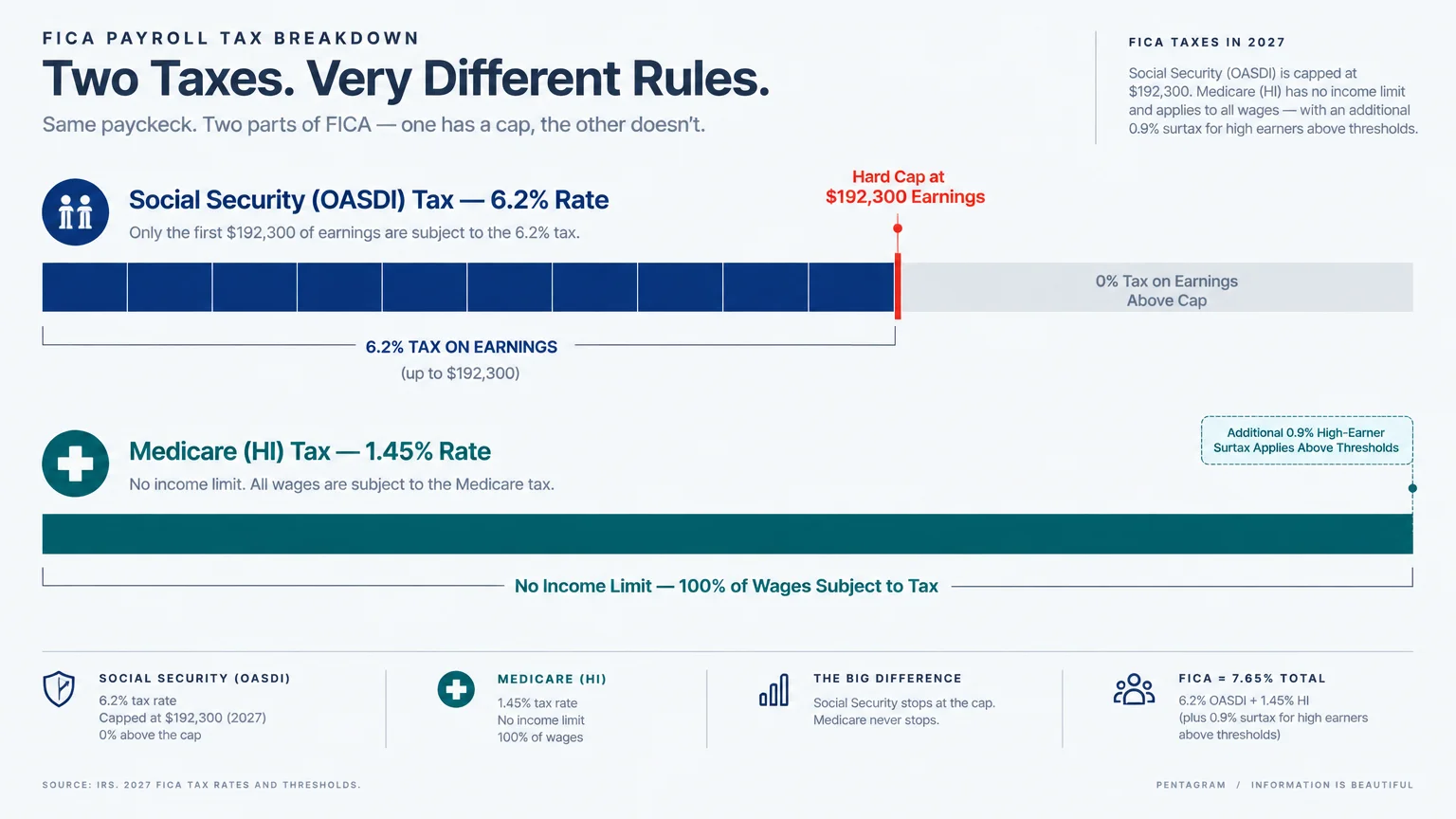
Payroll deductions under the Federal Insurance Contributions Act (FICA) consist of two distinct elements. You must evaluate both Social Security and Medicare taxes to understand your complete withholding picture.
Unlike Social Security, Medicare Hospital Insurance (HI) does not have any wage base limit. You must pay Medicare taxes on every single dollar of earned income you generate, without exception.
The baseline Medicare tax rate remains 1.45% for employees and 1.45% for employers, totaling 2.9%. When combined with Social Security, your standard FICA tax rate is 7.65% up to the wage cap.
High earners also face the Additional Medicare Tax of 0.9%, which lawmakers established under the Affordable Care Act. This surtax applies only to the employee portion of wages exceeding statutory income levels.
The surtax thresholds sit at $200,000 for single filers, $250,000 for married couples filing jointly, and $125,000 for married individuals filing separately. These thresholds do not adjust for annual inflation, pulling more households into the surtax each year.
| Tax Category | 2025 Limit | 2026 Limit | 2027 Limit |
|---|---|---|---|
| Social Security Wage Cap | $176,100 | $184,500 | $192,300 |
| Max Employee Social Security Tax (6.2%) | $10,918.20 | $11,439.00 | $11,922.60 |
| Max Self-Employed Tax (12.4%) | $21,836.40 | $22,878.00 | $23,845.20 |
| Medicare Tax Wage Cap | No Limit | No Limit | No Limit |
| Combined FICA Rate (Up to Cap) | 7.65% | 7.65% | 7.65% |
Tracking these numbers ensures you understand when your paycheck withholding changes during the year. Highly paid workers often see an increase in take-home pay late in the year once they cross the wage cap.
In 2027, that take-home pay boost arrives slightly later in the calendar year. You must earn $7,800 more before your employer halts your Social Security tax withholding.

Working While Collecting Social Security: 2027 Earnings Test Rules
Many Americans aged 62 and older choose to claim retirement benefits while continuing to work part-time or full-time. If you do this before reaching your Full Retirement Age (FRA), the Retirement Earnings Test applies to your wages.
The Social Security Administration adjusts these earnings limits every year alongside the payroll tax cap. Exceeding these limits causes the agency to temporarily withhold a portion of your monthly checks.
If you remain under your Full Retirement Age for the entirety of 2027, the annual exempt earnings limit rises to $25,560. That equals $2,130 per month in allowable earnings before penalties apply.
If your earned income exceeds $25,560 in 2027, the government withholds $1 in benefits for every $2 earned above the cap. This reduction can substantially disrupt your monthly cash flow if you do not plan ahead.
A more generous threshold applies during the calendar year in which you actually reach your Full Retirement Age. In that specific transition year, the 2027 earnings test limit climbs to $67,920 annually, or $5,660 per month.
During the months leading up to your birthday month in that transition year, the agency withholds $1 for every $3 earned above the limit. Once you reach your exact Full Retirement Age, the earnings penalty disappears completely.
From that milestone forward, you can earn an unlimited amount of money with zero benefit withholding. You can review claiming calculators on the Consumer Financial Protection Bureau retirement tools page to model these trade-offs.
Withheld benefits are not permanently lost; the agency recalculates your monthly benefit upward once you reach FRA. Nonetheless, paying payroll taxes on earnings that trigger benefit withholding creates immediate cash crunches for working seniors.

The Silver Lining: Higher Future Benefits and Credits
While paying higher payroll taxes feels frustrating, contributing toward the elevated cap provides tangible retirement advantages. The Social Security benefit formula rewards higher career contributions with larger monthly retirement checks.
Your ultimate retirement payment derives from your highest 35 years of wage-indexed earnings. When you pay taxes on up to $192,300 in 2027, that full amount enters your permanent earnings record.
Paying taxes on a higher wage base pushes up your Average Indexed Monthly Earnings (AIME). Over time, this raises your primary insurance amount and expands your baseline benefit.
Reflecting these higher lifetime contributions, the maximum monthly benefit at Full Retirement Age increases to $4,188 per month in 2027. This marks an increase from the $4,152 monthly ceiling established for 2026.
Older workers entering the workforce or working limited hours also face new thresholds for earning coverage credits. In 2027, one Social Security work credit requires $1,970 in covered earnings.
To secure the maximum allowable four credits for the year, you must earn at least $7,880. Securing 40 lifetime credits remains the foundational requirement to qualify for retirement benefits on your own record.
Retirees already collecting checks also receive positive news alongside the tax cap expansion. The 2027 Cost-of-Living Adjustment (COLA) arrived at 3.6%, up from the 2.8% boost enacted in 2026.
This adjustment lifts the average retired worker’s monthly benefit by roughly $75, moving from $2,095 to $2,170 starting in January 2027. You can check your personalized projections through the official Social Security Retirement Estimator.
“It’s not how much money you make, but how much money you keep, how hard it works for you, and how many generations you keep it for.” — Robert Kiyosaki
Higher career contributions also establish a stronger financial shield for your surviving spouse. A surviving spouse can inherit up to 100% of your earned benefit, making high-wage accumulation a valuable estate asset.

Tax-Smart Strategies to Offset the 2027 Payroll Tax Hike
You cannot legally opt out of FICA taxes on standard wage income, but you can take proactive steps to reduce your overall tax burden. Smart adjustments elsewhere on your tax return offset the higher payroll tax costs.
Pre-tax workplace deductions offer one of the most effective tools for softening this financial blow. Contributing to a traditional 401(k), 403(b), or 457 plan reduces your federal and state income tax liabilities immediately.
While standard retirement deferrals do not reduce your FICA tax liability, they lower your adjusted gross income. This preserved cash flow compensates for the extra $483.60 exiting your paycheck through payroll withholding.
Review the guidelines published on the IRS Retirement Plans resource portal to verify annual contribution limits. Catch-up contributions for individuals aged 50 and older provide substantial room to shield income from income taxes.
If you have access to a Health Savings Account (HSA), take full advantage of payroll deduction contributions. HSA contributions made through an employer Section 125 cafeteria plan bypass both federal income tax and FICA taxes completely.
This unique tax treatment saves you 7.65% in payroll taxes on every dollar contributed through payroll. Flexible Spending Accounts (FSAs) for healthcare and dependent care offer identical FICA exemption benefits.
- Maximize Cafeteria Plans: Route HSA and healthcare FSA contributions directly through payroll to eliminate the 7.65% FICA assessment.
- Restructure Business Income: Self-employed business owners can evaluate an S-Corporation tax structure to separate reasonable salary from dividend distributions.
- Review Non-Qualified Deferred Compensation: Executive deferred compensation plans allow pre-retirees to shift taxable wage recognition into future lower-income years.
- Coordinate Bonus Timing: Requesting bonus payouts in specific tax years can help avoid compounding bracket spikes with Medicare surtax thresholds.
Self-employed professionals must exercise caution when setting reasonable compensation inside an S-Corporation. The IRS closely scrutinizes business owners who artificially depress wages to evade the 12.4% payroll tax.
Always work with a qualified tax advisor before altering corporate distributions or compensation structures. Proper compliance protects you from severe back taxes, failure-to-withhold penalties, and audit exposure.

Errors That Cost Retirees Thousands
Navigating payroll taxes and benefit calculations requires careful attention to detail. Overlooking simple technical rules frequently costs older workers thousands of hard-earned dollars every year.
One common mistake involves failing to reclaim excess Social Security taxes when working multiple jobs. Each employer must withhold Social Security taxes independently until your wages reach $192,300 with that specific company.
If you work two executive roles or switch employers mid-year, both employers might withhold the maximum tax amount. The government will not notify you automatically if your combined withholding exceeds the $11,922.60 cap.
You must claim the excess withholding as a refundable tax credit on IRS Form 1040 when filing your tax return. Neglecting to claim this credit forfeits your right to recover hundreds or thousands of overpaid dollars.
Another expensive blunder occurs when working seniors trigger the Retirement Earnings Test unexpectedly. Claiming benefits at age 62 while continuing to earn a six-figure salary results in 100% of your benefits being withheld.
While those withheld funds eventually recalculate your benefit at Full Retirement Age, you lose valuable liquidity in the interim. You also lock in early claiming reductions that permanently depress your baseline payment.
Self-employed individuals often underestimate their quarterly estimated tax payments following a wage cap increase. Forgetting to factor the $967.20 self-employment tax hike into your quarterly vouchers triggers IRS underpayment penalties.
Finally, many workers assume their online earnings record is always completely accurate. Failing to audit your official statement through the Social Security Administration website can leave clerical wage errors uncorrected.
An employer may misreport your annual compensation or omit wages entirely due to an inverted digit in your Social Security number. If you fail to correct errors within three years, three months, and 15 days, amending records becomes exceptionally difficult.

When to Get Expert Help
Navigating the interplay between rising payroll taxes, Medicare thresholds, and retirement claiming decisions often requires specialized guidance. Making decisions in isolation frequently leads to unintended tax consequences.
You should consult a Certified Public Accountant (CPA) or enrolled agent if your earnings hover near the $192,300 mark. A tax professional can model your withholding to prevent surprise liabilities or unnecessary overpayment.
If you operate a small business or work as an independent contractor, professional tax preparation becomes essential. An advisor helps you balance self-employment tax obligations against the need to build lifetime Social Security credits.
“The best time to plan for retirement was 20 years ago. The second best time is today.”
Consider hiring a fee-only financial planner or Social Security claiming specialist before initiating your retirement benefits. These experts analyze claiming ages to determine whether delaying benefits outweighs the cost of current payroll taxes.
For healthcare coverage transitions, reach out to your local State Health Insurance Assistance Program (SHIP). SHIP counselors offer free, unbiased guidance on Medicare enrollment windows and can help you avoid lifelong late-enrollment penalties.
Coordinating tax management, retirement timing, and healthcare planning ensures your financial plan operates harmoniously. Expert assistance pays for itself by preventing costly structural missteps.
Frequently Asked Questions About the 2027 Social Security Tax Cap
Does the 2027 Social Security tax cap apply to investment income or pensions?
No, the Social Security payroll tax applies strictly to earned income, such as wages, salaries, and net business earnings. Capital gains, dividends, interest, pension payouts, and IRA distributions remain completely exempt from FICA taxes.
What happens if I work two jobs and pay more than $11,922.60 in Social Security taxes?
If multiple employers withhold more than the statutory maximum of $11,922.60 combined, you receive the difference back. You claim the excess amount as a refundable credit on your annual federal income tax return.
Why does the payroll tax limit increase almost every year?
Federal law indexes the wage cap directly to the National Average Wage Index. As national average wages climb due to economic growth and wage inflation, the taxable maximum rises automatically to maintain program revenue.
How does paying taxes up to the $192,300 limit affect my retirement checks?
Paying taxes on higher covered earnings raises your career average earnings record. This calculation increases your baseline primary insurance amount, yielding higher monthly benefits when you eventually claim retirement checks.
Action Steps for Your 2027 Retirement Plan
Take charge of your personal finances by reviewing your payroll allocations before January 1, 2027 arrives. Inspect your late-year paystubs to verify your current cumulative earnings and project your 2027 compensation.
Log in to your personal account on the Social Security website to verify your historical earnings record. Ensure every year of past work accurately reflects your true earnings so your final benefit calculation remains protected.
Adjust your workplace cafeteria contributions, such as HSAs and FSAs, to maximize FICA-exempt savings. Coordinate with your human resources team or accountant to ensure your quarterly tax vouchers account for the higher wage cap.
Retirement rules and benefit amounts vary based on individual work history, income, and circumstances. This article provides general guidance only. Consult a SHIP counselor, financial advisor, or elder law attorney for advice specific to your situation.
Last updated: October 2026. Medicare and Social Security rules change annually—always verify current details at official government sources.