Your pension election represents an irreversible financial milestone that defines your retirement cash flow for life. Choosing the wrong payout structure can permanently slash your household income or leave your surviving spouse financially vulnerable.
Plan administrators present complex distribution formulas ranging from single life streams to survivor annuities and lump-sum payouts. Each selection forces trade-offs between maximum monthly checks, long-term family security, and tax efficiency.
Understanding how these seven core pension payout options work gives you the power to protect your household before signing final paperwork.
What You Need to Know Before Choosing
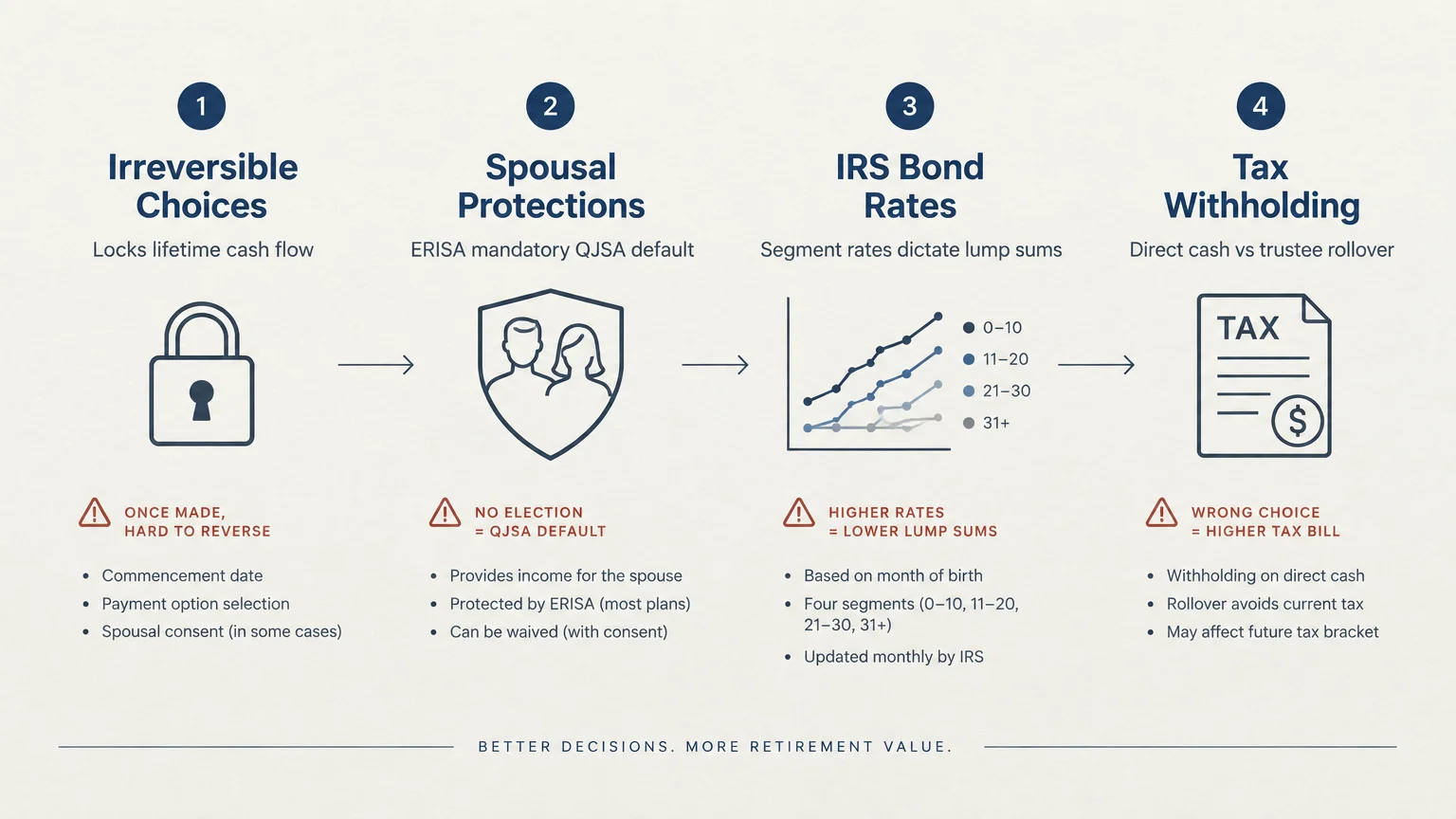
Selecting your pension payout structure requires evaluating both your financial obligations and your household longevity. Federal regulations strictly govern these choices, making your initial election permanent in almost every circumstance.
- Irreversible choices: Once your pension payments begin, you cannot alter your distribution method or change designated beneficiaries.
- Spousal protections: Federal law establishes a joint and survivor annuity as the mandatory default for married participants.
- Lump-sum interest sensitivity: Cash distribution values fluctuate inversely with prevailing corporate bond segment rates set by the IRS.
- Tax consequences: Direct cash distributions trigger mandatory federal tax withholding, whereas trustee-to-trustee rollovers preserve tax deferral.

1. Single Life Annuity (Straight Life)
The single life annuity provides the highest monthly payment among all annuity choices. Your plan sponsor calculates this amount using only your age, service history, and final average compensation.
The trade-off is absolute. All payments stop immediately upon your death, leaving zero ongoing monthly income for your spouse, children, or estate.
For example, a retiree might qualify for $3,200 per month under a single life election. If that retiree dies two years into retirement, the plan retains all remaining assets.
Because of this financial exposure, federal law protects married couples under the Employee Retirement Income Security Act (ERISA). Married workers cannot choose a single life annuity without written, notarized spousal consent.
Your spouse must sign this waiver within the mandatory 30- to 180-day election window before your annuity starting date. Without that notarized waiver, the plan administrator must reject your single life election.
This option works best for unmarried retirees without dependents. It also suits married couples where the non-pensioned spouse holds substantial independent retirement wealth or personal pensions.
2. Joint and Survivor Annuity (50%, 75%, and 100%)
A joint and survivor annuity provides continuous income across two lifetimes. You accept a reduced monthly benefit during your life so your spouse receives ongoing payments after you die.
Under ERISA and Internal Revenue Code Section 417, a Qualified Joint and Survivor Annuity (QJSA) is the legal default for married workers. The standard QJSA provides at least a 50% survivor benefit.
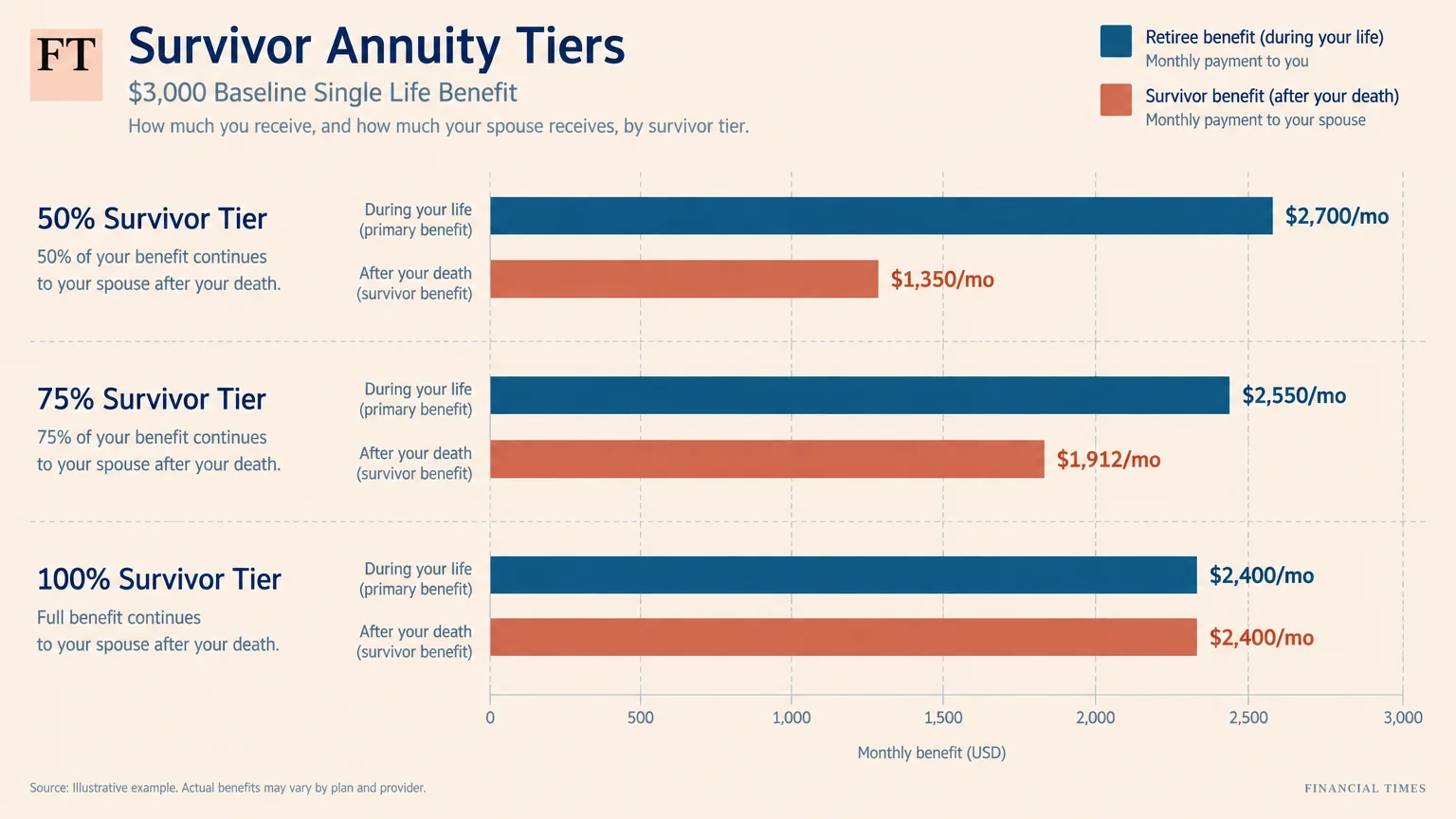
Most pension plans offer three standard tiers: 50%, 75%, and 100% continuation. The higher the ongoing percentage you designate for your spouse, the lower your starting monthly check.
The size of your benefit reduction depends on the age difference between you and your spouse. A significantly younger spouse creates a longer payout horizon, which reduces your starting payment further.
Consider a baseline single life benefit of $3,000 per month. A 50% joint and survivor election might reduce your payment to $2,700 monthly, leaving your survivor $1,350 per month.
Electing a 100% survivor annuity might lower your monthly check to $2,400. However, your surviving spouse continues receiving that full $2,400 every month for the rest of their life.
You can coordinate these options with household benefits from the Social Security Administration to maintain steady household cash flow after a breadwinner passes away.
3. Joint and Survivor Annuity with a Pop-Up Feature
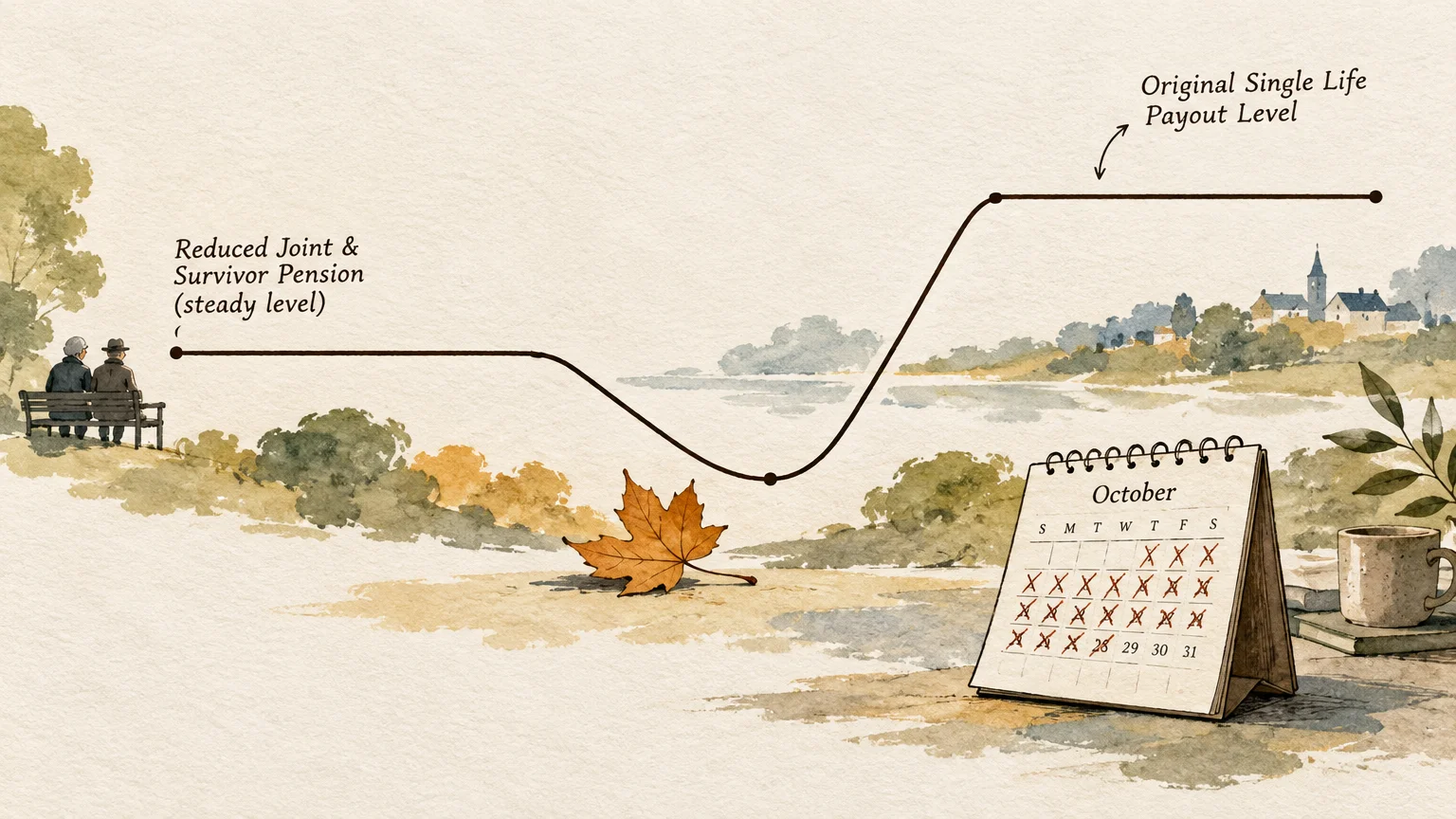
A standard joint and survivor annuity locks you into a permanently reduced benefit; if your spouse dies first, your payment remains at that lower level forever.
A pop-up option removes this penalty. If your designated spouse predeceases you, your monthly payment automatically “pops up” to the higher single life annuity amount.
Plan sponsors charge an actuarial fee for this built-in protection. Consequently, your starting monthly payment will be slightly lower than a standard joint and survivor annuity.
Suppose a standard 100% survivor annuity pays $2,400 per month from a $3,000 base. Adding a pop-up rider might drop your starting benefit to $2,310 monthly.
If your spouse passes away five years into retirement, your monthly payment immediately jumps to the full $3,000 straight life amount for the rest of your life.
This payout structure offers valuable security when your spouse faces pre-existing health concerns or has a shorter statistical life expectancy than you do.
4. Life with Period Certain (5, 10, 15, or 20 Years)
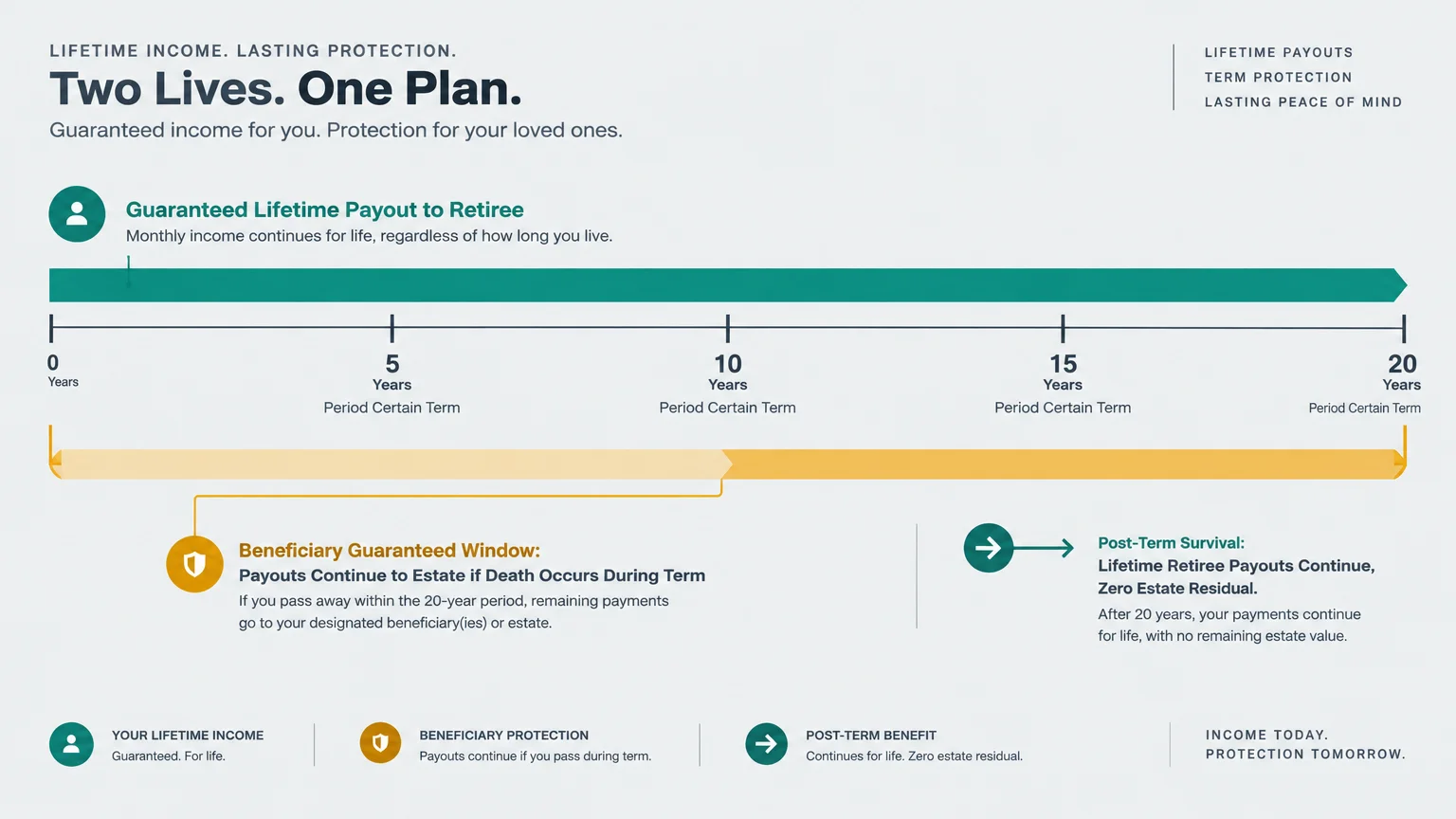
A life with period certain annuity blends lifetime income guarantees with a defined minimum payout window. You receive monthly payments for life, no matter how long you live.
If you pass away before your selected guarantee window ends, your designated beneficiary receives the remaining payments. Common guarantee windows include 5, 10, 15, and 20 years.
For instance, suppose you select a 10-year period certain benefit and pass away after four years. Your named beneficiary receives the remaining six years of monthly payments.
If you outlive the guarantee period, your lifetime benefits continue unchanged until your death. However, your beneficiary receives nothing after you die once that 10-year term has passed.
This option provides an effective alternative for single retirees who want to leave guaranteed financial support for adult children, grandchildren, or special needs trusts.
Married participants can also select a joint and survivor annuity with a period certain feature, creating two layers of household financial protection.

5. Full Pension Lump-Sum Distribution
A pension lump-sum buyout replaces your future monthly pension checks with an immediate single cash payment. This distribution transfers all longevity risk, market volatility, and investment management onto your shoulders.
Federal law under Internal Revenue Code Section 417(e) dictates how employers calculate lump sums. Actuaries discount future payments using corporate bond segment rates established by the IRS.
Interest rates share an inverse relationship with lump-sum values. When market interest rates rise, pension buyout amounts fall; when interest rates decline, lump-sum buyout values surge.
Tax rules surrounding lump sums require strict adherence. Under IRC Section 3405(c), plan administrators must automatically withhold 20% for federal taxes if you receive the check in your own name.
You can review detailed distribution rules through the IRS Retirement Plans portal before finalizing your distribution method.
To avoid this 20% tax bite, execute a direct trustee-to-trustee rollover into an existing traditional Individual Retirement Account (IRA). The entire balance transfers without tax withholding or current-year income recognition.
If you receive the funds directly, the strict 60-day rollover rule applies. You must deposit the full gross amount into an IRA within 60 days, replacing the withheld 20% out of your own pocket.
Rolling a lump sum into a traditional IRA subjects the balance to Required Minimum Distribution (RMD) rules. Under the SECURE 2.0 Act, RMDs begin at age 73 and shift to age 75 in 2033.
Keep in mind that SECURE 2.0 Section 304 raised the mandatory cash-out threshold from $5,000 to $7,000 for distributions made after December 31, 2023. Employers can automatically distribute vested balances below this amount without your consent.

6. Partial Lump-Sum Option (PLOP)
A partial lump-sum option (PLOP) creates a practical compromise between immediate capital access and guaranteed monthly income. You receive an upfront cash distribution alongside a reduced lifetime monthly annuity.
Plans usually limit the upfront cash amount to a percentage of your total benefit value, such as 10% or 25%, or a fixed multiple of your monthly check.
For example, a plan might offer a $60,000 immediate cash payout in exchange for reducing your monthly annuity from $2,800 to $2,250 for life.
Retirees often use this initial cash sum to eliminate mortgage balances, pay off high-interest debt, or establish a dedicated liquid emergency fund.
You can roll the lump-sum portion directly into a rollover IRA to avoid immediate taxation, while keeping the monthly annuity active for daily living expenses.
7. Social Security Leveling Option (Social Security Bridge)
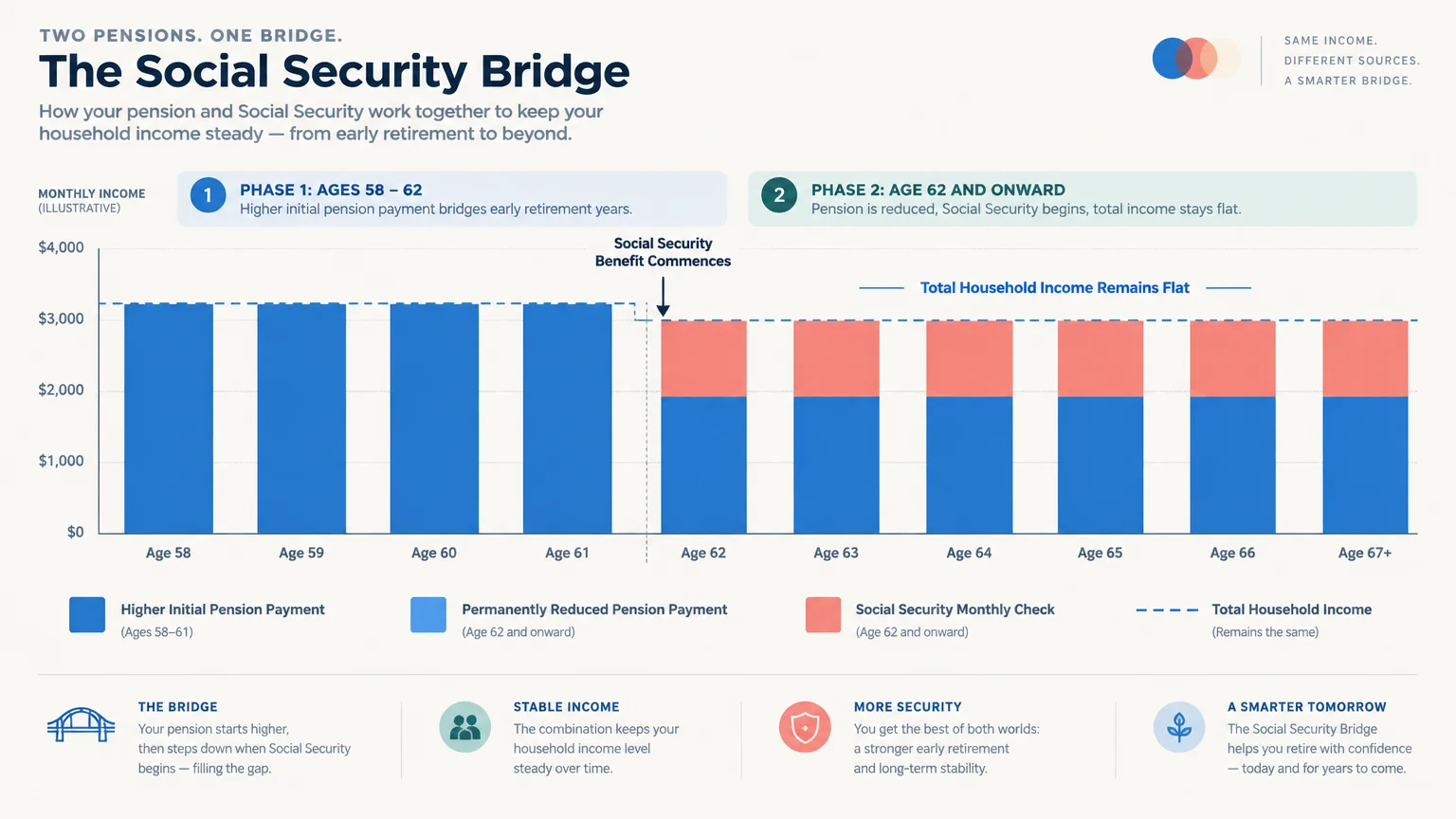
The Social Security leveling option synchronizes your early pension payments with your future Social Security retirement benefits. It creates a smooth, level income stream across your early and late retirement years.
This structure suits workers who retire before reaching Social Security eligibility. The pension plan pays you an inflated monthly benefit until you reach age 62 or full retirement age.
Once you reach the targeted age, your monthly pension benefit permanently drops by an amount equal to your estimated Social Security check. Your combined income from both sources remains roughly level.
You can review federal claiming strategies and timelines through USA.gov Retirement Resources before choosing a bridge option.
However, this strategy carries distinct risks. If you die earlier than actuarial tables predict, the total payout from your pension plan will be substantially lower.
Furthermore, because the pension reduction is permanent, high inflation later in retirement can erode your overall purchasing power significantly.
Comparing the 7 Pension Payout Options
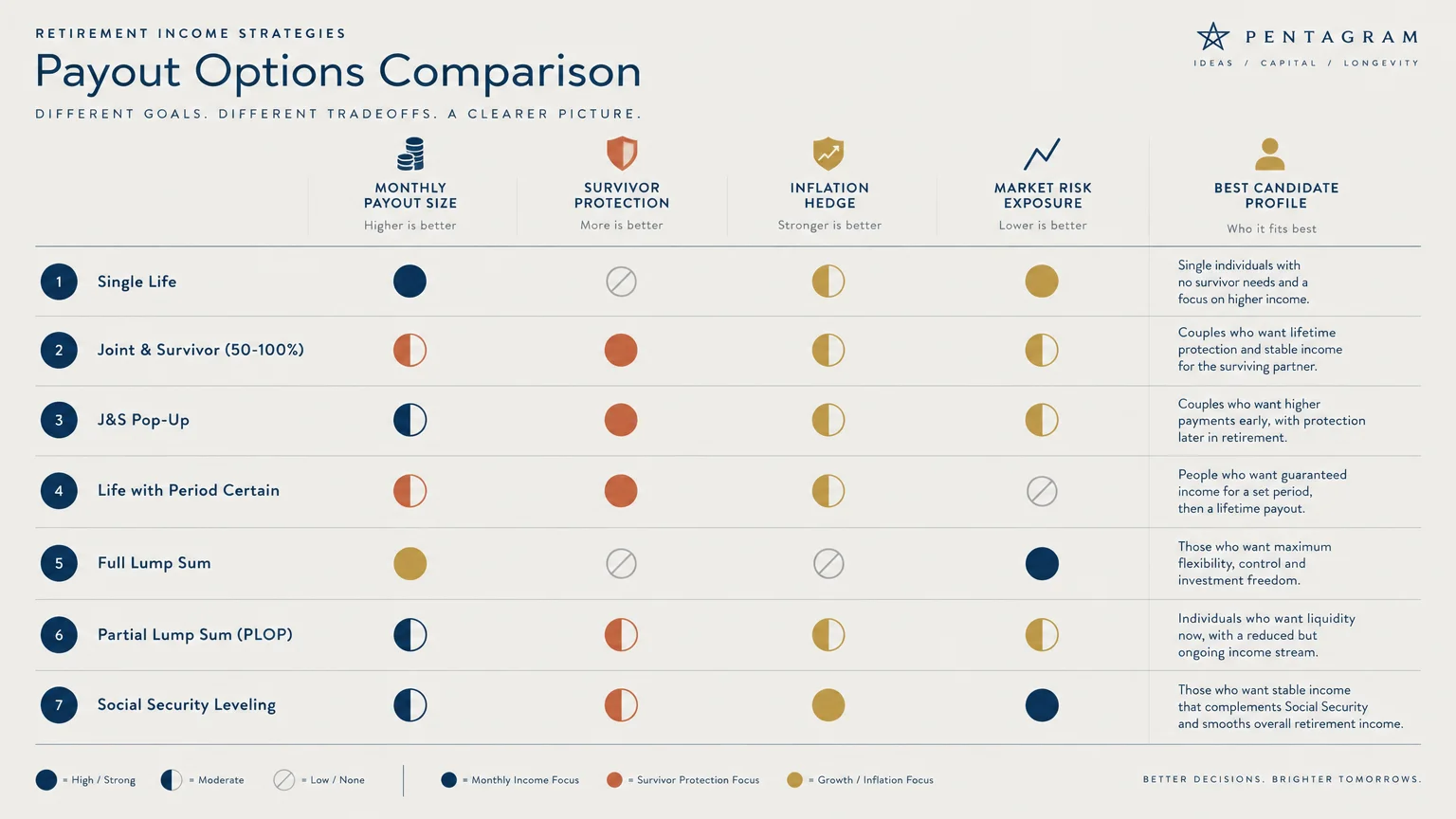
Evaluating each pension payout requires balancing maximum monthly income against survivor protection, inflation vulnerability, and investment control. Use this comparison table to identify the right fit for your household.
| Payout Option | Monthly Payment Level | Survivor Protection | Investment / Longevity Risk | Best Suited For |
|---|---|---|---|---|
| Single Life Annuity | Highest available | None; payments end at death | Retiree bears zero longevity risk; high spousal risk | Single retirees; couples with independent wealth |
| Joint and Survivor (50–100%) | Moderately reduced (10–25%) | Full lifetime income for surviving spouse | Zero longevity risk for both partners | Married couples dependent on pension cash flow |
| Joint and Survivor with Pop-Up | Slightly lower than standard J&S | Full spousal protection; pops up if spouse dies | Zero longevity risk; protects against early spousal death | Couples where the non-working spouse is older or ill |
| Life with Period Certain | Slightly reduced from Single Life | Guarantees payments for set years (5–20) | Protects beneficiaries if retiree dies prematurely | Single retirees wishing to leave assets to children |
| Full Lump-Sum Distribution | Zero monthly pension checks | Full balance passes to estate or heirs | Retiree bears all market, inflation, and longevity risk | Disciplined investors; retirees with shortened life expectancies |
| Partial Lump Sum (PLOP) | Reduced baseline monthly income | Partial spousal protection depending on annuity form | Balanced risk between guaranteed income and market growth | Retirees needing immediate debt payoff plus steady income |
| Social Security Leveling | High initially; drops permanently later | Usually limited or reduced survivor protection | Retiree bears substantial late-retirement inflation risk | Early retirees bridging income until Social Security claims |

PBGC Guarantees: How Safe Is Your Monthly Pension?
Private-sector defined-benefit plans carry backstop insurance through the Pension Benefit Guaranty Corporation (PBGC). If your private employer goes bankrupt, the PBGC takes over the plan up to statutory caps.
The PBGC sets maximum guarantee limits each year based on the worker’s age and chosen payout structure. Straight life annuities receive higher monthly caps than survivor arrangements.
For plans terminating in 2025, the PBGC maximum guarantee was capped at $7,431.82 per month ($89,181.84 annually) for a 65-year-old taking a straight-life annuity. A joint-and-50% survivor annuity capped at $6,688.64 monthly.
For plans terminating in 2026, the PBGC maximum guarantee cap for a 65-year-old rose to $7,789.77 per month ($93,477.24 annually) for a straight-life annuity. The joint-and-50% survivor cap increased to $7,010.79 monthly.
Public pensions for state and municipal workers operate outside the PBGC system entirely. Instead, state constitutional protections and dedicated municipal tax reserves govern public pension solvency.
“The goal of retirement is to live off your assets—not live off your regrets.”

Common Retirement Traps
Pension elections rank among the most consequential financial decisions you will ever make. Avoid these widespread traps when reviewing your paperwork.
Trap 1: The Pension Maximization Life Insurance Pitch. Financial salespeople often push healthy retirees to take the highest single life annuity and purchase private life insurance to cover the spouse.
If policy premiums skyrocket, the policy lapses, or the insurer experiences solvency troubles, your surviving spouse loses both the insurance proceeds and the pension income.
Trap 2: Overlooking Inflation’s Long-Term Bite. Most private corporate pensions provide flat monthly payments with no cost-of-living adjustments (COLAs). A $3,000 monthly check loses roughly half its purchasing power over 25 years at modest inflation.
You must maintain separate growth investments within an IRA or 401(k) to preserve your purchasing power against compounding living costs.
Trap 3: Triggering Mandatory 20% Withholding on Cash Payouts. Requesting a lump-sum check written to your name requires the plan administrator to withhold 20% under IRC Section 3405(c).
Always execute a direct trustee-to-trustee transfer to an IRA custodian. Direct transfers preserve 100% of your capital without early distribution penalties or tax friction.
Trap 4: Missing the Statutory Election Window. Federal rules restrict your formal election to a 30- to 180-day window before your annuity starting date. Missing this deadline can delay your retirement distributions for months.

When to Consult a Professional
Pension election packages contain dense actuarial terminology, tax consequences, and binding spousal waivers. Consulting qualified professionals ensures you avoid irreversible mistakes.
Work with a fee-only fiduciary financial advisor who does not sell commissioned life insurance products. A fiduciary can model whether taking a lump sum or an annuity aligns with your existing investment assets.
Consult an elder law attorney if you anticipate long-term care needs or Medicaid planning. A fixed pension payment counts as unearned income for Medicaid eligibility, whereas structured trusts offer alternative legal pathways.
You can find reliable consumer education materials and financial tools through the Consumer Financial Protection Bureau to guide your planning conversations.
Frequently Asked Questions About Pension Elections
Can I change my pension payout option after payments start?
In almost every situation, your pension payout election is completely irrevocable once the plan issues your first benefit payment. Federal law prohibits changes to prevent adverse selection against the pension trust.
What happens to my pension if my former employer goes out of business?
If your private defined-benefit plan terminates without sufficient funding, the PBGC assumes control of the plan. The PBGC pays your monthly benefits up to annual statutory maximum caps based on your age.
Is a lump sum better than a monthly pension annuity?
Neither choice is universally better. Annuities deliver guaranteed, lifelong income that eliminates longevity risk; lump sums provide liquidity, investment flexibility, and estate transfer options for your heirs.
Does my spouse have to sign my pension election form?
Yes. Federal law under ERISA mandates notarized spousal consent if you select any payout option other than a Qualified Joint and Survivor Annuity providing at least a 50% continuing benefit.
Taking Your Next Steps
Request an updated pension estimate package from your human resources department showing all payout amounts at your targeted retirement date. Compare each scenario carefully against your household budget, debt obligations, health status, and surviving spouse needs before signing your election paperwork.
Information in this article reflects current rules as of the publication date and may change. Always confirm benefit details directly with Social Security Administration, Medicare.gov, or relevant government agencies before making decisions.
Last updated: February 2026. Medicare and Social Security rules change annually—always verify current details at official government sources.